Abatacept: Discovery, Development, Safety and Pharmacovigilance
Abatacept is a recombinant CTLA4–Ig fusion protein, not a monoclonal antibody against a single cytokine. It reduces a costimulatory signal required for full activation of many T lymphocytes. The distinction matters clinically: unlike a tumour necrosis factor (TNF) inhibitor, abatacept acts at an upstream interaction between antigen-presenting cells and T cells. The same action that can reduce autoimmune inflammation can also alter host defence and responses to vaccination. Its safety assessment therefore has to consider the immune mechanism, the underlying disease, previous and concomitant immunosuppression, and the exact formulation and indication. [1–3]
- Abatacept: Discovery, Development, Safety and Pharmacovigilance
- The scientific problem that led to abatacept
- Mechanism: costimulation modulation rather than cytokine blockade
- From proof of concept to initial authorisation
- Clinical development: what each trial actually established
- Methotrexate-inadequate and TNF-inhibitor-inadequate rheumatoid arthritis
- Head-to-head comparative evidence: AMPLE
- Early rheumatoid arthritis and treatment withdrawal: AVERT
- Juvenile idiopathic arthritis and psoriatic arthritis
- A different clinical purpose: prevention of acute graft-versus-host disease
- Route, presentation and patient-safety boundaries
- Business and access history without false attribution
- Safety profile: mechanism, patient context and observed evidence
- Listedness against dated US and EU product information
- Practical pharmacovigilance: from case intake to regulatory action
- Key Takeaways
- References
- Regulatory Note
The scientific problem that led to abatacept
In rheumatoid arthritis (RA), persistent synovial inflammation damages cartilage and bone. Before biologic therapy, disease-modifying antirheumatic drugs (DMARDs) such as methotrexate could control many patients, but incomplete responses and toxicity left a need for other mechanisms. Targeting TNF was a major advance, yet not all patients responded or maintained benefit. Abatacept arose from a different question: could interfering with T-cell costimulation, rather than neutralising a single inflammatory cytokine, attenuate pathogenic immune activation?
A T cell normally receives more than an antigen-recognition signal. Antigen presented on a major histocompatibility complex engages the T-cell receptor (signal 1), while CD80 or CD86 on the antigen-presenting cell engages CD28 on the T cell (an important signal 2). CTLA4, an inhibitory receptor, also binds CD80/CD86 with high affinity. Blocking CD28-mediated costimulation can reduce full activation of naive T cells and downstream cytokine production. It is not equivalent to deleting T cells or abolishing every immune response; memory and alternative activation pathways remain relevant. [1,2]
From the 1991 CTLA4–Ig experiment to a medicine
In 1991, Peter Linsley and colleagues at the Oncogen Division of Bristol-Myers Squibb's research organisation described a soluble fusion of the extracellular portion of human CTLA4 to an immunoglobulin constant region. Their experiments established that CTLA4–Ig bound B7 and inhibited lymphocyte interactions dependent on costimulation. This is a documented molecular origin, not evidence that the later commercial formulation or clinical indication already existed in 1991. [1]
The clinical product uses the extracellular CTLA4 domain joined to a modified human IgG1 Fc region and is manufactured using recombinant DNA technology in Chinese hamster ovary cells. The Fc is a structural and pharmacokinetic component, not an intended antibody-mediated cell-killing payload. Bristol-Myers Squibb developed the molecule through clinical trials and commercialised it as Orencia. The origin and continuing marketing-authorisation-holder identity are documented; this article does not infer unsupported inventor ownership, licensing revenue or independent ingredient sales from the company's aggregate reporting. [2,3]
The earliest translational question was whether modifying costimulation could reduce inflammatory disease activity without unacceptable infections or malignancy. Clinical development also had to establish how a protein with systemic immune effects should be administered, whether its effects persisted between doses, and whether repeated dosing elicited clinically important anti-drug antibodies.
Mechanism: costimulation modulation rather than cytokine blockade
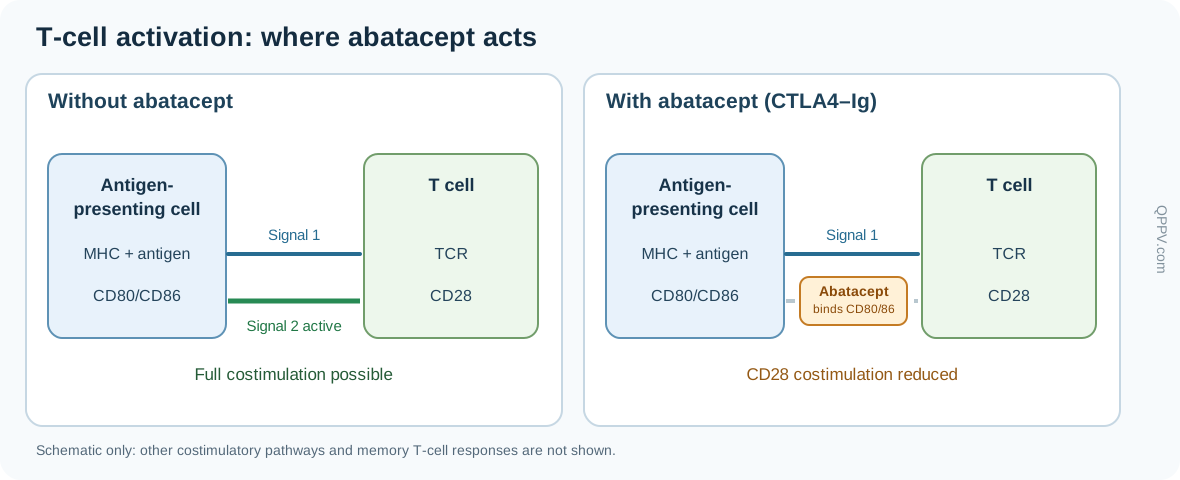
Figure 1. Conceptual signalling diagram: antigen presentation (signal 1) remains possible, while abatacept binding to CD80/CD86 interferes with the CD28 costimulatory interaction (signal 2). This is a selective pathway illustration, not a claim that all T-cell responses are abolished.
The extracellular CTLA4 domain of abatacept binds CD80 and CD86 on antigen-presenting cells. This competes with the CD28 interaction that contributes to full T-cell activation. Downstream observations include reduced proliferation and inflammatory mediator production in experimental systems. Abatacept is not an anti-CD80/86 cytotoxic antibody, and the word selective describes its molecular target, not an absence of systemic immune effects. [1–3]
The pharmacology explains both efficacy and limitations. In synovitis, reduced costimulation can reduce immune activation and improve disease activity. In a patient exposed to a pathogen, altered T-cell activation may also contribute to susceptibility or atypical infection presentations. Responses to live and non-live vaccines can be affected differently; regulatory instructions should be followed rather than assuming vaccination is universally ineffective or prohibited. In the transplant setting, modulation of donor T-cell activation has a different purpose: preventing acute graft-versus-host disease (aGVHD) as part of a multidrug prophylactic regimen. [2–4]
Pharmacokinetics, route and immunogenicity
As a large recombinant fusion protein, abatacept is not managed like a small molecule whose clearance is dominated by hepatic CYP enzymes. Its disposition is influenced by protein distribution and catabolism. The IV formulation delivers a weight-banded infusion for adult rheumatology indications; the subcutaneous formulation generally uses a weekly schedule. These are not interchangeable milligram-for-milligram instructions, and the transplant indication uses a different IV schedule. [2,3]
Anti-abatacept antibodies have been assessed in trials. Assay sensitivity, sampling timing, concurrent immunosuppression and treatment interruption can change apparent immunogenicity rates. A positive antibody test is not by itself evidence of neutralisation, loss of efficacy or anaphylaxis. In an individual report, record the assay and clinical chronology, and avoid transferring antibody rates between unlike studies or formulations. [3]
From proof of concept to initial authorisation
The RA development programme tested patients with inadequate response to conventional DMARDs and patients with inadequate response to TNF inhibitors. The ATTAIN randomised study in TNF-inhibitor inadequate responders reported an ACR20 response at six months in 50.4% of abatacept recipients versus 19.5% of placebo recipients on background treatment. This demonstrated clinically relevant activity in a population with prior biologic failure; it did not establish that combining abatacept with a TNF inhibitor was desirable. [5]
The US FDA first approved Orencia in December 2005 for adult RA, and the EU marketing authorisation was issued on 21 May 2007. Subsequent indications, routes and age groups were authorised through separate regulatory procedures; the original approvals must not be used as shorthand for the full 2026 label. [2,3,6]
The commercial lifecycle subsequently included subcutaneous syringes and pens, broader rheumatology use, and a US transplant prophylaxis indication. The EU marketing authorisation holder listed by EMA is Bristol-Myers Squibb Pharma EEIG. A 2026 proposed biosimilar application or press announcement should not be described as an approved interchangeable biosimilar unless an official authorisation is independently verified. [2,6]
Clinical development: what each trial actually established
The abatacept programme is best understood as a series of different treatment questions. A response in methotrexate-inadequate responders cannot automatically be extended to treatment-naive patients, paediatric arthritis or transplant recipients. Likewise, a head-to-head noninferiority result is not proof of superiority, and a clinical remission at treatment cessation is not evidence of permanent disease modification.
Methotrexate-inadequate and TNF-inhibitor-inadequate rheumatoid arthritis
In the AIM programme, adding abatacept to methotrexate in patients with inadequate methotrexate response improved clinical outcomes and inhibited radiographic progression compared with methotrexate-based control. These endpoints established a complementary immune mechanism rather than simply a new route for the same class of drug. The pivotal evidence included symptoms, physical function and structural damage; a safety programme was needed because immunosuppression can produce harms not captured by a six-month response endpoint. [3,7]
ATTAIN tested patients whose RA remained active despite a TNF inhibitor, after discontinuation of that inhibitor. The 2005 report documented ACR20 responses at six months of 50.4% with abatacept versus 19.5% with placebo on background DMARD therapy. This is a meaningful proof that costimulation modulation may work after TNF inhibition has failed, but the trial was not a randomised comparison of abatacept against every other biologic option. [5]
In contrast, studies of abatacept combined with a TNF antagonist observed more infections and serious infections than the TNF-antagonist control. The current US and EU product information does not recommend such coadministration. This is an important negative development lesson: two biologic mechanisms may be individually effective yet produce an unfavourable safety balance when used together. [2,3]
Head-to-head comparative evidence: AMPLE
The AMPLE randomised investigator-blinded trial compared subcutaneous abatacept weekly with adalimumab every other week, both with methotrexate, in biologic-naive adults with active RA. The prespecified one-year analysis found ACR20 responses of 64.8% versus 63.4%, meeting the study's noninferiority criterion. At two years, ACR20 rates were 59.7% and 60.1%, respectively, and radiographic outcomes remained comparable. [8]
This result does not establish that abatacept is generally safer than adalimumab across all populations. In this particular trial, injection-site reactions were less frequent with abatacept, and some serious infection outcomes numerically favoured abatacept. These observations require attention to sample size, follow-up and ascertainment. A different comparative cohort, with more prior infections or lung disease, could yield different absolute risks. [8]
Early rheumatoid arthritis and treatment withdrawal: AVERT
AVERT studied early active, anti-CCP-positive RA. At 12 months, DAS28-CRP-defined remission was reached by 60.9% receiving abatacept plus methotrexate versus 45.2% receiving methotrexate alone. After rapid withdrawal of all RA therapy in eligible patients, sustained remission at both months 12 and 18 occurred in 14.8% versus 7.8%. The second result is considerably smaller than the first and should not be presented as a high probability of drug-free remission for all patients. [9]
The distinction between achieving remission during treatment and maintaining remission without treatment illustrates why endpoint definitions are central to scientific writing and aggregate benefit–risk assessment. AVERT also involved a selected early-RA population and does not justify withdrawal of established therapy in an individual patient without clinical assessment.
Juvenile idiopathic arthritis and psoriatic arthritis
The paediatric programme expanded beyond adult RA. Both US and EU labels now address polyarticular juvenile idiopathic arthritis (pJIA) from age two, although the authorised route, age band and weight-based presentation matter. The US label also includes paediatric psoriatic arthritis from age two; the EU Orencia indications assessed here include adult PsA, not a blanket corresponding EU paediatric PsA indication. This jurisdictional difference is not a clinical-trial contradiction; it is a difference in authorisation scope. [2,3]
Psoriatic arthritis studies assessed peripheral joint outcomes in patients with inadequate prior DMARD response. The EU indication specifies patients for whom additional systemic treatment for psoriatic skin lesions is not required. It is therefore unsafe to infer that a joint-response result proves equivalent control of extensive psoriasis or that all PsA presentations have the same treatment role. [2]
A different clinical purpose: prevention of acute graft-versus-host disease
The US FDA approved abatacept for aGVHD prophylaxis on 15 December 2021, in combination with a calcineurin inhibitor and methotrexate, for eligible unrelated-donor haematopoietic stem-cell transplantation (HSCT). The decision used evidence from the ABA2/GVHD-1 programme and an external real-world comparator for a mismatched-donor cohort. The FDA described this as the first drug approved specifically to prevent aGVHD. [4,10]
GVHD-1 included a randomised matched-donor cohort and a single-arm one-allele-mismatched cohort; the latter cannot be interpreted as if every participant had been randomised against a concurrent placebo group. The FDA label describes an additional registry-based analysis. Importantly, the 2021 company report stated that grade III–IV aGVHD-free survival was not significantly improved in the matched-donor comparison. Selectively reporting only favourable endpoints would overstate the evidence. [3,10]
Transplant recipients receive other potent immunosuppressants and face risks from their malignancy, conditioning regimen, donor factors and viral reactivation. Therefore the post-transplant adverse-reaction profile cannot be used as a simple estimate of abatacept's risks in RA. The EU Orencia product information reviewed here does not list the US aGVHD prophylaxis indication. A European clinician should not infer EU authorisation from the US label. [2–4]
Route, presentation and patient-safety boundaries
For adult RA, US Orencia IV dosing is weight-banded (500, 750 or 1,000 mg) at initiation, weeks two and four, then every four weeks. The subcutaneous maintenance regimen is generally 125 mg weekly. For paediatric subcutaneous arthritis treatment, the label provides 50, 87.5 or 125 mg weight-band doses. The transplant regimen instead uses IV doses timed around transplantation; it is not a weekly rheumatology injection schedule. [3]
An error report must distinguish the prescribed and administered product, route, strength, weight, schedule and device. A patient who receives an IV preparation by an incorrect route, or whose weekly syringe is confused with a different strength, may have a medication error even without a documented adverse event. Conversely, an infection during correctly administered therapy is not necessarily a medication error. These are separate concepts requiring separate coding and investigation.
The biologic product is stored refrigerated and protected from light according to the authorised presentation's instructions. A temperature excursion, particulate appearance or device malfunction warrants quality evaluation with lot and excursion details. Do not assume that every quality complaint implies exposure to degraded protein or that every loss of efficacy reflects a manufacturing defect. A verified physical complaint and a medically valid suspected adverse reaction may need parallel quality and PV records. [2,3]
Business and access history without false attribution
Abatacept's commercial identity is strongly associated with Bristol Myers Squibb and the Orencia brand. Its development reflects investment in a biologic platform, manufacturing capability and a long lifecycle of regulatory extensions. Commercial uptake in RA cannot be converted into a numerical estimate of individual-patient exposure without defined geography, vial/syringe mix, dosing, indication and time. Nor should total company product revenue be treated as an independent measure of clinical benefit or pharmacovigilance risk.
The emergence of proposed abatacept biosimilars may eventually change exposure distribution and traceability needs. A biosimilar filing accepted for review is not an approval, and interchangeability is a distinct jurisdiction-specific status. Future signal reviews should retain the precise brand, manufacturer, batch and device rather than aggregating every suspected case under the INN alone. [2,3]
Safety profile: mechanism, patient context and observed evidence
Infections and immune defence
Infection is a central risk in abatacept benefit–risk assessment. The US label's placebo-controlled adult RA IV programme reported serious infections in 3% of abatacept recipients versus 1.9% of placebo recipients. These trial proportions reflect their particular populations and follow-up; they are not universal incidence rates. Serious reported infections included pneumonia, cellulitis, urinary infection, bronchitis, diverticulitis and pyelonephritis. [3]
Risk depends on age, diabetes, chronic lung disease, corticosteroid dose, prior biologics, underlying immune disorders, infection exposure and treatment setting. For a serious infection case, obtain the organism, diagnostic tests, hospitalisation, treatment, outcome, concomitant immunosuppression and whether abatacept was held or restarted. A suspected opportunistic infection requires careful differential diagnosis and documentation of relevant screening and prophylaxis. [2,3]
US labelling instructs screening for latent tuberculosis and viral hepatitis before starting treatment. EU product information similarly addresses tuberculosis screening and viral hepatitis risk. The EU label additionally treats severe uncontrolled infection as a contraindication, whereas the US Orencia section 4 states no contraindications; the US warnings nevertheless direct clinicians not to initiate treatment during an active infection until controlled. These are genuinely different regulatory structures, not evidence that infection is harmless in the US. [2,3]
Hypersensitivity, infusion and injection reactions
Acute infusion reactions can include dizziness, hypotension, urticaria, dyspnoea and wheezing. Anaphylaxis is uncommon but potentially life-threatening. Subcutaneous administration adds injection-site reactions and device-handling issues. Timing matters: a reaction during infusion suggests a different differential diagnosis from an infection several weeks later. Both immediate and delayed hypersensitivity hypotheses require the actual product, route, timing, co-medications and treatment response. [2,3]
The US RA clinical programme reported two anaphylaxis cases among 2,688 abatacept-treated IV patients; the same label reports a postmarketing fatal anaphylaxis case. Neither observation allows a precise prediction of an individual patient's risk. Emergency management is a clinical priority; the PV record must not delay it. [3]
Malignancy and skin surveillance
Impaired immune surveillance is a biologically plausible concern. In placebo-controlled RA trials the US label reported overall malignancy frequencies of 1.3% with abatacept and 1.1% with placebo, and noted lung cancer cases. These small numbers, limited duration and differing baseline risk do not establish that abatacept caused or prevented a specific cancer. The current US label recommends periodic skin examinations, particularly in patients with skin-cancer risk factors. [3]
The EU SmPC lists certain skin tumours, lymphoma and malignant lung neoplasm among reported adverse reactions with frequency categories. Those categories reflect a labelled safety dataset, not proof of individual causality. Surveillance should distinguish underlying RA-associated lymphoma risk, smoking, ultraviolet exposure, prior immunosuppressants and latency. [2]
COPD and respiratory vulnerability
The US label describes a small COPD subgroup in an RA safety study: respiratory disorders and serious adverse events occurred more frequently among abatacept recipients than controls. The small denominators—37 abatacept-treated and 17 placebo-treated patients—limit precision. A COPD exacerbation case should include baseline lung function, smoking, infections, oxygen requirement and concomitant respiratory therapies, not merely a temporal association with abatacept. [3]
Immunogenicity and loss of response
The US label's IV RA experience found binding antibodies in 34/1,993 patients (approximately 2%) during repeated treatment; assay and sampling limitations apply. In a subcutaneous-versus-IV trial, reported immunogenicity frequencies were 1% and 2%. Treatment interruption may affect antibody detection. The label did not establish a consistent association between detected antibodies and loss of clinical response in those studies. [3]
If treatment efficacy declines, first confirm disease activity, adherence, missed injections, device handling and concomitant DMARD changes. Anti-drug-antibody testing may be informative in selected settings, but a negative or positive result cannot be interpreted without knowing the validated assay, drug interference and clinical context.
Transplant-specific CMV, EBV and lymphoproliferation
The US aGVHD prophylaxis label includes CMV reactivation/invasive disease and EBV-associated post-transplant lymphoproliferative disorder (PTLD) precautions. In the 116 abatacept-treated patients pooled across GVHD-1 cohorts, four PTLD events were reported, all associated with EBV; seven percent had CMV invasive disease by the stated follow-up. These observations occur in highly immunosuppressed transplant recipients and must not be converted into RA incidence estimates. The US label specifies post-transplant viral monitoring and prophylaxis considerations. [3]
The causal contribution of abatacept cannot be isolated from transplant conditioning, calcineurin inhibitors, methotrexate, graft characteristics and donor/recipient viral serostatus by reading pooled event counts alone. A useful transplant ICSR includes HLA match, graft type, conditioning, viral serology and PCR trajectory, antiviral prophylaxis, GVHD status and other immunosuppressive exposure.
A formulation-specific analytical interference
An unusual but practical safety issue is maltose in the US IV lyophilised formulation. Certain glucose meters using GDH-PQQ chemistry can falsely read maltose as glucose on the day of infusion, potentially leading to inappropriate insulin treatment. The US subcutaneous formulation does not contain maltose and does not carry the same glucose-meter instruction. This is an example of a formulation-excipient risk that would be lost if every Orencia report were coded only as “abatacept exposure.” [3]
Listedness against dated US and EU product information
Assessment date: 28 October 2026. US reference: Orencia (abatacept), E.R. Squibb & Sons, IV powder and SC injection, DailyMed SPL set ID 0836c6ac-ee37-5640-2fed-a3185a0b16eb, version 35, updated 13 November 2025, sections 4–8. EU reference: Orencia 125 mg prefilled syringe, subcutaneous, EU centrally authorised product, SmPC revised 12 March 2026, accessible in Swedish on FASS; EMA's EPAR product-information listing was updated 11 May 2026. EU frequency comparisons below are taken from the Swedish EU-authorised presentation's section 4.8; US entries refer to the exact cited DailyMed sections. Different presentations and indication populations are stated explicitly. [2,3,11]
| Safety concept | US Orencia USPI | EU Orencia 125-mg SC SmPC | Interpretation |
|---|---|---|---|
| Upper respiratory infection, headache, nausea | Section 6.1 RA clinical-trial adverse reactions | Section 4.8: upper respiratory infection very common; headache and nausea common | Listed in both, with EU frequency categories; the US study percentages must not be relabelled as EU frequencies |
| Pneumonia and other serious infection | Sections 5.3 and 6.1 | Pneumonia common, sepsis uncommon, tuberculosis rare in section 4.8 | Named infection events listed, but a general serious-infection warning is broader than a specific event term |
| Hypersensitivity / anaphylaxis | Sections 5.2, 6.1 and postmarketing 6.3 | Hypersensitivity uncommon in section 4.8; anaphylaxis described in section 4.4 | A warning-only mention of anaphylaxis is not identical to a tabulated section-4.8 ADR |
| Injection-site reactions | Section 6.1 SC study | Local injection-site reactions common in section 4.8 | Listed in both; route matters |
| Vasculitis and psoriasis | Section 6.3 postmarketing identifies vasculitis and new/worsening psoriasis | Vasculitis and psoriasis uncommon in section 4.8 | Explicit terms appear in both, but the source and frequency framework differ |
| Non-melanoma skin cancer | Section 6.3 postmarketing, plus section 5.6 surveillance advice | Basal-cell carcinoma uncommon, squamous-cell carcinoma rare in section 4.8 | Product-specific terms and frequency categories differ |
| COPD exacerbation | Sections 5.5 and 6.1 describe COPD subgroup | Exacerbated COPD uncommon in section 4.8 | Both describe the event; denominators and categories are not interchangeable |
| PML | Not identified as a specific reaction in the assessed US sections | Discussed in EU section 4.4 warning | Warning-only EU mention is not automatically a tabulated section-4.8 listed reaction |
| CMV / EBV reactivation in aGVHD prophylaxis | Sections 5.7 and 6.1 transplant population | Not within the assessed EU SC rheumatology indication | Scope difference, not evidence of absent viral risk |
| Contraindications | US section 4: none | EU section 4.3: hypersensitivity and severe uncontrolled infections | Material jurisdictional labelling difference |
This is a defined comparison of selected clinically important terms, not a reproduction of every adverse reaction. “Listed” means present in the specified public label section or postmarketing subsection; a term appearing solely in a warning must be recorded as such. For a case-level expectedness determination, use the applicable reference safety information (RSI), not this public-label table by default. Company core safety information, local listedness, RSI expectedness, causality, seriousness and reporting obligations answer different questions. A product without a particular indication in one jurisdiction does not have a negative safety finding for that indication. [2,3,11]
The precise EU formulation matters: the comparison is against the 125-mg SC syringe, whereas US DailyMed combines IV and SC presentations and contains transplant-specific information. Do not attribute the IV maltose glucose-monitor interaction to an SC syringe. For any individual case, recheck the current locally applicable label and preserve the exact version, section and event terminology.
Practical pharmacovigilance: from case intake to regulatory action
The pharmacovigilance challenge is not simply to count infections or malignancies. It is to reconstruct a plausible exposure and clinical sequence, identify the correct product and regulatory context, assess alternative explanations and detect patterns that may change the benefit–risk balance. For a biologic used in very different populations, an aggregate analysis that merges rheumatology and transplant cases without stratification can be actively misleading.
Case intake: product, exposure and clinical context
Record the INN and brand, formulation (IV powder, SC syringe or autoinjector), strength, route, administered dose, treatment dates, lot/batch, indication, age, body weight when dosing depends on it, and whether treatment was interrupted or switched. For a suspected infection, document onset, diagnostic criteria, cultures/PCR, antimicrobial treatment, hospitalisation, seriousness, outcome and relevant history. For suspected hypersensitivity, capture infusion start and stop times, vital signs, clinical manifestations and emergency treatment. [2,3]
Concomitant medication is not an optional afterthought. Methotrexate, corticosteroids, TNF inhibitors, JAK inhibitors and other immunosuppressants can change both baseline risk and interpretation. The same patient may have received sequential biologics with residual exposure. Record previous treatment, stop dates and the reason for switching. Avoid describing a contraindicated combination when the label says not recommended; these terms have different regulatory meanings.
Causality, listedness and seriousness are separate
A suspected reaction can be serious but listed, non-serious but unlisted, or reported without sufficient information for a causal conclusion. Seriousness is assessed using applicable regulatory criteria; severity alone is not the same thing. Listedness against the USPI or EU SmPC is a document-specific comparison, not proof that the medicine caused the event. For clinical-trial cases, expectedness depends on the approved reference safety information and applicable study rules, not automatically on the local commercial label.
A report of pneumonia after abatacept may be medically plausible, but clinical evidence should also address pre-existing pulmonary disease, corticosteroids, exposure to infectious contacts and the pathogen. If a patient develops lymphoma, the assessment must consider underlying RA, age, smoking, prior immunosuppression and the latency interval. Lack of a definitive alternative explanation is not proof of causation.
Immunogenicity, product quality and medication errors
A report of loss of efficacy after a switch should capture the previous and new brand, batch, device, storage history, dosing adherence and objective disease activity. If anti-drug antibodies are reported, preserve the test method and timing relative to dosing. A quality complaint involving a cloudy solution or damaged autoinjector should be transferred to the quality system with documented reconciliation to PV when an adverse event is present.
An IV-infusion glucose-meter incident is particularly instructive. The initial symptom may be hypoglycaemia after an insulin dose based on a falsely elevated GDH-PQQ glucose result during exposure to an IV formulation containing maltose. The appropriate record needs the meter technology, actual and reported glucose, insulin administered, infusion timing and clinical outcome. Coding only “abatacept—hypoglycaemia” without the device and excipient mechanism would conceal the preventable error pathway. [3]
Signal detection and population stratification
For a periodic review or signal evaluation, stratify by RA, pJIA, PsA and aGVHD prophylaxis; by IV versus SC route; by age, previous biologic therapy, immunosuppressive combinations and available exposure. A spontaneous-report numerator without a credible denominator cannot estimate incidence. Disproportionality may identify a reporting pattern, not a causal association. Follow with medical case review, trial evidence, observational comparisons, biological plausibility and temporal regulatory-label history.
For infections, assess seriousness and organism, opportunistic features, vaccination, latent TB screening, concomitant therapy and geographic background. For malignancies, evaluate histology, exposure latency, baseline risk and registry evidence. For PTLD and CMV after HSCT, stratify by transplant regimen and donor-recipient viral risk. For immunogenicity, examine both validated laboratory findings and objective clinical outcomes. [2,3]
Governance, documentation and inspection readiness
A robust process preserves the original source report, translations, medical coding decisions, follow-up attempts, product identification, applicable label version, case assessment and reconciliation with product-quality, medical-information and clinical-study systems. The MAH should document why an emerging issue was escalated or not escalated for signal evaluation, who reviewed the evidence, what uncertainties remain and how actions were followed up.
Illustrative inspection scenario: An RA case is initially recorded as “abatacept-induced tuberculosis” but contains no TB screening history, no organism confirmation and only a brand name without route. A defensible record does not silently convert the reporter's causal statement into an established finding. It seeks microbiological and clinical confirmation, captures prior biologics and corticosteroids, records the current label, assesses seriousness and follows the applicable reporting process while clearly separating reported causality from company assessment.
Practical review checklist
| Question | Evidence to retain |
|---|---|
| Was the right product identified? | Brand, INN, route, presentation, strength, lot and country |
| Was exposure reconstructed? | Actual dates, dose, interruptions, previous biologics and device use |
| Was the event medically characterised? | Diagnostic criteria, seriousness, timeline, treatment and outcome |
| Were important alternatives considered? | Underlying disease, infection risks, concomitant immunosuppression and other medicines |
| Was the correct label used? | Jurisdiction, revision, exact section, listed reaction term and rationale |
| Were interfaces reconciled? | Quality, device, medical information, clinical studies and partner records |
| Was aggregate assessment proportionate? | Indication/route strata, denominators where valid, bias, follow-up and documented decisions |
Key Takeaways
Abatacept is a CTLA4–Ig fusion protein that modulates CD80/CD86–CD28 costimulation rather than directly neutralising TNF. Its clinical lifecycle runs from 1991 CTLA4–Ig experiments to RA approval, subcutaneous delivery, paediatric and psoriatic arthritis indications and US aGVHD prophylaxis. ATTAIN, AMPLE and AVERT answer different clinical questions; the negative experience with concurrent TNF inhibition and the limitations of drug-free remission after withdrawal are essential to balanced interpretation.
Infections, hypersensitivity, malignancy surveillance, immunogenicity and formulation errors require product- and population-specific assessment. The US and EU Orencia labels differ materially in formal contraindications and indication scope, and the US IV maltose–glucose-meter interaction is not a generic SC product risk. Listedness, causality, expectedness and reporting decisions remain distinct. Traceability and clinically useful follow-up are the foundation of credible pharmacovigilance.
References
- Linsley PS, Brady W, Urnes M, et al. CTLA-4 is a second receptor for the B cell activation antigen B7. J Exp Med. 1991;174:561–569. doi:10.1084/jem.174.3.561. https://pubmed.ncbi.nlm.nih.gov/1714933/
- European Medicines Agency. Orencia: European public assessment report, product information listing last updated 11 May 2026, authorisation 21 May 2007. https://www.ema.europa.eu/en/medicines/human/EPAR/orencia
- US National Library of Medicine, DailyMed. ORENCIA (abatacept) US Prescribing Information, SPL set ID 0836c6ac-ee37-5640-2fed-a3185a0b16eb, version 35, updated 13 November 2025; sections 1–8, 11–14. https://dailymed.nlm.nih.gov/dailymed/drugInfo.cfm?setid=0836c6ac-ee37-5640-2fed-a3185a0b16eb
- US Food and Drug Administration. FDA Approves First Drug to Prevent Graft Versus Host Disease, 15 December 2021. https://www.fda.gov/news-events/press-announcements/fda-approves-first-drug-prevent-graft-versus-host-disease
- Genovese MC, Becker JC, Schiff M, et al. Abatacept for rheumatoid arthritis refractory to tumor necrosis factor alpha inhibition. N Engl J Med. 2005;353:1114–1123. doi:10.1056/NEJMoa050524. https://pubmed.ncbi.nlm.nih.gov/16162882/
- Moreland L, Bate G, Kirkpatrick P. Abatacept. Nat Rev Drug Discov. 2006;5:185–186. https://www.nature.com/articles/nrd1989
- Kremer JM, Genant HK, Moreland LW, et al. Effects of abatacept in patients with methotrexate-resistant active rheumatoid arthritis: a randomized trial. Ann Intern Med. 2006;144:865–876. https://pubmed.ncbi.nlm.nih.gov/16785475/
- Schiff M, Weinblatt ME, Valente R, et al. Head-to-head comparison of subcutaneous abatacept versus adalimumab for rheumatoid arthritis: two-year efficacy and safety findings from AMPLE. Ann Rheum Dis. 2014;73:86–94. https://pubmed.ncbi.nlm.nih.gov/23962455/
- Emery P, Burmester GR, Bykerk VP, et al. Evaluating drug-free remission with abatacept in early rheumatoid arthritis: AVERT. Ann Rheum Dis. 2015;74:19–26. https://pubmed.ncbi.nlm.nih.gov/25367713/
- Bristol Myers Squibb. US FDA Approves Orencia for aGVHD Prophylaxis, 15 December 2021; GVHD-1 and GVHD-2 study context. https://news.bms.com/news/details/2021/U.S.-Food-and-Drug-Administration-Approves-Orencia-abatacept-in-Combination-with-a-Calcineurin-Inhibitor-and-Methotrexate-for-the-Prevention-of-Acute-Graft-Versus-Host-Disease-aGvHD/default.aspx
- FASS Vård (Sweden). ORENCIA 125 mg pre-filled syringe: EU-authorised Summary of Product Characteristics, Swedish text, section 10 revision 12 March 2026, sections 4.1–4.8. https://fass.se/health/product/20110825000049/smpc
Regulatory Note
This article is an educational review, not a substitute for current prescribing information or clinical advice. EU product information was cross-checked against the Swedish national presentation of the centrally authorised SmPC, revised 12 March 2026, because the EMA English PDF was not directly retrievable during this review; recheck the current local-language authoritative SmPC for a formal case decision. USPI, EU SmPC, indication, route and age-group differences may change. Observed associations, labelled reactions, individual causality and regulatory reporting obligations are separate assessments. Clinical management must follow the current authorised product, local guidelines and patient circumstances.