Abemaciclib: Discovery, Development, Safety and Pharmacovigilance
Abemaciclib is an oral inhibitor of cyclin-dependent kinases 4 and 6 (CDK4/6), developed by Eli Lilly as LY2835219 and marketed as Verzenio in the United States and Verzenios in the European Union. It occupies an important place in hormone receptor (HR)-positive, HER2-negative breast cancer because its clinical development progressed from treatment of refractory metastatic disease to first-line combinations and then adjuvant therapy for patients at high risk of recurrence. The September 2026 US approval of abemaciclib with the oral selective oestrogen-receptor degrader imlunestrant adds a biomarker-defined treatment setting to that history. [1,2,3]
This is also a useful pharmacovigilance case study. A medicine that can improve progression-free survival and, in selected settings, overall survival may produce early diarrhoea requiring active management, cytopenias, liver-test abnormalities, thromboembolism and potentially fatal interstitial lung disease. A serum creatinine rise can be pharmacological rather than a fall in measured glomerular filtration. Distinguishing those mechanisms changes the clinical investigation and the quality of a safety report. [1]
- Abemaciclib: Discovery, Development, Safety and Pharmacovigilance
- Why the CDK4/6 pathway became a therapeutic target
- Pharmacology: a continuous oral inhibitor
- Early clinical translation
- The MONARCH development programme: different questions, different evidence
- Regulatory and business lifecycle
- Dosing, interactions and exposure attribution
- Safety profile: early toxicity and serious uncommon outcomes
- A practical risk-to-evidence matrix
- Pharmacovigilance from intake to benefit-risk decisions
- Signal detection and aggregate surveillance
- Two illustrative case assessments
- Operational checklist for a PV team
- Key takeaways
- References
- Regulatory Note
Why the CDK4/6 pathway became a therapeutic target
Cell-cycle control and endocrine resistance
Progression from the G1 phase to DNA synthesis in the S phase depends partly on cyclin D binding to CDK4 or CDK6. The resulting kinase activity phosphorylates retinoblastoma protein (Rb), reducing its restraint of E2F-dependent transcription. Oestrogen-receptor signalling can increase cyclin D1 expression, linking endocrine stimulation to cell-cycle progression in susceptible breast tumours. Inhibiting CDK4/6 can preserve the Rb-mediated brake on G1-to-S progression, provided the relevant downstream machinery remains functional. [1,4]
The pathway explains why endocrine therapy and CDK4/6 inhibition are complementary rather than interchangeable. Endocrine agents reduce oestrogen-receptor signalling or receptor activity; abemaciclib acts downstream at a cell-cycle control point. This mechanistic rationale does not mean every HR-positive tumour will respond. Loss of functional Rb, bypass pathways, evolving endocrine resistance and tumour heterogeneity can limit benefit. Clinical decisions therefore require evidence from the specific treatment setting, not a pathway diagram alone.
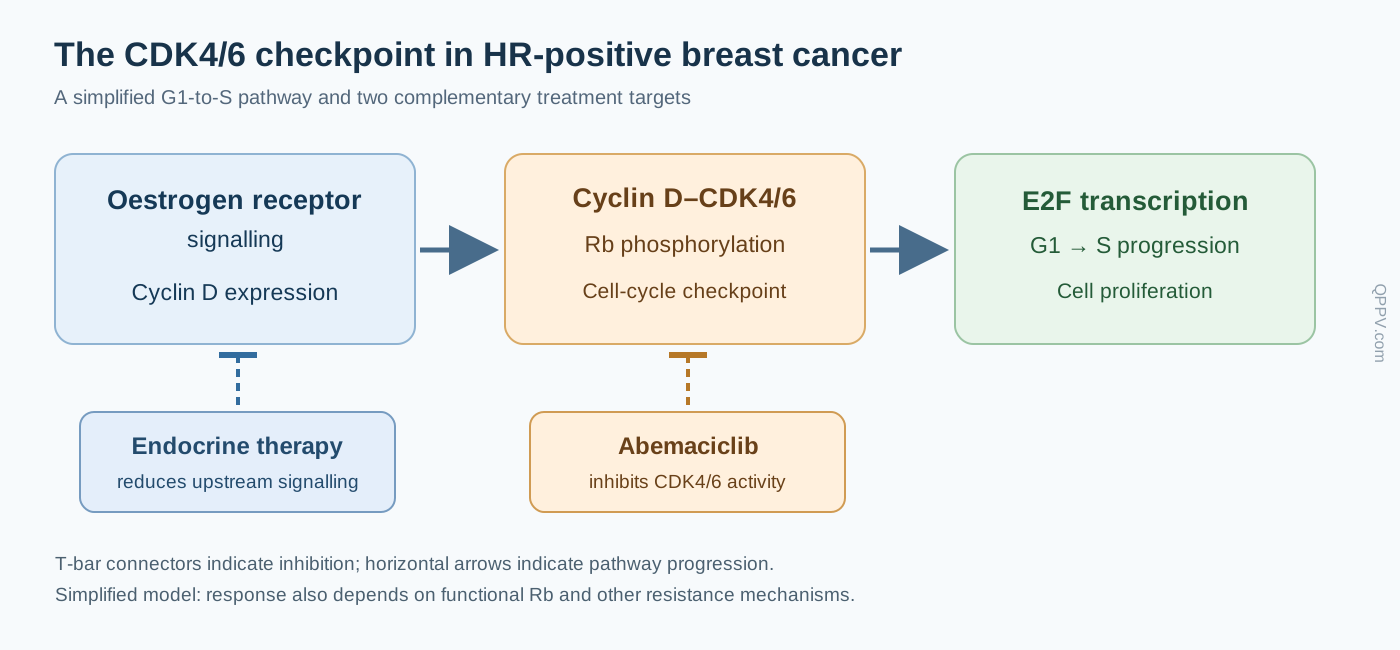
Figure 1. Simplified G1-to-S control in an Rb-competent tumour. Endocrine therapy acts upstream of cyclin D signalling; abemaciclib inhibits CDK4/6-mediated Rb phosphorylation. The diagram is a teaching model, not a validated patient-selection algorithm or a complete map of resistance.
Discovery within Lilly's kinase programme
The documented development lineage begins with Lilly's discovery and preclinical programme for the small molecule LY2835219. A 2014 preclinical report by Gelbert and colleagues characterised CDK4/6 inhibition, Rb-pathway effects and antitumour activity in experimental models. Other contemporaneous research investigated combinations and resistance mechanisms. The drug's later clinical name, abemaciclib, should not be confused with a new active substance: LY2835219 and abemaciclib refer to the same development candidate. [4,5]
Lilly's own research and clinical development organisation originated and advanced the programme. Public regulatory records and early publications support that attribution; they do not justify naming a single individual as the inventor of the final medicinal product or inventing an acquisition or licensing transaction. The brand and marketing authorisation holder are commercially relevant because they identify the responsible product lineage and labelling, but the scientific article remains centred on the active substance.
Pharmacology: a continuous oral inhibitor
Abemaciclib inhibits CDK4 and CDK6 and, in ER-positive breast-cancer cell lines, suppresses Rb phosphorylation and G1-to-S progression. Preclinical work also described cellular senescence and apoptosis under some experimental conditions. These laboratory observations establish biological plausibility, not clinical efficacy by themselves. [1,4]
The medicine is taken orally on a continuous twice-daily schedule in its approved regimens rather than being described as an intermittent-cycle drug. Active metabolites contribute to systemic pharmacology. CYP3A-mediated metabolism makes concomitant enzyme inhibitors and inducers clinically relevant, while inhibition of renal transporters explains a distinct laboratory effect discussed later. [1]
The difference between mechanistic selectivity and clinical tolerability is worth emphasising. Even a targeted cell-cycle inhibitor affects normal proliferating tissues. Gastrointestinal toxicity, neutropenia and fatigue remain central to its benefit-risk profile. No claim that abemaciclib is universally safer than other CDK4/6 inhibitors follows from its molecular target or dosing schedule; comparative safety requires appropriately designed comparisons.
Early clinical translation
In the phase I programme reported by Patnaik and colleagues in 2016, investigators examined safety, pharmacokinetics, pharmacodynamics and preliminary antitumour activity across solid tumours. The early signal in HR-positive breast cancer helped motivate subsequent dedicated studies. Activity reported in other tumour types during exploratory development did not establish licensed indications in those diseases. [6]
The programme then confronted a central development question: could a CDK4/6 inhibitor deliver meaningful benefit alone in heavily pretreated disease, and would combining it with endocrine therapy yield stronger evidence in earlier treatment lines? The MONARCH trials were designed to answer different parts of that question. Their populations and endpoints must remain separate when evaluating both benefit and harm.
The MONARCH development programme: different questions, different evidence
MONARCH 1: a single-arm signal, not a comparative survival claim
MONARCH 1 enrolled 132 women with HR-positive, HER2-negative metastatic breast cancer previously treated with endocrine therapy and chemotherapy. Abemaciclib monotherapy was administered at 200 mg twice daily. The confirmed objective response rate was 19.7% (95% CI 13.3–27.5); median progression-free survival was 6.0 months. These results demonstrated activity in a refractory population but could not establish superiority to another treatment, because the study had no randomised comparator. Gastrointestinal adverse reactions and fatigue were prominent. [7]
This distinction matters for international labelling. The US label continues to include monotherapy after endocrine therapy and chemotherapy in the metastatic setting, whereas the EMA's public benefit summary notes that the single-arm study did not establish benefit sufficient for the corresponding EU indication. A US authorisation must not be silently generalised into an EU authorisation. [1,2]
MONARCH 2: adding abemaciclib after endocrine progression
MONARCH 2 randomised 669 patients with HR-positive, HER2-negative advanced breast cancer that had progressed on endocrine therapy to abemaciclib plus fulvestrant or placebo plus fulvestrant. Median progression-free survival in the original analysis was 16.4 versus 9.3 months (hazard ratio 0.553). A prespecified interim overall-survival analysis subsequently reported median survival of 46.7 versus 37.3 months (HR 0.757; 95% CI 0.606–0.945). [8]
The later final analysis, with approximately 80 months of median follow-up, reported median overall survival of 45.8 versus 37.3 months (HR 0.784; 95% CI 0.644–0.955). The updated estimate should not be presented as a contradiction of the interim result: different event maturity and censoring can change survival estimates. The important conclusion is that randomised follow-up supports an overall-survival advantage for this specific combination and population. [9]
MONARCH 3: first-line endocrine combination and a negative OS boundary
MONARCH 3 evaluated abemaciclib with a nonsteroidal aromatase inhibitor versus placebo plus an aromatase inhibitor in 493 postmenopausal women with HR-positive, HER2-negative advanced disease. The initial trial showed a significant progression-free survival advantage (HR 0.54; 95% CI 0.41–0.72), and the EMA overview later summarised median progression-free survival at approximately 28 versus 15 months. [2,10]
At the final overall-survival analysis after median follow-up of 8.1 years, median survival was 66.8 versus 53.7 months, but the hazard ratio of 0.804 (95% CI 0.637–1.015; P=0.0664) did not cross the prespecified significance threshold. The numerical difference must therefore not be written as a statistically proven overall-survival benefit. This is a useful example of why efficacy endpoints, multiplicity control and trial maturity are essential to a balanced benefit-risk account. [11]
monarchE: moving into high-risk early breast cancer
The phase III monarchE trial enrolled 5,637 patients with HR-positive, HER2-negative, node-positive early breast cancer at elevated risk of recurrence. It compared two years of abemaciclib plus standard adjuvant endocrine therapy against endocrine therapy alone. The primary endpoint was invasive disease-free survival (IDFS), a composite capturing invasive recurrence, second primary invasive cancer or death, rather than overall survival. [12,13]
The original US adjuvant approval in October 2021 required high-risk clinicopathological features and a Ki-67 threshold. In March 2023, FDA removed the Ki-67 testing requirement and defined the high-risk population by nodal burden, tumour grade and tumour size. FDA specifically noted that the efficacy signal was primarily attributable to cohort 1; the label should not be interpreted as authorising every node-positive case regardless of risk. [13]
The primary overall-survival analysis published in 2025/2026 subsequently reported seven-year survival of 86.8% with abemaciclib plus endocrine therapy versus 85.0% with endocrine therapy alone (HR 0.842; 95% CI 0.722–0.981; two-sided P=0.027). The absolute difference of 1.8 percentage points is distinct from the relative hazard reduction, and neither number should be inflated into a cure rate. Seven-year IDFS was 77.4% versus 70.9%. Long follow-up strengthens the evidence for adjuvant benefit, while continued surveillance remains relevant to late effects and adherence to the planned two-year course. [12]
How the trials fit together
| Study | Setting and design | Main interpretive result | Evidence boundary |
|---|---|---|---|
| MONARCH 1 | Refractory metastatic; single-arm monotherapy | Confirmed response 19.7% | No randomised comparative efficacy |
| MONARCH 2 | After endocrine progression; abemaciclib + fulvestrant | PFS and OS benefit versus fulvestrant alone | Combination-specific |
| MONARCH 3 | Initial endocrine therapy for advanced disease | Significant PFS benefit | Final OS not statistically significant |
| monarchE | Node-positive high-risk early disease; two-year adjuvant treatment | Improved IDFS and subsequently OS | Not a general indication for all early disease |
| EMBER-3 | Endocrine-pretreated advanced disease; imlunestrant ± abemaciclib | Combination PFS advantage; new US biomarker-defined use | Requires separate ESR1-mutated US selection criteria |
The table deliberately separates trial design from regulatory authorisation. Regulatory labels reflect the submitted evidence, benefit-risk assessment and jurisdiction-specific decisions; a trial's presence in this table does not itself imply an approved indication.
Regulatory and business lifecycle
US and European milestones
The US Food and Drug Administration first approved abemaciclib in September 2017 for selected HR-positive, HER2-negative advanced or metastatic breast-cancer settings, supported by the early MONARCH programme. The European Commission granted EU-wide marketing authorisation for Verzenios on 27 September 2018. The product is an internally developed Lilly asset, and the available original FDA assessment and EMA authorisation record identify the sponsor and scientific basis without requiring a speculative commercial origin story. [2,3]
The clinical programme expanded the role of the molecule from metastatic disease to adjuvant therapy. The US adjuvant indication arrived in 2021 and was refined in 2023 when the Ki-67 selection requirement was removed. EMA authorised an early-breast-cancer indication in 2022, with the current European overview describing high-risk node-positive disease in men and women alongside advanced-disease combinations in women. As of the EMA product-information update dated 25 August 2026, its European indications must be checked against the current SmPC, not inferred from later US approvals. [2,13,14]
Commercial success can affect the number and diversity of exposed patients, but sales ranking is not an adverse-event rate, an independent measure of patients treated or evidence of a safety signal. Where company revenue reports aggregate brands, geographies or partnerships, those values cannot be translated into abemaciclib patient-years without a defensible exposure model.
September 2026: imlunestrant and ESR1 mutation selection
On 18 September 2026 FDA approved imlunestrant plus abemaciclib for adults with ER-positive, HER2-negative, ESR1-mutated advanced or metastatic breast cancer after at least one line of endocrine therapy, with mutation detection by an FDA-authorised test. The approval followed the randomised EMBER-3 programme, which included 874 patients assigned to imlunestrant, investigator-selected endocrine treatment or imlunestrant plus abemaciclib. [1,15]
The major combination efficacy comparison was investigator-assessed progression-free survival against imlunestrant alone. In the overall comparison the original trial reported median PFS of 9.4 versus 5.5 months (HR 0.57; 95% CI 0.44–0.73). In the FDA's exploratory ESR1-mutated subgroup of 159 patients, median PFS was 11.1 versus 5.5 months (HR 0.53; 95% CI 0.35–0.80). Subgroup estimates have different statistical certainty from the prespecified overall comparison; the approved US population is nevertheless defined by the mutation and prior-treatment criteria. [15,16]
The trial's updated analysis did not demonstrate a statistically significant overall-survival difference for the combination versus imlunestrant alone in the overall population at the reported cutoff (HR 0.82; 95% CI 0.59–1.16). It would be inaccurate to present the new approval as proof of an OS advantage. The addition of abemaciclib also increases toxicity burden: in the original EMBER-3 publication, grade 3 or higher adverse events were reported in 48.6% of the combination group versus 17.1% with imlunestrant alone. These are trial-group observations, not an estimate of the independent contribution of each agent to every event. [16,17]
For the US imlunestrant combination, the abemaciclib starting dose is 150 mg twice daily; imlunestrant has its own administration and safety instructions. Biomarker test, sampling date, disease setting and prior treatment are essential exposure-context fields for clinical records and meaningful benefit-risk analyses. The new US combination indication should not be represented as automatically approved in the EU; the EMA overview and August 2026 European product information precede this US decision. [1,2,15]
Dosing, interactions and exposure attribution
The September 2026 US label describes 150 mg twice daily with tamoxifen, an aromatase inhibitor, fulvestrant or imlunestrant, and 200 mg twice daily for authorised monotherapy. In adjuvant use, treatment is intended for two years unless recurrence or unacceptable toxicity occurs; in advanced disease, treatment generally continues until progression or unacceptable toxicity. Tablets are swallowed whole and may be taken with or without food. A missed or vomited dose is not replaced by an additional dose under the US label. [1]
Dose modifications depend on toxicity, indication and concomitant medicines. For combination therapy, the labelled reduction sequence is 150 to 100 to 50 mg twice daily. Monotherapy starts at 200 mg twice daily and has a separate sequence. The detailed dose-hold and restart tables should be consulted directly; a general pharmacovigilance article is not a substitute for prescribing instructions.
CYP3A interactions and hepatic impairment
Abemaciclib exposure increases with strong or moderate CYP3A inhibitors and decreases with enzyme inducers. The US label advises avoiding ketoconazole, reducing abemaciclib dosage with other strong CYP3A inhibitors, considering modification with moderate inhibitors, and avoiding strong or moderate inducers. Grapefruit products should be avoided. Severe hepatic impairment (Child–Pugh C) requires reduced dosing frequency in the US label, whereas mild or moderate hepatic impairment does not require routine adjustment. [1]
These interactions are relevant to case causality. A diarrhoea or neutropenia report occurring shortly after a strong CYP3A inhibitor was added is not adequately assessed until the co-medication timeline and actual abemaciclib dose are reconstructed. Conversely, loss of response following an enzyme inducer requires evaluation of disease biology, adherence and reduced exposure rather than an automatic conclusion of pharmacological resistance.
The serum creatinine paradox
The September 2026 US label added a prominent warning explaining that abemaciclib can increase serum creatinine without reducing glomerular function. In pooled trial data the mean increase was approximately 0.2–0.3 mg/dL, often appearing during the first 28-day cycle and reversing after discontinuation. The mechanism is inhibition of renal tubular creatinine secretion through OCT2 and MATE transporters. [1]
A creatinine-based estimated GFR can therefore appear to worsen even when filtration is preserved. The label recommends measures not based on serum creatinine, such as blood urea nitrogen, cystatin C or an alternative assessment of GFR, when evaluating renal function. This does not mean that acute kidney injury is impossible. Dehydration from severe diarrhoea, infection, obstruction, nephrotoxic co-medication or another renal disorder may coexist. The safety assessor must examine urine output, volume status, serial laboratory findings and alternative filtration measures before classifying the event as a benign transporter effect or a true kidney injury.
The transporter interaction also matters for other medicines: the US label describes increased metformin exposure in a clinical interaction study. It is not appropriate to infer from this finding alone that all metformin recipients will experience toxicity; review renal function, glycaemic control and the full co-medication record. [1]
Safety profile: early toxicity and serious uncommon outcomes
Diarrhoea: common, early and sometimes consequential
Diarrhoea is a characteristic abemaciclib adverse reaction, often beginning soon after treatment starts. The September 2026 US label reports diarrhoea in 81–90% of recipients across five trials (3,899 exposed patients), with grade 3 diarrhoea in 8–20%; median onset of the first event ranged from six to eight days. These are ranges across heterogeneous studies and regimens, not a single pooled incidence or a prediction for an individual patient. [1]
The clinical danger is not simply inconvenience. Persistent diarrhoea can cause dehydration, electrolyte disturbances, treatment interruption and hospitalisation, and may aggravate true renal injury. The label directs patients to initiate antidiarrhoeal treatment such as loperamide at the first loose stool, increase oral fluids and contact their care team. Grade 3–4 diarrhoea or diarrhoea requiring hospitalisation calls for interruption and subsequent dose reduction under the labelled schedule. In safety narratives, record onset relative to the first dose, stool frequency or CTCAE grade, fluid status, infection workup, antidiarrhoeal use, treatment interruption and outcome. [1]
Neutropenia and infection
Across the same five trials, neutropenia was reported in 37–51% of patients and laboratory grade 3 or higher neutrophil decreases in 19–32%. Febrile neutropenia occurred in fewer than 1%, but fatal neutropenic sepsis was observed. A serious infection in a patient receiving abemaciclib may involve myelosuppression, other anticancer therapies, tumour burden, invasive devices or coincidental pathogens. The report should capture absolute neutrophil count, fever, culture results, antibiotic therapy, co-treatment and whether abemaciclib was interrupted. [1]
The US label recommends a complete blood count before treatment, every two weeks for the first two months, monthly for the next two months, and then as clinically indicated. This is a product-label monitoring recommendation; institutional protocols may add further monitoring but should not be presented as identical to the regulatory text. [1]
Interstitial lung disease and pneumonitis
Drug-associated interstitial lung disease (ILD) or pneumonitis may be severe or fatal. In the US label's monarchE safety population, any-grade ILD/pneumonitis occurred in 3%, with grade 3–4 events in 0.4%. In the advanced/metastatic programme, any-grade ILD/pneumonitis occurred in 3.2%; fatal outcomes were also recorded. These estimates describe defined trial populations and should not be combined into an invented global incidence. [1]
New dyspnoea, cough, hypoxia or interstitial radiological infiltrates require prompt clinical evaluation. Infection, pulmonary embolism, tumour progression, radiation injury and other medicines can produce overlapping presentations. The US label instructs permanent discontinuation for grade 3 or 4 ILD/pneumonitis; lower-grade management depends on persistence and severity. Pharmacovigilance assessment should retain imaging descriptions, oxygen requirement, microbiology, other pneumotoxic exposures, corticosteroid use and resolution after withdrawal. [1]
Hepatotoxicity
The US label reports grade 3 or higher ALT elevations in approximately 2–6% and AST elevations in approximately 2–3% of treated patients across relevant trials. Monitoring is recommended before initiation, every two weeks for two months, monthly for the following two months, then as clinically indicated. [1]
An abnormal transaminase result is not synonymous with clinically significant drug-induced liver injury. Evaluate bilirubin, alkaline phosphatase, symptoms, viral hepatitis, liver metastases, biliary obstruction, alcohol, other hepatotoxic medicines and serial trajectories. For potential Hy's-law cases, assess the hepatocellular pattern and alternative explanations rather than treating a laboratory threshold as automatic proof of causality. Labelled interruption, reduction and discontinuation depend on grade and bilirubin findings; the prescribing information should be used for decisions.
Venous thromboembolism
Venous thromboembolism (VTE), including deep-vein thrombosis and pulmonary embolism, occurred in 2–5% across four trials cited in the September 2026 US label, and fatal VTE events occurred. Cancer itself, immobility, prior thrombosis, surgery, tamoxifen and other treatments can affect baseline risk. In monarchE, patients with a history of VTE were not studied in the early-breast-cancer setting, limiting direct generalisation to that subgroup. [1]
A useful VTE case includes objective imaging, anatomical site, anticoagulation, cancer stage, recent surgery, prior VTE, hormone therapy, abemaciclib exposure and outcome. The US label recommends interruption for any-grade VTE in early breast cancer and grade 3–4 VTE in advanced disease. It does not justify universal prophylactic anticoagulation solely on the basis of abemaciclib exposure. [1]
Pregnancy, lactation and other populations
Abemaciclib can cause embryo-fetal harm based on mechanism and animal data. The US label advises pregnancy verification before initiation in females of reproductive potential and effective contraception during therapy and for three weeks after the last dose; when combined with another agent, the longest applicable partner-drug contraception duration governs. Breastfeeding is discouraged during treatment and for three weeks afterward, or longer if a partner drug requires it. Male fertility may be impaired based on animal findings. [1]
Safety and effectiveness are not established in paediatric patients. For severe renal impairment or dialysis, pharmacokinetic evidence is insufficient; for mild or moderate renal impairment the US label does not require a dose adjustment. Do not mistake an apparent creatinine-based eGFR reduction for a proven pharmacokinetic need to reduce dose without appropriate clinical assessment. [1]
A practical risk-to-evidence matrix
| Safety concern | Clinical recognition | Essential case evidence | Label-led or clinical action |
|---|---|---|---|
| Diarrhoea/dehydration | Early loose stools, volume depletion | Grade, onset, fluids, infection, treatment hold | Prompt antidiarrhoeal therapy; severity-based hold/reduction |
| Neutropenia/infection | ANC fall, fever, sepsis | Serial counts, cultures, co-therapy | Scheduled CBC; severity-based dose modification |
| ILD/pneumonitis | Cough, hypoxia, infiltrates | Imaging, infectious exclusion, other causes | Investigate; permanent discontinuation for grade 3–4 |
| Liver injury | ALT/AST ± bilirubin rise | Full LFT pattern, alternative causes, serial values | Scheduled LFT; label-specific hold/reduction/stop |
| VTE | Leg swelling, chest symptoms, thrombosis | Imaging, cancer status, other risk factors | Treat thrombosis; indication-specific dose interruption |
| Creatinine rise | Increased creatinine without other renal evidence | Cystatin C, volume status, urine findings | Distinguish secretion effect from true kidney injury |
| Embryo-fetal exposure | Pregnancy during or soon after treatment | Timing, gestational age, partner drugs, outcome | Specialist assessment and appropriate follow-up |
This matrix is a case-assessment aid, not a replacement for the jurisdiction's current product information. Seriousness, clinical grade, causality and regulatory reportability are different classifications and should be documented separately.
Pharmacovigilance from intake to benefit-risk decisions
The minimum useful case is more than a reaction term
An individual case safety report begins with the applicable validity criteria, but a clinically interpretable abemaciclib case requires additional context. Establish an identifiable patient and reporter, suspect medicine and suspected reaction according to the relevant reporting framework. Then obtain the treatment indication, stage of disease, HR/HER2 and (where applicable) ESR1 status, the exact regimen, start/stop dates, dose changes, relevant laboratory or imaging findings, co-medications and outcome. A valid case is not necessarily a medically complete case.
In an oncology setting, the concomitant endocrine agent, other systemic anticancer treatment and supportive medicines are especially important. For example, attributing a pulmonary event solely to abemaciclib without documenting radiation, infection, tumour progression or other pneumotoxic medicines can obscure the true differential diagnosis. Conversely, recording an event as 'expected' because pneumonitis appears in the label does not remove the need for appropriate seriousness assessment, follow-up and reporting.
Follow-up should be tailored to the safety question
For diarrhoea, follow up stool frequency, duration, dehydration, hospitalisation, infection testing and treatment response. For neutropenia, obtain absolute counts, nadir, fever, microbiology and growth-factor use. For suspected ILD, obtain imaging and infectious workup; for VTE, objective confirmation and risk factors; for hepatotoxicity, laboratory pattern and alternative causes. For a creatinine rise, explicitly request cystatin C or other filtration evidence when available. These are recommended medical follow-up priorities, not an assertion that every field is a legally mandatory minimum for every ICSR.
Where abemaciclib is used with imlunestrant, obtain the relevant ESR1 mutation result and test method if the question concerns indication, effectiveness or medication error. For suspected interactions, reconstruct when the CYP3A inhibitor or inducer was started, stopped or dose-adjusted. For pregnancy exposure, the case must preserve gestational timing, both treatment components and follow-up outcomes while respecting applicable privacy safeguards.
Distinguishing disease progression, lack of efficacy and adverse reactions
Progression-free survival is an endpoint in clinical trials; an individual report of disease progression is not automatically evidence that abemaciclib was defective or that a product-quality problem occurred. Assess treatment line, prior endocrine resistance, adherence, interruptions, dose reductions, drug interactions and tumour biology. In a biomarker-defined regimen, incorrect test selection or interpretation may constitute a clinically important medication-use issue.
The oncology context also makes dechallenge and rechallenge difficult to interpret. Stopping abemaciclib may coincide with antibiotics, anticoagulation, corticosteroids or discontinuation of another drug. Apparent improvement after withdrawal can support temporal plausibility without proving a unique causal role. Rechallenge may be inappropriate after a severe reaction and should never be suggested solely to strengthen a pharmacovigilance case.
Signal detection and aggregate surveillance
What routine data can and cannot show
Spontaneous reports can identify rare phenotypes, unusual severity, medication errors, interactions and emerging population patterns. They do not provide an exposed-population denominator sufficient to calculate incidence from raw report counts. Reporting rates vary by country, time since launch, publicity, disease setting and healthcare system. Comparisons between abemaciclib and other CDK4/6 inhibitors require attention to confounding by indication, treatment duration, line of therapy and reporting practices.
A practical signal-review strategy can stratify suspected reactions by early versus metastatic use, combination partner, dose and treatment duration. Changes in reported pneumonitis severity, VTE patterns or serious diarrhoea warrant medical review against clinical-trial and real-world evidence. Such stratification is an analytical recommendation, not a claim that a particular regulatory signal has been confirmed.
Label evolution as a surveillance outcome
The September 2026 US label illustrates two different reasons product information changes: an expanded indication for an ESR1-mutated population and more explicit risk communication about creatinine changes. The first primarily changes the treated population and combination exposure; the second changes how clinicians interpret a laboratory observation. Both can alter case mix, medication-use errors, follow-up quality and signal-detection baselines. Version-controlled label comparison is therefore a useful part of aggregate review. [1,15]
EU risk management plans, periodic safety evaluation, ICSR handling and additional risk minimisation must be interpreted under the applicable EU legislation and current GVP guidance. The EMA Verzenios page provides the current product information and a separately published risk management plan; the existence of an RMP is not evidence that every possible safety concern is an important identified risk or that an additional risk-minimisation measure is imposed. EMA's GVP Module VI addresses ICSR collection and reporting and Module IX addresses signal management; revisions following 2025–26 regulatory and ICH changes must be checked before applying historical wording as current instructions. [2,18]
Two illustrative case assessments
Illustrative case A — creatinine rise with diarrhoea. A patient develops diarrhoea during the first two weeks of abemaciclib and serum creatinine rises. The clinician obtains serial electrolytes, fluid balance, urine findings and cystatin C. If cystatin C remains stable but dehydration is present, the interpretation may involve both transporter-mediated creatinine secretion and a potentially genuine volume-related renal problem. Coding only 'renal impairment' without the clinical context loses useful information; coding only a benign laboratory effect could miss an important complication. The facts are hypothetical and are not a published case.
Illustrative case B — new dyspnoea on combination therapy. A patient receiving abemaciclib and endocrine therapy reports new cough and hypoxia. Imaging reveals interstitial infiltrates. The safety team documents the chronology and investigates infection, pulmonary embolism, tumour involvement and other drugs. A possible drug-induced ILD diagnosis is assessed on the full evidence, while the treating team follows the current label's severity-based interruption and discontinuation instructions. A spontaneous report should not be upgraded to confirmed drug causation solely because ILD is labelled.
Operational checklist for a PV team
- Confirm the jurisdiction and current product-information version, especially the September 2026 US combination indication.
- Record whether exposure is adjuvant, metastatic combination therapy or US-labelled monotherapy; do not merge the risk populations.
- Capture dose, treatment dates, dose reductions, endocrine partner and clinically relevant CYP3A co-medications.
- Apply validity, seriousness, expectedness and reporting rules separately under the applicable regulatory framework.
- For priority reactions, request targeted clinical evidence rather than generic follow-up forms.
- Review creatinine rises with appropriate alternative filtration measures and a differential diagnosis.
- Track serious ILD, VTE, hepatic injury and severe diarrhoea for aggregate evaluation, without treating report counts as incidence.
- Maintain traceable records of medical assessment, label versions, signal decisions, escalation and quality oversight.
Key takeaways
Abemaciclib's clinical story is not one trial or one indication. MONARCH 1 provided noncomparative activity evidence, MONARCH 2 established combination survival benefit, MONARCH 3 showed progression-free survival benefit without statistically significant final overall survival, and monarchE ultimately demonstrated adjuvant overall-survival improvement. EMBER-3 supported a new US biomarker-defined combination in September 2026 without establishing an overall-survival advantage for that combination at the analysed cutoff. [7–17]
Its safety profile combines common early diarrhoea and cytopenias with potentially serious ILD, hepatotoxicity, VTE and embryo-fetal toxicity. The 2026 creatinine warning is particularly instructive: an apparent laboratory deterioration can reflect renal transporter inhibition, but clinical assessment must still exclude real kidney injury. Effective pharmacovigilance depends on separating product mechanism, disease and treatment context, trial evidence, labelled requirements and clinical interpretation.
References
- US National Library of Medicine. VERZENIO (abemaciclib) tablets: US prescribing information. Structured Product Labeling, revised 18 September 2026, NDA 208716. https://dailymed.nlm.nih.gov/dailymed/drugInfo.cfm?setid=be4bc0de-0fdc-4d46-8d25-be43c79e6a06
- European Medicines Agency. Verzenios (abemaciclib): European public assessment report, including product information updated 25 August 2026 and risk management plan updated February 2026. https://www.ema.europa.eu/en/medicines/human/EPAR/verzenios
- US Food and Drug Administration. NDA 208716: multidisciplinary review of abemaciclib (Verzenio). 2017. https://www.accessdata.fda.gov/drugsatfda_docs/nda/2017/208716Orig1s000MultidisciplineR.pdf
- Gelbert LM, et al. Preclinical characterization of the CDK4/6 inhibitor LY2835219. Invest New Drugs. 2014;32:825–837. doi:10.1007/s10637-014-0120-7. https://pubmed.ncbi.nlm.nih.gov/24919854/
- Yadav V, et al. The CDK4/6 inhibitor LY2835219 overcomes vemurafenib resistance. Mol Cancer Ther. 2014;13:2253–2263. doi:10.1158/1535-7163.MCT-14-0257. https://pubmed.ncbi.nlm.nih.gov/25122067/
- Patnaik A, et al. Efficacy and safety of abemaciclib in breast cancer and other solid tumours. Cancer Discov. 2016;6:740–753. doi:10.1158/2159-8290.CD-16-0095. https://pubmed.ncbi.nlm.nih.gov/27217383/
- Dickler MN, et al. MONARCH 1: abemaciclib as a single agent in refractory HR-positive/HER2-negative metastatic breast cancer. Clin Cancer Res. 2017;23:5218–5224. doi:10.1158/1078-0432.CCR-17-0754. https://pubmed.ncbi.nlm.nih.gov/28533223/
- Sledge GW Jr, et al. The effect of abemaciclib plus fulvestrant on overall survival: MONARCH 2. JAMA Oncol. 2020;6:116–124. doi:10.1001/jamaoncol.2019.4782. https://jamanetwork.com/journals/jamaoncology/fullarticle/2752266
- Abemaciclib plus fulvestrant: final overall survival results from MONARCH 2. JCO Oncology Advances. 2025. doi:10.1200/OA-25-00052. https://ascopubs.org/doi/10.1200/OA-25-00052
- Goetz MP, et al. MONARCH 3: abemaciclib as initial therapy for advanced breast cancer. J Clin Oncol. 2017;35:3638–3646. doi:10.1200/JCO.2017.75.6155. https://pubmed.ncbi.nlm.nih.gov/28968163/
- Goetz MP, et al. Abemaciclib plus a nonsteroidal aromatase inhibitor: final overall survival from MONARCH 3. Ann Oncol. 2024;35:718–727. doi:10.1016/j.annonc.2024.04.013. https://pubmed.ncbi.nlm.nih.gov/38729566/
- Johnston S, et al. Overall survival with abemaciclib in early breast cancer. Ann Oncol. 2026;37:155–165. doi:10.1016/j.annonc.2025.10.005. https://pubmed.ncbi.nlm.nih.gov/41110697/
- US Food and Drug Administration. FDA expands early breast cancer indication for abemaciclib with endocrine therapy. 3 March 2023. https://www.fda.gov/drugs/resources-information-approved-drugs/fda-expands-early-breast-cancer-indication-abemaciclib-endocrine-therapy
- European Medicines Agency. Verzenios: assessment and post-authorisation documentation, including 2022 indication extension. https://www.ema.europa.eu/en/medicines/human/EPAR/verzenios
- US Food and Drug Administration. FDA approves imlunestrant with abemaciclib for ESR1-mutated advanced breast cancer. 18 September 2026. https://www.fda.gov/drugs/resources-information-approved-drugs/fda-approves-imlunestrant-combination-abemaciclib-er-positive-her2-negative-esr1-mutated-advanced-or
- Jhaveri KL, et al. Imlunestrant with or without abemaciclib in advanced breast cancer: EMBER-3. N Engl J Med. 2025;392:1189–1202. doi:10.1056/NEJMoa2410858. https://pubmed.ncbi.nlm.nih.gov/39660834/
- Imlunestrant with or without abemaciclib: updated efficacy from EMBER-3. Ann Oncol. 2026. https://pubmed.ncbi.nlm.nih.gov/41391667/
- European Medicines Agency. Good pharmacovigilance practices (GVP): current modules, addenda and implementation notes, including Modules VI and IX. https://www.ema.europa.eu/en/human-regulatory-overview/post-authorisation/pharmacovigilance-post-authorisation/good-pharmacovigilance-practices-gvp
Regulatory Note
This article reflects the US Verzenio labelling revised 18 September 2026 and the EMA Verzenios product-information update dated 25 August 2026, as identified on 24 October 2026. Indications, dose modifications, risk-management obligations and adverse-reaction terminology differ across jurisdictions and may change. The scientific interpretation and operational examples are educational, not individual treatment instructions or legal advice. For prescribing and regulatory reporting, use the current local authorised product information and applicable legislation and pharmacovigilance guidance.