Amlodipine: Discovery, Development, Safety and Pharmacovigilance
Amlodipine is a long-acting dihydropyridine calcium-channel blocker used for hypertension and forms of angina. Its extensive use makes its safety profile familiar, but familiarity can conceal two important distinctions. First, ankle swelling after amlodipine is often a consequence of altered microvascular pressure rather than salt-and-water overload; nevertheless, swelling in a patient with cardiovascular disease must not automatically be dismissed as a benign drug effect. Second, randomised cardiovascular trials have established different conclusions for coronary outcomes, heart failure and treatment-regimen comparisons. These findings cannot be reduced to a single statement that amlodipine is either uniformly superior or uniformly harmful. [2–8]
This reference follows the international nonproprietary name amlodipine across its salt forms, formulations and brands. It separates the active substance from the finished product, distinguishes UK and US authorised information, and examines how clinical evidence becomes an operational pharmacovigilance problem. Amlodipine in a fixed-dose combination remains the same INN, but adverse events involving the combination require assessment of every constituent and the complete exposure history.
- Amlodipine: Discovery, Development, Safety and Pharmacovigilance
- Discovery and pharmaceutical development
- Pharmacology and clinical use
- Clinical evidence and the evolution of benefit–risk understanding
- Safety profile: mechanisms, clinical patterns and differential assessment
- Drug interactions and exposure-related risk
- Special populations and product-specific use
- Pharmacovigilance implementation and governance
- Practical application, inspection evidence and failure modes
- Key takeaways
- References
- Regulatory Note
Discovery and pharmaceutical development
From dihydropyridine chemistry to a long-acting agent
Dihydropyridine calcium-channel blockers emerged from efforts to control vascular smooth-muscle contraction by inhibiting calcium influx. Earlier agents established the usefulness of this mechanism but also exposed limitations associated with relatively rapid changes in vascular tone and short dosing intervals. Amlodipine was developed to provide sustained vasodilation suitable for once-daily treatment. This development rationale is pharmacological; it does not establish clinical outcome superiority over every other antihypertensive drug. [1–3]
A contemporaneous patent history, later examined in US litigation, places amlodipine's discovery within Pfizer's chemistry programme in Sandwich, England. Pfizer filed a UK patent application in March 1982 and had identified antihypertensive and anti-ischaemic properties before that date. The available legal record supports the institution and approximate period of discovery, but it does not justify assigning sole invention to an individual scientist without a separately verified inventor record. [1]
Why the salt form mattered
The free-base molecule was not the whole development story. Pfizer evaluated acid-addition salts to obtain a manufacturable, stable tablet. The early maleate formulation presented pharmaceutical-development difficulties, and the besylate (besilate) salt became the commercial form. This was a formulation and stability decision, not a change in the calcium-channel-blocking active moiety. The distinction remains useful in pharmacovigilance: an adverse reaction attributable to amlodipine exposure differs from a complaint about a particular tablet, batch, excipient or manufacturing defect. [1]
The patent record describes the eventual besylate formulation and the ensuing commercial dispute. It is evidence of the development history, not evidence that a patent court assessed the drug's modern benefit–risk balance. Current labels identify amlodipine besylate tablets and express strength as the equivalent amount of amlodipine. [1–3]
Regulatory introduction and commercial lifecycle
The US Norvasc prescribing information gives 1992 as the initial US approval year. The litigation record describes a US commercial launch later that year. These dates should not be confused with the 1982 discovery/patent period or with any earlier marketing in other territories, which is not independently dated here. [1,2]
Amlodipine subsequently became widely available as generic tablets and as a constituent of fixed-dose combinations with other antihypertensive or lipid-lowering substances. Regulatory and commercial histories now span multiple marketing authorisation holders. A report involving a named brand, generic or combination should therefore preserve the product identity and country rather than assume that all safety information refers to a single manufacturer's formulation. Historical origin with Pfizer does not mean Pfizer remains the MAH for every contemporary product. [2,3]
Pharmacology and clinical use
Amlodipine inhibits calcium-ion influx through L-type calcium channels in vascular smooth muscle, producing predominantly arteriolar relaxation and reduced peripheral resistance. Its coronary vasodilator actions also contribute to angina treatment. It is not primarily a diuretic and should not be expected to treat fluid overload through renal salt excretion. The vasodilatory mechanism is central to both efficacy and the characteristic dependent oedema described later. [2,3]
The UK SmPC describes a terminal elimination half-life of approximately 35–50 hours, with peak plasma concentrations after roughly 6–12 hours. Extensive hepatic metabolism and the long half-life support once-daily administration and gradual accumulation. This also means that a change in dose, interaction or hepatic function may influence tolerability over several days rather than being fully assessed from the first post-dose blood-pressure reading. Amlodipine is highly protein-bound and is not readily removed by dialysis. [3]
Current UK product information lists hypertension, chronic stable angina and vasospastic angina. The US originator label also includes angiographically documented coronary artery disease in a specified population without heart failure or markedly reduced ejection fraction. The difference is a jurisdiction- and product-specific label distinction, not a claim that one territory has rejected the other's evidence. Clinicians and MAHs must consult the authorised information for the actual product and region. [2,3]
The clinical evidence supporting this scope was accumulated through both blood-pressure trials and outcome studies. These studies ask different questions: whether the medicine lowers pressure, whether an amlodipine-based strategy prevents events, and whether it benefits patients with established coronary disease or heart failure. Their design must remain visible when interpreting the results. [4–8]
Clinical evidence and the evolution of benefit–risk understanding
ALLHAT: coronary outcomes and heart failure are different endpoints
ALLHAT compared initial treatment strategies in 33,357 high-risk hypertensive participants assigned to chlorthalidone, amlodipine or lisinopril. Mean follow-up was 4.9 years. The primary outcome, fatal coronary heart disease or nonfatal myocardial infarction, was not significantly different for amlodipine and chlorthalidone (relative risk 0.98; 95% CI 0.90–1.07). The study therefore does not establish that amlodipine was superior for this endpoint. [4]
A secondary finding was a higher six-year heart-failure rate with amlodipine (10.2%) than with chlorthalidone (7.7%), relative risk 1.38 (95% CI 1.25–1.52). A subsequent independent validation supported this comparative difference. These data address prevention of heart failure under first-step randomised treatment strategies. They do not mean that every patient who develops ankle swelling while taking amlodipine has heart failure, nor do they prove that the drug directly injures the myocardium. [4,5]
The comparison also involved subsequent antihypertensive treatment. An assessor should preserve the endpoint definition, baseline cardiovascular risk, randomised assignment and subsequent treatment when applying trial evidence to a reported event.
ASCOT-BPLA: treatment-regimen evidence
ASCOT-BPLA randomised 19,257 patients with hypertension and additional cardiovascular risk factors to an amlodipine-based strategy, adding perindopril when needed, or an atenolol-based strategy, adding bendroflumethiazide when needed. The trial stopped early after a median of approximately 5.5 years. [6]
The primary composite of nonfatal myocardial infarction (including silent events) and fatal coronary heart disease was numerically lower in the amlodipine-based group but did not reach conventional statistical significance (429 versus 474 events; hazard ratio approximately 0.90). Several secondary outcomes, including stroke and all-cause mortality, favoured the amlodipine-based strategy. These are comparative findings for regimens, not proof that amlodipine alone accounts for every difference. Achieved blood pressure and co-treatment are part of the interpretation. [6]
The same principle applies to fixed-dose products. A combination trial's outcomes and total commercial revenue cannot be attributed entirely to each constituent INN.
CAMELOT and VALUE: different populations and comparators
CAMELOT randomised 1,991 patients with angiographically documented coronary disease and relatively normal baseline blood pressure to amlodipine, enalapril or placebo for approximately two years. Its broad cardiovascular-event composite occurred in 16.6% of amlodipine-treated patients and 23.1% of placebo recipients (hazard ratio 0.69, 95% CI 0.54–0.88). The composite included revascularisation and hospitalisation for angina, so the reduction must not be described as an equivalent reduction in cardiovascular death. The intravascular-ultrasound substudy did not establish a significant overall difference in atheroma progression against placebo. [7]
VALUE compared valsartan-based and amlodipine-based regimens in 15,245 high-risk hypertensive patients. The principal cardiac composite did not differ significantly, while early blood-pressure reduction was greater in the amlodipine group. These results are comparator-dependent; they do not establish a universal hierarchy between calcium-channel blockers and renin–angiotensin agents. [8]
PRAISE and PRAISE-2: testing a heart-failure hypothesis
An earlier study in severe chronic heart failure did not establish an overall benefit on its primary composite endpoint, but a prespecified non-ischaemic subgroup suggested a possible survival advantage. PRAISE-2 was designed to test that hypothesis in patients with non-ischaemic cardiomyopathy. In 1,654 randomised patients, deaths occurred in 278 of 827 assigned amlodipine and 262 of 827 assigned placebo (hazard ratio 1.09; 95% CI 0.92–1.29). The subgroup survival hypothesis was not confirmed. [9]
Amlodipine is therefore not established as a disease-modifying treatment for heart failure. The UK SmPC advises caution in patients with cardiac failure and describes pulmonary-oedema observations in a severe-heart-failure trial. Such information must be applied to the patient's clinical condition, rather than extrapolated into a claim that amlodipine is uniformly harmful or beneficial in every heart-failure phenotype. [3,9]
Across these studies, blood-pressure reduction, angina relief, incident heart failure, hospitalisation and mortality are distinct outcomes. Pharmacovigilance review should maintain these distinctions when interpreting an individual case or the cumulative benefit–risk profile.
Safety profile: mechanisms, clinical patterns and differential assessment
Dependent oedema and the problem of misclassification
Peripheral oedema is the most characteristic and dose-related adverse reaction in the US originator label. Predominant precapillary arteriolar dilation can raise hydrostatic pressure within dependent capillary beds, favouring movement of fluid into the interstitium. This is not the same mechanism as systemic sodium retention in decompensated heart failure. Amlodipine-associated ankle swelling may therefore occur without a substantial increase in total body fluid volume. [2,3]
The distinction is clinically useful but cannot be used as a diagnostic shortcut. New oedema may reflect venous disease, kidney or liver disease, another medicine, heart failure or several causes at once. Breathlessness, orthopnoea, rapid weight change, pulmonary findings, cardiac history, renal function and temporal association with a dose change can help distinguish mechanisms. An absence of documented breathlessness in a spontaneous report is not evidence that heart failure was excluded.
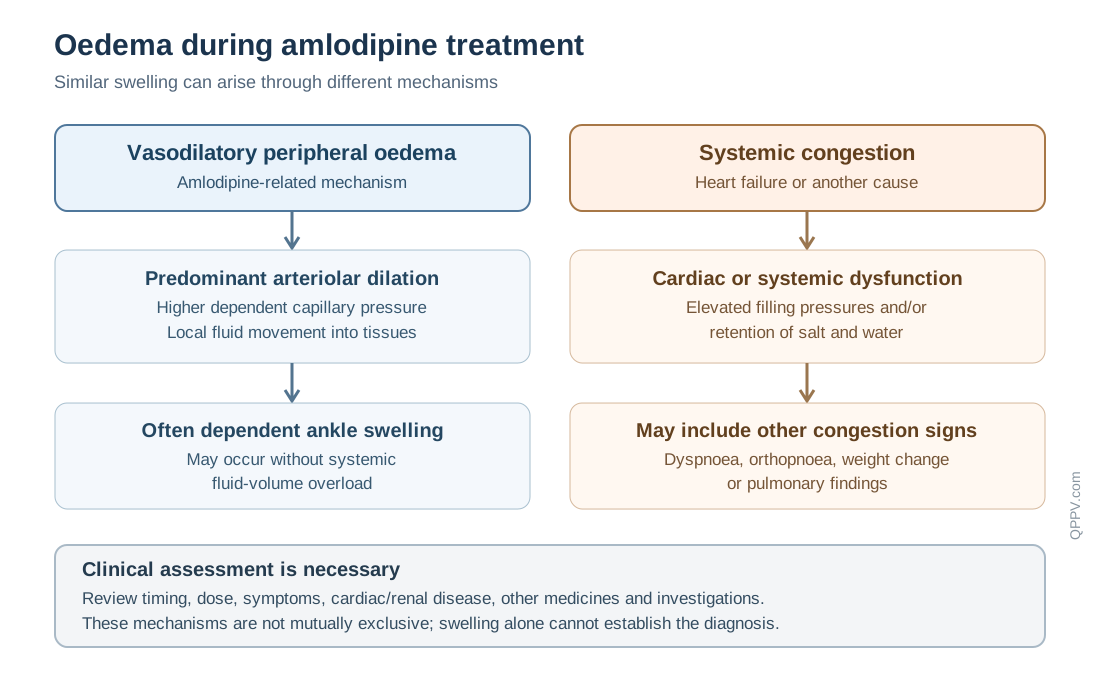
Figure 1. Two clinically different explanations for swelling during amlodipine treatment. The branches describe possible mechanisms, not mutually exclusive diagnoses. Clinical assessment is needed because drug-related dependent oedema and systemic congestion can coexist.
A useful follow-up record captures laterality, timing, amlodipine dose, co-treatment, weight change, cardiopulmonary symptoms, investigations, management and outcome. Dose reduction or withdrawal may help causal assessment, but dechallenge alone is not conclusive when diuretics, heart-failure treatment or other medicines change simultaneously. It is inappropriate to classify all oedema as serious heart failure, just as it is inappropriate to disregard possible decompensation because oedema is a recognised label effect.
Hypotension, dizziness and coronary symptoms
Amlodipine lowers peripheral vascular resistance, so excessive pressure reduction, dizziness and symptomatic hypotension are pharmacologically plausible, particularly with other antihypertensives, interacting medicines or limited physiological reserve. The US label cautions about symptomatic hypotension in severe aortic stenosis and worsening angina or acute myocardial infarction after initiation or dose escalation in patients with severe obstructive coronary disease. [2]
Case assessment should therefore distinguish transient dizziness from documented syncope, injury, shock or myocardial ischaemia. Blood-pressure measurements, timing, hydration status, dose escalation, interacting medicines and pre-existing coronary or valvular disease matter. A fall occurring months after initiation cannot be attributed to amlodipine solely because the medicine appears on the treatment list.
Heart failure and pulmonary oedema
The ALLHAT comparative heart-failure finding and the PRAISE-2 pulmonary-oedema observations create a separate assessment pathway from uncomplicated dependent swelling. A report of hospitalisation for pulmonary oedema should be medically evaluated for cardiac function, underlying disease, infection, renal impairment, fluid administration, concurrent treatment and objective findings. [4,5,9]
Importantly, the randomised evidence does not establish a simple causal model in which amlodipine invariably worsens cardiac contractility. It establishes context-specific comparative outcomes. The MAH should preserve the event phenotype and comparator evidence when reviewing cases or potential signals. For example, a cluster of reports coded as “peripheral oedema” should not automatically be treated as a cluster of “cardiac failure”; conversely, a report coded as “oedema” may warrant follow-up if the narrative suggests pulmonary congestion.
Other recognised adverse reactions
The UK and US product information describe headache, flushing, fatigue, nausea, abdominal discomfort, dizziness and somnolence among possible adverse effects. The UK SmPC also lists gingival hyperplasia and less frequent serious or medically significant events, including liver-related and cutaneous reactions, with frequency and causality qualifications that must be taken from the specific label. [2,3]
Gingival changes illustrate the value of longitudinal information: the onset may be gradual, oral hygiene and periodontal disease are competing contributors, and the outcome after medication adjustment may be delayed. For suspected liver injury or severe skin reactions, medical review must establish clinical criteria, latency, co-medications and alternative causes rather than treating mere temporal association as confirmation.
Drug interactions and exposure-related risk
Amlodipine is extensively metabolised through hepatic pathways involving CYP3A4. Strong or moderate inhibitors, including some macrolides, azoles, protease inhibitors and other cardiovascular drugs, may increase exposure and hypotension risk. Inducers can alter concentrations in the opposite direction; monitoring is relevant when they are introduced or withdrawn. These effects are context-specific and the exact action depends on the authorised SmPC and interacting product. [2,3]
An especially actionable interaction concerns simvastatin. Both the UK SmPC and the US originator label limit simvastatin to 20 mg daily when used with amlodipine, because amlodipine increases simvastatin exposure. This is a drug–drug interaction relevant to statin-associated muscle toxicity; a myopathy report involving both agents should not be assigned to amlodipine as an isolated direct muscle-toxic effect without evaluating the interaction. [2,3]
The UK SmPC also addresses monitoring of tacrolimus and ciclosporin concentrations in relevant settings and potential interactions with mTOR inhibitors. Its grapefruit advice differs in emphasis from some other calcium-channel blockers; the applicable local label governs. A case narrative should record starting and stopping dates for interacting medicines, changes in amlodipine dose and whether the reaction improved after intervention. [3]
Amlodipine's long half-life makes exposure history important after an interaction is recognised. Abrupt changes in the perpetrator drug may not produce immediate stabilisation of the clinical picture. Pharmacovigilance documentation should not infer a precise washout or interaction magnitude for an individual patient solely from population pharmacokinetic values.
Special populations and product-specific use
Older patients and hepatic impairment
Age and hepatic impairment may increase systemic exposure to amlodipine. The US label permits a lower initial dose in small, fragile or elderly patients and in hepatic insufficiency, while the UK SmPC emphasises cautious selection and slower titration in hepatic impairment. These are product-information instructions, not universal numerical thresholds that can be applied without checking the relevant authorisation. [2,3]
When evaluating hypotension or falls in older patients, review concurrent antihypertensives, frailty, orthostatic symptoms and recent changes in treatment. The long half-life may make adverse effects persist after a dose change. A pharmacovigilance report that lacks dose history or hepatic status may be insufficient for meaningful assessment even if the minimum ICSR criteria are satisfied.
Renal impairment and dialysis
The UK SmPC states that amlodipine plasma concentrations are not correlated with the degree of renal impairment and that the usual dose can be used; the drug is not dialysable. This differs from drugs whose dose must be adjusted primarily according to renal clearance. Nevertheless, renal disease remains relevant to overall cardiovascular risk, co-treatment and competing explanations for oedema. The absence of a routine renal-dose adjustment is not proof that every symptom in renal impairment is unrelated to amlodipine. [3]
Pregnancy and breastfeeding
The UK SmPC states that amlodipine's safety in human pregnancy has not been established and recommends use only where there is no safer alternative and the untreated condition presents greater risk. It also states that amlodipine is excreted in breast milk and that the clinical effect on exposed infants is unknown. The decision to continue breastfeeding or treatment requires consideration of maternal and infant benefit. [3]
Pregnancy-exposure case assessment should distinguish maternal hypertension, pre-eclampsia and other underlying risks from medicine exposure. It should document timing, dose, other medicines, pregnancy outcome and relevant congenital or neonatal findings. Neither an uneventful exposed pregnancy nor an isolated adverse outcome proves the absence or presence of teratogenic risk. Regional product information and specialist obstetric guidance govern treatment choices; the pharmacovigilance role is to collect and evaluate evidence accurately.
Children and adolescents
Both UK and US information describe use for hypertension in patients aged six years and older, with important limits on studied doses and long-term outcomes. The UK SmPC notes that effects on growth, puberty and subsequent adult cardiovascular outcomes have not been established. Paediatric reports should include age, weight when relevant, formulation, dosing method and medication-error possibilities. Adult outcome-trial results cannot simply be extrapolated as proof of long-term paediatric benefit. [2,3]
Overdose and medication errors
Clinically significant overdose can cause marked vasodilation and hypotension. The UK SmPC describes supportive cardiovascular management and notes that dialysis is unlikely to be beneficial because of high protein binding. Such statements are not an invitation to substitute a reference article for emergency clinical management. [3]
Errors can arise from duplicate prescriptions, confusion between strengths, an unintended extra dose, failure to recognise amlodipine in a fixed-dose combination, or co-prescription with interacting drugs. Product identification and the actual amount taken are essential. A suspected medication error without harm may require a different reporting and quality pathway from a valid suspected adverse-reaction ICSR; the local regulatory framework determines reporting obligations.
Pharmacovigilance implementation and governance
Case intake and medical evaluation
A robust case assessment starts with the event as described by the reporter rather than a preferred mechanism. Minimum ICSR validity criteria and EU reporting obligations derive from the applicable regulatory framework; more extensive follow-up supports medical interpretation but does not redefine validity. For oedema, determine whether the reported event is local dependent swelling, systemic congestion or insufficiently characterised. For hypotension, capture objective measurements and consequences. For interaction-related events, reconstruct the full medication timeline. [2,3,10]
Medical coding should reflect the documented clinical diagnosis and evidence, not the assessor's unsupported conclusion. Coding “cardiac failure” for uncomplicated ankle swelling may distort signal detection; coding “oedema” alone when pulmonary oedema and hospitalisation are documented may lose clinically material information. Where terminology is uncertain, seek appropriate follow-up and preserve the reporter's verbatim description.
Aggregate surveillance and benefit–risk review
Amlodipine's long market history provides substantial clinical context but does not make post-marketing reports self-interpreting. Signals may arise from new populations, formulations, interactions, medication-use patterns or product quality. Spontaneous reporting can help identify unusual phenotypes, but report counts alone cannot establish incidence or relative risk without a valid denominator and consideration of reporting bias.
A safety review should distinguish a new reaction from a known reaction appearing under different exposure circumstances, a formulation-specific defect, a class effect, and a comparator-dependent trial finding. Trial evidence should be assessed alongside real-world data with attention to confounding by indication: patients receiving amlodipine may differ systematically from patients prescribed another antihypertensive.
EU regulatory responsibilities and evidence
In the EU, pharmacovigilance obligations for MAHs are established by legislation and implementing rules. EMA GVP provides operational guidance on quality systems, ICSR management, periodic evaluation, signal management and risk minimisation. The precise applicable revisions and any product-specific conditions must be checked at the time of implementation. Neither this article nor a generic checklist creates a new amlodipine-specific reporting deadline. [10]
Operationally, an MAH should be able to trace the receipt of a suspected adverse reaction through validity assessment, seriousness and medical review, follow-up, coding, submission where required, aggregate evaluation and any subsequent product-information decision. Vendor and partner arrangements need documented transfer responsibilities and oversight. The QPPV's role is to oversee the adequacy and functioning of the pharmacovigilance system, not to personally adjudicate every routine amlodipine case.
For general process details see MedDRA coding, pharmacovigilance reconciliation and pharmacovigilance record retention. These are operational cross-references rather than additional product-specific legal requirements.
Practical application, inspection evidence and failure modes
Illustrative case: ankle swelling after dose escalation
A patient reports bilateral ankle swelling several weeks after an amlodipine dose increase. A preliminary reviewer might attribute the event to a known dose-related effect. An experienced assessor would first establish whether the swelling is dependent and isolated or accompanied by dyspnoea, orthopnoea, rapid weight gain or other evidence of congestion. Relevant questions include the prior dose, timing, comorbid heart or kidney disease, other vasodilators, venous disease and the results of any investigations.
If no objective evidence of heart failure emerges, the case may be compatible with vasodilatory peripheral oedema. If pulmonary findings or a new diagnosis of heart failure are documented, both event terms and their relationship to treatment require separate evaluation. This is a hypothetical teaching example, not a documented regulatory case or a diagnostic algorithm.
Illustrative case: muscle injury with simvastatin
A second patient develops myalgia and a marked creatine kinase increase while taking amlodipine and high-dose simvastatin. The assessment should identify the actual simvastatin dose, concurrent inhibitors, renal status, symptom timing, laboratory trajectory and other causes of muscle injury. The documented interaction raises a clinically plausible mechanism, but the causal contribution of each medicine remains a medical judgement. A signal reviewer should avoid coding this solely as an intrinsic amlodipine myopathy without examining the interaction and current labels. [2,3]
Evidence an inspector could examine
An inspector could select a case initially coded as peripheral oedema and ask whether a subsequent hospitalisation for heart failure was detected, followed up, medically reviewed and reflected in the final record. A second trace could follow a simvastatin interaction case from source document to medical assessment, product-information check and aggregate evaluation. For a combination product, the inspector could ask whether all active substances and the actual brand, batch and territory were retained.
These are illustrative inspection questions, not reports of actual inspection findings. Evidence of a functioning system includes contemporaneous records, explainable coding, reconciliation with relevant partners, documented medical reasoning, review of cumulative patterns and a traceable decision on any regulatory action. Merely having an SOP that mentions oedema or drug interactions is not evidence that these controls work.
A practical review checklist
| Review domain | Evidence or decision to establish |
|---|---|
| Product identity | INN, salt, brand, strength, formulation, combination constituents, country and batch if relevant |
| Exposure | Dose, start/stop dates, recent escalation, adherence and interacting medicines |
| Event phenotype | Dependent oedema versus cardiac congestion; hypotension severity; laboratory or diagnostic evidence |
| Susceptibility | Age, hepatic function, cardiac and renal disease, pregnancy status where relevant |
| Clinical course | Treatment changes, dechallenge/rechallenge where available, competing interventions and outcome |
| Regulatory assessment | Current regional label, ICSR criteria, seriousness, reporting pathway and documented medical judgement |
| System oversight | Follow-up completeness, coding consistency, partner transfer, aggregate review and decision traceability |
The checklist is a recommended review aid, not a separate binding legal requirement.
Key takeaways
Amlodipine's scientific and commercial history illustrates how the selection of a stable salt and long-acting pharmacology enabled a widely used antihypertensive medicine. Its pivotal trials do not tell a single story: ALLHAT found similar primary coronary outcomes but more incident heart failure than chlorthalidone; ASCOT-BPLA favoured an amlodipine-based regimen on several secondary outcomes without a significant primary coronary difference; CAMELOT supported benefit on a broad coronary-event composite; and PRAISE-2 did not confirm a heart-failure survival hypothesis. [4–9]
The main practical safety challenge is accurate phenotype and context. Dependent oedema may be a predictable vasodilatory effect, but swelling must not conceal heart failure. Hypotension, coronary symptoms, hepatic exposure changes and drug interactions require medication and clinical timelines. In EU pharmacovigilance, a high-quality assessment links source evidence to medically justified coding, reporting, aggregate evaluation and governance, while keeping legal duties, guidance and recommended practice distinct.
References
- Pfizer Inc. v. Apotex Inc., US Court of Appeals for the Federal Circuit, 2007. Development and patent history of amlodipine and the besylate salt. Judicial decision.
- Pfizer. NORVASC (amlodipine besylate) US Prescribing Information. Initial US approval 1992; Pfizer-hosted label revision January 2019. Originator label. For current US clinical use, check the specific marketed product's latest FDA label.
- Sandoz Ltd. Amlodipine 10 mg Tablets: UK Summary of Product Characteristics. emc product 4582; updated 6 October 2026. UK SmPC.
- ALLHAT Officers and Coordinators. Major outcomes in high-risk hypertensive patients randomised to ACE inhibitor or calcium channel blocker versus diuretic: ALLHAT. JAMA. 2002;288:2981–2997. DOI: 10.1001/jama.288.23.2981.
- Einhorn PT et al. ALLHAT Heart Failure Validation Study: diagnosis and prognosis. Am Heart J. 2007. PubMed 17174636.
- Dahlöf B et al. Prevention of cardiovascular events with an amlodipine/perindopril versus atenolol/thiazide regimen: ASCOT-BPLA. Lancet. 2005;366:895–906. University of Birmingham publication record.
- Nissen SE et al. Effect of antihypertensive agents on cardiovascular events in coronary disease: CAMELOT. JAMA. 2004;292:2217–2225. DOI: 10.1001/jama.292.18.2217.
- Julius S et al. Outcomes in high-risk hypertensive patients treated with valsartan- or amlodipine-based regimens: VALUE. Lancet. 2004;363:2022–2031. DOI: 10.1016/S0140-6736(04)16451-9.
- Packer M et al. Effect of amlodipine on survival in severe nonischaemic chronic heart failure: PRAISE-2. JACC Heart Fail. 2013;1:308–314. DOI: 10.1016/j.jchf.2013.04.004.
- European Medicines Agency. Good pharmacovigilance practices (GVP). Current collection and revision notices, including Modules I, VI, VII and IX. EMA guidance.
Regulatory Note
This reference differentiates scientific evidence, judicially documented historical facts, product-specific authorised information, EU legislation and GVP guidance, and suggested operational practice. US and UK indications, contraindications, special-population advice and label revisions are not interchangeable. The US originator label cited here is a historical revision, not a representation that every current US generic label is identical. Before clinical or regulatory use, verify the most recent authorised information for the particular product, country and formulation. Information reviewed through 20 October 2026.