Apalutamide: Discovery, Development, Safety and Pharmacovigilance
Apalutamide is an oral second-generation androgen-receptor (AR) antagonist used with continuing androgen-deprivation therapy (ADT) in specified prostate-cancer populations. Its development illustrates a distinction that remains central to both prescribing and pharmacovigilance: lowering androgen production and blocking androgen-receptor signalling are complementary, not identical, interventions. The history also illustrates why efficacy from one disease stage cannot be transported uncritically to another and why an adverse event during combination endocrine treatment may have several contributing causes. [1] [4] [5]
- Apalutamide: Discovery, Development, Safety and Pharmacovigilance
- The clinical problem: androgen dependence despite castration
- Discovery of ARN-509 and its scientific lineage
- Pharmacological mechanism: the receptor as a second therapeutic target
- Clinical development: what the randomised studies actually established
- Presentations, dosing and administration errors
- Safety profile: interpreting observed events in an endocrine-oncology population
- Drug interactions: a source of therapeutic failure
- US–EU product-specific listedness: Erleada, October 2026
- Practical pharmacovigilance: translating evidence into a defensible case
- Signal governance and inspection readiness
- Key Takeaways
- References
- Regulatory Note
The clinical problem: androgen dependence despite castration
Androgen-receptor signalling supports the growth of many prostate cancers. Medical ADT suppresses testicular testosterone through gonadotropin-releasing hormone (GnRH) analogues; orchiectomy achieves surgical castration. Both reduce circulating ligand, but neither necessarily extinguishes AR signalling in the tumour. Cancer may progress with castrate testosterone through AR overexpression, altered steroid synthesis, receptor changes and other adaptive mechanisms. “Castration resistant” therefore does not mean “androgen-receptor independent”.
This distinction generated two different therapeutic questions. In non-metastatic castration-resistant prostate cancer (nmCRPC), could an AR antagonist delay the appearance of distant metastases in men with rapid PSA progression but no metastases on conventional imaging? In metastatic castration-sensitive prostate cancer (mCSPC, also called mHSPC), could early AR blockade added to ADT prolong survival after metastatic disease had already been established? The patient populations, primary endpoints, prognosis and subsequent treatment options differ. [6] [8]
The definition of nmCRPC in pivotal trials relied on conventional imaging. Modern PSMA-PET may detect metastases that conventional imaging misses. This is a staging and evidence-translation issue: it does not retrospectively turn SPARTAN into a trial of PSMA-PET-defined metastatic disease. Accurate trial interpretation requires the imaging criteria actually used.
Discovery of ARN-509 and its scientific lineage
The 2012 report by Clegg and colleagues described ARN-509, subsequently named apalutamide, as a competitive AR antagonist optimised for receptor transcriptional inhibition, pharmacokinetics and activity in preclinical prostate-cancer models. The research involved Memorial Sloan Kettering, UCLA and Aragon Pharmaceuticals. In laboratory systems the compound inhibited AR nuclear localisation and DNA binding, including models of AR overexpression. This established a scientific rationale for clinical testing; animal efficacy and comparisons with the development candidate MDV3100 cannot be read as proof of superior patient outcomes or fewer adverse reactions. [1]
The compound was subsequently also identified as JNJ-56021927. The development story is not simply a change of brand name: it links receptor biology, medicinal chemistry, translational pharmacology, a targeted clinical programme and later regulatory review. Early evidence made a hypothesis credible; large randomised trials were required to test patient benefit and harm.
Aragon Pharmaceuticals and the Janssen transition
Johnson & Johnson announced in June 2013 that it would acquire Aragon Pharmaceuticals' androgen-receptor antagonist programme for $650 million upfront, with up to $350 million in contingent milestone payments. The acquisition was completed on 19 August 2013, after which Janssen Research & Development managed ARN-509 development. Other Aragon assets were to be spun out rather than included in the acquisition. These transaction figures are documented corporate terms; they are not apalutamide revenue, profit or a measure of the product's eventual market share. [2]
The US FDA first approved Erleada 60-mg tablets on 14 February 2018 for nmCRPC. The European Union granted a marketing authorisation on 14 January 2019. The US indication expanded on 17 September 2019 to mCSPC. Current US and EU product information must still be checked separately because an authorisation, formulation or safety statement in one jurisdiction is not automatically valid in the other. [3] [4] [12]
Pharmacological mechanism: the receptor as a second therapeutic target
Apalutamide binds the AR ligand-binding domain and interferes with receptor activation, nuclear signalling and transcription of androgen-responsive genes. It is not a GnRH analogue, testosterone-synthesis inhibitor or cytotoxic chemotherapy. Patients without bilateral orchiectomy continue GnRH-based ADT. Inadequate androgen suppression, nonadherence to the GnRH treatment or changes in tumour biology can complicate the interpretation of a rising PSA despite apalutamide. [1] [4] [5]
The clinical logic can be understood as two connected interventions. ADT reduces ligand supply; apalutamide reduces the tumour's response to residual androgen. Neither action eliminates every possible resistance pathway.
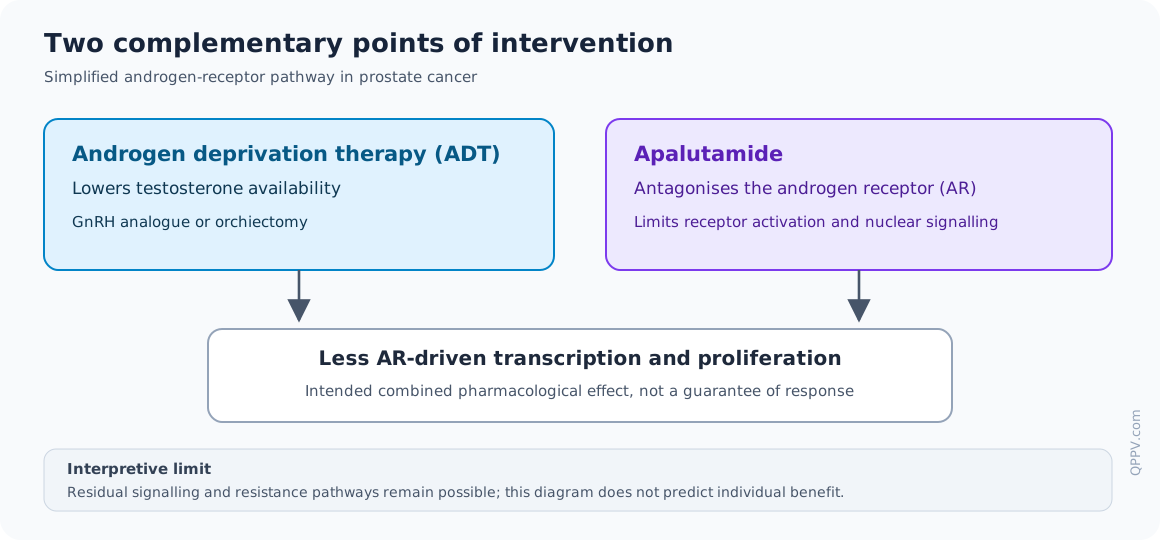
Figure 1. ADT reduces androgen availability while apalutamide antagonises the receptor. Both limit androgen-dependent transcription; the simplified pathway does not imply complete suppression of resistance mechanisms or predict individual efficacy.
Pharmacokinetics and active metabolite
Apalutamide is metabolised through CYP2C8 and CYP3A4 to N-desmethyl apalutamide, which retains pharmacological activity. With repeated administration, parent and metabolite exposures evolve over time; enzyme induction also develops. Therefore an adverse event, interaction or treatment failure may emerge after weeks of apparently stable dosing. A medication history limited to drugs taken on the event day can miss the causal chronology. [4] [5]
The drug is a strong inducer of CYP3A4 and CYP2C19, a weaker inducer of CYP2C9, and affects transporters including P-glycoprotein, BCRP and OATP1B1. Its clinically important interactions often cause lower exposure and loss of efficacy of another medicine, rather than an obvious toxicity of apalutamide. The substrate, its therapeutic index, co-medications and relevant monitoring determine the consequence. [4] [5]
The June 2026 US prescribing information and April 2026 EU SmPC both describe a 120-mg once-daily dose for severe hepatic impairment (Child–Pugh C), rather than the usual 240 mg. This is a specific posology recommendation, not a universal dose reduction for minor liver-enzyme elevations. [4] [5]
Clinical development: what the randomised studies actually established
SPARTAN: metastasis-free survival in high-risk nmCRPC
SPARTAN enrolled 1,207 men with nmCRPC and a PSA doubling time of 10 months or less. Patients continued ADT and were randomised 2:1 to apalutamide 240 mg once daily or placebo. Its primary endpoint, metastasis-free survival (MFS), combined distant metastasis detected on imaging or death. At the planned primary analysis, median MFS was 40.5 months with apalutamide versus 16.2 months with placebo, hazard ratio 0.28 (95% CI 0.23–0.35). This was compelling evidence for delaying metastasis or death in the enrolled population, not a mature overall-survival result at that time. [6]
The later prespecified overall-survival analysis, at approximately 52 months' median follow-up, reported median overall survival of 73.9 versus 59.9 months, hazard ratio 0.78 (95% CI 0.64–0.96; p=0.016). Nineteen percent of patients still receiving placebo crossed over to apalutamide after unblinding, and subsequent life-prolonging therapies differed between groups. The statistically significant result should be reported together with these interpretive limitations, rather than implying that every patient received the originally assigned therapy throughout follow-up. [7]
SPARTAN also showed the importance of monitoring adverse events during prolonged therapy. The trial populations excluded some patients at high risk for seizures and recent cardiovascular events, so its adverse-event rates do not directly quantify risks in those excluded populations. The timing and duration of exposure differed between groups, making exposure-adjusted analyses important when interpreting accumulated event counts.
TITAN: treatment intensification in metastatic hormone-sensitive disease
TITAN randomised 1,052 men with metastatic castration-sensitive prostate cancer to apalutamide 240 mg daily plus ADT or placebo plus ADT. Unlike SPARTAN, metastatic disease was already present. The original analysis demonstrated improvements in both radiographic progression-free survival and overall survival. These were effects of adding apalutamide to ongoing ADT, not evidence for apalutamide monotherapy or superiority over every contemporary multi-drug regimen. [8]
The final TITAN survival analysis reported 44.0 months' median follow-up. Overall survival favoured apalutamide plus ADT, hazard ratio 0.65 (95% CI 0.53–0.79), with median overall survival not reached in the apalutamide arm versus 52.2 months in the control arm. Approximately 39.5% of placebo-assigned patients crossed over to apalutamide after unblinding. A crossover-adjusted estimate was also reported, but depends on modelling assumptions; it should not replace the observed randomised comparison. Patient-reported quality of life was broadly maintained. [9]
The trial included patients with different metastatic disease volumes and some prior treatment histories. Subgroup findings can inform clinical interpretation but should not be converted into categorical claims about an individual subgroup without attention to sample size, events and interaction testing. A non-significant subgroup comparison is not proof that the drug does not work in that subgroup.
PROTEUS in 2026: promising perioperative evidence, not an authorised indication
PROTEUS studied 2,109 patients with high-risk localised or locally advanced prostate cancer undergoing radical prostatectomy. Apalutamide or placebo was combined with ADT for six months before and six months after surgery. In the 2026 report, pathologic complete response or minimal residual disease occurred in 8.9% versus 1.0%. At five years, estimated MFS was 78.2% versus 73.5%, hazard ratio 0.80 (95% CI 0.67–0.96; p=0.02). Grade 3–4 adverse events occurred in 39.6% versus 31.0%. [10]
These are important randomised results, but the US and EU Erleada labels assessed in October 2026 do not authorise a general perioperative prostatectomy indication. The trial's imaging and endpoint framework, including PSMA-PET, also differs from the earlier SPARTAN setting. The combination includes ADT and major surgery, so perioperative events require evaluation of surgical, anaesthetic, thrombotic, infectious and endocrine factors as well as apalutamide.
The comparison of these studies is useful precisely because their questions differ:
| Study | Disease state | Main evidence | Essential boundary |
|---|---|---|---|
| SPARTAN | High-risk nmCRPC, conventional-imaging M0 | MFS improvement; later mature OS benefit | Continued ADT; crossover and later therapy |
| TITAN | Metastatic castration-sensitive disease | Radiographic progression and OS benefit | Continued ADT; substantial crossover |
| PROTEUS | High-risk localised/locally advanced, radical prostatectomy | Pathologic response and MFS improvement | Perioperative regimen remains investigational against assessed labels |
What the evidence does not establish
Apalutamide has not been shown by these three trials to improve outcomes in every stage of prostate cancer, every sequencing strategy after other AR inhibitors, or every combination with chemotherapy. Biological plausibility and positive trials in adjacent settings do not establish authorisation. Similarly, no single hazard ratio is a universal treatment effect independent of baseline risk, follow-up, concomitant therapy and endpoint definition.
A pharmacovigilance professional reviewing a new safety signal should therefore ask which population generated the evidence. For example, a fracture in a patient with metastatic bone disease, a fracture in an nmCRPC patient on long-term ADT, and a perioperative fracture in a high-risk localised-disease trial may have materially different background risks and competing causes. Pooling them without stratification can obscure a clinically important pattern.
Presentations, dosing and administration errors
The current US label lists 60-mg and 240-mg film-coated tablets. EU product information also describes these strengths. The usual adult dose is 240 mg once daily, alongside continuing castration, subject to dose modifications for toxicity, interactions and severe hepatic impairment. Four 60-mg tablets and one 240-mg tablet can deliver the same amount; “four tablets daily” without the tablet strength is insufficient for assessing overdose or underdose. [4] [5]
Both labels describe specific methods for dispersing tablets in non-carbonated water, combining them with permitted soft foods or beverages, and administering through an appropriately sized feeding tube. These instructions vary with tablet strength and administration method. Patients should not improvise crushing, splitting, mixing or storage. A medication-error report should capture the strength, actual number of tablets, water volume, waiting time, food or liquid used, tube size, flushing, any residue and whether the full dose was consumed.
Dose interruption for a suspected serious adverse reaction should be documented separately from interruption of ADT. If a GnRH analogue was inadvertently stopped when apalutamide was withheld, the resulting hormonal change may complicate both efficacy and safety interpretation. Likewise, PSA progression after a supply interruption should not be treated as proof of biological resistance without checking treatment continuity, castrate testosterone and imaging.
Safety profile: interpreting observed events in an endocrine-oncology population
Apalutamide is generally given to men with prostate cancer who may already have age-related cardiovascular disease, osteoporosis, metabolic abnormalities, polypharmacy and adverse effects of ADT. Trial imbalances, postmarketing case reports, biologically plausible effects and labelled adverse reactions are distinct evidence categories. A report may involve more than one of these and should not be reduced prematurely to a single drug–event assertion.
Rash: common, sometimes delayed, occasionally severe
Rash is a characteristic adverse reaction. In pooled SPARTAN and TITAN data, rash was reported in 26% of apalutamide recipients versus 8% of placebo recipients; grade 3 rash occurred in 6% versus 0.5%. Median onset was 83 days. Many reactions were managed with topical corticosteroids, antihistamines, temporary interruption or dose reduction. Rechallenge can lead to recurrence. These figures support vigilance well beyond the first treatment weeks, but do not establish that any particular rash was caused by apalutamide. [4] [5]
The differential includes infection, other medicines and severe cutaneous adverse reactions (SCARs). Fever, mucosal involvement, blistering, skin pain, facial oedema, eosinophilia or organ injury require urgent assessment for Stevens–Johnson syndrome/toxic epidermal necrolysis (SJS/TEN) or drug reaction with eosinophilia and systemic symptoms (DRESS). The current US and EU labels identify these as postmarketing reactions and warn that they can be fatal. Confirmed SCARs require permanent discontinuation under the assessed product information. The management of an uncomplicated maculopapular rash must not be applied to suspected SJS/TEN. [4] [5]
Falls, fractures and the contribution of ADT
In SPARTAN, the USPI reports fractures in 12% of apalutamide-treated patients versus 7% on placebo and falls in 16% versus 9%. ADT-related bone loss, sarcopenia, age, frailty, sedatives, balance disorders and metastases can contribute. A fall may cause a fracture, while a pathological fracture at a metastatic site may occur without a preceding fall. Recording the sequence and anatomical diagnosis is essential. [5]
Follow-up should establish baseline osteoporosis, prior fracture, bone density where available, bone-targeted treatment, mobility and visual impairment, seizure or syncope symptoms, fracture imaging and whether metastatic disease involved the site. A report of “fracture due to apalutamide” without these details may be clinically uninterpretable even if the event is listed.
Cardiovascular and cerebrovascular disorders
The US label reports ischaemic cardiovascular events in SPARTAN (3.7% versus 2.0%) and TITAN (4.4% versus 1.5%), apalutamide versus placebo. The EU SmPC lists ischaemic heart disease and ischaemic cerebrovascular disorders as common adverse reactions. Patients with recent major cardiovascular events were excluded from pivotal trials, limiting extrapolation to the highest-risk groups. [4] [5]
For a suspected myocardial infarction, capture ECG, troponin and imaging evidence, coronary history, blood pressure, diabetes, dyslipidaemia, smoking, ADT, concomitant medicines and competing acute illness. For stroke or transient ischaemic attack, obtain brain and vascular imaging, atrial fibrillation history, anticoagulation and neurological outcome. A temporal relationship is one component of causality assessment, not a substitute for diagnostic confirmation.
Seizure and loss of consciousness
The USPI reports seizures in 0.4% of apalutamide-treated patients and 0.1% of placebo recipients across SPARTAN and TITAN; the EU SmPC uses a different pooled percentage in its warnings and lists seizure as uncommon. Trial exclusions included seizure histories and predisposing conditions. Both labels direct permanent discontinuation after a seizure. [4] [5]
Do not classify every collapse as a seizure. Arrhythmia, orthostatic hypotension, stroke, hypoglycaemia and other causes of syncope may produce overlapping narratives. Useful evidence includes witness description, duration, postictal features, EEG or imaging, electrolytes, recent brain injury and medicines lowering seizure threshold.
Thyroid, metabolic and functional effects
Pooled US trial data report hypothyroidism in 8% with apalutamide versus 1.5% with placebo, with TSH checked every four months. Increased TSH was more common than clinically recorded hypothyroidism. An increase in levothyroxine requirement may reflect changes in hormone disposition and the underlying thyroid disorder; a useful report includes baseline and follow-up TSH/free T4, symptoms, thyroid replacement dose and adherence. [5]
Fatigue, decreased appetite, weight loss, diarrhoea, arthralgia and hot flushes can compromise treatment continuity and quality of life. Prostate cancer progression, infection, malnutrition, ADT and other treatments may cause similar symptoms. Follow-up should identify whether a cluster represents a distinct clinical syndrome and how symptoms changed with treatment interruption or other interventions.
ILD/pneumonitis and differential diagnosis
Both assessed labels include interstitial lung disease (ILD)/pneumonitis, including serious postmarketing cases. New cough, dyspnoea, fever or hypoxaemia should prompt assessment for infection, pulmonary embolism, heart failure, tumour progression, prior radiation and other medicines. The US label directs withholding during suspected ILD and permanent discontinuation for severe ILD or where no alternative cause is identified. The EU SmPC recommends interruption while investigating unexplained respiratory deterioration and discontinuation if ILD is diagnosed. [4] [5]
Clinical records should preserve the CT pattern, oxygen requirement, infectious investigations, treatment, dechallenge and outcome. An uncertain diagnosis can still be reported as a suspected reaction, with uncertainty clearly recorded. A spontaneous report of “pneumonia” should not automatically be reclassified as drug-induced ILD.
Drug interactions: a source of therapeutic failure
Apalutamide induces CYP3A4, CYP2C19, CYP2C9 and transporters. It can lower exposure to other drugs, including clinically important anticoagulant and cardiovascular substrates. The EU SmPC advises avoiding concomitant warfarin or coumarin-like anticoagulants where possible and additional INR monitoring when such treatment is unavoidable. The US label advises considering alternatives or monitoring for loss of activity of sensitive substrates. An interaction can be important even when the patient has no new symptom until the co-medication fails. [4] [5]
Strong CYP2C8 or CYP3A4 inhibitors can alter apalutamide and active-metabolite exposure. The June 2026 US label provides dose-reduction advice for these inhibitors, whereas the April 2026 EU SmPC discusses predicted active-moiety exposure and generally does not require an initial dose adjustment, with clinical monitoring. This is a material regional prescribing distinction and should be assessed against the current exact label. [4] [5]
Digoxin assay interference is not necessarily digoxin toxicity
The June 2026 US label added a dedicated warning that apalutamide can cause falsely elevated digoxin concentrations in certain chemiluminescent microparticle immunoassays. The EU SmPC also discusses this phenomenon in its interaction section. An unexpectedly high assay result may be analytical interference, not increased digoxin exposure. Confirm the assay method with the laboratory and use a suitable alternative method before adjusting digoxin solely on that result. [4] [5]
This analytical issue is distinct from apalutamide's enzyme/transporter induction, which may change the true exposure of some medicines. A high reported digoxin value, reduced anticoagulant effect and an actual apalutamide adverse reaction require three different investigation pathways.
US–EU product-specific listedness: Erleada, October 2026
Documents and scope. This comparison was assessed on 29 October 2026. The US comparator is Erleada (apalutamide) 60-mg and 240-mg film-coated tablets, DailyMed set ID d1cda4f7-cb33-46ea-b9ac-431f6452b1a5, updated 2 July 2026, prescribing text revised June 2026. Relevant sections are 4, 5, 6.1–6.2, 7 and 8.6. The EU comparator is Erleada film-coated tablets, centrally authorised EMA product information updated 22 April 2026, SmPC sections 4.3–4.8 and 5.2. The EMA record identifies procedure VR/0000319048 of 12 March 2026. Both concern apalutamide, but their jurisdictions and label conventions differ. [4] [5]
| Safety concept | US Erleada USPI | EU Erleada SmPC | Interpretation |
|---|---|---|---|
| Contraindications | Section 4: none | Section 4.3: hypersensitivity; women pregnant or potentially pregnant | US embryo-fetal warning must not be described as a US section-4 contraindication |
| Rash | Section 6.1 trial reaction, 26% pooled | Section 4.8 very common | Listed in both; uncomplicated rash differs from SCAR |
| SJS/TEN and DRESS | Section 6.2 postmarketing; section 5.5 warning | Section 4.8 frequency not known; section 4.4 warning | Listed in both; spontaneous reporting does not estimate incidence |
| ILD/pneumonitis | Section 6.2 postmarketing; section 5.6 warning | Section 4.8 frequency not known | Listed in both; distinguish from infection or tumour progression |
| Hypothyroidism | Section 6.1, 8% pooled | Section 4.8 common | Listed in both; do not transplant US trial frequency to EU table |
| Falls and fractures | Sections 6.1 and 5.2–5.3 | Section 4.8 very common | Listed in both; capture mechanism and fracture type |
| Ischaemic cardiovascular and cerebrovascular events | Sections 5.1 and 6.1 | Section 4.8 common | Warning, trial reaction and tabulated ADR are not identical evidence categories |
| Seizure | Sections 5.4 and 6.1 | Section 4.8 uncommon | Listed in both; trial exclusions limit generalisation |
| QT prolongation | No directly corresponding section-6.2 postmarketing term identified in this assessed scope | Section 4.8 frequency not known | Material difference in reaction-table presentation; do not infer an unlisted US case without full term review |
| Digoxin assay interference | Sections 5.8 and 7.3 | Section 4.5 interaction text | Laboratory interference is not automatically a clinical adverse reaction |
| Severe hepatic impairment | Section 2.3: 120 mg once daily | Section 4.2: 120 mg once daily | A dosing instruction, not listedness |
This is a selected comparison, not a complete reproduction of all adverse reactions. A reaction is “listed” here only in relation to the specified product and the cited section of its dated public label. A term in a warning or interaction section is not automatically a section-6 or section-4.8 adverse reaction. “Frequency not known” does not imply a low frequency or a reliable incidence estimate. Differences in terminology, coding and clinical-study populations should be documented rather than assigned speculative biological causes. [4] [5]
Public-label listedness is distinct from company core listedness, clinical-trial expectedness against the applicable reference safety information (RSI), causality, seriousness and expedited reporting obligations. An adverse event can be medically plausible and reportable even if its wording does not appear in the current public label. A suspected adverse reaction is not proof of an individual causal relationship.
Practical pharmacovigilance: translating evidence into a defensible case
Intake, validation and follow-up
Capture the exact brand, strength, formulation, country, batch when available, prescribed and actually taken dose, start and stop dates, missed doses and restarts. Record cancer stage, baseline imaging, PSA/testosterone trajectory, type and continuity of ADT, prior AR-pathway therapy, comorbidity and all co-medications with their start/stop dates. Establish the event's diagnostic evidence, seriousness, onset, management, outcome and possible dechallenge or rechallenge.
GVP Module VI addresses the collection, management and submission of suspected adverse-reaction reports, including the regulatory criteria for a valid individual case safety report. These requirements must not be replaced by this article's recommended high-value clinical follow-up questions. GVP Module IX addresses signal management and the evidentiary steps needed before a concern is accepted, evaluated and acted upon. [11]
Illustrative case: delayed rash
A man develops a diffuse eruption nine weeks after beginning apalutamide. The initial report calls it “mild rash.” Ask about fever, mucosal lesions, skin pain, blistering, eosinophilia, liver injury, infection and other new medicines. The trial median onset of 83 days supports temporal plausibility but does not prove causality. If SCAR is suspected, the clinical and regulatory implications differ from a simple exanthem. Preserve the source wording, follow-up evidence, coding changes and the reason for any permanent-discontinuation recommendation.
Illustrative case: anticoagulant failure
A patient taking warfarin develops a thrombotic event after apalutamide initiation. Retrieve INR before and after initiation, warfarin dose changes, adherence, diet, other interacting medicines and the cancer-associated thrombosis risk. Enzyme induction could lower anticoagulant exposure, but the patient's malignancy and cardiovascular status provide competing explanations. Document the anticoagulation management and outcome; do not attribute thrombosis solely to the presence of an interaction warning.
Illustrative case: unexpected digoxin concentration
A laboratory reports a high digoxin concentration without matching symptoms or ECG findings. Establish whether a susceptible chemiluminescent immunoassay was used, confirm the result by an alternative assay, and review renal function, timing and the clinical examination. This may be a laboratory artefact rather than true digoxin accumulation. The laboratory investigation and any actual pharmacokinetic interaction should be documented separately. [4] [5]
Illustrative case: dyspnoea and pulmonary infiltrates
A patient on apalutamide plus ADT develops breathlessness and CT ground-glass opacities. Infection, pulmonary embolism, heart failure, prior radiation, other medicines and cancer progression must be evaluated alongside ILD. Capture oxygen need, imaging, microbiology, bronchoscopy when performed, steroid/antibiotic treatment, drug interruption and outcome. It is appropriate to retain uncertainty rather than force a diagnosis not established by the record.
Signal governance and inspection readiness
A cumulative review should stratify by nmCRPC versus mCSPC, age, baseline cardiovascular disease, dose, exposure duration, ADT regimen, interaction-prone medicines and reporting region. Preserve the original case narratives alongside MedDRA coding, particularly when a rash evolves into a confirmed SCAR or an apparent digoxin toxicity proves to be assay interference. Trial event proportions and spontaneous reports are not directly interchangeable; spontaneous reports lack a reliable exposed denominator and can be affected by stimulated reporting and duplication.
Inspection-ready evidence links source documentation, follow-up attempts, seriousness and causality assessment, product and label version, coding decisions, case transmission, signal validation, risk-minimisation action and effectiveness review. A hypothetical case in this article is not an alleged regulatory inspection finding. The objective is traceability: an independent reviewer should be able to reproduce why a decision was made and what uncertainty remained.
Key Takeaways
Apalutamide originated as ARN-509 and moved from an academic–Aragon discovery programme into Janssen development. It antagonises AR signalling alongside ongoing castration. SPARTAN and TITAN support two distinct authorised disease settings, while PROTEUS supplies important investigational perioperative evidence as of October 2026. Rash, falls, fractures, cardiovascular events, seizures, hypothyroidism, SCAR and ILD require longitudinal and differential assessment. Enzyme induction can reduce the effectiveness of other medicines; digoxin immunoassay interference can produce false laboratory signals. US and EU listedness, RSI expectedness, seriousness and causality remain separate determinations.
References
- Clegg NJ, et al. ARN-509: a novel antiandrogen for prostate cancer treatment. Cancer Research. 2012;72:1494–1503. doi:10.1158/0008-5472.CAN-11-3948. https://pubmed.ncbi.nlm.nih.gov/22266222/
- Johnson & Johnson. Acquisition of Aragon Pharmaceuticals, 17 June 2013; completion 19 August 2013. https://www.jnj.com/media-center/press-releases/johnson-johnson-announces-definitive-agreement-to-acquire-aragon-pharmaceuticals-inc
- US FDA. Erleada NDA 210951 original approval package, 14 February 2018. https://www.accessdata.fda.gov/drugsatfda_docs/nda/2018/210951Orig1s000Approv.pdf
- European Medicines Agency. Erleada EPAR product information, updated 22 April 2026, SmPC sections 4.1–4.8. https://www.ema.europa.eu/en/documents/product-information/erleada-epar-product-information_en.pdf
- US National Library of Medicine DailyMed. Erleada (apalutamide) tablets, updated 2 July 2026; prescribing text revised June 2026. https://dailymed.nlm.nih.gov/dailymed/drugInfo.cfm?setid=d1cda4f7-cb33-46ea-b9ac-431f6452b1a5
- Smith MR, et al. Apalutamide treatment and metastasis-free survival in prostate cancer. N Engl J Med. 2018;378:1408–1418. https://pubmed.ncbi.nlm.nih.gov/29420164/
- Smith MR, et al. Apalutamide and overall survival in prostate cancer. Eur Urol. 2021;79:150–158. https://pubmed.ncbi.nlm.nih.gov/32907777/
- Chi KN, et al. Apalutamide for metastatic, castration-sensitive prostate cancer. N Engl J Med. 2019;381:13–24. doi:10.1056/NEJMoa1903307. https://www.nejm.org/doi/full/10.1056/NEJMoa1903307
- Chi KN, et al. TITAN final survival analysis. J Clin Oncol. 2021;39:2294–2303. https://pubmed.ncbi.nlm.nih.gov/33914595/
- Taplin ME, et al. Perioperative apalutamide in high-risk localized prostate cancer (PROTEUS). N Engl J Med. 2026;395:546–560. https://pubmed.ncbi.nlm.nih.gov/42223077/
- European Medicines Agency. Good pharmacovigilance practices, Modules VI (Rev.2) and IX (Rev.1). https://www.ema.europa.eu/en/human-regulatory-overview/post-authorisation/pharmacovigilance-post-authorisation/good-pharmacovigilance-practices-gvp
- American Society of Clinical Oncology. FDA approval of apalutamide for mCSPC, 17 September 2019. https://www.asco.org/practice-policy/policy-issues-statements/asco-in-action/fda-approves-apalutamide-metastatic
Regulatory Note
This article is educational and does not replace current authorised product information, clinical guidance or case-specific regulatory advice. Verify the exact product, strength, jurisdiction and label revision before decisions. Clinical trials provide population-level evidence; a suspected event or its presence in a label does not establish individual causality.