Avelumab: Classification, Clinical Context, Safety and Pharmacovigilance
Avelumab illustrates why checkpoint inhibitors should be assessed as individual products rather than treated as interchangeable examples of “immunotherapy.” It blocks programmed death-ligand 1 (PD-L1), but its molecular design, treatment settings, combinations and exposure histories shape the evidence that pharmacovigilance must interpret. The same immune-mediated event can have different alternative explanations in metastatic Merkel cell carcinoma, renal cell carcinoma treated with axitinib, and urothelial carcinoma managed with maintenance therapy.
Classification and pharmacological rationale
Avelumab is a fully human IgG1 monoclonal antibody directed against PD-L1. The PD-1/PD-L1 pathway normally limits T-cell activity and helps prevent excessive immune responses. Some tumours exploit this inhibitory pathway: PD-L1 binding to PD-1 on T cells reduces antitumour activity. Avelumab binds PD-L1 and interrupts that interaction, allowing immune activity to recover in the tumour microenvironment.
Avelumab also retains an IgG1 Fc region capable of engaging immune effector mechanisms. Fc-mediated activity, including antibody-dependent cellular cytotoxicity observed in experimental settings, is a mechanistic feature to understand, not a substitute for clinical evidence. It should not be assumed to explain every clinical response or adverse event. The established therapeutic rationale in the EU product information is PD-L1 blockade.
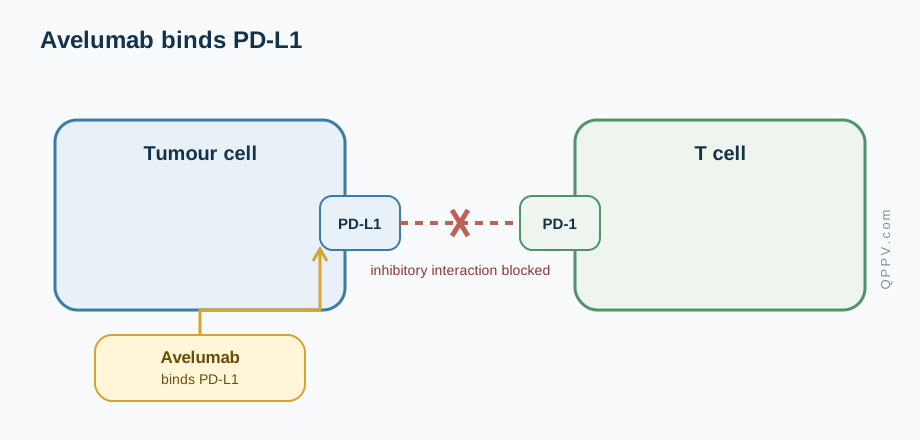
Figure 1. Avelumab binds PD-L1 and prevents inhibitory signalling through PD-1. The diagram shows the principal checkpoint mechanism; it does not imply that all downstream immune effects or toxicities are fully predictable from target binding alone.
Clinical settings and exposure context
The EMA product information describes avelumab use in Merkel cell carcinoma (MCC), advanced renal cell carcinoma (RCC) in combination with axitinib, and locally advanced or metastatic urothelial carcinoma (UC) as first-line maintenance in patients whose disease has not progressed after platinum-based chemotherapy. The exact authorised wording and treatment conditions should be checked against the current EU product information because indications can change.
These settings create different causal contexts. In MCC, the underlying cancer and previous systemic treatment may affect immune status and event attribution. In RCC, hypertension, diarrhoea, hepatic abnormalities and other findings can reflect axitinib, avelumab, their interaction, cancer or supportive medicines. In UC maintenance, events arise after chemotherapy has already been given, and disease control itself defines the population entering maintenance. Recording regimen, line of therapy, prior exposure, start and stop dates, and treatment interruptions is therefore part of clinical interpretation, not administrative detail.
How evidence informs the safety profile
Checkpoint inhibition can produce inflammatory injury in normal tissues because immune tolerance is altered. The resulting reactions may affect endocrine organs, gastrointestinal tract, liver, lungs, kidneys, skin, nervous system or other tissues. An event can begin during treatment or after the last dose; stopping exposure does not immediately reverse the biological effect. The current product information governs the listed risks, monitoring advice, interruption rules and emergency management.
Infusion-related reactions form a separate temporal pattern. They tend to occur during or shortly after administration and can include fever, chills, flushing, back or abdominal pain, dyspnoea or hypersensitivity features. Premedication is recommended for the initial infusions under the EU label, with later practice determined by prior reaction history and the current SmPC. A delayed organ-specific inflammatory syndrome should not be collapsed into an infusion reaction simply because it followed an infusion.
Combination therapy requires regimen-aware evaluation. When avelumab is used with axitinib, overlapping symptoms such as diarrhoea, fatigue, liver-test abnormalities or hypertension need a differential assessment that considers both products, dose changes, timing, dechallenge, rechallenge, tumour status and competing causes. A database report naming only the regimen may be insufficient for product-specific signal work.
Case assessment and aggregate evaluation
For an individual case, reconstruct the clinical sequence: indication and disease status; prior anticancer therapy; avelumab and concomitant-product exposure; event onset; objective findings; diagnostic work-up; treatment and outcome; dose interruption or withdrawal; and recurrence on re-exposure, if any. For suspected immune-mediated toxicity, capture the affected organ, severity, diagnostic evidence, treatment with immunosuppression and recovery course. For infusion reactions, record infusion timing, symptoms, interventions, completion or interruption, and subsequent tolerance.
Causality is not established by biological plausibility alone. A temporal association with a checkpoint inhibitor is a reason to investigate, not proof that the event is immune-mediated. Infection, tumour progression, paraneoplastic disease, prior chemotherapy, comorbidity and concomitant medicines may provide competing explanations. Equally, a normal early investigation does not necessarily exclude an evolving immune-mediated event.
Aggregate analyses should preserve indication, monotherapy versus combination, line of treatment, prior therapies, exposure duration, event latency and relevant co-medications. Pooling all avelumab reports may be useful for broad detection, but interpretation should return to clinically coherent strata. Spontaneous-report counts do not provide incidence because reporting is incomplete and lacks a reliable exposure denominator.
Practical pharmacovigilance controls
The safety database and case-processing guidance should support:
- exact identification of avelumab and concomitant anticancer products;
- capture of infusion dates, treatment phase, interruptions and last dose;
- targeted follow-up for suspected organ-specific immune toxicity;
- distinction between infusion reactions, immune-mediated events and disease-related symptoms;
- review of competing causes and relevant diagnostic evidence;
- indication- and regimen-specific signal review.
A potential failure mode is classifying every event as a generic “immune-related adverse event.” That label can obscure the phenotype, weaken coding quality and prevent comparison of clinically distinct conditions. Another is losing combination attribution when the reporter supplies only a regimen name. Follow-up should recover component-level exposure without implying that one product caused the event.
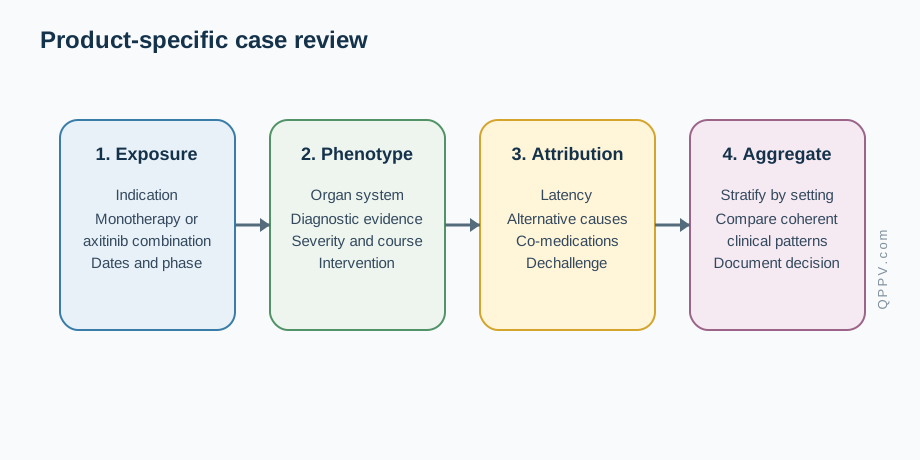
Figure 2. A practical review sequence separates exposure reconstruction, phenotype assessment and causal interpretation before aggregate comparison. The sequence supports consistent evaluation; it is not a legal algorithm or a substitute for medical judgement.
Governance and inspection perspective
An inspection assessment would look for evidence that the system can identify the administered product, reconstruct exposure, medically evaluate important suspected reactions and use the resulting information in aggregate benefit-risk review. Relevant records may include case narratives, follow-up requests, coding conventions, combination-therapy procedures, signal evaluations and documented decisions. The point is to demonstrate an effective process, not merely the existence of a procedure.
A useful quality check is whether a reviewer can distinguish the three EU treatment contexts and reconstruct the contribution of axitinib when the combination is used. If the available data cannot support that distinction, the organisation should document the limitation and consider whether a proportionate process change or targeted follow-up is needed.
Key takeaways
- Avelumab blocks PD-L1; Fc-mediated experimental effects should not be overstated as established clinical explanations.
- EU indication, treatment phase and combination status are essential case context.
- Immune-mediated toxicities can be delayed and organ-specific; infusion reactions have a different temporal and clinical pattern.
- Causality requires clinical assessment of alternatives, not mechanism alone.
- Aggregate review should stratify where treatment context materially changes interpretation.
References
- European Medicines Agency. Bavencio: European Public Assessment Report.
- European Medicines Agency. Bavencio: current EU product information.
- European Medicines Agency. Good pharmacovigilance practices.
- European Medicines Agency. Bavencio risk-management plan and post-authorisation assessment documents, available through the EPAR assessment history.
Regulatory Note
This article describes the EU-authorised context reviewed on 24 September 2026. The current Summary of Product Characteristics and applicable regulatory documents govern prescribing and pharmacovigilance obligations. Recommendations for internal case review are presented as operational practice, not as additional legal requirements.