Axatilimab: Classification, Mechanism, Clinical Evidence and Pharmacovigilance
Axatilimab is a humanised monoclonal antibody that blocks colony-stimulating factor 1 receptor (CSF-1R). Its clinical role is distinctive because the target is expressed on monocytes and macrophages: the treatment is intended to modulate a cellular compartment implicated in chronic graft-versus-host disease (cGVHD), rather than directly suppressing donor T cells. This distinction shapes both the biological rationale and the safety-monitoring approach.
The U.S. Food and Drug Administration approved axatilimab-csfr on 14 August 2024 for adults and paediatric patients weighing at least 40 kg with cGVHD after failure of at least two prior lines of systemic therapy. This article describes that U.S. indication and the evidence supporting it; it does not imply authorisation in other jurisdictions. [1,2]
Classification and biological context
Axatilimab is a therapeutic IgG monoclonal antibody directed against CSF-1R, also called CD115. CSF-1R is a receptor tyrosine kinase found chiefly on cells of the monocyte–macrophage lineage. Binding by its ligands, colony-stimulating factor 1 (CSF-1) and interleukin-34 (IL-34), supports survival, differentiation and tissue adaptation of these cells. Axatilimab interrupts ligand-driven receptor signalling. It is not a lymphocyte-depleting antibody and is not an antibody–drug conjugate.
Monocytes and tissue macrophages have context-dependent functions: host defence, tissue repair, antigen presentation, cytokine production and matrix remodelling. In cGVHD, persistent immune injury can coexist with inflammatory and fibrotic tissue changes. Macrophage-lineage cells may participate in these processes, providing a rationale for targeting CSF-1R. This is a mechanistic treatment hypothesis supported by translational biology; it should not be read as proof that all cGVHD manifestations are macrophage-driven.
Why the target matters for safety
A target-mediated effect can yield laboratory changes beyond conventional infection monitoring. CSF-1R biology intersects with tissue macrophage function and bone remodelling; the U.S. label therefore includes a broad pattern of enzyme and mineral abnormalities alongside infections, infusion-related reactions and symptoms. A raised transaminase, lipase, amylase or creatine phosphokinase result may reflect different underlying processes and should be assessed in clinical context rather than attributed automatically to one mechanism.
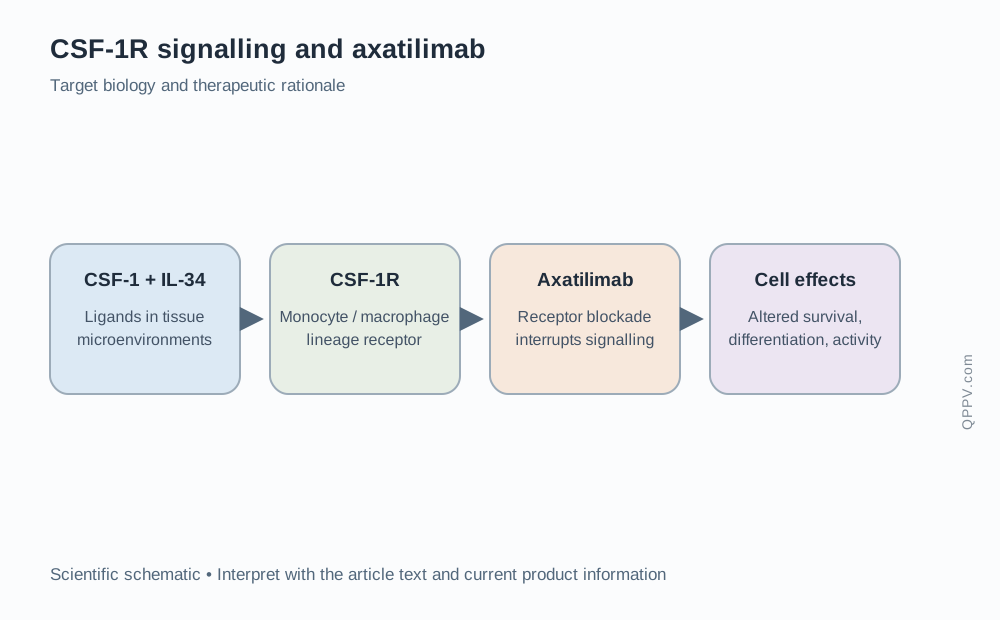
Figure 1. Simplified target biology: CSF-1 and IL-34 engage CSF-1R on monocyte-lineage cells; axatilimab blocks receptor signalling. The figure presents a therapeutic rationale, not a complete model of cGVHD pathogenesis.
Clinical development and authorised use
AGAVE-201 was a randomised, open-label, multicentre phase 2 study in adults and children with recurrent or refractory cGVHD after at least two systemic treatment lines. It compared three axatilimab dose schedules; FDA’s efficacy assessment focused on 79 patients receiving the recommended 0.3 mg/kg intravenous dose every two weeks. Through Cycle 7 Day 1, the overall response rate (complete or partial response under the 2014 NIH cGVHD response criteria) was 75% (95% CI 64–84); all responses in that cohort were partial. Median time to first response was 1.5 months. [1,3]
The response endpoint is not interchangeable with cure, global disease control or survival benefit. Response duration and freedom from additional cGVHD therapy provide complementary context, but the study was not a blinded comparison against an active standard. The label’s selected population and weight threshold matter when interpreting benefit: the authorised regimen should not be extrapolated to lower-weight children or earlier treatment lines without jurisdiction-specific evidence and authorisation.
The U.S. recommended dose is 0.3 mg/kg, capped at 35 mg, infused intravenously over 30 minutes every two weeks for patients weighing at least 40 kg. Treatment continues until progression or unacceptable toxicity. The label’s dose-modification and interruption instructions govern clinical use; medication decisions remain with the treating team. [2]
Safety profile and pharmacovigilance
In the AGAVE-201 label safety cohort, serious adverse reactions occurred in 44% of patients; infection, viral infection and respiratory failure were among serious events reported in more than two patients. Infusion-related reactions, including hypersensitivity, occurred in 18%, with grade 3 or 4 reactions in 1.3%. Common reported reactions and laboratory abnormalities included infections, transaminase and other enzyme increases, decreased phosphate and haemoglobin, musculoskeletal pain, fatigue, gastrointestinal symptoms, cough, fever and dyspnoea. These frequencies describe a selected clinical-trial population and are not comparative incidence estimates against other cGVHD therapies. [2]
For pharmacovigilance, capture the clinical sequence around an event: baseline cGVHD organ involvement; prior and concomitant immunosuppressants; infection prophylaxis and microbiology; dose and infusion timing; laboratory trends; treatment interruption or discontinuation; and outcome. Distinguish an infection from an inflammatory flare, cGVHD-related organ dysfunction, an infusion reaction and a laboratory signal where the available evidence permits. Report serious suspected adverse reactions through the applicable local system and follow current product information.
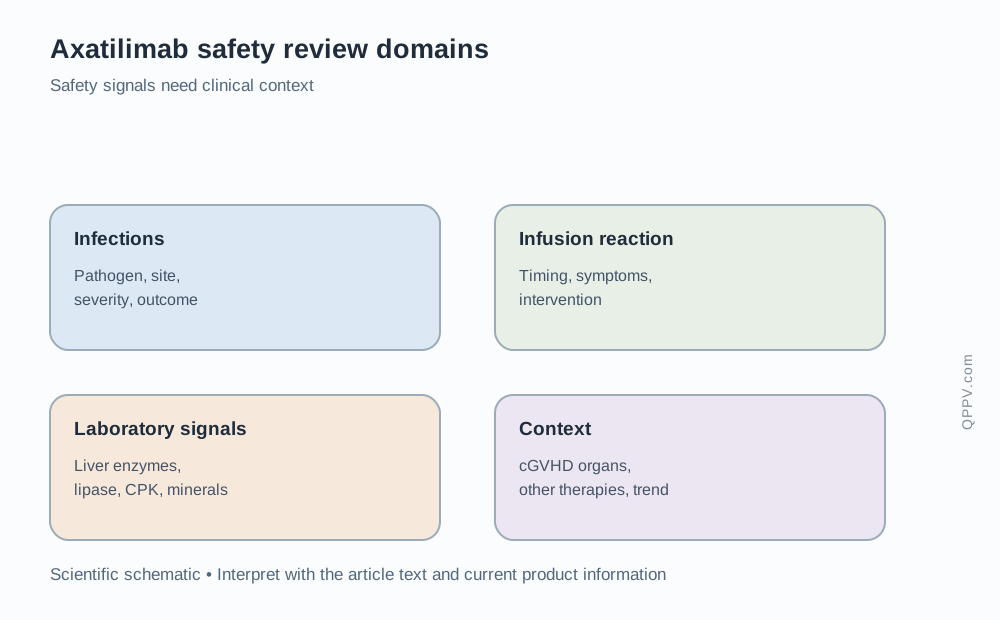
Figure 2. Label-described safety signals and useful case context. The monitoring domains do not replace the U.S. prescribing information or local clinical protocols.
Practical pharmacovigilance considerations
Case assessment and signal interpretation
A useful case narrative records the treatment line, cGVHD organs affected, baseline function, prior transplantation context, concomitant immune-modifying treatment and the timing of axatilimab exposure. For infection, document suspected or confirmed pathogen, site, severity, treatment, recurrence and any interruption. For enzyme elevations, preserve units, reference ranges, baseline values, serial results, symptoms and diagnostic work-up. This supports assessment without assuming that every abnormal test is caused by axatilimab.
The current U.S. label reports treatment-emergent anti-drug antibodies in 33.7% of 276 tested patients after a median exposure of 7.8 months; neutralising antibodies were detected in a subset. The label reports no clinically meaningful effect on pharmacokinetics, pharmacodynamics or effectiveness. Immunogenicity is therefore a characterised product property, not evidence that an individual loss of response is antibody-mediated. [2]
Governance and inspection evidence
A sponsor or marketing-authorisation holder should maintain traceability from source reports to coded events, seriousness and expectedness assessments, follow-up, aggregate review and any required expedited reporting under the governing jurisdiction. Reconcile clinical-trial and post-authorisation safety data using the applicable reporting framework. Keep a clear audit trail when an event is attributed to cGVHD, transplantation, concomitant therapy or the product, including uncertainty and alternative causes.
In a treatment setting with complex baseline morbidity, “not related” should not be a default for events common in the underlying population. Equally, temporal association alone does not establish causality. Review patterns by event, dose, exposure duration, organ involvement, concomitant immunosuppression and dechallenge or rechallenge information where available.
Key takeaways
- Axatilimab blocks CSF-1R on monocyte/macrophage-lineage cells; its rationale is distinct from direct T-cell depletion.
- The FDA indication is limited to cGVHD after at least two prior systemic lines in adults and children weighing at least 40 kg.
- AGAVE-201 supported the authorised dose with a 75% response rate in the label-evaluable cohort; the open-label, non-comparative design limits broader inference.
- Infection, infusion reactions and laboratory abnormalities require contextual case documentation.
- Separate label requirements from operational pharmacovigilance practice and from mechanistic hypotheses.
References
- U.S. Food and Drug Administration. FDA approves axatilimab-csfr for chronic graft-versus-host disease. https://www.fda.gov/drugs/resources-information-approved-drugs/fda-approves-axatilimab-csfr-chronic-graft-versus-host-disease
- U.S. National Library of Medicine. NIKTIMVO (axatilimab-csfr), current U.S. prescribing information. DailyMed. https://dailymed.nlm.nih.gov/dailymed/drugInfo.cfm?setid=bb6dba23-e7a6-4765-a1e6-b9e277ce0381
- Wolff D, et al. Axatilimab in recurrent or refractory chronic graft-versus-host disease. N Engl J Med. 2024. PMID: 39292927. https://pubmed.ncbi.nlm.nih.gov/39292927/
- FDA approval summary: axatilimab for chronic GVHD after two prior lines of systemic therapy. Clin Cancer Res. 2025. PMID: 40577088. https://pubmed.ncbi.nlm.nih.gov/40577088/
Regulatory Note
Regulatory status and label details in this article were checked on 25 September 2026. The described indication is the U.S. FDA indication; approval, product information, reporting duties and local practice may differ elsewhere. The article is educational and does not replace the current prescribing information or an individual clinical assessment.