Bictegravir: Discovery, Development, Safety and Pharmacovigilance
Bictegravir is an HIV-1 integrase strand transfer inhibitor (INSTI) developed for once-daily oral antiretroviral treatment without a pharmacokinetic booster. It is marketed as one component of a fixed-dose combination with emtricitabine and tenofovir alafenamide, rather than as a separately authorised single-agent tablet. This distinction defines the pharmacovigilance problem: clinical trials and routine reports usually describe exposure to all three substances, while the mechanism of a suspected reaction or loss of efficacy may implicate one component, the combination, an interacting medicine or the patient's underlying condition. [1,7,8]
The subject of this article is the international nonproprietary name bictegravir. The accompanying medicines have distinct actions and safety profiles and merit their own lifecycle articles. The discussion follows bictegravir from molecular design and early trials through authorisation, longer-term evidence, clinically important safety distinctions and the controls that make surveillance interpretable.
- Bictegravir: Discovery, Development, Safety and Pharmacovigilance
- Scientific origin and discovery
- Mechanism and the three-component regimen
- Early clinical development
- Pivotal efficacy and safety evidence
- Authorisation and commercial lifecycle
- Regulatory scope and treatment populations
- Pharmacokinetic interactions and medication-use risk
- Safety profile and medically important distinctions
- Translating the evidence into pharmacovigilance
- Key takeaways
- References
- Regulatory Note
Scientific origin and discovery
HIV-1 replication requires conversion of viral RNA to DNA and integration of that DNA into the genome of an infected host cell. Early antiretroviral combinations chiefly targeted reverse transcriptase and viral protease. Integrase inhibitors subsequently made a different viral step druggable. First-generation INSTIs established the clinical value of blocking strand transfer, but their resistance patterns, interaction liabilities and dosing characteristics left room for additional compounds. [1,10]
Gilead Sciences developed bictegravir under the research identifier GS-9883. The publicly documented preclinical programme described a distinctive bridged bicyclic ring system and substituted benzyl group. These structural changes were investigated to improve antiviral potency, pharmacokinetic characteristics and activity against some integrase-resistant variants. A 2016 laboratory study reported inhibition of integrase strand transfer and activity in human lymphocyte systems, together with a higher in-vitro resistance barrier than raltegravir or elvitegravir under the experimental conditions studied. Those laboratory results supported clinical development; they did not establish that bictegravir would overcome every clinically relevant INSTI-resistance pattern. [1]
The published research identifies Gilead investigators and collaborators but does not, by itself, establish a single inventor or a precise original synthesis date. The discovery should therefore be attributed to the documented company research programme rather than to an unsupported individual invention story. Bictegravir's eventual commercial history is also principally the history of a three-drug regimen, not a standalone bictegravir product. [1,11]
Mechanism and the three-component regimen
Bictegravir binds the HIV-1 integrase–viral DNA complex and inhibits the strand-transfer step needed for stable insertion of viral DNA into host-cell DNA. It does not inhibit reverse transcriptase, eradicate integrated provirus or cure HIV infection. Its partners work earlier in the replication cycle: emtricitabine is a nucleoside reverse transcriptase inhibitor, while tenofovir alafenamide is a prodrug that delivers tenofovir, whose intracellular diphosphate is an active nucleotide analogue. Together, the components block complementary replication steps. [7,8]
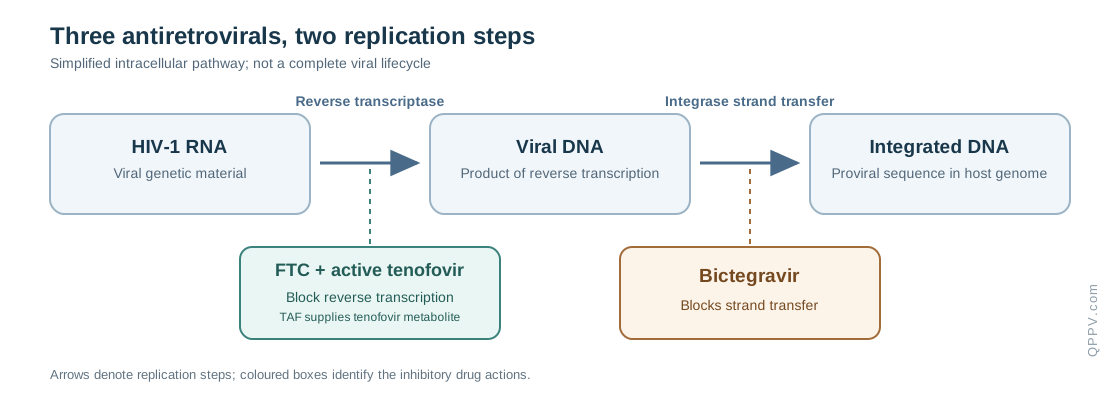
Figure 1. Simplified sequence of HIV-1 reverse transcription and integration. Emtricitabine and the active tenofovir metabolite interfere with reverse transcription; bictegravir inhibits integrase-mediated strand transfer. The diagram depicts pharmacological targets, not the complete HIV lifecycle or independent clinical efficacy of each ingredient.
The three substances are supplied in one tablet at a fixed ratio. This simplifies administration but limits the ability to adjust the bictegravir dose separately when renal function, drug interactions or another component's toxicity changes. The authorised product information, not the theoretical suitability of an isolated ingredient, determines whether a given patient can receive the combination. [7,8]
Bictegravir is metabolised principally through CYP3A and UGT1A1 pathways and inhibits the renal transporters OCT2 and MATE1. The latter effect can raise serum creatinine through reduced tubular secretion without necessarily reducing measured glomerular filtration. It can also increase exposure to some transporter substrates, notably metformin and dofetilide. This pharmacology connects an apparently simple regimen to two different surveillance questions: whether a laboratory change reflects kidney injury, and whether a co-medication creates clinically important interaction risk. [8,10]
Early clinical development
After preclinical and short-term antiviral investigations, bictegravir entered controlled comparative studies in previously untreated adults. A published phase II trial randomly assigned 98 participants to bictegravir or dolutegravir, each given with emtricitabine and tenofovir alafenamide. At week 24, HIV-1 RNA below 50 copies/mL was observed in 63 of 65 participants receiving bictegravir and 31 of 33 receiving dolutegravir. The trial was small and was designed to support further development, not to establish superiority or rare-event safety. Its exclusions—including pregnancy, hepatitis B coinfection and substantial renal impairment—also limited extrapolation to populations later addressed by labels and post-authorisation evidence. [2]
The phase II study used 75 mg bictegravir, whereas the subsequently authorised adult combination contains 50 mg. This is a development-stage dose distinction, not an alternative routine dose. The clinical programme then evaluated the coformulated regimen in larger active-controlled trials. [2,8]
Pivotal efficacy and safety evidence
Two double-blind phase III trials in treatment-naive adults supplied the main comparative evidence. Study GS-US-380-1489 compared bictegravir/emtricitabine/tenofovir alafenamide (BIC/FTC/TAF) with dolutegravir/abacavir/lamivudine; GS-US-380-1490 compared BIC/FTC/TAF with dolutegravir plus FTC/TAF. Both used virological suppression at week 48 and prespecified non-inferiority margins. In 1489, suppression below 50 copies/mL occurred in 92.4% versus 93.0%, respectively. The result supported non-inferiority, not superiority. Study 1490 likewise supported non-inferiority against an INSTI regimen sharing the same nucleoside backbone. [3,4]
The two comparisons answer different questions. Trial 1489 changes both the integrase inhibitor and the nucleoside backbone, so an observed tolerability difference cannot automatically be assigned to bictegravir. Trial 1490 holds FTC/TAF constant and therefore provides a more direct, though still regimen-level, comparison of the integrase inhibitors. Both trials enrolled selected populations with screening requirements; their results do not imply that all patients with prior resistance, untreated coinfections or severe organ dysfunction were studied. [3,4]
The phase III programme was followed by switch studies in people whose HIV-1 infection was already virologically suppressed. One double-blind trial evaluated replacing dolutegravir/abacavir/lamivudine with BIC/FTC/TAF. Another open-label trial evaluated switching from boosted protease-inhibitor regimens. Both supported maintenance of suppression under their respective eligibility conditions. The boosted-protease-inhibitor comparison is especially informative for clinical practice because changing a regimen may alter several interaction and metabolic risks at once; it is not a clean single-molecule safety experiment. [5,6]
Longer-term outcomes and the limits of the trial evidence
A pooled five-year follow-up of the original treatment-naive trials reported no treatment-emergent resistance to BIC/FTC/TAF among the evaluated participants. At week 240, 426 of 432 participants with available virological data were suppressed, but the corresponding proportion was 426 of 634 when missing data were counted as failure. This difference is essential: an observed-case analysis describes those retained with measurements, whereas a missing-as-failure analysis more conservatively reflects attrition. Neither should be quoted without its denominator. [9]
The five-year report also described weight increases and changes in lipid measures. Median weight gain was 6.1 kg from baseline at week 240 in the reported cohort. Such findings justify longer-term metabolic surveillance but do not by themselves isolate bictegravir's causal contribution from changes in HIV health, background nucleoside therapy, lifestyle or switching from earlier agents. Trials can characterise common events and selected laboratory trends; very rare reactions, complex comorbidity and patterns of use after approval require additional evidence. [9]
Negative evidence and unanswered questions
No claim of superiority over dolutegravir was established by the original pivotal non-inferiority trials. In-vitro activity against some resistant isolates did not amount to a clinical indication for unrestricted use after INSTI resistance. In addition, many initial trial participants lacked hepatitis B coinfection, advanced renal disease or pregnancy exposure. The subsequent expansion of the evidence base therefore matters as much as the positive initial efficacy result. A responsible lifecycle account records these limitations rather than interpreting successful authorisation as proof that all populations were already understood. [1–4,7,8]
Authorisation and commercial lifecycle
The United States first authorised the fixed-dose Biktarvy regimen in 2018. The European Commission granted EU marketing authorisation on 21 June 2018, following a positive CHMP opinion in April; the EU marketing authorisation holder is Gilead Sciences Ireland UC. Later regulatory changes expanded the population and presentations supported by evidence, including paediatric weight-based tablets. The current EU EPAR lists treatment of adults and children aged at least two years and weighing at least 14 kg, with the specified absence of relevant historical or current resistance. [7,8]
The US label revised in March 2026 includes three treatment situations: people without antiretroviral treatment history; certain treatment-experienced people who are not virologically suppressed and lack known or suspected relevant resistance; and eligible suppressed patients replacing a stable regimen. This broader US wording must not be transposed automatically to the EU indication. The 2025 change to the US indications is explicitly recorded in the current label. [7,8]
Commercially, the product has remained within Gilead's HIV portfolio. Gilead reported US$14.3 billion in worldwide Biktarvy sales for 2025, a company-reported figure for the entire three-drug branded combination. It is not a bictegravir-only revenue figure and cannot be divided among the three ingredients without an unsupported allocation model. The commercial scale helps explain the importance of systematic surveillance across countries, formulations and age groups; sales alone do not measure individual patient exposure, adverse-reaction incidence or safety performance. [11]
Regulatory scope and treatment populations
The authorised fixed-dose tablet is the relevant unit of prescribing and safety evaluation. EU and US product information agree on the presence of three antiretroviral substances, but differ in the exact indication wording and some operational detail. The EU EPAR currently describes two strengths: 50/200/25 mg and 30/120/15 mg (bictegravir/emtricitabine/tenofovir alafenamide). Weight determines the applicable presentation. The US label uses the lower strength for children weighing at least 14 kg but less than 25 kg, and the adult strength for those at least 25 kg. The product is not recommended below 14 kg. [7,8]
In the US, the usual renal threshold for starting the fixed combination is an estimated creatinine clearance of at least 30 mL/min. The label also describes a narrowly defined option for virologically suppressed adults with end-stage renal disease receiving chronic haemodialysis; it is not a general authorisation for untreated patients with end-stage disease. For creatinine clearance from 15 to below 30 mL/min and for other specified end-stage situations, the combination is not recommended. Severe hepatic impairment (Child–Pugh C) is another situation in which the US label does not recommend use. These distinctions should be checked against the current local product information before making a patient-level decision. [8]
Resistance and virological eligibility
A high in-vitro barrier to resistance is a useful development property, not a substitute for reviewing a patient's treatment history. The authorised indication, particularly the EU wording, places conditions on known or suspected resistance to the INSTI class and the nucleoside components. A patient with detectable viraemia may have missed doses, interacting medicines, inadequate exposure, pre-existing resistance, newly selected resistance or an unrelated laboratory problem. These possibilities require separate evaluation rather than automatic classification as bictegravir resistance. [1,7,8,10]
At an operational level, the pharmacovigilance record for a suspected lack-of-efficacy event should preserve serial viral loads, treatment dates, adherence evidence, full regimen and concomitant medicines, relevant genotype or phenotype results, and the clinical consequences of virological failure. The presence or absence of a valid suspected adverse-reaction report is assessed under the applicable reporting framework; every isolated increase in viral load is not automatically a reportable adverse reaction. [8,12]
Pregnancy and paediatric use
Pregnancy illustrates how the evidence base can evolve after the original adult trials. The US label provides dosing instructions for virologically suppressed pregnant individuals on a stable regimen without relevant resistance; it also advises close viral-load monitoring because bictegravir exposure is lower in pregnancy. US perinatal guidance reviewed in March 2026 states that no bictegravir dose adjustment is recommended and summarises reassuring but still developing human outcome evidence. It reports a pregnancy-registry comparison that depends on the reference population used and has not identified a specific birth-defect pattern. The responsible interpretation is neither a declaration of zero risk nor a claim that a statistical comparison alone proves teratogenicity. [8,13]
The paediatric programme progressively added weight-based evidence and a lower-strength tablet. Paediatric clinical trials enrolled smaller populations than the adult pivotal studies, and the US label describes no new adverse-reaction pattern in the evaluated cohorts. Rare reactions, developmental outcomes, formulation errors and long-term exposure still merit surveillance. A case involving a child should record age, weight at exposure, exact tablet strength, administration method, adherence and growth trajectory, rather than assuming the adult presentation was used. [7,8]
Pharmacokinetic interactions and medication-use risk
Bictegravir is susceptible to exposure changes through metabolic induction and to reduced absorption through chelation by polyvalent cations. The US label contraindicates coadministration of Biktarvy with rifampin because of reduced bictegravir exposure, and with dofetilide because increased dofetilide exposure may cause serious harm. Rifabutin and rifapentine are not recommended, which is a different regulatory category from contraindication. Selected anticonvulsants and St John's wort may also lower bictegravir or tenofovir alafenamide exposure. These distinctions should be recorded accurately when a safety case involves a treatment change or a suspected virological failure. [8]
Calcium, iron and aluminium/magnesium-containing products may reduce bictegravir absorption. Administration instructions depend on the particular cation, food and timing, and pregnancy instructions have additional specificity. For example, the US label permits simultaneous calcium or iron with food, while recommending separation from aluminium/magnesium antacids. A generic rule to separate every mineral product by an identical interval would misstate the label. Exact ingestion times, meal context and formulation matter when investigating a failure to suppress HIV. [8,10]
Bictegravir's OCT2/MATE1 inhibition can increase metformin exposure. The US label directs clinicians to assess the benefits and risks using metformin's own prescribing information. It does not automatically prohibit the combination. This is an instructive cross-product interface: metformin's renal and lactic-acidosis profile should be assessed alongside the antiretroviral regimen, particularly when kidney function changes. [8]
A fixed-dose product can also be misused through duplication with other antiretrovirals or confusion between the two tablet strengths. Because Biktarvy is a complete regimen, routine coadministration with additional HIV antiretroviral treatment is not recommended in US labelling. Medication-error assessment should distinguish incorrect dispensing, incorrect administration, an intended regimen change and an authorised specialist decision; it should document the precise exposure before attributing an outcome to an ingredient. [8]
Safety profile and medically important distinctions
Common tolerability and laboratory effects
Diarrhoea, nausea and headache were among the most commonly reported adverse reactions in the treatment-naive pivotal programme. The March 2026 US label reports week-144 trial adverse-reaction frequencies by comparator and cautions against comparing rates across studies. In trial 1489, nausea was less frequent with BIC/FTC/TAF than with dolutegravir/abacavir/lamivudine, but this was a comparison of complete regimens rather than a controlled assessment of bictegravir alone. [3,8]
Bictegravir may cause an early, modest increase in serum creatinine through reduced tubular secretion without reducing true glomerular filtration. The US label describes a median rise of approximately 0.11 mg/dL at week 144. This laboratory effect is distinct from progressive kidney dysfunction or proximal tubular injury. Postmarketing renal events reported with tenofovir alafenamide-containing products include proximal renal tubulopathy and Fanconi syndrome, often with possible confounders. A predictable creatinine shift must not be used to dismiss other evidence of renal disease. [8]
US product information recommends renal assessment before or when starting treatment and during therapy as clinically appropriate, with serum phosphorus assessment in patients with chronic kidney disease. Clinical evaluation of a suspected renal event should reconstruct baseline function, urine findings, other nephrotoxic medicines, intercurrent illness and the course after any treatment change. [8]
Hepatitis B, hepatic events and immune reconstitution
Bictegravir itself is not an anti-hepatitis-B medicine. Its companion components emtricitabine and tenofovir have HBV activity. In HIV/HBV coinfection, stopping the combination can remove HBV-active therapy and precipitate severe hepatitis B exacerbation. This is the subject of the US boxed warning. The label calls for HBV testing before or when initiating treatment and close follow-up for at least several months after discontinuation in coinfected patients. The mechanism should not be misdescribed as a direct bictegravir liver toxicity. [8]
Immune reconstitution inflammatory syndrome may follow successful antiretroviral therapy as immune responses recover against previously indolent infections. Clinical deterioration after starting treatment therefore needs differentiation between an inflammatory response, an adverse drug reaction and progression of infection. The label also retains a warning for lactic acidosis and severe hepatomegaly with steatosis associated with nucleoside analogues; this should not be presented as a proven bictegravir-specific effect. [8]
Postmarketing observations and their interpretation
The March 2026 US label identifies voluntarily reported renal disorders, severe skin reactions, angioedema, urticaria and weight increase during use of Biktarvy or tenofovir alafenamide-containing products. These reports arise from populations of uncertain size, so frequency cannot reliably be estimated and causation is not established for every report. The evaluation must distinguish bictegravir pharmacology, the companion ingredients, interacting medicines and alternative clinical causes. [8]
For a suspected serious skin reaction, useful evidence includes morphology, mucosal involvement, timing of all medicines, infection history, treatment and outcome. For renal disease, serial laboratory results help distinguish the creatinine transporter effect from tubular dysfunction. For gradual weight increase, baseline weight, treatment history, viral suppression, lifestyle and comorbidity matter. These are clinical assessment elements, not additional statutory ICSR-validity criteria. [8,9,12]
Sleep disturbance, abnormal dreams and mood symptoms also require careful attribution. Trial labelling includes such events, while background HIV-related morbidity, psychiatric history and other medicines may contribute. An isolated report cannot establish a frequency or a causal class effect. The evaluator should preserve the chronology and source account rather than imposing a presumed mechanism. [8,10]
Translating the evidence into pharmacovigilance
The EU pharmacovigilance framework applies to the authorised medicinal product and its marketing authorisation holder. Binding obligations derive from applicable legislation, while EMA GVP describes processes for safety reporting, quality systems, periodic evaluation and signal management. The following operational interpretation is not a separate bictegravir-specific legal requirement. [7,12]
Case intake and ingredient attribution
A safety report may name only Biktarvy, but medical evaluation needs the exact combination and strength, start and stop dates, country, indication, concomitant medicines and relevant clinical history. A suspected lack-of-efficacy event may require serial HIV RNA results, adherence information and resistance testing. A hepatitis B flare after interruption may be explained by loss of HBV-active treatment rather than toxicity of the integrase inhibitor. [7,8]
The suspected medicinal product should be recorded faithfully as reported. That does not establish bictegravir alone as the cause. Distinguishing product-level reporting from ingredient-level medical reasoning improves coding, duplicate management and aggregate review. A valid case is assessed under the applicable ICSR rules; every isolated viral-load change does not automatically constitute a suspected adverse reaction. [8,12]
Signal evaluation and benefit–risk assessment
Case-series review should group comparable clinical phenotypes and evaluate whether changes over time reflect exposure, reporting, surveillance intensity or a change in underlying risk. An increase in renal reports after use expands to patients with more comorbidity might reflect changed population characteristics or a real safety concern. Appropriate evidence may include longitudinal cohorts, comparator data, trial extensions and exposure estimates. Spontaneous-report counts alone do not establish incidence. [8,9,12]
Reviewers should distinguish treatment-emergent events, investigator-attributed adverse reactions, spontaneously reported suspected reactions, and outcomes after treatment interruption. They answer different questions. A symptom after discontinuation may reflect loss of antiviral or HBV-active treatment rather than a toxic effect; a reaction to the combination cannot automatically be assigned to bictegravir. This distinction is particularly important for renal dysfunction, hepatitis B exacerbation and virological failure. [3–9]
Records, governance and inspection perspective
The marketing authorisation holder's pharmacovigilance system needs reliable interfaces with medical information, clinical teams, regulatory affairs, quality, partners and affiliates. The evidence chain should connect source information and receipt dates with assessment, follow-up, coding, aggregate review, decisions, implementation and verification. The QPPV's oversight concerns the effectiveness of this system, not personal adjudication of every individual report. These are general EU PV governance principles, not additional bictegravir-only requirements. [12]
For the process foundations, see day zero and reporting awareness, pharmacovigilance reconciliation and MedDRA coding. These linked articles explain the underlying process controls.
In an illustrative scenario, a patient with previously suppressed HIV-1 starts an aluminium/magnesium antacid and later has persistent detectable viral load. A medically useful assessment reconstructs dose timing, meals, adherence, earlier resistance and competing explanations before attributing failure to chelation. In another hypothetical scenario, a person with HIV/HBV coinfection develops hepatitis after the fixed-dose combination is stopped; evaluation focuses on interruption of HBV-active therapy, alternative treatment and monitoring history. Neither example is a documented inspection finding or proof of causation. [8]
An inspector might trace a suspected renal event from original source through laboratory follow-up and aggregate review, or examine whether a potential interaction reached appropriate clinical reviewers. The key evidence is a reconstructable path from information to judgement and action, rather than the existence of a written procedure alone. [12]
Key takeaways
Bictegravir's development combined an unboosted integrase inhibitor with two nucleoside analogues in a once-daily fixed-dose regimen. The pivotal trials established non-inferiority of complete regimens in selected populations, not superiority of bictegravir as an isolated ingredient. Subsequent evidence extended use across additional populations and strengthened understanding of long-term outcomes. The 2026 US and EU product information must be read independently because their indication wording and operational instructions are not identical. [3,4,7–9]
For pharmacovigilance, the central discipline is component-aware evaluation: distinguish bictegravir-related transporter and interaction effects from tenofovir-associated renal concerns, HBV rebound after withdrawal of the companion medicines, HIV-related illness and changes associated with effective treatment. Maintain precise product identification, exposure chronology and medically justified uncertainty, then connect individual-case evidence to aggregate benefit–risk review.
References
- Tsiang M, Jones GS, Goldsmith J, et al. Antiviral activity of bictegravir (GS-9883), a novel potent HIV-1 integrase strand transfer inhibitor with an improved resistance profile. Antimicrob Agents Chemother. 2016;60:7086–7097. DOI: 10.1128/AAC.01474-16.
- Sax PE, DeJesus E, Crofoot G, et al. Bictegravir versus dolutegravir, each with emtricitabine and tenofovir alafenamide, for initial treatment of HIV-1 infection: a randomised, double-blind, phase 2 trial. Lancet HIV. 2017;4:e154–e160. DOI: 10.1016/S2352-3018(17)30016-4.
- Gallant J, Lazzarin A, Mills A, et al. Bictegravir, emtricitabine, and tenofovir alafenamide versus dolutegravir, abacavir, and lamivudine for initial treatment of HIV-1 infection (GS-US-380-1489). Lancet. 2017;390:2063–2072. DOI: 10.1016/S0140-6736(17)32299-7.
- Sax PE, Pozniak A, Montes ML, et al. Coformulated bictegravir, emtricitabine, and tenofovir alafenamide versus dolutegravir with emtricitabine and tenofovir alafenamide (GS-US-380-1490). Lancet. 2017;390:2073–2082. DOI: 10.1016/S0140-6736(17)32340-1.
- Molina J-M, Ward D, Brar I, et al. Switching to fixed-dose bictegravir, emtricitabine, and tenofovir alafenamide from dolutegravir plus abacavir and lamivudine in virologically suppressed adults. Lancet HIV. 2018;5:e357–e365. DOI: 10.1016/S2352-3018(18)30092-4.
- Daar ES, DeJesus E, Ruane P, et al. Efficacy and safety of switching to bictegravir, emtricitabine, and tenofovir alafenamide from boosted protease inhibitor-based regimens. Lancet HIV. 2018;5:e347–e356. DOI: 10.1016/S2352-3018(18)30091-2.
- European Medicines Agency. Biktarvy: European public assessment report, including product information updated 28 January 2026 and current authorisation details. EMA EPAR. Accessed 20 October 2026.
- Gilead Sciences, Inc. Biktarvy (bictegravir/emtricitabine/tenofovir alafenamide): US prescribing information, revised March 2026. DailyMed label, version 24. Accessed 20 October 2026.
- Sax PE, Arribas JR, Orkin C, et al. Bictegravir/emtricitabine/tenofovir alafenamide as initial treatment for HIV-1: five-year follow-up from two randomized trials. EClinicalMedicine. 2023;59:101991. DOI: 10.1016/j.eclinm.2023.101991.
- US Department of Health and Human Services, ClinicalInfo HIV.gov. What to Start: Integrase Strand Transfer Inhibitor Regimens. Adult and adolescent HIV treatment guidelines. Accessed 20 October 2026.
- Gilead Sciences. Fourth Quarter and Full Year 2025 Financial Results, published 2026; Biktarvy product sales reported for full-year 2025. Company financial release.
- European Medicines Agency. Good pharmacovigilance practices (GVP), especially Modules I, VI, VII and IX, read with applicable EU legislation and current implementation guidance. EMA GVP collection. Accessed 20 October 2026.
- US Department of Health and Human Services, ClinicalInfo HIV.gov. Bictegravir: Safety and Toxicity in Pregnancy. Perinatal HIV guidelines, updated 31 March 2026. NIH clinical guidance. Accessed 20 October 2026.
Regulatory Note
This reference distinguishes clinical-trial evidence, preclinical research, company financial reporting, authorised US and EU product information, NIH clinical guidance, binding pharmacovigilance legislation and EMA GVP guidance. Product-specific prescribing restrictions are jurisdiction-dependent and can change. Bictegravir is discussed as an active substance, but the clinical evidence and most safety reporting concern its fixed-dose combination with emtricitabine and tenofovir alafenamide. The article does not replace the current local SmPC, prescribing information, specialist HIV care or patient-specific clinical judgement. Evidence and source revisions reviewed through 20 October 2026.