Budesonide: Discovery, Development, Safety and Pharmacovigilance
Budesonide is a synthetic, non-halogenated glucocorticoid whose clinical identity is defined as much by where a formulation deposits the drug as by its molecular structure. The same active substance is delivered to the bronchial mucosa for asthma, to the ileum and proximal colon for selected inflammatory bowel disease, to the oesophagus for eosinophilic oesophagitis (EoE), and to the nasal mucosa for rhinitis. High local anti-inflammatory activity and extensive first-pass hepatic metabolism can limit systemic exposure, but neither property makes it a steroid without systemic adverse effects. [1–5]
This formulation dependence makes budesonide a particularly instructive pharmacovigilance case. A report of oral thrush after an inhaled powder, oesophageal candidiasis after a swallowed orodispersible tablet, and adrenal suppression after prolonged intestinal-release capsules cannot be assessed as though they arose from the same route and exposure pattern. The product name, device, dose, intended tissue, concurrent corticosteroids, CYP3A inhibitors, hepatic function and administration technique all change the causal interpretation. [1–5]
- Budesonide: Discovery, Development, Safety and Pharmacovigilance
- Discovery: the search for a locally selective glucocorticoid
- Pharmacology: local delivery does not mean zero systemic exposure
- Clinical development: efficacy belongs to a specific disease and formulation
- Inhaled maintenance treatment for asthma
- SYGMA 1: three regimens and two different questions
- SYGMA 2: noninferiority for exacerbations, not symptom equivalence
- Novel START and pragmatic interpretation
- Crohn's disease: controlled-ileal release versus systemic steroids
- Eosinophilic oesophagitis: contact time is a design feature
- What the trial evidence cannot answer
- Safety biology: local reactions, systemic exposure and withdrawal
- Product-specific public-label listedness: US and UK inhaled budesonide
- Practical pharmacovigilance: from an individual report to a safety question
- A teaching diagram: where local benefit and systemic risk diverge
- Review checklist and common failure modes
- Key takeaways
- References
- Regulatory Note
Discovery: the search for a locally selective glucocorticoid
Swedish medicinal chemistry and the first patent
The early programme began in the 1960s at Sweden's Bofors Nobel-Pharma, later incorporated into Astra's development history. Chemists explored non-symmetrical 16α,17α-acetal corticosteroids, using local anti-inflammatory potency and systemic exposure as competing design objectives. A historical review of the original development identifies a first budesonide patent application in 1972, selection as a development candidate in 1974, and initial approval for asthma maintenance in 1981. These are distinct milestones: an early patent does not imply clinical availability, and a candidate-selection date is not an approval date. The review documents the institutional lineage but does not establish that one individual alone invented the molecule. [6]
The development objective was to retain strong glucocorticoid-receptor activity at the target mucosa while limiting systemic activity after the swallowed fraction or absorbed drug passed through the liver. This was not a discovery of a new hormone receptor. Rather, medicinal chemistry and delivery technology attempted to change the therapeutic index of an established anti-inflammatory mechanism. Inhaled budesonide therefore belongs to the history of both corticosteroid pharmacology and inhaler engineering. [1,6]
From pressurised aerosols to dry-powder delivery
Early asthma studies used pressurised metered-dose inhalers. Subsequent dry-powder systems, including the Turbohaler/Turbuhaler family, shifted the engineering problem toward inspiratory flow, dose metering and deposition. The US Pulmicort Flexhaler label now describes a breath-actuated powder inhaler for maintenance treatment of asthma in patients aged six years and older; it explicitly excludes relief of acute bronchospasm. The UK Pulmicort Turbohaler 200 SmPC describes a different product and device. Their nominal microgram strengths, instructions and safety documents must not be silently merged. [1,2,6]
A device can fail to deliver an intended dose even when the prescription is correct. Insufficient inspiratory effort, failure to prime or load a device, exhaling into a dry-powder mouthpiece, confusion between preventer and reliever inhalers, and omitted mouth rinsing can produce very different clinical outcomes. Some are medication-use problems; others are adverse reactions or disease deterioration. The distinction should be documented rather than presumed.
Expansion beyond the airway
Budesonide's development subsequently extended to controlled-ileal-release capsules for Crohn's disease, colonic formulations for ulcerative colitis, rectal preparations, nasal sprays and purpose-designed oesophageal delivery. In the gastrointestinal setting, controlled release or mucosal contact is the pharmacological strategy: the intended local effect depends on reaching the correct segment of the digestive tract. This differs from the aerosol particle deposition required in asthma. [3–5,7]
In Europe, Dr. Falk Pharma's Jorveza orodispersible tablets received centralised authorisation for adult EoE in January 2018. The European Commission's current register additionally identifies a 0.2 mg/mL oral suspension for patients aged 2–17 years; this is a distinct presentation and paediatric indication, not evidence that the adult tablet may be substituted for the suspension. In the United States, Takeda's Eohilia budesonide oral suspension was approved in February 2024 for 12 weeks of EoE treatment from age 11 years. These different routes, ages and duration limits matter for both benefit–risk interpretation and coding of medication errors. [4,5,8]
Business and regulatory continuity
Budesonide's history is not one unbroken branded product. The original Swedish development became part of the Astra/AstraZeneca respiratory portfolio, while specialised gastrointestinal and oesophageal products have separate development programmes, manufacturers and marketing-authorisation holders. The European Jorveza authorisation is held by Dr. Falk Pharma; the US Eohilia programme was commercialised by Takeda. These facts explain why evidence and safety commitments may be product-specific even when the INN is identical. Revenue for a budesonide–formoterol combination cannot be assigned to budesonide alone, and the next planned A041 formoterol article should treat the beta-agonist as a separate active substance. [4,6,8]
Pharmacology: local delivery does not mean zero systemic exposure
Glucocorticoid-receptor signalling
Budesonide binds the intracellular glucocorticoid receptor, which influences transcriptional programmes involved in inflammatory cytokines, immune-cell recruitment and mediator production. In airway disease, this reduces mucosal inflammation and exacerbation susceptibility; it is not an immediate bronchodilator. In EoE, topical steroid action reduces oesophageal eosinophilic inflammation. In Crohn's disease, the drug is released into intestinal regions where inflammatory disease is present. These effects share a receptor mechanism but have different clinical endpoints, treatment durations and comparator therapies. [1,3–5]
CYP3A metabolism, the liver and the hypothalamic–pituitary–adrenal axis
Budesonide undergoes extensive CYP3A-mediated metabolism. First-pass extraction helps explain its relatively low systemic availability after some oral formulations, but strong CYP3A inhibitors, including ritonavir or certain azole antifungals, can increase exposure. Hepatic impairment may likewise reduce clearance. The resulting effects may include Cushingoid features, hyperglycaemia, infection risk or suppression of endogenous cortisol production. Conversely, stopping chronic corticosteroid exposure or transferring from systemic steroids can uncover adrenal insufficiency. [1–5]
The total steroid burden may include oral prednisolone, inhaled budesonide, intranasal steroids, topical preparations and intermittent high-dose rescue courses. A safety report describing only one budesonide product can therefore miss the principal determinant of systemic glucocorticoid toxicity. Exposure reconstruction should encompass the complete medication history, not just the suspect pack.
A formulation map for safety interpretation
| Intended site and delivery | Representative product | Typical safety question |
|---|---|---|
| Bronchi: inhaled dry powder | Pulmicort Flexhaler / Turbohaler | Thrush, dysphonia, device technique, adrenal effects, acute-relief confusion |
| Ileum and proximal colon: delayed release | Entocort-type capsules | Prolonged exposure, adrenal suppression, hepatic impairment, inappropriate crushing |
| Oesophagus: swallowed topical therapy | Jorveza tablets or suspension; Eohilia suspension | Oesophageal candidiasis, administration timing, treatment-duration limits |
| Nose: intranasal spray | Budesonide nasal products | Epistaxis, local injury, cumulative steroid exposure |
| Bronchi: fixed combination | Budesonide–formoterol inhalers | Separate ICS and beta-agonist contributions; regimen and device errors |
These are illustrative products, not a claim that the listed formulations are therapeutically interchangeable. The figure later in this article makes the same principle visible: delivery and metabolism jointly shape local benefit and systemic risk.
Clinical development: efficacy belongs to a specific disease and formulation
Inhaled maintenance treatment for asthma
The early budesonide respiratory programme established that inhaled corticosteroid treatment could reduce chronic airway inflammation while limiting many systemic effects associated with oral glucocorticoids. Later dry-powder inhalers introduced device-specific questions of delivered dose and inspiratory technique. The January 2026 US Pulmicort Flexhaler prescribing information describes maintenance asthma treatment for patients aged at least six years, including trial safety experience in children and adults. Its indication is not rescue treatment for an acute asthma attack. [1]
A clinical trial showing improved lung function or fewer exacerbations does not prove that every deterioration during treatment is a drug reaction. Conversely, worsening wheeze immediately after an inhalation may represent paradoxical bronchospasm, an important labelled risk. A case assessment must determine whether the symptom followed the actuation, developed gradually with inadequate control, or occurred in the context of an intercurrent infection. Device use and access to the prescribed reliever are part of the evidence.
SYGMA 1: three regimens and two different questions
The 52-week SYGMA 1 trial randomised 3,836 people aged at least 12 years with mild asthma to as-needed terbutaline, as-needed budesonide–formoterol, or maintenance budesonide with as-needed terbutaline. As-needed budesonide–formoterol improved electronically measured symptom-control weeks relative to terbutaline alone, but maintenance budesonide produced better symptom control than the as-needed combination. Severe exacerbation rates with the two budesonide-containing strategies were similar and lower than with terbutaline alone. Median metered daily inhaled steroid exposure was 57 micrograms with the as-needed combination versus 340 micrograms with maintenance budesonide. [9]
This trial is sometimes cited as though it showed that all budesonide-containing inhalers can be used as relievers. It did not. The as-needed arm contained formoterol, a fast-acting bronchodilator; budesonide alone has no immediate bronchodilating action. The regimen was investigated using a particular combination inhaler and study protocol. Neither a single-ingredient Pulmicort product nor an arbitrary budesonide combination acquires an as-needed indication by analogy. [1,9]
SYGMA 2: noninferiority for exacerbations, not symptom equivalence
SYGMA 2 enrolled 4,215 participants, with 4,176 in the full analysis set, comparing as-needed budesonide–formoterol against twice-daily budesonide plus as-needed terbutaline. Annualised severe-exacerbation rates were 0.11 and 0.12, respectively; the rate ratio was 0.97, and the upper one-sided 95% confidence limit of 1.16 met the prespecified noninferiority margin of 1.2. Symptom-control scores favoured maintenance budesonide by 0.11 ACQ-5 units. Median metered daily steroid exposure was 66 versus 267 micrograms. [10]
The correct conclusion is endpoint-specific: noninferiority was shown for severe exacerbation rates under the study's margin, not for every dimension of asthma control. The lower average steroid exposure with as-needed combination treatment is an exposure finding, not evidence that adrenal suppression or other systemic effects are impossible. For a patient using multiple corticosteroid products, total exposure still matters.
Novel START and pragmatic interpretation
Novel START was a 52-week, open-label randomised trial in adults with mild asthma. Its analysed population comprised 668 of 675 randomised participants. The annualised exacerbation rate was 0.195 with as-needed budesonide–formoterol and 0.400 with as-needed albuterol (relative rate 0.49; 95% CI 0.33–0.72). The rate with maintenance budesonide was 0.175, not significantly different from the as-needed combination. Severe exacerbations numbered 9, 23 and 21 in the combination, albuterol and maintenance-budesonide groups, respectively. [11]
The open-label design improved resemblance to ordinary treatment choices but introduced potential bias; scheduled visits and electronic inhaler monitoring were still more intensive than typical routine care. The trial cannot by itself settle the best regimen for every patient with severe asthma or establish approval of a specific inhaler in every jurisdiction. For pharmacovigilance, it illustrates why disease exacerbations, steroid exposure, adherence and bronchodilator effects must be interpreted together.
Crohn's disease: controlled-ileal release versus systemic steroids
Two influential 1994 trials demonstrated the value and limitations of locally delivered oral budesonide. Greenberg and colleagues randomised 258 patients with active Crohn's disease involving the ileum or proximal colon to placebo or controlled-ileal-release budesonide at 3, 9 or 15 mg daily. The 9-mg group achieved clinical remission in approximately 51% of patients; the placebo-controlled study supported induction efficacy at the targeted intestinal site. [7]
Rutgeerts and colleagues compared controlled-release budesonide with prednisolone in 176 patients with active ileal or ileocaecal Crohn's disease. Both induced remission; prednisolone produced a larger reduction in Crohn's Disease Activity Index, whereas budesonide produced fewer glucocorticoid-associated adverse effects and less pituitary–adrenal suppression. This is a relative tolerability advantage, not the absence of adrenal effects. The study did not establish efficacy for disease confined to unrelated bowel regions. [16]
US Entocort EC product information limits its adult maintenance indication to up to three months after remission, and states that continued 6-mg treatment beyond that period has not shown substantial clinical benefit. Its release design and dosing cannot be transferred to budesonide MMX or to swallowed EoE preparations. A prolonged course may represent a deliberate specialist decision, a treatment failure or a prescribing error; pharmacovigilance should record the actual clinical context before classifying it. [3]
Eosinophilic oesophagitis: contact time is a design feature
For EoE, the target is the oesophageal mucosa rather than the lung or ileum. Jorveza orodispersible tablets were designed to release budesonide in saliva during slow dissolution and swallowing. In a European placebo-controlled phase III study of 88 adults, clinicopathological remission after six weeks was reported in 34/59 (57.6%) receiving budesonide 1 mg twice daily versus 0/29 receiving placebo. This combined endpoint is not equivalent to histological remission alone. [13]
In a separate maintenance trial, orodispersible budesonide 0.5 or 1 mg twice daily was superior to placebo for sustaining remission over 48 weeks. Clinically manifested candidiasis was suspected in 16.2% and 11.8% of the two active-dose groups, and four treated patients developed asymptomatic low morning cortisol levels. These findings demonstrate that even a therapy intended for local oesophageal action can produce local infection and measurable systemic endocrine effects. [12]
Takeda's US Eohilia oral suspension was evaluated in two 12-week placebo-controlled studies. Histological remission was achieved by 53.1% versus 1% in one trial and 38% versus 2.4% in the other. Its US indication remains limited to 12 weeks; safety and efficacy beyond that duration have not been established in the label. It is a different product from Jorveza tablets and from the newer EU paediatric Jorveza suspension. [5,8]
What the trial evidence cannot answer
Trials establish treatment effects under defined inclusion criteria, doses, comparators and follow-up. They are usually underpowered to quantify very rare events, may exclude severe hepatic disease or complex polypharmacy, and cannot fully characterise cumulative exposure across multiple steroid products. The clinical-development programme therefore informs—but does not replace—post-authorisation surveillance of serious infections, adrenal insufficiency, interactions, growth effects, cataracts and medication errors. [1–5]
The practical consequence is to maintain separate evidence strata: inhaled monotherapy trials, combination inhaler trials, intestinal-release trials and EoE formulation trials. Pooling them without accounting for formulation, indication and route would create a misleading composite safety profile.
Safety biology: local reactions, systemic exposure and withdrawal
Local deposition and infection
Inhaled budesonide can leave drug in the mouth and pharynx, where it suppresses local immune defence and predisposes to candidiasis. Dysphonia, hoarseness and throat irritation may reflect local effects or technique. Rinsing and spitting after inhalation is a product-label risk-minimisation instruction, but it does not guarantee that infection cannot occur. A patient with recurrent thrush warrants review of dose, device technique, inhaler cleaning, diabetes, other immunosuppressants and alternative diagnoses. [1,2]
Swallowed topical budesonide deliberately increases oesophageal contact, so the site of local infection shifts. The June 2026 UK Jorveza tablet SmPC reports clinically symptomatic suspected fungal infections in 44 of 268 exposed trial participants (16.4%); a broader definition including endoscopic and histological findings identified infections in 72 of 268 (26.9%). Those denominators are trial-specific and should not be used as spontaneous-report incidence estimates. [13]
Adrenal suppression, steroid withdrawal and CYP3A interactions
Glucocorticoid receptor activation can suppress hypothalamic corticotropin-releasing hormone and pituitary ACTH, reducing endogenous cortisol synthesis. A patient with low morning cortisol, fatigue, postural symptoms or adrenal crisis may have experienced prolonged steroid exposure, abrupt withdrawal or both. Interpreting cortisol requires dose history, timing, assay context and clinician-directed endocrine assessment. [1–5]
Potent CYP3A inhibition can transform a relatively locally selective regimen into a systemic-exposure problem. The UK Pulmicort SmPC describes marked increases in budesonide exposure with itraconazole and advises avoiding potent inhibitors where possible or monitoring when co-treatment is justified. The UK Jorveza tablet SmPC likewise names ketoconazole, ritonavir, itraconazole, clarithromycin, cobicistat and grapefruit juice. A report of iatrogenic Cushing's syndrome should prompt a medication timeline extending to antiviral, antifungal and antibiotic treatments, including medicines that may have been started outside the primary clinic. [1,2,13]
Children, bone, eyes and pregnancy
Inhaled corticosteroids can reduce paediatric growth velocity. The UK Pulmicort SmPC cites a long-term study in which children treated with high-dose inhaled budesonide 400 micrograms daily for up to six years without dose titration were, on average, 1.2 cm shorter as adults than those given placebo. This is a population mean from a defined study, not a prediction for every treated child. Dose optimisation and growth monitoring must be considered alongside the risks of poorly controlled asthma. [2]
Other recognised systemic corticosteroid concerns include reduced bone mineral density, cataracts, raised intraocular pressure, hyperglycaemia, mood or behavioural changes and infection susceptibility. Pregnancy requires route-specific evidence: the US Pulmicort label summarises reassuring observational experience with inhaled budesonide, whereas the UK Jorveza tablet SmPC advises avoiding treatment during pregnancy unless compelling reasons exist because oral exposure differs. It would be scientifically unsound to transfer a conclusion from inhaled pregnancy cohorts to every swallowed formulation. [1,2,13]
Paradoxical bronchospasm and apparent treatment failure
Acute wheeze immediately after a dose may represent paradoxical bronchospasm, including a potentially serious hypersensitivity or device-associated reaction. Gradual deterioration over days may instead indicate poor control, incorrect inhaler technique, infection or inadequate anti-inflammatory therapy. The US Pulmicort label specifically warns against using budesonide alone for rapid relief and requires attention to rescue medication. A good case narrative distinguishes temporal association from a confirmed causal mechanism. [1]
Product-specific public-label listedness: US and UK inhaled budesonide
This comparison is deliberately restricted to US Pulmicort Flexhaler inhalation powder, DailyMed set ID 5d0c6c7e-2f53-4238-ab34-bd8cf49d8a66, USPI revised January 2026, and UK Pulmicort Turbohaler 200, electronic Medicines Compendium SmPC updated 21 November 2022, accessed 2 November 2026. Both contain budesonide and are dry-powder inhalers, but they are not the same device or regulatory product. UK labelling is not automatically an EU-wide SmPC, and a newer US revision does not invalidate a still-published UK document. [1,2]
Reactions explicitly included in adverse-reaction sections
| Reaction or safety category | US Flexhaler, sections 6.1/6.2 | UK Turbohaler 200, section 4.8 |
|---|---|---|
| Oropharyngeal candidiasis | Clinical-trial reaction, 1.3% vs 0.4% placebo in pooled 12-week Flexhaler trials | Common |
| Upper-airway irritation and voice symptoms | Pharyngitis in 6.1; throat irritation in postmarketing 6.2; voice alteration described for a different Pulmicort DPI | Cough, hoarseness and throat irritation common; dysphonia rare |
| Anaphylaxis and angioedema | Postmarketing hypersensitivity in 6.2 | Hypersensitivity including anaphylaxis and angioedema rare |
| Adrenal effects | Symptoms of hypo- and hypercorticism in postmarketing 6.2 | Systemic steroid effects including adrenal suppression rare |
| Psychiatric symptoms | Psychosis, depression, aggression, irritability, nervousness, restlessness and anxiety in postmarketing 6.2 | Anxiety and depression uncommon; sleep and behavioural changes rare |
| Ocular effects | Cataracts, glaucoma and increased intraocular pressure in postmarketing 6.2 | Cataract and blurred vision uncommon; glaucoma frequency not known |
| Pneumonia in COPD | Not identified in the assessed Flexhaler 6.1/6.2 reaction listings | Listed common in COPD patients, despite this Turbohaler product's asthma-focused indication |
The last row is a useful caution: an adverse-reaction entry can describe evidence in a population outside the primary labelled indication. It is not, by itself, authorisation to use the product for COPD. The US 6.1 trial percentages are not comparable with UK SmPC frequency categories as though derived from the same study. US 6.2 postmarketing entries have no reliably estimated frequency. [1,2]
Warnings and contraindications are not the same as section-6/4.8 listing
The US Flexhaler label contraindicates primary treatment of status asthmaticus or other acute episodes requiring intensive measures, and severe hypersensitivity to milk proteins or ingredients; the dry powder contains lactose with trace milk proteins. The UK Turbohaler 200 SmPC's section 4.3 lists hypersensitivity to the active substance. These are documented differences between the named products and sections, not proof that all inhaled budesonide devices contain the same excipients. [1,2]
Both documents warn about systemic corticosteroid effects, infection, growth and adrenal suppression. The US label also describes eosinophilic vasculitis-like presentations during oral-steroid withdrawal while stating that a causal relationship with budesonide has not been established. Mention in a warning does not necessarily mean a reaction is listed in section 6.2, and a class precaution is not equivalent to a product-specific frequency estimate. [1]
Oesophageal formulations: a separate listedness assessment
The UK Jorveza 1-mg orodispersible tablet SmPC, updated 2 June 2026, lists oral, oropharyngeal and oesophageal candidiasis as very common in section 4.8, along with decreased blood cortisol among common investigations and other local and systemic events. Its section 4.8 separately identifies potential corticosteroid-class reactions of unknown frequency. The US Eohilia 2-mg/10-mL oral suspension label, updated February 2025, includes gastrointestinal mucosal candidiasis, adrenal suppression and other adverse reactions from its own 12-week EoE trials. These labels must not be substituted for the Pulmicort inhaler comparison. [5,13]
A further geographic boundary matters in 2026: the EU Jorveza authorisation includes a paediatric oral suspension for ages 2–17, while the UK Jorveza tablet SmPC cited here describes adults. The EMA's current product-level overview must be interpreted alongside the exact formulation's Annex I information, rather than assuming the paediatric approval applies to tablets. [4,13]
What this listedness exercise can—and cannot—decide
A reaction may be listed in one named public product document and absent from another because the products, formulations, evidence bases, dates or document conventions differ. Absence from a searched section is not proof that a reaction is unlisted in every authorised product or in the marketing authorisation holder's core safety information. For an actual case, company-core listedness, case-specific expectedness against the applicable reference safety information, seriousness, causality and regulatory reporting rules are separate determinations. The comparison above is a dated educational assessment, not an automated case-level expectedness decision.
Practical pharmacovigilance: from an individual report to a safety question
Reconstruct the actual exposure
For budesonide, a valid safety narrative starts with the product identity rather than a generic steroid class label. Record the scientific name and brand where known, manufacturer or authorisation holder, formulation, route, strength, delivery device, batch if relevant, prescribed regimen, actual administrations, dates of initiation and discontinuation, and indication. A history of "budesonide 2 mg" is insufficient: 2 mg swallowed as an EoE suspension is not equivalent to 2 mg nebulised, administered rectally or taken as intestinal-release capsules.
Then identify the entire corticosteroid burden and interacting medicines. A patient may receive a budesonide inhaler for asthma, oral prednisolone for an exacerbation, intranasal steroids for rhinitis and an oral budesonide product for bowel disease. Record hepatic disease, infection, diabetes, growth or bone concerns, pregnancy, and relevant baseline investigations. For an adrenal event, the timing of steroid reduction, intercurrent stress and biochemical testing is especially important. [1–5]
Separate clinical seriousness, causality and listedness
The seriousness of a suspected adverse reaction depends on regulatory seriousness criteria, not on whether the reaction appears common in a label. Severe oral thrush may not meet a serious-outcome criterion; an adrenal crisis with hospitalisation may. A labelled reaction can still have weak causality in a particular patient, and a previously unlisted reaction can warrant prompt investigation. The applicable local rules, case validity and reporting timelines must be assessed separately. EMA GVP Module VI is guidance on collecting, managing and submitting suspected adverse-reaction reports, not a substitute for the legislation or jurisdiction-specific procedures governing a particular case. [14]
The medical reviewer should examine the temporal sequence, plausible mechanism, objective findings, alternative explanations, exposure changes, response after withdrawal and any justified re-exposure. Avoid implying that a positive dechallenge is obligatory: abrupt discontinuation of a glucocorticoid can itself create risk, and a rechallenge after anaphylaxis or adrenal crisis may be clinically inappropriate.
Three illustrative safety investigations
Case A: adrenal suppression with an interaction. A patient stable on inhaled budesonide develops weight gain, facial rounding and low morning cortisol after starting a strong CYP3A inhibitor. The investigation should confirm the inhibitor's start date and dose, all steroid routes, hepatic function, clinical signs and the subsequent management. A mechanistic interaction is plausible, but the reviewer must distinguish drug-induced hypercorticism, adrenal suppression after exposure reduction and other endocrine disease. This is a hypothetical example, not an actual reported case.
Case B: oesophageal candidiasis during EoE treatment. A patient receiving swallowed budesonide reports new odynophagia. Confirm the exact EoE formulation, adherence to administration instructions, endoscopic or microbiological evidence, diabetes or other immunosuppression, and whether symptoms might instead reflect active EoE. The UK Jorveza tablet SmPC explicitly lists oesophageal candidiasis, but listedness does not settle individual causality. This is an illustrative case. [13]
Case C: wheezing after a new inhaler. A patient reports immediate worsening breathlessness after changing dry-powder devices. Record timing relative to inhalation, peak-flow or spirometry findings if available, severe milk-protein allergy, device technique, the exact excipients, and treatment of the acute episode. The US Flexhaler label's milk-protein contraindication is formulation-specific; do not assume the same excipients for a different inhaler. An asthma exacerbation unrelated to the device remains a differential diagnosis. This is an illustrative case. [1,2]
Aggregate surveillance and risk-minimisation effectiveness
Useful aggregate analyses stratify suspected events by route, formulation, indication, age and exposure context. A pooled "budesonide" disproportionality result may be dominated by asthma prescribing, obscure a signal specific to swallowed oesophageal products or conflate budesonide with the formoterol component of combination therapy. Duplicate reports, coding granularity, stimulated reporting and missing denominators must be addressed before interpreting a signal. Spontaneous-report counts cannot yield reliable incidence or prove causation. [14]
Risk minimisation should be evaluated against observable behaviour: are patients instructed and able to use the device, rinse after inhalation, avoid confusing maintenance and rescue treatment, follow EoE timing restrictions, and disclose concurrent steroid or CYP3A-inhibitor therapy? A complaint about a device may be a product-quality issue, a medication error and a safety report simultaneously. Appropriate internal routing and reconciliation should preserve the original information and follow-up, without multiplying duplicate cases.
For Jorveza, the European Commission's register documents the current paediatric suspension authorisation separately from adult tablets. This is a reminder that aggregate reviews must use a versioned product inventory; a signal assessment based on an outdated product list can misclassify age-related use as off-label or overlook a newly authorised formulation. [15]
A teaching diagram: where local benefit and systemic risk diverge
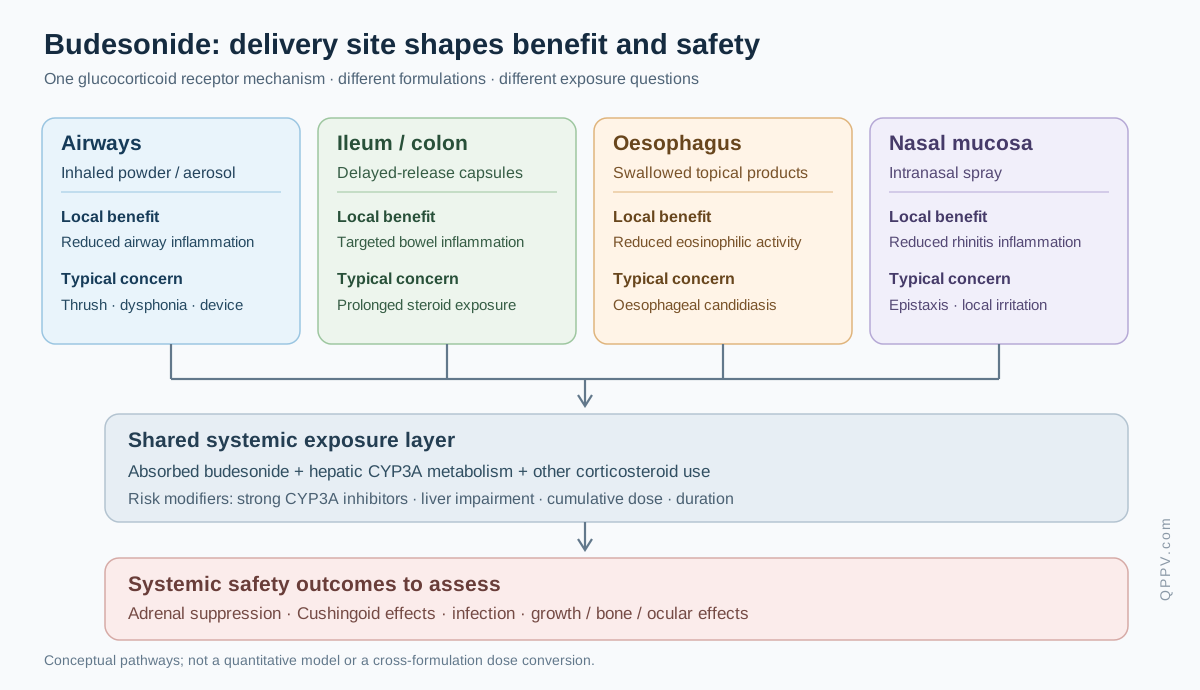
Figure 1. Budesonide acts through the same glucocorticoid receptor across distinct delivery sites. Formulation and technique determine local exposure; absorbed drug, hepatic CYP3A metabolism, inhibitors and cumulative steroid use influence systemic risk. The pathways are conceptual, not a quantitative pharmacokinetic model.
The figure's purpose is to make the relationship between target site, delivery route and systemic risk visible. It deliberately avoids representing a fixed proportion of absorbed drug, because bioavailability varies by product, route and patient characteristics.
Review checklist and common failure modes
| Question for the reviewer | Evidence or corrective action |
|---|---|
| Is the exact product identified? | Capture formulation, device, brand, strength, route and market |
| Was the drug administered correctly? | Obtain technique and timing; distinguish prescribed from actual dose |
| Was another steroid or CYP3A inhibitor used? | Reconstruct complete medication chronology and interaction window |
| Could the event reflect disease progression? | Review baseline severity, infections, treatment response and alternatives |
| Does a dated label actually list the reaction? | Check the relevant section and exact jurisdiction/product; document source date |
| Does the case meet seriousness/reporting criteria? | Apply the applicable regulatory process independently of causality |
| Are there repeated cases with a shared exposure pattern? | Stratify by formulation, population, device and co-medication |
| Can risk minimisation be evaluated? | Check patient instructions, medication reconciliation, dispensing and follow-up |
A common failure is to treat the word budesonide as a complete exposure description. Another is to interpret a low systemic bioavailability claim as a guarantee against adrenal suppression. A third is to cite a budesonide–formoterol reliever trial as though it authorises budesonide monotherapy for acute symptoms. Each error can distort an individual case, aggregate signal or public safety message.
Key takeaways
Budesonide's enduring therapeutic value arose from a rational attempt to maximise local glucocorticoid effects while limiting systemic exposure. Its lifecycle now spans several different anatomical targets and drug-delivery systems. That diversity creates distinct local adverse reactions, interaction risks, treatment-duration constraints and medication-use failures. Evidence from inhaled asthma therapy, intestinal-release Crohn's therapy and swallowed EoE therapy must be interpreted separately. Product-specific public-label listedness is useful but cannot replace company-core safety assessment or case-specific expectedness.
References
- US National Library of Medicine, DailyMed. Pulmicort Flexhaler (budesonide inhalation powder), set ID 5d0c6c7e-2f53-4238-ab34-bd8cf49d8a66. US prescribing information revised January 2026, especially sections 1, 4–8, 12 and 14. Accessed 2 November 2026. https://dailymed.nlm.nih.gov/dailymed/lookup.cfm?setid=5d0c6c7e-2f53-4238-ab34-bd8cf49d8a66
- UK electronic Medicines Compendium. Pulmicort Turbohaler 200 (budesonide 200 micrograms/actuation), SmPC last updated 21 November 2022, sections 4.1–4.8 and 5. Accessed 2 November 2026. https://www.medicines.org.uk/emc/product/1385/smpc
- US National Library of Medicine, DailyMed. Budesonide delayed-release capsules for ileal/ascending-colon Crohn's disease, including induction and limited adult maintenance use. Accessed 2 November 2026. https://dailymed.nlm.nih.gov/dailymed/drugInfo.cfm?setid=263303c2-8e4f-7b6c-e063-6394a90aef9e
- European Medicines Agency. Jorveza EPAR, product overview and authorisation details, including adult orodispersible tablets and paediatric oral suspension. Accessed 2 November 2026. https://www.ema.europa.eu/en/medicines/human/EPAR/jorveza
- US National Library of Medicine, DailyMed. Eohilia (budesonide oral suspension), set ID 56f2023a-69b2-4470-b4ad-af7ec1be527a; current SPL published February 2025, sections 1, 2, 5, 6 and 14. Accessed 2 November 2026. https://dailymed.nlm.nih.gov/dailymed/lookup.cfm?setid=56f2023a-69b2-4470-b4ad-af7ec1be527a
- Benefit:Risk Profile of Budesonide in Obstructive Airways Disease. Drugs. 2019. Historical development review, including the 1972 patent, 1974 selection and 1981 first approval. https://link.springer.com/article/10.1007/s40265-019-01198-7
- Greenberg GR, et al. Oral Budesonide for Active Crohn's Disease. N Engl J Med. 1994;331:836–841. doi:10.1056/NEJM199409293311303. https://www.nejm.org/doi/full/10.1056/NEJM199409293311303
- Takeda. FDA Approves Eohilia (budesonide oral suspension). Company regulatory announcement, 12 February 2024; trial results should be checked against the USPI. https://www.takeda.com/newsroom/newsreleases/2024/fda-approves-eohilia/
- O'Byrne PM, et al. Inhaled Combined Budesonide–Formoterol as Needed in Mild Asthma. N Engl J Med. 2018;378:1865–1876. doi:10.1056/NEJMoa1715274. https://www.nejm.org/doi/full/10.1056/NEJMoa1715274
- Bateman ED, et al. As-Needed Budesonide–Formoterol versus Maintenance Budesonide in Mild Asthma. N Engl J Med. 2018;378:1877–1887. doi:10.1056/NEJMoa1715275. https://www.nejm.org/doi/full/10.1056/NEJMoa1715275
- Beasley R, et al. Controlled Trial of Budesonide–Formoterol as Needed for Mild Asthma (Novel START). N Engl J Med. 2019;380:2020–2030. doi:10.1056/NEJMoa1901963. https://www.nejm.org/doi/full/10.1056/NEJMoa1901963
- Straumann A, et al. Budesonide Orodispersible Tablets Maintain Remission in a Randomized, Placebo-Controlled Trial of Patients With Eosinophilic Esophagitis. Gastroenterology. 2020. https://pubmed.ncbi.nlm.nih.gov/32721437/
- UK electronic Medicines Compendium. Jorveza 1 mg orodispersible tablets, SmPC updated 2 June 2026, sections 4.1–4.8 and 5. Accessed 2 November 2026. https://www.medicines.org.uk/emc/product/9446/smpc
- European Medicines Agency. Good pharmacovigilance practices, Module VI (Rev. 2): Collection, management and submission of reports of suspected adverse reactions, adopted guidance, effective 22 November 2017. https://www.ema.europa.eu/en/human-regulatory-overview/post-authorisation/pharmacovigilance-post-authorisation/good-pharmacovigilance-practices-gvp
- European Commission. Union Register: Jorveza (EU/1/17/1254), adult tablets and paediatric oral suspension, current product/indication register. Accessed 2 November 2026. https://ec.europa.eu/health/documents/community-register/html/h1254.htm
- Rutgeerts P, et al. A Comparison of Budesonide with Prednisolone for Active Crohn's Disease. N Engl J Med. 1994;331:842–845. doi:10.1056/NEJM199409293311304. https://www.nejm.org/doi/full/10.1056/NEJM199409293311304
Regulatory Note
This article is an educational review of scientific evidence and publicly accessible product information, assessed on 2 November 2026. The named US and UK labels apply to specific presentations and revision dates; they do not establish identical authorisation or adverse-reaction listedness across all budesonide products, and UK SmPCs must not be presented as EU-wide product information. European Commission/EMA information is used where EU authorisation is discussed. The article does not provide individual prescribing advice or determine the expectedness, causality, seriousness or reportability of any particular safety case. Verify the current authorised product information and applicable local pharmacovigilance requirements before operational use.