Bupropion: Discovery, Development, Safety and Pharmacovigilance
Bupropion is an aminoketone antidepressant whose clinical history is unusually instructive for pharmacovigilance. Its discovery preceded the selective serotonin reuptake inhibitor era; its original commercial launch was interrupted after seizures in patients with bulimia; later dose and formulation changes broadened its use in depression and smoking cessation. Decades after first approval, adverse-event reporting and regulatory review continue to shape product information, including a US safety-labelling action on aseptic meningitis in 2025. [1,2,4,12]
The molecule is used as a single active substance and as a constituent of combination products. Those uses must not be conflated: the US indication for a particular bupropion extended-release antidepressant is not automatically an indication for smoking cessation, and the efficacy of a combination containing bupropion cannot be attributed entirely to bupropion. The central safety problem is to identify the exact product, release system, daily exposure, patient susceptibility and concurrent medicines before interpreting an event. [4,5,13,14]
- Bupropion: Discovery, Development, Safety and Pharmacovigilance
- Discovery: an antidepressant outside the tricyclic template
- The 1985 approval and the seizure-related interruption
- Mechanism: noradrenergic and dopaminergic pharmacology
- From immediate release to sustained and extended release
- Clinical evidence across indications
- EAGLES and the reassessment of neuropsychiatric safety
- The contemporary safety profile
- Drug interactions: two different metabolic questions
- Special populations and clinically important exceptions
- Combination products: the same INN, different clinical evidence
- Operational pharmacovigilance: from intake to benefit–risk assessment
- Signal evaluation and governance
- Practical review checklist
- Key takeaways
- References
- Regulatory Note
Discovery: an antidepressant outside the tricyclic template
Burroughs Wellcome and the original chemical programme
The historical record is unusually direct. US patent 3,819,706, titled Meta chloro substituted-alpha-butylamino-propiophenones, names N. Mehta as inventor and Burroughs Wellcome as the original assignee. It claims a family of substituted aminoketones and was filed in 1970, with priority in December 1969 and publication in June 1974. The patent provides primary evidence for the origin of the chemical programme, although it does not by itself establish every later clinical-development decision or the precise contribution of each laboratory scientist. [1]
The candidate that became bupropion differed structurally from tricyclic antidepressants and monoamine oxidase inhibitors. That difference mattered to medicinal-chemistry strategy and later clinical evaluation, but chemical novelty alone was not proof of a superior safety profile. Early investigators tested whether the compound produced antidepressant effects without the sedation and anticholinergic burden familiar from some older therapies. Contemporary reports were necessarily limited by short exposure, modest sample sizes and the populations enrolled. [1,3]
Early controlled depression studies
In a 1983 three-centre, double-blind, placebo-controlled inpatient study reported by Zung and colleagues, 48 patients received bupropion and 27 placebo, at bupropion doses of 300–600 mg/day. Clinical rating scales generally favoured active treatment over four weeks. Those findings established a signal of antidepressant efficacy, not a modern safety denominator for every formulation or an endorsement of the historical upper doses. The trials were short, and a rare adverse reaction could easily escape detection. [3]
A second lesson is methodological. When efficacy trials enrol selected patients and measure average symptom improvement, they may not reveal a risk concentrated in a subgroup excluded or underrepresented in the trial. Bupropion's later seizure history illustrates precisely why post-authorisation evidence and targeted risk assessment remain necessary even after apparently reassuring pre-authorisation tolerability. [2,4]
The 1985 approval and the seizure-related interruption
US prescribing information identifies 1985 as the initial approval year. The historical FDA review record documents four seizures among 55 patients with bulimia exposed in a study, followed by Burroughs Wellcome's voluntary interruption of planned commercial distribution in March 1986 while the reports were investigated. The record describes active product retrieval and instructions to stop treatment in affected eating-disorder populations. It is more precise to describe this as a voluntary interruption and retrieval than to assume that every formulation's marketing authorisation was formally revoked. [2]
Subsequent clinical and pharmacovigilance experience established that seizure risk was related to dose and to individual predisposing factors. The modern US antidepressant label contraindicates treatment in patients with a seizure disorder or current or previous bulimia or anorexia nervosa, and in particular abrupt-withdrawal settings. These are not merely general cautions: they are product-specific labelled contraindications with direct consequences for medication history, prescribing checks and case assessment. [4]
The subsequent return of bupropion to routine clinical use depended on dose limitations, better characterisation of risk and improved communication. Its history demonstrates that a safety problem need not end development of a useful medicine, but that a product's benefit–risk balance can change materially when the susceptible population, exposure and risk controls are better defined. The specific recommended maximum and titration schedule must be taken from the current label of the actual formulation; historical trial doses should never be substituted for present prescribing instructions. [2,4,5]
Mechanism: noradrenergic and dopaminergic pharmacology
Bupropion inhibits neuronal reuptake of norepinephrine and dopamine, and is generally described as a norepinephrine–dopamine reuptake inhibitor rather than a conventional serotonin reuptake inhibitor. The exact contribution of the parent molecule and its active metabolites to antidepressant efficacy in humans remains incompletely resolved. This uncertainty matters when interpreting interactions that alter metabolite formation: a change in parent-drug concentration is not necessarily an equivalent change in clinical effect. [4,6]
The drug undergoes extensive metabolism, including CYP2B6-mediated formation of hydroxybupropion. Other active metabolites include threohydrobupropion and erythrohydrobupropion. Bupropion and metabolites inhibit CYP2D6, creating a second interaction pathway distinct from CYP2B6-mediated clearance. Thus bupropion may be the victim of an interaction that changes its own exposure and the perpetrator of an interaction that changes exposure to another drug. [4,6,15]
These pharmacological features help explain its differentiated clinical profile, but they do not justify describing it as seizure-free, universally weight-reducing or incapable of causing sexual adverse reactions. Population averages and mechanistic expectations must be separated from patient-level outcomes and the current regulatory safety text. [4,6]
From immediate release to sustained and extended release
Bupropion's formulations are part of its clinical development, not a packaging footnote. Immediate-release (IR) tablets required multiple daily doses; sustained-release (SR) and extended-release (XL) products permit less frequent administration and have different absorption profiles. A pharmacokinetic review reports approximate times to maximum concentration of 1.5 hours for IR, 3 hours for SR and 5 hours for XL, with substantial contribution from active metabolites. These are descriptive comparisons, not interchangeable dose-conversion instructions. [6]
The US Wellbutrin XL label covers major depressive disorder (MDD) and prevention of seasonal major depressive episodes in seasonal affective disorder (SAD). The UK Zyban 150 mg prolonged-release SmPC, revised 28 August 2026, instead authorises smoking cessation in conjunction with motivational support. The products have different instructions and risk language, and the same active ingredient does not make them clinically interchangeable. [4,5]
| Product context | Principal purpose in the cited source | Formulation issue with PV consequences |
|---|---|---|
| Historical immediate-release bupropion | Depression | More frequent administration; historical dose–seizure evidence must be interpreted by formulation and exposure. |
| US Wellbutrin XL | MDD and prevention of seasonal depressive episodes | Once-daily release; do not crush, split or chew; confirm the particular product's labelled dose limits. |
| UK Zyban prolonged release | Smoking cessation | Different course length and dosing; do not crush or chew; assess smoking-cessation neuropsychiatric events and nicotine replacement. |
| US dextromethorphan–bupropion combination | Adult MDD | Bupropion inhibits CYP2D6 and prolongs dextromethorphan exposure; the combination's evidence and risks are not those of bupropion alone. |
| EU naltrexone–bupropion combination | Weight management in defined adults | Weight-loss efficacy and restrictions are combination-specific, including treatment-response review and cardiovascular risk management. |
The US 2025 Wellbutrin XL document contains an important internal dose-text inconsistency: its seizure warning states that the dose should not exceed 300 mg once daily, while another sentence in the same section discusses risk reduction below 450 mg/day. An educational article must not silently harmonise contradictory wording into a universal prescribing rule. Verify the latest product-specific full label, strength and local professional guidance before giving an individual dosing instruction; the current review reports the discrepancy without resolving it by inference. [4]
A formulation-quality pharmacovigilance case
A separate historical event demonstrates why formulation is itself a safety and efficacy variable. FDA-sponsored testing found that the specific generic Budeprion XL 300 mg product marketed by Impax/Teva was not therapeutically equivalent to Wellbutrin XL 300 mg. The regulator changed that product's therapeutic-equivalence assessment, and the product was withdrawn from distribution. The conclusion did not establish that all generic bupropion products were ineffective or unsafe. It also was not a new causal finding about seizure risk: the principal concern was the rate and extent of exposure and possible loss of antidepressant effect. [16,17]
For a contemporary report of apparent treatment failure after a switch, record the manufacturer, product identifier, strength, release technology, dispensing date, batch where available, adherence, timing of symptom recurrence and any dechallenge/rechallenge information. Product-quality complaints and pharmacovigilance reports may require coordinated assessment, but a temporal association with substitution is not proof of non-equivalence.
Clinical evidence across indications
Depression: acute efficacy and relapse prevention
Early placebo-controlled trials demonstrated antidepressant efficacy in selected adult inpatients, and later studies examined maintenance after response. In the 2002 randomised continuation-phase study by Weihs and colleagues, 423 responders to open-label bupropion SR were assigned to continue active treatment or receive placebo for 44 weeks. Time to intervention for depressive relapse favoured continued bupropion (log-rank p=0.003). Because randomisation occurred after response, the result addresses continuation in responders, not the likelihood that every newly treated patient will respond. [3,7]
The trial is also a reminder that symptom recurrence after stopping a medicine may reflect relapse of the underlying disease rather than an adverse drug withdrawal syndrome. In individual safety reports, the distinction requires the pretreatment course, timing, symptom pattern, concomitant treatment changes and clinician assessment. An aggregate safety database should not code every recurrence as a drug-induced reaction without the necessary context.
Prevention of seasonal depression
Three prospective, randomised, placebo-controlled prevention studies enrolled 1,042 patients with a history of autumn–winter seasonal depressive episodes. Participants began bupropion XL or placebo while well and continued through the relevant season. Recurrence proportions favoured bupropion in each trial: 19% versus 30%, 13% versus 21%, and 16% versus 31%, respectively. These data support prevention in a selected recurrent seasonal population; they do not demonstrate that bupropion treats every episode of winter depression or that seasonal prophylaxis is required for all patients. [8]
The timing of exposure is distinctive for safety surveillance. Treatment may be initiated before symptoms, so adverse reactions can appear in otherwise well individuals. Monitoring must therefore capture emerging psychiatric symptoms, insomnia, blood pressure changes and the patient's individual history, rather than assuming that any new symptom represents depression itself. [4,8]
Smoking cessation: efficacy with a different benefit–risk context
In the 1999 four-arm randomised trial by Jorenby and colleagues, 12-month abstinence was 15.6% with placebo, 16.4% with nicotine patch, 30.3% with bupropion SR and 35.5% with the combination of bupropion and nicotine patch. The enrolled smokers with clinical depression were excluded, which limits extrapolation to all psychiatric populations. The combination arm's higher observed quit rate does not establish that every individual should receive both treatments; hypertension and tolerability require consideration. [9]
The smoking-cessation benefit–risk comparison differs from antidepressant treatment. Nicotine withdrawal can itself produce depressed mood, irritability, anxiety and sleep disturbance. An event arising during cessation may be drug-related, withdrawal-related, attributable to underlying psychiatric disease, or multifactorial. Source documents should preserve those possibilities rather than preselecting one explanation. [5,9,10]
EAGLES and the reassessment of neuropsychiatric safety
Postmarketing reports of agitation, hostility, depressed mood, suicidal behaviour and other neuropsychiatric events during smoking cessation led to substantial regulatory concern. The pivotal response was EAGLES, a large randomised, double-blind trial comparing varenicline, bupropion SR, nicotine patch and placebo in smokers with and without stable psychiatric disorders. A total of 8,144 participants were randomised; the safety analysis included 3,984 participants without and 4,074 with psychiatric diagnoses. [10,11]
The prespecified composite of moderate or severe neuropsychiatric adverse events occurred in 2.2% of bupropion recipients versus 2.4% of placebo recipients in the non-psychiatric cohort. In the psychiatric cohort the corresponding proportions were 6.7% and 4.9%; the estimated bupropion–placebo risk difference had a 95% confidence interval crossing zero. The investigators did not find a statistically significant increase attributable to bupropion compared with placebo or nicotine patch, while also documenting a higher background event burden in the psychiatric cohort. The trial did not establish that clinically important events are impossible, nor did it represent unstable psychiatric illness or every real-world substance-use pattern. [10]
In December 2016 FDA revised its description of neuropsychiatric risks for smoking-cessation medicines in light of the EAGLES results. This regulatory action is not equivalent to removing the antidepressant class's suicidality boxed warning from bupropion products. The latter addresses increased suicidal thoughts and behaviours in younger patients taking antidepressants, especially during early treatment and dose changes; the former concerns the specific evidence for smoking-cessation neuropsychiatric events. They involve different populations, clinical contexts and evidence bases. [4,11]
For pharmacovigilance, a report of suicidal ideation should record age, indication, baseline psychiatric status, previous suicidality, tobacco-use and quit dates, withdrawal symptoms, time from initiation or dose change, concurrent psychoactive drugs, and clinical outcome. A positive dechallenge alone may be misleading if nicotine withdrawal or an underlying disorder is simultaneously changing. Conversely, the absence of a statistically significant average risk increase in EAGLES must not be used to dismiss a serious individual case.
The contemporary safety profile
Seizure: dose, susceptibility and formulation
Seizure is the defining historical safety concern. The 2025 US Wellbutrin XL label states that seizure incidence with XL itself was not formally evaluated in clinical trials; it quotes approximately 0.1% with bupropion SR up to 300 mg/day and approximately 0.4% in a large prospective follow-up of IR treatment at 300–450 mg/day. These are estimates from different formulations and exposure settings, not a head-to-head comparison and not an XL-specific incidence. The UK Zyban SmPC similarly describes approximately 0.1% at doses up to its 300 mg/day maximum. [4,5]
Predisposing factors include seizure disorders, eating disorders, abrupt withdrawal of alcohol or sedatives, head injury, certain metabolic disturbances, hypoxia, other seizure-threshold-lowering drugs and inappropriate exposure. A seizure report should reconstruct actual doses, duplicate bupropion-containing products, tablet manipulation, recent titration, alcohol or sedative withdrawal, glucose and electrolyte abnormalities, renal/hepatic impairment and possible overdose. The cited US and UK product information instructs discontinuation without restarting after a seizure. [4,5]
Suicidality, mania, psychosis and behavioural changes
The US antidepressant boxed warning calls for monitoring clinical worsening and emergence of suicidal thoughts or behaviour in children, adolescents and young adults. It should be interpreted as a class-level risk communication grounded in antidepressant trial data, not a claim that bupropion causes every reported suicide attempt. In patients of any age, clinically significant agitation, psychosis or mania warrants prompt assessment. Screening for bipolar disorder before antidepressant treatment is included in the US label because antidepressant exposure can precipitate manic or hypomanic episodes in susceptible patients. [4]
Smoking-cessation treatment adds the challenge of nicotine withdrawal and relapse. For both depression and cessation, chronology and baseline clinical history are more informative than an isolated preferred term. When an event is serious, the reporting decision and necessary clinical care must not wait for definitive causal attribution.
Blood pressure and cardiovascular concerns
Bupropion can elevate blood pressure. The US label recommends assessing blood pressure before treatment and periodically thereafter. In a trial of smoking-cessation therapies, treatment-emergent hypertension occurred in 6.1% of patients receiving bupropion SR plus nicotine patch, compared with 2.5% receiving bupropion alone, 1.6% receiving patch alone and 3.1% receiving placebo. These are trial-specific proportions; they do not establish a general incidence for every product or combination. [4]
Postmarketing cardiovascular reports include serious events, but spontaneous-report listings alone do not establish causation or incidence. A useful case captures baseline blood pressure, smoking status, cardiovascular comorbidity, nicotine-replacement exposure, other sympathomimetic drugs and objective measurements before and after treatment changes. [4,5]
Hypersensitivity and the 2025 aseptic-meningitis update
The US Wellbutrin XL label includes hypersensitivity reactions such as urticaria, angioedema and anaphylactic reactions, as well as serious cutaneous events reported after marketing. Importantly, an August 2025 FDA safety-labelling-change notification required information on aseptic meningitis for bupropion-containing products. The 2025 Wellbutrin XL label lists aseptic meningitis among postmarketing nervous-system events. FDA's subsequent approval letter for a dextromethorphan–bupropion combination explicitly documents the bupropion-wide notification. [4,12]
A suspected aseptic-meningitis case requires careful medical evaluation to exclude infectious and other causes. A safety report should seek cerebrospinal-fluid findings where available, microbiological testing, timing of drug exposure, other causative drugs, associated rash or systemic hypersensitivity, treatment and outcome. The regulatory inclusion of an event does not imply a known population incidence or prove causality in each report. This is an example of how an established medicine can acquire a newly explicit safety term decades after first authorisation.
Drug interactions: two different metabolic questions
CYP2B6 changes bupropion and metabolite exposure
Bupropion is metabolised to hydroxybupropion primarily through CYP2B6. The US label identifies inhibitors such as clopidogrel and ticlopidine that may increase parent bupropion exposure while reducing hydroxybupropion formation, and inducers such as efavirenz or ritonavir-containing regimens that may reduce exposure. These interactions are not adequately described by the simple statement that 'bupropion levels rise or fall': the parent and active-metabolite profiles can move in different directions. [4,6]
Clinical consequences depend on the indication, formulation, dose and patient response. A case of apparent loss of efficacy or unexpected toxicity should include when the interacting medicine was started or stopped, the dose, the temporal response and any relevant organ dysfunction. Do not automatically infer therapeutic failure from a pharmacokinetic change without corresponding clinical evidence.
CYP2D6 inhibition affects other medicines
Bupropion and its active metabolites inhibit CYP2D6. This can increase exposure to certain antidepressants, antipsychotics, beta-blockers and antiarrhythmics metabolised by that pathway. The US label names metoprolol, several tricyclic and other antidepressants, and type IC antiarrhythmics as examples requiring consideration. A clinical study in patients with depression demonstrated dose-related CYP2D6 phenoconversion, reinforcing that inhibition can be clinically substantial and variable. [4,15]
The opposite concern arises for medicines requiring CYP2D6-mediated activation, notably tamoxifen. The label describes a theoretical reduction in efficacy with CYP2D6 inhibition; the article should not transform this mechanistic concern into a proven bupropion-specific cancer outcome. For pharmacovigilance, distinguish measured exposure, plausible interaction, clinical event and established causality.
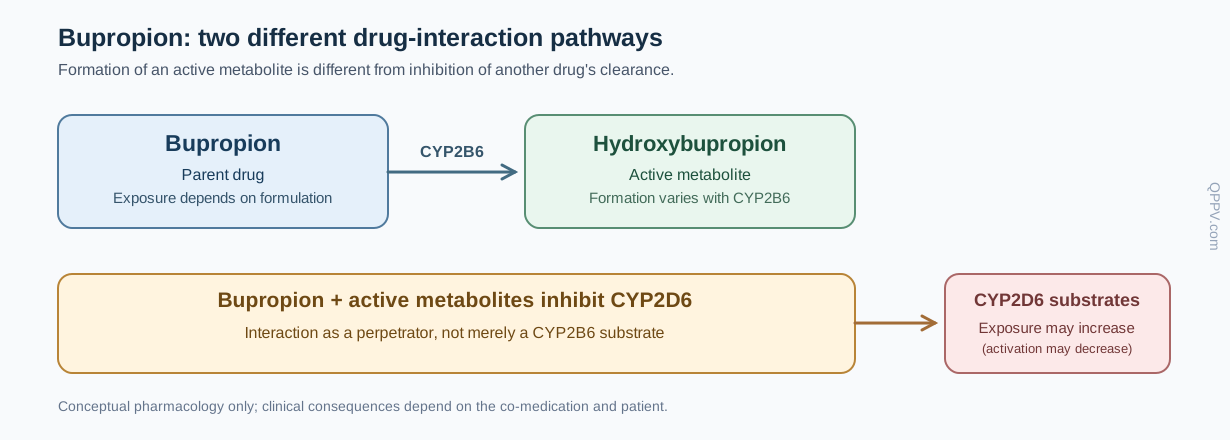
Figure 1. Bupropion is converted to the active metabolite hydroxybupropion primarily through CYP2B6, while bupropion and its active metabolites inhibit CYP2D6. This schematic distinguishes interaction pathways; it is not a dosing algorithm or a quantitative pharmacokinetic model. [4,6,15]
Duplicate bupropion, seizure threshold and analytical interference
The ingredient appears in antidepressant, smoking-cessation and combination products. Duplicate therapy can therefore occur without the patient recognising that two brand names contain bupropion. Co-prescribed drugs that lower seizure threshold and abrupt sedative withdrawal further complicate the risk assessment. A medication-reconciliation step should search by active substance rather than relying solely on brand names. [4,5,13,14]
Some urine immunoassays can yield false-positive amphetamine results during bupropion treatment. The US label recommends confirmatory testing using a more specific method such as gas chromatography/mass spectrometry. A screening result should not be represented as proof of amphetamine exposure without confirmation. Record the test method and any confirmatory result in the case narrative. [4,5]
Special populations and clinically important exceptions
Pregnancy, breastfeeding and reproductive safety
The 2025 US Wellbutrin XL label reports that epidemiological studies of first-trimester exposure have not identified an increased risk of congenital malformations overall, while noting uncertainties around specific cardiovascular defects in some studies. These statements are compatible: an overall estimate may be reassuring without excluding an uncommon specific phenotype. Maternal untreated depression and smoking also carry risks and can confound comparisons. [4]
The UK Zyban SmPC advises against its use during pregnancy for smoking cessation and encourages non-pharmacological quitting support. These are different regulatory contexts, not a contradiction to be erased. Pregnancy reports should capture gestational timing, exact exposure, smoking history, psychiatric history, concomitant medicines, ultrasound findings and outcomes; no single spontaneous case establishes a population risk. [5]
Bupropion and metabolites are excreted into breast milk. Product information should guide individual counselling and assessment of infant exposure; pharmacovigilance follow-up should capture infant age, feeding pattern, maternal dose and any observed infant event. A report of infant irritability or a seizure requires a broad differential and careful exposure reconstruction rather than automatic attribution. [4,5]
Renal and hepatic impairment, age and clinical vulnerability
Because active metabolites contribute to exposure and are cleared in part through renal pathways, impairment may change the balance of parent drug and metabolites. The US Wellbutrin XL label advises considering dose or frequency reduction in renal impairment and specifies reduced dosing in moderate to severe hepatic impairment. The UK Zyban SmPC has its own recommendations. Do not apply one presentation's numerical instructions to another formulation or jurisdiction. [4,5,6]
Older age alone is not a labelled universal contraindication, but comorbid disease, polypharmacy and reduced clearance can alter tolerability. Similarly, a history of bipolar disorder or seizures changes the risk calculus more than chronological age alone. The pharmacovigilance objective is to document the actual susceptibility profile, not to infer that a demographic category caused an adverse event.
Combination products: the same INN, different clinical evidence
Dextromethorphan–bupropion in US depression treatment
The FDA-authorised combination of dextromethorphan hydrobromide and bupropion hydrochloride was initially approved in 2022 for MDD in adults. Bupropion inhibits CYP2D6 metabolism of dextromethorphan and thereby contributes to its pharmacokinetic exposure, while dextromethorphan has NMDA receptor and sigma-1-related pharmacology. The combination's efficacy and tolerability are properties of the combined regimen. They cannot be added to a standalone bupropion efficacy estimate or treated as proof of equivalent safety across formulations. [13]
The FDA's 2025 aseptic-meningitis notification explicitly included bupropion-containing products and prompted a supplement for this combination. This illustrates why an INN-level signal review must examine every relevant product lineage while preserving formulation-specific action and marketing-authorisation responsibilities. [12,13]
Naltrexone–bupropion in European weight management
The EMA's Mysimba EPAR describes a naltrexone–bupropion prolonged-release combination authorised for weight management in specified adult populations alongside diet and exercise. The clinical trial programme and risk-management conditions belong to the combination, not to bupropion monotherapy. A patient may receive a bupropion-containing combination without using bupropion as an antidepressant; indication, intended benefit and expected adverse effects must be documented accordingly. [14]
A database search restricted to one brand or one indication can therefore miss relevant exposure. Conversely, pooling all combinations into a single undifferentiated denominator can create misleading comparisons. A sound signal review records active ingredient, brand, strength, release type, co-ingredient, indication, route, country and period before drawing conclusions.
Operational pharmacovigilance: from intake to benefit–risk assessment
The reporting pathway should start with the actual patient and medicinal product, not a preconceived adverse reaction. A valid suspected adverse reaction report requires the applicable minimum elements under the jurisdiction's reporting rules; the scientific assessment then asks a broader set of questions about exposure, chronology, competing causes and seriousness. Company procedures should use the current regional requirements and product reference safety information, rather than treating this article as a substitute for the relevant legislation or GVP guidance.
A bupropion-specific case-assessment matrix
| Reported problem | High-value follow-up | Common interpretive error |
|---|---|---|
| Seizure | Exact formulation and total daily dose; recent escalation; eating-disorder and seizure history; alcohol/sedative withdrawal; glucose, electrolytes, hypoxia; co-medication and overdose | Treating a historical IR incidence as the patient's XL risk or ignoring duplicate combination products. |
| Suicidality or behavioural change | Indication; age; baseline severity and prior events; quit-smoking timeline; nicotine withdrawal; dose changes; concomitant psychiatric medicines | Assuming EAGLES excludes all individual risk, or attributing every event to the medicine. |
| Hypertension | Pretreatment and serial measurements; nicotine patch, stimulants and sympathomimetics; cardiovascular history; dose and time course | Comparing spontaneous reports with a clinical-trial denominator as though reporting were complete. |
| Aseptic meningitis | Symptom onset; CSF and microbiology where available; alternative causes; hypersensitivity signs; treatment, dechallenge and outcome | Labelling a meningitis case as drug-induced before infectious causes are assessed. |
| Unexpected drug response | CYP2B6 perpetrators; CYP2D6 substrates; dose changes; renal/hepatic function; therapeutic monitoring where applicable | Confusing reduced metabolite formation with a known increase or decrease in efficacy. |
| Loss of antidepressant effect after substitution | Exact product, strength, release system, manufacturer, dispensing dates, adherence and clinical course | Generalising the historic Budeprion XL 300 mg issue to every generic formulation. |
The table is an editorial assessment aid, not a new legal checklist. Serious suspected reactions require prompt clinical management and timely regulatory processing irrespective of whether the final causal assessment is certain.
Illustrative learning example 1: seizure after overlapping products
A patient taking a once-daily bupropion antidepressant begins a smoking-cessation product containing bupropion from a separate prescriber. A seizure occurs after several days. This is a hypothetical scenario, not a published case. The key investigation is ingredient-level reconciliation: was the patient inadvertently exposed to two bupropion products, what was the total daily dose, was there abrupt alcohol or sedative withdrawal, and were any other seizure-threshold-lowering medicines present? The narrative should record the sequence and the clinical outcome, not assert that a particular brand was defective.
Illustrative learning example 2: meningitis with competing causes
A patient develops fever, headache and neck stiffness shortly after starting bupropion. The reporter suspects drug-induced aseptic meningitis. This is also hypothetical. Immediate clinical assessment is essential because bacterial, viral and other causes may require urgent treatment. The pharmacovigilance record should preserve the reporter's suspicion while documenting the results of investigations, co-medications, prior episodes and clinical response. A temporal association and a labelled postmarketing event support follow-up; they do not independently establish causation.
Signal evaluation and governance
An INN-wide safety search should include immediate-, sustained- and extended-release monotherapy, smoking-cessation products, relevant combinations and regional brand synonyms. Deduplicate by patient and event chronology rather than by brand alone. Stratify analyses by indication, formulation, dose, age, psychiatric history, co-medication and calendar period when data allow. A raw count of spontaneous reports is not an incidence rate and cannot establish a risk ratio without a defensible denominator and suitable comparator.
Signals involving overdose, misuse, duplicate therapy or formulation defects need coordinated assessment across pharmacovigilance, medical information, product quality and regulatory affairs. If a new case pattern supports a safety concern, the MAH's governance process should document evidence appraisal, alternative explanations, potential need for label updates, communication, additional study or other risk minimisation. The 1986 interruption, 2012 generic-equivalence issue and 2025 aseptic-meningitis label action represent different kinds of regulatory response: patient-subgroup risk, product-specific pharmaceutical equivalence, and a postmarketing safety-label change, respectively. [2,12,17]
A QPPV or equivalent accountable safety leader should be able to trace a decision from source cases through assessment and action, including why a potential signal was closed or escalated. That traceability matters more than a dashboard displaying unqualified report totals.
Practical review checklist
- Verify the scientific active ingredient, every co-ingredient, presentation, strength, release system and local authorisation.
- Confirm indication and exposure chronology, including recent initiation, titration, interruption, switching and potential duplicate therapy.
- Assess seizure predisposition, psychiatric history, blood pressure and clinically important CYP2B6/CYP2D6 interactions.
- For serious or unexpected events, seek objective clinical evidence and competing-cause assessment without delaying appropriate reporting.
- Apply the current jurisdiction-specific reference safety information, coding and submission rules; distinguish a postmarketing listing from a proven causal incidence.
- Document aggregate findings, regulatory decisions, risk-minimisation actions and the effectiveness of any implemented controls.
Key takeaways
Bupropion's lifecycle shows how a useful antidepressant can remain clinically important after an early safety-related distribution interruption, provided exposure, contraindications and risk communication are reassessed. Formulation is a central part of that story: IR, SR, XL and combination products do not share a single unqualified dosing or evidence statement. EAGLES refined the interpretation of smoking-cessation neuropsychiatric events without abolishing the antidepressant suicidality warning. The 2025 US aseptic-meningitis action illustrates the continuing role of postmarketing surveillance long after first approval. [2,4,10,12]
The most useful pharmacovigilance question is therefore not simply 'was bupropion involved?' but 'which bupropion exposure, in which clinical setting, with which susceptibility and competing explanations?' That question links regulatory precision to better case narratives and more credible benefit–risk decisions.
References
- Mehta N. Meta chloro substituted-alpha-butylamino-propiophenones. US Patent 3,819,706; published 25 June 1974. https://patents.google.com/patent/US3819706A/en
- US Food and Drug Administration. Wellbutrin (bupropion hydrochloride) tablets: original NDA and historical review correspondence, including the 1986 seizure-related distribution interruption. https://www.accessdata.fda.gov/drugsatfda_docs/nda/pre96/018644Orig1s000rev.pdf
- Zung WWK, Brodie HKH, Fabre LF, et al. Comparative efficacy and safety of bupropion and placebo in the treatment of depression. Psychopharmacology (Berl). 1983;79:343–347. https://pubmed.ncbi.nlm.nih.gov/6407050/
- US Food and Drug Administration. Wellbutrin XL (bupropion hydrochloride extended-release tablets), prescribing information, 2025, NDA 021515/S-049. https://www.accessdata.fda.gov/drugsatfda_docs/label/2025/021515s049lbl.pdf
- GlaxoSmithKline UK. Zyban 150 mg prolonged-release tablets, UK Summary of Product Characteristics; revised 28 August 2026. https://www.medicines.org.uk/emc/product/3827/smpc
- Jefferson JW, Pradko JF, Muir KT. Bupropion for major depressive disorder: pharmacokinetic and formulation considerations. Clin Ther. 2005. https://pubmed.ncbi.nlm.nih.gov/16368442/
- Weihs KL, Houser TL, Batey SR, et al. Continuation phase treatment with bupropion SR effectively decreases the risk for relapse of depression. Biol Psychiatry. 2002;51:753–761. https://pubmed.ncbi.nlm.nih.gov/11983189/
- Modell JG, Rosenthal NE, Harriett AE, et al. Seasonal affective disorder and its prevention by anticipatory treatment with bupropion XL. Biol Psychiatry. 2005;58:658–667. https://pubmed.ncbi.nlm.nih.gov/16271314/
- Jorenby DE, Leischow SJ, Nides MA, et al. A controlled trial of sustained-release bupropion, a nicotine patch, or both for smoking cessation. N Engl J Med. 1999;340:685–691. https://pubmed.ncbi.nlm.nih.gov/10053177/
- Anthenelli RM, Benowitz NL, West R, et al. Neuropsychiatric safety and efficacy of varenicline, bupropion, and nicotine patch in smokers with and without psychiatric disorders (EAGLES). Lancet. 2016;387:2507–2520. https://pubmed.ncbi.nlm.nih.gov/27116918/
- US Food and Drug Administration. Drug Safety Communication: FDA revises description of mental-health side effects of varenicline and bupropion for smoking cessation following clinical trial findings. 2016. https://www.fda.gov/files/drugs/published/Drug-Safety-Communication--FDA-revises-description-of-mental-health-side-effects-of-the-stop-smoking-medicines-Chantix-%28varenicline%29-and-Zyban-%28bupropion%29-to-reflect-clinical-trial-findings-%28PDF%29.pdf
- US Food and Drug Administration. Auvelity NDA 215430/S-016 supplemental approval letter; references 22 August 2025 safety-label notification for aseptic meningitis in bupropion-containing products. https://www.accessdata.fda.gov/drugsatfda_docs/appletter/2025/215430Orig1s016ltr.pdf
- US Food and Drug Administration. Auvelity (dextromethorphan hydrobromide and bupropion hydrochloride), prescribing information, 2024. https://www.accessdata.fda.gov/drugsatfda_docs/label/2024/215430s008lbl.pdf
- European Medicines Agency. Mysimba (naltrexone/bupropion), European public assessment report and product overview. https://www.ema.europa.eu/en/medicines/human/EPAR/mysimba
- Hole K, Arnestad M, Molden E, Haslemo T. Dose-dependent inhibition of CYP2D6 by bupropion in patients with depression. J Clin Psychopharmacol. 2021;41:281–285. https://pubmed.ncbi.nlm.nih.gov/33905640/
- US Food and Drug Administration. Approved Drug Products with Therapeutic Equivalence Evaluations (Orange Book). https://www.fda.gov/drugs/drug-approvals-and-databases/approved-drug-products-therapeutic-equivalence-evaluations-orange-book
- Woodcock J, Khan M, Yu LX. Withdrawal of generic Budeprion for nonbioequivalence. N Engl J Med. 2012;367:2463–2465. https://www.nejm.org/doi/abs/10.1056/NEJMp1212969
Regulatory Note
This article is an educational pharmacovigilance review, not prescribing advice, a legal opinion or a substitute for the current local Summary of Product Characteristics, US Prescribing Information or applicable national reporting requirements. US and UK indications, formulation-specific dose instructions, safety warnings and combination-product authorisations differ. The evidence and cited product information were reviewed as available on 24 October 2026; regulatory text and authorised products may subsequently change. Quantitative trial findings apply to their studied populations, while postmarketing case listings do not establish incidence or individual causality.