Cariprazine: Discovery, Development, Safety and Pharmacovigilance
Cariprazine is an oral atypical antipsychotic whose clinical interpretation is unusually sensitive to time. A patient may tolerate the first week yet develop akathisia after a later dose increase; a suspected interaction may persist after the interacting drug is stopped; and the disappearance of the parent compound does not imply disappearance of pharmacological exposure. Two active metabolites, particularly didesmethylcariprazine, explain much of this delayed exposure. For pharmacovigilance, the correct unit of assessment is not simply “cariprazine taken yesterday,” but the entire dose, co-medication and symptom trajectory over several weeks. [1,2]
- Cariprazine: Discovery, Development, Safety and Pharmacovigilance
- Discovery: a dopamine D3 research programme becomes an antipsychotic
- Pharmacological identity and what it does not prove
- Metabolism, accumulation and delayed clinical consequences
- Clinical development: separating indication, comparator and endpoint
- Safety profile: adverse reactions, class risks and delayed exposure
- Public-label listedness: US Vraylar versus EU Reagila
- Practical pharmacovigilance: from an individual report to a signal
- Signal detection, aggregate review and governance
- Practical review checklist
- Key Takeaways
- References
- Regulatory Note
Discovery: a dopamine D3 research programme becomes an antipsychotic
The original medicinal-chemistry problem
The dopamine hypothesis of psychosis motivated successive generations of antipsychotics, but dopamine D2 receptor blockade alone was associated with extrapyramidal symptoms, prolactin changes and other limitations. Partial agonism offered a different pharmacological strategy: a ligand can activate a receptor to a limited degree while also competing with endogenous dopamine. Its functional effect therefore depends on receptor occupancy, intrinsic efficacy and the surrounding signalling environment. That is not equivalent to a drug that simply raises dopamine where it is low and lowers it where it is high. [1,3]
Gedeon Richter's published corporate chronology dates its D3 research programme to December 1999, first synthesis of the molecule to December 2002, a patent application to August 2003, and initial European clinical studies to November 2004. These are sponsor-reported historical milestones, not independent proof of priority over all competing medicinal-chemistry programmes. The development compound was designated RGH-188. Its high affinity for D3 receptors relative to D2 receptors made it a distinctive candidate, although receptor affinity by itself cannot establish superior clinical efficacy for motivation, cognition or negative symptoms. [3]
Richter subsequently partnered with Forest Laboratories in the United States; the commercial history later involved Allergan and AbbVie. The drug was approved by the US FDA as Vraylar on 17 September 2015 for adult schizophrenia and acute manic or mixed episodes of bipolar I disorder. The European Commission authorised Reagila for adult schizophrenia on 13 July 2017. Later US indications expanded into bipolar depression, adjunctive major depressive disorder and, by the December 2025 US label, specified paediatric schizophrenia and bipolar-mania populations. These are different regulatory histories, not evidence that every indication is authorised in the EU. [1–3]
Commercialisation without confusing product sales and molecule value
Cariprazine moved from an original Hungarian research programme into multinational development, regional licensing and branded commercialisation. Its lifecycle includes patent-protected brand marketing, additional indications and formulation extensions. Such business history is relevant to exposure growth and geographic differences in safety reporting, but it does not justify inventing global sales figures or treating one company's reported product revenue as a complete INN-wide market estimate. The A030 queue position is a screening priority, not an audited revenue rank. [3]
Pharmacological identity and what it does not prove
Cariprazine has high affinity for dopamine D3 and D2 receptors and is a partial agonist at both; it also interacts with serotonin receptors, including 5-HT1A partial agonism and 5-HT2A antagonism. The US prescribing information explicitly says that the precise mechanism responsible for clinical efficacy is unknown. Mechanistic explanations should therefore be framed as plausible contributions, not a settled map from receptor to psychiatric outcome. [1]
D3 receptor engagement was part of the rationale for studying negative symptoms and mood. However, D3 preference is not itself evidence that an individual patient's negative symptoms are primarily D3-mediated, or that cariprazine is categorically superior to all D2 antagonists. In vitro binding values do not reproduce the complexity of brain exposure, active metabolites, receptor adaptation or concurrent treatment. [1,3,4]
Cariprazine is administered as a hydrochloride salt in oral products; label strengths express cariprazine base. The US Vraylar label describes capsules including 0.5, 0.75, 1.5, 3, 4.5 and 6 mg. The January 2026 EU Reagila product information describes 1.5, 3, 4.5 and 6 mg hard capsules, and also includes orodispersible tablets. The EU tablet formulation must not be silently substituted for the hard-capsule product when discussing a formulation-specific adverse reaction, excipient or medication error. [1,2]
Metabolism, accumulation and delayed clinical consequences
Cariprazine is metabolised predominantly through CYP3A4, with a minor CYP2D6 contribution, into desmethylcariprazine (DCAR) and didesmethylcariprazine (DDCAR). Both are pharmacologically active. The US label estimates half-lives from concentration–time profiles of approximately 2–4 days for parent cariprazine, 1–2 days for DCAR and 1–3 weeks for DDCAR. Mean DDCAR concentrations approached steady state only around weeks 4–8 in a 12-week study. These are population-level pharmacokinetic observations, not a patient-specific calendar for symptom onset or resolution. [1]
The combined active-moiety exposure can therefore continue to evolve after a clinician has stopped titrating. A patient who becomes restless in week three after an earlier increase may still be experiencing drug-related toxicity. Conversely, improvement after stopping cariprazine can lag, and starting a replacement antipsychotic can produce pharmacodynamic overlap even without an intentional combination regimen. The EU SmPC advises several weeks of monitoring after initiation, dose changes and interacting-drug changes. [1,2]
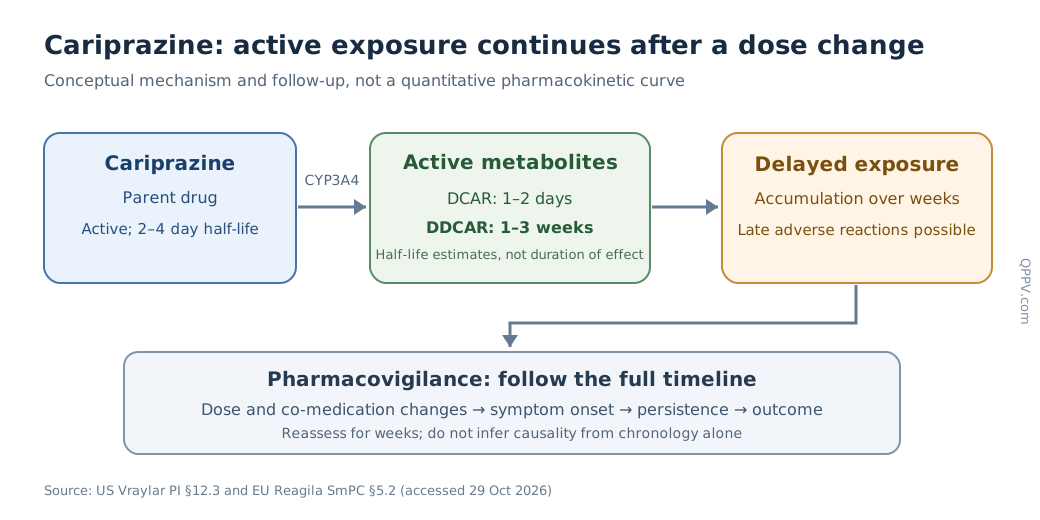
Figure 1. Conceptual pharmacokinetic-to-pharmacovigilance pathway. The diagram is not a quantitative concentration–time curve; it highlights the delayed contribution of DDCAR and the need for longitudinal follow-up.
Why the interaction rules are clinically important
Strong or moderate CYP3A4 inhibitors can increase exposure to active moieties. US Vraylar gives dose-reduction instructions when such inhibitors are co-administered; EU Reagila contraindicates strong CYP3A4 inhibitors but provides monitoring and possible dose reduction for moderate inhibitors. The EU SmPC contraindicates strong or moderate CYP3A4 inducers, while the US label states that concomitant CYP3A4 inducer use is not recommended because the net effect has not been evaluated. These are genuine jurisdiction-specific differences in regulatory wording; they must not be flattened into a universal “avoid CYP3A4 drugs” rule. [1,2]
For a suspected interaction case, capture exact start and stop dates for both medicines, the inhibitor or inducer's strength, dose changes, adherence, renal and hepatic status, and symptom progression after each change. The prolonged active-metabolite time course makes a simplistic 24-hour dechallenge assessment especially unreliable.
Clinical development: separating indication, comparator and endpoint
Cariprazine's development programme did not consist of one pivotal experiment followed by routine label expansion. It tested different populations, dose ranges, comparators and endpoints. The schizophrenia evidence primarily addressed psychotic symptoms and relapse; bipolar trials addressed acute mania or depression; adjunctive major-depression trials studied cariprazine added to an existing antidepressant. The trials cannot be pooled casually into a single “antidepressant efficacy” claim. [1,2,4–8]
Acute schizophrenia and maintenance of effect
Three principal short-term studies in adults with schizophrenia, involving 1,795 participants in the EMA's summary, found greater improvement in Positive and Negative Syndrome Scale (PANSS) total scores after six weeks than placebo. The agency reports decreases of approximately 17–23 points with cariprazine compared with 9–14 points with placebo, depending on study. This supports efficacy for the studied acute-schizophrenia populations; it does not show that every dose or patient subgroup has the same effect. [2]
A relapse-prevention study used an enriched randomised-withdrawal design: patients first received open-label cariprazine, and those who achieved and maintained stability were randomised to continue cariprazine or receive placebo. The EMA summarises relapse in about one quarter of continued-treatment patients versus approximately one half of placebo patients over the withdrawal period. This supports maintenance efficacy in previously stabilised patients. It should not be read as a head-to-head superiority claim over all other maintenance antipsychotics or as a general population incidence estimate. Withdrawal, adherence and enrichment affect interpretation. [2]
Predominant negative symptoms: a specific comparative trial
The 26-week Németh and colleagues trial randomised 461 adults with schizophrenia and predominant negative symptoms to cariprazine or risperidone; the primary outcome was change in the PANSS factor score for negative symptoms. The least-squares mean changes were −8.90 and −7.44 points, respectively, giving a difference of −1.46 (95% CI −2.39 to −0.53; p=0.0022). The trial also reported improvement in functioning. [4]
That result is important because negative symptoms are often persistent and difficult to treat, but the design selected a particular population and active comparator. The study does not prove that D3 preference directly caused the observed benefit, that the drug improves every cognitive domain, or that the effect generalises to all patients with depression or schizophrenia. The magnitude and clinical relevance should be considered alongside the patient's functional goals and adverse effects. The comparator was risperidone, not placebo, and the study was sponsored by Gedeon Richter. [4]
Bipolar I mania and bipolar depression are different programmes
The original US authorisation included acute manic or mixed episodes of bipolar I disorder in adults. These studies assessed mania ratings over short treatment intervals. A positive result in acute mania cannot be assumed to establish bipolar-depression efficacy; the direction of symptoms, dose strategy and safety context differ. The current US Vraylar label contains indication-specific efficacy tables and dosing, and the 2025 label expanded certain paediatric uses. [1]
Bipolar-depression development included both positive and non-significant dose comparisons. In one phase 3 study published in American Journal of Psychiatry in 2019, 1.5 mg/day and 3 mg/day reduced week-six MADRS scores more than placebo (least-squares mean differences −2.5 and −3.0 points, respectively), while the secondary CGI-S differences did not reach adjusted statistical significance. In another phase 3 study, 1.5 mg/day met the adjusted primary and secondary outcomes, but 3 mg/day did not achieve statistical significance. The programme therefore cannot be accurately summarised as “higher doses always work better.” [5,6]
For benefit–risk assessment, note that a modest average symptom-scale difference may be valuable for some patients while akathisia, insomnia or restlessness may undermine functioning or adherence in others. Individual response and tolerability must be assessed rather than extrapolating a population mean to every patient. The EU Reagila indication assessed here remains adult schizophrenia; the existence of US bipolar indications is not an EU authorisation. [1,2]
Adjunctive major depressive disorder: preserve the negative study
The US adjunctive-MDD indication is supported by trials in adults who had an inadequate response to antidepressant monotherapy. In the positive phase 3 study reported by Sachs and colleagues, the week-six MADRS change was −14.1 with cariprazine 1.5 mg/day versus −11.5 with adjunctive placebo, whereas the 3 mg/day arm did not meet the primary significance threshold. Response rates were 44.0% versus 34.9%, but remission rates were not significantly different. These details matter: response is not the same endpoint as remission. [7]
A separate phase 3 study by Fava and colleagues, involving approximately 750 participants in the modified intent-to-treat analysis, found no statistically significant difference from placebo for either 1.5 or 3 mg/day on the primary MADRS outcome or the secondary CGI-S outcome. The numerical changes were −13.8, −14.8 and −13.4 for the two cariprazine groups and placebo, respectively. The negative result should remain visible in an educational account even though the drug ultimately received US approval for adjunctive MDD. Selectively quoting only positive trials exaggerates certainty. [8]
The trials also illustrate an attribution problem: an adverse event during adjunctive therapy may relate to cariprazine, the background antidepressant, a pharmacodynamic interaction, the depressive illness or another factor. A report that records only “cariprazine and depression” without naming the antidepressant is materially incomplete for pharmacovigilance. [1,7,8]
Regulatory and commercial lifecycle as of October 2026
| Milestone | Regulatory or evidentiary meaning | Boundary |
|---|---|---|
| 1999–2004 D3 programme and first clinical work | Sponsor-documented discovery and early translation | Historical chronology is manufacturer-reported |
| September 2015 US Vraylar approval | Initial adult schizophrenia and bipolar I mania/mixed indication | Not an EU authorisation |
| July 2017 EU Reagila authorisation | Adult schizophrenia, with ongoing EU lifecycle changes | Does not include US mood-disorder indications |
| 2019 US bipolar-depression expansion | Additional indication supported by its own trials | Do not infer benefit from mania data alone |
| December 2022 US adjunctive-MDD approval | Additional adult adjunctive indication | Not cariprazine monotherapy for MDD |
| December 2025 US label revisions | Paediatric schizophrenia and bipolar-mania populations included in current label | EU Reagila remains adult schizophrenia in January 2026 PI |
| January 2026 EU product-information update | Hard-capsule and orodispersible-tablet presentations described | Exact formulation must be recorded for product quality and error cases |
This table records regulatory milestones, not prescription counts, comparative sales or a claim that a particular region has adopted the same clinical guidelines. Regional authorisation is a necessary but not sufficient input to a case's expectedness and reporting analysis. [1–3]
Safety profile: adverse reactions, class risks and delayed exposure
The most prominent practical safety problem is akathisia, an inner restlessness that may present as inability to sit still, pacing, rocking, agitation or worsening distress. It can be mistaken for anxiety, activation, psychiatric deterioration or insufficient antipsychotic effect. A clinician who responds to apparent agitation by increasing the dose may worsen a drug-related movement disorder. The EU Reagila SmPC reports pooled schizophrenia-study adverse reactions of akathisia 19% and parkinsonism 17.5% within the 1.5–6 mg dose range. These percentages are from specified clinical datasets, not universal real-world incidence estimates. [2]
Other extrapyramidal effects include tremor, dystonia, dyskinesia and potentially persistent tardive dyskinesia. Antipsychotic-associated neuroleptic malignant syndrome (NMS) is a rare but potentially fatal emergency involving fever, rigidity, altered mental state, autonomic disturbance and often raised creatine kinase. A suspected NMS report should capture emergency treatment and differential diagnoses, including infection, serotonin toxicity, heat illness and other dopamine-modifying drugs. The presence of a class warning does not establish causality in a particular patient. [1,2]
Metabolic, cardiovascular and systemic risks
US Vraylar prescribing information warns about hyperglycaemia/diabetes, dyslipidaemia, weight gain, orthostatic hypotension and syncope, blood-count abnormalities, seizures, falls, impaired motor performance, temperature dysregulation and dysphagia. Monitoring is clinically relevant even if average trial changes in some metabolic measures were small. An individual may have obesity, diabetes, polypharmacy or other risks that were under-represented in trials. [1]
The EU SmPC additionally discusses changes in blood pressure, QT-related precautions, venous thromboembolism risk factors, seizures and ocular findings. Dog studies showed lens changes, but the EU text explicitly states that a causal relationship between human cataracts/lenticular changes and cariprazine has not been established. A cataract report therefore needs baseline ophthalmic history, diabetes, corticosteroid exposure, age and other explanations; it should not be converted into a proven mechanism from an animal observation. [2]
Dementia, suicidality and reproductive exposure
The US label carries a boxed warning on increased mortality in older patients with dementia-related psychosis and on suicidal thoughts and behaviours associated with antidepressant treatment in younger populations. The two warning components have different evidentiary and indication contexts. Vraylar is not approved for dementia-related psychosis; the suicidality component must be interpreted alongside its use as adjunctive treatment in depression and the patient's baseline psychiatric risk. [1]
For pregnancy, the US label describes limited human data, animal reproductive findings and possible neonatal extrapyramidal or withdrawal symptoms after third-trimester antipsychotic exposure. The EU Reagila SmPC advises highly effective contraception during treatment and for at least 10 weeks after the last dose, reflecting prolonged elimination. That period is an EU product-specific instruction, not a general rule to be extrapolated to every antipsychotic. A pregnancy-exposure report must establish dates of dosing, last menstrual period, pregnancy recognition, gestational exposure, co-medication, outcome and neonatal observations. [1,2]
A pharmacovigilance time axis rather than a single visit
For an adverse event beginning after a dose change, capture the original dose, every titration date, missed doses, inhibitor/inducer changes, and the full sequence of symptoms. Record whether restlessness preceded a psychiatric deterioration or vice versa. Monitor after discontinuation rather than assuming that a lack of improvement in 48 hours excludes a relationship. The active metabolite DDCAR may remain measurable for weeks; the US label notes detection up to 12 weeks after discontinuation in some adults. Detectability is not synonymous with clinically meaningful toxicity throughout that period. [1]
Public-label listedness: US Vraylar versus EU Reagila
Source and access date: 29 October 2026. The US comparator is Vraylar (cariprazine) oral capsules, Allergan/AbbVie, DailyMed SPL version 32 (archive published 20 August 2026, prescribing-information revision December 2025), assessed at sections 4, 5, 6.1, 6.2, 7, 8 and 12.3. The EU comparator is Reagila (cariprazine) 1.5/3/4.5/6 mg hard capsules, Gedeon Richter, EMA product information last updated 8 January 2026, assessed at SmPC sections 4.1–4.8 and 5.2. The same EMA document also contains orodispersible-tablet SmPCs, but the primary EU comparison here is for the hard capsules. [1,2]
| Question or event | US Vraylar capsule USPI | EU Reagila hard-capsule SmPC | Interpretation for listedness |
|---|---|---|---|
| Authorised population | Schizophrenia from age 13; bipolar I mania/mixed from age 10; adult bipolar depression and adjunctive MDD | Adult schizophrenia | Different indications and populations; an EU case cannot inherit US paediatric or mood-disorder listedness |
| Akathisia / parkinsonism | Section 6.1: EPS and akathisia prominent in indication-specific trial tables | Section 4.8: akathisia and parkinsonism very common | Listed in both; EU frequencies are not US incidence figures |
| Weight increase / dyslipidaemia | Section 6.1 trial data and section 5.7 metabolic warnings | Section 4.8: common | Listed concepts; compare the exact event term and dataset |
| Tardive dyskinesia | Section 5.5 warning, not to be equated with a US section-6.1 incidence estimate | Section 4.8: uncommon | EU ADR-table entry and US warning have different documentary status |
| Neuroleptic malignant syndrome | Section 5.4 warning | Section 4.8: frequency not known | Explicit EU ADR listing; US warning mention must be identified separately |
| Stevens–Johnson syndrome | Section 6.2 postmarketing adverse reaction | Not explicitly named in the reviewed EU hard-capsule section-4.8 table | Listed in the assessed USPI; do not declare a universal EU “unlisted” outcome without case-term/label-version review |
| Hepatitis / toxic hepatitis / rhabdomyolysis | Section 6.1 includes rare hepatitis and rhabdomyolysis in the adult schizophrenia trial safety listing | Section 4.8 includes toxic hepatitis and rhabdomyolysis | Rhabdomyolysis appears in both; the US term “hepatitis” and EU term “toxic hepatitis” require case-term equivalence review rather than automatic synonymy |
| CYP3A4 strong inhibitors | Section 2.6/7 provides dose reduction | Section 4.3 contraindicates concomitant strong inhibitors | Material restriction difference, not an ADR-frequency difference |
| CYP3A4 moderate inhibitors | US dose-reduction instructions | EU section 4.4/4.5: monitor and consider dose reduction | Distinct operational instructions |
| CYP3A4 inducers | US: not recommended | EU: strong or moderate inducers contraindicated | Different regulatory wording must be preserved |
The table deliberately distinguishes a listed adverse reaction in section 6 or 4.8 from an event described only under warnings, precautions, interactions or overdose. US trial tables are stratified by indication and dose; the EU 4.8 table is based principally on schizophrenia trials. Even an identically named event may have different supporting datasets. Neither label provides a universal frequency for all settings. [1,2]
Case-specific assessment: To call a reaction “listed,” name the exact product, jurisdiction, version, section, MedDRA concept and any medically justified synonym. For the US Vraylar label assessed here, Stevens–Johnson syndrome is listed in section 6.2 as a postmarketing reaction, whose voluntary-report frequency and causality cannot reliably be estimated. In the EU Reagila hard-capsule SmPC assessed here, NMS is listed in section 4.8 with frequency not known. These are document-specific statements, not determinations of expectedness under a company's clinical-trial reference safety information (RSI). [1,2]
Public USPI/SmPC listedness, company-core safety information, case-specific RSI expectedness, medical causality and expedited-reporting decisions are separate. If the applicable label is unavailable, document the evidence gap rather than treating an unverified event as unlisted. Where a serious suspected event occurs, reporting obligations must be evaluated under the relevant jurisdiction's rules and the applicable company procedures—not inferred from the table alone.
Practical pharmacovigilance: from an individual report to a signal
A useful cariprazine assessment must combine psychiatric context, movement-disorder phenomenology, time-varying exposure and regional product information. A short narrative such as “agitation after Vraylar” is insufficient to distinguish akathisia from relapse, a manic switch, anxiety, antidepressant activation, substance exposure or an interaction. The following workflow is recommended professional practice; legal reporting requirements arise from the applicable pharmacovigilance framework, not from this illustrative checklist. [10,11,13]
Intake: preserve the case as reported
Record the identifiable reporter, identifiable patient, suspect medicinal product and suspected adverse reaction required for a valid individual case safety report (ICSR), then obtain follow-up details without overwriting the original verbatim narrative. Capture the exact brand, country, dosage form, strength, lot if available, indication, dose, administration dates, adherence and concomitant products. Distinguish the patient's report from a clinician's diagnostic assessment and from the company's causal interpretation. The source document and subsequent corrections should remain traceable. [10,13]
For cariprazine, the most discriminating additional information often includes the dates of each dose increase, the date of the first subjective restlessness, observed motor behaviour, a standardised movement-disorder examination if performed, sleep pattern, psychotic and mood symptoms, co-prescribed antidepressants, antiemetics or antipsychotics, and CYP3A4 inhibitors or inducers. Ask whether symptoms began during titration, after a new interacting medicine, or after stopping treatment. Record outcomes over weeks when clinically available. An apparent lack of efficacy needs assessment of diagnosis, adherence, dose, time since titration and substance use; it should not be automatically attributed to poor product quality. [1,2]
Assessment: separate seriousness, causality, listedness and expectedness
Seriousness concerns outcomes such as death, life-threatening illness, hospitalisation, disability or other medically important events under applicable rules. It is not synonymous with symptom intensity. Causality asks whether the product may have contributed, considering chronology, alternative explanations and pharmacology. Listedness compares the case term against the specified dated product information. Expectedness in a clinical-trial setting depends on the protocol-designated RSI and applicable rules. These are four distinct assessments and should remain independently documented. [10,13]
A well-governed case file records the coding term, medical-review rationale, label version and section, seriousness criteria, follow-up attempts, data-entry audit trail, submission decisions and any subsequent corrections. When the diagnosis changes—for example from “agitation” to “akathisia”—the case should preserve the history of what was initially reported and how the updated medical assessment was reached. A company should not recode an event merely to make it match a label or to avoid a reporting threshold. [10]
Illustrative case 1: late-onset akathisia after titration
Hypothetical case. An adult with schizophrenia begins cariprazine and is increased from 1.5 to 3 mg after several days. At week three, the patient develops pacing, insomnia and severe internal restlessness. The report initially calls this “worsening psychosis.” Review the original psychotic symptoms, objective restlessness, onset relative to both doses, concurrent antidepressants or stimulants, and response to a clinician-directed intervention. The prolonged metabolite time course makes delayed onset pharmacologically plausible, but does not prove causality. Record any suicidality or hospitalisation separately rather than collapsing all outcomes into “akathisia.” [1,2]
Illustrative case 2: an interacting antimicrobial
Hypothetical case. A stable patient taking Reagila receives a strong CYP3A4 inhibitor for an infection and subsequently experiences dizziness and movement symptoms. The EU hard-capsule SmPC contraindicates strong inhibitors; the US Vraylar label instead provides specific dose-reduction guidance. The assessment must use the actual product and jurisdiction, document the antimicrobial and its dates, consider infection and other causes, and follow the outcome beyond discontinuation because active moieties clear slowly. Do not treat a contraindicated combination as proof that every subsequent symptom was drug-caused. [1,2]
Illustrative case 3: pregnancy discovered after discontinuation
Hypothetical case. A patient stops cariprazine and learns of pregnancy several weeks later. Record the exact last dose and conception estimate, all co-exposures and pregnancy outcomes, and identify which product information was in force. The EU recommendation for contraception for at least ten weeks after stopping is a risk-minimisation instruction based on prolonged elimination. It is not a prediction that a particular pregnancy will have an adverse outcome. Follow-up should be sensitive, proportionate and consistent with local privacy and reporting requirements. [1,2,10]
Signal detection, aggregate review and governance
Individual cases provide hypotheses, not incidence rates. Spontaneous-report databases lack reliable exposure denominators, may contain duplicates and are affected by stimulated reporting, underlying illness and reporting practices. A rising count of akathisia cases after an indication expansion could reflect increased exposure, a changed patient mix, better recognition or a genuine safety issue. Signal evaluation therefore needs clinical review, stratification, relevant denominators where available and triangulation with trials, epidemiology, product information and published literature. [11]
For cariprazine, stratify reports by indication (schizophrenia, bipolar disorder or adjunctive MDD), age, geography, dosage form, dose, time since initiation or titration, co-prescribed antipsychotics and antidepressants, and interacting CYP3A4 drugs. The current US paediatric populations should not be pooled uncritically with the EU adult-schizophrenia population. Consider separate analyses for delayed akathisia, severe skin reactions, NMS, metabolic effects and medication errors. The EU Reagila risk-management-plan documentation and post-authorisation updates provide context for product-specific risk governance; they do not replace current case evaluation. [1,2,9,11,12]
When a potential signal warrants further evaluation, record the trigger, case-series definition, duplicate handling, medical review, benefit–risk hypothesis, literature search, exposure assumptions, uncertainty, governance decision, owner and follow-up date. Document why a signal was validated, rejected, kept under monitoring or escalated, rather than recording only a dashboard count. EMA GVP Module IX describes the regulatory signal-management framework; an individual company's operational procedures should translate it into auditable responsibilities and records. [11]
Inspection and quality-management perspective
An inspector reviewing a serious movement-disorder case should be able to reconstruct the patient's treatment timeline, source-to-database changes, medical review, relevant product label, submission history and any signal evaluation to which the case contributed. Missing titration dates, undocumented coding changes, failure to reconcile a concomitant strong inhibitor, or use of the wrong regional label can materially affect the conclusion. These are illustrative failure modes, not claims of actual inspection findings. [10,11]
Practical review checklist
- Verify the precise INN, brand, strength, formulation, jurisdiction and indication.
- Reconstruct initiation, titration, interacting drugs, symptoms, discontinuation and long follow-up.
- Distinguish akathisia, relapse, mania, anxiety, tardive syndromes and NMS using available clinical evidence.
- Record seriousness, suspected causality, label listedness and RSI expectedness as separate decisions.
- Reconcile EU versus US contraindications and authorised populations rather than importing one label into the other.
- Preserve source data, coding history, submission evidence, signal decisions and quality follow-up.
Key Takeaways
Cariprazine emerged from a Gedeon Richter D3 research programme and developed into an antipsychotic with substantially different US and EU indications. Its parent drug and two active metabolites create a prolonged exposure profile that can delay both benefit and adverse reactions. The strongest educational lesson is not that D3 preference guarantees better outcomes, but that trial population, endpoint, dose, active metabolites and regional label must all be kept distinct. Positive negative-symptom and bipolar-depression studies coexist with non-significant dose comparisons and a negative adjunctive-MDD phase 3 study. Akathisia, parkinsonism, delayed adverse reactions and CYP3A4 interactions are central practical PV concerns. A credible assessment documents what happened over time and what the applicable product information actually says.
References
- US National Library of Medicine, DailyMed. Vraylar (cariprazine) capsules and kit, Allergan, Inc.; prescribing information revised December 2025, SPL archive version 32 published 20 August 2026. Sections 1–8, 12–14. Accessed 29 October 2026. https://dailymed.nlm.nih.gov/dailymed/drugInfo.cfm?setid=4b5f7c65-aa2d-452a-b3db-bc85c06ff12f
- European Medicines Agency. Reagila: centrally authorised EU product information, hard capsules and orodispersible tablets; updated 8 January 2026. SmPC sections 4.1–4.8, 5.2. Accessed 29 October 2026. https://www.ema.europa.eu/en/documents/product-information/reagila-epar-product-information_en.pdf
- Gedeon Richter. Cariprazine: original research and development milestones. Sponsor historical account, accessed 29 October 2026. https://www.gedeonrichter.com/ro/en/areas-of-expertise/original-research/cariprazine
- Németh G, et al. Cariprazine versus risperidone monotherapy for predominant negative symptoms of schizophrenia. Lancet. 2017;389:1103–1113. doi:10.1016/S0140-6736(17)30060-0. https://pubmed.ncbi.nlm.nih.gov/28185672/
- Earley W, et al. Cariprazine treatment of bipolar depression: a randomised phase 3 study. Am J Psychiatry. 2019;176:439–448. doi:10.1176/appi.ajp.2018.18070824. https://pubmed.ncbi.nlm.nih.gov/30845817/
- Earley W, et al. Efficacy and safety of cariprazine in bipolar I depression: a phase 3 study. Bipolar Disord. 2020;22:372–384. doi:10.1111/bdi.12852. https://pubmed.ncbi.nlm.nih.gov/31628698/
- Sachs GS, et al. Adjunctive cariprazine for major depressive disorder: a phase 3 study. Am J Psychiatry. 2023;180:241–251. doi:10.1176/appi.ajp.20220504. https://pubmed.ncbi.nlm.nih.gov/36789515/
- Fava M, et al. Cariprazine adjunctive treatment in major depressive disorder: a negative randomised phase 3 study. J Clin Psychiatry. 2023. PMID 37585254. https://pubmed.ncbi.nlm.nih.gov/37585254/
- European Medicines Agency. Reagila EPAR: assessment overview, authorisation and product history. Accessed 29 October 2026. https://www.ema.europa.eu/en/medicines/human/EPAR/reagila
- European Medicines Agency. Good pharmacovigilance practices (GVP), Module VI: management and reporting of adverse reactions. Current module and revision history at EMA GVP portal, accessed 29 October 2026. https://www.ema.europa.eu/en/human-regulatory-overview/post-authorisation/pharmacovigilance-post-authorisation/good-pharmacovigilance-practices-gvp
- European Medicines Agency. Good pharmacovigilance practices (GVP), Module IX: signal management. Current module and revision history at EMA GVP portal, accessed 29 October 2026. https://www.ema.europa.eu/en/human-regulatory-overview/post-authorisation/pharmacovigilance-post-authorisation/good-pharmacovigilance-practices-gvp
- European Medicines Agency. Reagila: Risk Management Plan. EPAR document published 5 September 2024; product-specific risk-management context. https://www.ema.europa.eu/en/medicines/human/EPAR/reagila
- International Council for Harmonisation. ICH E2D(R1): Post-Approval Safety Data—Definitions and Standards for Management and Reporting. Efficacy guidance collection. https://www.ich.org/page/efficacy-guidelines
Regulatory Note
This professional educational article was researched against the identified US and EU product information available on 29 October 2026. It distinguishes authorised indications, primary clinical evidence, regulatory guidance, public-label listedness and suggested PV practice. It is not a dosing instruction, medical advice or a substitute for the current product label, trial RSI, local reporting rules or medical judgement. Hypothetical cases are teaching examples and are not actual safety reports. Neither an adverse-event report nor its appearance in a label establishes individual causality.