Catumaxomab: Classification, Mechanism, Authorisation History and Pharmacovigilance
Catumaxomab is an immune-cell-bridging antibody whose EU history includes a withdrawn product and a later, currently authorised product.
- Catumaxomab: Classification, Mechanism, Authorisation History and Pharmacovigilance
1. Catumaxomab as an active substance
Catumaxomab is a monoclonal antibody with a distinctive trifunctional structure. One antigen-binding arm recognises epithelial cell adhesion molecule (EpCAM), which is expressed on many epithelial tumour cells; the other recognises CD3 on T lymphocytes. Its hybrid Fc region can engage Fcγ receptors on accessory immune cells. The result is a local immune-cell bridge: tumour cells, T cells and accessory cells can be brought into functional proximity.[1,2]
This biology explains why catumaxomab is not interchangeable in safety interpretation with a conventional monospecific antibody. Infusion-related inflammatory symptoms, cytokine release and systemic inflammatory response require attention to dose sequence, route, timing, clinical observations and the patient's hepatic and general condition. Mechanistic plausibility supports clinical review; it does not prove causality in an individual case.
1.1 EU authorisation history and current scope
The active substance has two distinct EU product lifecycles. Removab was authorised in 2009 and its marketing authorisation was withdrawn in 2017. A new catumaxomab product, Korjuny, received EU marketing authorisation on 10 February 2025.[1,2] At the time of writing, Korjuny is authorised for intraperitoneal treatment of malignant ascites in adults with EpCAM-positive carcinomas who are not eligible for further systemic anticancer therapy.
These lifecycle events should not be collapsed into a single continuous authorisation. The old product's withdrawal did not itself establish a new indication or current product status. For a safety report, identify the actual product and treatment period; assess expectedness against the applicable reference safety information for that product and time.
1.2 Why indication boundaries matter
Malignant ascites can arise from different tumour types and may cause abdominal distension, pain, impaired mobility, early satiety and repeated drainage. The current indication is limited by tumour EpCAM positivity and treatment eligibility. It should not be paraphrased as general treatment for all ascites or all EpCAM-positive cancers. The product is given intraperitoneally as a staged four-infusion course, with increasing doses on days 0, 3, 7 and 10.[2] The sequence and route are clinically material exposure information.
2. Trifunctional activity and treatment context
Catumaxomab's EpCAM and CD3 binding can support tumour-cell-directed T-cell activation. Fcγ-receptor engagement adds accessory immune cells to the interaction. The intended effect is local immune-mediated elimination of EpCAM-positive tumour cells in the peritoneal cavity. Because the product can activate several immune-cell populations, inflammatory effects may occur alongside antitumour activity.
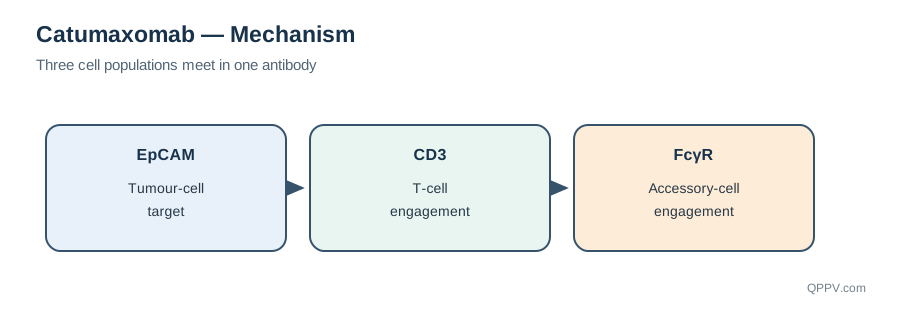
Figure 1. Catumaxomab can connect an EpCAM-positive target cell, a CD3-positive T cell and an Fcγ-receptor-bearing accessory cell. The diagram describes the proposed pharmacological bridge, not an individual patient's response.
3. Safety profile and risk-informed assessment
3.1 Inflammatory reactions and cytokine release
The current product information identifies cytokine release syndrome (CRS) and systemic inflammatory response syndrome (SIRS) among clinically important risks.[2] Fever, chills, nausea, vomiting, pain, hypotension, tachycardia or respiratory changes can overlap with infection, tumour-related illness, fluid shifts and complications of malignant ascites. Timing relative to the infusion and the evolving vital-sign pattern matter, but temporal association alone is not diagnostic.
The current label provides product-specific instructions on premedication, infusion duration, observation and management. Clinical teams should follow the current Summary of Product Characteristics (SmPC). In pharmacovigilance, capture the exact step and dose, start and stop times, infusion interruption, vital signs, symptom sequence, laboratory findings, treatment, response, outcome and any subsequent infusion exposure. Distinguish a suspected CRS/SIRS diagnosis from individual symptoms where the source supports that distinction.
3.2 Hepatic events and other clinical alternatives
Liver failure is a serious labelled risk.[2] A case review should include baseline liver disease, liver metastases, ascites aetiology, recent procedures, concomitant medicines, liver-test trends, coagulation measures, clinical signs of decompensation and outcome. Cancer progression, infection, portal or vascular complications and other treatments may be relevant alternatives. Do not compress a complex hepatic event into a single laboratory abnormality.
Abdominal pain, fever, nausea and inflammatory laboratory changes can also reflect the underlying malignancy, peritoneal disease, infection or drainage procedures. The narrative should retain the clinician's diagnosis and evidence rather than substituting a mechanistic explanation.
4. Case processing and operational controls
Catumaxomab is administered intraperitoneally in a treatment unit familiar with the staged schedule and the management of inflammatory reactions. The oncology team, infusion service, safety function and any relevant surgical or ascites-care team need a reliable way to reconcile the dosing sequence and event chronology. Product identity, dose, route and batch/lot should be recorded when available.
For a valid individual case, preserve the required patient, reporter, suspected product and reaction information. Product-specific follow-up should seek:
- EpCAM status and tumour type, treatment eligibility and relevant disease history.
- Product name, batch/lot, dose, exact infusion date/time, route, infusion duration and sequence day.
- Onset and resolution of symptoms, vital signs, laboratory data and the clinician's diagnosis.
- Premedication, supportive treatment, interruption, subsequent doses and outcome.
- Liver disease, hepatic metastases, procedures, infection and concomitant medicines.
- Source documents or investigator assessment where available, with uncertainty retained when data cannot be obtained.
Seriousness, expectedness and causality are separate assessments. A labelled reaction can still be serious and reportable. A suspected inflammatory event should not be downgraded solely because it is mechanistically anticipated; regulatory reporting and follow-up are governed by applicable requirements and the organisation's procedures.
4.1 Traceability across the authorisation transition
Cases associated with Removab and Korjuny belong to different product and regulatory contexts. Ensure that product names, authorisation period, source documents and applicable product information remain visible in case records and aggregate reviews. A change in marketing authorisation holder or a new product presentation should not cause the active substance to be treated as a new, unrelated safety entity; equally, substance-level aggregation must preserve product-specific context.
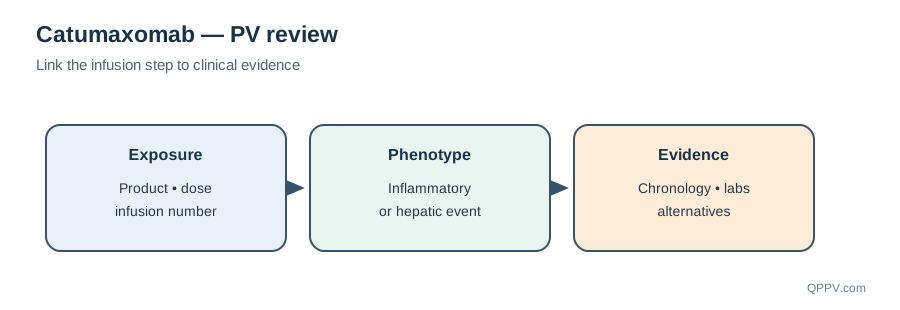
Figure 2. A useful catumaxomab case narrative joins dose-sequence exposure, inflammatory or hepatic phenotype, management and competing clinical explanations.
5. Aggregate review and governance
Aggregate review should distinguish treatment-related inflammatory patterns from background symptoms of advanced cancer and malignant ascites. Review event timing by infusion number and dose, seriousness, intervention, recovery, liver findings and relevant co-morbidities. Spontaneous-report counts alone cannot estimate incidence because they lack a reliable exposure denominator and are affected by reporting patterns.
The marketing authorisation holder's pharmacovigilance system should retain traceable intake, medical review, coding, follow-up, submission and aggregate evaluation records under applicable EU requirements. The QPPV oversees the system and has access to relevant safety information; the treating clinician remains responsible for patient care. Inspection readiness means being able to reconstruct which product and dose were used, how an event was classified, what evidence supported the assessment and whether new data changed the benefit–risk evaluation.
Common weaknesses include missing the infusion sequence, recording only “fever” without chronology or vital signs, overlooking hepatic context, confusing the old and current product lifecycle, and merging reports without retaining treatment period or formulation context.
6. Key takeaways
Catumaxomab is a trifunctional EpCAM×CD3 antibody whose Fc region can engage accessory immune cells. Its current EU use is a staged intraperitoneal course for a narrowly defined malignant-ascites population. The 2017 withdrawal of Removab and the 2025 authorisation of Korjuny are separate lifecycle events.
High-quality pharmacovigilance captures infusion-level chronology, inflammatory findings, hepatic status, clinical alternatives, product identity and outcome. Mechanism helps shape follow-up questions, while the full clinical evidence supports case assessment.
References
- European Medicines Agency. Korjuny: European Public Assessment Report. Current EU indication, authorisation date, mechanism and public assessment. Accessed 23 September 2026.
- European Medicines Agency. Korjuny: EU product information. Current dosing, warnings, contraindications and adverse reactions. Accessed 23 September 2026.
- European Medicines Agency. Removab: European Public Assessment Report. Historical authorisation and withdrawal on 2 June 2017. Accessed 23 September 2026.
- European Medicines Agency. GVP Module VI: Collection, management and submission of reports of suspected adverse reactions. Apply the current module and addenda.
- European Medicines Agency. GVP Module IX: Signal management. Apply the current module and addenda.
- European Commission. Commission Implementing Regulation (EU) No 520/2012. EU pharmacovigilance requirements, as amended.
Regulatory Note
This article is an educational pharmacovigilance reference and does not replace the current EU SmPC, applicable legislation, regulatory guidance or clinical judgement. Authorisation status and product information may change. Confirm the current Korjuny information for present assessments; use historical product information when reviewing reports from the earlier Removab lifecycle.