Cenobamate (Ontozry/Xcopri): From Drug Discovery to Severe Liver Injury and Evolving Pharmacovigilance
Cenobamate is an oral antiseizure medicine developed for adults with focal-onset seizures. In the United States it is marketed as Xcopri; in the European Union it is marketed as Ontozry. Its development is notable not only for substantial efficacy in drug-resistant epilepsy but also for the way its safety profile has evolved after authorisation. The medicine entered the U.S. market in 2019 and received European Union marketing authorisation in 2021. In 2026, European pharmacovigilance review identified liver injury as a rare adverse reaction and led to a direct healthcare professional communication concerning new liver-monitoring requirements after reports of severe liver injury, including hepatic failure.[1–5]
The case is useful for pharmacovigilance because the hepatic issue cannot be understood as an isolated adverse-event term. Cenobamate is commonly used with other antiseizure medicines, has clinically important pharmacokinetic interactions, requires gradual titration, and can itself cause several other clinically significant adverse reactions. Consequently, interpretation of a hepatic case requires information about concomitant treatment, baseline liver status, laboratory findings, symptoms, dose changes, treatment chronology, dechallenge, rechallenge, alternative causes and the clinical outcome.
The regulatory history also illustrates an important distinction between pre-authorisation safety evidence and post-authorisation evidence. Before approval, clinical trials identified elevated hepatic enzymes among adverse reactions, but the later post-marketing experience generated evidence sufficiently concerning for regulators to strengthen the product information. In the United States, the current label states that clinically significant liver injury has occurred post-marketing and that acute liver failure requiring transplantation has been reported. The 2026 European review separately concluded that the benefit-risk balance remained unchanged while requiring product-information changes and enhanced monitoring.[4,5]
This article follows cenobamate from medicinal-chemistry discovery through clinical development and regulatory approval, then examines its pharmacology, important safety risks, the emergence of severe liver injury as a post-authorisation concern, and the pharmacovigilance controls needed to manage that evolving risk.
- Cenobamate (Ontozry/Xcopri): From Drug Discovery to Severe Liver Injury and Evolving Pharmacovigilance
- Therapeutic Context and Development Rationale
- Discovery and Preclinical Development
- Clinical Development and Evidence of Efficacy
- Regulatory Milestones
- Pharmacology, Exposure and the Safety Context
- Titration and Dose-Related Risk Management
- Established Safety Profile Before the Liver Signal
- Emergence of Liver Injury as a Post-Authorisation Concern
- Figure: How a Post-Marketing Liver Signal Changes the Control System
- What the Liver Signal Means Clinically
- Pharmacovigilance Case Assessment
- The Importance of Concomitant Antiseizure Medicines
- Monitoring as a Risk-Control Measure
- Signal Detection and Cumulative Evaluation
- Risk Management and the Safety Specification
- Practical Management of a Serious Hepatic Case
- Other Important Special Situations
- Inspection and Governance Perspective
- Common Failure Modes
- QPPV Oversight
- Current Pharmacovigilance Questions
- Practical Pharmacovigilance Checklist
- Key Takeaways
- References
- Regulatory Note
Therapeutic Context and Development Rationale
Focal epilepsy is characterised by seizures that originate within networks involving a limited region of one cerebral hemisphere. Many patients achieve adequate control with antiseizure medicines, but a clinically important group continues to experience seizures despite treatment with multiple medicines. This population creates a persistent need for therapies with a different or more effective pharmacological profile.
Cenobamate was developed specifically in this setting. The discovery programme at SK Biopharmaceuticals sought new alkyl-carbamate compounds with broad antiseizure activity while attempting to improve efficacy and tolerability relative to earlier members of the chemical class. A 2026 account of the discovery programme describes work beginning in 2001 and identifies cenobamate as YKP3089.[6]
The development hypothesis was not based on a single conventional molecular target. Cenobamate has effects on voltage-gated sodium channels and positively modulates GABA-A receptor signalling, although its precise contribution to clinical efficacy is not reduced to one simple mechanism. This pharmacological profile is relevant to pharmacovigilance because it helps explain both its antiseizure activity and some of its central nervous system adverse reactions.[7–9]
Discovery and Preclinical Development
The discovery of cenobamate illustrates a chemocentric and phenotypic approach rather than a straightforward target-first programme. Earlier alkyl-carbamates provided chemical starting points, while seizure models and tolerability assessments were used to identify compounds with useful activity. The eventual molecule incorporated a tetrazole-containing structure that distinguished it from earlier compounds in the class.[6]
SK Biopharmaceuticals' corporate history records the U.S. investigational new drug activation for cenobamate in 2005. The company and its U.S. subsidiary subsequently developed the medicine through to FDA approval rather than licensing the asset to an external innovator during the core development programme.[10,11]
Preclinical studies supported broad antiseizure activity across several experimental models. Later mechanistic work demonstrated effects on persistent sodium currents and GABA-A receptor function, providing a biological basis for the drug's activity while also reinforcing that cenobamate is pharmacologically distinct from many established antiseizure medicines.[7–9]
For pharmacovigilance, the discovery history establishes the first layer of context: cenobamate was selected because of its antiseizure pharmacology, not because a hepatic target had been identified. The subsequent liver signal therefore belongs to the post-discovery safety story rather than being a planned pharmacodynamic effect that defined the molecule.
Clinical Development and Evidence of Efficacy
The clinical programme evaluated cenobamate as adjunctive therapy in adults with uncontrolled focal seizures. A pivotal dose-response trial randomised 437 patients to placebo or cenobamate at 100, 200 or 400 mg/day. Median seizure-frequency reductions during the maintenance phase were greater with each active dose than with placebo, providing evidence of clinically meaningful antiseizure activity.[12]
A second pivotal study also supported efficacy and contributed to the regulatory evidence base. Across the development programme, cenobamate produced reductions in seizure frequency that were clinically important in a population with substantial prior treatment exposure. The evidence was particularly notable for the proportion of patients achieving very substantial seizure reduction, including seizure freedom in a subset of treated patients.[13]
The efficacy findings need to be interpreted together with the treatment burden. Cenobamate was not developed as a medicine that could simply be started at the eventual maintenance dose. Its recommended titration begins at 12.5 mg once daily and increases every two weeks to 200 mg once daily, with further increases possible according to response and tolerability. Rapid titration is specifically associated with serious adverse-reaction concerns, most notably DRESS.[4]
This relationship between efficacy, titration and safety became an important part of the product's risk-management architecture. The pharmacovigilance system therefore needs to capture not only whether an adverse event occurred but also the actual exposure trajectory that preceded it.
Regulatory Milestones
FDA approved Xcopri on 21 November 2019 for the treatment of partial-onset seizures in adults.[14] The product subsequently became a Schedule V controlled substance in the United States, and later U.S. labelling expanded administration options to include crushed tablets administered orally as a suspension or through a nasogastric tube.[15,16]
In the European Union, Ontozry received a centrally authorised marketing authorisation on 26 March 2021 for adjunctive treatment of focal-onset seizures with or without secondary generalisation in adults whose epilepsy had not been adequately controlled despite treatment with at least two antiseizure medicines.[2]
The two regulatory systems therefore provide related but not identical product contexts. The U.S. indication is expressed as treatment of partial-onset seizures in adults, while the EU indication is explicitly framed as adjunctive treatment after inadequate control despite at least two previous antiseizure medicines. Pharmacovigilance records should preserve the applicable indication and regulatory jurisdiction rather than treating all post-marketing exposure as a single undifferentiated population.
Pharmacology, Exposure and the Safety Context
Cenobamate's clinical pharmacology is central to understanding its safety profile. It is administered once daily, and exposure changes with hepatic and renal impairment. The U.S. label limits the maximum dose to 200 mg once daily in mild or moderate hepatic impairment and does not recommend use in severe hepatic impairment.[4]
Cenobamate also affects the exposure of several concomitant medicines. The U.S. prescribing information identifies clinically relevant interactions involving phenytoin, phenobarbital, clobazam, lamotrigine, carbamazepine, CYP2B6 and CYP3A substrates, CYP2C19 substrates and hormonal oral contraceptives.[4] These interactions are particularly important in epilepsy because polytherapy is common. A safety case occurring during multiple-drug treatment cannot automatically be attributed to cenobamate simply because cenobamate is present.
The pharmacovigilance consequence is straightforward but operationally important: case intake should capture the complete antiseizure regimen, recent dose changes and the chronology of treatment. A hepatic event occurring shortly after introduction of several medicines requires a different causality assessment from an event arising after a stable long-term regimen in which cenobamate was the only recent change.
Titration and Dose-Related Risk Management
Cenobamate is initiated at 12.5 mg once daily and normally increased every two weeks through 25, 50, 100 and 150 mg before reaching the 200 mg maintenance dose. Further increases to a maximum of 400 mg may be made in 50-mg increments every two weeks when clinically justified.[4]
The slow titration schedule is not merely a prescribing convenience. It is part of the safety architecture. The U.S. label reports DRESS, including a fatal case, in patients exposed to weekly or faster titration. No DRESS cases were reported in a large open-label safety study using the 12.5-mg starting dose with two-week titration, although the label appropriately states that this does not establish that slower titration eliminates the risk.[4]
The same principle matters when interpreting hepatic cases. A pharmacovigilance database that records only the maintenance dose loses information about the period in which exposure was being escalated. For serious hepatic events, the case chronology should therefore include the starting dose, each titration step where available, concomitant antiseizure medicines, laboratory measurements and the timing of symptoms.
Discontinuation creates another safety interface. Cenobamate should generally be withdrawn gradually over at least two weeks unless safety concerns require abrupt withdrawal. The reason is the potential for increased seizure frequency following abrupt cessation.[4] Thus, when a serious adverse event requires discontinuation, the risk-management decision is not simply “stop the suspect medicine”; the clinical team must balance the hepatic or other safety risk against seizure-control consequences.
Established Safety Profile Before the Liver Signal
The common adverse reactions identified during clinical development include somnolence, dizziness, fatigue, diplopia and headache. Dose-dependent increases were also observed for somnolence/fatigue and dizziness or gait and coordination abnormalities.[4]
Cenobamate also carries warnings concerning DRESS, QT shortening and suicidal behaviour or ideation. Familial short QT syndrome is a contraindication. These risks illustrate why a product-specific pharmacovigilance system must maintain a structured safety profile rather than allowing a newly identified signal to displace previously established risks.[4]
DRESS is particularly relevant to hepatic case assessment because liver abnormalities can occur as part of a systemic hypersensitivity reaction. Fever, rash, lymphadenopathy, facial swelling, eosinophilia and other organ involvement can accompany hepatitis. A case containing abnormal liver tests therefore needs review for evidence of DRESS rather than being automatically classified as isolated drug-induced liver injury.[4]
QT shortening creates a different example of contextual risk. The concern is not hepatic, but it demonstrates that cenobamate's overall benefit-risk assessment includes pharmacodynamic effects that may not be visible in routine spontaneous hepatic surveillance. A mature safety system must preserve these separate risk domains while allowing cases with overlapping features to be linked appropriately.
Emergence of Liver Injury as a Post-Authorisation Concern
The liver safety story changed materially after wider clinical use. FDA's current label states that clinically significant liver injury has been reported in the postmarketing setting, including markedly elevated transaminases with elevated total bilirubin and acute liver failure requiring transplantation. The label directs baseline ALT, AST and total bilirubin assessment and prompt testing when symptoms suggest hepatic dysfunction.[4]
The European signal developed through a formal PSUR assessment. At its April 2026 meeting, PRAC concluded that the benefit-risk balance remained unchanged but recommended adding liver injury as a rare undesirable effect and regrouping hepatic adverse reactions under the hepatobiliary system-organ class. PRAC also agreed distribution of a DHPC concerning new liver-monitoring requirements because of reports of severe liver injury.[5]
The subsequent EMA communication stated that most severe cases occurred when Ontozry was used with other antiseizure medicines. Healthcare professionals were advised to perform liver-function testing before starting treatment and throughout treatment, and to evaluate patients promptly when symptoms suggest liver injury.[1]
This sequence is important. The regulatory action did not establish that every liver event occurring during cenobamate exposure is caused by cenobamate. Rather, cumulative post-authorisation evidence was sufficient to change the recognised safety profile and the controls around use. The benefit-risk balance remained positive in the PRAC assessment, but the evidence justified additional risk-management measures.
Figure: How a Post-Marketing Liver Signal Changes the Control System
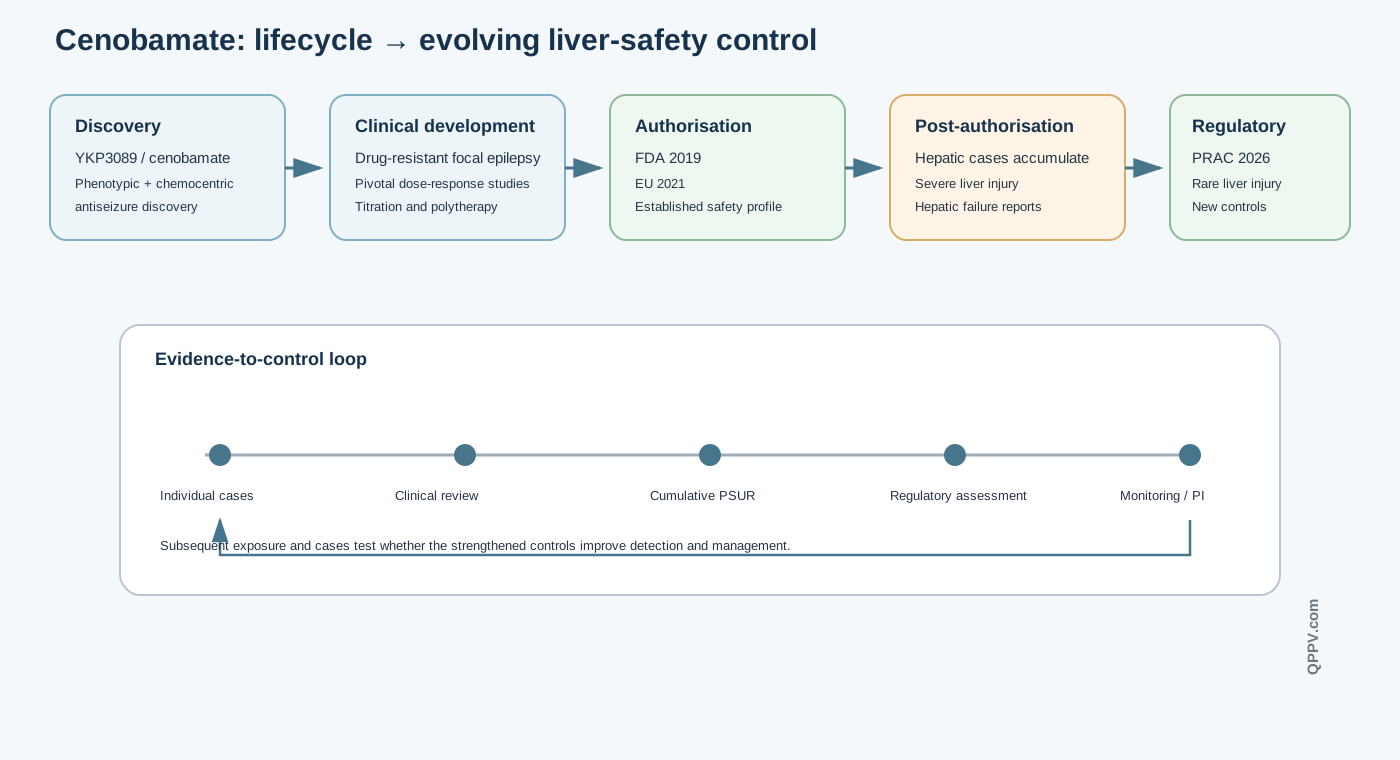
Figure 1. Cenobamate moves from discovery and efficacy development into post-authorisation surveillance, where individual hepatic cases, cumulative evidence and regulatory assessment can lead to strengthened monitoring and updated risk controls. The diagram does not imply that every hepatic event is causally attributable to cenobamate.
What the Liver Signal Means Clinically
The central clinical distinction is between an isolated laboratory abnormality and clinically significant liver injury. Cenobamate's product information already recognised hepatic enzyme increases before the 2026 European change. The later addition of liver injury reflects a more consequential clinical phenotype, including severe cases and hepatic failure reported after wider exposure.[1,4,5]
In the United States, the label identifies unexplained nausea, vomiting, right-upper-quadrant abdominal pain, fatigue, anorexia, jaundice and dark urine as symptoms that should prompt liver testing. It also identifies transaminases greater than three times the reference range together with total bilirubin greater than two times the reference range as an important predictor of severe liver injury.[4]
These findings have a direct case-processing implication. A spontaneous report containing “ALT increased” should not be handled as equivalent to a report describing jaundice, bilirubin elevation, hepatic failure or transplantation. The preferred terms, seriousness assessment, outcome, laboratory values, clinical diagnosis and follow-up questions all need to preserve the clinical phenotype.
Pharmacovigilance Case Assessment
A cenobamate hepatic case should be reconstructed as a clinical timeline rather than processed as a list of isolated terms. The first question is whether the patient was actually exposed to cenobamate and when. The second is what happened to liver tests and symptoms relative to initiation, titration and concomitant treatment. The third is whether alternative explanations provide a more plausible account.
The case record should capture, where available, baseline liver function, ALT, AST, alkaline phosphatase, bilirubin and other clinically relevant investigations; dates of abnormal results; symptoms; diagnostic conclusions; imaging or specialist assessment; treatment interruption; dechallenge and rechallenge; concomitant medicines; alcohol or other relevant exposures; underlying liver disease; infection or other competing diagnoses; and clinical outcome.
For a serious case, follow-up is particularly valuable because the initial spontaneous report may contain only “liver failure” without enough information to determine whether the event was isolated DILI, DRESS-associated hepatitis, another systemic illness, or a hepatic event attributable to a concomitant antiseizure medicine.
Causality assessment should therefore remain evidence-based. Temporal association supports but does not establish causation. Dechallenge can strengthen an assessment when the clinical course is compatible, while rechallenge may provide additional evidence but is generally not something to undertake deliberately after a serious suspected drug-induced liver injury merely to test causality. The pharmacovigilance record should distinguish documented clinical facts from the assessor's interpretation.
The Importance of Concomitant Antiseizure Medicines
The European DHPC noted that most severe liver-injury cases occurred when cenobamate was used alongside other antiseizure medicines.[1] This observation does not by itself establish which medicine caused an individual event, but it demonstrates why polytherapy is a central feature of signal evaluation.
Cenobamate itself can alter the exposure of several other medicines. Conversely, concomitant therapies may have their own hepatic liabilities. The case therefore needs a complete medication history rather than a narrow “suspect drug” field.
For signal management, cases should be stratified where possible by concomitant medicines, baseline hepatic impairment, dose and titration, latency, laboratory pattern, clinical severity and outcome. Such stratification helps distinguish a general reporting increase from a reproducible clinical phenotype and can identify subgroups that warrant further investigation.
Monitoring as a Risk-Control Measure
The 2026 European action changed the practical monitoring environment. The EMA communication recommends liver-function tests before treatment and throughout treatment, while the U.S. label requires baseline ALT, AST and total bilirubin and prompt testing when clinical signs or symptoms suggest hepatic dysfunction.[1,4]
These requirements should not be conflated. The exact regulatory wording and implementation pathway differ between jurisdictions. For an organisation operating in multiple markets, the controlled process should therefore map the applicable local product information rather than relying on one global instruction that silently substitutes one jurisdiction's requirement for another.
Operationally, a useful control system connects prescribing information, laboratory monitoring, case intake and escalation. A monitoring result that crosses a clinically relevant threshold should lead to appropriate clinical action; if an adverse event is suspected or confirmed, the event should enter the pharmacovigilance process with sufficient detail for case assessment and, where applicable, expedited reporting.
The control is therefore a closed loop:
exposure → monitoring or clinical observation → detection → clinical management → safety case → cumulative assessment → regulatory action → updated control.
A pharmacovigilance system that captures cases but cannot demonstrate how the new liver risk was translated into controlled operational practice is incomplete from a quality perspective.
Signal Detection and Cumulative Evaluation
The cenobamate liver signal illustrates why signal detection cannot be reduced to disproportionality statistics. A statistical association may identify a hypothesis, but regulatory action depends on clinical review, case quality, cumulative evidence, biological plausibility, alternative explanations and the totality of the benefit-risk evidence.
For cenobamate, the 2026 PRAC conclusion is particularly instructive. PRAC did not conclude that the emerging hepatic risk overturned the medicine's positive benefit-risk balance. Instead, it classified liver injury as rare, required a product-information variation, strengthened monitoring communication and requested further attention to severe liver injury in subsequent PSURs.[5]
This is a classic post-authorisation pharmacovigilance progression: case reports generate concern; cumulative review characterises the concern; regulatory assessment determines whether the safety profile or controls should change; subsequent surveillance tests whether the change is adequate.
The PSUR consequently remains important even after a risk has been identified. Future reports need to examine whether the frequency, severity, latency, clinical phenotype, risk factors and outcomes remain consistent with the current understanding, and whether additional measures are justified.
Risk Management and the Safety Specification
The European PRAC assessment also illustrates how a newly characterised risk can alter the safety specification. In April 2026, PRAC requested that severe liver injury be included as a new important identified risk and that effects of cenobamate on bone density and bone turnover be considered as a new important potential risk for PSUR discussion.[5]
This distinction matters. An identified risk is supported by sufficient evidence of an association with the medicine, whereas a potential risk requires further evidence. Pharmacovigilance governance should not collapse both categories into a generic “safety concern” label because their evidentiary status and management implications differ.
For the QPPV and safety governance function, changes to the safety specification should propagate consistently into the RMP, signal-management system, PSUR strategy, case-review guidance, medical-information materials, training and relevant quality controls. The objective is not merely to update a document; it is to ensure that the organisation's operational controls reflect the current evidence.
Practical Management of a Serious Hepatic Case
When a serious hepatic case is received, the immediate clinical priority belongs to the treating healthcare professional. The pharmacovigilance function's role is to ensure that the safety information is captured accurately, assessed appropriately and escalated within the applicable regulatory framework.
A useful operational sequence is:
- establish exposure and chronology;
- identify the clinical hepatic phenotype;
- capture laboratory values and trends;
- identify concomitant medicines and relevant exposures;
- assess alternative causes;
- document seriousness and outcome;
- seek targeted follow-up information;
- perform medical review and causality assessment;
- determine reporting and signal implications;
- retain traceable evidence for cumulative evaluation.
This sequence should not be treated as a legal checklist unless the underlying step is explicitly required by the applicable regulatory framework. Several elements are recommended operational practice intended to improve case quality and signal interpretability.
Other Important Special Situations
A patient with pre-existing hepatic impairment represents a distinct exposure context. U.S. labelling limits dosing in mild or moderate impairment and does not recommend use in severe hepatic impairment.[4] A case in such a patient should therefore retain the baseline hepatic status and prescribed dose because these facts materially affect interpretation.
A case with fever, rash, eosinophilia, lymphadenopathy or other systemic findings requires consideration of DRESS. Because hepatic involvement can occur as part of DRESS, treating every such report as isolated liver injury could obscure the clinically relevant syndrome.[4]
A case occurring shortly after a rapid titration also requires review of the exposure trajectory. The DRESS history makes titration speed particularly important, while the general principle remains applicable to other adverse reactions: dose history is clinical evidence, not merely administrative information.
Finally, abrupt discontinuation because of a serious adverse reaction creates a competing risk of seizure worsening. The safety record should therefore capture both the reason for discontinuation and the clinical course after withdrawal, including any change in seizure frequency.
Inspection and Governance Perspective
An inspector evaluating cenobamate safety management would be interested not simply in whether the organisation knew that liver injury had been reported, but whether the safety system could demonstrate how the evidence moved through the pharmacovigilance framework.
Illustrative inspection questions would include:
| Area | Illustrative question | Evidence expected |
|---|---|---|
| Case intake | Can the organisation identify serious hepatic cases and their original sources? | Source records, case versions, audit trail |
| Medical assessment | How are hepatic phenotype, alternative causes and DRESS considered? | Medical review, causality assessment, follow-up |
| Follow-up | How are missing laboratory and outcome data pursued? | Follow-up attempts and responses |
| Signal management | How was the liver signal detected and evaluated? | Signal records, cumulative reviews, assessment reports |
| Regulatory change | How was the 2026 EU safety information incorporated? | Variation records, controlled product information |
| Risk management | How do monitoring recommendations reach operational teams? | Procedures, training, controlled materials |
| PSUR | How is severe liver injury represented in cumulative evaluation? | PSUR sections, case series, benefit-risk assessment |
| Governance | How does the QPPV know that controls are functioning? | Oversight records, metrics, CAPA and management review |
These are illustrative questions, not claims that a particular inspection found these deficiencies.
The strongest evidence is traceability. An organisation should be able to move from an individual case to the aggregate evidence, from the aggregate evidence to the regulatory assessment, and from the regulatory assessment back to the controlled process used in the field. Gaps between these layers can create risk even when each individual document appears acceptable.
Common Failure Modes
One failure mode is treating every elevated ALT or AST as equivalent to the newly characterised liver-injury risk. This loses clinical granularity and can inflate or distort signal evaluation. The opposite failure is equally problematic: dismissing serious hepatic cases because enzyme elevations were already known before the 2026 regulatory action.
A second failure is incomplete concomitant-medication information. Because cenobamate is frequently used in polytherapy and has multiple pharmacokinetic interactions, incomplete treatment histories weaken causality assessment and subgroup analysis.
A third failure is treating the EU monitoring requirement as though it were identical to the U.S. label. The jurisdictions have related but distinct regulatory texts. Global procedures should map the applicable local requirements rather than silently harmonising away meaningful differences.
A fourth failure is updating the SmPC, label or safety specification without updating operational controls. If case intake forms, follow-up templates, medical-review guidance, training and signal-management plans continue to reflect the previous risk profile, the documented regulatory change may not have become an effective pharmacovigilance control.
A fifth failure is losing the titration history. Cenobamate's exposure trajectory is clinically relevant, particularly when evaluating DRESS and other early adverse reactions. A case record containing only the current maintenance dose may be inadequate for reconstructing the risk period.
QPPV Oversight
The QPPV's role in this setting is not to personally reassess every cenobamate case. It is to ensure that the pharmacovigilance system is capable of identifying, evaluating, escalating and governing important safety information.
For a product with an evolving hepatic safety profile, oversight should include whether serious cases are rapidly visible, whether follow-up is effective, whether signal detection captures clinically meaningful phenotypes, whether the safety specification remains current, whether regulatory changes are implemented consistently, and whether cumulative reports accurately reflect the emerging evidence.
The QPPV should also consider interfaces outside the core case-processing team. Medical information, clinical safety, regulatory affairs, quality, commercial or patient-support functions may encounter information relevant to liver injury. The control environment must ensure that safety information originating in these interfaces enters the pharmacovigilance system appropriately.
Current Pharmacovigilance Questions
The 2026 regulatory action does not close the cenobamate liver-safety question. It establishes a strengthened control environment in which subsequent evidence can be evaluated more effectively.
Important questions for continued surveillance include whether severe liver injury remains rare, whether cases share identifiable risk factors, whether concomitant antiseizure medicines or other exposures contribute to risk, whether particular latency patterns emerge, whether monitoring detects clinically important injury early enough to change outcomes, and whether additional risk-minimisation measures become necessary.
These questions should be answered through cumulative evidence rather than isolated cases. The value of the strengthened monitoring requirement will ultimately depend on whether it improves detection, clinical management and the quality of information available for subsequent regulatory assessment.
Practical Pharmacovigilance Checklist
For cenobamate, a product-specific operational checklist can therefore include:
- confirm the applicable jurisdiction and current product information;
- capture indication, start date, titration history and current dose;
- document all concomitant antiseizure medicines and recent changes;
- retain baseline and follow-up liver-function results where available;
- distinguish laboratory abnormalities from clinically diagnosed liver injury;
- assess symptoms and outcome, including hepatic failure or transplantation;
- consider DRESS when systemic hypersensitivity features are present;
- assess alternative hepatic causes;
- document dechallenge and any subsequent clinical course;
- perform appropriate medical review and causality assessment;
- evaluate serious cases for signal relevance;
- incorporate cumulative evidence into PSUR and risk-management activities;
- verify that regulatory safety changes are reflected in controlled operational materials.
The list is an operational aid, not a substitute for the applicable legislation, GVP requirements, current SmPC, FDA prescribing information or local regulatory procedures.
Key Takeaways
Cenobamate demonstrates how pharmacovigilance evolves after a medicine reaches broader clinical use. Its development began with a deliberate search for an effective antiseizure compound and produced strong efficacy evidence in patients with difficult-to-control focal epilepsy. Its subsequent safety management shows why pre-authorisation evidence cannot define the final safety profile of a medicine.
The liver signal is particularly instructive. Hepatic enzyme abnormalities were known during development, but post-marketing reports of clinically significant liver injury and hepatic failure led to stronger regulatory attention. In April 2026, PRAC classified liver injury as a rare adverse reaction and supported strengthened monitoring communication while concluding that the overall benefit-risk balance remained unchanged. The U.S. label separately describes post-marketing clinically significant liver injury and acute liver failure requiring transplantation.[1,4,5]
For pharmacovigilance professionals, the central lesson is methodological. A serious hepatic signal must be understood through chronology, laboratory data, clinical phenotype, concomitant medicines, alternative causes, treatment changes and outcome. Regulatory action then needs to propagate into the entire safety system—from case intake and medical review to signal management, risk management, PSURs, training and QPPV oversight.
Cenobamate is therefore not simply a product with a new liver warning. It is a useful example of the pharmacovigilance lifecycle itself: evidence accumulated after approval, changed the recognised safety profile, strengthened risk controls and created a new body of post-authorisation questions that must now be answered through continued surveillance.
References
- European Medicines Agency. Meeting highlights from the Pharmacovigilance Risk Assessment Committee (PRAC), 7–10 April 2026. Cenobamate – Ontozry: new requirements for liver monitoring due to reports of severe liver injury. 2026.
- European Medicines Agency. Ontozry (cenobamate): European public assessment report and product information. Marketing authorisation issued 26 March 2021; product information updated July 2026.
- European Medicines Agency. Ontozry – Direct healthcare professional communication: new requirements for liver monitoring due to reports of severe liver injury. First published 13 May 2026.
- U.S. Food and Drug Administration. XCOPRI (cenobamate) Prescribing Information. Revised August 2025. NDA 212839.
- European Medicines Agency, PRAC. Minutes of the PRAC meeting 7–10 April 2026. EMA/PRAC/117688/2026; PSUSA/00010921/202509.
- Choi YM, et al. The Discovery of Cenobamate: A Drug with High Efficacy in Drug-Resistant Epilepsy. CNS Drugs. 2026. doi:10.1007/s40263-026-01290-z.
- Nakamura M, Cho JH, Shin H, et al. Effects of cenobamate (YKP3089) on voltage-gated sodium channels in rat hippocampal CA3 neurons. European Journal of Pharmacology. 2019;855:175–182.
- Sharma R, Nakamura M, Neupane C, et al. Positive allosteric modulation of GABA(A) receptors by cenobamate. European Journal of Pharmacology. 2020.
- Guignet M, Campbell A, White HS. Cenobamate (Xcopri): can preclinical and clinical evidence provide insight into its mechanism of action? Epilepsia. 2020;61:2329–2339.
- SK Biopharmaceuticals. Company history. Records U.S. IND activation for cenobamate in 2005 and subsequent development milestones.
- SK Biopharmaceuticals. XCOPRI product information. Statement that SK Biopharmaceuticals and SK Life Science independently developed cenobamate from inception through FDA approval.
- Krauss GL, Klein P, Brandt C, et al. Safety and efficacy of adjunctive cenobamate in patients with uncontrolled focal seizures: a multicentre, double-blind, randomised, placebo-controlled, dose-response trial. Lancet Neurology. 2020;19:38–48.
- French JA, et al. Remarkably high efficacy of cenobamate in adults with focal-onset seizures: a double-blind, randomised, placebo-controlled trial. Neurology. 2020;95:e1505–e1518.
- U.S. Food and Drug Administration. Approval Package: NDA 212839, XCOPRI (cenobamate). Approval date 21 November 2019.
- U.S. Drug Enforcement Administration / SK Life Science. XCOPRI Schedule V designation. March 2020.
- U.S. Food and Drug Administration. XCOPRI supplemental approval for alternate administration methods. April 2024.
Regulatory Note
This article is an educational pharmacovigilance reference, not legal advice or a substitute for the current applicable product information, legislation, GVP guidance, regulatory procedures or local requirements. Regulatory status and product information can change. For operational decisions, use the current authoritative source applicable to the product, indication and jurisdiction.