Designated Medical Events (DMEs) in Pharmacovigilance: A Practical Guide to Signal Detection
Designated Medical Events (DMEs) are a deliberately small group of medically important adverse-event concepts used as a safety net in pharmacovigilance signal detection. Their value comes from a particular property: some events are so unusual in the absence of a medicinal cause, or so important not to miss, that even a small number of well-documented reports may deserve prompt clinical attention.
This makes DME surveillance different from routine statistical screening. A product-event combination does not have to cross a disproportionality threshold before a DME report can be reviewed. Under the EU signal-detection framework, DME reports should be brought to signal detection assessors' attention irrespective of other statistical methods and prioritised for clinical review.
That priority does not mean that a DME report is automatically a signal, that the suspect medicine caused the event, or that regulatory action is required. It means that the event has characteristics that justify looking closely at the case without waiting for a numerical pattern to become prominent.
- Designated Medical Events (DMEs) in Pharmacovigilance: A Practical Guide to Signal Detection
- Purpose and Scope
- Regulatory and Methodological Framework
- Why a DME Safety Net Is Needed
- What the EMA DME List Represents
- DME and IME Are Related but Serve Different Purposes
- DME Is Not a Seriousness Criterion
- DME Is Not a Signal
- DME Is Not Proof of Causality
- How DME Surveillance Complements Disproportionality Analysis
- Clinical Review of a DME Report
- From One DME Case to a Potential Signal
- Product-Specific Risks and Common Conditions
- Coding and MedDRA Considerations
- DME Review in EudraVigilance
- Prioritisation Is Not Validation
- Governance of a DME Surveillance Process
- Automation and Human Review
- Quality and Inspection Considerations
- Common Failure Modes
- Practical DME Review Framework
- Relationship With the IME Article
- Key Takeaways
- References
- Regulatory Note
Purpose and Scope
This article explains DMEs in human pharmacovigilance, with emphasis on the European Medicines Agency (EMA), EudraVigilance and GVP Module IX Addendum I.
It addresses:
- why the DME concept exists;
- how DMEs differ from Important Medical Events (IMEs);
- how DME surveillance complements disproportionality analysis;
- what clinical review of a DME report should examine;
- how a DME observation progresses—or does not progress—toward a signal;
- and how organisations can govern DME-based signal detection.
The subject belongs primarily to signal detection and signal management, not to ICSR seriousness classification. That boundary is essential.
Regulatory and Methodological Framework
EU signal management is governed by the pharmacovigilance legislation described in GVP Module IX, including Regulation (EC) No 726/2004, Directive 2001/83/EC and Commission Implementing Regulation (EU) No 520/2012.
GVP Module IX establishes the broader signal-management process. Its Addendum I addresses methodological aspects of signal detection from spontaneous reports and contains the specific methodological discussion of DMEs.
The Addendum explains that some medical events are known to result on most occasions from exposure to medicines. When such events are reported, the prior probability of a causal relationship to one of the medicinal products in the ICSR can therefore be relatively high. It recommends creating a list of such terms, complemented by important and serious events that should not be missed, as a safety net in signal detection.
EMA separately publishes its DME list for transparency and describes the listed conditions as inherently serious and often medicine-related. The Agency and Member States use the list to focus on suspected adverse-reaction reports deserving special attention regardless of statistical criteria used to prioritise safety reviews.
These sources provide the central operating principle:
DME identification → priority clinical review → signal assessment when warranted
They do not establish:
DME identification → confirmed causal association
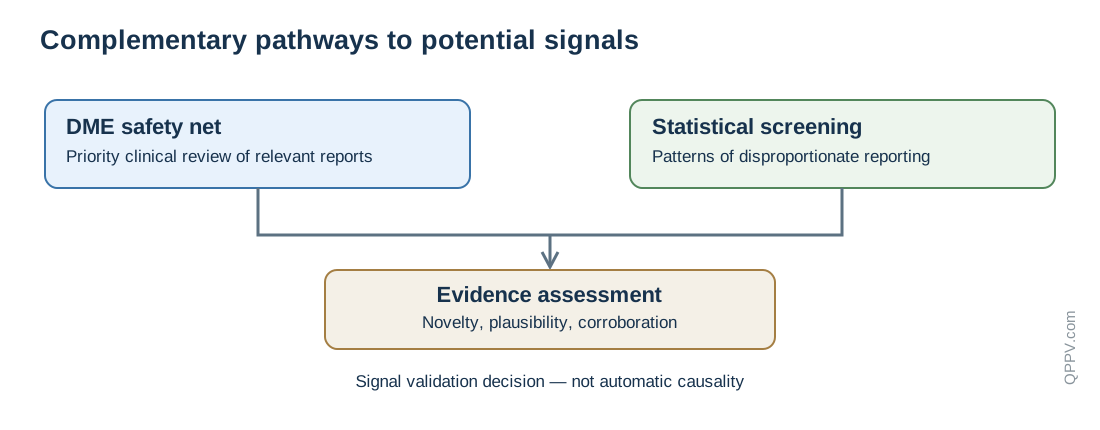
Figure 1. DME surveillance provides a clinically driven safety-net pathway alongside statistical screening. Either pathway may lead to further signal assessment, but neither a DME flag nor a statistical association alone establishes causality.
Why a DME Safety Net Is Needed
Large spontaneous-report databases contain many product-event combinations. Statistical signal-detection methods help identify combinations reported disproportionately often, but no statistical method is perfectly sensitive to every clinically important pattern.
Rare events create a particular problem. If an event is uncommon in the general population and is strongly associated with medicinal exposure when it occurs, waiting for a large case count may delay recognition. Conversely, an event with a high background incidence may generate many reports without being particularly specific for a medicine.
DME surveillance therefore adds a clinical-prior-probability layer to signal detection.
The logic is not that rare equals causal. Rather, certain event concepts have enough pharmacovigilance significance that the reports should not disappear within a much larger statistical screening output.
GVP Module IX Addendum I accordingly describes the DME list as a safety net and recommends that DME reports be prioritised for clinical review irrespective of other statistical methods.
What the EMA DME List Represents
EMA describes its DME list as containing medical conditions that are inherently serious and often medicine-related. It also states what the list is not intended to capture: product-specific issues or medical conditions with high prevalence in the general population.
The list uses MedDRA terminology, allowing DME concepts to be identified within structured EudraVigilance analyses.
The list is not intended to be comprehensive for all signal-detection activity. EMA explicitly describes it as one tool used by the European medicines regulatory network.
This is important operationally. An organisation cannot meet its signal-detection responsibilities simply by reviewing DME terms. DME surveillance supplements, rather than replaces, broader methods for detecting new safety information.
DME and IME Are Related but Serve Different Purposes
Important Medical Events and Designated Medical Events are sometimes confused because both use MedDRA terms and both concern medically important events. Their primary purposes are different.
| Feature | Important Medical Event (IME) | Designated Medical Event (DME) |
|---|---|---|
| Primary purpose | Support seriousness classification, ICSR assessment and aggregate analysis | Safety net for signal detection |
| Breadth | Relatively broad | Relatively small, selective set |
| Main question | Could this event be medically serious? | Does this event deserve priority clinical review as a potential safety signal? |
| Relationship | Broader reference set | Generally a small subset of IMEs |
| Effect of a match | Prompts seriousness/medical assessment | Prompts prioritised signal-detection review |
| Establishes causality? | No | No |
| Replaces other PV methods? | No | No |
GVP Module IX Addendum I states that elements of a DME list are generally a relatively small subset of the IME list.
The distinction can be expressed simply:
IME asks about medical importance within the seriousness framework.
DME asks whether a medically distinctive event should receive special attention during signal detection.
A single MedDRA PT can participate in both frameworks, but the downstream question is different.
DME Is Not a Seriousness Criterion
The fact that EMA describes DME conditions as inherently serious should not lead to a new seriousness category called “DME”.
ICSR seriousness assessment continues to use the applicable regulatory seriousness criteria and medical judgement. The DME concept is used in signal detection.
In many practical cases, a DME-coded reaction will also be serious because of the nature or consequences of the event. Nevertheless, databases and procedures should avoid conflating two different operations:
- determining and recording seriousness for the ICSR; and
- identifying the event for prioritised signal-detection review.
Keeping these functions separate improves traceability and prevents the DME flag from becoming an undocumented surrogate for case assessment.
DME Is Not a Signal
A signal is information that suggests a new potentially causal association, or a new aspect of a known association, judged sufficiently likely to justify verificatory action.
A DME flag is earlier in the reasoning chain.
A single DME report may be compelling, weak, confounded, poorly documented, duplicated or biologically implausible. It may describe a labelled adverse reaction or an already characterised risk. It may ultimately contribute no new safety information.
The appropriate conceptual sequence is:
DME report → clinical review → assessment of novelty and plausibility → additional evidence if needed → signal validation decision
This prevents two opposite errors.
The first is under-reaction: ignoring a medically distinctive report because a statistical threshold has not been met.
The second is over-reaction: calling every DME report a signal merely because its PT is on the list.
DME Is Not Proof of Causality
GVP's rationale for DMEs concerns prior probability, not certainty.
Clinical review must still examine whether the suspect medicine could plausibly have caused or contributed to the event. The strength of a DME concept is that the event itself may justify a lower threshold for attention—not a lower standard of scientific reasoning.
Relevant considerations can include:
- temporal relationship;
- dechallenge and rechallenge where informative;
- alternative causes;
- concomitant medicines;
- underlying disease;
- diagnostic confirmation;
- known pharmacology or class effects;
- biological plausibility;
- previous cases;
- literature;
- product information;
- and other relevant data sources.
The relative importance of these factors depends on the event and the available evidence.
How DME Surveillance Complements Disproportionality Analysis
Disproportionality analysis asks whether a product-event combination is reported more frequently than expected relative to a comparator distribution in the database.
DME surveillance asks a different question: is this event important enough that the case deserves clinical attention even without a statistical alert?
These approaches are complementary.
A DME may have only one or a few reports and fail to generate a statistical signal of disproportionate reporting. Clinical review may nevertheless identify a persuasive temporal relationship, absence of alternative causes and a plausible mechanism.
Conversely, a statistically prominent product-event combination may involve a common event that is not a DME. It can still represent an important signal.
A mature signal-detection system therefore combines quantitative and qualitative methods rather than treating either as universally superior.
Clinical Review of a DME Report
The first review should establish whether the coded DME concept is actually supported by the source information.
Confirm the medical event
Review diagnosis, signs and symptoms, investigations and relevant clinical criteria. A miscoded or unconfirmed event can create a misleading DME alert.
Understand the chronology
Establish exposure dates, event onset, dose changes, discontinuation, treatment and outcome. Timing may materially alter causal plausibility.
Examine alternative explanations
Underlying disease, infections, concomitant medicines, procedures, trauma and other exposures may provide competing explanations.
Look for drug-specific evidence
Consider known pharmacology, class effects, labelled information, previous reports, clinical-trial findings, non-clinical evidence and relevant literature.
Determine novelty
Ask whether the case suggests a genuinely new association or a new aspect of a known association, such as a change in severity, outcome, frequency, population, latency or circumstances of use.
Decide the next signal-management step
The outcome may be no further action, targeted follow-up, search for additional cases, broader data review, signal validation or another action appropriate to the organisation's signal process.
The DME flag initiates attention. The evidence determines what follows.
From One DME Case to a Potential Signal
The amount of evidence needed to justify further action is context-dependent. For an event with a strong known association with drug exposure and a very low background occurrence, one well-documented case can carry more evidentiary weight than many poorly documented reports of a common symptom. That does not create an automatic “one case equals signal” rule.
Instead, assess the totality of evidence:
case identified as DME → medical confirmation → causal plausibility → novelty check → search for corroboration → signal validation decision
Corroboration may come from other spontaneous reports, clinical studies, literature, non-clinical evidence, epidemiological data, class information or mechanistic knowledge. The decision should be documented whether the observation progresses or is closed.
Product-Specific Risks and Common Conditions
EMA states that its DME list does not address product-specific issues or medical conditions with high prevalence in the general population. This boundary matters because signal detection must remain product-aware.
A medicinal product can have a highly important potential risk that is not represented by a generic DME term. Similarly, common conditions can still become genuine signals when a product-specific pattern emerges.
Therefore, not DME does not mean not important, and DME does not define the complete signal-detection universe.
Product knowledge, risk-management information, emerging scientific evidence and the characteristics of the exposed population remain necessary.
Coding and MedDRA Considerations
DME detection depends on the coded MedDRA term. Incorrect coding can therefore create false alerts or hide relevant cases.
Signal reviewers should be able to return from the DME flag to the underlying ICSR and source-derived clinical information. The coded term is an index into the evidence, not the evidence itself.
MedDRA version changes also require attention. Terms can be added, modified or reorganised, and signal-detection configurations must remain aligned with the terminology environment in which searches are run.
GVP Module IX Addendum I recommends periodic review of the DME list based on experience and performance. A DME implementation is therefore not a one-time configuration exercise.
DME Review in EudraVigilance
EudraVigilance provides structured data-analysis functionality for monitoring suspected adverse reactions. EMA user guidance describes an IME/DME indicator associated with MedDRA PTs and filtering functionality that can be used when reviewing outputs.
This technical capability should be understood in the context of the methodological framework. A DME column makes clinically distinctive events visible to the assessor; it does not perform the clinical assessment.
The reviewer still needs to examine case content, reporting patterns, product context and other available evidence.
Prioritisation Is Not Validation
Signal detection, signal validation and signal prioritisation are related but distinct activities.
A DME mechanism provides detection priority. Once information is considered a potential signal, the applicable signal-management process determines whether it is validated and how it is prioritised for further assessment.
This distinction is particularly important in metrics. Counting “DME alerts” as “signals” can distort signal-management performance data. An alert, an observation under review, a validated signal and a regulatory recommendation represent different stages and should be recorded separately.
Governance of a DME Surveillance Process
A reliable DME process should define where the list is used and what happens when a match occurs.
| Control area | Practical question |
|---|---|
| Reference list | Which DME list/version is configured? |
| MedDRA alignment | Is the list compatible with the terminology version used for analysis? |
| Detection | Where and how are DME matches surfaced? |
| Review | Who performs clinical review and with what information? |
| Timeliness | How quickly should priority observations be reviewed under the organisation's risk-based process? |
| Escalation | What evidence triggers broader review or signal validation? |
| Documentation | Are assessment and decisions reconstructable? |
| Performance | Are false alerts, missed events and useful detections reviewed to improve the process? |
| Change control | How are list or system changes assessed and tested? |
These are recommended operational controls, not a claim that EU legislation prescribes one universal DME workflow or review deadline.
Automation and Human Review
DME identification is highly amenable to automation because it can be implemented as a terminology-based flag. The harder work begins after the match.
Automation can reliably answer: does this coded PT match the configured DME list?
It cannot, from the match alone, determine whether the diagnosis is adequately supported, whether the association is new, whether credible alternative causes exist, whether timing is plausible, whether the event is already an established risk, or whether signal validation is justified.
Those are clinical and scientific questions. The most useful automation therefore reduces the chance that a DME is overlooked while preserving qualified human review of what the report means.
Quality and Inspection Considerations
GVP Module IX describes signal management as a critical pharmacovigilance process and requires a documented quality system, clear responsibilities, appropriately qualified staff, traceability and record management.
For DME surveillance, an inspector could therefore examine whether the safety-net concept is actually functioning rather than merely whether a DME list exists.
Illustrative inspection questions include:
- How are DME reports identified?
- How does the process ensure they reach qualified signal assessors?
- Is clinical review independent of whether a statistical threshold was crossed?
- Can the organisation reconstruct the assessment and decision for a selected DME case?
- How are coding errors or duplicate cases handled?
- How is the DME list maintained and aligned with MedDRA?
- How are product-specific important risks detected when they are not DMEs?
- How is the performance of the signal-detection approach reviewed?
These are illustrative questions, not reported inspection findings.
Evidence could include procedures, system configuration, review records, signal tracking records, audit trails, training, quality checks, change controls and documented improvements.
Common Failure Modes
Waiting for a statistical threshold before reviewing a DME. This defeats the purpose of the safety net. GVP Module IX Addendum I recommends bringing DMEs to assessors' attention irrespective of other statistical methods.
Calling every DME a signal. A DME is a prioritised observation for clinical review. Signal status requires assessment of whether the information suggests a sufficiently likely new association or new aspect of a known association to justify verificatory action.
Assuming DME means causal. DME selection reflects medical characteristics and prior probability. It does not prove that the medicine caused the event in a particular report.
Treating the DME list as comprehensive. EMA explicitly states that the list is one tool and is not intended as a comprehensive set of terms for signal detection.
Ignoring coding quality. A DME flag generated from an inappropriate PT can misdirect reviewer attention.
Ignoring product-specific surveillance. The generic DME list does not replace knowledge of the product's mechanism, identified and potential risks, populations, class effects and emerging evidence.
Failing to learn from DME performance. GVP recommends periodic review of DME lists based on experience and performance.
Practical DME Review Framework
When a DME alert appears, a signal assessor can use the following sequence:
- Confirm the event. Does the ICSR support the DME-coded medical concept?
- Review case quality. Is there enough information for meaningful clinical assessment?
- Assess chronology. Is the temporal relationship compatible with the suspected association?
- Assess alternatives. What competing causes are present?
- Check prior knowledge. Is the event labelled, already monitored or otherwise established?
- Assess biological and pharmacological plausibility.
- Search for corroboration. Review other cases and relevant sources where warranted.
- Determine novelty. Does the information suggest a new association or new aspect of a known one?
- Decide the signal-management disposition.
- Document the evidence and rationale.
The DME flag determines priority; it does not predetermine the conclusion.
Relationship With the IME Article
The companion QPPV.com article The IME List in Pharmacovigilance: Important Medical Events, Seriousness and Practical Use explains the broader IME framework and its relationship to ICSR seriousness assessment.
Read together:
IME → seriousness and case-assessment aid
DME → signal-detection safety net
Both use MedDRA terminology. Neither replaces clinical judgement.
Key Takeaways
Designated Medical Events are a selective pharmacovigilance tool for ensuring that certain medically distinctive suspected adverse reactions receive clinical attention even when routine statistical methods do not highlight them.
Within the EU framework, EMA describes DME conditions as inherently serious and often medicine-related; GVP Module IX Addendum I recommends bringing DMEs to signal assessors' attention irrespective of other statistical methods; DME elements are generally a small subset of the broader IME list; and a DME report is not automatically a signal and does not establish causality.
DME surveillance complements rather than replaces disproportionality analysis and other qualitative and quantitative methods. Effective implementation depends on clinical review, coding quality, traceability, product knowledge and periodic evaluation.
The defining idea is not “DME means signal.” It is “DME means do not allow this medically distinctive report to be missed.”
References
- European Medicines Agency. Signal management — Designated medical events. EMA website. Accessed 8 October 2026.
- European Medicines Agency. Guideline on good pharmacovigilance practices (GVP) Module IX — Signal management (Rev. 1). EMA/827661/2011 Rev. 1. Effective 22 November 2017.
- European Medicines Agency. Guideline on good pharmacovigilance practices (GVP) Module IX Addendum I — Methodological aspects of signal detection from spontaneous reports of suspected adverse reactions. EMA/209012/2015. Effective 22 November 2017.
- European Medicines Agency. Designated Medical Event (DME) list. Current list published through the EMA signal-management page; users should verify the current file before operational use.
- European Medicines Agency. EudraVigilance User Manual: Marketing Authorisation Holders — EudraVigilance access via the EudraVigilance Data Analysis System. Current applicable version.
- European Medicines Agency. EudraVigilance system overview — Important Medical Events. Current EMA materials.
- European Medicines Agency. Guideline on good pharmacovigilance practices (GVP) Annex I — Definitions. Current applicable revision.
- Commission Implementing Regulation (EU) No 520/2012, as amended, Chapter III provisions on signal management.
Regulatory Note
This article describes the EU pharmacovigilance framework and EMA methodology for DME-based signal detection. Legal signal-management obligations arise from applicable EU legislation; GVP Module IX and its Addendum provide regulatory and methodological guidance for implementation. The practical workflow and control examples in this article are recommended operational approaches unless specifically identified as legal or regulatory requirements. EMA states that its DME list is one tool used by the European medicines regulatory network and is not a comprehensive list for signal-detection activities. Always verify the current EMA DME list, MedDRA version and current GVP materials before operational implementation.