Dolutegravir: Discovery, Development, Safety and Pharmacovigilance
Dolutegravir is a second-generation HIV-1 integrase strand-transfer inhibitor (INSTI) used as part of antiretroviral treatment. Its significance extends beyond potent suppression of viral replication. It helped make unboosted once-daily therapy practical, subsequently became a component of two-drug maintenance and initial-treatment strategies, and entered global treatment programmes in which long-term tolerability, pregnancy outcomes, paediatric formulation errors and resistance after incomplete viral suppression are major pharmacovigilance concerns. The same active ingredient appears in several combinations, but neither their clinical effects nor their sales can simply be assigned to dolutegravir. [1–5]
- Dolutegravir: Discovery, Development, Safety and Pharmacovigilance
- The scientific problem: preventing permanent integration
- Pharmacology and exposure
- Clinical development: what the trials actually established
- The expanding product family
- Safety: from expected symptoms to rare serious events
- Drug interactions that can create apparent treatment failure
- Dated US–EU listedness: Tivicay, not an unspecified combination
- Pharmacovigilance assessment: the regimen is the exposure
- From individual cases to signal governance
- Key Takeaways
- References
- Regulatory Note
The scientific problem: preventing permanent integration
HIV reverse transcriptase produces double-stranded viral DNA from the RNA genome. The viral integrase enzyme then processes the DNA ends and catalyses their insertion into host chromosomal DNA. Once integrated, viral genetic information can persist in infected cells. Blocking this step prevents productive establishment of newly infected cells, although it cannot remove integrated provirus already present. This distinction explains why dolutegravir can suppress viral load but does not cure HIV infection.
The strand-transfer reaction depends on metal ions at the integrase active site. Medicinal chemists exploited metal-chelating pharmacophores that interfere with the integrase–viral-DNA complex. Earlier agents such as raltegravir validated the target, but twice-daily administration, pharmacokinetic limitations and resistance created a rationale for improved molecules. The discovery programme that yielded dolutegravir pursued a tricyclic carbamoyl-pyridone scaffold and carefully controlled stereochemistry. Johns and colleagues described the diastereomeric medicinal-chemistry route to dolutegravir, coded S/GSK1349572, alongside the related investigational compound S/GSK1265744, later known as cabotegravir. They are distinct medicines and must not be conflated. [1]
The therapeutic goal was not absolute resistance-proofing. It was to combine durable integrase inhibition with a favourable dosing profile and activity against some viruses bearing resistance to first-generation INSTIs. Viral genotype still matters. Certain complex Q148-associated substitution patterns markedly compromise dolutegravir activity; its clinical effectiveness depends on companion antiretrovirals, prior exposure, adherence and the total resistance profile. [4,5]
How dolutegravir blocks replication
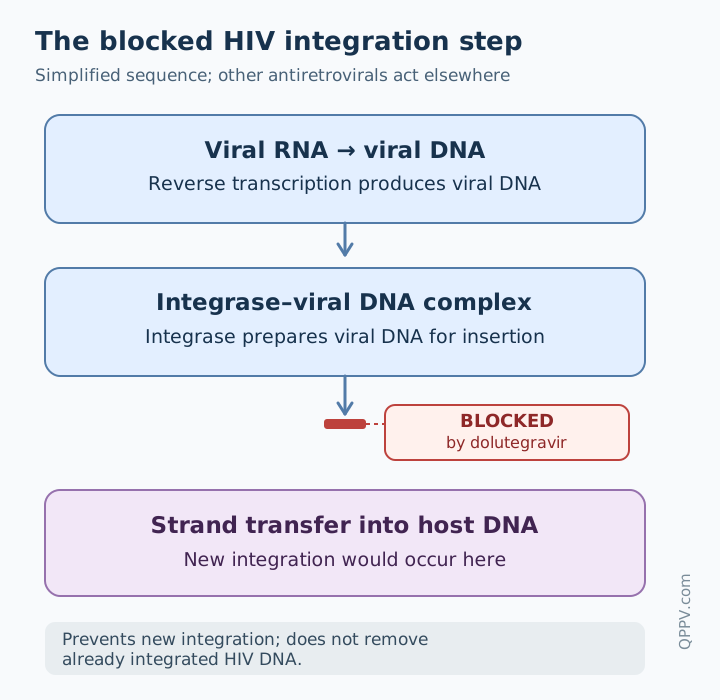
Dolutegravir binds to the integrase–viral-DNA complex and inhibits the strand-transfer step that normally links viral DNA to host DNA. It does not directly inhibit reverse transcription, viral protease or host-cell DNA replication. The partner nucleoside reverse-transcriptase inhibitors (NRTIs), non-nucleoside agents or rilpivirine in a regimen act at other viral stages. Their combined activity reduces the likelihood that replication continues under selective drug pressure.
A single low viral-load result is therefore not proof of eradication. When viral replication persists, HIV can acquire substitutions that reduce susceptibility, particularly if treatment effectively becomes functional monotherapy because companion drugs have lost activity. Conversely, detectable virus after an interruption may reflect insufficient exposure rather than an intrinsic loss of dolutegravir potency. A pharmacovigilance investigation of suspected lack of efficacy must reconstruct the full regimen, not just the integrase inhibitor.
From discovery to registration
The development was a Shionogi–GlaxoSmithKline/ViiV collaboration. ViiV Healthcare was formed by GSK and Pfizer in 2009 as a specialist HIV business; Shionogi became an equity participant in 2012, and the joint programme pursued dolutegravir through pivotal studies. This corporate chronology matters because development sponsorship and later product marketing arrangements should be attributed to the appropriate entity and period. It does not justify assigning revenue from fixed-dose combination brands to the dolutegravir molecule alone. [2,3]
The US initially approved Tivicay in August 2013; the EU issued its centrally authorised Tivicay marketing authorisation on 16 January 2014. The initial approvals were followed by additional paediatric evidence, dispersible-tablet presentations and combination products. Tivicay is the relevant single-ingredient comparator for this article. Triumeq (dolutegravir/abacavir/lamivudine), Dovato (dolutegravir/lamivudine) and Juluca (dolutegravir/rilpivirine) are separate authorised products with their own indication, constituent-specific warnings and product information. [3–5]
Pharmacology and exposure
Metabolism, transport and dose selection
Dolutegravir is metabolised mainly by UGT1A1, with a smaller contribution from CYP3A4; transporters also influence disposition. Standard adult dosing in the absence of relevant resistance or interacting inducers is generally once daily, while selected resistance patterns and enzyme-inducing co-medication require different regimens. The exact product label, resistance context and companion drugs govern the dose. Increasing the dose cannot reliably rescue activity against every resistance pattern. [4,5]
Inhibition of renal OCT2 and MATE1 reduces tubular secretion of creatinine. Serum creatinine may rise soon after starting dolutegravir without a true reduction in glomerular filtration. The distinction is clinically important but should not be used to dismiss genuine kidney injury, dehydration or tenofovir-associated renal effects without evaluation. Dolutegravir also inhibits transport of certain co-administered drugs, notably metformin, and can increase their exposure. [4,5]
Formulation is part of the medicine
Tivicay film-coated tablets and Tivicay PD tablets for oral suspension have different pharmacokinetic profiles and cannot be substituted milligram for milligram. This is a clinically consequential medication-error hazard when a patient changes from a paediatric dispersible presentation to an adult tablet, or when a caregiver interprets “five milligrams” as equivalent across products. Strength, number of tablets, formulation, weight band and preparation method must all be recorded. [4,5]
The 2026 US label expanded Tivicay PD use to term neonates weighing at least 2 kg, with age-specific dosing from birth. The EU product information assessed here still starts dispersible-tablet treatment at four weeks of age and 3 kg. The US neonatal extension cannot be assumed to apply to the EU or to preterm neonates. These are authorisation boundaries, not a scientific judgement that treatment in one region is intrinsically safer. [3–5]
Clinical development: what the trials actually established
The pivotal programme studied different clinical questions rather than a single universal efficacy claim. A treatment-naïve adult, a person with resistance to two previous drug classes, a person with integrase resistance and a virologically suppressed person considering a simplified regimen are not interchangeable trial populations. The endpoint definition, companion drugs and follow-up duration determine what can be concluded about dolutegravir. [4–12]
SPRING-2 and SINGLE: initial treatment
SPRING-2 compared once-daily dolutegravir with twice-daily raltegravir, each added to investigator-selected dual NRTI therapy, in antiretroviral-naïve adults. It was designed as a noninferiority trial. The primary 48-week analysis supported noninferiority; the subsequent 96-week results extended the observation of virologic suppression and tolerability. Noninferiority means the data excluded a loss of efficacy beyond the prespecified margin under the trial's conditions. It is not proof that two drugs or regimens are biologically identical, and the outcome cannot be attributed to the INSTI without acknowledging the background therapy. [6]
SINGLE compared dolutegravir plus abacavir/lamivudine with the fixed combination efavirenz/tenofovir disoproxil fumarate/emtricitabine. The regimen containing dolutegravir had better overall virologic response in the trial, with tolerability and discontinuation contributing to the difference. Because both the INSTI/NNRTI and the NRTI backbones differed, SINGLE is not a head-to-head isolated-molecule comparison. In particular, abacavir hypersensitivity, tenofovir renal/bone effects and efavirenz neuropsychiatric effects must be assigned to their own pharmacological and product contexts. [7]
FLAMINGO compared dolutegravir with ritonavir-boosted darunavir, both combined with selected NRTIs. At week 48, HIV-1 RNA below 50 copies/mL was achieved in 90% (217/242) and 83% (200/242), respectively. The prespecified analysis supported noninferiority and a secondary superiority finding. The open-label design and differences in discontinuation limit simplistic claims that the efficacy difference is entirely due to integrase potency. The result supports the tested regimen in treatment-naïve adults; it does not establish efficacy for dolutegravir monotherapy. [8]
SAILING and VIKING-3: treatment experience and resistance
SAILING enrolled treatment-experienced adults with resistance to at least two antiretroviral classes but without prior INSTI exposure. At week 48, 71% (251/354) receiving dolutegravir versus 64% (230/361) receiving raltegravir had HIV-1 RNA below 50 copies/mL; the prespecified sequential analysis supported superiority. Treatment-emergent integrase resistance at virologic failure was less frequent with dolutegravir. This is an important finding about a particular population and optimised background therapy, not a guarantee that resistance cannot arise. [9]
VIKING-3 addressed a more difficult group: adults with integrase inhibitor resistance and limited remaining treatment options. Dolutegravir was given twice daily with an optimised background regimen; the US product label describes 69% achieving HIV-1 RNA below 50 copies/mL at week 24. Response varied by baseline integrase substitutions, especially complex Q148 pathways. This study helped define the role and limits of dolutegravir after previous INSTI failure, but was not a randomised proof of equivalence to fully active first-line regimens. [4]
Second-line therapy: DAWNING and NADIA
DAWNING compared dolutegravir with ritonavir-boosted lopinavir, each with two NRTIs, after failure of an NNRTI-based first-line regimen. The trial found superior virologic suppression with the dolutegravir regimen at 48 weeks, alongside fewer grade 2–4 drug-related adverse events than boosted lopinavir. The study required at least one fully active NRTI at screening, a crucial qualification when generalising to patients with more extensive resistance. [10]
NADIA then addressed a different and highly practical question in seven African sites: could dolutegravir remain effective in a second-line regimen even where resistance predicted limited NRTI activity, and could tenofovir be retained rather than replaced with zidovudine? In its factorial design, 90.2% of the dolutegravir group and 91.7% of the boosted-darunavir group had HIV-1 RNA below 400 copies/mL at 48 weeks, meeting the prespecified noninferiority criterion for dolutegravir. Retaining tenofovir was also noninferior to switching to zidovudine. The threshold was 400, not the 50-copy endpoint used in many registration trials; mixing these endpoints would materially distort comparison. The results do not remove the need for resistance testing and viral-load monitoring in an individual with suspected failure. [11]
Two-drug regimens: a narrower evidentiary claim
GEMINI-1 and GEMINI-2 compared dolutegravir/lamivudine with dolutegravir plus tenofovir disoproxil fumarate/emtricitabine in selected treatment-naïve adults. At 48 weeks the pooled response was 91% (655/716) for two drugs versus 93% (669/717) for three drugs, meeting the prespecified noninferiority margin. This does not establish that any two-drug regimen is adequate in every person with HIV. Baseline viral load, resistance, hepatitis B coinfection, adherence and trial exclusions matter. Lamivudine alone is not adequate treatment for concomitant hepatitis B, and an HIV regimen must be constructed to address both infections appropriately. [12]
The separate SWORD programme studied switching virologically suppressed adults to dolutegravir plus rilpivirine. It is a switch strategy, not initial therapy for viraemic patients, and its label requires a stable suppressed regimen without relevant treatment failure or resistance. The clinical question differs from GEMINI, and the companion rilpivirine introduces its own food, acid-suppression and interaction considerations. [4]
Negative and limiting evidence
Not all clinically relevant findings are positive. The VIKING experience demonstrates markedly reduced susceptibility with some complex integrase resistance patterns. GEMINI's noninferiority does not apply to populations excluded or inadequately represented in the trials. The 2018 early pregnancy signal raised a legitimate safety concern that required much larger surveillance cohorts before its interpretation changed. And trial populations cannot adequately quantify every rare hepatic, psychiatric or pregnancy outcome. A sound lifecycle narrative records these limitations as prominently as successful registration endpoints.
The expanding product family
Dolutegravir now appears as single-ingredient Tivicay and in several fixed-dose combinations. The INN-level history can explain the shared integrase mechanism, but the adverse-event and clinical-evidence record must preserve the actual combination: abacavir can cause HLA-B*57:01-associated hypersensitivity, lamivudine and tenofovir have hepatitis B implications, and rilpivirine has distinct drug-interaction restrictions. The same principle applies to commercial performance. Sales of Dovato or Triumeq are product revenues, not an audited measure of dolutegravir's standalone revenue. [3–5,12]
The global scale of dolutegravir-based therapy also changes the evidence base. Trials are important for efficacy under defined conditions; large treatment programmes can reveal different adherence patterns, drug supply interruptions, pregnancy exposures and rare adverse events. Pharmacovigilance must combine these evidence types without treating spontaneous reports as incidence estimates or observational associations as proof of causality.
Safety: from expected symptoms to rare serious events
The clinical benefit of effective HIV suppression is substantial, but the safety assessment of a lifelong regimen must separate three layers: reactions plausibly caused by dolutegravir, effects of other antiretrovirals, and consequences of HIV infection or immune recovery. A symptom that begins after an antiretroviral switch may belong to any of these layers. The original regimen, switch date, baseline viral load, organ function, other medicines and dechallenge chronology are indispensable. [4,5]
Gastrointestinal and neuropsychiatric symptoms
Nausea, diarrhoea, headache, insomnia, fatigue and abnormal dreams are familiar tolerability concerns. In the US Tivicay registration trials, the most common moderate-to-severe reactions reported in at least 2% of participants were insomnia, fatigue and headache. The EU SmPC lists nausea, diarrhoea and headache as very common and includes insomnia, abnormal dreams, depression and anxiety among common reactions. These statements use different datasets and presentation rules; their frequency figures should not be mechanically compared. [4,5]
Depression and suicidality require particularly careful evaluation. The US label includes suicidal ideation, attempt, behaviour or completion among less common reactions in trials, mainly in participants with a history of depression or other psychiatric illness. The EU SmPC includes suicidal ideation and suicide attempt as uncommon and completed suicide as rare, with a similar contextual note. Neither label entry proves that dolutegravir caused a particular death or that stopping HIV treatment is appropriate without clinical review. Record pre-existing psychiatric history, prior antiretrovirals, substance use, life events, symptom severity, treatment changes and clinical outcome. [4,5]
Hypersensitivity and hepatotoxicity
Dolutegravir-associated hypersensitivity may involve rash, systemic symptoms and liver injury. Both regulatory labels warn that delaying discontinuation when a serious hypersensitivity reaction is suspected can be life-threatening. The EU SmPC lists hypersensitivity as uncommon and acute hepatic failure as rare; the US label describes acute liver failure and hepatotoxicity in postmarketing experience. A suspected severe reaction should trigger urgent clinical assessment under the applicable product information, not routine waiting for a second dose. [4,5]
Liver enzyme elevations have several possible explanations: dolutegravir-related injury, hepatitis B/C coinfection, other medicines, alcohol-related disease, immune reconstitution or an unrelated hepatic process. An assessment should capture bilirubin, ALT/AST, alkaline phosphatase, symptoms, virology, baseline liver function and time course. The combination's NRTI components and interruption of active hepatitis B treatment can be decisive. A labelled warning is not evidence that every elevation is a dolutegravir adverse reaction.
Creatinine, renal disease and drug transport
Dolutegravir's inhibition of OCT2/MATE1 can produce a small early serum-creatinine rise through reduced secretion without a true fall in filtration. The EU SmPC describes a mean increase of about 9.96 micromol/L at 48 weeks in clinical studies and notes that this is not considered a clinically relevant reduction in GFR. The mechanistic explanation is useful for interpreting laboratory changes, but a new progressive creatinine rise, proteinuria, dehydration or systemic illness needs independent investigation. Cystatin C, urinalysis and longitudinal trends may help clinicians distinguish transporter effects from kidney injury. [4,5]
Weight, glucose and metabolic effects
Weight gain can accompany successful HIV treatment, reversal of advanced disease and the pharmacological effects of particular antiretroviral combinations. In ADVANCE and related studies, regimens containing dolutegravir, especially with tenofovir alafenamide, were associated with more weight gain than an efavirenz/tenofovir disoproxil fumarate comparator. This is not a clean dolutegravir-only comparison: the NRTI backbone and prior treatment context also matter. The EU SmPC includes weight increased among common investigation findings; the US label includes it in postmarketing reactions. Monitor trajectories and relevant metabolic risk factors rather than attributing every change to a single ingredient. [4,5,13]
Pregnancy: how a signal changed with accumulating evidence
In 2018, an interim Botswana surveillance analysis raised concern about neural-tube defects after dolutegravir exposure at conception. Early numerical imbalance prompted caution and further follow-up. Subsequent much larger surveillance datasets substantially changed the assessment. The August 2026 US Tivicay label reports a neural-tube-defect prevalence of 0.11% among more than 9,460 conception exposures in Botswana, similar to 0.11% with non-dolutegravir regimens. The November 2025 EU SmPC likewise states that the Tsepamo and Eswatini data do not indicate an increased risk, and that Tivicay can be used during pregnancy if clinically needed. [4,5]
These are observed surveillance findings, not proof of zero risk in every subgroup. The US label acknowledges limitations in balancing confounders and evaluating folic-acid exposure. The important pharmacovigilance lesson is that an early serious signal should be investigated, communicated proportionately and revised when stronger evidence becomes available. It would be misleading to repeat an older unqualified “dolutegravir causes neural-tube defects” claim after the later evidence and label revisions. For an individual pregnancy report, record the exact exposure window relative to conception and neural-tube closure, companion medicines, folate history if known, ultrasound or outcome ascertainment and the method of case confirmation. [4,5]
Neonatal use and the limits of evidence
The 25 August 2026 US label expanded Tivicay PD to term neonates from birth weighing at least 2 kg. It relies on the IMPAACT 2023 neonatal pharmacokinetic/safety programme and modelling, not a large neonatal efficacy trial. The label describes 48 enrolled neonates in two exposure cohorts and explicitly states that safety and effectiveness have not been established for preterm neonates, those below 2 kg or paediatric patients with relevant INSTI resistance. The EU SmPC assessed here has not adopted the same birth-to-four-week indication. Extrapolating from the US label into EU authorisation would be a regulatory error. [4,5,14]
Neonatal safety monitoring has practical dimensions beyond laboratory events: caregiver administration, dispersible-tablet preparation, timing and age/weight transitions, concomitant maternal exposure, competing neonatal diagnoses and loss to follow-up. A reported event in an HIV-exposed but uninfected neonate may be from prophylactic exposure or maternal in-utero exposure, not necessarily treatment of established neonatal infection. Record the indication and exposure route before coding lack of efficacy.
Drug interactions that can create apparent treatment failure
Chelation: an absorption problem, not viral resistance
Magnesium/aluminium antacids, sucralfate and mineral-containing supplements can reduce dolutegravir absorption. In the EU product information, coadministration of magnesium/aluminium antacid under studied conditions reduced dolutegravir AUC by approximately 74%. The US label instructs separation by two hours before or six hours after such products; when taken with food, calcium or iron supplements may be taken at the same time under the stated conditions. The EU SmPC gives corresponding instructions and additionally discusses multivitamins containing magnesium. [4,5]
A patient who has been “adherent” to all prescribed tablets but takes dolutegravir with an antacid each morning may have inadequate exposure. Such a case is not automatically a manufacturing defect or resistance mutation. Establish the actual clock times, food, supplement composition and whether the instruction was explained in a language the patient understood.
Enzyme induction and incomplete suppression
Rifampicin, carbamazepine and some other inducers can reduce dolutegravir concentrations through UGT/CYP induction. Labels provide different management instructions depending on prior INSTI exposure, resistance and age. In the US label, coadministration with oxcarbazepine, phenytoin, phenobarbital or St John's wort is to be avoided because there are insufficient data for dosing recommendations; the EU SmPC contains dose recommendations for some of these combinations in susceptible patients. This difference must be preserved rather than merged into a universal rule. [4,5]
Increased exposure to other medicines
Dolutegravir can increase metformin exposure through OCT2/MATE1 inhibition; the clinical response may require monitoring or dose adjustment, particularly with reduced kidney function. The US label contraindicates dofetilide because of potentially dangerous increased exposure, while its dalfampridine interaction is addressed as a seizure-risk benefit–risk warning. The EU SmPC contraindicates narrow-therapeutic-window OCT2 substrates, explicitly including fampridine/dalfampridine. The difference between a US contraindication and a US interaction warning for dalfampridine is a meaningful regional safety distinction. [4,5]
An interaction table is a starting point, not a substitute for checking the current local product information and the exact co-prescribed medicines. Changes to rifampicin, antiepileptics or metformin can themselves create a new exposure period even when the dolutegravir prescription is unchanged.
Dated US–EU listedness: Tivicay, not an unspecified combination
Review date: 29 October 2026. The US reference is the ViiV Healthcare Tivicay film-coated tablets and Tivicay PD tablets for oral suspension, DailyMed set 63df5af3-b8ac-4e76-9830-2dbb340af922, SPL version 34, effective 25 August 2026, especially sections 4–8 and 12–14. The EU reference is the centrally authorised Tivicay film-coated and dispersible tablets, EMA product information last updated 14 November 2025, SmPC sections 4.1–4.8 and 5.1–5.2. The US neonatal extension and EU paediatric scope are explicitly different. These documents are not the USPI or SmPC for Dovato, Triumeq or Juluca. [3–5]
| Safety or regulatory question | US Tivicay/Tivicay PD, August 2026 | EU Tivicay, November 2025 | Assessment boundary |
|---|---|---|---|
| Nausea, diarrhoea, headache | Section 6.1 trial tables and clinical context; highlights emphasise moderate/severe insomnia, fatigue and headache | Section 4.8: nausea, diarrhoea and headache very common | US trial reporting threshold is not an EU frequency category |
| Insomnia, depression, suicidality | Insomnia in 6.1; suicidal ideation/attempt/behaviour/completion described among less common trial reactions, particularly with psychiatric history | Insomnia and depression common; suicidal ideation/attempt uncommon, completed suicide rare | Explicitly listed in both with different presentation and frequencies; causality is separate |
| Hypersensitivity | Section 5.1 serious warning and section 6 clinical context | Section 4.8 uncommon; section 4.4 describes severe systemic presentations | Warning prominence does not replace exact reaction-term assessment |
| Hepatitis, liver failure | Hepatitis in section 6.1; acute liver failure and hepatotoxicity in postmarketing section 6.2 | Hepatitis uncommon; acute hepatic failure/increased bilirubin rare | US postmarketing reports do not yield a reliable incidence |
| Weight gain | Section 6.2: weight increased | Section 4.8: weight increased common | EU frequency cannot be transferred to US spontaneous reports |
| Sideroblastic anaemia | Section 6.2 postmarketing | Section 4.8 frequency not known; contribution of dolutegravir in combination cases unclear | Listed in both, with explicit causal uncertainty |
| Renal creatinine change | Section 12.3 explains OCT2/MATE1 transporter effect; renal impairment also mentioned in 6.1 | Section 4.8 explanatory text describes early stable creatinine rise without reduced GFR | Do not confuse mechanistic lab change with confirmed acute kidney injury |
| Major interacting drugs | Dofetilide contraindicated (section 4); dalfampridine seizure-risk interaction in section 7 | Narrow-therapeutic-window OCT2 substrates, including fampridine/dalfampridine, contraindicated (4.3) | Material contraindication-versus-interaction difference |
| Paediatric indication | Tivicay PD from birth in term neonates at least 2 kg; film-coated tablets have separate weight restrictions | Dispersible tablets from 4 weeks and 3 kg; film-coated tablets from 6 years and 14 kg | Regional indication and formulation differences, not reaction frequencies |
| Pregnancy | Section 8.1 includes large Botswana/Eswatini surveillance datasets and limitations | Section 4.6 says use during pregnancy if clinically needed, with no increased NTD signal in larger datasets | Pregnancy narrative is not a tabulated adverse-reaction listedness claim |
Listedness method. For a particular ICSR event, match the medically precise term to the correct dated product and the actual adverse-reaction section, and record whether it appears in a clinical-trial table, postmarketing list, explanatory narrative, warning or interaction section. An event appearing only in a precaution must not be silently described as a tabulated EU section-4.8 reaction. “Not mentioned in the reviewed section” is not synonymous with “not listed” under company core safety information. The company's CCDS/CCSI, applicable clinical-trial reference safety information (RSI), local label and reporting rules answer different questions. A listed event can still be unrelated to the product in an individual patient; an unlisted event may be a genuine new signal. [4,5]
Pharmacovigilance assessment: the regimen is the exposure
An effective case intake sequence
For suspected dolutegravir reactions or lack of efficacy, begin with the exact product, country, strength, tablet formulation, number of doses, indication and dates. Reconstruct every antiretroviral component and recent switches, including a prior or concurrent long-acting regimen. Record the viral load and resistance history, CD4 count, hepatitis B/C status, renal and liver function, pregnancy exposure if relevant, and concomitant medicines. Determine whether the event was reported by the patient, clinician, programme or other source; maintain original reporter wording alongside coded medical terms.
Then establish the temporal sequence. For hypersensitivity, document rash morphology, mucosal involvement, fever, liver tests, treatment and outcome. For a creatinine rise, document baseline trend, urinary findings, concomitant nephrotoxins and any alternative measure of filtration. For virologic rebound, obtain actual dosing times, pharmacy refill gaps, antacids and supplements, TB treatment, adherence barriers, repeat viral load and genotype when available. The aim is to test alternative explanations, not to assume a drug defect because a patient reports “treatment stopped working.”
Distinguishing case types
A valid suspected adverse reaction, a medication error without harm, a product-quality complaint, a drug interaction and lack of therapeutic efficacy are related but distinct records. A child given the wrong number of dispersible tablets may experience toxicity or insufficient antiviral exposure; the error and its outcome need separate documentation. A batch-quality concern warrants coordination with quality and, where applicable, device/product investigations. A viral-load rise after a supply interruption is not automatically a resistance mutation, and a confirmed mutation does not establish which missed dose caused it.
The relevant reporting and escalation requirements depend on jurisdiction, report source, seriousness, causality and applicable pharmacovigilance procedures. Good practice is to document day zero, follow-up attempts, duplicate search, translation and source traceability. These are process recommendations unless tied to an identified legal or procedural requirement; they are not invented universal deadlines.
Three illustrative assessments
Apparent loss of efficacy after tuberculosis treatment. A previously suppressed adult develops detectable HIV RNA after starting rifampicin. Record the actual dolutegravir regimen, inducer start date, any dose adjustment, other NRTIs, adherence and repeat viral load. Reduced dolutegravir exposure is plausible; resistance should be assessed rather than presumed. Document the label and clinician's management decision.
Neonatal dispensing discrepancy. A caregiver reports that an infant received film-coated tablets rather than Tivicay PD. Capture gestational age, current weight, country, exact tablet strengths, prescribed dose, preparation, administration and exposure timing. The US 2026 neonatal indication does not authorise milligram-for-milligram substitution, and the EU product scope differs. Evaluate both the error and clinical outcome.
New depression after an antiretroviral switch. Record symptom onset, prior psychiatric history, social circumstances, other drugs, sleep, HIV control, seriousness and intervention. Both assessed labels discuss psychiatric events, but listedness does not determine individual causality. A suicidal crisis requires urgent clinical management; a pharmacovigilance assessment must not delay it.
From individual cases to signal governance
Signal detection should stratify by Tivicay versus each fixed-dose combination, indication, age, pregnancy status, previous antiretroviral exposure and co-medications. The numerator in a spontaneous-report database is not an incidence rate, because reporting probability, duplicate cases and exposure denominators vary. Compare disproportionality findings with clinical trials, registries, pregnancy surveillance, cohort studies and regulatory communications.
For weight gain, compare changes within regimens and consider TAF versus TDF, prior efavirenz exposure, sex, baseline BMI and disease recovery. For suspected neuropsychiatric reactions, use medically reviewed case series with baseline risk and dechallenge information. For paediatric errors, assess whether revised labelling, pack design, dosing charts and caregiver education reduce errors in practice. For pregnancy, retain the chronology of the 2018 early signal and later larger datasets; do not continue outdated warning narratives after authoritative reassessment.
An inspection-ready record should preserve the source case, assessment rationale, label revision, medical review, signal decisions, corrective actions and effectiveness checks. If a new regional label difference becomes clinically consequential, the MAH should assess its own obligations under the applicable framework rather than assuming one authority's decision automatically changes another authority's authorised information.
Key Takeaways
Dolutegravir was discovered through integrase medicinal chemistry and developed through the Shionogi–ViiV programme into a widely used HIV treatment component. Its efficacy is supported by multiple trials, but trial results belong to their studied regimens and populations. Important safety questions include hypersensitivity, liver injury, psychiatric symptoms, weight change, pregnancy outcomes, renal transporter effects and interactions that can undermine exposure. The August 2026 US neonatal indication is not the same as the November 2025 EU indication. Product-specific listedness, clinical-trial expectedness, individual causality and reporting obligations must be assessed separately.
References
- Johns BA et al. Carbamoyl pyridone HIV-1 integrase inhibitors 3: discovery of dolutegravir and S/GSK1265744. J Med Chem. 2013;56:5901–5916. doi:10.1021/jm400645w. https://pubmed.ncbi.nlm.nih.gov/23845180/
- GSK. Shionogi–ViiV Healthcare announces completion of initial clinical registration package for dolutegravir. 2012. https://www.gsk.com/en-gb/media/press-releases/shionogi-viiv-healthcare-announces-completion-of-initial-clinical-registration-package-for-dolutegravir-in-hiv/
- European Medicines Agency. Tivicay EPAR, authorisation and product history, accessed 29 October 2026. https://www.ema.europa.eu/en/medicines/human/EPAR/tivicay
- DailyMed, US National Library of Medicine. Tivicay and Tivicay PD (dolutegravir), ViiV Healthcare Company, SPL version 34, effective 25 August 2026; USPI sections 1–8 and 12–14. https://dailymed.nlm.nih.gov/dailymed/drugInfo.cfm?setid=63df5af3-b8ac-4e76-9830-2dbb340af922
- European Medicines Agency. Tivicay EU product information, last updated 14 November 2025; SmPC sections 4.1–4.8 and 5. https://www.ema.europa.eu/en/documents/product-information/tivicay-epar-product-information_en.pdf
- Raffi F et al. Once-daily dolutegravir versus raltegravir in antiretroviral-naïve adults (SPRING-2). Lancet. 2013. PMID 23306000. https://pubmed.ncbi.nlm.nih.gov/23306000/
- Walmsley SL et al. Dolutegravir plus abacavir–lamivudine for treatment of HIV-1 infection (SINGLE). N Engl J Med. 2013;369:1807–1818. doi:10.1056/NEJMoa1215541. https://www.nejm.org/doi/abs/10.1056/NEJMoa1215541
- Clotet B et al. Once-daily dolutegravir versus darunavir/ritonavir (FLAMINGO), week 48. Lancet. 2014. PMID 24698485. https://pubmed.ncbi.nlm.nih.gov/24698485/
- Cahn P et al. Dolutegravir versus raltegravir in treatment-experienced, INSTI-naïve adults (SAILING). Lancet. 2013. PMID 23830355. https://pubmed.ncbi.nlm.nih.gov/23830355/
- Aboud M et al. Dolutegravir versus lopinavir/ritonavir in second-line HIV treatment (DAWNING). Lancet Infect Dis. 2019. PMID 30732940. https://pubmed.ncbi.nlm.nih.gov/30732940/
- Paton NI et al. Dolutegravir or darunavir with NRTIs after first-line failure (NADIA). N Engl J Med. 2021. PMID 34289276. https://pubmed.ncbi.nlm.nih.gov/34289276/
- Cahn P et al. Dolutegravir/lamivudine versus three-drug therapy (GEMINI-1 and GEMINI-2), week 48. Lancet. 2019. PMID 30420123. https://pubmed.ncbi.nlm.nih.gov/30420123/
- Kanters S et al. Evidence synthesis evaluating body weight gain among people treating HIV with antiretroviral therapy: systematic review and network meta-analysis. eClinicalMedicine. 2022;48:101412. doi:10.1016/j.eclinm.2022.101412. PMID 35706487. https://pubmed.ncbi.nlm.nih.gov/35706487/
- ViiV Healthcare. FDA approval of Tivicay PD for term neonates from birth weighing at least 2 kg, August 2026; IMPAACT 2023 and pharmacokinetic bridging. https://viivhealthcare.com/en-us/media-center/news/press-releases/2026/august/helping-close-a-critical-hiv-treatment-gap/
Regulatory Note
This educational review is not individual medical advice or a substitute for authorised product information. Dolutegravir indications, dosing, interaction management, formulation interchangeability and paediatric restrictions differ by jurisdiction and change over time. Use the exact current USPI or EU SmPC and appropriate HIV treatment guidance for clinical decisions. A suspected adverse event, a label entry and an individual causal relationship are different concepts; clinical-trial RSI expectedness and local reporting duties require separate assessment.