Efanesoctocog alfa: Discovery, Development, Safety and Pharmacovigilance
Efanesoctocog alfa is a recombinant factor VIII (FVIII) replacement medicine engineered to remain active longer than conventional FVIII concentrates. Its central innovation is not a different clotting target but a different relationship with von Willebrand factor (VWF), the plasma carrier that protects endogenous FVIII while also imposing a limit on its circulating half-life. The product can sustain clinically useful FVIII activity across a once-weekly prophylaxis interval in many previously treated patients with severe haemophilia A. This benefit does not eliminate breakthrough bleeding, inhibitor formation, hypersensitivity or the need for reliable laboratory interpretation. [1–4]
The article follows the single WHO international nonproprietary name efanesoctocog alfa. ALTUVIIIO is the US brand; ALTUVOCT is the EU brand. These are not separate INNs or independent discovery stories. Other recombinant FVIII medicines, including efmoroctocog alfa, provide essential historical context but have different molecular constructs, labels and evidence. The comparisons below are anchored to the US FDA package insert revised December 2025, the EMA ALTUVOCT product-information record updated 12 October 2026, and the accessible European product-information text. [1–3]
- Efanesoctocog alfa: Discovery, Development, Safety and Pharmacovigilance
- The clinical problem before this molecule
- Molecular design: decoupling FVIII from its usual carrier
- Discovery and development history
- Early pharmacokinetic evidence and the transition to phase III
- XTEND-1: efficacy in previously treated adolescents and adults
- XTEND-Kids: extending evidence to younger children
- Surgery and the extension programme
- Benefit, burden and competing treatment approaches
- Product-specific listedness: US ALTUVIIIO versus EU ALTUVOCT
- Immunogenicity: inhibitors remain a decisive safety concern
- Other special safety situations
- Pharmacovigilance practice: a product, a patient and a laboratory result
- Risk minimisation, evidence and governance
- Unanswered questions and boundaries of evidence
- Practical review checklist
- Key Takeaways
- References
- Regulatory Note
The clinical problem before this molecule
Haemophilia A is caused by deficiency or dysfunction of FVIII, a cofactor that enables activated factor IX to accelerate activation of factor X. Inadequate thrombin generation predisposes patients to spontaneous and trauma-related bleeding, particularly haemarthroses, deep muscle bleeds and potentially life-threatening internal haemorrhage. Repeated joint bleeding can produce chronic pain, synovitis, structural damage and disability. Replacement FVIII increases circulating cofactor activity but does not correct the inherited F8 defect. The clinical objective of prophylaxis is to prevent bleeding and preserve function over years, not merely to treat each episode after it begins. [1–3,5]
Earlier plasma-derived and recombinant FVIII products transformed care but commonly required multiple intravenous infusions each week. Fc-fusion and other extended-half-life technologies reduced some of this burden. Yet FVIII circulates bound to VWF, and the clearance kinetics of that complex constrain how much its half-life can be extended. In contrast to factor IX, for which half-life extension can be more pronounced, an FVIII fusion that remains dependent on endogenous VWF faces a biological ceiling. The development question was whether one could retain FVIII function and protection from premature degradation without depending on binding to the patient's circulating VWF. [4,5]
Bleeding risk is not a linear function of a single measured FVIII concentration. Physical activity, joint status, prior bleeding phenotype, comorbidities, injury and the timing of exposure all matter. A high peak immediately after an infusion does not prove sustained protection at the end of the dosing interval. Likewise, a trough value measured using an inappropriate assay may misrepresent exposure. These distinctions became especially important when a novel molecule offered much higher sustained activity than traditional concentrates.
Molecular design: decoupling FVIII from its usual carrier
Efanesoctocog alfa was developed under the code BIVV001, described as a recombinant FVIII–Fc–VWF–XTEN fusion protein. Its architecture combines an FVIII functional region with a covalently attached VWF D′D3 domain, an immunoglobulin G1 Fc region and two XTEN polypeptide segments. The VWF D′D3 domain provides a built-in FVIII-binding partner and helps prevent the engineered protein from binding endogenous VWF. Fc can engage the neonatal Fc receptor (FcRn) recycling pathway, while XTEN segments contribute to the altered pharmacokinetic profile. The components act together; the construct should not be described as a mixture of freely administered FVIII, VWF and an antibody. [2,4,5]
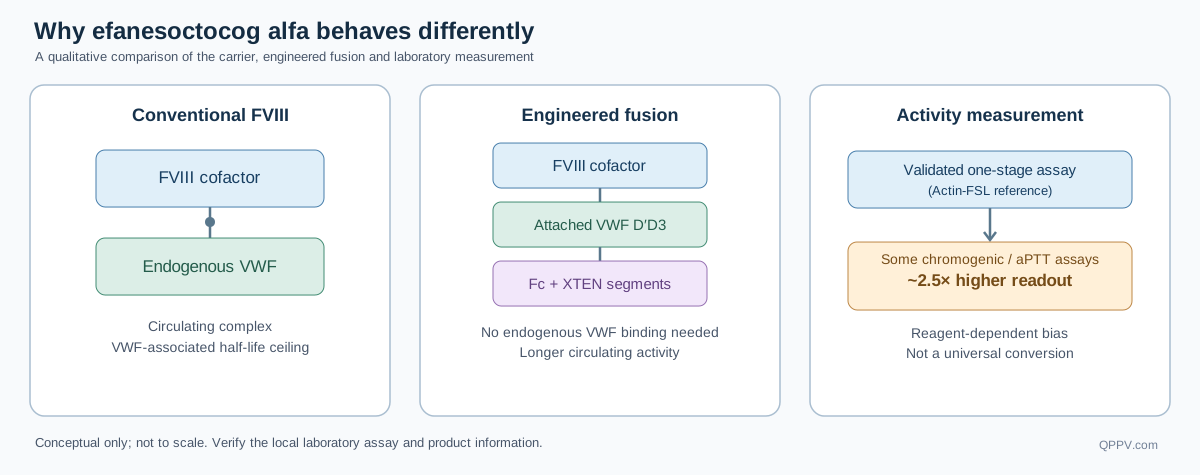
Figure 1. A qualitative mechanism-and-measurement map. The attached VWF D′D3 domain, Fc and XTEN segments are design elements of one recombinant fusion protein. The assay panel describes an analytical discrepancy, not a biological increase in FVIII concentration or a universal correction for every reagent.
This engineering allows high sustained FVIII activity without requiring the administered protein to travel as a conventional complex with endogenous VWF. The resulting longer half-life is a property demonstrated in clinical pharmacokinetic studies, not a promise that every patient will have identical exposure. A person's measured activity can depend on body size, baseline disease, assay system, sampling time and other variables. [1,2,4]
Pharmacodynamic interpretation
Once infused intravenously, the molecule supplies functional FVIII cofactor activity in the intrinsic tenase complex. Activated FVIII supports factor IXa-mediated factor X activation; factor Xa then contributes to thrombin generation and fibrin formation. This is replacement therapy, not gene transfer. It does not create durable endogenous FVIII production after the drug has cleared, nor does it bypass a high-titre neutralising anti-FVIII inhibitor. [1,2]
A clinical benefit–risk analysis must therefore consider both sustained protection and reversibility of exposure. A weekly infusion may reduce venous-access burden compared with more frequent products, but a missed weekly dose creates a longer interval without intended prophylaxis. The medicine remains an intravenous biologic requiring preparation, training, traceability and a plan for acute bleeding. A once-weekly schedule is not evidence that laboratory monitoring, perioperative planning or emergency access to haemophilia care has become unnecessary.
Discovery and development history
BIVV001 grew from a programme seeking to extend FVIII activity beyond the VWF-related ceiling. The technology built on earlier recombinant FVIII–Fc work while incorporating VWF D′D3 and XTEN elements. Bioverativ, formed as a Biogen spin-off, held an important development role. Sanofi announced its acquisition of Bioverativ in January 2018 and completed it in March 2018. Swedish Orphan Biovitrum (Sobi) participated through a longstanding haemophilia collaboration and became the EU marketing-authorisation holder for ALTUVOCT. These relationships explain why the FDA identifies Bioverativ Therapeutics Inc. (a Sanofi company) as manufacturer while the EMA identifies Swedish Orphan Biovitrum AB as marketing-authorisation holder. They do not mean that every partner independently invented the molecule. [1–3,6–8]
The US FDA granted fast-track designation in February 2021 and breakthrough-therapy designation in June 2022. These designations are development and review mechanisms, not proof of efficacy or marketing approval. The clinical programme advanced from single- and repeated-dose pharmacokinetic studies into XTEND-1 in adults and adolescents, XTEND-Kids in younger children and the XTEND-ed extension. FDA approval followed on 22 February 2023. EMA's positive CHMP opinion was adopted 25 April 2024, and EU authorisation was issued 17 June 2024. The chronology matters: initial clinical trials established efficacy in previously treated populations; subsequent surveillance and extension studies address questions that a finite pivotal trial cannot settle. [1–4,6–9]
The business story is relevant to pharmacovigilance because responsibilities for product complaints, batch traceability, national labelling, local distribution and safety reporting follow the applicable legal entities and contracts. They must not be inferred from the molecule's brand alone. The same INN can have different marketed presentations and jurisdiction-specific risk-minimisation arrangements.
Early pharmacokinetic evidence and the transition to phase III
Before efficacy claims could be tested in a broad prophylaxis programme, investigators needed to establish whether the molecular design actually changed exposure in humans. Early sequential-dose comparisons in previously treated adults with severe haemophilia A found a substantially longer terminal half-life than conventional recombinant FVIII comparators. At a 50 IU/kg dose, a reported mean terminal half-life of 43.3 hours for efanesoctocog alfa compared with 15.4 hours for rurioctocog alfa pegol and 11.0 hours for octocog alfa in that early comparison. These are pharmacokinetic measurements in small selected groups, not estimates of long-term clinical effectiveness or proof of a safety advantage. [4,5]
Repeat-dose research supported weekly administration without clinically important accumulation in the studied patients. Pharmacokinetic performance was especially relevant because conventional FVIII levels can fall toward very low values between injections. Investigators were seeking a weekly regimen that could preserve more sustained activity while still allowing flexible treatment of bleeding and surgery. The dose ultimately studied in the pivotal programme was 50 IU/kg intravenously once weekly. This is the authorised routine prophylaxis dose in the assessed US and EU information, although other dosing instructions for bleeding and surgery must be checked separately. [1,2,4]
XTEND-1: efficacy in previously treated adolescents and adults
The pivotal XTEND-1 phase III study was open-label and enrolled 159 previously treated patients aged 12 years or older with severe haemophilia A. In group A, 133 patients received 50 IU/kg weekly prophylaxis for 52 weeks. Group B included 26 patients who initially received on-demand treatment and subsequently switched to prophylaxis. The main endpoint was annualised bleeding rate (ABR) under weekly prophylaxis. A key secondary endpoint compared prophylaxis during the trial with the same participants' prestudy FVIII prophylaxis where suitable data existed. The design was not a blinded, randomised head-to-head comparison against every available replacement product. [4]
The estimated mean ABR in group A was 0.71 (95% confidence interval 0.52–0.97), with a median of 0. Among the 77 participants contributing to the within-person prestudy comparison, estimated mean ABR fell from 2.96 (95% CI 2.00–4.37) during prior prophylaxis to 0.69 (95% CI 0.43–1.11) during efanesoctocog alfa prophylaxis (P<0.001). The primary mean of 0.71 and the paired-comparison mean of 0.69 describe different analysis populations; combining them as though they were the same endpoint would be an error. Prior-treatment comparisons may also be affected by differences in observation and ascertainment. [4]
Nearly all recorded bleeding episodes in the overall study population—97%—resolved after one efanesoctocog alfa injection. At steady state, mean FVIII activity remained above 40 IU/dL for much of the weekly interval and was approximately 15 IU/dL at day 7 in the adult/adolescent study. Physical-health, pain-intensity and joint-health outcomes also improved in prespecified analyses, but patient-reported and joint endpoints should not be substituted for a long-term demonstration that structural arthropathy is prevented. No FVIII inhibitors were detected during this finite previously treated study population. [4]
What the pivotal comparison does not establish
A low ABR is clinically meaningful because repeated bleeding causes cumulative harm. Yet an ABR averaged across a selected trial population cannot predict an individual patient's bleed risk during trauma, surgery or a prolonged interruption in prophylaxis. Cross-trial comparisons are particularly hazardous: baseline severity, age, prior inhibitor history, adherence, joint disease, outcome definitions and reporting periods differ. XTEND-1 did not randomise patients to efanesoctocog alfa versus emicizumab, gene therapy or every extended-half-life FVIII product. It therefore does not establish direct comparative superiority over those strategies. [4,5]
Likewise, the absence of inhibitors in previously treated patients cannot be extrapolated to previously untreated patients (PUPs). Inhibitor risk is concentrated early in FVIII exposure for many patients, and a programme dominated by PTPs has limited power to measure that risk. Clinical trial findings should be presented alongside postmarketing evidence and class-specific immunogenicity experience rather than used to dismiss inhibitor surveillance. [1,2]
XTEND-Kids: extending evidence to younger children
XTEND-Kids was a phase III, open-label study of 74 previously treated boys younger than 12 years, including 38 younger than six and 36 aged six to under twelve. Patients received weekly efanesoctocog alfa 50 IU/kg for 52 weeks. The primary endpoint was development of FVIII inhibitors; secondary outcomes included treated bleeding, haemostatic response, safety and pharmacokinetics. No inhibitors were detected in the study. Among 73 patients treated according to protocol, the model-based mean ABR was 0.61 (95% CI 0.42–0.90) and the median was zero. Of 43 treated bleeding episodes, 41 (95%) resolved with a single injection. [5]
Steady-state mean FVIII activity in children exceeded 40 IU/dL for about three days and remained above 10 IU/dL for almost seven days. The reported geometric mean terminal half-life was approximately 40 hours. These values illustrate the intended pharmacology but should not be treated as a guaranteed trough in a child whose infusion was delayed or whose assay method differs. No treatment-related serious adverse event was reported in the primary trial publication, a finding bounded by sample size, selection and follow-up. [5]
The age range of the trial must be distinguished from marketing authorisation. The US ALTUVIIIO label covers adults and paediatric patients with haemophilia A; the EU ALTUVOCT SmPC states that the medicine can be used in all age groups. A UK ALTUVOCT SmPC updated in May 2026 separately describes use from age two years for moderate or severe disease. These are different regulatory documents; the UK age restriction must not be attributed to the EU central authorisation. [1–3,10]
Surgery and the extension programme
The EMA assessment describes combined evidence from 41 patients undergoing major surgery across three studies. Surgical haemostasis was considered supportive of the perioperative indication, but these patients were not a randomised trial comparing competing haemostatic protocols. Surgical management still requires assessment of procedure, timing, measured FVIII activity where indicated, blood loss and postoperative bleeding. The US label includes perioperative management among its indications; the EU treatment indication and posology likewise address surgery. [1–3]
XTEND-ed, a long-term, open-label extension, provides additional follow-up of previously treated patients. Published and conference-reported interim analyses have generally shown low bleeding rates and no detected inhibitors in their selected rollover cohorts, including children; the follow-up is valuable but remains subject to survivorship, selection and absence of a contemporaneous control group. A 2026 peer-reviewed interim report in children strengthens the duration of observation but does not establish lifetime immunogenicity safety. Conversely, the December 2025 US label now identifies postmarketing inhibitor development and anaphylaxis despite no inhibitors or anaphylaxis-related adverse drug reactions being reported in its original pooled clinical-trial dataset. This is an important example of how evidence changes after approval. [1,11]
Benefit, burden and competing treatment approaches
Once-weekly FVIII prophylaxis can be attractive to patients and families facing repeated venous access. It offers a measurable replacement factor activity that can be adapted for acute bleeding and surgery. Non-factor prophylaxis such as emicizumab, other haemostatic strategies and selected gene therapies differ fundamentally in mechanism, eligibility, laboratory interference, long-term uncertainty and access. Their benefits and risks cannot be ranked solely by counting infusions or comparing ABRs from unrelated trials.
Treatment choice remains a shared clinical decision shaped by age, inhibitor history, venous access, bleeding phenotype, joint health, planned procedures, patient preference, access and local guidance. A product's longer half-life may improve convenience, but it cannot replace contingency planning for breakthrough bleeding or a specialist haemophilia treatment centre.
Product-specific listedness: US ALTUVIIIO versus EU ALTUVOCT
For pharmacovigilance, listedness must be assessed against a specified reference document, not against the generic expectation that factor VIII products may cause inhibitors. The two regulatory anchors used here are:
- United States: FDA ALTUVIIIO, Bioverativ Therapeutics Inc., recombinant Fc–VWF–XTEN FVIII powder for intravenous reconstitution; US package insert revised December 2025, particularly sections 4, 5.1–5.3, 6.1–6.2, 8 and 14. The FDA biologics page lists subsequent and prior approval actions; a supplement approval date alone does not establish the wording of every adverse reaction. [1]
- European Union: EMA ALTUVOCT, Swedish Orphan Biovitrum AB, centrally authorised recombinant FVIII powder and solvent; EMA product-information page last updated 12 October 2026. The accessible EU Annex I SmPC text and EMA overview were assessed, particularly sections 4.1–4.8. The direct PDF's extracted content was available, but its file-level revision stamp was not independently established from the extracted text; therefore the page's October update date should not be misrepresented as proof that every extracted paragraph was newly revised that day. A UK ALTUVOCT SmPC updated 18 May 2026 corroborates several safety terms but is a separate national document, not the EU label. [2,3,10]
Comparative adverse-reaction assessment
| Safety issue | US ALTUVIIIO, December 2025 | EU ALTUVOCT, available Annex I text |
|---|---|---|
| Headache and arthralgia | Section 6.1: most common trial ADRs; pooled trial table lists headache 15% and arthralgia 13% among 233 previously treated participants | Section 4.8: both very common (at least 1 in 10) |
| Pain in extremity, back pain, vomiting, pyrexia | Section 6.1 pooled trial table: 4%, 4%, 3%, 4%, respectively | Section 4.8: all common |
| Eczema, rash, urticaria | Not named in the US section 6.1 pooled ADR table assessed | Section 4.8: each common; do not interpret omission from the US table as proof of absence or US case-specific unexpectedness |
| Injection-site reaction | Not named in the US pooled section 6.1 ADR table assessed | Section 4.8: uncommon |
| FVIII neutralising inhibitors | Section 5.2 warning and section 6.2 postmarketing adverse reaction; no inhibitors detected in the original 233-person trial safety dataset | Section 4.4 warning and section 4.8 adverse-reaction table; frequency is class-based, very common in previously untreated patients and uncommon in previously treated patients, not an efanesoctocog-specific observed trial incidence |
| Hypersensitivity including anaphylaxis | Severe prior hypersensitivity is a contraindication; sections 5.1 and 6.2 postmarketing describe hypersensitivity/anaphylaxis | Sections 4.3–4.4 and 4.8 cover hypersensitivity/anaphylaxis; frequency not known in the adverse-reaction table |
| Thromboembolic events | Section 6.1 reports 3/261 (1%) patients with events in a long-term extension, all with pre-existing risk factors; this is a reported observation, not one of the named US section 6.1 pooled ADR-table terms | Section 4.4 discusses cardiovascular risk in patients with existing risk factors; the accessible 4.8 table does not identify a distinct thromboembolic ADR frequency |
This comparison deliberately separates a listed adverse reaction, a warning or contraindication, and a study observation. The labels use different population denominators and reporting conventions. The EU table's PUP and PTP inhibitor frequency categories are derived from other FVIII product experience rather than measured rates in the original efanesoctocog trials. The US table covers 233 participants from the two original pivotal studies; the accessible EU table describes a broader 277-person safety population, including additional data. One must not subtract these counts and claim that the difference represents a safety signal or a product-specific change in incidence. [1,2]
The presence of a reaction in a public USPI or SmPC is not equivalent to company-core listedness, the applicable reference safety information for a particular clinical trial, case-specific expectedness, a causality judgement or an automatic expedited-reporting decision. Those determinations require the actual governing document, date, authorisation and reporting rules. Similarly, a term not displayed in the US pooled ADR table may still be addressed elsewhere in the label or be reportable as a suspected reaction.
Immunogenicity: inhibitors remain a decisive safety concern
Neutralising anti-FVIII antibodies can prevent an infused replacement product from producing the expected activity and haemostatic response. The clinical clue may be new spontaneous bleeding, failure of a bleed to respond to an adequate dose, or a lower-than-expected measured FVIII recovery. The US and EU labels direct clinicians to assess for inhibitors when the expected response is not achieved. Inhibitor titre is typically expressed in Bethesda units using a validated modified assay. [1,2]
It would be wrong to state that efanesoctocog alfa cannot produce inhibitors because XTEND-1 and XTEND-Kids detected none. Those trials enrolled previously treated patients and could not exclude rare events or define the risk in previously untreated infants. Postmarketing inhibitor reports are now acknowledged in both the US and EU product information. When reviewing a suspected case, distinguish a true neutralising antibody from an assay artefact, missed infusion, administration error, product storage problem, active major bleed or increased clearance. A haemophilia centre should direct clinical evaluation and management. [1,2,4,5]
Laboratory interference is a safety issue, not merely a technical footnote
Efanesoctocog alfa activity can be overestimated by approximately 2.5-fold using certain chromogenic assays or particular ellagic-acid-based one-stage aPTT reagents, relative to the validated Actin-FSL-based one-stage assay used during development. The assessed labels describe dividing the affected result by about 2.5 to approximate the reference result; this is a reagent-dependent estimate, not a universal correction to apply to every assay, laboratory or patient. Other reagents may show different bias. [1,2,10]
This matters during life-threatening bleeding and surgery, when decisions about repeat dosing depend on the reliability of measured FVIII activity. An erroneously high reported activity could lead clinicians to underestimate a patient's need for replacement; an erroneously low result could prompt unnecessary dosing. The laboratory report should document reagent, assay method, calibration and interpretation. A validated reference method or specialist laboratory consultation is preferable to silently applying a conversion factor after the fact. If inhibitors are suspected, testing must also use a method suitable for the particular therapy and laboratory context.
Other special safety situations
Hypersensitivity. The US label contraindicates ALTUVIIIO after severe hypersensitivity to the product or excipients. Allergic symptoms including urticaria, wheeze, chest tightness, hypotension and anaphylaxis warrant immediate clinical assessment; the label directs discontinuation and appropriate treatment when a hypersensitivity reaction occurs. Record timing relative to infusion, batch, concomitant exposures and objective clinical signs. Do not call a postinfusion rash anaphylaxis without evidence of the syndrome. [1,2]
Thrombosis and cardiovascular context. Restoring FVIII activity changes haemostatic balance, particularly in people with additional cardiovascular or thrombotic risk factors. The US extension-study observation of three thromboembolic events in 261 patients is not a controlled estimate of drug-attributable thrombosis. Assess pre-existing risk factors, concurrent therapies, surgery, immobility and the temporal relation to infusion. Neither dismiss the reports nor extrapolate a causal incidence from this uncontrolled denominator. [1,2]
Pregnancy, lactation and age. The US label reports no adequate pregnancy exposure data or animal developmental-reproduction studies for ALTUVIIIO; the EU SmPC notes limited experience with FVIII during pregnancy and breastfeeding. Haemophilia A is uncommon in women but does occur, including in symptomatic carriers. Avoid claims of established fetal safety or absolute contraindication unsupported by these sources. For older adults, limited trial representation constrains certainty even when dosing recommendations do not require an automatic age-based change. [1,2]
Administration and storage. Incorrect reconstitution, a wrong vial strength, an incomplete infusion, an expired reconstituted solution or a missed dose can mimic treatment failure. These are important medication-error and product-quality pathways, not necessarily immunogenicity. Document the exact product, potency, batch, expiry, preparation technique, infusion time and residual volume. The US and EU labels describe intravenous administration over approximately 1–10 minutes after reconstitution. [1,2]
Pharmacovigilance practice: a product, a patient and a laboratory result
A useful safety report for efanesoctocog alfa begins by reconstructing the actual treatment episode. Record the INN, brand, marketing authorisation and country, vial strength, batch number, expiry date, dose in IU/kg, administration date and time, infusion technique, indication (prophylaxis, treatment of a bleed or surgery), prior FVIII exposure and any concurrent haemostatic therapy. The name and batch are especially important for a biological product: two lots, a preparation error and an immunogenicity signal can otherwise become indistinguishable in aggregated reports. The EU SmPC explicitly addresses traceability, while the US label provides product-specific preparation, administration and monitoring instructions. [1,2]
For a reported loss of efficacy, do not start by assuming a neutralising antibody. Ask whether the planned infusion occurred, whether the correct potency was used, whether the product was reconstituted and administered correctly, and whether the patient had an unusual haemostatic challenge. Obtain the timing of the blood sample relative to infusion and the laboratory's FVIII assay reagent. If FVIII recovery remains unexpectedly low or bleeding is inadequately controlled, inhibitor testing and specialist review are indicated. A case narrative should distinguish the reporter's observation from the assessor's interpretation and preserve the original laboratory units and methods. [1,2,12]
A case-to-signal investigation in four stages
1. Establish the clinical event. Define the bleed site and severity, imaging or objective findings, intervention, hospitalisation, haemodynamic status and outcome. For suspected anaphylaxis, document onset after infusion, skin/mucosal findings, respiratory or cardiovascular compromise, acute treatment and relevant alternative exposures. For a thromboembolic event, establish diagnostic imaging, competing risk factors and timing. A report of joint pain without clinical context should not be automatically coded as either a drug reaction or failure of bleed prophylaxis.
2. Reconstruct exposure and measurement. Retrieve infusion diaries, dispensed and administered vials, batch numbers, missed doses, surgery or trauma, concomitant medication and FVIII assays. Check whether the assay used Actin-FSL or a method prone to overestimating efanesoctocog alfa activity. When a result is revised by a reference laboratory, preserve both values and document the reason. Do not retroactively replace the original report with a corrected number without audit trail. [1,2]
3. Assess competing explanations. Distinguish neutralising inhibitors from non-neutralising antibodies, laboratory bias, venous-access problems, underdosing, acute blood loss, infection or changes in adherence. In suspected allergy, consider infusion equipment, other administered agents and underlying conditions. In suspected thrombosis, examine age, immobility, surgery, vascular disease and prior events. These are hypotheses to evaluate, not predetermined causal conclusions.
4. Escalate and aggregate appropriately. Follow the applicable local reporting and medical-escalation procedures for serious or otherwise reportable suspected adverse reactions. For signal review, examine multiple cases for consistent onset, exposure, batch, assay method, prior treatment status, inhibitor titres, outcomes and plausible mechanisms. Compare with clinical trials, postmarketing reports, product information and epidemiology. Spontaneous-report counts without reliable exposure denominators cannot provide incidence. [1,2,12]
Three illustrative failure modes
A falsely reassuring FVIII result. A patient has recurrent bleeding despite a laboratory report suggesting high FVIII activity. The local laboratory uses an assay that can overestimate this molecule's activity. The team initially interprets the event as pharmacological resistance. A specialist laboratory review reveals the assay bias. This is an illustrative scenario, not a published case, and it shows why analytical validity precedes a causality conclusion.
A postmarketing inhibitor missed because the trial had none. A previously treated patient experiences breakthrough bleeds after previously stable prophylaxis. The clinician assumes an inhibitor is impossible because none occurred in XTEND-1. Delayed testing prolongs inadequate haemostasis. The proper inference is narrower: the pivotal trials detected none in their study populations, while the current label recognises postmarketing inhibitor reports. [1,4]
A brand change without traceability. A report names only “long-acting factor VIII,” with no INN, brand, batch or administration record. It is subsequently combined with cases involving different Fc-fusion or pegylated products. Such aggregation can obscure a true product-specific pattern or create a false one. Reconciliation should use verifiable dispensing, lot and infusion records before coding the suspect product.
Risk minimisation, evidence and governance
Risk minimisation should connect the risk to an observable control. For hypersensitivity, patients and carers need training to recognise early warning symptoms and access urgent care. For inhibitors, haemophilia teams need a plan for investigating unexpected bleeding or reduced recovery. For laboratory interference, centres should maintain assay-specific instructions and communicate with laboratories before surgery or life-threatening bleeds. For dosing errors, training should include vial strength, reconstitution, infusion technique and the plan after a missed prophylactic dose. These are operational examples, not claims that a single universal checklist is legally mandated. [1,2,12]
Effectiveness can be evaluated with proportionate measures: completeness of lot capture in suspected-reaction cases, the fraction of unexpected-treatment-failure reports with a documented assay method, time to specialist review of suspected inhibitors, and the rate of correct product preparation in observed training. Such indicators are useful for governance only if their definitions, denominators, limitations and follow-up actions are documented. A dashboard counting “no inhibitors in trials” does not substitute for active surveillance after launch.
Regulatory history and ownership also affect governance. Bioverativ's 2018 annual report describes its collaboration with Sobi and the inclusion of BIVV001 among selected programmes. That arrangement helps explain regional commercial responsibilities, but the current local authorisation and pharmacovigilance system determine which entity must act on a case or a safety change. A development partner's historical role is not a substitute for checking the present marketing-authorisation holder and its contracted reporting interfaces. [3,8,13]
Unanswered questions and boundaries of evidence
Longer follow-up is needed to characterise uncommon immunogenicity outcomes, repeated treatment in previously untreated children, rare hypersensitivity events and safety across heterogeneous populations. The 2026 XTEND-ed paediatric interim analysis supports sustained bleed prevention in a selected rollover cohort but cannot rule out rare events or prove equivalence to alternative treatment modalities. Additional uncertainty concerns the best approach to individualised trough targets, real-world adherence, long-term joint preservation, cost-effectiveness and the performance of assay methods across laboratories. [11,12]
Evidence should also be interpreted in the context of evolving practice. A patient may move between replacement FVIII, non-factor prophylaxis, surgery-specific regimens or other approaches over time. A longitudinal safety dataset should record these transitions, exposure days and treatment reasons, rather than assigning every later event to the last product on the medication list.
Practical review checklist
- Verify the INN, brand, country, authorised indication and label revision before a listedness judgement.
- Record dose, IU/kg, date, time, vial strength, batch, infusion technique and actual adherence.
- Establish bleed severity and outcome, not just a generic term such as “breakthrough bleed.”
- If response is unexpectedly poor, check assay method, sampling time, inhibitor testing and product administration.
- Treat hypersensitivity and anaphylaxis as urgent clinical concerns; preserve objective evidence.
- Distinguish trial ADR rates, postmarketing listed reactions, warnings and uncontrolled extension observations.
- Review rare events and product-quality patterns at the appropriate case, batch and aggregate levels.
- Apply jurisdiction-specific reporting rules and preserve the rationale for causality and expectedness decisions.
Key Takeaways
Efanesoctocog alfa is a recombinant FVIII–Fc–VWF–XTEN fusion engineered to escape the usual VWF-related half-life limitation. The XTEND programme demonstrated effective once-weekly prophylaxis and bleed treatment in previously treated patients, but did not establish that inhibitors or severe allergy can never occur. The December 2025 US label and European product information recognise postmarketing inhibitor development and hypersensitivity, including anaphylaxis. The distinction between original trial observations and later listed risks is central to accurate pharmacovigilance. [1–5]
A second defining issue is measurement: selected assays can overestimate FVIII activity by approximately 2.5-fold. Laboratory method, clinical response and timing of infusion must be interpreted together. Finally, the same INN has US and EU product information with different presentation conventions and adverse-reaction frequencies; public listedness must be documented against the exact dated reference, not assumed from the molecule's name. [1–3]
References
- US Food and Drug Administration. ALTUVIIIO (efanesoctocog alfa) full prescribing information, Bioverativ Therapeutics Inc., revised December 2025, sections 1, 2, 4–6, 8, 12 and 14. Accessed 1 November 2026. https://www.fda.gov/media/165594/download?attachment=
- European Medicines Agency. ALTUVOCT (efanesoctocog alfa), Annex I Summary of Product Characteristics, centrally authorised product information; EMA EPAR product-information page last updated 12 October 2026. Assessed sections 4.1–4.8 and 5.1; direct PDF content was accessible, but its extracted text did not independently establish a file-level revision stamp. Accessed 1 November 2026. https://www.ema.europa.eu/en/documents/product-information/altuvoct-epar-product-information_en.pdf
- European Medicines Agency. Altuvoct EPAR overview and authorisation details. CHMP opinion 25 April 2024; EU marketing authorisation 17 June 2024; EPAR product information updated 12 October 2026. Accessed 1 November 2026. https://www.ema.europa.eu/en/medicines/human/EPAR/altuvoct
- von Drygalski A, et al. Efanesoctocog Alfa Prophylaxis for Patients with Severe Hemophilia A (XTEND-1). N Engl J Med. 2023;388:310–318. DOI:10.1056/NEJMoa2209226. https://doi.org/10.1056/NEJMoa2209226
- Malec L, et al. Efanesoctocog Alfa Prophylaxis for Children with Severe Hemophilia A (XTEND-Kids). N Engl J Med. 2024;391:235–246. DOI:10.1056/NEJMoa2312611. https://doi.org/10.1056/NEJMoa2312611
- US Food and Drug Administration. ALTUVIIIO biologics product page and approval history, STN 125771; original approval 22 February 2023 and subsequent supplements. Accessed 1 November 2026. https://www.fda.gov/vaccines-blood-biologics/altuviiio
- Sanofi. Efanesoctocog alfa granted FDA Fast Track designation for haemophilia A. Company announcement, 18 February 2021; development-history source, not evidence of clinical benefit. https://www.news.sanofi.us/2021-02-18-Efanesoctocog-alfa-granted-FDA-Fast-Track-Designation-for-treatment-of-hemophilia-A
- Sanofi. Completion of acquisition of Bioverativ. SEC-filed press release, 8 March 2018. https://www.sec.gov/Archives/edgar/data/1121404/000119312518074806/d538875dex991.htm
- Sanofi. FDA breakthrough-therapy designation for efanesoctocog alfa. Company announcement, 1 June 2022; development-history source, not approval. https://www.sanofi.com/assets/dotcom/pressreleases/2022/2022-06-01-05-00-00-2453803-en.pdf
- UK electronic Medicines Compendium. ALTUVOCT 500 IU SmPC, Swedish Orphan Biovitrum Ltd, last updated on emc 18 May 2026. UK document assessed for contextual comparison only, not substituted for the EU central authorisation. https://www.medicines.org.uk/emc/product/100568/smpc
- Malec L, et al. Clinical Outcomes of Efanesoctocog Alfa Prophylaxis in Children With Severe Haemophilia A: Interim Data From XTEND-ed. Haemophilia. Published online July 2026. DOI:10.1111/hae.70338. https://doi.org/10.1111/hae.70338
- Srivastava A, et al. WFH Guidelines for the Management of Hemophilia, third edition. Haemophilia. 2020;26(Suppl 6):1–158. DOI:10.1111/hae.14046. General haemophilia care guidance, not product-specific labelling. https://doi.org/10.1111/hae.14046
- Bioverativ Inc. 2017 Annual Report on Form 10-K, filed 14 February 2018; historical collaboration and BIVV001 programme context. Archived filing reproduction, not a current regulatory source. https://getfilings.com/sec-filings/180214/Bioverativ-Inc_10-K/
Regulatory Note
This article is an educational pharmacovigilance reference, not an individual treatment recommendation. It distinguishes product-specific authorised indications, label-listed reactions, warnings, trial outcomes, postmarketing observations, scientific interpretation and recommended operational practice. Public USPI/SmPC listedness is not the same as company-core listedness, trial reference-safety-information expectedness, case causality or a jurisdiction-specific reporting determination. Check the current locally applicable product information, haemophilia specialist guidance and validated assay method before clinical or regulatory decisions. Research and label access date: 1 November 2026.