Efmoroctocog Alfa: Discovery, Development, Safety and Pharmacovigilance
Efmoroctocog alfa is a recombinant factor VIII (FVIII)–Fc fusion protein for treating and preventing bleeding in congenital haemophilia A. Known as Elocta in Europe and Eloctate in the United States, it was designed to extend the circulating persistence of replacement FVIII without changing the fundamental goal of therapy: restoring sufficient FVIII cofactor activity for haemostasis. Its pharmacovigilance challenges are those of a biological replacement medicine—neutralising inhibitors, hypersensitivity, variable recovery, infusion-related problems and long-term treatment exposure—rather than the adverse-effect profile of an oral small molecule.
- Efmoroctocog Alfa: Discovery, Development, Safety and Pharmacovigilance
- Haemophilia A and the reason for factor replacement
- Molecular invention: using Fc recycling
- Translational development and clinical design
- Regulatory entry
- The A-LONG, Kids A-LONG and ASPIRE programme
- Safety profile: what matters most
- Laboratory monitoring and assay interpretation
- Administration, quality and traceability
- Changing treatment landscape and benefit–risk
- Pharmacovigilance case workflows
- Practical review checklist
- Key takeaways
- References
- Regulatory Note
Haemophilia A and the reason for factor replacement
Haemophilia A is an inherited deficiency of functional FVIII. FVIII acts as a cofactor for activated factor IX in the intrinsic tenase complex, accelerating activation of factor X and the generation of thrombin. Severe deficiency predisposes patients to spontaneous joint, muscle and internal bleeding and to excessive bleeding after trauma or procedures. Replacement treatment raises circulating FVIII activity temporarily. It does not correct the underlying genetic defect.
Conventional recombinant FVIII replacement often requires frequent intravenous administration because FVIII has a limited circulating half-life. Frequent infusions impose a substantial burden, especially for children, caregivers and people with difficult venous access. Extended-half-life molecules seek to preserve coagulation function while reducing the frequency of infusions or improving the durability of protection. The clinical endpoint is not half-life alone: meaningful measures include bleeding, successful treatment of acute episodes, perioperative haemostasis, inhibitor formation, adherence and patient burden.
Molecular invention: using Fc recycling
Efmoroctocog alfa comprises a B-domain-deleted recombinant human FVIII moiety fused to the Fc region of human IgG1. The Fc portion binds the neonatal Fc receptor (FcRn) [2,3], which participates in a recycling pathway that protects IgG-related molecules from lysosomal degradation. FcRn binding within acidified endosomes allows a proportion of internalised Fc-fused molecules to be recycled and released back into circulation at physiological pH. The resulting FVIII–Fc fusion can remain in circulation longer than standard-half-life FVIII products. This is an extension of replacement-factor exposure, not a gene therapy or a bispecific antibody that substitutes for FVIII activity.
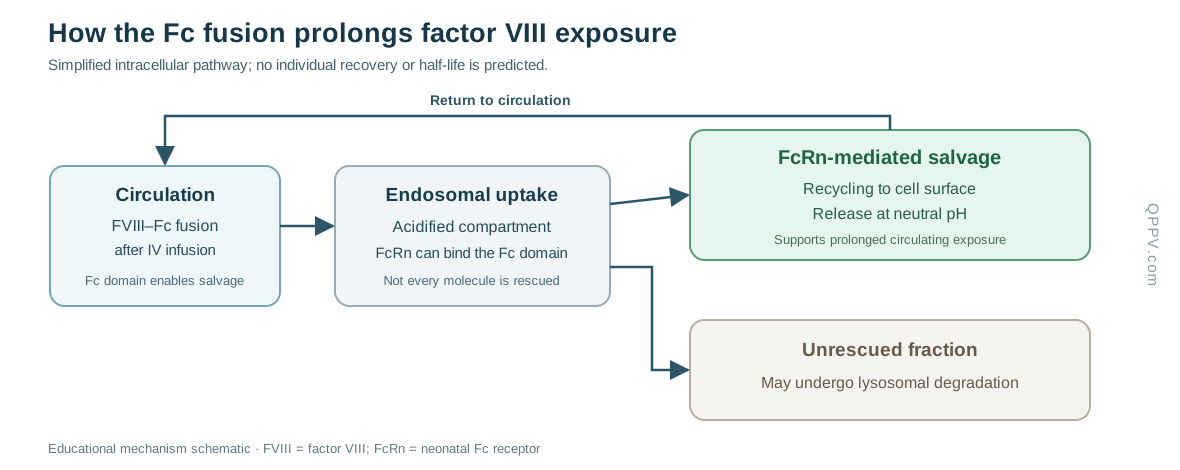
Figure 1. Conceptual FcRn salvage pathway for the FVIII–Fc fusion: endosomal recycling can reduce degradation and extend plasma persistence. This schematic does not represent measured probabilities or an individual patient's factor VIII recovery.
Biogen developed the molecule with Swedish Orphan Biovitrum (Sobi), building on Fc-fusion engineering as a way to address the infusion burden of haemophilia care [6,14]. The European Commission approved transfer of the Elocta marketing authorisation from Biogen to Sobi in March 2016 [14]. Biogen's haemophilia business became the independent Bioverativ in February 2017; Sanofi announced its acquisition of Bioverativ in January 2018 [7,15]. Sobi retained commercial rights in its defined European and regional territory, while Bioverativ and subsequently Sanofi held rights elsewhere under the collaboration. These changes are relevant to regional authorisation-holder and product-safety responsibility; they do not establish clinical interchangeability with newer FVIII constructs. Efanesoctocog alfa is a distinct INN and molecular design, not another name for efmoroctocog alfa.
Translational development and clinical design
Preclinical work and early clinical studies explored whether an Fc-fused FVIII could retain activity while improving pharmacokinetic exposure. The pivotal clinical programme used previously treated patients with severe haemophilia A because inhibitor risk and bleeding outcomes can be assessed against established replacement-treatment experience. Subsequent studies examined younger children and previously untreated patients, whose immune responses may differ substantially.
A fundamental methodological constraint is that haemophilia trials frequently lack the blinding and randomisation typical of large cardiovascular outcome trials. In A-LONG, treatment-arm assignment partly reflected previous treatment patterns. Comparisons between prophylaxis and on-demand arms therefore should not be interpreted as though every arm were a randomised comparison of equivalent patients. Annualised bleeding rate (ABR) is a useful measure, but estimates are sensitive to observation duration, prior bleeding history, adherence and the way events are recorded.
Regulatory entry
The US FDA first approved Eloctate in 2014 [4,5] for on-demand treatment and control of bleeding, perioperative management and routine prophylaxis in adults and children with haemophilia A. EMA's authorisation record dates the EU Elocta decision to 18 November 2015, while its public overview describes EU-wide authorisation from 19 November; both refer to the same initial authorisation, not two approvals [1]. The EU indication is treatment and prophylaxis of bleeding in haemophilia A across all age groups. The current EU marketing authorisation holder is Swedish Orphan Biovitrum AB [1,14]. The EMA product information was updated on 16 July 2026, while the cited US DailyMed label was revised in May 2023; each is identified by its own date [1,2,5]. US and EU labels differ in wording, product presentation and monitoring detail and should not be conflated.
The approved indication is congenital haemophilia A. Eloctate is not indicated to treat von Willebrand disease. The presence of a factor VIII moiety does not justify extending an indication to every bleeding disorder or assuming that replacement products have identical pharmacokinetics and immunogenicity.
The A-LONG, Kids A-LONG and ASPIRE programme
A-LONG: prophylaxis, episodic treatment and surgery
A-LONG enrolled 165 previously treated adolescents and adults with severe haemophilia A. It evaluated individualised prophylaxis, weekly prophylaxis and episodic treatment [2,9]. The EU product information reports median annualised bleeding rates (ABRs) of 1.60 for individualised prophylaxis and 3.59 for weekly prophylaxis during the initial study [2]. The A-LONG publication also reports an ABR of 37.3 in the episodic-treatment group, compared with a model-based ABR of 2.9 in the individualised-prophylaxis group [9]. The median and model-based estimates are different statistics, and allocation partly depended on pre-study treatment; they must not be combined into an invented head-to-head randomised comparison of all regimens.
Individualised prophylaxis commonly began at 25–65 IU/kg every three to five days, with subsequent adjustment according to bleeding and pharmacokinetic response. The important innovation was flexibility in scheduling while maintaining effective bleeding control. Acute-bleed treatment and perioperative management were also evaluated; clinical success requires more than demonstrating an expected laboratory factor peak.
Kids A-LONG and the paediatric exposure problem
Kids A-LONG enrolled 71 previously treated boys under 12 years of age; 69 received at least one dose and were evaluable for efficacy. The phase 3 study reported a median overall ABR of 1.96 and no new FVIII inhibitors in this previously treated cohort [2,10]. Age matters because clearance per kilogram can be higher in young children, affecting dosing intervals and trough levels. The US prescribing information reports [5] that clearance per kilogram was approximately 75% higher in children aged one to five years than in adults. This is a population pharmacokinetic observation, not a rule that every child needs exactly 75% more medicine.
Paediatric studies also confront venous-access and caregiver-administration challenges. Reports of infusion failure or breakthrough bleeding need the actual delivered dose, vial potency, infusion timing and technique. A presumed pharmacological failure may instead reflect missed treatment, reconstitution problems, delayed administration or a newly developed inhibitor.
ASPIRE: extension follow-up
ASPIRE followed participants from the earlier studies and provided longer exposure for assessment of prophylaxis, bleeding outcomes and inhibitor development [11]. The EMA product information describes [2] an extension of up to four years and 80,848 exposure days among 276 previously treated patients across the evaluated programme. The 2016 interim ASPIRE publication reported no inhibitors in its observed previously treated extension population and low ABRs with continued prophylaxis [11]. These findings must be read with their data-cut dates and population selection in mind. Extension data are valuable for cumulative safety experience, but participation may favour people who tolerated or benefited from earlier therapy; absence of an event in this cohort cannot exclude rare reactions or predict the immunogenicity of previously untreated children.
Previously untreated patients
The subsequent Study IV (PUPs A-LONG) evaluated 103 previously untreated boys younger than six years with severe haemophilia A [2,12]. The final study reported 28 inhibitors among 90 evaluable children (31.1%; 95% CI 21.8–41.7%), including 14 high-titre inhibitors (15.6%; 95% CI 8.8–24.7%); the denominator comprised children with at least 10 exposure days plus those developing an inhibitor earlier [12]. The median time to high-titre inhibitor development was nine exposure days (range four to fourteen) [12]; a subsequent post hoc analysis explored the broader timing and characteristics of inhibitor development [13]. These are observed trial proportions, not an individual's predicted probability. A 2024 post hoc analysis examined inhibitor patterns and risk factors but cannot replace prospective comparative evidence [13].
PUPs are particularly important for FVIII immunogenicity because their risk differs from that of previously treated patients with substantial prior exposure. The current EU SmPC categorises FVIII inhibition as very common in PUPs and uncommon in previously treated patients [2]. It is scientifically incorrect to generalise a zero-inhibitor observation from the earlier previously treated trials to newly exposed children. Regulatory assessment and post-authorisation surveillance must preserve these denominators separately.
Safety profile: what matters most
Neutralising FVIII antibodies
The formation of inhibitors against FVIII is a major complication of replacement therapy. Neutralising antibodies can reduce factor recovery and cause breakthrough bleeding despite apparently adequate doses. The US label advises suspecting inhibitors [5] when expected plasma FVIII activity is not achieved or bleeding is not controlled with an appropriate dose. The EMA SmPC identifies the first 50 exposure days as the period of greatest inhibitor risk while noting that risk does not cease thereafter [2]. Confirmation uses an appropriate inhibitor assay, with interpretation informed by timing, assay methodology and recent treatment.
A suspected inhibitor case needs the patient's previous FVIII products, cumulative exposure days, genetic and family context when available, inhibitor titre and test method, baseline and post-infusion FVIII activity, bleeding phenotype, treatment changes and clinical outcome. An inhibitor is not simply a positive antibody screening test: neutralising activity and clinical relevance must be evaluated. Immune tolerance induction or alternative haemostatic therapy may be considered by specialist teams, but treatment decisions are outside the scope of routine case processing.
Hypersensitivity and anaphylaxis
Hypersensitivity, including anaphylaxis, is a labelled risk. Early features may include rash, urticaria, pruritus, chest tightness, wheeze, dyspnoea or angioedema. The US label instructs immediate discontinuation and appropriate treatment when hypersensitivity reactions occur. Case follow-up should capture onset relative to infusion, clinical criteria for anaphylaxis, intervention, resolution, co-exposures, prior product history and whether the same lot was involved in other reports.
Common adverse reactions and interpretation
The US 2023 prescribing information identifies arthralgia, malaise, myalgia, headache and rash among adverse reactions observed in previously treated patients. In PUPs, FVIII inhibition, device-related thrombosis and papular rash are among reported reactions. These categories come from different study populations and should not be pooled as if they shared one denominator. The occurrence of device-related thrombosis does not imply that every venous-access event is caused by the active molecule.
Breakthrough bleeding and effectiveness reports
An effectiveness complaint requires medical assessment even when it is not a conventional adverse reaction. Important causes include inadequate dose, delayed infusion, missed prophylaxis, increased activity, injury, assay discrepancies and inhibitor formation. The reviewer should distinguish a pharmacological lack of effect from an administration or supply problem and record both where supported. A spontaneous case report may suggest a safety concern but cannot independently measure comparative efficacy.
Laboratory monitoring and assay interpretation
FVIII activity is monitored to assess recovery and guide individualised therapy. The EU product information notes [2,8] that chromogenic and one-stage clotting assays may give different results, depending on the reagent and reference standard. A result without assay method, laboratory and sampling time may be misleading. When a patient appears to have unexpectedly low recovery, verify the assay platform, calibration, timing relative to infusion, administered dose and possible inhibitor before concluding that the product failed.
For suspected inhibitors, the relevant laboratory record includes the screening and confirmatory assay, neutralising titre, exposure history and repeat results. Assay interference can also arise in patients receiving other haemostatic therapies; the exact therapeutic context should be recorded. The label and local specialist laboratory protocols govern interpretation. A general article cannot replace product- and assay-specific validation.
Pharmacokinetic interpretation and clinical endpoints
The EMA product information reports a geometric mean terminal half-life of 19.0 hours by one-stage assay (28 previously treated participants) and 20.9 hours by chromogenic assay (27 participants) in the specified adult pharmacokinetic assessments [2]. These are assay- and population-specific estimates, not an individual's predicted trough. The FcRn mechanism explains the direction of the change but not every difference in FVIII activity across laboratories or patients. Pharmacokinetic monitoring, clinical bleeding and exposure-day history should therefore be interpreted together rather than treating any single assay result as a definitive measure of effectiveness.
Administration, quality and traceability
Efmoroctocog alfa is supplied as a lyophilised powder for intravenous use after reconstitution. It is not a subcutaneous maintenance drug. Product handling, storage, reconstitution, infusion equipment and actual vial potency matter to both effectiveness and safety. Errors may involve the wrong strength, incorrect diluent, incomplete reconstitution, delayed use after preparation, missed doses, administration through a compromised venous-access device or confusion with another FVIII product.
For biological medicines, traceability is especially important. The EU SmPC explicitly directs recording the name and batch number of the administered product [2]; this is product-label language, not merely an optional local checklist item. A case should additionally record strength, expiry, actual dose, administration route and timing where available. This supports product-specific and lot-specific investigation without assuming that a cluster necessarily represents a manufacturing defect. If a quality complaint is suspected, preserve the product and packaging information through the applicable quality channel and reconcile the quality investigation with pharmacovigilance records.
Special populations and venous-access risks
For patients who need a central venous access device, the EU SmPC identifies infection, bacteraemia and catheter-site thrombosis as relevant complications [2]. A catheter-related infection should not be automatically coded as a reaction to the infused FVIII protein. In pregnancy and breastfeeding, the EU SmPC notes the lack of clinical experience and advises use only when clearly indicated [2]. This is a limitation of evidence, not proof of either safety or harm. The SmPC also notes that no FVIII interaction studies have been performed and no interactions reported [2]; it does not establish that clinically meaningful co-treatment effects are impossible.
Changing treatment landscape and benefit–risk
The haemophilia A treatment landscape now includes standard- and extended-half-life FVIII products, non-factor prophylaxis and gene-therapy approaches in selected settings. Elocta also expanded regionally after its EU authorisation, including Saudi Food and Drug Authority approval announced in May 2017 [7]. Regional approvals are separate regulatory decisions and should not be treated as new evidence of comparative effectiveness. Their mechanisms and safety profiles differ. The introduction of other options does not retrospectively invalidate efmoroctocog alfa's trial results, but it changes the questions relevant to shared decision-making: infusion burden, breakthrough bleeding, inhibitor history, venous access, cost and access, preference, and suitability for particular procedures.
Comparisons of annualised bleeding rates across different trials are particularly unreliable when baseline severity, prophylaxis exposure, prior treatment and definitions differ. The EMA product information explicitly cautions against comparing ABR between factor concentrates and studies [2]. Pharmacovigilance reviews should likewise distinguish adverse reactions to the FVIII molecule from risks associated with central venous devices, underlying haemophilia and co-administered haemostatic agents.
Pharmacovigilance case workflows
Suspected inhibitor with breakthrough bleeding
Illustrative scenario, not a reported case. A child receiving regular FVIII–Fc prophylaxis experiences repeated joint bleeds. The initial report says that the medicine has stopped working. The case processor reconstructs dosing and adherence, identifies the exact product and lot, collects infusion dates, obtains pre- and post-infusion FVIII levels and the assay method, and seeks inhibitor testing. The medical reviewer considers underexposure, missed doses, assay problems and neutralising antibodies rather than assuming immunogenicity. The resulting narrative should state what is documented, what is suspected and what remains unknown.
Immediate infusion reaction
Illustrative scenario, not a reported case. A patient develops urticaria and breathlessness during an infusion. Important information includes onset in minutes, vital signs, treatment for anaphylaxis, response, previous exposures, excipients, co-medications, and whether the infusion was stopped. A lack of positive allergy testing does not automatically exclude a clinically important hypersensitivity event. Any subsequent product decision belongs to the treating specialist.
Aggregate signal evaluation
Inhibitor reports should be stratified by previous treatment status and exposure days. Hypersensitivity reports require clinical validation, timing and lot traceability. Product-quality reports need reconciliation across pharmacovigilance, manufacturing and supply teams. An apparent rise in spontaneous reports may reflect more patients treated, a new reporting campaign or changed data collection; counts alone do not establish incidence or a new causal signal.
For EU operations, applicable pharmacovigilance legislation and GVP govern individual-case handling, signal management and periodic evaluation. A recommended practice such as a structured exposure-day worksheet is useful but is not itself a universal legal requirement. Inspection readiness means being able to trace source information, coding, medical assessment, follow-up, product identification, escalation, decisions and effectiveness of any risk-minimisation action.
Practical review checklist
- Confirm efmoroctocog alfa, brand, jurisdiction, formulation, dose and lot; do not confuse it with efanesoctocog alfa.
- Establish haemophilia severity, treatment indication, previous FVIII exposure and prophylaxis schedule.
- For breakthrough bleeding, collect actual dosing, adherence, injury history, FVIII recovery and inhibitor results.
- For suspected immunogenicity, preserve assay method, inhibitor titre, exposure days and treatment history.
- For hypersensitivity, document timing, symptoms, interventions, outcome and possible competing causes.
- For device events or quality complaints, distinguish product, device, preparation and administration contributions.
- Separate previously treated and previously untreated safety denominators.
- Record the current local label and explain any regulatory or medical interpretation separately from observed facts.
Key takeaways
Efmoroctocog alfa illustrates how Fc-mediated recycling can extend FVIII exposure and reduce treatment burden without eliminating the underlying risk of bleeding or FVIII inhibitor development. A-LONG, Kids A-LONG and ASPIRE established clinical experience in previously treated populations; later PUP evidence addresses a different immunogenicity context. Reliable pharmacovigilance depends on inhibitor assessment, hypersensitivity recognition, precise treatment chronology, FVIII assay interpretation and biological-product traceability. The product's clinical role must be interpreted alongside newer therapies without relying on invalid cross-trial comparisons.
References
- European Medicines Agency. Elocta: European public assessment report and authorisation details. https://www.ema.europa.eu/en/medicines/human/EPAR/elocta
- European Medicines Agency. Elocta: summary of product characteristics and product information. https://www.ema.europa.eu/en/documents/product-information/elocta-epar-product-information_en.pdf
- European Medicines Agency. Elocta: initial public assessment report (2015). https://www.ema.europa.eu/en/documents/assessment-report/elocta-epar-public-assessment-report_en.pdf
- US Food and Drug Administration. Eloctate: approved blood product. https://www.fda.gov/vaccines-blood-biologics/approved-blood-products/eloctate
- National Library of Medicine. DailyMed: Eloctate prescribing information, revised May 2023. https://dailymed.nlm.nih.gov/dailymed/fda/fdaDrugXsl.cfm?setid=e1419c33-ef07-4268-be1f-c8993502d597&type=display
- Frampton JE. Efmoroctocog alfa: a review in haemophilia A. Drugs. 2016;76:1281–1291. https://pubmed.ncbi.nlm.nih.gov/27487799/
- Swedish Orphan Biovitrum. Elocta approval in Saudi Arabia (2017), regional regulatory and business history. https://www.sobi.com/en/press-releases/eloctar-approved-kingdom-saudi-arabia-treatment-haemophilia-1491935
- UK electronic Medicines Compendium. Elocta 500 IU summary of product characteristics, updated January 2025. https://www.medicines.org.uk/emc/product/10482/smpc
- Mahlangu J et al. Phase 3 study of recombinant factor VIII Fc fusion protein in severe hemophilia A (A-LONG). Blood. 2014;123:317–325. https://pubmed.ncbi.nlm.nih.gov/24227821/
- Young G et al. Recombinant factor VIII Fc fusion protein for the prevention and treatment of bleeding in children with severe hemophilia A (Kids A-LONG). J Thromb Haemost. 2015;13:967–977. https://pubmed.ncbi.nlm.nih.gov/25912075/
- Nolan B et al. Long-term safety and efficacy of recombinant factor VIII Fc fusion protein in subjects with haemophilia A (ASPIRE interim results). Haemophilia. 2016. https://pubmed.ncbi.nlm.nih.gov/26218032/
- Königs C et al. First study of extended half-life rFVIIIFc in previously untreated patients with hemophilia A: PUPs A-LONG final results. Blood. 2022;139:3699–3707. https://pubmed.ncbi.nlm.nih.gov/35421219/
- Carcao M et al. A post hoc analysis of previously untreated patients with severe hemophilia A who developed inhibitors in the PUPs A-LONG trial. Blood Adv. 2024;8:1494–1503. https://pubmed.ncbi.nlm.nih.gov/38266154/
- Swedish Orphan Biovitrum. European Commission approves transfer of marketing authorisation for Elocta to Sobi. 24 March 2016. https://www.globenewswire.com/news-release/2016/03/24/822843/0/en/european-commission-approves-transfer-of-marketing-authorisation-for-elocta-to-sobi.html
- Sanofi. Sanofi to acquire Bioverativ for $11.6 billion. 22 January 2018; SEC-filed announcement. https://www.sec.gov/Archives/edgar/data/1121404/000119312518016132/d524979dex991.htm
Regulatory Note
This educational review is not a prescribing protocol or substitute for locally authorised product information. The EMA and US product documents differ in details and are updated independently. Clinical trial observations, labelled risks, regulatory obligations, medical interpretation and recommended pharmacovigilance practice are distinct. For actual treatment or regulatory action, consult the current authorised product information and the relevant specialist and jurisdictional requirements.