Elranatamab: Classification, Mechanism, Clinical Use and Pharmacovigilance
Elranatamab is a bispecific antibody designed to bring a cytotoxic T lymphocyte into physical proximity with a malignant plasma cell. One arm binds B-cell maturation antigen (BCMA) on the plasma-cell lineage and the other binds CD3 on T cells. The resulting immune synapse can activate T cells, trigger cytokine release and kill BCMA-expressing cells.
That mechanism explains both efficacy and risk. The same rapid immune activation that produces antimyeloma activity can cause cytokine release syndrome (CRS) and neurological toxicity, while sustained depletion of plasma-cell function and heavily pretreated disease can contribute to infection and hypogammaglobulinaemia. Pharmacovigilance therefore needs to reconstruct not merely whether an adverse event occurred after treatment, but where the patient was in the step-up sequence, what the tumour burden and baseline immune status were, and what supportive therapy was used.
- Elranatamab: Classification, Mechanism, Clinical Use and Pharmacovigilance
- Classification and Molecular Design
- Why Step-Up Dosing Matters
- Development and Regulatory Context
- Safety Profile Through the Mechanism
- Practical Pharmacovigilance Assessment
- Signal Detection and Periodic Benefit-Risk Review
- Risk Controls and Operational Implementation
- Illustrative Failure Modes
- Inspection and Governance Considerations
- Practical Checklist
- Key Takeaways
- References
- Regulatory Note
Classification and Molecular Design
Elranatamab is a full-length bispecific IgG antibody with two functional targets rather than a conventional monoclonal antibody with one antigen target.
BCMA as the tumour-side target
BCMA is a receptor expressed predominantly on plasma cells and many multiple-myeloma cells. It is biologically attractive because it is much more restricted than broadly expressed haematopoietic targets. Nevertheless, normal plasma cells also depend on BCMA-related biology, so treatment can reduce normal immunoglobulin production as well as malignant plasma-cell mass.
CD3 as the effector-cell target
CD3 is part of the T-cell receptor signalling complex. Binding CD3 does not make elranatamab a nonspecific T-cell stimulant in isolation; clinically meaningful activation is favoured when the antibody simultaneously engages BCMA on a nearby target cell. The drug therefore acts as a molecular bridge that converts antigen recognition into spatially directed T-cell cytotoxicity.
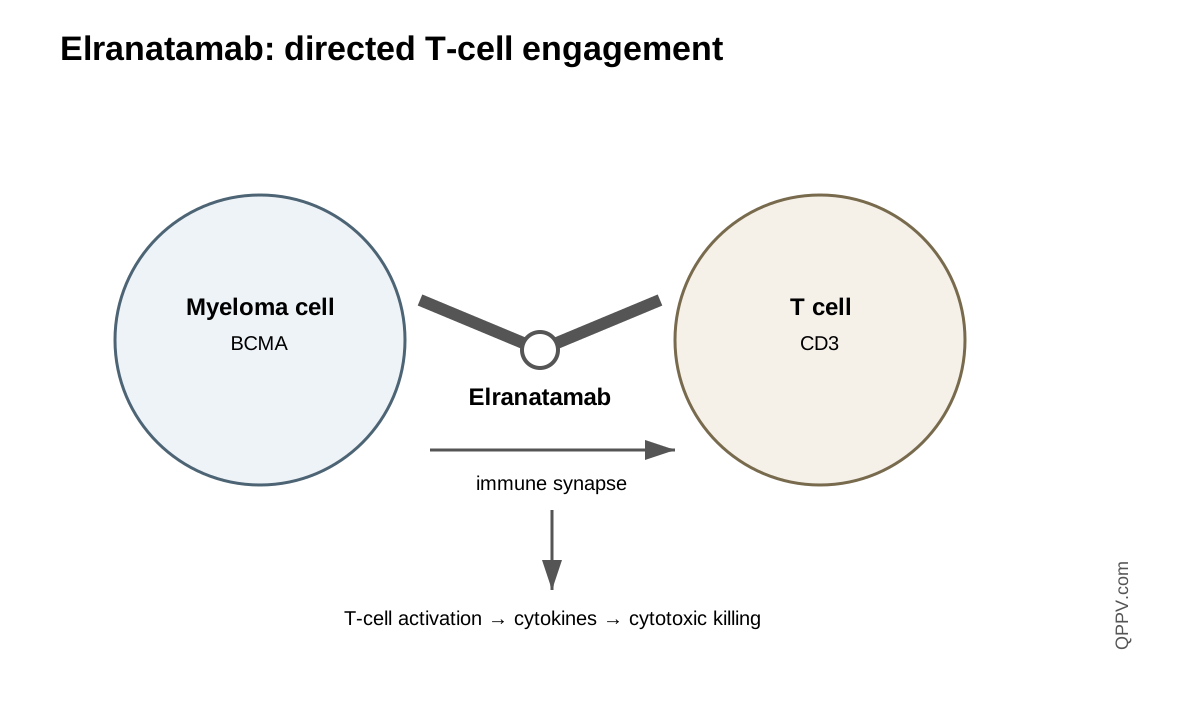
Figure 1. Elranatamab bridges a BCMA-expressing plasma cell and a CD3-positive T cell, creating a cytotoxic immune synapse. The same signalling sequence that supports tumour-cell killing can generate systemic cytokine release.
Why Step-Up Dosing Matters
The first clinically important exposure to a T-cell engager is not equivalent to a later maintenance dose. Early doses encounter the largest combination of untreated target cells and relatively unconditioned effector cells. Step-up dosing reduces the size of the initial pharmacodynamic perturbation and allows early toxicity to be recognised before full-dose exposure.
For pharmacovigilance, the relevant time axis is therefore dose sequence, not only days since first treatment. A fever after the first step-up dose has a different mechanistic context from fever after months of therapy, when infection, neutropenia and immune suppression may dominate the differential diagnosis.
Development and Regulatory Context
Elranatamab was developed for patients with relapsed or refractory multiple myeloma after multiple prior lines of therapy. In the European Union it is authorised as monotherapy for adults whose disease has progressed after at least three prior classes of treatment, including an immunomodulatory agent, a proteasome inhibitor and an anti-CD38 antibody.
This late-line setting is important to safety interpretation. Many patients begin treatment with pre-existing cytopenias, infection susceptibility, renal impairment, prior transplantation or cumulative organ toxicity. A sound case assessment therefore separates what is new after elranatamab from the residual effects of previous therapy and the underlying myeloma.
Safety Profile Through the Mechanism
Cytokine release syndrome
CRS is the archetypal early toxicity of T-cell-engaging bispecific antibodies. It reflects systemic cytokine production after immune-cell activation and may present with fever, hypotension, hypoxia or constitutional symptoms. Severity and timing must be interpreted against the exact step-up dose, premedication, tumour burden and any prior CRS episode.
A useful PV case should capture the dose number and dose level, time from injection to symptom onset, maximum temperature, blood pressure and oxygen requirement, relevant laboratory results, treatment given, hospitalisation, resolution and whether later doses were delayed or modified. Infection must remain in the differential diagnosis because the same patient population is highly infection-prone.
Neurological toxicity and ICANS
Immune effector cell-associated neurotoxicity syndrome (ICANS) may manifest as confusion, impaired attention, dysgraphia, aphasia, tremor, somnolence, seizure or reduced consciousness. Neurological symptoms can overlap with metabolic disturbances, infection, opioid or sedative exposure, hyperviscosity, renal failure and central nervous system disease.
The PV assessment should therefore record baseline neurological status and, where possible, structured neurological observations rather than relying on a single term such as “confusion”. Timing relative to CRS is also important because neurotoxicity may occur with, after or independently of CRS.
Infection and impaired humoral immunity
Multiple mechanisms converge on infection risk: heavily pretreated myeloma, marrow suppression, corticosteroid exposure used to manage immune toxicity, reduction of normal plasma cells and hypogammaglobulinaemia. Serious and opportunistic infections are therefore not peripheral events; they are central to longitudinal benefit-risk surveillance.
Case follow-up should identify infection site, organism where known, immunoglobulin concentrations, neutrophil counts, antimicrobial treatment, prophylaxis, vaccination context, hospitalisation and outcome. Recurrent infection clusters can be more informative than isolated cases.
Cytopenias
Neutropenia, anaemia and thrombocytopenia may arise from disease, prior therapy, infection or treatment. Attribution requires a trajectory rather than a single laboratory value. Baseline counts, nadir, recovery, growth-factor use, transfusion, concurrent marrow-active drugs and disease status should be captured.
Hepatic abnormalities and other systemic events
Abnormal liver tests may occur during therapy, but hepatic injury in advanced myeloma has a wide differential including infection, concomitant medicines, disease infiltration and haemodynamic events. The usual drug-induced liver injury framework should therefore be applied rather than assuming immune causality from chronology alone.
Practical Pharmacovigilance Assessment
A useful elranatamab case can be reconstructed along four linked timelines:
| Timeline | Key data |
|---|---|
| Treatment | Step-up dose, full dose, interruptions, restarts |
| Immune toxicity | Fever, hypotension, hypoxia, neurological findings, treatment |
| Immune competence | IgG, neutrophils, infection history, prophylaxis |
| Myeloma state | Disease burden, response, marrow involvement, prior therapies |
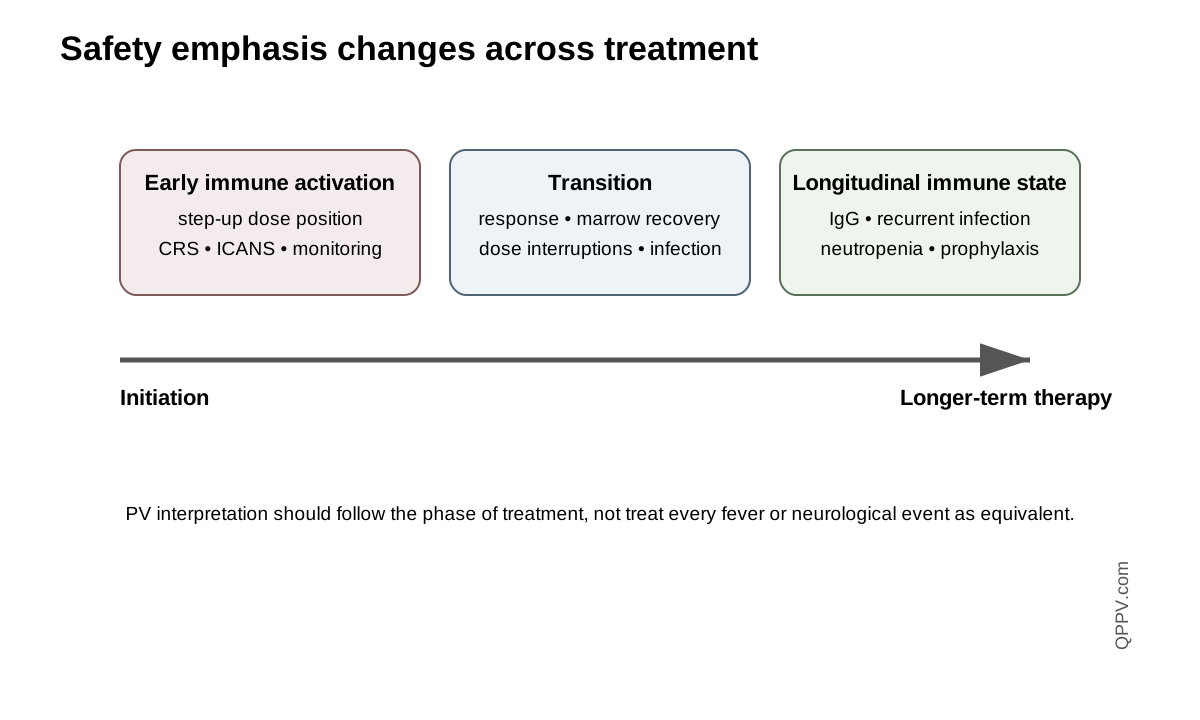
Figure 2. Elranatamab safety assessment changes over time. Early surveillance emphasises immune activation and step-up dosing; later surveillance increasingly depends on infection, cytopenia and cumulative immune-function data.
Signal Detection and Periodic Benefit-Risk Review
Aggregate review should preserve the distinction between acute pharmacodynamic toxicity and later immune-compromise toxicity. Combining all fevers or all neurological events into a single frequency obscures clinically meaningful patterns.
Useful stratifications include step-up versus later dosing, prior CRS or ICANS, baseline disease burden, severe versus non-severe infection, immunoglobulin status and treatment interruption. Medication errors involving the step-up schedule are also independently important because an error can alter the expected exposure-toxicity relationship.
Risk Controls and Operational Implementation
The labelled step-up regimen, monitoring requirements and management instructions are regulatory risk controls, not optional workflow preferences. Operational systems should therefore make dose sequence visible at prescribing, dispensing and administration. Where a patient has interrupted treatment, the current product information should be consulted to determine whether step-up dosing must be repeated.
Recommended operational practice includes maintaining a treatment record that links every dose to its sequence position, premedication, observation period and toxicity outcome. This is particularly useful when treatment crosses inpatient, outpatient and emergency-care settings.
Illustrative Failure Modes
The following are hypothetical examples intended to show how process weaknesses can affect safety assessment.
Fever coded without dose context
A report records “pyrexia, serious” but omits that onset occurred several hours after the first step-up dose with transient hypotension and no microbiological evidence of infection. The case is technically valid but analytically weak because it cannot be reliably grouped with CRS.
Infection misclassified as recurrent CRS
A patient develops fever months into therapy. The event is initially treated as immune activation despite neutropenia and a positive blood culture. Failure to reconsider the differential diagnosis can delay antimicrobial treatment and distort aggregate CRS data.
Restart after interruption without reconstructing the schedule
A long treatment gap occurs, but the record does not document whether dosing was restarted according to current product instructions. The safety significance is not limited to a medication error; it also affects interpretation of any subsequent CRS.
Inspection and Governance Considerations
An inspector assessing elranatamab pharmacovigilance would be interested in whether the system can demonstrate that known acute and delayed risks are actually distinguishable in source data. Evidence may include case-processing conventions for CRS and ICANS, follow-up questionnaires, reconciliation of dose sequence, medical review of serious infections, signal stratification and documented escalation of medication-error patterns.
The quality question is not whether the organisation has a list of labelled adverse reactions. It is whether its data allow reviewers to recognise when the expected pharmacology has changed into clinically important toxicity and whether risk-minimisation controls are functioning.
Practical Checklist
- Confirm exact indication and prior-treatment context.
- Record each step-up and subsequent dose with dates and interruptions.
- For fever or hypotension, distinguish CRS from infection and other causes.
- For neurological symptoms, capture structured findings and competing diagnoses.
- Follow immunoglobulin concentrations, neutrophils and serious/recurrent infections longitudinally.
- Capture antimicrobial prophylaxis, immunoglobulin replacement and supportive treatment where relevant.
- Treat schedule errors and restart errors as safety-relevant medication errors.
- Preserve the relationship between acute toxicity, later infection and tumour response in aggregate review.
Key Takeaways
Elranatamab is best understood as a controlled T-cell-redirection system rather than simply an anti-myeloma antibody. BCMA provides the target-cell address and CD3 supplies the effector-cell connection. Step-up dosing moderates the first immune perturbation, but it does not remove the need for longitudinal surveillance.
For pharmacovigilance, the core task is to connect dose sequence, immune activation, neurological status, immune competence and myeloma state. Acute CRS and ICANS dominate early treatment, whereas infection, hypogammaglobulinaemia and cytopenias become increasingly important over time.
References
- European Medicines Agency. Elrexfio (elranatamab): EPAR and product information. Product information updated 16 January 2026. https://www.ema.europa.eu/en/medicines/human/EPAR/elrexfio
- U.S. Food and Drug Administration. Elranatamab prescribing information and regulatory review materials. https://www.accessdata.fda.gov/drugsatfda_docs/label/2023/761345Orig1s000lbl.pdf
- Lesokhin AM, et al. Elranatamab in relapsed or refractory multiple myeloma. Nature Medicine. 2023.
- International Myeloma Working Group and contemporary consensus literature on bispecific-antibody infection and immune-toxicity management, interpreted in conjunction with current regional product information.
Regulatory Note
Authorised indications, dosing schedules, restart instructions and risk-minimisation measures can change. This article explains the pharmacovigilance logic of elranatamab and should not replace the current regional Summary of Product Characteristics, prescribing information or local risk-management materials.