Emapalumab: Classification, Mechanism and Pharmacovigilance
Emapalumab is an example of a targeted cytokine-blocking antibody used in rare, severe hyperinflammatory disease. Its benefits and risks must be interpreted in the context of the underlying syndrome, concurrent immunosuppression and the different evidence assessments made by regulators.
- Emapalumab: Classification, Mechanism and Pharmacovigilance
- 1. Identity and classification
- 2. Target biology and mechanism
- 3. Indications and clinical use
- 4. Evidence and regulatory assessment
- 5. Safety profile and mechanism-related risks
- 6. Pharmacovigilance case assessment
- 7. Regulatory status and practical safeguards
- Key takeaways
- References
- Regulatory Note
1. Identity and classification
Emapalumab is a therapeutic monoclonal antibody that binds and neutralises interferon gamma (IFNγ), a cytokine that coordinates several immune and inflammatory responses. It is classified as an anti-cytokine antibody. Its therapeutic class is therefore defined by the soluble mediator it targets, rather than by binding a cell-surface receptor or depleting a cell population.[1]
HLH is a life-threatening syndrome of uncontrolled immune activation. Primary HLH is associated with inherited defects in immune-cell cytotoxicity; secondary HLH can occur with infections, malignancy, immune disorders or other triggers. Macrophage activation syndrome is an overlapping hyperinflammatory syndrome that can complicate Still’s disease, including systemic juvenile idiopathic arthritis. These syndromes can share fever, cytopenias, organ dysfunction, coagulopathy and very high inflammatory markers, but they are not interchangeable diagnoses.
2. Target biology and mechanism
In HLH, excessive IFNγ activity contributes to immune activation and tissue injury. Emapalumab binds IFNγ and reduces its biological activity; the U.S. label notes a fall in CXCL9, an IFNγ-induced chemokine, as a pharmacodynamic effect.[1] A pharmacodynamic marker can show that a pathway has been affected, but it does not by itself establish clinical benefit for every patient or every HLH trigger.
The causal chain is therefore narrower than “turning off inflammation”: emapalumab neutralises IFNγ, one important mediator within a wider immune network. Infection, malignancy, inherited immune dysfunction and other cytokines may continue to drive illness. Clinical response must be assessed using the syndrome’s overall trajectory, organ function and treatment context, not a single laboratory value.
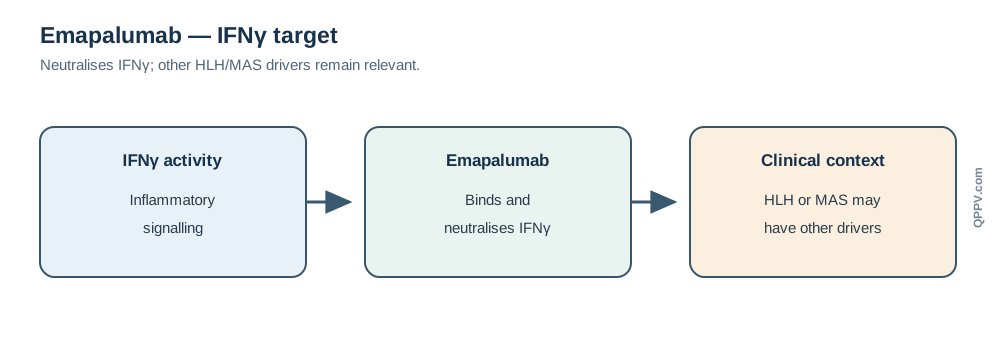
Figure 1. Simplified target map: emapalumab neutralises IFNγ signalling; HLH/MAS and its other drivers remain clinically relevant.
3. Indications and clinical use
The U.S. prescribing information covers two populations. Emapalumab is indicated for adults and children, including newborns, with primary HLH that is refractory, recurrent or progressive, or who are intolerant of conventional HLH therapy. A separate indication covers adults and children with HLH/MAS in known or suspected Still’s disease, including systemic juvenile idiopathic arthritis, after inadequate response or intolerance to glucocorticoids, or with recurrent MAS.[1]
These indications are not a general authorisation for every secondary HLH syndrome. The trigger, prior therapies, diagnostic criteria and jurisdiction-specific label should be recorded when interpreting use. In the U.S., dosing is by intravenous infusion and differs between the primary-HLH and Still’s disease-associated HLH/MAS indications; response-guided dose adjustments are described in the current label.[1] Exact dosing belongs to that label, not to a pharmacovigilance summary.
4. Evidence and regulatory assessment
The pivotal primary-HLH evidence included a single-arm study of 34 patients, 27 of whom had previously received treatment. The FDA label and EMA assessment describe this small, uncontrolled evidence base.[1,3] The published study reported a response rate using a composite of complete response, partial response or improvement in HLH at week 8 or the end of treatment; it also reported that some patients proceeded to haematopoietic stem-cell transplantation.[4] Without a concurrent comparator, these outcomes cannot isolate the treatment effect from other medicines, supportive care, patient selection or the fluctuating course of HLH.
The FDA’s current label also includes the Still’s disease-associated HLH/MAS indication, added in 2025.[1,2] This U.S. decision must be kept separate from the EU history: after re-examination, the EMA confirmed its recommendation to refuse marketing authorisation for the proposed paediatric primary-HLH use. The EMA cited uncertainty about efficacy, concomitant therapies, study-data reliability and the ability to characterise safety from the submitted evidence.[3] This was an evidentiary benefit–risk decision, not an EU-approved medicine later withdrawn for a safety signal.
5. Safety profile and mechanism-related risks
The U.S. label warns that IFNγ neutralisation may increase fatal or serious infections, including infections caused by mycobacteria, herpes zoster virus and Histoplasma. Serious infections were reported in 32% of patients with primary HLH in the clinical trials; in the Still’s disease-associated HLH/MAS group, serious infections were reported in 13%.[1] These proportions come from different small clinical populations and are not directly comparable incidence estimates. HLH itself, prior treatment, organ failure and concurrent immunosuppression create substantial competing explanations.
The label also warns about infection risk with live vaccines and infusion-related reactions, which may be severe. A suspected infection should be assessed against baseline infection status, organism, prophylaxis, immune status and concomitant therapies. A fever after an infusion can reflect infection, the hyperinflammatory disorder, infusion reaction or more than one process; timing alone does not settle causality.[1]
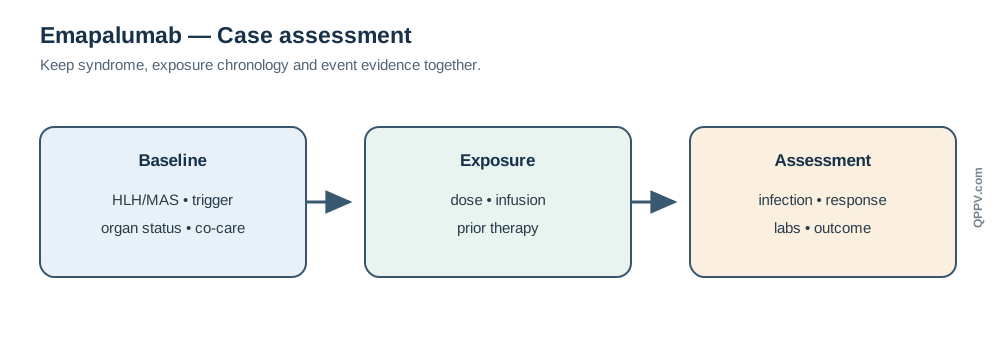
Figure 2. Case review links the HLH/MAS baseline, emapalumab exposure, infection or other event and objective response evidence.
6. Pharmacovigilance case assessment
A useful case chronology begins before the first dose. Record the working HLH/MAS diagnosis, trigger investigation, organ involvement, inflammatory and haematologic markers, prior and concurrent immunosuppression, antimicrobial prophylaxis, dose history and any planned transplant. Then establish whether the reported event began before exposure, during infusion, after a dose or during disease progression.
For a suspected infection, capture microbiology, site, severity, immune status, prophylaxis, antimicrobial treatment and outcome. For worsening hyperinflammation or lack of effect, document the diagnostic basis, trend in organ function and laboratory markers, dose changes, rescue treatment and alternative drivers. Preserve the reporter’s causality opinion, but distinguish it from the clinical assessment. Suppression of CXCL9 or another pathway marker is evidence of pharmacodynamic activity, not proof that all disease mechanisms were controlled.[1]
Because treatment may be used in critically ill newborns, children and adults, reports should include age, weight, relevant genetic or immune diagnosis, treatment setting and concomitant medicines. Do not compare crude event proportions across the primary-HLH and MAS studies as if they were head-to-head groups.
7. Regulatory status and practical safeguards
As of the June 2025 U.S. prescribing information, emapalumab has the two U.S. indications described above. In the EU, the EMA confirmed its recommendation to refuse marketing authorisation for paediatric primary HLH after re-examination; the product should not be described as EU-authorised on that basis.[1–3] Regulatory status and indication must be checked for the jurisdiction relevant to each report.
Key pharmacovigilance questions are whether the event reflects IFNγ blockade, the underlying hyperinflammatory disorder, its trigger, prior treatment or a combination. The assessment should keep target biology, temporal sequence, clinical evidence and competing causes visible rather than turning mechanism into a presumption of causality.
Key takeaways
- Emapalumab neutralises IFNγ, a mediator in HLH and Still’s disease-associated HLH/MAS.
- The U.S. label includes two defined populations; it is not a general indication for every secondary HLH syndrome.
- Serious infection and infusion-related reactions are important labelled risks, with substantial confounding from disease severity and co-treatment.
- The FDA and EMA outcomes differ: U.S. indications include both populations, while the EMA confirmed refusal for the proposed paediatric primary-HLH indication.
References
- U.S. Food and Drug Administration. GAMIFANT prescribing information. Revised June 2025.
- U.S. Food and Drug Administration. Supplement approval letter for the HLH/MAS indication. 27 June 2025.
- European Medicines Agency. Gamifant EPAR: refusal and re-examination outcome; public assessment report.
- Locatelli F, et al. Emapalumab in Children with Primary Hemophagocytic Lymphohistiocytosis. New England Journal of Medicine. 2020;382:1811–1822.
Regulatory Note
This article describes the U.S. indications and the EMA application outcome available on 25 September 2026. It is an educational reference, not a treatment recommendation or a substitute for current jurisdiction-specific product information, applicable law or clinical judgement.