Emtricitabine: Discovery, Development, Safety and Pharmacovigilance
Emtricitabine (FTC) is a nucleoside reverse transcriptase inhibitor (NRTI) used in combination antiretroviral treatment for HIV-1 and as one constituent of several fixed-dose regimens, including combinations authorised for HIV pre-exposure prophylaxis (PrEP). It is not a stand-alone cure, nor does the single-ingredient Emtriva authorisation itself confer a PrEP indication. Those distinctions are fundamental to interpreting both efficacy and safety: the exposure recorded in a clinical trial, prescription or adverse-reaction report may be a three-drug treatment regimen, a two-drug prevention regimen or the separately administered active substance. [2–4]
The molecule has a particularly instructive lifecycle. Its development crossed university research, pharmaceutical licensing, a corporate merger, an interrupted clinical programme and a subsequent acquisition before authorisation. Its clinical role then expanded largely through combinations rather than new emtricitabine monotherapy indications. The pharmacovigilance question is consequently not only whether FTC causes a suspected reaction, but whether the event is attributable to FTC, its partner drugs, HIV or HBV infection, treatment interruption, or an interacting clinical circumstance.
- Emtricitabine: Discovery, Development, Safety and Pharmacovigilance
- Scientific origin and discovery
- From discovery to clinical development
- Mechanism, pharmacology and resistance
- Pivotal trials and the transition to combination treatment
- Regulatory approvals and formulation history
- Expansion into HIV prevention
- Safety profile and the significance of the formulation
- Special populations and changes in the benefit–risk context
- Practical pharmacovigilance assessment
- Inspection perspective and illustrative learning cases
- Practical implementation checklist
- Key takeaways
- References
- Regulatory Note
Scientific origin and discovery
The first generation of HIV nucleoside analogues established that inhibiting viral reverse transcriptase could suppress replication, but toxicity, frequent dosing and resistance limited sustained treatment. Researchers therefore explored nucleoside structures that retained antiviral activity while improving selectivity for viral rather than human polymerases. Emtricitabine arose from work on sulfur-containing oxathiolane nucleosides, particularly stereochemically defined cytidine analogues. [1]
At Emory University, Dennis Liotta and Raymond Schinazi and collaborators investigated this chemical series in the early 1990s. The fluorinated analogue that became emtricitabine was distinguished from its close relative lamivudine by a fluorine substitution on the cytosine base. Enantiomeric selection was important: biological activity and toxicity could differ substantially between mirror-image molecules. Published development history attributes early synthetic and antiviral work to the Emory programme and describes collaborations with Burroughs Wellcome investigators, including work on preclinical pharmacology and candidate selection. It would be inaccurate to reduce this collaborative discovery to a single inventor or to equate the date of the earliest synthesis with the date of a commercial product. [1]
Both emtricitabine and lamivudine showed activity against HIV and hepatitis B virus (HBV) in laboratory systems. This dual antiviral activity would later create a safety problem when an HBV-active HIV regimen was stopped in a coinfected patient. The ability to inhibit HBV does not mean that emtricitabine alone is an appropriate authorised or recommended HBV treatment. [1,3]
From discovery to clinical development
Burroughs Wellcome advanced the compound under the research identifier 524W91. A first-in-human phase I study began in 1995 according to the published development account; small short-term tolerability and pharmacokinetic studies could support dose selection but could not resolve uncommon or long-latency toxicity. Development was interrupted during the Wellcome–Glaxo corporate consolidation. Triangle Pharmaceuticals licensed emtricitabine rights from Emory in 1996, restarted clinical development and established once-daily dosing as a central design objective. The programme also faced patent and licensing disputes, resolved before approval. Gilead announced its acquisition of Triangle in December 2002 and completed it in January 2003. [1]
The commercial sequence matters because safety knowledge was generated by different sponsors under different study protocols. A pharmacovigilance history should therefore trace the actual compound and study identifiers across ownership changes, rather than assume that the current marketing authorisation holder generated all early evidence. Historical corporate arrangements do not change the present marketing authorisation holder's regulatory responsibilities.
Mechanism, pharmacology and resistance
Emtricitabine is taken up by cells and phosphorylated to emtricitabine 5′-triphosphate. The active intracellular metabolite competes with deoxycytidine triphosphate for incorporation by HIV-1 reverse transcriptase; incorporation terminates elongation of viral DNA. This blocks a step in viral replication but does not remove integrated viral DNA or eradicate latent infection. FTC acts at the same broad viral stage as tenofovir's active metabolite, whereas integrase inhibitors such as bictegravir block a later stage. [3,12]
The drug is principally eliminated through the kidneys, making renal function relevant to systemic exposure and to the feasibility of dosing a single-ingredient product. In contrast, a fixed-dose combination cannot always be adjusted component by component. Pharmacokinetic changes, dose selection and contraindications must be assessed against the specific formulation and regional label rather than copied between single-agent FTC and combinations. [2,3]
HIV-1 reverse transcriptase substitutions M184V or M184I can confer high-level resistance to FTC and cross-resistance to lamivudine. The appearance of a resistance mutation during virological failure is not, by itself, evidence of a defective drug: adherence, drug interactions, treatment history, baseline resistance and the other regimen components must be evaluated. Resistance also has implications for subsequent regimen selection. [3]
The relationship between these mechanisms and clinical safety becomes clearer in the pivotal trials, where FTC was compared with older nucleosides within multidrug regimens rather than as an isolated therapy.
Pivotal trials and the transition to combination treatment
The FTC-301A study compared once-daily emtricitabine with twice-daily stavudine in 571 antiretroviral-naive adults, with both groups also receiving didanosine and efavirenz. The randomised, double-blind trial reported a higher probability of persistent virological suppression to 50 copies/mL at week 48 in the FTC arm (78% versus 59%) and fewer study-drug discontinuations due to adverse events through week 60 (7% versus 15%). These are the published trial's specific analysis measures, not a claim that FTC alone is superior to stavudine in every possible regimen. The EMA's EPAR summary reports somewhat different percentages for the same programme because its summarised endpoint and analysis presentation differ; figures from those sources should not be mixed without explaining the estimand. [2,5]
A separate switch trial, Protocol 303, evaluated replacement of lamivudine with FTC in people whose HIV was already suppressed on combination treatment. In the published open-label equivalence study of 440 patients, virological failure at 48 weeks was uncommon (7% with FTC and 8% with continued lamivudine). The design supported the clinical feasibility of a switch in a controlled population; it did not establish efficacy in people with uncontrolled viraemia or resistant virus. [6]
One development setback is especially relevant to pharmacovigilance attribution. The FTC-302 trial, which compared FTC with lamivudine alongside stavudine and nevirapine or efavirenz, was interrupted following serious hepatic events and deaths. The published development history describes subsequent evidence implicating nevirapine in the hepatic toxicity; nevertheless, the US regulator did not accept the study as a registration trial. The event illustrates the need to distinguish the safety of an individual molecule from the safety of a regimen and to preserve the chronology of regulatory decisions. It should not be retold as proof that emtricitabine caused those fatalities. [1]
These studies helped establish FTC as a once-daily NRTI suitable for combination treatment. They did not establish that all combinations containing FTC are interchangeable, because other agents determine resistance barriers, drug interactions, renal and bone effects, and population-specific restrictions.
Regulatory approvals and formulation history
The US Food and Drug Administration initially approved Emtriva in July 2003; the European Commission granted its EU marketing authorisation on 24 October 2003. Emtriva is authorised for HIV-1 treatment in combination with other antiretroviral medicines. The EMA EPAR describes 200 mg capsules and 10 mg/mL oral solution, including paediatric dosing and adjustments for renal impairment. The current US originator label also contains both formulations, with dose and age distinctions that must be read directly rather than extrapolated from the EU summary. [1–3]
The next step in FTC's lifecycle was incorporation into fixed-dose products. The FTC/tenofovir disoproxil combination (Truvada) entered US treatment use in 2004 and received an EU authorisation in February 2005. Later products combined FTC with tenofovir and other agents, including efavirenz and newer integrase inhibitors. For example, the Biktarvy regimen contains bictegravir, FTC and tenofovir alafenamide. These products have their own authorised indications, dose restrictions, interactions and risk-management measures. [1,4,12]
This creates three different units of analysis: the active substance for pharmacology and signal evaluation; the authorised medicinal product for labelling and regulatory obligations; and the actual administered regimen for clinical causality. A report coded only as “emtricitabine” may conceal an exposure to several medicines. Conversely, a suspected reaction to a combination product must not automatically be allocated to FTC merely because it appears in the product name.
Expansion into HIV prevention
FTC's contribution to PrEP arose through combinations, not through an independent preventive indication for Emtriva. In the iPrEx randomised trial, daily oral FTC/tenofovir disoproxil reduced HIV acquisition relative to placebo in the studied population; the published overall relative reduction was 44%, with protection strongly related to adherence and drug exposure. The result supports the combination strategy and cannot isolate the fraction of efficacy attributable to FTC. [7]
Subsequent studies and authorisations extended FTC/tenofovir disoproxil PrEP to eligible populations. The EMA Truvada EPAR specifies prevention in HIV-negative people at high risk alongside other preventive measures and HIV testing; the same product is also authorised for HIV treatment under different conditions. In the DISCOVER trial, FTC/tenofovir alafenamide was non-inferior to FTC/tenofovir disoproxil for prevention in the enrolled population of cisgender men who have sex with men and transgender women who have sex with men. The comparison showed differences in renal biomarkers and bone mineral density, but because both arms contained FTC, those differences principally inform the choice of tenofovir prodrug/regimen, not a novel FTC-specific toxicity. Population and route-of-exposure limitations prevent generalisation of DISCOVER to all PrEP candidates. [4,8]
For safety surveillance, prevention changes the benefit-risk context. An adverse event in a person without HIV has a different clinical background from the same event in a person receiving lifelong treatment for established infection. HIV acquisition during PrEP also requires evaluation of baseline infection status, adherence, timing of exposure and resistance; it should not automatically be classified as a pharmacological failure of FTC. The transition from treatment to prevention thus makes indication and regimen traceability central to a meaningful case assessment.
Safety profile and the significance of the formulation
The single-ingredient Emtriva label identifies commonly reported reactions including headache, gastrointestinal symptoms, rash and fatigue, and it describes skin hyperpigmentation, particularly involving palms or soles. The US label notes that skin discoloration was generally mild and asymptomatic, with uncertain mechanism and clinical significance. In children, pigmentation changes require age-appropriate interpretation and should not be confused with evidence of serious systemic toxicity. The clinical trial tables record treatment-emergent events, not necessarily events proven to have been caused by FTC. [2,3]
Serious warnings deserve separate attention because their clinical consequences and causal pathways differ. The US Emtriva label warns about lactic acidosis and severe hepatomegaly with steatosis reported with nucleoside analogues, including FTC alone or with other antiretrovirals. This is a labelled safety concern, not a claim that such outcomes are frequent with modern FTC regimens. A suspected case requires assessment of clinical and laboratory findings, alternative causes of metabolic acidosis, liver disease, sepsis, hypoperfusion and other drugs. [3]
Immune reconstitution inflammatory syndrome can occur when effective combination antiretroviral treatment restores immune responses to previously unrecognised or incompletely treated infections. Some autoimmune disorders can also emerge later. A temporal association with FTC initiation is insufficient to assign the syndrome specifically to FTC; the relevant exposure is generally the effective antiretroviral regimen and the evolving host immune response. [3]
Renal function, exposure and dosing
Because emtricitabine is cleared principally by the kidney, reduced renal function increases exposure. The US label recommends modifying the single-ingredient capsule dosing interval or oral-solution dose below a creatinine clearance of 50 mL/min and notes that the clinical efficacy and safety of the adjustments in moderate to severe impairment have not been directly evaluated. It also notes insufficient paediatric renal-impairment data. This is a dosing/exposure control, not proof that FTC itself is the cause of a patient's kidney disease. [3]
Fixed-dose products containing FTC may have different renal eligibility thresholds and may be unsuitable when their individual components require incompatible dose adjustments. Tenofovir disoproxil-related renal tubular toxicity, pre-existing kidney disease, dehydration and other nephrotoxic medicines must be considered before attributing a creatinine change to FTC. Conversely, a clinician should not assume a combination is safe merely because a single-agent FTC formulation can be dose-adjusted.
HIV/HBV coinfection and interruption
The US Emtriva label carries a boxed warning for severe acute exacerbation of hepatitis B following discontinuation in people coinfected with HIV-1 and HBV. It calls for HBV testing before or when starting FTC and close clinical and laboratory follow-up for at least several months after discontinuation in coinfected patients, with anti-HBV therapy when appropriate. The mechanism is loss of antiviral suppression of HBV, not necessarily a new direct hepatotoxic effect of the withdrawn drug. This distinction changes both medical management and the way a safety case should be described. [3]
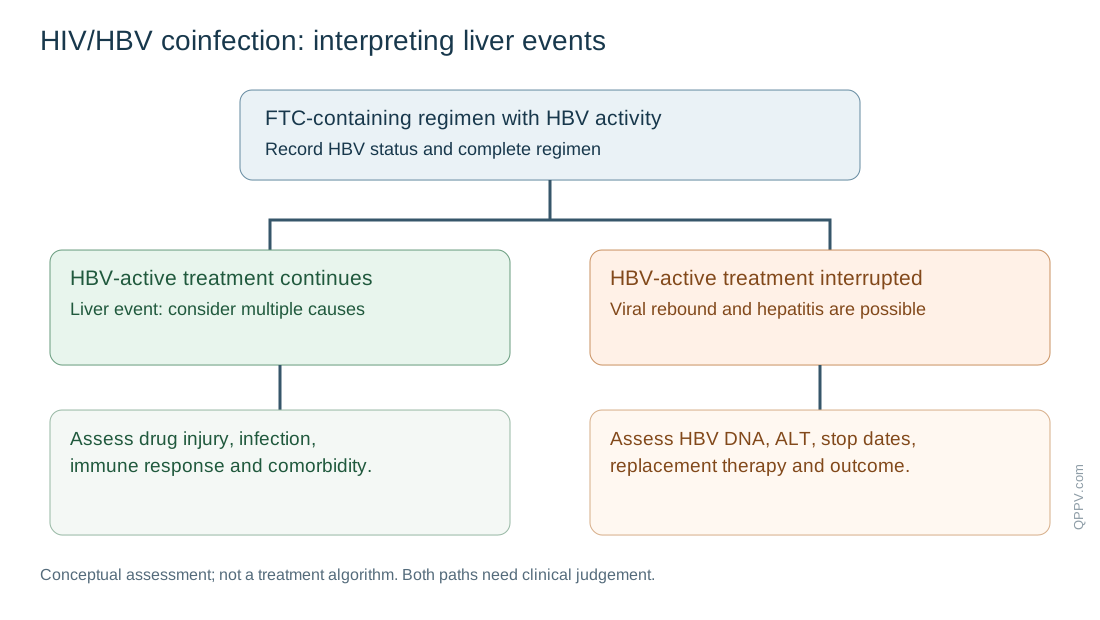
Figure 1. Conceptual separation of two clinical pathways in HIV/HBV coinfection. An HBV-active regimen can suppress HBV replication; interruption may permit virological rebound and hepatitis, whereas liver injury occurring during treatment requires a separate differential diagnosis. The figure is an assessment framework, not a treatment algorithm or a claim that all interruptions cause hepatitis.
When a combination containing FTC and tenofovir is stopped, both drugs' HBV activity may be lost simultaneously. The case narrative should therefore document each ingredient, the exact stop dates, HBV status and virological trajectory. Restarting an antiretroviral regimen, changing the tenofovir component and initiating a separate HBV agent are different interventions with different implications. The current specialist guidance and product information govern treatment decisions.
Resistance, incomplete suppression and preventable loss of efficacy
FTC-associated M184V/I resistance can arise during inadequate viral suppression. In practice, apparent loss of effect should trigger an assessment of viral-load trend, adherence, dispensing interruptions, concomitant medicines, absorption, prior resistance results and whether the regimen remains appropriate. A resistant isolate may help explain virological failure but does not prove poor manufacturing quality or medication error. Reports of HIV acquisition during PrEP likewise need careful confirmation of HIV status and exposure chronology before a suspected failure is attributed to the preventive regimen. [3,4]
The safety profile cannot be reduced to a single frequency table. The next question is how different populations and real-world treatment circumstances modify both the expected risks and the evidence needed to assess them.
Special populations and changes in the benefit–risk context
Pregnancy, breastfeeding and paediatric exposure
Pregnancy alters the clinical context of antiretroviral safety assessment: uncontrolled maternal HIV infection and interruption of effective therapy can themselves pose substantial risks. The US NIH perinatal guidance updated in March 2026 states that no FTC dose adjustment is required during pregnancy, that first-trimester FTC exposure has not been associated with increased congenital-anomaly risk, and that available human evidence has not identified adverse maternal, obstetric or infant outcomes attributable to FTC. These are evidence assessments within US clinical guidance, not a guarantee of zero risk or a replacement for the applicable local product information. [9]
A pregnancy safety case should record gestational timing, indication, the entire regimen, viral suppression, HBV status, comorbidities, pregnancy outcome and infant follow-up when available. Concomitant tenofovir, integrase inhibitors or other drugs may have different pregnancy evidence and different product-specific instructions. Breastfeeding recommendations are jurisdiction- and clinical-context-dependent; avoid treating a US guidance statement as if it automatically superseded an EU SmPC. [2,3,9]
Emtriva oral solution allows weight-based paediatric administration, but dose selection differs by age and region. The US label includes specific dosing for infants under three months, while the EMA EPAR gives a general paediatric overview; neither summary should be used to infer the other jurisdiction's exact instructions. Paediatric reports also warrant scrutiny of solution concentration, measuring devices, weight changes, renal function and possible dispensing errors. [2,3]
Older adults, renal impairment and polypharmacy
Renal impairment can arise from age-related changes, HIV-associated disease, diabetes, dehydration, nephrotoxic drugs or tenofovir-containing regimens. When a report describes elevated FTC exposure, kidney injury or a dosing error, reviewers should reconstruct baseline and follow-up renal function, the prescribed and administered formulation, and any combination-specific restrictions. A single-agent interval adjustment is not an automatic option for a fixed-dose product. [3]
Practical pharmacovigilance assessment
The EU marketing authorisation holder's responsibilities derive from the applicable pharmacovigilance legislation and quality-system framework. GVP provides detailed guidance for collecting and assessing suspected adverse reactions, signal management and ongoing benefit–risk oversight. Those duties apply to the authorised product and the MAH's system; they do not create a separate emtricitabine-only reporting clock, inspection category or universal laboratory schedule. Product-specific conditions and regional labels must be checked independently. [10,11]
Intake, product identification and medical review
A useful initial case narrative establishes the precise product and formulation, dose, route, treatment or PrEP indication, start and stop dates, and concomitant medicines. It then records HIV status, HBV serology, viral-load trends, relevant renal and liver tests, and the clinical phenotype of the suspected event. Follow-up should be proportionate to the uncertainty that affects seriousness, causality or medical action. For a combination product, identify every active substance without inventing a causal ranking. [3,4,10]
| Presentation | Principal question | Information most likely to resolve uncertainty |
|---|---|---|
| Hepatitis after stopping treatment | HBV rebound, new infection, drug injury or another cause? | HBV status and DNA before/after interruption; ALT, bilirubin, timing of all stopped HBV-active medicines; other hepatotoxins |
| Increased creatinine during treatment | Renal disease, dehydration, transporter effect of another drug or tenofovir-associated injury? | Baseline trend, eGFR/creatinine clearance, urinalysis, tenofovir formulation, interacting and nephrotoxic medicines |
| Loss of HIV suppression | Resistance, missed doses, interaction, incorrect regimen or new illness? | Serial HIV RNA, adherence, dispensing, genotype, regimen composition, co-medications |
| Suspected lactic acidosis | Nucleoside-related mitochondrial toxicity or competing acute illness? | Acid–base findings, lactate, perfusion, sepsis, liver disease, other medicines, outcome |
| Skin pigmentation | FTC-associated change or other dermatological/systemic condition? | Distribution, onset, photos, competing medicines, clinical examination, dechallenge where available |
The table is a recommended assessment aid, not a mandatory regulatory form. It helps reviewers separate clinical questions that otherwise collapse into an uninformative “possible drug-related” conclusion.
From individual cases to signal evaluation
An isolated report may justify follow-up or clinical action without establishing a new signal. When similar reports accumulate, medical reviewers should evaluate phenotype consistency, chronology, competing explanations, co-exposures, dechallenge/rechallenge where interpretable, prior evidence and changes in the exposed population. Stratifying by FTC alone versus FTC/TDF and FTC/TAF combinations can reveal whether an apparent renal or bone pattern follows the tenofovir formulation rather than FTC. Conversely, a signal affecting both combinations may warrant a different hypothesis, but shared FTC exposure alone does not establish causality. [3,4,8,10]
A spontaneous-report count is not an incidence rate: exposed denominators, reporting probability and clinical ascertainment are generally unknown. Regulatory action should be tied to the totality of evidence, not to a count divorced from its clinical context.
Interfaces, quality controls and QPPV oversight
Medical information, patient-support programmes, partners, clinical teams, regulatory affairs and product-quality functions may each receive fragments of a safety case. Reconciliation should ensure that suspected reactions and relevant follow-up reach the safety system with traceable receipt dates. Coding should represent the reported clinical event without replacing the reporter's narrative; medical review should preserve uncertainty and the evidence supporting decisions. [10]
For related operational methods, see day-zero and reporting awareness, how to write an ICSR narrative, MedDRA coding and pharmacovigilance reconciliation. The QPPV's role is oversight of the effectiveness of the pharmacovigilance system, not a requirement to personally adjudicate every FTC case.
The operational evidence should make it possible to follow a suspected event from source and intake through follow-up, medical assessment, submission where required, aggregate evaluation and any resulting label or risk-management action. This leads naturally to the inspection question: can an independent reviewer reconstruct why the organisation reached its conclusion?
Inspection perspective and illustrative learning cases
A pharmacovigilance inspector may select an HBV exacerbation report and examine whether the MAH identified the exact combination and discontinuation date, sought relevant HBV laboratory results, evaluated seriousness and causality, met applicable case-handling obligations and considered aggregate implications. The inspector may also compare partner intake logs, safety database records, follow-up correspondence and any safety-signal decision trail. These are illustrative inspection questions, not reported regulatory findings or additional FTC-specific obligations. [10]
In a hypothetical case, a person with suppressed HIV-1 and chronic HBV stops an FTC/tenofovir-containing regimen during an admission for an unrelated illness. Several weeks later, ALT rises markedly and HBV DNA increases. A case assessment should examine interruption of HBV-active treatment, any replacement antiviral therapy, other causes of hepatitis and the timing of virological rebound. Coding a suspected hepatitis reaction may be appropriate according to the reported facts, but a narrative that labels it “emtricitabine hepatotoxicity” without qualification would obscure the principal mechanistic hypothesis. [3]
In a second hypothetical case, a patient receiving FTC/tenofovir disoproxil develops declining renal function. The investigation finds a recent change in concomitant medication and incomplete baseline renal documentation. The team must distinguish pre-existing disease, tenofovir-associated tubular toxicity, other nephrotoxins and dose/exposure issues before attributing the event to FTC. An adequate CAPA, if a process deficiency is established, would address the failed control and test its effectiveness rather than merely retrain staff without examining why information was missing.
These scenarios illustrate a broader principle: regulatory-quality assessment is not the mechanical assignment of every adverse outcome to every constituent of a combination. It is the transparent reconciliation of what happened, what is known, what remains uncertain and what action is justified.
Practical implementation checklist
For a programme involving emtricitabine-containing medicines, a proportionate operational review should confirm that the current regional product information is available; product identity and all ingredients are captured; HIV treatment and PrEP indications are distinguished; renal and HBV status are considered where medically relevant; interruption and virological failure cases receive targeted follow-up; pregnancy and paediatric reports include the relevant exposure context; and potential signals are assessed by formulation and regimen rather than indiscriminately pooled. These are recommended operational checks derived from the clinical and regulatory issues discussed above, not a new product-specific legal checklist. [2–4,9,10]
Key takeaways
Emtricitabine progressed from Emory oxathiolane chemistry through interrupted industrial development, Triangle's renewed clinical programme and Gilead's acquisition to US and EU authorisation in 2003. Its initial clinical evidence established once-daily use within combination HIV treatment. Subsequent fixed-dose products expanded its role, including HIV prevention, but the clinical benefits and safety differences of those regimens cannot be assigned to FTC alone.
For pharmacovigilance, three distinctions are decisive: substance versus combination product, drug toxicity versus loss of antiviral suppression after interruption, and virological failure versus an adverse drug reaction. Renal clearance, M184V/I resistance, HIV/HBV coinfection and the patient's indication determine what information is necessary to make those distinctions responsibly.
References
- Liotta DC, Painter GR. Discovery and Development of the Anti-Human Immunodeficiency Virus Drug, Emtricitabine (Emtriva, FTC). Accounts of Chemical Research. 2016. Full text.
- European Medicines Agency. Emtriva: European public assessment report, including product information and authorisation history. EMA EPAR. Accessed 21 October 2026.
- Gilead Sciences. Emtriva (emtricitabine) US prescribing information, DailyMed, updated 2 December 2025. Official US label. Accessed 21 October 2026.
- European Medicines Agency. Truvada: European public assessment report, including HIV treatment and PrEP indications and risk minimisation. EMA EPAR. Accessed 21 October 2026.
- Saag MS, Cahn P, Raffi F, et al. Efficacy and safety of emtricitabine vs stavudine in combination therapy in antiretroviral-naive patients: a randomized trial. JAMA. 2004;292:180–189. doi:10.1001/jama.292.2.180.
- Benson CA, van der Horst C, LaMarca A, et al. A randomized study of emtricitabine and lamivudine in stably suppressed patients with HIV. AIDS. 2004;18(17):2269–2276. doi:10.1097/00002030-200411190-00007.
- Grant RM, Lama JR, Anderson PL, et al. Preexposure chemoprophylaxis for HIV prevention in men who have sex with men. N Engl J Med. 2010;363:2587–2599. doi:10.1056/NEJMoa1011205.
- Mayer KH, Molina J-M, Thompson MA, et al. Emtricitabine and tenofovir alafenamide versus emtricitabine and tenofovir disoproxil fumarate for HIV pre-exposure prophylaxis (DISCOVER). Lancet. 2020;396:239–254. Full text.
- US Department of Health and Human Services. Perinatal HIV Guidelines: Emtricitabine (Emtriva, FTC), updated 31 March 2026. NIH guidance. Accessed 21 October 2026.
- European Medicines Agency. Good pharmacovigilance practices (GVP), current modules and implementation updates. EMA GVP collection. Accessed 21 October 2026.
- European Union. Directive 2001/83/EC and Regulation (EC) No 726/2004, as amended, legal framework for EU medicines authorisation and pharmacovigilance. Directive and Regulation.
- European Medicines Agency. Biktarvy: European public assessment report, including the authorised bictegravir/emtricitabine/tenofovir alafenamide combination. EMA EPAR. Accessed 21 October 2026.
Regulatory Note
This article distinguishes binding EU pharmacovigilance obligations from EMA GVP guidance, authorised EU product information, US prescribing information, US clinical guidance, primary clinical research and recommended operational practice. Specific labels, authorisations, clinical recommendations and reporting arrangements can change and may differ by jurisdiction, presentation and indication. Clinical trial results concern the regimens and populations studied; they should not be generalised to emtricitabine monotherapy or to unstudied prevention populations. The hypothetical cases are teaching examples, not actual inspection findings. Evidence and source revisions were reviewed through 21 October 2026.