Enfortumab Vedotin: Classification, Mechanism, Safety and Pharmacovigilance
Enfortumab vedotin is best understood as a three-part therapeutic system: a monoclonal antibody that recognises Nectin-4, a linker that connects the antibody to its cytotoxic cargo, and the payload monomethyl auristatin E (MMAE). The antibody provides tumour-directed delivery; the payload disrupts microtubules after internalisation. Pharmacovigilance therefore has to follow the whole architecture rather than treating the medicine as either a conventional monoclonal antibody or conventional chemotherapy.
- Enfortumab Vedotin: Classification, Mechanism, Safety and Pharmacovigilance
- Classification and therapeutic context
- Nectin-4 biology and mechanism of action
- Development and regulatory position
- Major safety domains
- Combination therapy and attribution
- Medication errors and administration issues
- Pharmacovigilance implementation
- Illustrative failure modes
- Inspection and governance considerations
- Practical checklist
- Key Takeaways
- References
- Regulatory Note
Classification and therapeutic context
Enfortumab vedotin is an antibody-drug conjugate (ADC) used in urothelial carcinoma. Nectin-4 is a cell-adhesion protein that is frequently expressed on urothelial tumour cells and is also present in some normal epithelial tissues. That distribution helps explain why tumour targeting can coexist with clinically important skin and ocular toxicity.
The medicine belongs to the vedotin ADC family because it uses MMAE as the cytotoxic payload. Other vedotin ADCs may share payload-related toxicities such as peripheral neuropathy, but target expression, linker behaviour, disease context and combination therapy substantially alter the observed safety profile.
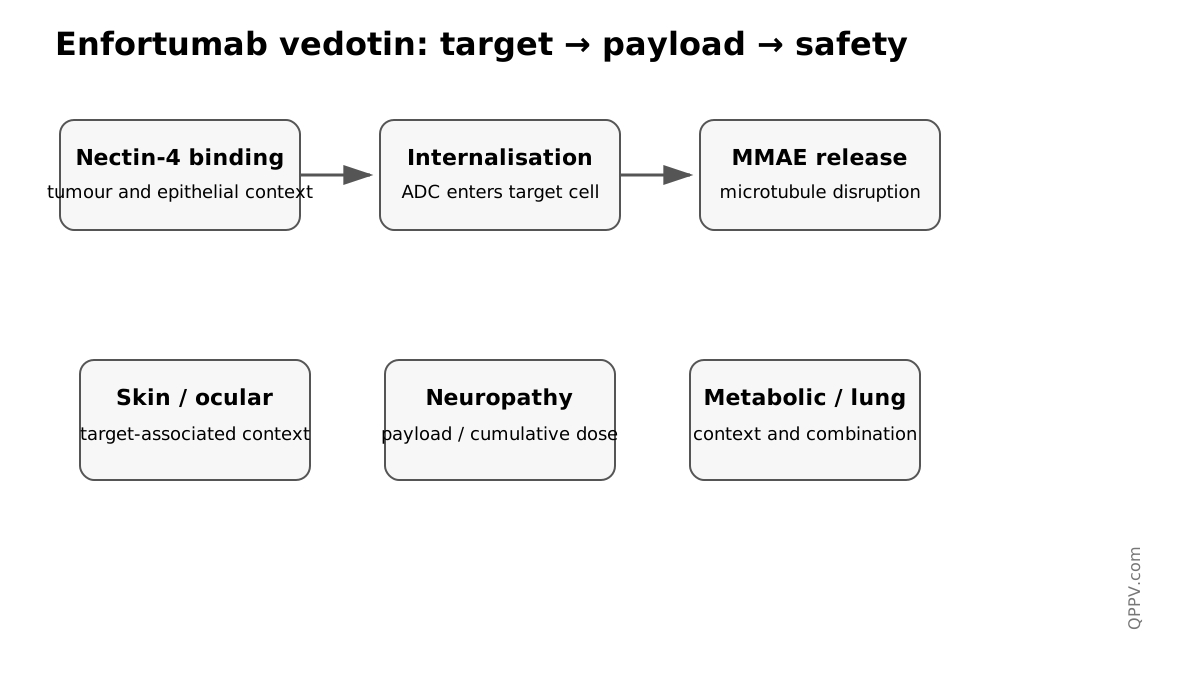
Figure 1. Enfortumab vedotin should be assessed as an integrated system in which target distribution, linker stability, MMAE exposure and treatment context jointly shape pharmacovigilance.
Nectin-4 biology and mechanism of action
Nectin-4 participates in cell-cell adhesion. After the antibody component binds Nectin-4 on a tumour cell, the ADC-target complex is internalised. Intracellular processing releases MMAE, which binds tubulin and disrupts microtubule assembly. Cells that cannot maintain a functional microtubule network are unable to progress normally through mitosis and may undergo cell death.
This sequence creates two clinically relevant layers of toxicity. First, tissues expressing Nectin-4 may be affected through target-associated exposure. Second, MMAE has a pharmacological toxicity profile that is not confined to the tumour, particularly involving peripheral nerves and proliferating tissues.
Development and regulatory position
The medicine entered clinical use in advanced urothelial carcinoma and subsequently moved into earlier treatment settings and combinations. Current regulatory assessment therefore cannot be reduced to monotherapy experience. In particular, combination use with immune-checkpoint inhibition changes attribution because rash, pneumonitis, endocrine abnormalities and other events may plausibly arise from either component or from their interaction.
For pharmacovigilance, the key history is not simply chronological approval. It is the progressive widening of treatment context—from later-line ADC monotherapy to combination and perioperative use—which changes baseline patient characteristics, concomitant treatments, exposure duration and the consequences of treatment interruption.
Major safety domains
Severe cutaneous reactions
Skin toxicity is one of the defining risks. Reports should capture morphology, body-surface-area involvement, mucosal involvement, timing from first dose and most recent dose, concomitant medicines, biopsy results where available, treatment interruption and outcome. Serious blistering or exfoliative presentations require assessment for severe cutaneous adverse reactions, including Stevens-Johnson syndrome and toxic epidermal necrolysis.
Hyperglycaemia and metabolic decompensation
Hyperglycaemia can be clinically significant and may occur with or without pre-existing diabetes. Useful follow-up includes baseline metabolic status, glucose values, ketones where relevant, steroid exposure, infection, dehydration and whether diabetic ketoacidosis occurred. This is a good example of why a laboratory abnormality and a clinical metabolic emergency must not be collapsed into one safety term.
Peripheral neuropathy
MMAE disrupts microtubules, which are also essential for axonal transport. Cumulative sensory or motor neuropathy therefore has a mechanistic basis. Case assessment should record baseline neuropathy, prior neurotoxic chemotherapy, onset relative to cumulative ADC exposure, functional consequences, dose modification and reversibility.
Ocular disorders
Dry eye, keratitis and other ocular events require laterality, symptoms, examination findings, pre-existing ocular disease and supportive treatment. Ocular toxicity may be underestimated when reports use only non-specific terms such as “eye irritation.”
Pneumonitis and interstitial lung disease
New respiratory symptoms need imaging, infectious work-up, immune-checkpoint exposure and competing causes. Combination therapy makes attribution particularly difficult because both ADC-associated and immune-mediated pneumonitis may be relevant.
Combination therapy and attribution
When enfortumab vedotin is administered with a checkpoint inhibitor, the correct PV unit is the regimen, not an isolated product. Rash, pneumonitis, hyperglycaemia and hepatic abnormalities should be assessed against the timing and known profiles of both agents. A causality narrative should preserve uncertainty rather than force a single-drug explanation when evidence is insufficient.
Medication errors and administration issues
Weight-based dose calculation, dose caps, preparation, infusion, extravasation and schedule errors can change exposure. Product traceability should include dose, body weight used for calculation, cycle/day, batch where available and any interruption or reduction.
Pharmacovigilance implementation
A useful enfortumab vedotin case narrative should reconstruct the treatment sequence rather than list events in isolation. At minimum, capture indication and disease setting, monotherapy or combination regimen, dose and schedule, cumulative exposure, relevant baseline comorbidity, event onset, investigations, management, dose action and outcome.
For aggregate review, stratification by treatment setting and concomitant checkpoint inhibition is important. A rise in rash reports after expansion into combination use is not interpretable without changes in exposure, reporting intensity and population.
Illustrative failure modes
An illustrative failure mode is a severe rash reported simply as “skin reaction” without mucosal involvement, body-surface-area estimate or photographs. The report may technically be valid but clinically inadequate for assessing a severe cutaneous adverse reaction.
A second is hyperglycaemia coded without baseline diabetic status, glucose values or ketone assessment. A third is neuropathy pooled without cumulative dose or prior taxane/platinum exposure. These are not hypothetical regulatory findings; they illustrate how missing context can weaken signal evaluation.
Inspection and governance considerations
An inspector could reasonably examine whether follow-up questions are tailored to the major identified risks, whether combination cases preserve regimen-level attribution, whether dose interruptions and reductions are traceable, and whether aggregate reviews distinguish cutaneous, metabolic, neurological, ocular and pulmonary patterns rather than relying only on broad SOC-level counts.
Practical checklist
- Confirm the exact treatment setting and combination regimen.
- Capture cumulative exposure and dose modifications.
- For rash, document mucosal involvement and severity features.
- For hyperglycaemia, reconstruct metabolic status and acute complications.
- For neuropathy, document baseline status and functional impairment.
- For respiratory events, investigate infection and concomitant immunotherapy.
- Preserve brand/batch traceability where available.
Key Takeaways
Enfortumab vedotin pharmacovigilance is governed by ADC architecture and treatment context. Nectin-4 targeting, MMAE exposure and combination therapy create an overlapping safety profile in which skin toxicity, hyperglycaemia, neuropathy, ocular events and pneumonitis require targeted follow-up and careful attribution.
References
- European Medicines Agency. Padcev (enfortumab vedotin): EPAR and product information. Current EU regulatory information, accessed September 2026.
- European Medicines Agency. Padcev: post-authorisation assessment history and variation documents. Current through 2026.
- Rosenberg JE, et al. Enfortumab vedotin in previously treated advanced urothelial carcinoma. Journal of Clinical Oncology. 2019.
- Powles T, et al. Enfortumab vedotin plus pembrolizumab in advanced urothelial cancer. New England Journal of Medicine. 2024.
Regulatory Note
Authorised indications, combinations, dosing and risk-minimisation instructions differ by jurisdiction and can change through variations. Operational decisions should therefore use the current locally applicable product information rather than this educational overview.