EU QPPV Requirements
An EU qualified person responsible for pharmacovigilance—the QPPV—is not compliant merely because a person has been named in a contract or entered in a database. The marketing authorisation holder (MAH) must have permanently and continuously at its disposal an appropriately qualified person who is responsible for establishing and maintaining the pharmacovigilance system and who resides and operates in the Union.[1]
That single sentence contains several separate requirements. The person must be appropriately qualified. The person must be located and work within the required territory. The role must remain continuously available. The organisational position must permit access, authority and influence. Regulatory contact data and the pharmacovigilance system master file (PSMF) must accurately reflect the arrangement. These conditions are connected: a strong curriculum vitae cannot compensate for inaccessible systems, and a current database record cannot compensate for an ineffective authority pathway.
This article explains those requirements in the order in which a reader can evaluate them. It addresses the EU framework; the United Kingdom has a related but legally distinct framework.
Table of Contents
- First Understand the Sources
- The Core Appointment Requirement
- “Appropriately Qualified” Is a Functional Standard
- Medical Training and Medical Assistance
- Residence and Operating Location
- Permanent and Continuous Availability
- Deputy, Delegate and National Contact Are Different Roles
- Authority, Hierarchy and Organisational Position
- Access to the Pharmacovigilance System and PSMF
- Regulatory Contact Details and Article 57 Data
- Turning Appointment Into an Operational Control
- A Proportionate Evidence Set
- Change Control Is Part of Compliance
- Practical Scenarios
- Inspection-Oriented Review Questions
- Common Failure Modes
- Review Checklist
- Key Takeaways
- References
- Regulatory Note
First Understand the Sources
The requirements come from sources with different legal status:
| Source | Function | How to use it |
|---|---|---|
| Directive 2001/83/EC | Establishes core MAH and QPPV obligations | Treat the applicable transposed obligations as binding law |
| Commission Implementing Regulation (EU) No 520/2012 | Specifies conditions for personnel, competence, authority, training, continuity and PSMF content | Consult the current consolidated text; it is directly applicable EU law |
| GVP Modules I and II | Explain regulatory expectations for the pharmacovigilance system, QPPV and PSMF | Use as regulatory guidance for implementing the legislation |
| MAH procedures and contracts | Define how one organisation will operate | Use to implement—not narrow—the external requirements |
This hierarchy prevents two common errors. An internal policy cannot reduce a legal obligation. Conversely, a recommended control should not be described as though its exact wording appeared in legislation.
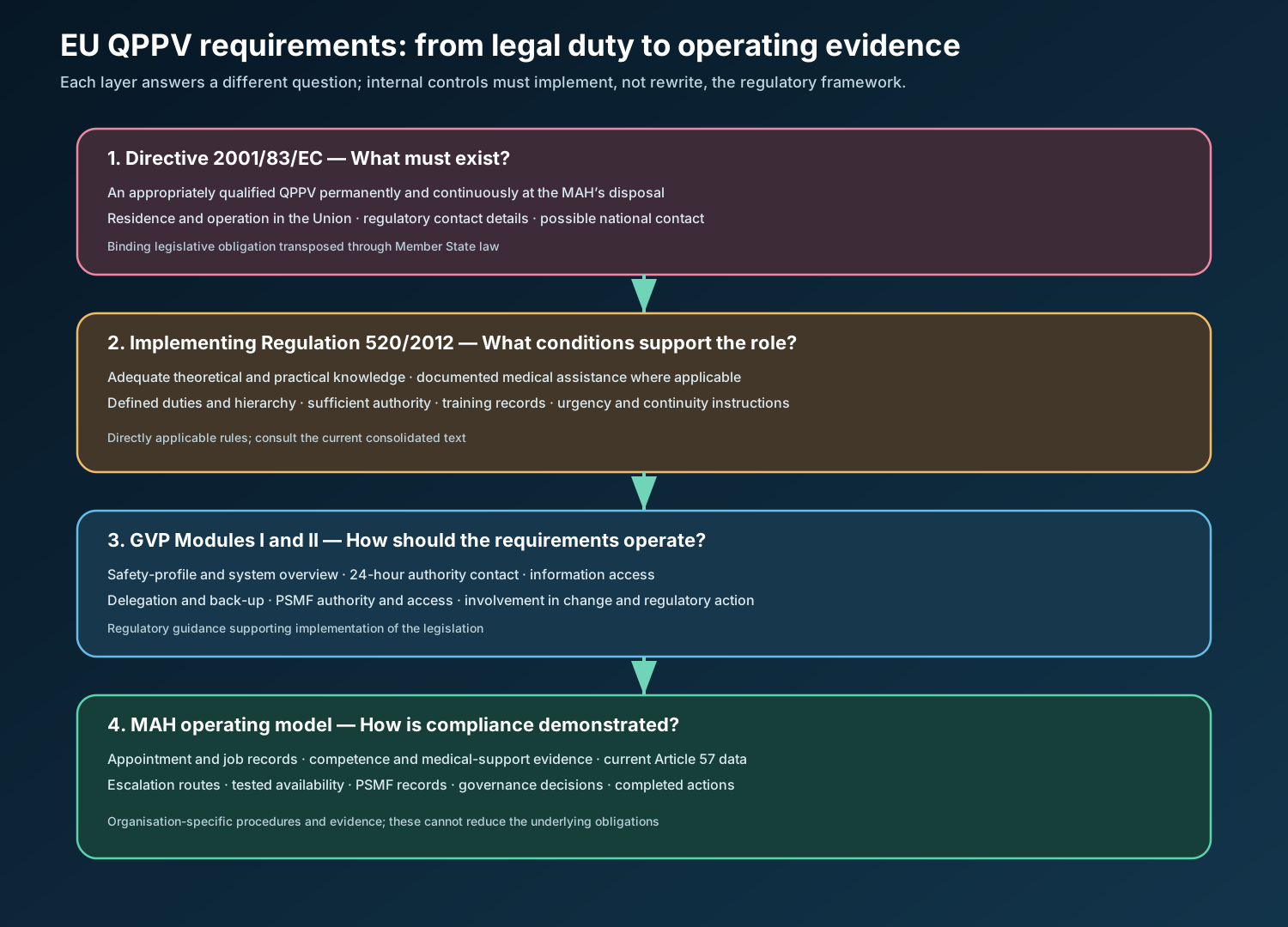
Figure 1. The framework moves from binding legislation to implementation guidance and organisation-specific controls. Each layer answers a different question and should retain its correct regulatory status.
The Core Appointment Requirement
Article 104 of Directive 2001/83/EC places the obligation on the MAH. The MAH must operate a pharmacovigilance system and have permanently and continuously at its disposal an appropriately qualified QPPV who resides and operates in the Union.[1] The MAH remains responsible for compliance even when the QPPV is externally contracted or pharmacovigilance tasks are outsourced.
The wording at its disposal is operational. It requires more than legal association with a named person. The QPPV must be able to obtain relevant information, understand the system and product portfolio, respond through controlled arrangements and exercise the role when needed. Whether the QPPV is an employee or contractor changes the governance mechanisms, not the standard that must be achieved.
The European Economic Area extends relevant EU medicines arrangements to participating EEA states. Operational materials therefore commonly use EU/EEA QPPV. When an appointment depends on a particular country, the MAH should confirm the current legal applicability rather than relying only on the shorthand expression.
“Appropriately Qualified” Is a Functional Standard
EU legislation does not prescribe one universal QPPV degree or one compulsory career sequence. Commission Implementing Regulation 520/2012 instead requires adequate theoretical and practical knowledge for performing pharmacovigilance activities.[2] The assessment is therefore functional and must take account of the actual role.
Relevant competence normally includes:
- the legal and GVP framework applicable to the portfolio;
- individual case safety reporting, signal management and benefit–risk evaluation;
- periodic safety reporting and risk-management systems;
- the architecture and quality system of the MAH’s pharmacovigilance system;
- product, therapeutic-area and population-specific safety considerations;
- regulatory communication, inspection and escalation;
- and the judgement needed to integrate specialist evidence under uncertainty.
Theoretical knowledge is the organised understanding of concepts and requirements. Practical knowledge is the demonstrated ability to apply them in real decisions and operating conditions. A training certificate may support the first; it does not by itself prove the second. Appointment evidence should therefore connect education, experience, induction and assessed readiness to the system and products within scope.
Qualification is also dynamic. A QPPV appointed for a small, established portfolio may require additional preparation before taking responsibility for advanced therapies, complex combination products, a major acquisition or a substantially outsourced global system. Continuing training should respond to changes in legislation, guidance, products, safety profiles and system design.[2,3]
Medical Training and Medical Assistance
A QPPV is not required in every case to be a physician. The Implementing Regulation establishes a conditional safeguard: if the QPPV has not completed the specified basic medical training, the MAH must ensure that the QPPV is assisted by a medically trained person, and that assistance must be duly documented.[2]
The control should identify who provides the medical assistance, when it is available, what types of question trigger involvement, how urgent advice is obtained and how the contribution is recorded. A name on an organisation chart without a functioning consultation route is not persuasive evidence that assistance exists.
Medical assistance does not transfer the QPPV role to the assisting clinician. The clinician contributes medical expertise; the QPPV retains the system-level responsibilities attached to the appointment.
Residence and Operating Location
The Directive requires the QPPV to reside and operate in the Union.[1] The two words address different facts:
- reside concerns where the person ordinarily lives;
- operate concerns where the person actually performs the QPPV role.
Neither should be treated as a postal formality. Evidence may include the appointment record, address information, working arrangements, travel pattern, system-access configuration and the practical location from which ordinary and urgent duties are performed. Remote work does not remove the territorial requirement.
An organisation should reassess the arrangement when the QPPV relocates, changes working pattern, begins an extended assignment elsewhere or becomes subject to immigration or employment conditions that affect where the role can be performed. The relevant question is not only what an agreement states, but whether residence and operation remain true in practice.
Permanent and Continuous Availability
Permanent and continuous availability is a property of the MAH’s operating arrangement. It does not mean that one person must remain awake and personally answer every message. GVP Module I describes the QPPV as a single pharmacovigilance contact for competent authorities and EMA on a 24-hour basis.[3] The organisation therefore needs a dependable route through which an urgent authority request or safety issue can reach an appropriately prepared response at any time.
A controlled availability model usually includes:
- current routine and emergency contact routes;
- defined on-call or call-routing arrangements;
- a qualified deputy or other documented continuity provision;
- access to the information and systems needed for urgent assessment;
- criteria for matters requiring immediate escalation;
- handover arrangements for planned and unplanned absence;
- and periodic testing of the complete pathway.
A test should examine more than whether a telephone rings. It should establish whether the responder can identify the matter, reach the person holding the necessary authority, access relevant information and initiate an appropriate action within the required timeframe.
Deputy, Delegate and National Contact Are Different Roles
These terms are sometimes used interchangeably, but they solve different problems.
| Role | Primary purpose | Relationship to the QPPV |
|---|---|---|
| Deputy or back-up | Maintains continuity during QPPV unavailability | Temporarily performs defined QPPV-related functions under an established activation and handover model |
| Delegate | Performs a specified task, such as review of an output or attendance at a meeting | Receives bounded responsibility for the task; delegation does not remove QPPV overview |
| National contact person | Provides a pharmacovigilance contact at Member State level where required | Reports to the QPPV and does not replace the EU QPPV[1] |
The PSMF must contain information concerning back-up arrangements and, where relevant, the national contact person and delegated tasks.[2] The controls should show activation, authority, competence, access and reporting—not merely a list of names.
Authority, Hierarchy and Organisational Position
Commission Implementing Regulation 520/2012 requires the MAH to define duties and hierarchical relationships in job descriptions and an organisational chart. It also requires the QPPV to have sufficient authority to influence the performance of the quality system and pharmacovigilance activities.[2]
Authority in this context is the recognised organisational capacity to obtain information, require attention to a concern, influence change and escalate where agreement is not reached. It is not identical to seniority, line management or personal independence. A QPPV may work effectively without directly managing every pharmacovigilance function, provided the real governance pathways support the role.
The arrangement should enable the QPPV to:
- access information considered relevant to the pharmacovigilance system or a product’s safety profile;
- request evaluation of a safety or compliance concern;
- be involved early in material system, portfolio and contractual changes;
- contribute to risk-management and regulatory action;
- request appropriate investigation or audit;
- escalate disagreement to an accountable decision-maker;
- and receive evidence of the decision, completed action and resulting effectiveness.[3]
A job description proves that duties were assigned. It does not prove that authority works. Operating evidence comes from actual escalations, decisions, access records, meeting materials, change controls and closed actions.
Access to the Pharmacovigilance System and PSMF
The PSMF is the controlled description of the pharmacovigilance system. The QPPV must have permanent access to it, and the file must be located in the Union either at the site where the MAH’s main pharmacovigilance activities are performed or at the site where the QPPV operates.[2]
Permanent access means the QPPV can obtain the current file and the supporting information needed to understand the system. It should not depend on an unavailable document owner or on ad hoc permission. GVP Module II connects PSMF governance to notification of relevant changes and to QPPV authority over the file.[4]
The PSMF should contain a description of QPPV responsibilities demonstrating authority, a summary curriculum vitae, EudraVigilance registration information, contact details, back-up arrangements and relevant national-contact and delegation information.[2] These records make the appointment traceable within the system; they must remain consistent with the way the role actually operates.
Regulatory Contact Details and Article 57 Data
The MAH must submit the QPPV’s name and contact details to the competent authorities and EMA.[1] EMA uses the Article 57 medicinal-product database—the database established under Article 57 of Regulation (EC) No 726/2004—for QPPV and PSMF-location information associated with authorised medicines. EMA states that changes to QPPV or PSMF data should be updated through the Article 57 process rather than submitted as a variation, and that the data should be updated immediately.[5]
The regulatory record should agree with the appointment, the PSMF and working contact routes. A mismatch can prevent an authority from reaching the correct person and can indicate that change control failed across the system.
Contact governance should cover:
- the QPPV’s current details;
- the 24-hour authority-contact route;
- EudraVigilance registration and access where applicable;
- PSMF location data;
- product and legal-entity associations;
- any required national contact;
- and change triggers, ownership, verification and completion evidence.
Turning Appointment Into an Operational Control
An appointment is ready only when the legal, competence, organisational, continuity and record conditions work together.
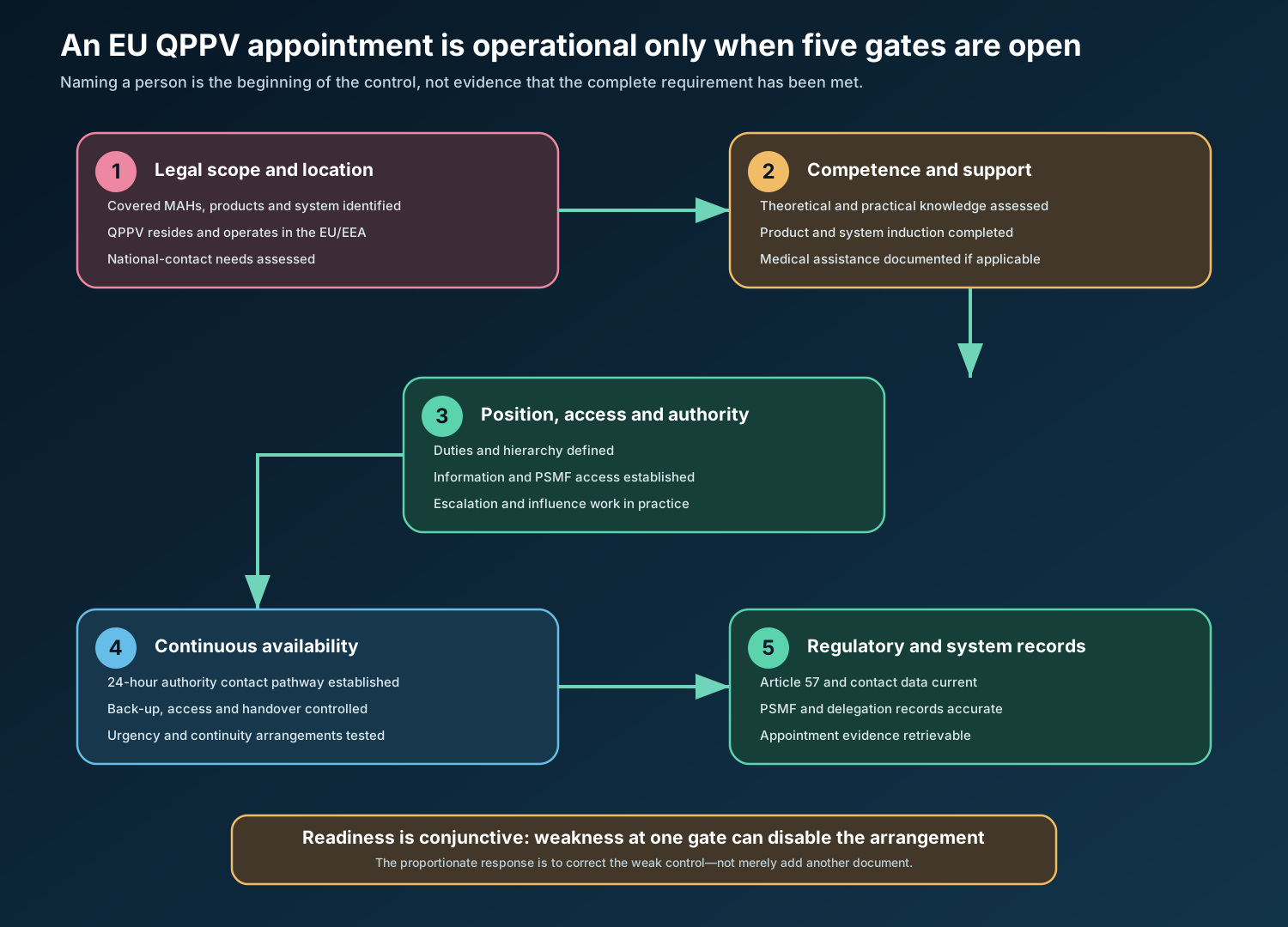
Figure 2. The five gates are conjunctive: each must be sufficiently controlled for the appointment to operate. The model is an educational synthesis, not a separate legal test.
Gate 1: Confirm scope and location
Identify the MAH legal entities, products, territories and pharmacovigilance system covered by the appointment. Confirm residence and operating location, determine whether a national contact is required, and identify any transition from a previous QPPV.
Gate 2: Assess competence and support
Assess theoretical and practical knowledge against the actual portfolio and operating model. Complete product and system induction. Where the legal condition applies, document a workable medically trained assistance arrangement.
Gate 3: Establish position, access and authority
Approve the job description and organisational relationships. Provide system and PSMF access. Establish information flows, governance participation, escalation and a route for recording and resolving disagreement.
Gate 4: Establish continuous availability
Configure routine and urgent contact pathways, deputies or back-up, access, activation criteria and handover. Test the end-to-end arrangement, including outside ordinary working hours.
Gate 5: Align regulatory and system records
Update Article 57 and other applicable authority records, the PSMF, controlled contact lists and relevant procedures. Verify that all sources identify the same current arrangement.
A Proportionate Evidence Set
The purpose of evidence is to demonstrate that the requirement operates, not to create paperwork without analytical value.
| Requirement | Useful evidence examples |
|---|---|
| Appointment and scope | Signed appointment record, role scope, effective date, covered entities and products |
| Qualification | CV, competence assessment, relevant experience, induction and continuing-training records |
| Medical support | Named arrangement, availability route, trigger criteria and records of advice where used |
| Residence and operation | Verified location information and working arrangements consistent with actual practice |
| Duties and hierarchy | Current job description, organisational chart and governance terms of reference |
| Authority and access | System permissions, escalation records, decisions, change involvement and completed actions |
| Continuous availability | Contact tree, back-up plan, handover records and test results |
| PSMF relationship | Current PSMF content, access evidence and QPPV notification or approval records |
| Regulatory data | Article 57 submission and verification evidence; current authority-contact records |
| Delegation | Defined tasks, competent delegates, limits, access, reporting and oversight evidence |
No single document proves the entire arrangement. A credible evidence set is internally consistent and allows a reviewer to trace requirement, control, operation and outcome.
Change Control Is Part of Compliance
QPPV compliance can deteriorate after a sound appointment. Organisational restructures may alter hierarchy. Acquisitions may add products or systems. Vendor changes may interrupt information flows. A move may affect residence or operating location. New safety issues may require expertise not previously needed. Contact details or database associations may become outdated.
The change-control process should therefore ask whether a proposed change affects:
- QPPV scope, workload or competence needs;
- residence or operating location;
- authority, reporting line or governance access;
- pharmacovigilance information flows;
- PSMF content or location;
- regulatory contact or Article 57 data;
- back-up, delegation or national-contact arrangements;
- urgent access and business continuity;
- or the need for additional training, medical or specialist support.
GVP Module I specifically places importance on QPPV awareness of relevant system changes and involvement in matters capable of affecting pharmacovigilance.[3] Early involvement allows controls to be designed before a change takes effect.
Practical Scenarios
A highly experienced QPPV relocates outside the required territory
Competence remains strong, but the location condition may no longer be met. The MAH must assess the legal position and correct the appointment arrangement; updating the address alone does not cure a territorial failure.
A non-physician QPPV has informal access to a company doctor
The model may have suitable expertise, but the legal safeguard requires medical assistance to be ensured and duly documented where the condition applies.[2] Availability, scope and records should be formalised.
An external QPPV cannot access vendor metrics without requesting them monthly
The appointment exists, but timely system overview may be impaired. The MAH should determine which information the QPPV needs directly, which may be routinely reported and which requires event-driven escalation.
A deputy receives urgent calls but lacks system access
The telephone pathway works while the response pathway does not. Continuity testing should verify authority, information access and handover as well as contactability.
Article 57 is current but the PSMF names the former QPPV
The external record is correct, but the pharmacovigilance system description is not. The inconsistency indicates incomplete change control and should be investigated and corrected.
Inspection-Oriented Review Questions
An inspector or internal reviewer may test whether the appointment works through questions such as:
- Which MAHs, products and systems fall within the QPPV’s scope?
- What demonstrates that the QPPV resides and operates in the required territory?
- How was theoretical and practical competence assessed for this portfolio?
- Is medically trained assistance required, and how does it operate?
- What happens when an authority contacts the MAH outside working hours?
- How does the QPPV obtain urgent and routine safety information?
- Which decisions can the QPPV influence, and how is disagreement escalated?
- Can the QPPV access the current PSMF and its supporting records without delay?
- How are deputy, national-contact and delegated arrangements controlled?
- Do Article 57, PSMF, appointment and contact records agree?
- How are acquisitions, restructures and system changes brought to the QPPV?
- Can a real concern be traced from information through QPPV involvement to decision, action and closure?
The questions are an educational synthesis. They are not an exhaustive inspection checklist and do not replace authority-specific inspection procedures.
Common Failure Modes
- treating appointment as a signature rather than an operating arrangement;
- relying on seniority or years of experience without assessing role-specific competence;
- leaving medical assistance informal or unavailable during urgent situations;
- interpreting residence as an address while the role is routinely performed elsewhere;
- equating continuous availability with a telephone number only;
- using a deputy without defined activation, authority, access or handover;
- confusing a national contact or delegate with replacement of the QPPV;
- documenting authority that does not work in real governance decisions;
- restricting PSMF or safety-data access through avoidable permission barriers;
- updating one record but leaving Article 57, PSMF or contact lists inconsistent;
- involving the QPPV only after material system or portfolio changes are decided;
- and closing actions administratively without checking whether the control became effective.
These are analytical failure modes, not statements that a regulator has made a finding against a particular organisation.
Review Checklist
Before an appointment becomes effective—and after every material change—confirm that:
- the individual, MAHs, products, territories and system scope are defined;
- residence and operating location are verified;
- theoretical and practical competence is assessed against the role;
- system and product induction is complete;
- medically trained assistance is documented where required;
- duties and hierarchical relationships are current;
- authority, governance participation and escalation work in practice;
- the QPPV can access relevant safety, compliance and quality information;
- permanent PSMF access and the PSMF location are compliant;
- routine and urgent authority-contact routes operate continuously;
- back-up or deputy arrangements are competent, accessible and tested;
- delegated tasks retain clear boundaries and reporting;
- any required national contact is appointed and reports to the QPPV;
- Article 57 and other regulatory data are current;
- PSMF, regulatory, appointment and contact records agree;
- changes trigger reassessment and controlled updates;
- and evidence can demonstrate operation, decisions and closure.
Key Takeaways
- The MAH must have an appropriately qualified QPPV permanently and continuously at its disposal; the MAH retains legal responsibility.
- Qualification is a functional combination of theoretical knowledge, practical capability and suitability for the system and portfolio.
- A QPPV need not always be a physician, but documented medically trained assistance is required when the condition in the Implementing Regulation applies.
- Residence and operation are separate territorial facts and must both be true in practice.
- Continuous availability depends on a complete response pathway, not a phone number alone.
- Deputy, delegate and national contact roles have different purposes and do not remove the EU QPPV requirement.
- Authority must operate through real access, influence, escalation and follow-up pathways.
- The QPPV must have permanent access to the PSMF, whose content must accurately describe the appointment and supporting arrangements.
- Article 57, PSMF and internal records must remain aligned through effective change control.
- Compliance is best demonstrated by connected evidence showing requirement, control, operation and outcome.
References
- European Parliament and Council. Directive 2001/83/EC on the Community code relating to medicinal products for human use, as amended, particularly Articles 8 and 104. urlEUR-Lex — Directive 2001/83/EChttps://eur-lex.europa.eu/eli/dir/2001/83/oj
- European Commission. Commission Implementing Regulation (EU) No 520/2012 on the performance of pharmacovigilance activities, current consolidated text, particularly Articles 2, 7 and 10. urlEUR-Lex — Consolidated Implementing Regulation 520/2012https://eur-lex.europa.eu/legal-content/EN/TXT/?uri=CELEX:02012R0520-20260212
- European Medicines Agency. Guideline on good pharmacovigilance practices: Module I — Pharmacovigilance systems and their quality systems (EMA/541760/2011). urlEMA — GVP Module Ihttps://www.ema.europa.eu/en/documents/scientific-guideline/guideline-good-pharmacovigilance-practices-module-i-pharmacovigilance-systems-and-their-quality-systems_en.pdf
- European Medicines Agency. Guideline on good pharmacovigilance practices: Module II — Pharmacovigilance system master file, Revision 2 (EMA/816573/2011). urlEMA — GVP Module II Rev. 2https://www.ema.europa.eu/en/documents/scientific-guideline/guideline-good-pharmacovigilance-practices-module-ii-pharmacovigilance-system-master-file-rev-2_en.pdf
- European Medicines Agency. Pharmacovigilance system: questions and answers, including notification of QPPV and PSMF changes through Article 57. urlEMA — Pharmacovigilance system questions and answershttps://www.ema.europa.eu/en/human-regulatory-overview/post-authorisation/pharmacovigilance-post-authorisation/pharmacovigilance-system-questions-answers
- European Medicines Agency. Good pharmacovigilance practices, current modules and revision information. urlEMA — Good pharmacovigilance practiceshttps://www.ema.europa.eu/en/human-regulatory-overview/post-authorisation/pharmacovigilance-post-authorisation/good-pharmacovigilance-practices-gvp
- European Commission. Commission Implementing Regulation (EU) 2025/1466, amending Implementing Regulation (EU) No 520/2012. urlEUR-Lex — Implementing Regulation 2025/1466https://eur-lex.europa.eu/eli/reg_impl/2025/1466/oj
Regulatory Note
This article is professional education about the EU QPPV framework. Binding obligations arise from applicable legislation, national implementation of directives and the conditions of individual marketing authorisations. GVP Modules I and II provide regulatory guidance. The five-gate model, evidence examples, scenarios, review questions and checklist are explanatory or recommended practice unless directly attributed to legislation.
The regulatory framework changes. EMA states that GVP modules are reviewed for revision, including work following amendments introduced by Commission Implementing Regulation (EU) 2025/1466. Before operational use, verify the current consolidated legislation, current GVP revisions, national requirements, Article 57 instructions and product-specific obligations.
The United Kingdom operates a related but legally distinct post-Brexit pharmacovigilance framework. UK QPPV and national-contact requirements should be checked against current MHRA guidance and are addressed separately on QPPV.com.