Famotidine: Discovery, Development, Safety and Pharmacovigilance
Famotidine is a selective histamine H2-receptor antagonist that reduces gastric acid secretion. Introduced when peptic-ulcer treatment was being transformed by receptor-directed pharmacology, it remains useful for selected ulcer, reflux and hypersecretory conditions and for short-term relief of heartburn. Its apparently familiar safety profile presents a particular challenge: the same drug is encountered as prescribed 20- or 40-mg tablets, lower-strength nonprescription preparations, hospital formulations and sometimes combination products. The route, strength, intended duration, jurisdiction and patient's renal function are therefore not optional details in a safety report. [1,2]
A central pharmacovigilance lesson is that a medicine can be well tolerated in most short-term users yet produce clinically consequential adverse effects in vulnerable patients. Famotidine is substantially eliminated through the kidneys. In older patients or those with reduced renal clearance, accumulation can contribute to delirium, confusion, seizures and QT-interval prolongation. At the same time, its intended elevation of gastric pH may reduce absorption of other medicines and cause loss of their therapeutic effect. These are different causal pathways requiring different evidence: one concerns famotidine exposure and toxicity, the other the effectiveness of a co-administered drug. [1,2]
- Famotidine: Discovery, Development, Safety and Pharmacovigilance
- The therapeutic problem before famotidine
- Discovery, invention and commercial development
- Mechanism: a receptor intervention with downstream effects
- Clinical scope is defined by indication and product
- From pharmacology to clinical evidence
- Later evidence and changes in the therapeutic landscape
- How evidence changes pharmacovigilance questions
- Safety profile: common tolerability and rare serious events
- Product-specific US and UK listedness comparison
- Drug interactions: loss of efficacy can be the key safety event
- Practical pharmacovigilance: reconstructing the actual exposure
- From individual cases to signal evaluation
- Governance, quality and the safety lifecycle
- Key takeaways
- References
- Regulatory Note
The therapeutic problem before famotidine
Before the histamine H2-antagonist class, treatment of acid-related ulcer disease relied heavily on antacids, dietary measures and, for refractory disease, surgery. A major conceptual advance was recognition that histamine could stimulate gastric acid secretion through receptors distinct from the H1 receptors targeted by conventional antihistamines. James Black and colleagues' receptor-directed programme produced cimetidine, the first widely successful H2 antagonist, and established acid suppression as a drug-discovery strategy rather than merely symptomatic neutralisation. [3]
The initial H2 antagonists transformed ulcer care, but they were not the final answer. Medicinal chemists sought agents with strong and sustained acid suppression, practical dosing and fewer unwanted interactions. Famotidine emerged from this second wave of H2-antagonist research. It did not discover the H2 receptor; its achievement was to exploit that validated target with a distinct chemical structure and pharmacological profile. The later identification of Helicobacter pylori as a major cause of peptic ulcer disease, the introduction of proton-pump inhibitors and changes in NSAID-related disease subsequently altered the clinical position of the entire H2-antagonist class. [1,3]
Discovery, invention and commercial development
Yamanouchi's medicinal-chemistry programme
Famotidine was developed by Yamanouchi Pharmaceutical in Japan. The historical patent record identifies Yamanouchi as the inventor and licensor of the molecule and describes the US compound patent, No. 4,283,408, issued in 1981. A 1983 primary chemical paper from Yamanouchi's Central Research Laboratories described radiolabelled famotidine for metabolic studies and cited Japanese patent and scientific work from 1981–82. These sources establish the institutional origin without requiring an unsupported attribution of sole discovery to one named scientist. [4,5]
Famotidine differs structurally from cimetidine and ranitidine, including a substituted thiazole-containing region. Its development illustrates the medicinal-chemistry practice of retaining a pharmacological target while changing molecular structure to improve drug properties. Relative in-vitro potency estimates do not by themselves predict clinical superiority: effective acid suppression depends on exposure, receptor occupancy, dosing schedule and clinical context. Clinical outcome studies, rather than structural analogy, were needed to determine whether the molecule healed ulcers and controlled symptoms. [1,5]
Merck licensing, US authorisation and genericisation
The historical US patent litigation records that Merck held exclusive US licensing rights and received marketing approval for famotidine in 1986, selling it as Pepcid. The current US prescription label likewise states initial US approval in 1986. The originator's brand and its marketing rights are separate from the scientific identity of the active substance. Subsequent generic entry changed who could supply the medicine; it did not change the INN or make all presentations interchangeable. [1,4]
The lifecycle later expanded into nonprescription acid relief and combination preparations. Lower-dose Pepcid AC and famotidine-containing antacid combinations occupy a different use context from prescription therapy for endoscopically documented ulcers or pathological hypersecretion. A safety report that merely states "Pepcid" may conceal whether the patient took famotidine alone, an antacid combination or multiple products with overlapping ingredients. Reconciliation must therefore establish the actual package and active ingredients, not infer them from a familiar brand. [1,6,15]
The rise of proton-pump inhibitors and H. pylori eradication therapy changed the business and clinical environment. Famotidine remained available as a generic H2 antagonist, while the originator and consumer-health rights evolved. Without audited primary financial disclosures, brand revenue, combined-product revenue and market share should not be attributed to famotidine as a worldwide INN total. The alternating editorial programme uses a US prescription-frequency proxy, not a verified global commercial or safety ranking.
Mechanism: a receptor intervention with downstream effects
Histamine H2 receptors and the parietal cell
Gastric parietal cells integrate signals from histamine, gastrin and acetylcholine. Histamine binds H2 receptors coupled to Gs signalling, increases intracellular cyclic AMP and promotes activity of the final acid-secretory machinery, the H+/K+-ATPase. Famotidine competitively antagonises H2-receptor-mediated stimulation and decreases basal, nocturnal and stimulated acid output. It does not directly neutralise acid already present in the lumen, nor does it inhibit the proton pump by the same mechanism as a proton-pump inhibitor. [1,2]
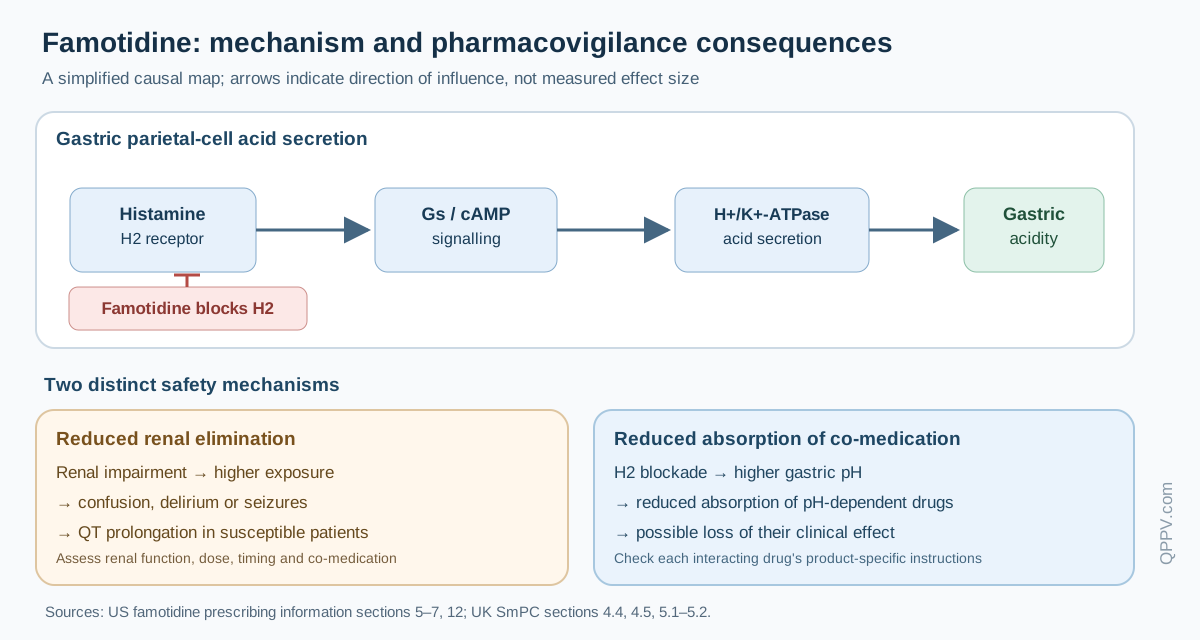
Figure 1. Simplified parietal-cell pathway. Famotidine blocks histamine's H2-mediated contribution to acid secretion; the figure also shows the separate clinical consequences of higher gastric pH and reduced renal elimination. It is a conceptual diagram, not a quantitative pharmacokinetic model.
Nocturnal acid suppression helped motivate once-nightly regimens in the early ulcer trials. The response is nevertheless variable, and acid secretion is influenced by meal timing, other secretagogues and duration of H2-antagonist exposure. Tachyphylaxis to repeated H2 blockade can develop; the magnitude and clinical relevance depend on the setting. In a small repeated-dosing physiology study, famotidine's effect on intragastric pH diminished over several weeks, illustrating pharmacodynamic tolerance rather than evidence of progressive disease. [16] Persistent symptoms do not automatically justify unlimited dose escalation or continued empiric treatment without reassessment.
Pharmacokinetics and renal dependence
Famotidine has incomplete oral bioavailability and is cleared substantially by renal mechanisms, including tubular secretion. Reduced renal function increases systemic exposure and can extend elimination. This matters particularly when a standard regimen is continued after acute kidney injury, when an older patient's renal function is estimated from serum creatinine alone, or when different clinicians prescribe both scheduled and as-needed doses. The US label provides indication-specific renal adjustment tables; the UK product information uses its own thresholds and directions. A dosing assessment must apply the relevant product's instructions, rather than a single universal "renal dose". [1,2]
Unlike cimetidine, famotidine is not generally characterised as a strong broad-spectrum inhibitor of hepatic cytochrome P450 enzymes. Nevertheless, the US label specifically flags possible interaction with tizanidine through CYP1A2 inhibition, alongside the much broader problem of reduced absorption of drugs requiring an acidic gastric environment. "Few CYP interactions" must never be simplified to "no interactions". [1]
Clinical scope is defined by indication and product
The US 20-mg prescription tablet information examined here covers duodenal and gastric ulcer, nonerosive gastro-oesophageal reflux disease, erosive oesophagitis and, in adults, pathological hypersecretory conditions and prevention of duodenal-ulcer recurrence. Its paediatric tablet use is limited by a 40-kg threshold and indication. The UK Zentiva 20-mg tablet SmPC describes duodenal and benign gastric ulcers, recurrence prevention, Zollinger–Ellison syndrome and symptomatic mild-to-moderate reflux oesophagitis; it states that paediatric safety and efficacy have not been established for that product. These are product-specific differences, not proof that the molecule is universally indicated or contraindicated in all children. [1,2]
The evidence that originally justified these uses was assembled before modern diagnostic and eradication pathways. The next section evaluates pivotal ulcer trials, comparative evidence and important negative or uncertain extensions of famotidine use.
From pharmacology to clinical evidence
Randomised evidence for duodenal-ulcer healing
The pivotal placebo-controlled evidence is unusually direct. In a multicentre double-blind study reported in 1987, 384 patients with endoscopically confirmed active duodenal ulcer were enrolled and 363 met evaluation criteria. Four-week healing rates were 70% with famotidine 40 mg at bedtime, 75% with 40 mg twice daily and 67% with 20 mg twice daily, compared with 31% on placebo. At eight weeks the corresponding rates were 83%, 82%, 82% and 45%. Pain and antacid use were also lower in the famotidine groups. These are endoscopic healing and symptom outcomes, not evidence that famotidine eradicates H. pylori or prevents all later ulcer complications. [7]
The three active regimens produced similar healing proportions despite different daily doses. That observation supports the practical significance of sustained nocturnal acid suppression and shows why a higher total daily dose should not automatically be interpreted as proportionately more effective. It does not imply that the schedules are identical for every indication, renal-function category or formulation. The trial was conducted before contemporary H. pylori management and modern patterns of NSAID and antithrombotic exposure; its absolute response rates are not guaranteed for present-day patients.
Benign gastric ulcer and diagnostic safeguards
In a placebo-controlled multicentre trial of 157 patients with endoscopically verified benign gastric ulcers, famotidine 40 mg at bedtime produced healing rates of 45%, 66% and 78% at weeks four, six and eight, versus 39%, 44% and 64% with placebo. The reported differences favoured famotidine at weeks six and eight, but not necessarily at the earliest time point. This distinction matters because a reduction in pain or an early impression of improvement does not establish mucosal healing. [8]
A further multicountry double-blind trial evaluated 336 patients with benign gastric ulcers; in the per-protocol analysis at four weeks, healing was reported in 70/149 (47%) famotidine-treated patients and 45/145 (31%) placebo-treated patients. Per-protocol denominators exclude some randomised patients and should not be substituted for intention-to-treat denominators. [9]
Both US and UK labels warn that symptomatic response does not exclude gastric malignancy. A serious failure mode is repeated empirical suppression of symptoms without appropriate investigation when alarm features, persistent symptoms or suspected gastric ulcer require evaluation. This is not a famotidine adverse reaction in the narrow pharmacological sense, but it is a treatment-process risk with potentially serious consequences. [1,2]
Comparisons with another H2 antagonist
A randomised multicentre double-blind comparison of 40 mg famotidine nightly and 300 mg ranitidine nightly enrolled 143 patients with active duodenal ulcers. Among 133 evaluable patients, healing at four and six weeks did not differ significantly between groups. Such a study supports comparable short-term ulcer healing under those tested conditions; it does not establish equivalent long-term safety, contamination risk or availability decades later. [10]
Head-to-head outcomes should not be converted into a blanket claim of superiority based on receptor-binding potency. The clinical context includes symptom pattern, adherence, adverse effects, renal function, cost, interacting medicines and diagnostic certainty. When comparing studies, one must retain whether analyses used all randomised patients or a smaller evaluable group and whether endpoints were healing, symptom relief or recurrence.
Reflux and hypersecretory conditions
Famotidine can improve symptoms in selected patients with nonerosive reflux disease and promote healing in some patients with erosive oesophagitis. The US label's clinical-study section describes indication-specific evidence and dose regimens, including more intensive regimens for erosive disease. Pathological hypersecretory conditions such as Zollinger–Ellison syndrome require individualised titration and careful reassessment rather than direct extrapolation from ordinary heartburn dosing. [1]
H2-receptor antagonism is mechanistically different from the more sustained proton-pump inhibition achieved with PPIs. Treatment choice depends on disease severity, need for healing, recurrence risk and whether a reversible underlying cause can be treated. In particular, H. pylori-associated ulcer disease requires assessment for infection and eradication when indicated; acid suppression alone does not remove the organism. The 2024 American College of Gastroenterology guidance emphasises eradication and confirmation of cure rather than indefinite symptomatic suppression as a substitute. [11]
Nonprescription use changes the exposure picture
Nonprescription famotidine is often taken intermittently, in advance of a provoking meal or in response to symptoms, without a clinician documenting the episode. A medication history that includes only prescription records may miss this exposure. Conversely, an OTC product containing famotidine plus antacids should not be counted as famotidine monotherapy in a case report. The presence of calcium carbonate or magnesium hydroxide can affect interpretation of gastrointestinal symptoms, electrolyte abnormalities and co-medication timing.
Self-treatment can also create prolonged unobserved use. If symptoms persist or recur, the safety issue may involve delayed diagnosis rather than an intrinsic adverse drug reaction. The correct response is not to classify every persistent symptom as a lack-of-efficacy signal: establish indication, intended duration, red flags, H. pylori status where relevant, adherence and the exact formulation.
Later evidence and changes in the therapeutic landscape
H. pylori, proton-pump inhibitors and the place of famotidine
The discovery of H. pylori's role in ulcer disease and the availability of eradication regimens changed the natural history of many peptic ulcers. Famotidine can suppress acid and permit healing while the underlying infection remains. Therefore, a patient whose ulcer recurs after stopping famotidine may have persistent infection, NSAID exposure or another cause; recurrence alone does not demonstrate pharmacological withdrawal toxicity. A well-designed pharmacovigilance evaluation asks whether the treatment was appropriate to the aetiology and whether the presumed diagnosis was confirmed.
Ranitidine withdrawal: a class comparison that must remain precise
In April 2020, the FDA requested removal of ranitidine products because levels of the nitrosamine impurity NDMA could increase during storage. At that time FDA stated its testing had not detected NDMA in tested famotidine products. This was a product- and time-specific analytical finding, not a guarantee that every possible famotidine batch or future formulation is free of all impurities. It would be inaccurate to transfer ranitidine's specific impurity findings to famotidine merely because both inhibit H2 receptors. [12]
The episode illustrates why quality-related pharmacovigilance requires batch and manufacturing information, validated analytical methods and an assessment of the precise chemical substance. Class membership is useful for hypothesis generation but insufficient to establish a product defect.
Exploratory repurposing is not an approved indication
During the COVID-19 pandemic, famotidine was investigated at doses and schedules unlike standard ulcer treatment. In a small placebo-controlled outpatient trial, 55 patients were randomised; the primary time-to-symptom-resolution comparison was not statistically significant (P=0.4), although a secondary symptom-resolution-rate measure favoured famotidine. The trial was too small to establish a clinically definitive treatment effect or rare safety outcomes. COVID-19 is not an indication in the US and UK prescription labels compared in this article. [13]
A postmarketing report from such use should record the indication as off-label, the actual dose and duration, and the acute illness as a competing cause of symptoms or laboratory abnormalities. Off-label exposure is not itself proof of an adverse reaction, but unusual dose intensity may change the benefit–risk assessment.
How evidence changes pharmacovigilance questions
The original ulcer trials primarily addressed healing over weeks and collected common short-term adverse events. They were not designed to detect very rare immune reactions, severe neuropsychiatric events in renally impaired patients, or pharmacokinetic interactions with medicines developed much later. Such questions arise through product-label evolution, mechanistic knowledge, spontaneous reports and targeted observational research.
Trial and postmarketing evidence should not be combined as if both used a common denominator. A clinical trial estimates events under its eligibility and observation conditions; a spontaneous-report database contains suspected events without a reliable count of exposed persons. The next section examines the specific US and UK product labels and the safety phenotypes that require careful case evaluation.
Safety profile: common tolerability and rare serious events
Frequent reactions versus clinically important exceptions
In the US prescription tablet label, headache, dizziness and constipation were reported in at least 1% of famotidine-treated trial participants; diarrhoea also appears in the highlights among the common reactions. These usually do not define the product's most consequential safety decisions. Rare or postmarketing phenomena include severe hypersensitivity, serious cutaneous reactions, blood-cell disorders, neuropsychiatric effects, cardiac rhythm abnormalities and liver injury. A symptom's frequency in selected trials should not be confused with its potential seriousness in an individual patient. [1]
For adverse-event assessment, the most important initial distinction is between a symptom plausibly attributable to the drug, an exacerbation of the underlying gastrointestinal disorder, a manifestation of renal or metabolic disease, and an event caused by another medicine. Headache after a first dose in an otherwise well patient is a different problem from acute confusion after several days of an unadjusted dose during kidney injury.
Central nervous system toxicity and renal impairment
The US label's section 5.1 explicitly describes confusion, delirium, hallucinations, disorientation, agitation, seizures and lethargy in older patients and those with moderate or severe renal impairment. It links the concern to higher blood concentrations in renal impairment. These manifestations can be mistaken for dementia, infection, stroke, sedative toxicity or metabolic encephalopathy. They demand medical evaluation rather than an assumption of drug causation based only on temporal association. [1]
A high-quality case narrative records baseline cognition, time from first exposure to symptom onset, exact dose and frequency, estimated creatinine clearance at each relevant time, acute kidney injury, dialysis timing, co-administered psychoactive drugs and changes after stopping or adjusting treatment. When symptoms resolve after withdrawal, the dechallenge supports but does not prove causality; spontaneous improvement of the competing illness may explain part of the course. Rechallenge should not be undertaken merely to strengthen a pharmacovigilance report when the prior event was serious.
QT prolongation, arrhythmias and interacting risk factors
The US postmarketing section lists arrhythmia, atrioventricular block and prolonged QT interval. The UK SmPC lists arrhythmias and QT prolongation as very rare, particularly in renal impairment, and notes AV block with intravenously administered H2 antagonists. The US label separately advises patients with moderate or severe renal impairment about QT risk. A Korean ECG database study reported an association between famotidine exposure and QTc prolongation, with a stronger observed signal in subsets with low calcium or magnesium; its observational design cannot isolate drug causality or quantify a population incidence. [1,2,14]
A case of syncope or QT prolongation requires the actual ECG and correction formula where available, baseline QTc, electrolytes, renal function, cardiac disease, dose timing and concurrent QT-prolonging medicines. An observed QTc change should not automatically be coded as torsades de pointes without rhythm documentation. Conversely, a normal ECG obtained days after an event does not exclude an earlier transient abnormality.
Severe hypersensitivity, skin and haematological reactions
The US label identifies anaphylaxis, angioedema and urticaria in postmarketing experience; its adverse-reaction section also describes agranulocytosis, pancytopenia and leukopenia. Stevens–Johnson syndrome and toxic epidermal necrolysis are identified postmarketing. The UK SmPC similarly lists severe hypersensitivity, blood dyscrasias and severe skin reactions, often within a very-rare frequency category. In a suspected severe skin reaction, document mucosal involvement, extent of detachment, latency, pathology if available and every newly introduced medicine. A broad "rash" code loses clinically important diagnostic detail. [1,2]
For cytopenias, baseline counts and competing explanations are essential: intercurrent infection, haematological disease, nutritional deficiency and other marrow-suppressing medicines may be more plausible than famotidine. Anaphylaxis is a medical emergency; a report must distinguish observed airway or circulatory compromise from non-specific pruritus or facial swelling.
Hepatic, pulmonary and muscular events
Postmarketing US information includes hepatitis, cholestatic jaundice, interstitial pneumonia and rhabdomyolysis. The UK SmPC includes hepatic reactions and interstitial pneumonia, sometimes fatal. These are clinically important candidates for evaluation but cannot be assigned a reliable incidence from voluntary reporting. A suspected liver-injury case should document alanine aminotransferase, alkaline phosphatase, bilirubin, the time course and competing causes. A suspected interstitial lung event needs imaging, oxygen requirement and evaluation for infection or underlying lung disease. [1,2]
Product-specific US and UK listedness comparison
Reference documents and scope
This comparison uses US famotidine prescription tablets, 20 mg, Ascend Laboratories source product distributed as RemedyRepack, NLM DailyMed set ID e59a2c97-19c7-485c-bb1b-272ddb9ae053, label revised September 2025 and DailyMed published/updated June 2026, sections 1–8 and 12; and UK Zentiva Famotidine 20 mg film-coated tablets, electronic Medicines Compendium SmPC last updated 20 March 2025, sections 4.1–4.8 and 5. Both were accessed 2 November 2026. They are specific oral prescription tablet products, not the US OTC Pepcid AC label, a US injectable product or an EU-centralised SmPC. [1,2]
Here, listed means identified in the named public product's adverse-reaction section; warning means described in warnings/precautions; and mentioned means addressed elsewhere without necessarily appearing as an adverse-reaction entry. A listed reaction is not automatically caused by the medicine in a particular patient. The assessment does not establish company-core listedness, clinical-trial expectedness against a study's reference safety information, or local expedited-reporting obligations.
| Safety topic | US prescription tablet label | UK Zentiva 20-mg tablet SmPC |
|---|---|---|
| Common tolerability | Section 6.1: headache, dizziness, constipation at least 1%; highlights also identify diarrhoea | Section 4.8: headache, dizziness, constipation and diarrhoea listed as common |
| CNS effects | Section 5.1 warning for confusion, delirium, hallucinations, disorientation, agitation, seizures and lethargy in older or renally impaired patients; some psychiatric/neurological terms in 6.1/6.2 | Section 4.8: reversible psychiatric disturbance and convulsions, particularly in renal impairment, listed as very rare |
| Cardiac effects | Section 6.2 postmarketing: arrhythmia, AV block, prolonged QT; renal QT concern in section 8.6 | Section 4.8: arrhythmias and QT prolongation very rare; IV H2-antagonist AV block noted |
| Hypersensitivity | Section 4 contraindication for serious famotidine or class hypersensitivity; 6.2 anaphylaxis and angioedema | Sections 4.3 and 4.8: class hypersensitivity contraindication and very-rare anaphylaxis/angioedema/bronchospasm |
| Blood and skin | Section 6.2 includes agranulocytosis, pancytopenia, leukopenia, SJS/TEN | Section 4.8 lists blood dyscrasias and SJS/TEN as very rare |
| Renal adjustment | Section 2.2: indication-specific reductions when creatinine clearance is below 60 mL/min | Section 4.2: 50% daily dose reduction when clearance is below 30 mL/min, with additional caution below 10 mL/min in 4.4 |
| Paediatric scope | Indicated tablet uses for specified conditions at weight 40 kg or more; other formulations for lower weight | Section 4.4: safety and efficacy in children not established for this product |
| Pregnancy/lactation | Sections 8.1–8.2: insufficient human pregnancy evidence; individual risk–benefit and breastfeeding considerations | Section 4.6: not recommended in pregnancy unless clearly needed; breastfeeding mothers advised to stop treatment or breastfeeding |
| Interaction presentation | Section 7: pH-dependent drug absorption and possible tizanidine interaction | Section 4.5: pH-dependent interactions, probenecid, antacids and sucralfate; different wording on CYP effects |
What these differences mean
The US threshold of creatinine clearance below 60 mL/min and the UK threshold below 30 mL/min are not interchangeable instructions. They belong to different authorised product information, with different dosing tables and clinical assumptions. Similarly, the US tizanidine warning should not be falsely described as present in the UK section 4.5, nor should its absence from the selected UK text be treated as proof that a clinical interaction is impossible. The UK very-rare frequency assignments must not be transferred to US postmarketing entries that explicitly lack reliable denominators. [1,2]
Neither label should be used as a substitute for a patient's actual product leaflet or an applicable local regulatory reference. A safety team comparing a report against an MAH's reference safety information must document the reference version in force at the relevant time and preserve jurisdiction-specific differences.
Drug interactions: loss of efficacy can be the key safety event
The US label advises against co-administration with dasatinib, delavirdine, cefditoren and fosamprenavir because reduced gastric acidity may reduce absorption. It directs readers to the co-medication labels for atazanavir, erlotinib, azole antifungals, ledipasvir/sofosbuvir, nilotinib and rilpivirine. The UK SmPC also warns about pH-dependent absorption, and identifies probenecid inhibition of renal tubular secretion, antacid and sucralfate administration timing, and several tyrosine kinase inhibitors. Exact restrictions vary by product, dose and schedule; a blanket spacing rule is not safe. [1,2]
A loss-of-effect case may present as virological rebound, progression of a malignancy or worsening infection rather than an immediate famotidine symptom. Causality evaluation must consider the co-medication's formulation and pharmacology, adherence, drug levels where available, and whether famotidine was added before the deterioration. The outcome may be clinically serious even if famotidine itself caused no direct tissue toxicity.
Practical pharmacovigilance: reconstructing the actual exposure
A useful case begins with a time line rather than a diagnosis. Record the reason famotidine was started, the intended regimen, the brand and active ingredients, whether the product was prescription or OTC, the route, actual administered dose and changes in kidney function. In a hospital case, administration records are more informative than the original prescription alone. For self-treatment, ask about tablets kept at home, combination antacid products and duplicate use under different brand names.
For serious events, capture onset, progression, objective findings, management, outcome and relevant follow-up. Document the reporter's description faithfully before applying MedDRA terminology. If an event is medically important, its seriousness classification is independent of whether a causal association with famotidine has been established. Similarly, a labelled reaction is not necessarily expected under the specific reference safety information used for a particular regulatory report.
Illustrative case: acute confusion during kidney injury
An older adult receives a usual adult famotidine regimen for reflux. Several days later, during dehydration and acute kidney injury, the patient develops confusion. A pharmacovigilance assessment should retrieve baseline cognitive status, the full drug administration record, creatinine trajectory, estimated creatinine clearance, infection investigations, electrolyte results, sedatives and the timing of improvement. Famotidine accumulation is biologically plausible and the US label specifically warns of CNS reactions in renal impairment. But infection, uraemia, hypoxia or another medicine may contribute; the final causality assessment should preserve that uncertainty. [1]
A process review should ask whether renal adjustment was considered when kidney function changed, whether a clinical decision-support alert was available and whether a duplicate OTC product was missed. These are illustrative operational questions, not claims that a particular hospital failed an inspection.
Illustrative case: prolonged QT and syncope
A patient with chronic kidney disease receives famotidine and another QT-prolonging drug, then experiences syncope. The case needs the ECG with QTc, rhythm strip if available, potassium, magnesium, calcium, renal function and the exact sequence of dose changes. The US and UK labels both recognise QT concerns, but their listedness presentation differs. It would be an error to report confirmed torsades de pointes solely from syncope and a later prolonged QTc, or to assume famotidine was the only contributor. [1,2,14]
Illustrative case: reduced co-medication effectiveness
A patient stable on a medicine whose absorption depends on gastric acidity starts famotidine and later shows deterioration of the treated condition. The suspected event may be reduced exposure to the other medicine rather than a direct adverse reaction to famotidine. Confirm the exact co-medication, formulation, label restrictions, timing, adherence and objective disease markers. Do not advise spacing without checking whether the relevant co-medication label permits it; for some combinations, co-administration is discouraged rather than simply time-separated. [1,2]
From individual cases to signal evaluation
Spontaneous reports are valuable for detecting unusual patterns, particularly serious events in patients excluded from clinical trials. However, they lack a reliable exposed denominator, may contain duplicates and are vulnerable to reporting bias. A disproportionality finding is a screening signal, not a causal estimate. Aggregate review should examine seriousness, diagnostic certainty, plausible latency, dose and renal function, dechallenge, concomitant drugs and background rates before deciding whether a safety signal warrants further evaluation.
A signal of confusion in older adults should be stratified by renal impairment and dose rather than interpreted as uniform risk across all users. A QT signal should examine electrolytes, concomitant medicines and objective ECG confirmation. A loss-of-efficacy signal involving an antiretroviral or targeted anticancer medicine should identify which co-medication was affected and whether its absorption is pH-dependent. These refinements make the aggregate review medically interpretable.
Risk minimisation can be proportionate. Pharmacy medication reconciliation, renal-function review, warnings for interacting drugs, education about duplicate OTC use and prompts to investigate persistent gastrointestinal symptoms may all be useful. Whether any particular measure is legally required depends on the jurisdiction, marketing authorisation and product-specific obligations; these examples are recommended practices, not universal regulatory mandates.
Governance, quality and the safety lifecycle
The distinction between pharmacovigilance and product quality becomes especially important when a suspected reaction clusters by batch, formulation or manufacturer. Preserve batch number, expiry, storage conditions, photographs and packaging if a quality concern is suspected. The ranitidine NDMA episode demonstrates that a quality defect in one H2 antagonist cannot simply be assigned to all others; chemical identity, stability data and testing determine whether a product is implicated. [12]
Literature surveillance should also separate mechanistic speculation from reproducible clinical outcomes. The small COVID-19 trial generated a hypothesis, not an authorisation or an established new benefit. Observational QT findings can motivate targeted study but are not equivalent to randomised proof of arrhythmic risk. A sound safety review retains both kinds of uncertainty rather than converting every reported association into a confirmed reaction. [13,14]
For a mature generic medicine, changes in product ownership and national labels create an additional governance challenge. A case from a particular manufacturer should be assessed against the appropriate product information, while class-wide scientific evidence can inform signal evaluation. Periodic review should distinguish newly reported risks from long-recognised reactions appearing under different coding or terminology. Regulatory changes should be dated and attributed to the authority or MAH responsible.
Key takeaways
Famotidine's clinical usefulness follows from H2-receptor blockade and reduced gastric acid secretion, supported by randomised ulcer-healing trials. Its main pharmacovigilance vulnerabilities arise when exposure exceeds the patient's renal clearance, when severe rare reactions are overlooked because the medicine is familiar, or when acid suppression compromises absorption of another drug. US and UK labels share several important safety themes but differ in paediatric scope, renal dosing and presentation of adverse-reaction frequencies. Neither label comparison nor spontaneous reporting alone establishes individual causality.
The practical standard is to reconstruct the precise product, indication, administration history, kidney function and interacting medicines, then integrate objective clinical findings with dated product-specific regulatory information. This approach protects against both under-recognition of serious reactions and over-attribution of common disease events to an established therapy.
References
- US National Library of Medicine, DailyMed. Famotidine tablets, 20 mg, Ascend Laboratories source product, RemedyRepack distribution. Prescribing information revised September 2025; DailyMed updated June 2026. Sections 1–8, 12 and 14. https://dailymed.nlm.nih.gov/dailymed/lookup.cfm?setid=e59a2c97-19c7-485c-bb1b-272ddb9ae053
- Zentiva. Famotidine 20 mg film-coated tablets, UK Summary of Product Characteristics. Electronic Medicines Compendium, updated 20 March 2025. Sections 4.1–4.8, 5. https://www.medicines.org.uk/emc/product/100688/smpc
- American Chemical Society. Tagamet: Discovery of Histamine H2-Receptor Antagonists. National Historic Chemical Landmark. https://www.acs.org/education/whatischemistry/landmarks/cimetidinetagamet.html
- Yamanouchi Pharmaceutical Co. v. Danbury Pharmacal, Inc. 21 F. Supp. 2d 366 (S.D.N.Y. 1998). Patent and licensing history of famotidine. https://law.justia.com/cases/federal/district-courts/FSupp2/21/366/2577772/
- Tamazawa K, Arima H. Synthesis of 35S- and 14C-labeled famotidine, a new potent histamine H2 receptor antagonist. J Label Compd Radiopharm. 1983;20:1193–1200. doi:10.1002/jlcr.2580201009. https://doi.org/10.1002/jlcr.2580201009
- US National Library of Medicine, DailyMed. Pepcid AC Original Strength, famotidine OTC tablet, Kenvue Brands. SPL effective February 2026. https://dailymed.nlm.nih.gov/dailymed/drugInfo.cfm?setid=54f4086f-e443-4e7e-8c7e-94e152e1c256
- Gitlin N, McCullough AJ, Smith JL, et al. A multicenter, double-blind, randomized, placebo-controlled comparison of nocturnal and twice-a-day famotidine in active duodenal ulcer disease. Gastroenterology. 1987;92:48–53. doi:10.1016/0016-5085(87)90838-9. https://pubmed.ncbi.nlm.nih.gov/2877912/
- Suppression of nocturnal acid secretion with famotidine accelerates gastric ulcer healing. Randomised placebo-controlled trial. PubMed PMID:2570730. https://pubmed.ncbi.nlm.nih.gov/2570730/
- Simon B, Müller P, Dammann HG. Famotidine once-a-day in the therapy of acute, benign gastric ulcer: a worldwide experience. J Clin Gastroenterol. 1987;9 Suppl 2:19–22. doi:10.1097/00004836-198707002-00006. https://pubmed.ncbi.nlm.nih.gov/2887614/
- A multicentre, randomized, double-blind study comparing nocte famotidine or ranitidine for active duodenal ulceration. Aliment Pharmacol Ther. 1989;3:103–110. https://onlinelibrary.wiley.com/doi/10.1111/j.1365-2036.1989.tb00195.x
- Chey WD, Howden CW, Moss SF, et al. ACG Clinical Guideline: Treatment of Helicobacter pylori Infection. Am J Gastroenterol. 2024;119:1730–1753. doi:10.14309/ajg.0000000000002968. https://gi.org/wp-content/uploads/2025/01/ACG-Hpylori-Guidelines-Highlights-2024-FINAL.pdf.pdf
- US Food and Drug Administration. FDA Requests Removal of All Ranitidine Products from the Market. 1 April 2020. https://www.fda.gov/news-events/press-announcements/fda-requests-removal-all-ranitidine-products-zantac-market
- Oral famotidine versus placebo in non-hospitalised patients with COVID-19: a randomised, double-blind, phase 2 trial. PubMed PMID:35144974. https://pubmed.ncbi.nlm.nih.gov/35144974/
-
Analysis of an ECG record database reveals QT interval prolongation potential of famotidine in a large Korean population. PubMed PMID:25253561. https://pubmed.ncbi.nlm.nih.gov/25253561/
-
US National Library of Medicine, DailyMed. Pepcid Complete chewable tablets: famotidine 10 mg, calcium carbonate 800 mg and magnesium hydroxide 165 mg. Product label published June 2025. https://dailymed.nlm.nih.gov/dailymed/drugInfo.cfm?setid=549136d5-8f2c-d417-e063-6394a90a23e4
- Wilder-Smith CH, Ernst T, Gennoni M, et al. Tolerance to oral H2-receptor antagonists. Dig Dis Sci. 1990;35:976–983. doi:10.1007/BF01537246. https://pubmed.ncbi.nlm.nih.gov/1974493/
Regulatory Note
This educational article reflects the specific publicly accessible US and UK product information identified above and scientific sources reviewed on 2 November 2026. The UK SmPC is a national product record, not an EMA centrally authorised EU product-information document. Product labels, approved indications and safety information can change; clinicians and pharmacovigilance professionals must consult the current applicable local label and their organisation's controlled reference safety information. The article does not provide individual prescribing advice, determine case-specific expectedness or causality, or replace regulatory reporting procedures.