Fluoxetine: Discovery, Development, Safety and Pharmacovigilance
Fluoxetine is a selective serotonin reuptake inhibitor (SSRI) with a long clinical history in depression and several other psychiatric conditions. The medicine illustrates both the benefits and limitations of mechanistically targeted drug discovery: inhibition of serotonin reuptake can be measured pharmacologically, but clinical improvement depends on a complex biological and psychosocial context. Its long-lived active metabolite, norfluoxetine, gives fluoxetine a distinctive interaction and switching profile. Safety evaluation therefore requires attention not only to events occurring during treatment, but also to events after discontinuation and when another medicine is started.
- Fluoxetine: Discovery, Development, Safety and Pharmacovigilance
- Discovery: from monoamine hypotheses to a selective inhibitor
- Pharmacology and disposition
- Clinical development and approved uses
- Regulatory evolution and formulation differences
- Safety and benefit–risk
- Interaction risk beyond the final dose
- Special populations and long-term outcomes
- Pharmacovigilance workflows
- Practical checklist
- Key takeaways
- References
- Regulatory Note
Discovery: from monoamine hypotheses to a selective inhibitor
Research at Eli Lilly during the early 1970s investigated whether selectively blocking neuronal serotonin uptake could produce antidepressant effects with a different tolerability profile from older tricyclic agents. The discovery team associated with fluoxetine included David T. Wong, Bryan B. Molloy, Ray W. Fuller and colleagues. Work on phenoxyphenylpropylamine compounds identified LY110140, subsequently named fluoxetine. The original research and its historical reconstruction distinguish molecular discovery from the later evidence required to establish clinical effectiveness [1,2].
The Lilly research programme was active in 1971, and the original 1974 paper described the selective serotonin-uptake inhibitor LY110140 [1,2,3]. Discovery was followed by a prolonged period of pharmacology, clinical testing and regulatory review rather than a direct leap from target identification to approval. A six-week double-blind comparison with imipramine and placebo, published in 1985, reported antidepressant efficacy and different tolerability patterns; its modest sample and short duration limited inference about rare harms and long-term outcomes [12]. The US FDA approved fluoxetine for depression in 1987, with the US launch following in 1988 [1,4]. The dates of scientific discovery, first publication, authorisation and launch refer to different milestones.
The compound became one of the best-known antidepressants, but its commercial history is not itself evidence of comparative clinical superiority. Lilly's original compound-patent protection expired around the early-2000s transition to generic competition, which diversified manufacturers and formulations [2,7]. The 2001 weekly formulation was a separate development strategy rather than a new active substance. Medicinal-chemistry programmes also examined individual fluoxetine enantiomers; work on an R-fluoxetine candidate did not proceed to a marketed replacement, with potential cardiac toxicity reported as a development concern [2]. A negative programme is part of the lifecycle, but preclinical or candidate-specific findings must not be retroactively treated as an established clinical risk at the same magnitude for the marketed racemate. Product identification still matters: Prozac, generic fluoxetine products, weekly formulations and fluoxetine-containing combinations may have different authorised indications and instructions.
Pharmacology and disposition
Fluoxetine inhibits the serotonin transporter (SERT), reducing presynaptic reuptake of serotonin. Norfluoxetine is pharmacologically active and contributes to the prolonged elimination profile. Fluoxetine also inhibits CYP2D6, making clinically important pharmacokinetic interactions possible even after dosing stops. The current US Prozac label describes an elimination half-life of fluoxetine of approximately four to six days after chronic administration and norfluoxetine of approximately four to sixteen days [4]. Individual values vary.
This long persistence has two opposing consequences. Concentrations change relatively slowly, which can reduce some abrupt withdrawal phenomena compared with short-lived SSRIs, but adverse effects and drug interactions may also persist. A five-week interval after stopping fluoxetine is specified before starting an MAOI intended to treat psychiatric disorders in the US label; at least fourteen days are required after stopping such an MAOI before starting fluoxetine [4]. These are product-specific safety instructions, not a generic recommendation for all antidepressant switches.
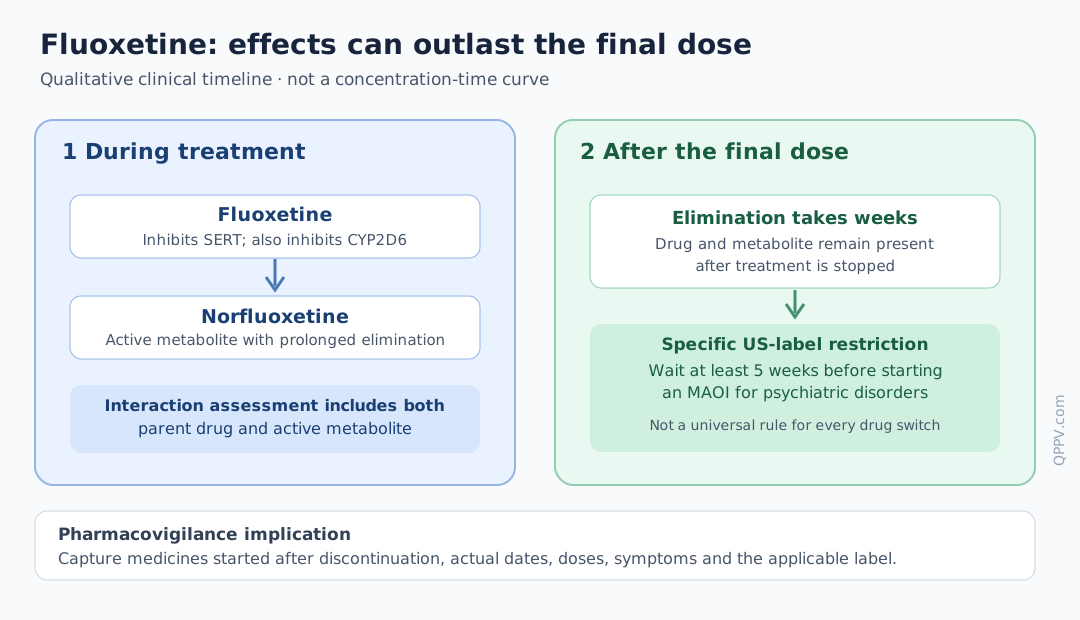
Figure 1. Fluoxetine and its active metabolite can remain relevant to interaction assessment after the last dose. The five-week MAOI interval shown is a specific US-label precaution, not a universal washout interval. The figure is conceptual rather than a concentration–time curve [4].
Clinical development and approved uses
Major depressive disorder
The US label supports acute and maintenance treatment of major depressive disorder in adults and in specified paediatric age groups. Short-term placebo-controlled trials demonstrated improvement on depression rating scales, while maintenance studies addressed relapse prevention in responders [4,5]. An early 1985 trial compared fluoxetine, imipramine and placebo; its short duration and limited size make it more informative for short-term efficacy and common tolerability than for uncommon serious adverse events [12]. Clinical improvement is not synonymous with a demonstrated correction of a simple serotonin deficiency. Trials of antidepressants are sensitive to selection, severity, placebo response and outcome measurement; an individual patient may respond, fail to respond or experience unacceptable adverse effects.
Obsessive-compulsive disorder and panic disorder
Fluoxetine also demonstrated efficacy in placebo-controlled trials of obsessive-compulsive disorder (OCD), including paediatric OCD, and in adults with panic disorder. The US product label describes two adult thirteen-week OCD trials and a paediatric thirteen-week trial, as well as two twelve-week panic-disorder trials [5]. These results support defined indications but do not establish efficacy for every anxiety presentation or justify extrapolating adult results to unstudied paediatric populations.
Bulimia nervosa and dose-specific evidence
Bulimia trials are an important example of why dose-specific negative evidence belongs in a lifecycle review. In three placebo-controlled studies, fluoxetine 60 mg/day reduced binge-eating and vomiting episodes; 20 mg/day did not show the same statistically significant superiority over placebo [5]. This is evidence for a particular population and outcome, not a claim that larger doses are universally better or safer.
Premenstrual dysphoric disorder and combination therapy
Fluoxetine was separately marketed as Sarafem for premenstrual dysphoric disorder in the United States; FDA records document approval of the PMDD indication in 2000 and of intermittent dosing in 2002 [13]. Fluoxetine combined with olanzapine has its own evidence and product-specific labelling for bipolar depression and treatment-resistant depression. Adverse effects of the combination cannot be attributed automatically to fluoxetine alone, and the combination's metabolic and other risks require separate assessment [4,6].
Regulatory evolution and formulation differences
Following the 1987 US depression approval, the development programme expanded into OCD, bulimia nervosa, panic disorder and PMDD, with each indication supported by its own evidence rather than by a blanket assumption that all psychiatric symptoms respond to serotonin reuptake inhibition [4,5]. FDA regulatory history documents the PMDD indication in 2000 and an intermittent-dosing supplement in 2002 [13]. FDA approved the 90-mg delayed-release Prozac Weekly formulation in February 2001 for depression [7,14]. Its rationale relied partly on long elimination, not on evidence that a weekly formulation could replace any daily regimen without a defined transition. Current market availability must be verified separately from historical approval.
The January 2026 US Prozac label retains a boxed warning on suicidal thoughts and behaviours in children, adolescents and young adults [4]. Generic and brand labels can differ in presentation, approved indications or exclusivity-related wording. European products are commonly authorised nationally; the existence of an EMA website or a US label does not establish one uniform EU-wide fluoxetine SmPC. A UK SmPC, for example, lists adult depression, OCD and bulimia nervosa, but its paediatric indication is restricted to moderate-to-severe depression after insufficient response to psychological therapy, alongside concurrent psychological treatment; this is narrower than the US paediatric OCD indication [4,10]. The UK SmPC also contraindicates fluoxetine with metoprolol used for heart failure, an important local-label distinction [10]. Clinical and regulatory reviewers must identify the exact jurisdiction, product and revision date.
October 2026 UK safety-communication changes
On 15 October 2026, the MHRA announced strengthened antidepressant risk communication after review by the Commission on Human Medicines. The measures include more prominent patient-information warnings about suicidal thoughts and behaviours, a patient card, and planned supporting material; the agency also directed attention to sexual dysfunction that can persist after discontinuation [8,9]. The term post-SSRI sexual dysfunction (PSSD) is being introduced in patient information for certain antidepressants, including fluoxetine. The MHRA describes uncertainty about mechanism and frequency, so neither a reliable incidence nor a validated individual causal test can be inferred [8,9]. The supplementary safety leaflet was described as forthcoming in 2027; its existence should not be claimed as already implemented in October 2026. These are UK regulatory communication measures, not automatic changes to the US label or evidence that every national product leaflet has already been revised.
Safety and benefit–risk
Suicidal thoughts, behavioural activation and early monitoring
Antidepressant trials demonstrated an increased risk of suicidal thinking and behaviour in children, adolescents and young adults in short-term studies, reflected in the US boxed warning. The warning does not imply that every suicidal event during treatment was drug-induced or that untreated depression carries no risk. Monitoring is especially important at initiation, dose changes and periods of clinical deterioration. Safety case narratives should preserve baseline illness severity, prior suicidal behaviour, emerging agitation, akathisia, insomnia, dose history, other treatment changes and clinical outcome.
Serotonin syndrome
Serotonin syndrome can arise with fluoxetine, especially when combined with other serotonergic medicines. The syndrome may involve altered mental status, autonomic instability, neuromuscular findings and gastrointestinal symptoms. Concomitant MAOIs, linezolid, certain opioids, triptans and other serotonergic products require product-specific interaction review. A safety report should identify exact agents, start and stop times, examination findings, temperature, rigidity, clonus, treatment and recovery. Mere co-prescription does not confirm the diagnosis.
Bleeding and hyponatraemia
SSRIs can impair platelet serotonin uptake and are associated with increased bleeding risk, particularly alongside NSAIDs, aspirin, anticoagulants and other agents affecting haemostasis. Fluoxetine can also cause hyponatraemia, sometimes associated with inappropriate antidiuretic hormone secretion. Older adults, patients taking diuretics and those with volume depletion may be more vulnerable. For a suspected case, obtain sodium trends or bleeding investigations, relevant medicines, clinical context and outcome rather than attributing the event to the SSRI by temporal association alone.
Mania, seizures and other clinically important risks
Screening for bipolar disorder before antidepressant treatment helps identify patients at risk of manic or hypomanic activation. Seizures, severe hypersensitivity or skin reactions, appetite and weight changes, sexual dysfunction and sleep disturbance are additional concerns addressed in product information [4,5]. For sexual dysfunction, record the pre-treatment baseline, onset, symptom type, concurrent psychiatric symptoms, other medicines, the discontinuation date and whether symptoms persisted beyond expected drug clearance. The MHRA's 2026 review explicitly recognised the importance of persistent sexual symptoms while acknowledging that the frequency and mechanism remain uncertain [8,9]. An adverse-event record should distinguish the underlying psychiatric illness, the event phenotype, concomitant drugs and the time course. The label's contraindications and warnings take precedence over generic class summaries.
QT effects and cardiac context
QT prolongation and ventricular arrhythmia, including torsades de pointes, have been reported with fluoxetine. Risk assessment should consider pre-existing heart disease, electrolyte disturbances, overdose, drug interactions and other QT-prolonging agents. An ECG report should include correction method, actual intervals and dates. A spontaneous report of palpitations without electrocardiographic evidence cannot be assumed to represent torsades de pointes.
Interaction risk beyond the final dose
Fluoxetine is a potent CYP2D6 inhibitor, and both fluoxetine and norfluoxetine persist after treatment stops. This can affect exposure to medicines such as certain antipsychotics, tricyclic antidepressants and antiarrhythmics. The US label specifically contraindicates use with thioridazine and pimozide and imposes washout intervals relevant to their use [4]. Interaction assessment should record the chronology of both medicines, dose adjustments, concentrations when available, ECGs and clinical effects.
Tamoxifen is a particularly consequential example. Its conversion to the active metabolite endoxifen depends partly on CYP2D6. A small pharmacokinetic switching study found substantially higher endoxifen exposure after patients changed from potent CYP2D6-inhibiting fluoxetine or paroxetine to a weak inhibitor, but this was a metabolite-exposure study, not proof of improved breast-cancer survival [15]. A larger observational comparison did not find increased all-cause mortality with potent CYP2D6-inhibiting SSRIs versus other SSRIs; residual confounding and endpoint selection limit causal interpretation [16]. The MHRA nevertheless advises avoiding fluoxetine or paroxetine with tamoxifen because of the pharmacological interaction [9]. Distinguish a demonstrated metabolic interaction, uncertain clinical outcome effect and jurisdiction-specific prescribing advice.
An important operational error is treating the date of the last capsule as the date on which fluoxetine's pharmacological effects ended. Another is assuming that a five-week washout requirement applies to every switch without consulting the relevant products' instructions. Pharmacovigilance teams should avoid both mistakes.
Special populations and long-term outcomes
Children and adolescents
The US Prozac label includes major depressive disorder in patients aged eight years and older and OCD in patients aged seven years and older, subject to its detailed paediatric provisions [4]. The boxed suicidality warning makes monitoring and documentation particularly important. Paediatric safety evaluation should include developmental stage, baseline illness, caregiver observations, behavioural activation, weight or growth concerns, and co-treatment. Adult efficacy cannot simply be extrapolated to younger children outside studied and authorised populations.
The independent Treatment for Adolescents With Depression Study (TADS) randomised 439 adolescents aged 12–17 years to fluoxetine, cognitive-behavioural therapy (CBT), their combination or placebo. At 12 weeks, response on the Clinical Global Impressions measure was 71.0% with combined fluoxetine–CBT, 60.6% with fluoxetine, 43.2% with CBT and 34.8% with placebo [11]. The combined treatment was the most favourable of these study arms on the prespecified short-term benefit–risk assessment. Seven participants attempted suicide and no suicide deaths occurred during the initial 12 weeks; the trial was not powered to establish comparative risk of rare suicidal outcomes. The trial excluded patients at particularly high acute suicide risk, and psychotherapy arms could not be blinded. These constraints are essential when translating a trial result into real-world monitoring.
Pregnancy and lactation
Fluoxetine crosses the placenta, and the US label discusses possible neonatal adaptation symptoms and persistent pulmonary hypertension following SSRI exposure in pregnancy [4]. These are not grounds for claiming that an individual exposed pregnancy will have an adverse outcome. The MHRA's October 2026 safety background summarises earlier observational evidence suggesting a small elevation in congenital cardiac-defect risk after first-trimester fluoxetine exposure; the agency describes a background frequency of approximately 1 in 100 and an exposed risk of less than 2 in 100 [9]. Such comparisons are observational and susceptible to confounding by indication and other factors. Maternal illness and relapse risk also matter. A pregnancy-exposure case should capture timing by gestational week, dose, concomitant medicines, maternal condition, birth outcomes and neonatal follow-up while respecting privacy.
Fluoxetine and norfluoxetine can enter breast milk. Risk assessment requires consideration of the infant's condition, feeding, symptoms and the maternal clinical need. Recommendations should follow current local product information and specialist assessment rather than categorical statements about all antidepressants.
Discontinuation, persistence and overdose
Discontinuation symptoms can occur after stopping antidepressants, although fluoxetine's long elimination profile changes their timing. The October 2026 MHRA review separately addresses withdrawal reactions and persistent sexual dysfunction: these are different clinical questions and should not be merged into one diagnosis [8,9]. Withdrawal phenomena should be distinguished from recurrence of depression or anxiety, intercurrent illness and the effects of another medicine. In overdose, collect exact dose, co-ingestions, time of exposure, neurological findings, ECG and clinical course. The prolonged elimination of the active substances may complicate observation and interaction assessment.
Pharmacovigilance workflows
Suspected serotonin syndrome after a new medicine
Hypothetical teaching case. A patient stable on fluoxetine develops fever, agitation and clonus after a second serotonergic medicine is introduced. A useful safety narrative reconstructs exposure and symptom chronology, captures vital signs and neuromuscular findings, checks alternative diagnoses and records interventions and resolution. The reviewer should not treat the mere combination as sufficient evidence of serotonin syndrome; clinical diagnostic criteria and source documentation matter.
Suicidality report after treatment initiation
Hypothetical teaching case. A young adult reports worsening suicidal thoughts soon after starting fluoxetine. Follow-up seeks the baseline psychiatric diagnosis, prior suicidal behaviour, other stressors, activation symptoms, dose and adherence, concurrent therapy, clinical management and outcome. The objective is an accurate medically reviewable record, not an unsupported assertion that the drug either caused or prevented the event.
Persistent sexual dysfunction after stopping
Hypothetical teaching case. A patient reports genital sensory change and reduced sexual function continuing months after fluoxetine discontinuation. The assessor documents symptom type, onset relative to treatment, pre-treatment sexual function, psychiatric symptoms, other medicines, hormonal or neurological conditions, cessation date and subsequent trajectory. The MHRA's 2026 communication identifies persistent sexual dysfunction as a concern for some antidepressants, including fluoxetine, while acknowledging uncertainty about incidence and mechanism [8,9]. A spontaneous case can be important even when a precise denominator or a definitive causal mechanism is unavailable.
Aggregate signal assessment
For a mature generic drug, spontaneous reports, literature, epidemiological studies and regulatory actions provide complementary evidence. Reports of bleeding should be examined with co-medications and patient risk factors; reports of persistent adverse effects should include adequate exposure and follow-up; pregnancy reports need careful denominator and confounding interpretation. Disproportionality is a signal-detection method, not an incidence estimate or proof of causality.
A regulatory safety review should document the safety question, case definition, source quality, medical assessment, competing explanations, benefit–risk implications, decision and effectiveness of any action. Requirements for expedited reporting, periodic assessment and signal management depend on the jurisdiction and authorisation. Internal quality practices, such as a standard interaction chronology template, should not be described as universally binding law.
Practical checklist
- Verify the INN, exact brand or generic product, strength, formulation, jurisdiction and label version.
- Establish the psychiatric indication, baseline symptoms, dose, adherence and recent changes.
- Capture all serotonergic and CYP2D6-interacting medicines, including drugs started after fluoxetine was stopped.
- For suspected suicidality, document baseline risk, clinical course, interventions and outcome.
- For suspected serotonin syndrome, seek examination findings, temperature, clonus, exposure timing and alternative causes.
- For bleeding, QT events or hyponatraemia, collect relevant laboratory, ECG and co-medication evidence.
- For pregnancy or paediatric cases, document the appropriate developmental or gestational context.
- Separate reporter facts, medical judgement, labelled risk and regulatory obligations.
Key takeaways
Fluoxetine's discovery helped establish selective serotonin reuptake inhibition as an antidepressant strategy, but its clinical effects and risks cannot be reduced to one molecular mechanism. Its evidence base differs by indication and dose; bulimia studies, for example, support the 60-mg regimen rather than assuming equivalent results with 20 mg. The January 2026 US label retains a boxed warning on suicidality in younger patients. Long-lived norfluoxetine and CYP2D6 inhibition make interaction timelines particularly important. Effective pharmacovigilance combines careful psychiatric baseline assessment, objective clinical evidence and clear jurisdictional distinctions.
References
- Wong DT, Perry KW, Bymaster FP. The discovery of fluoxetine hydrochloride (Prozac). Nature Reviews Drug Discovery. 2005;4:764–774. https://doi.org/10.1038/nrd1821
- Wenthur CJ, Bennett MR, Lindsley CW. Classics in Chemical Neuroscience: Fluoxetine (Prozac). ACS Chemical Neuroscience. 2014;5:14–23. https://pmc.ncbi.nlm.nih.gov/articles/PMC3894728/
- Science History Institute. Ray W. Fuller, David T. Wong, and Bryan B. Molloy: the discovery of fluoxetine. https://www.sciencehistory.org/education/scientific-biographies/ray-w-fuller-david-t-wong-and-bryan-b-molloy/
- National Library of Medicine. DailyMed: Prozac (fluoxetine hydrochloride) capsules, updated 8 January 2026. https://www.dailymed.nlm.nih.gov/dailymed/drugInfo.cfm?setid=c88f33ed-6dfb-4c5e-bc01-d8e36dd97299
- National Library of Medicine. DailyMed: fluoxetine tablets, clinical studies and indications. https://www.dailymed.nlm.nih.gov/dailymed/fda/fdaDrugXsl.cfm?setid=a9ed97dd-8041-4a02-889c-dcb8b2805f36&type=display
- National Library of Medicine. DailyMed: fluoxetine capsules, combination-therapy evidence and warnings. https://dailymed-beta.nlm.nih.gov/dailymed/fda/fdaDrugXsl.cfm?setid=aae4e339-5244-f6f9-e053-2995a90a42ce&type=display
- US Food and Drug Administration. Prozac Weekly: NDA 21-235 administrative review. 2001. https://www.accessdata.fda.gov/drugsatfda_docs/nda/2001/21-235_Prozac_Admindocs_P1.pdf
- UK Medicines and Healthcare products Regulatory Agency. Antidepressants: new safety measures to improve communication of suicidal thoughts and behaviours and persistent sexual dysfunction. Drug Safety Update. 15 October 2026. https://www.gov.uk/drug-safety-update/antidepressants-new-safety-measures-for-all-patients-to-improve-communication-of-the-risk-of-suicidal-thoughts-and-behaviours-and-persistent-sexual-dysfunction
- UK Medicines and Healthcare products Regulatory Agency. Antidepressants: use and safety, updated 15 October 2026. https://www.gov.uk/government/publications/antidepressants-use-and-safety--2/selective-serotonin-reuptake-inhibitors-ssris-and-serotonin-and-noradrenaline-reuptake-inhibitors-snris-use-and-safety
- UK electronic Medicines Compendium. Fluoxetine 20 mg/5 mL oral solution: summary of product characteristics. https://www.medicines.org.uk/emc/product/10286/smpc
- Treatment for Adolescents With Depression Study (TADS) Team. Fluoxetine, cognitive-behavioral therapy, and their combination for adolescents with depression: a randomized controlled trial. JAMA. 2004;292:807–820. https://doi.org/10.1001/jama.292.7.807
- Cohn JB, Wilcox C. A comparison of fluoxetine, imipramine, and placebo in patients with major depressive disorder. J Clin Psychiatry. 1985;46:26–31. https://pubmed.ncbi.nlm.nih.gov/3882677/
- US Food and Drug Administration. Sarafem (fluoxetine): NDA 21-860 medical review, regulatory history of PMDD indication and intermittent dosing. 2006. https://www.accessdata.fda.gov/drugsatfda_docs/nda/2006/021860s000_MedR.pdf
- US Food and Drug Administration. Prozac Weekly (fluoxetine hydrochloride delayed-release capsules): NDA 21-235 approval letter. February 2001. https://www.accessdata.fda.gov/drugsatfda_docs/nda/2001/21-235_Prozac_Approv.pdf
- Binkhorst L, et al. Augmentation of endoxifen exposure in tamoxifen-treated women following SSRI switch. Clin Pharmacokinet. 2016. https://pubmed.ncbi.nlm.nih.gov/26446141/
- Donneyong MM, et al. Risk of mortality with concomitant use of tamoxifen and selective serotonin reuptake inhibitors: multi-database cohort study. BMJ. 2016. https://pubmed.ncbi.nlm.nih.gov/27694571/
Regulatory Note
This article is educational and is not a substitute for locally authorised product information, clinical assessment or applicable pharmacovigilance obligations. US brand, generic, weekly and combination-product labels may differ, and European authorisations are product- and jurisdiction-specific. Historical regulatory milestones, current label statements, trial findings, medical interpretation and recommended operational practices are distinct categories of evidence.