Formoterol: Discovery, Development, Safety and Pharmacovigilance
Formoterol is a long-acting beta2-adrenoceptor agonist (LABA) whose comparatively rapid onset of bronchodilation distinguishes it from some other drugs in its class. That pharmacological property made formoterol useful not only as a twice-daily maintenance bronchodilator but also, in specifically authorised inhaled-corticosteroid (ICS) combinations and regimens, as part of an anti-inflammatory reliever strategy. The distinction matters: a rapid onset does not make every formoterol product a licensed rescue medicine, and it never makes formoterol-only treatment an acceptable substitute for anti-inflammatory treatment of asthma. [1,2,6]
This is a single-INN lifecycle review, not an article about a single brand or combination. Its product-specific safety comparison examines US NorthStar RxLLC formoterol fumarate inhalation solution 20 micrograms/2 mL, DailyMed revised and updated May 2026, and UK AstraZeneca Oxis Turbohaler 6 dry-powder inhaler, SmPC last updated on emc 12 June 2023. The US label is for a nebulised COPD maintenance product; the UK SmPC covers a dry-powder inhaler used in COPD and, as an adjunct to ICS, asthma. These are different presentations, devices, patient groups and authorisations. The UK SmPC is not an EU-wide centralised marketing authorisation. Both were accessed on 3 November 2026. [1,2]
- Formoterol: Discovery, Development, Safety and Pharmacovigilance
- Discovery: from short-acting bronchodilators to sustained beta2 stimulation
- Mechanism and pharmacology
- Clinical evidence: the endpoint belongs to the regimen
- Safety mechanisms and clinically important phenotypes
- Product-specific listedness: US nebuliser versus UK dry-powder inhaler
- Special populations and interacting treatments
- Pharmacovigilance practice: reconstruct the inhaled exposure
- Aggregate surveillance, signals and risk minimisation
- Key Takeaways
- References
- Regulatory Note
Discovery: from short-acting bronchodilators to sustained beta2 stimulation
The scientific problem
Early inhaled sympathomimetics demonstrated that airway smooth muscle could be relaxed rapidly through adrenergic receptors, but brief action meant frequent administration and sometimes troublesome systemic effects. Medicinal chemistry sought beta2 selectivity, durable receptor activity and an inhaled delivery system that could produce a predictable pulmonary dose. Formoterol emerged from this programme as a synthetic beta2 agonist with a long duration of effect yet an onset measured in minutes. Its clinical significance was therefore partly molecular and partly technological: a drug cannot be evaluated independently of the inhaler that delivers it. [2,3]
The documented origin of formoterol is Yamanouchi Pharmaceutical Company. A later process patent identifies Yamanouchi Japanese patent filings from 1972 as early disclosures. This establishes a historical development trail, not the identity of an individual inventor or an exact first-in-human study; those details should not be supplied without primary evidence. The molecule subsequently entered international respiratory development through licensing and device partnerships. [3]
Licensing, device development and the original US launch
Novartis' historical regulatory filings describe Foradil as licensed from Yamanouchi, launched in the United States in 2001, and marketed internationally using the single-dose Aerolizer dry-powder system. In 2002, Novartis granted Schering-Plough US distribution and marketing rights for Foradil; in 2003 the companies announced plans to develop a fixed combination with mometasone. This is a documented partnership, not proof that any combination's entire sales or clinical benefit belongs to formoterol alone. [4,5]
Device development created its own commercial and safety history. A published 2004 development review describes SkyePharma's work on the Foradil Certihaler multi-dose dry-powder system, including powder and device manufacturing arrangements and licensing to Novartis. Changes in capsule loading, breath activation, dose counting, delivered dose and patient technique can influence exposure and medication errors even when the active molecule is unchanged. The Foradil, Oxis, nebulised and fixed-combination programmes therefore form one molecular lifecycle with multiple product-specific regulatory histories. [5,12]
From monotherapy to combination-based asthma management
In COPD, a LABA can provide maintenance bronchodilation without the same disease-specific requirement for concurrent ICS as in asthma. In asthma, LABA monotherapy became a major safety concern because bronchodilation may temporarily improve symptoms while airway inflammation remains inadequately treated. Large safety studies of ICS/LABA fixed combinations subsequently supplied reassuring evidence relative to ICS alone, leading to the 2017 removal of the US boxed warning from fixed ICS/LABA combinations—not from the general concern about LABA monotherapy in asthma. [1,6]
Later studies of budesonide/formoterol established the rationale for coupling rapid bronchodilation with an inhaled anti-inflammatory dose when symptoms prompt treatment. That result belongs to the tested combination, device, patient population and regimen. It is not evidence that nebulised formoterol alone should be used for acute asthma relief. [6,9]
Mechanism and pharmacology
Receptor signalling and bronchodilation
Formoterol activates beta2 adrenergic receptors on bronchial smooth-muscle cells. These Gs-coupled receptors stimulate adenylyl cyclase, increase intracellular cyclic AMP and activate protein kinase A, shifting smooth-muscle regulation toward relaxation. This pathway improves airflow obstruction but does not itself replace corticosteroid-mediated control of airway inflammation. The accompanying schematic distinguishes the beneficial airway branch from systemic beta-agonist effects. [1,2]
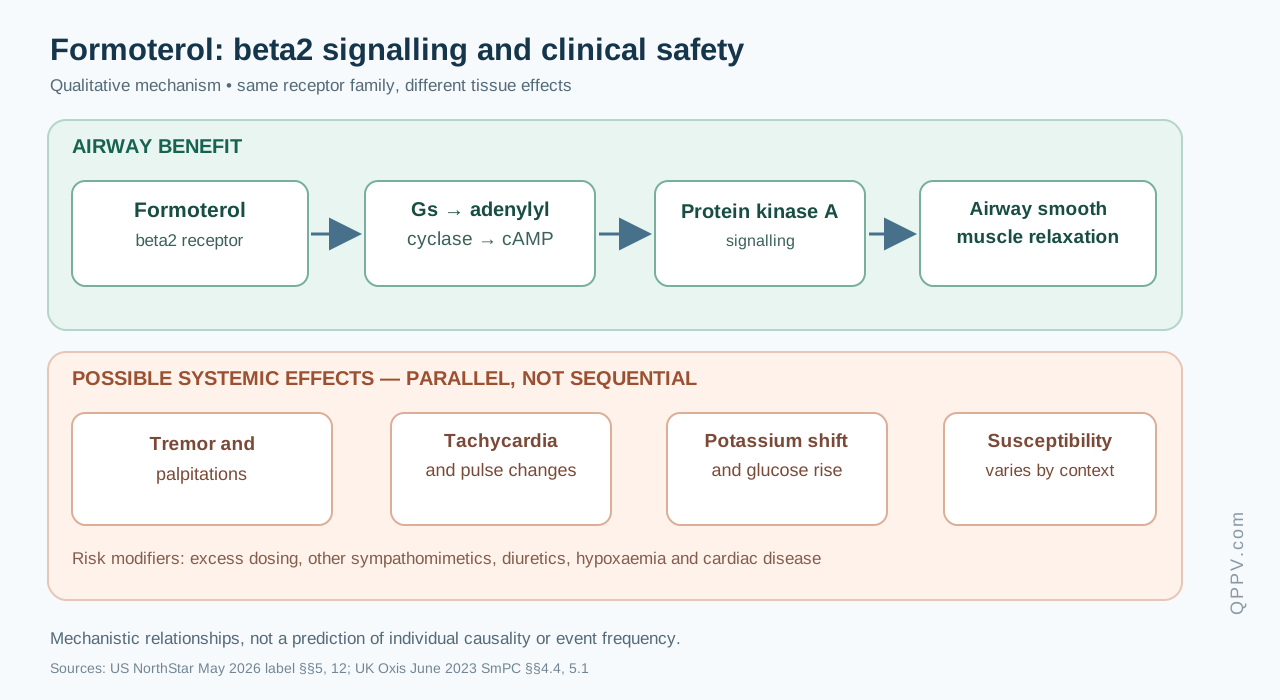
Figure 1. Qualitative mechanism and safety map: beta2 stimulation relaxes airway smooth muscle, while systemic adrenergic effects and excessive exposure can affect heart rate, potassium and glucose. The diagram does not imply a quantitative incidence or that every event is drug-caused.
Rapid onset, prolonged effect and pharmacokinetics
The Oxis SmPC describes bronchodilation beginning within approximately 1–3 minutes and lasting on average 12 hours after a single inhaled dose. Those figures describe the assessed product and studies; they should not be used to infer interchangeability with a nebulised solution, a different device or a combination inhaler. Systemic exposure varies with delivered pulmonary dose, swallowed fraction, device technique and metabolism. The Oxis SmPC describes glucuronidation and O-demethylation and an estimated terminal half-life after inhalation of 17 hours. [2]
Beta2 selectivity is relative, not absolute. Increased dose or exposure may produce tremor, palpitations, tachycardia, glucose changes and potassium redistribution into cells. These effects are mechanistically coherent but require clinical context before an individual suspected adverse reaction is assigned to formoterol. [1,2]
Distinguishing formoterol from arformoterol and combinations
Arformoterol is the (R,R)-enantiomer and is a distinct active substance with its own product labels; its trials must not be represented as trials of racemic formoterol. Budesonide/formoterol and mometasone/formoterol are combination products containing formoterol, but efficacy and adverse events in those studies cannot be automatically attributed to the formoterol component. The INN article should cross-link related constituent articles while preserving the correct exposure identity. [1,7,9]
Clinical evidence: the endpoint belongs to the regimen
Nebulised formoterol in COPD
The US inhalation-solution label describes a 12-week, randomised, double-blind, placebo- and active-controlled trial involving 351 adults with COPD. Of these, 237 were assigned to nebulised formoterol fumarate 20 micrograms twice daily or placebo; the remainder received the active dry-powder comparator. The population had a mean pre-bronchodilator FEV1 of approximately 1.34 L, or 44% of predicted. The primary analysis assessed serial FEV1 over the 12 hours after dosing, and formoterol solution produced greater bronchodilation than placebo at the endpoint. This is evidence of lung-function improvement in selected COPD patients, not proof of lower all-cause mortality or of efficacy during an acute exacerbation. [1]
A peer-reviewed report of the same 351-participant programme found significant improvement in 12-hour FEV1 area under the curve versus placebo (P < 0.0001). At 12 weeks, the St George's Respiratory Questionnaire total score favoured nebulised formoterol by 4.9 points relative to placebo (P = 0.0067). No significant efficacy difference was detected between the nebulised and tested Foradil dry-powder arms, but this study was not a universal bioequivalence assessment across all devices, strengths or populations. Its comparator and outcome definitions must be retained when the result is cited. [7]
The US label also describes 52-week active-controlled exposure and a clinical-trial safety dataset of 586 formoterol-solution recipients, including 155 exposed for at least one year. Patients with significant concurrent cardiac and other medical disorders were excluded. Thus, apparently reassuring trial cardiac-event rates cannot be extrapolated uncritically to frail patients with arrhythmias, severe cardiac disease, interacting medicines or repeated excess dosing. The label's 12-week comparison reports cardiovascular adverse events in 4.1% of formoterol recipients versus 4.4% of placebo recipients; those numbers describe the study, not an estimate of risk in all COPD patients. [1]
Adding formoterol to another bronchodilator
A six-week randomised study evaluated nebulised formoterol fumarate solution added to ongoing tiotropium in 155 COPD participants. The study addresses a specific combination of long-acting bronchodilators with different mechanisms. It is not a test of duplicate LABA therapy, and it cannot justify combining multiple formoterol-containing products. A clinical record should distinguish intended LABA plus long-acting muscarinic antagonist (LAMA) therapy from inadvertent LABA duplication. [8]
Asthma: the safety lesson of LABA monotherapy
The US label explicitly states that the assessed formoterol solution is not indicated for asthma and that using a LABA without an ICS in asthma is contraindicated. The class concern includes increased asthma-related death with LABA monotherapy; the label cites a large salmeterol trial as class evidence rather than presenting it as a formoterol-specific mortality trial. This distinction is critical in regulatory writing. It is incorrect either to claim that the cited deaths occurred with formoterol or to dismiss the class warning because the direct evidence involved another LABA. [1]
The 2017 US decision to remove the boxed asthma-death warning from fixed ICS/LABA combinations followed large randomised safety studies showing no significant increase in serious asthma-related events versus ICS alone within the studied populations. It did not establish the safety of LABA monotherapy, and it did not mean that every inhaler with formoterol is approved for asthma or for reliever use. The UK Oxis product instead authorises use as an add-on to maintenance ICS for selected patients aged six years and older, with a separate, detailed dose schedule. [2,6]
Budesonide/formoterol reliever evidence is combination evidence
SYGMA 1 was a 52-week double-blind trial in mild asthma comparing as-needed budesonide/formoterol, as-needed terbutaline, and maintenance budesonide with terbutaline reliever. The trial's primary outcome concerned weeks with well-controlled asthma; exacerbation outcomes and corticosteroid exposure provide additional context. In the pragmatic Novel START study, the annualised exacerbation rate was 0.195 with as-needed budesonide/formoterol versus 0.400 with as-needed albuterol (relative rate 0.49, 95% CI 0.33–0.72). The result was obtained with the fixed combination and its study regimen, not with formoterol alone. [9,10]
The PRACTICAL trial compared as-needed budesonide/formoterol with maintenance budesonide plus terbutaline in mild-to-moderate asthma. Severe exacerbations occurred at annualised rates of 0.119 versus 0.172, respectively (relative rate 0.69, 95% CI 0.48–1.00; P = 0.049). This result is clinically relevant but close to the conventional statistical threshold, and it should not be exaggerated into a claim that every formoterol combination or every reliever regimen is superior. [11]
A pooled safety analysis of SYGMA 1 and 2 reported adverse events in 40.8% of patients assigned as-needed budesonide/formoterol and 42.5% assigned maintenance budesonide. Such aggregate rates are not formoterol-specific adverse-reaction incidences. The corticosteroid and beta2-agonist components, the indication, frequency of use and background disease all influence the observed safety profile. [13]
Reading the evidence as a pharmacovigilance professional
An FEV1 response, symptom improvement, exacerbation rate, serious asthma event and mortality outcome answer different questions. A positive result for one endpoint cannot silently be relabelled as evidence for another. An open-label pragmatic trial has different susceptibility to behavioural and ascertainment effects than a blinded trial; a selected COPD population differs from a population with acute severe asthma. Post-authorisation reports broaden observation to patients and use patterns often absent from trials, but spontaneous reports lack reliable exposure denominators and cannot by themselves quantify event incidence. [1,7,9]
Safety mechanisms and clinically important phenotypes
Excess beta-adrenergic stimulation
Tremor, headache, palpitations, tachycardia, nervousness and sleep disturbance are consistent with beta-agonist pharmacology. The clinical importance depends on intensity, dose, underlying disease, other sympathomimetics and the temporal relationship to inhalation. A mild transient tremor after initiation is not equivalent to sustained tachyarrhythmia or a clinically significant electrolyte disturbance. The assessed US label includes these effects in its beta2-agonist adverse-reaction profile; the UK SmPC assigns specific frequency categories to several of them. [1,2]
Hypokalaemia, hyperglycaemia and arrhythmia
Beta2 stimulation can move potassium into cells and increase circulating glucose. In a susceptible patient, low potassium may compound arrhythmia risk, particularly with diuretics, xanthine derivatives, systemic corticosteroids, hypoxaemia or other QT-active medicines. A safety assessment should record potassium, magnesium when relevant, glucose, ECG/QTc, concurrent medication changes and whether the laboratory abnormality preceded the suspected exposure. A measured QTc increase does not by itself prove that formoterol caused a ventricular arrhythmia. [1,2]
Paradoxical bronchospasm and hypersensitivity
Immediate worsening of wheeze or airflow shortly after inhalation may indicate paradoxical bronchospasm, but device technique, acute disease deterioration, another inhaled product and excipient sensitivity are alternatives to investigate. Both assessed labels address paradoxical bronchospasm. The US label also lists postmarketing reports of anaphylactic reactions, urticaria, angioedema, rash and bronchospasm; their voluntary reporting does not establish a numerical frequency or individual causality. [1,2]
Deterioration and over-reliance
Increasing reliance on bronchodilation may be an early indicator of worsening asthma or COPD control rather than an isolated pharmacological adverse reaction. The US nebulised solution must not be used for sudden COPD deterioration; the UK Oxis asthma instructions require maintenance ICS and review when rescue use increases. The distinction between lack of efficacy, disease progression, off-label use, medication error and a suspected adverse reaction should be maintained through the case record. [1,2]
Product-specific listedness: US nebuliser versus UK dry-powder inhaler
A public label comparison is meaningful only after the product, date, jurisdiction, formulation and section are fixed. This assessment uses two current accessible single-ingredient formoterol documents reviewed 3 November 2026:
- United States: NorthStar RxLLC formoterol fumarate inhalation solution, 20 micrograms/2 mL unit-dose vials for jet nebulisation, DailyMed set ID
4dbb9620-5731-40d9-8258-2977ecc781c4, label revised May 2026, DailyMed updated 1 May 2026. Relevant sections: 1–8 and 14. The product is indicated for twice-daily maintenance treatment of COPD, not asthma or acute deterioration. [1] - United Kingdom: AstraZeneca Oxis Turbohaler 6, formoterol fumarate dihydrate dry-powder inhaler with 4.5 micrograms delivered per inhalation from a 6-microgram metered dose; emc SmPC updated 12 June 2023. Relevant sections: 4.1–4.8 and 5. The product is authorised for adult COPD and, as add-on therapy with maintenance ICS, for asthma in patients aged six years and older. This is a UK national SmPC, not a centralised EU SmPC. [2]
Why section location matters
The US label's section 6.1 presents a broad beta2-agonist adverse-reaction profile, section 6.2 gives adverse reactions from COPD trials and section 6.3 reports selected postmarketing reactions. Sections 5 and 7 separately describe warnings and interactions. The UK SmPC has a frequency-classified section 4.8 adverse-reaction table, plus distinct precautions in 4.4 and interactions in 4.5. A term appearing only as a warning should not be described as a frequency-listed adverse reaction without checking the relevant adverse-reaction section. [1,2]
| Clinical question | US NorthStar solution, May 2026 | UK Oxis Turbohaler 6, June 2023 | Interpretation |
|---|---|---|---|
| Intended population | COPD maintenance; not asthma | Adult COPD; asthma adjunct to ICS from age six | Different authorisations; no cross-product indication transfer |
| Tremor and headache | Section 6.1 beta2-agonist profile | Section 4.8 common | Listed in both assessed adverse-reaction contexts, with UK frequency |
| Palpitations and tachycardia | Section 6.1 beta2-agonist profile | Section 4.8 uncommon | Frequency should not be borrowed for US product |
| Hypokalaemia and hyperglycaemia | Section 6.1 profile and 5.7 warning | Section 4.8 uncommon; 4.4 precautions | Clinical monitoring is context-dependent |
| Arrhythmia and QTc | Arrhythmias in 6.1; cardiovascular/QTc cautions in 5 and 7 | Arrhythmias uncommon, QTc prolongation very rare in 4.8 | Do not infer identical frequencies or exposure risks |
| Paradoxical bronchospasm | Warning 5.4; bronchospasm in 6.3 postmarketing | Very rare paradoxical bronchospasm described below 4.8 table; 4.4 warning | Both labels recognise the event; source sections differ |
| Hypersensitivity | 5.8 and 6.3 postmarketing anaphylaxis, urticaria, angioedema, rash | 4.8 uncommon hypersensitivity examples, including bronchospasm, rash and urticaria | The assessed UK table does not explicitly list the US postmarketing term anaphylactic reaction |
| Gastrointestinal effects | 6.2 trial table includes diarrhoea, nausea, vomiting | 4.8 lists nausea common | Trial-event frequencies are not directly comparable |
| Asthma LABA monotherapy | Explicitly contraindicated in asthma in section 4 | Oxis is indicated only as add-on to ICS in asthma; 4.3 lists hypersensitivity as contraindication | Same clinical need for anti-inflammatory treatment, different label architecture |
| Device/excipient concerns | Sterile unit-dose nebuliser solution; compressor device restrictions | Breath-actuated dry powder containing lactose with traces of milk proteins | Device and excipient events require exact-product assessment |
The table is a comparison of the named documents, not a claim that other US, UK or EU formoterol products share the same listedness. For example, the UK Oxis section 4.8 frequency of very rare QTc prolongation must not be used as an incidence estimate for the US nebulised product. Conversely, the US postmarketing report of anaphylaxis does not establish that every formoterol SmPC contains the exact term in section 4.8. [1,2]
Warnings are not identical to expectedness
For an individual case, the applicable reference safety information (RSI) may be a company core safety document, a local approved label, an investigator brochure or another authorised source depending on the regulatory context. Public-label listedness is not automatically case-specific expectedness, nor does it determine causality, seriousness or reporting obligations. An event not found in the assessed UK section 4.8 is only not listed in that section of that document; it is not thereby absent from all UK labels, all regulatory sources or the relevant RSI. [1,2,14]
How to document the listedness conclusion
A defensible case assessment records: “US NorthStar formoterol fumarate inhalation solution, revised May 2026, section 6.3: angioedema reported postmarketing; frequency cannot be estimated.” A separate UK assessment might read: “Oxis Turbohaler 6, emc 12 June 2023, section 4.8: hypersensitivity reactions including bronchospasm, exanthema, urticaria and pruritus are classified uncommon; the precise term angioedema was not identified in that assessed section.” These statements should not be merged into an unqualified conclusion that angioedema is or is not “expected for formoterol.” [1,2]
Special populations and interacting treatments
Cardiovascular disease and endocrine conditions
COPD frequently coexists with cardiovascular disease, which complicates causal interpretation of palpitations, atrial fibrillation, syncope and myocardial ischaemia. Both labels recommend caution with relevant cardiovascular conditions and medicines that may amplify adrenergic effects. Hyperthyroidism and diabetes may modify tolerability. The US label's COPD trial excluded patients with significant cardiac illness, leaving uncertainty about precise event rates in routine care. [1,2]
Pregnancy, lactation and children
The US solution has no paediatric COPD indication and its pregnancy/lactation sections describe limitations of available human data. The UK Oxis SmPC considers use in pregnancy when needed for asthma control if expected maternal benefit outweighs possible fetal risk, and notes insufficient data below six years. These are product-specific regulatory statements, not generalised guarantees of safety or an instruction to stop needed asthma treatment. A pregnancy case should capture gestational timing, disease control, dose, co-exposures, outcomes and follow-up without converting animal findings into a quantified human risk. [1,2]
Concomitant medicines
Other sympathomimetics may increase beta-agonist effects; xanthines, corticosteroids and potassium-wasting diuretics can compound hypokalaemia; monoamine oxidase inhibitors, tricyclic antidepressants and QT-active drugs raise cardiovascular concerns. Beta-blockers, including ophthalmic products, may antagonise bronchodilation and provoke bronchospasm in susceptible patients. These are pharmacodynamic interaction concerns rather than evidence that every combination causes harm. [1,2]
Formulation and administration errors
The US solution is a 20-microgram vial used every 12 hours with a standard jet nebuliser and compressor; the label does not establish compatibility with other medicines mixed in the nebuliser cup. Oxis Turbohaler is an inspiratory-flow-driven dry-powder device; correct technique requires a sufficiently forceful inhalation. The number on a device's metered-dose strength and the amount delivered from the mouthpiece can differ. Switching products without checking these details can cause under-treatment, excessive dosing or apparent lack of efficacy. [1,2]
In asthma, an error with the greatest potential significance is supplying or using a LABA without concurrent ICS. In COPD, duplicate LABA exposure can arise when a single-agent formoterol product is continued after adding a combination inhaler containing formoterol or another LABA. Medication reconciliation should therefore inspect active ingredients rather than just brand names.
Pharmacovigilance practice: reconstruct the inhaled exposure
Intake, validity and source classification
A suspected formoterol event may arrive from a clinician, patient, pharmacist, device-support service, manufacturer contact, clinical programme, literature report or digital channel. The initial process should preserve the source narrative, establish the applicable minimum information for an individual case safety report (ICSR), identify the awareness date under local procedures and request clinically important follow-up. ICH E2D(R1) offers harmonised post-approval definitions and principles; regional requirements and implementation govern actual submission decisions. A report can be valid without proving that the medicine caused the event. [14]
The intake team should identify whether the reporter described an adverse event, a medication error, lack of efficacy, misuse, overdose, off-label use, product-quality concern or some combination of these. For example, “breathing worsened after a new inhaler” may represent paradoxical bronchospasm, incorrect device technique, an empty device, disease progression or exposure to a different active ingredient. Coding one possibility prematurely can obscure the actual clinical course.
A case-evidence matrix
| Evidence to collect | Why it changes the assessment |
|---|---|
| Exact brand, INN, strength, salt, formulation, batch and device | Distinguishes nebulised solution, dry powder, metered-dose and fixed combinations; identifies product and quality questions |
| Label jurisdiction and indication | Determines whether treatment was authorised for asthma, COPD, adjunctive or reliever use |
| Prescribed and actually inhaled doses, timestamps and technique | Identifies dose escalation, repeated rescue use, missed doses and delivery failures |
| ICS co-therapy and all other LABA-containing products | Detects asthma LABA monotherapy and accidental duplicate LABA exposure |
| Other beta-agonists, xanthines, diuretics, steroids, beta-blockers and QT-active medicines | Tests pharmacodynamic interactions and alternative explanations |
| Baseline asthma/COPD control, recent infection, hypoxaemia and exacerbations | Distinguishes disease progression from drug-related events |
| Heart rate, blood pressure, ECG/QTc, potassium, glucose, oxygen saturation, spirometry | Objectively characterises suspected systemic toxicity or bronchospasm |
| Dechallenge, rescue treatment, subsequent inhaler use and outcome | Establishes chronology; improvement after several interventions is not proof of causality |
| Reporter identifiers, source documentation, dates and duplicates | Supports traceability, reconciliation and region-specific case processing |
A patient's statement that they took “two puffs” cannot establish dose without the inhaler identity and strength. Equally, a recorded prescription does not prove that the patient inhaled the medicine correctly or that a nebuliser delivered the intended amount.
Illustrative case: acute wheeze after inhalation
A patient with stable COPD reports abrupt worsening of wheeze within minutes of the first nebulised dose. The assessor should obtain the timing, oxygen saturation, examination, concomitant nebulised products, device and diluent details, batch where available, response to treatment and any recurrence. Paradoxical bronchospasm is a clinically urgent differential, but worsening infection, technique error and a reaction to another component remain possible. The US label instructs immediate discontinuation if paradoxical bronchospasm occurs; a pharmacovigilance case should document the treating clinician's actions rather than recommend a deliberate rechallenge. [1]
Illustrative case: arrhythmia with low potassium
An older COPD patient receiving a loop diuretic develops palpitations and hypokalaemia after increasing use of multiple inhalers. Assessment should reconstruct all formoterol and other LABA exposure, short-acting beta2 agonist doses, diuretic changes, renal function, potassium trajectory, ECG rhythm and QTc, intercurrent illness and hypoxia. The beta2 mechanism provides plausibility, but diuretic exposure and underlying cardiac disease may be contributing or alternative causes. Record the exact rhythm and laboratory values rather than coding a vague “cardiac side effect.” [1,2]
Illustrative case: asthma controlled by bronchodilation alone
A patient with asthma continues single-agent formoterol but stops their ICS because breathing feels better. Later they develop a severe exacerbation. The case raises treatment-pattern and risk-minimisation questions as well as possible lack of efficacy. The US nebulised product is not indicated for asthma; the UK Oxis asthma indication requires concurrent maintenance ICS. Assessment should establish the dispensed products, prescriber instructions, adherence barriers and whether the patient mistakenly understood a fast-acting LABA to replace anti-inflammatory treatment. It would be inaccurate to attribute the exacerbation solely to formoterol without evaluating underlying asthma severity and withdrawal of ICS. [1,2,6]
Aggregate surveillance, signals and risk minimisation
Group cases by phenotype and exposure pattern
A useful aggregate review separates cardiovascular events, potassium/glucose abnormalities, paradoxical bronchospasm, hypersensitivity, asthma-related serious events, medication errors and device-quality problems. Each group needs a clear case definition, duplicate assessment, exposure and indication stratification, alternative-cause review and temporal analysis. Formoterol-only and fixed-combination reports should be identifiable separately; pooled counts that conceal the co-administered ICS may mislead the analysis.
Spontaneous reporting systems can suggest new patterns, but reporting intensity, notoriety, channel changes, incomplete product identity and duplicate reports limit causal inference. A disproportionality signal is a prompt for medical review, not an incidence rate or a regulatory conclusion. Where possible, triangulate with clinical trials, observational designs, exposure data, literature and device-quality investigations. [14]
Risk-minimisation controls and their effectiveness
Practical controls include accurate medication reconciliation, asthma-specific ICS co-therapy checks, product-specific instructions, inhaler-technique assessment, maximum-dose counselling and recognition of deterioration requiring medical review. For nebulised products, instructions about the appropriate compressor and not mixing medicines without established compatibility can reduce administration uncertainty. These are operational recommendations unless explicitly stated in a particular label or local regulatory condition.
Effectiveness should be evaluated through measurable evidence rather than the existence of a leaflet alone: for example, the proportion of asthma patients with documented ICS coverage, frequency of duplicate LABA dispensing, confirmed inhaler-technique errors, time to follow-up of serious bronchospasm reports and completeness of product identification. A change in these indicators may reflect documentation improvements rather than an immediate change in clinical risk, so trends require interpretation.
Governance and inspection readiness
The marketing authorisation holder's safety system should retain the assessed label version, source record, case narrative, medical review, coding decisions, follow-up attempts, reconciliation results, signal evaluation and rationale for any risk action. Quality complaints concerning dose counters, blocked devices, leaking vials or nebuliser compatibility need a documented interface between product quality and pharmacovigilance. Oversight should test whether the information reaches the correct teams and whether decisions are traceable. No hypothetical workflow in this article is presented as a real inspection finding.
Key Takeaways
Formoterol's rapid-onset, prolonged beta2 activity made it a valuable maintenance bronchodilator and a component of tested ICS/formoterol asthma strategies. The clinically decisive unit is not just the INN: it is the formulation, device, indication, companion ICS, dose and actual administration. US nebulised formoterol and UK Oxis Turbohaler have different authorised scopes, and their adverse-reaction sections are not interchangeable. A robust pharmacovigilance assessment distinguishes disease deterioration from suspected toxicity, warning text from adverse-reaction listedness, and combination evidence from single-agent evidence. [1,2,9]
References
- NorthStar RxLLC. Formoterol fumarate inhalation solution, 20 mcg/2 mL, US prescribing information, revised May 2026, DailyMed updated 1 May 2026, set ID 4dbb9620-5731-40d9-8258-2977ecc781c4. DailyMed label.
- AstraZeneca UK Ltd. Oxis Turbohaler 6, inhalation powder, UK SmPC, emc updated 12 June 2023, sections 4.1–4.8 and 5. emc.
- An improved process for the preparation of high purity formoterol and its pharmaceutically acceptable salts, patent WO2008035380A2, historical background identifying Yamanouchi Japanese filings of 1972. Patent.
- Novartis. Annual Report / Form 20-F 2005, historical Foradil licensing, US launch, device and distribution history. Corporate filing.
- Novartis Pharma AG. Novartis and Schering-Plough plan joint development of a fixed inhaled combination of Foradil and Asmanex. Press release, 10 April 2003. Announcement.
- US Food and Drug Administration. Clinical review of inhaled corticosteroid/LABA asthma safety and 2017 class-labelling decision, sNDA 021077 supplement 056. FDA clinical review.
- Efficacy and safety of formoterol fumarate delivered by nebulization to COPD patients. Randomised 12-week trial, PubMed PMID 18363201. PubMed.
- Efficacy and safety of nebulized formoterol as add-on therapy in COPD patients receiving maintenance tiotropium bromide. Randomised six-week study, PubMed PMID 19537837. PubMed.
- O'Byrne PM, et al. Inhaled Combined Budesonide–Formoterol as Needed in Mild Asthma. N Engl J Med. 2018;378:1865–1876. DOI 10.1056/NEJMoa1715274. PubMed.
- Beasley R, et al. Controlled Trial of Budesonide–Formoterol as Needed for Mild Asthma. N Engl J Med. 2019. DOI 10.1056/NEJMoa1901963. PubMed.
- Hardy J, et al. Budesonide–formoterol reliever therapy versus maintenance budesonide plus terbutaline (PRACTICAL). Lancet. 2019. PubMed.
- Formoterol dry-powder inhalation—Novartis/SkyePharma, product-development review, PubMed PMID 15139778 (2004). PubMed.
- Safety of As-Needed Budesonide–Formoterol in Mild Asthma: Data from the Two Phase III SYGMA Studies. PubMed PMID 33548020. PubMed.
- International Council for Harmonisation. ICH E2D(R1): Post-Approval Safety Data, Definitions and Standards for Management and Reporting of ICSRs. Step 4 final guideline, 2025. ICH guideline.
Regulatory Note
This educational review is not prescribing advice, an approved company core data sheet, reference safety information or a determination of individual-case expectedness. Product-specific label statements refer to the US NorthStar nebulised solution revised May 2026 and UK Oxis Turbohaler 6 SmPC updated June 2023, reviewed 3 November 2026; neither is a substitute for checking the latest label of the product actually supplied. Historical regulatory decisions, trials and corporate documents are cited for their respective contexts. Regional pharmacovigilance reporting requirements, clinical causality, seriousness, listedness and expectedness must be assessed separately under the applicable current framework.