Furosemide: Discovery, Development, Safety and Pharmacovigilance
Furosemide, historically also spelled frusemide, is a short-acting, high-ceiling loop diuretic used to mobilise sodium and water in fluid-overload states. Its effectiveness can make treatment appear straightforward: give a dose, observe urine output, adjust. Yet a good response can coexist with hypovolaemia, electrolyte depletion or kidney dysfunction, and an apparently ineffective dose can reflect poor absorption, impaired tubular secretion or persistent sodium retention rather than an intrinsically ineffective molecule. Pharmacovigilance must reconstruct the patient's volume state, drug delivery and time course, not merely record whether urine output rose. [3,4,7]
- Furosemide: Discovery, Development, Safety and Pharmacovigilance
- From the diuretic search to a clinical workhorse
- Renal pharmacology: why the response varies
- Clinical development: from diuresis to modern trial questions
- Indications, populations and formulation boundaries
- Safety profile: consequences of potency and less predictable reactions
- Product-specific public-label listedness: United States and Ireland
- Interactions and exposure changes
- Operational pharmacovigilance: from a reported event to a defensible assessment
- Worked examples: decisions that should remain auditable
- Inspection and quality-system evidence
- Key Takeaways
- References
- Regulatory Note
From the diuretic search to a clinical workhorse
Before the loop diuretics
The earliest drug approaches to oedema included mercury-containing compounds with considerable toxicity. Sulfonamide observations then helped direct medicinal chemistry towards renal salt handling. The development of carbonic anhydrase inhibitors and thiazides made pharmacological natriuresis more practical, but patients with marked cardiac, hepatic or renal salt retention could still require greater diuretic effect. The search for compounds with a different renal action led to high-ceiling loop diuretics. These were not simply stronger versions of thiazides: their principal transport target lies in another nephron segment, with a much larger contribution to sodium chloride reclamation. [1]
Furosemide is an anthranilic-acid-derived sulfonamide, chemically 4-chloro-N-furfuryl-5-sulfamoylanthranilic acid. The historical literature places its discovery in the late 1950s and clinical introduction in the 1960s; the 1964 British Medical Journal paper A New Effective Diuretic—Lasix provides contemporaneous evidence of clinical evaluation. The evidence does not justify assigning the invention to a single named scientist or claiming that one modern brand registration is the molecule's first worldwide approval. [1–3,12]
The commercial and regulatory lifecycle
The Lasix name became closely associated with furosemide, but the WHO INN is the scientific article subject. Today's market includes oral tablets, oral liquids and injectable formulations from multiple authorisation holders; differences in strengths, excipients, routes and local licences matter. In the United States the reviewed Lasix 20-, 40- and 80-mg tablets are labelled by Validus Pharmaceuticals LLC. In Ireland the reviewed Furosemide 40 mg Tablets are authorised to Clonmel Healthcare Ltd under PA0126/008/002. These are two distinct authorised products, not two names for an identical marketing authorisation. [3,4]
Generic entry and competitive supply have made furosemide a widely used inexpensive medicine. An Irish HPRA public assessment for a generic furosemide tablet describes comparison with a Lasix reference product and acceptance of bioequivalence evidence. Such regulatory bridging supports a particular formulation's authorisation; it does not establish that every oral and intravenous presentation has interchangeable exposure or that all labels contain identical safety wording. The B030 queue priority is based on a US outpatient prescription proxy, not a worldwide sales ranking or a claim that furosemide is more hazardous than other medicines. [10,13]
Renal pharmacology: why the response varies
The thick ascending limb and NKCC2
Furosemide inhibits the sodium–potassium–2-chloride cotransporter NKCC2 (SLC12A1) on the luminal membrane of the thick ascending limb of the loop of Henle. This segment normally reabsorbs a substantial fraction of filtered sodium chloride while remaining relatively impermeable to water. Inhibiting NKCC2 reduces salt reclamation and the medullary concentration gradient, increasing excretion of sodium, chloride and water and reducing the kidney's ability to concentrate urine. Enhanced downstream sodium delivery can also favour potassium and hydrogen-ion losses, helping explain hypokalaemia and metabolic alkalosis. [1,3,4]
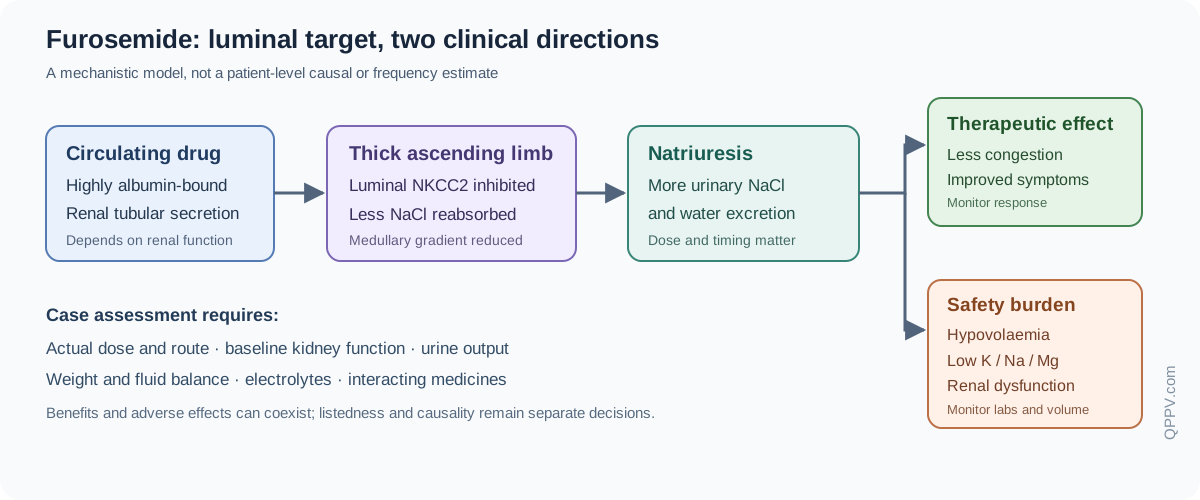
Figure 1. Furosemide reaches the tubular lumen and inhibits NKCC2 in the thick ascending limb. Natriuresis relieves congestion but can also lead to volume and electrolyte depletion; the figure is a mechanistic teaching model, not a prediction of event incidence or individual causality.
The drug must reach the tubular lumen to act. Plasma protein binding is high; renal organic-anion secretion is therefore important in delivering active drug to its luminal target. Reduced kidney function, competition for tubular transport and changes in albumin binding can alter the dose–response relationship. Increasing the prescribed dose may overcome some reduced delivery, but also increases the risk of excessive diuresis and toxicity. A high serum concentration does not guarantee adequate concentration at NKCC2. [3,4]
Threshold, ceiling and post-diuretic sodium retention
A loop diuretic has a threshold below which little natriuresis occurs and a ceiling above which additional drug produces diminishing incremental effect. The threshold shifts with renal dysfunction and disease severity. A patient may show little response to an oral dose because of gut oedema, delayed absorption, insufficient tubular delivery or continued dietary sodium intake. The short duration of action also allows compensatory sodium retention between doses. A single post-dose urine measurement therefore cannot establish 24-hour sodium balance.
Chronic exposure may increase distal nephron sodium reabsorption. Combining a loop with a thiazide-like diuretic can counter this adaptation, but it adds risk of sodium, potassium and volume depletion. Before labelling a patient “diuretic resistant,” verify the actual formulation, administered dose, timing, renal function, sodium intake, urine output and adherence. The mechanism helps structure follow-up but cannot substitute for clinical assessment. [7,9]
Pharmacokinetics and route
The September 2025 US oral Lasix label reports onset of diuresis within about one hour, peak effect in the first or second hour and an effect lasting approximately six to eight hours; its mean oral tablet bioavailability in fasted volunteers was about 64% relative to intravenous administration. Those figures describe the studied product and population, not a universal oral-to-IV conversion ratio. Absorption can be variable in illness, and the timing of an oral dose must not be used to infer the exposure after rapid intravenous administration. [3]
The drug is extensively bound to albumin, is eliminated mainly by the kidneys and undergoes some glucuronidation. Impaired renal function can prolong elimination while reducing delivery to the action site. The consequences of a dose change depend on both the disease and the formulation; a stable milligram dose is not a stable pharmacodynamic exposure across changes in renal perfusion, protein binding or volume status. [3,4,10]
Clinical development: from diuresis to modern trial questions
The early evidence answered a practical physiological question
The earliest clinical reports asked whether furosemide could produce useful salt and water excretion in patients with oedema. The 1964 BMJ evaluation of Lasix belongs to that era: it established an early clinical experience with a potent diuretic, not modern evidence that the molecule reduces mortality in heart failure. Once loop diuretics became routine background treatment, many subsequent trials tested how to deliver decongestion, rather than whether diuresis itself should be withheld from a severely congested patient. This distinction explains why an old medicine may have extensive clinical use but relatively few large placebo-controlled mortality trials of the drug alone. [2,7]
DOSE: route strategy and dose intensity
The NHLBI-sponsored DOSE trial randomised 308 patients hospitalised with acute decompensated heart failure in a two-by-two design: intravenous furosemide given as bolus injections every 12 hours or continuous infusion, and a lower-dose strategy based on the previous oral daily dose or a higher-dose strategy at 2.5 times that dose. The co-primary endpoints were patient-assessed symptom burden over 72 hours and change in creatinine at 72 hours. [5]
There was no statistically significant difference in either co-primary endpoint between bolus and continuous infusion. Comparing high- with low-dose strategies likewise did not show a statistically significant co-primary endpoint difference, although higher doses improved some secondary decongestion measures and more patients experienced transient worsening of renal function. It would be incorrect to write either that continuous infusion is proven superior or that higher doses are universally safer. DOSE did not test furosemide against placebo, was not designed to establish mortality benefit and does not replace patient-specific titration. [5]
TRANSFORM-HF: a negative superiority comparison
The pragmatic TRANSFORM-HF trial enrolled 2,859 patients hospitalised with heart failure and compared a post-discharge strategy of torsemide with furosemide. During a median 17.4-month follow-up, all-cause death occurred in 26.1% of the torsemide group and 26.2% of the furosemide group (hazard ratio 1.02, 95% CI 0.89–1.18). The trial did not demonstrate the hypothesised superiority of torsemide for mortality. [6]
This is not evidence that the two drugs are chemically or pharmacokinetically identical, nor that their safety profiles are interchangeable. The open-label pragmatic design, treatment crossovers, nonadherence and loss to follow-up constrain interpretation. A signal reviewer should not translate a negative superiority test into proof of equivalence or assume that one formulation can be substituted without reassessing exposure and response. [6]
Combination strategies: ADVOR and CLOROTIC
ADVOR studied acetazolamide versus placebo added to standardised intravenous loop-diuretic therapy in 519 patients with acute decompensated heart failure and volume overload. Successful decongestion within three days occurred in 42.2% versus 30.5%, respectively; the trial did not demonstrate a reduction in death or heart-failure rehospitalisation over three months. The tested intervention was addition of acetazolamide to loop treatment, not a new isolated efficacy claim for furosemide. [8]
CLOROTIC randomised 230 patients to hydrochlorothiazide or placebo on top of intravenous furosemide. The hydrochlorothiazide arm had greater weight loss at 72 hours but no significant improvement in patient-reported dyspnoea; impaired renal function occurred more often in the add-on group. The trial reinforces a practical trade-off: intensifying natriuresis can improve fluid removal while increasing monitoring burden. These results do not justify extrapolating the same adverse-event frequency to every outpatient combination or to a different diuretic. [9]
| Evidence source | Question actually tested | Finding | What it does not establish |
|---|---|---|---|
| 1964 early Lasix clinical report | Can the new agent cause useful diuresis? | Early clinical experience supported further use | Modern mortality benefit |
| DOSE (2011) | IV bolus vs infusion; higher vs lower intensity | No significant difference in co-primary endpoints | One strategy always optimal |
| TRANSFORM-HF (2023) | Torsemide vs furosemide after HF admission | No demonstrated torsemide mortality superiority | Pharmacokinetic equivalence |
| ADVOR (2022) | Add acetazolamide to loop therapy | More early successful decongestion | Proven survival improvement |
| CLOROTIC (2023) | Add hydrochlorothiazide to IV furosemide | More weight loss; more renal impairment | Universal safety of dual diuresis |
Guidelines and endpoint discipline
The 2022 AHA/ACC/HFSA heart-failure guideline recommends diuretics for fluid retention to relieve congestion, improve symptoms and prevent worsening heart failure. It advises reserving the addition of a thiazide to a loop for inadequate response to moderate or high loop doses because of electrolyte risk. This is a guideline recommendation, not the same as a binding product-authorisation requirement. The guideline also notes uncertainty about the effects of diuretics, apart from mineralocorticoid receptor antagonists, on morbidity and mortality. [7]
Clinical practice uses diuretics alongside therapies with proven disease-modifying effects in the relevant heart-failure phenotype. A favourable diuretic response may reduce breathlessness without reversing the underlying cardiomyopathy. Conversely, a creatinine rise during successful decongestion is not always equivalent to structural kidney injury. The clinician must interpret haemodynamics, urine output, weight, electrolytes, congestion and perfusion together. A pharmacovigilance case should preserve those measurements rather than collapsing them into an unqualified “acute kidney injury due to furosemide” narrative.
Indications, populations and formulation boundaries
Oedema and hypertension
The US Lasix tablet label covers oedema associated with congestive heart failure, hepatic cirrhosis and renal disease including nephrotic syndrome in adults and children, and adult hypertension. The reviewed Irish 40-mg tablet SmPC covers fluid retention and mild-to-moderate hypertension. These overlapping indications do not imply identical paediatric instructions, maximum doses or prescribing contexts. In an emergency pulmonary-oedema report, the administered route may be intravenous; oral-tablet labelling must not be treated as the source for injection-specific dosing or rapid-administration safety. [3,4]
Cirrhosis, renal impairment and nephrotic syndrome
In cirrhosis, excessive diuresis can precipitate electrolyte disturbances, hypotension and encephalopathy. Renal impairment may reduce luminal drug delivery even as systemic exposure increases. Nephrotic syndrome introduces hypoalbuminaemia and altered distribution and may increase ototoxicity vulnerability. A suspected loss of efficacy must therefore distinguish inadequate dose delivery from persistent sodium retention and worsening underlying disease. A serious adverse event may involve both furosemide and disease-related vulnerabilities. [3,4]
Pregnancy, lactation and paediatrics
The Irish SmPC states that furosemide crosses the placenta and should not be used during pregnancy unless compelling medical reasons exist, with fetal-growth monitoring when treatment is necessary; breastfeeding is a contraindication in its section 4.3. The US label frames pregnancy and nursing precautions differently. These are jurisdiction- and product-specific statements, not a blanket assertion that every pregnancy exposure is contraindicated worldwide. [3,4]
Premature infants can be susceptible to nephrocalcinosis/nephrolithiasis; some labels also describe persistence of patent ductus arteriosus. Such reports need gestational age, birth weight, cumulative exposure, calcium supplementation, ultrasound findings and competing neonatal conditions. Do not transfer an adult outpatient frequency estimate to neonates. [4]
Safety profile: consequences of potency and less predictable reactions
Volume depletion, electrolytes and cardiovascular consequences
The most immediate hazards arise from the intended mechanism when water and electrolyte losses exceed the patient's ability to compensate. Hypovolaemia and orthostatic hypotension can lead to falls, syncope, reduced renal perfusion and, in severe cases, circulatory collapse. Sodium and potassium disturbances may present with confusion, weakness, cramps or arrhythmias. Magnesium and calcium losses can further modify neuromuscular and cardiac risk. Severe hypokalaemia can potentiate the cardiac toxicity of digoxin, while a combination of hypokalaemia and QT-prolonging medicines can increase arrhythmia vulnerability. These are clinically related mechanisms, but the seriousness and causality of each reported event still require evidence. [3,4]
The patient's starting state matters. A congested patient may benefit from substantial net fluid loss, whereas a frail person with diarrhoea, low oral intake and an unchanged maintenance dose may develop hypotension and acute kidney dysfunction. Both could receive the same milligram dose. Reported “renal failure” should be evaluated against baseline creatinine, congestion, blood pressure, weight, urine output and intercurrent illness; do not assume every rise in creatinine proves direct nephrotoxicity or that every rise is harmless. [7]
Ototoxicity: the route and interacting drugs matter
Tinnitus, hearing impairment and sometimes irreversible deafness are documented in furosemide product information. The US Lasix warning identifies associations with rapid injection, severe renal impairment, high doses, hypoproteinaemia and concurrent ototoxic medicines, including aminoglycosides. The reviewed Irish SmPC lists hearing disorders and tinnitus, and lists deafness, sometimes irreversible, with an uncommon frequency. That Irish frequency should not be transferred to the US tablet label or to rapid IV exposure. [3,4]
For an ototoxicity case, document actual route and administration rate, total and cumulative dose, baseline hearing, renal function, albumin, concomitant aminoglycosides or cisplatin, onset, audiometry and recovery. A report that only says “hearing loss after Lasix” cannot distinguish drug exposure from other ototoxic causes or establish the relevant formulation. If the suspected exposure was intravenous, assess the appropriate injection label in addition to oral-product listedness.
Hypersensitivity, skin reactions and blood disorders
The US tablet adverse-reactions section names severe anaphylactic or anaphylactoid reactions, interstitial nephritis, vasculitis, blood dyscrasias and severe skin reactions including Stevens–Johnson syndrome (SJS), toxic epidermal necrolysis (TEN), drug reaction with eosinophilia and systemic symptoms (DRESS) and acute generalised exanthematous pustulosis (AGEP). The Irish 40-mg SmPC section 4.8 lists severe anaphylactic/anaphylactoid reactions, interstitial nephritis, blood dyscrasias, bullous skin reactions and AGEP; its reviewed text does not explicitly name SJS, TEN or DRESS in that section. Absence of those exact terms from this particular Irish SmPC is not evidence of absence of risk or of non-listedness in every EU furosemide product. [3,4]
A suspected severe cutaneous adverse reaction needs precise onset, morphology, mucosal involvement, laboratory abnormalities, biopsy if performed, treatment, outcomes and all newly introduced drugs. A case with blistering should not be automatically coded as SJS/TEN without diagnostic evidence. When the reaction is serious, prompt clinical management and applicable safety reporting are separate from the final causality conclusion.
Other important events
Hyperuricaemia and gout, altered glucose tolerance, pancreatitis, hepatic enzyme abnormalities and thrombocytopenia are documented in product information. Increased urine production may precipitate acute retention in someone with bladder outlet obstruction. Premature infants require attention to nephrocalcinosis and possible persistence of patent ductus arteriosus. These adverse effects have different biological pathways and different opportunities for case follow-up. A common medication error is to record all such events as “dehydration,” losing the clinically specific term and its seriousness. [3,4]
Product-specific public-label listedness: United States and Ireland
Assessment date: 29 October 2026. The US comparator is Lasix (furosemide) oral tablets 20, 40 and 80 mg, Validus Pharmaceuticals LLC, DailyMed SPL set ID 2c9b4d8f-0770-482d-a9e6-9c616a440b1a, version 7, effective 30 September 2025. The label uses the older US section headings ADVERSE REACTIONS, WARNINGS, PRECAUTIONS and CONTRAINDICATIONS, rather than modern numeric sections. The EU comparator is Furosemide 40 mg Tablets, Clonmel Healthcare Ltd, Irish HPRA licence PA0126/008/002, SmPC revised 9 August 2024, sections 4.3–4.8. Both sources were retrieved from their current official regulatory pages for this review. These are different oral products with the same active ingredient; the Irish label is not a Lasix brand label. [3,4]
| Safety term or scope | US Lasix tablets (September 2025) | Irish Furosemide 40 mg (August 2024) | Listedness conclusion for the reviewed documents |
|---|---|---|---|
| Volume and electrolyte depletion | Prominent warning/precautions and overdose text; orthostatic hypotension under ADVERSE REACTIONS | Section 4.8 includes symptomatic electrolyte disturbances, hypovolaemia/dehydration and orthostatic hypotension | Both describe the risk; do not equate a US warning with an EU 4.8 reaction frequency |
| Ototoxicity | ADVERSE REACTIONS: tinnitus and hearing loss; WARNINGS: reversible/irreversible impairment and risk modifiers | Section 4.8: hearing disorders/tinnitus; deafness sometimes irreversible uncommon | Listed in both; the stated frequency is from this Irish SmPC only |
| AGEP | Explicitly named under dermatologic ADVERSE REACTIONS | Section 4.8: AGEP frequency not known | Explicitly listed in both; Irish frequency not known |
| SJS, TEN and DRESS | All explicitly named under dermatologic ADVERSE REACTIONS | Not explicitly named as those terms in reviewed section 4.8 | US-listed by exact term; no claim of pan-EU unlistedness |
| Anaphylactic/anaphylactoid reaction | Listed under systemic hypersensitivity reactions | Section 4.8 lists severe reactions | Listed in both, but not proof of individual causality |
| Interstitial nephritis | Listed under systemic hypersensitivity reactions | Section 4.8 renal/urinary disorders | Listed in both; distinguish from haemodynamic kidney injury |
| Gout/hyperuricaemia | Hyperuricaemia in ADVERSE REACTIONS and precautions | Section 4.8 lists increased uric acid and gout attacks | Both describe the events; clinical diagnosis and exposure matter |
| Contraindications | Anuria and prior hypersensitivity | Section 4.3 additionally includes hypovolaemia/dehydration, severe electrolyte depletion, specified renal/hepatic states and breastfeeding | Materially different contraindication scope; a contraindication is not an adverse-reaction frequency |
| Paediatric use | Label includes paediatric oedema dosing and precautions | Product-specific paediatric instructions and premature-infant warnings | Do not transfer dose, indication or risk frequency across labels |
How to make a case-specific listedness determination. Identify the exact event term, its medically appropriate synonyms and the label section that contains it. “Hypokalaemia” appears as a named clinical risk in US precautions and in Irish section 4.8; that does not justify labelling both as identical section-6/4.8 entries. The US label's adverse-reaction list is organised by system and severity, without the same frequency grid used by some EU SmPCs. The Irish 2024 SmPC provides an explicit frequency for deafness and AGEP but does not assign a frequency to every reaction in section 4.8. Do not invent missing denominators. [3,4]
Boundaries: Public USPI/SmPC listedness is not company-core safety information, the reference safety information (RSI) for clinical-trial expectedness, a case-specific causality judgement, or a reporting-deadline determination. A serious suspected reaction can be reportable regardless of whether the term is already listed. A different furosemide formulation, concentration, country, label revision or route requires its own comparator. [11]
Interactions and exposure changes
Non-steroidal anti-inflammatory drugs may blunt natriuresis and aggravate renal risk in susceptible volume-depleted patients. Lithium exposure and toxicity can increase with diuretics. Aminoglycosides and cisplatin may compound ototoxicity; some antibiotics also increase nephrotoxicity. ACE inhibitors and angiotensin receptor blockers can amplify hypotension or changes in renal function when started or intensified during aggressive diuresis. Sucralfate can reduce oral furosemide absorption; the US and Irish documents recommend separating administration by at least two hours. These interactions are clinically important, but a drug–drug interaction is not automatically a contraindication. [3,4]
A medication review should include over-the-counter NSAIDs, corticosteroids, laxatives, other diuretics, digoxin, antiepileptics, nephrotoxic antibiotics and agents that prolong QT. Determine whether the co-medication began before the event, whether its dose changed, and whether the patient had an intercurrent illness. The same observed event may reflect excessive pharmacodynamic response, impaired drug elimination, additive toxicity or a competing disease.
Operational pharmacovigilance: from a reported event to a defensible assessment
Capture the actual exposure
A useful intake record starts with the exact product and formulation: brand or generic manufacturer, tablet or liquid or injection, strength, route, dose per administration, frequency, indication, country, dates and batch where available. Ask whether the prescribed and administered doses differed, whether an IV dose was infused or injected rapidly, whether another diuretic was added, and whether a hospital discharge changed the regimen. Do not convert an oral dose to an IV dose using an assumed fixed ratio without checking the product and clinical context.
Record the reaction separately from the treatment's intended effect. “Diuresis” may be expected pharmacology; “symptomatic orthostatic hypotension with fall,” “severe hypokalaemia with ventricular arrhythmia” or “hearing impairment after high-dose IV therapy” are more specific safety events. An ineffective treatment report may involve an adverse clinical consequence (for example worsening pulmonary oedema), a medication error or a product-quality complaint; these categories are related but not synonymous.
Reconstruct the clinical timeline
For suspected dehydration or electrolyte injury, obtain baseline and follow-up weight, blood pressure (including orthostatic measurements if available), fluid balance, urine output, serum sodium/potassium/magnesium, creatinine and relevant acid–base data. Record the timing of doses, vomiting or diarrhoea, oral intake, renal-function changes, added thiazides, NSAIDs and other interacting medicines. A patient whose potassium fell after combined diuretics and gastrointestinal losses presents a different causal problem from one who developed the same laboratory value on stable monotherapy.
For hearing events, seek audiometry, route and injection rate, renal function and concomitant ototoxic drugs. For skin reactions, seek diagnostic criteria and all suspect drugs. For suspected medication error, distinguish prescription, dispensing, preparation, administration and patient-use stages; preserve a copy of the label or package image where permitted by privacy rules. Record uncertainty instead of filling missing fields with plausible assumptions.
Seriousness, listedness, causality and expectedness
These are separate assessments. Seriousness concerns regulatory criteria such as death, life threat, hospitalisation or medically important outcomes; an abnormal potassium result is not automatically a serious regulatory case without context. Listedness compares the event to a specified public product label or other applicable safety document. Causality weighs timing, alternative causes, pharmacology, dechallenge, rechallenge and evidence quality. Clinical-trial expectedness depends on the protocol-defined reference safety information. Reporting rules and timelines follow the applicable jurisdiction, case type and marketing-authorisation obligations. EMA GVP provides process guidance; it should not be paraphrased into invented universal reporting deadlines. [11]
A documented label comparison should store the document title, country, product, formulation, revision, access date, section, event term and medical-equivalence rationale. The case assessor should be able to reproduce the conclusion years later even if the live label has changed.
Signal detection and aggregate review
Furosemide has extensive exposure, making crude spontaneous-report counts particularly difficult to interpret. Stratify where possible by oral versus injectable route, strength, dose intensity, indication, age, kidney function, co-diuretics and ototoxic medicines. Separate expected dose-related consequences from rarer idiosyncratic reactions and product-quality clusters. Apparent increases in hearing-loss reports might reflect a change in hospital IV use, new reporting awareness, concomitant antibiotics or a genuine safety change; evaluate all plausible explanations before escalating a signal conclusion.
Denominators require care. Dispensed outpatient prescriptions are not patient-years of treatment, and hospital IV use is not captured by the same source. In the ClinCalc 2024 US outpatient dataset furosemide is rank 29, with 20,051,956 estimated prescriptions and 5,552,905 estimated patients; these estimates are a US outpatient utilisation proxy, not measured global exposure or adverse-reaction incidence. [13]
A well-governed signal assessment records the hypothesis, data sources, case definitions, stratification, disproportionality limitations, clinical plausibility, exposure changes, alternative explanations, expert review, decision, owners and follow-up dates. Risk minimisation may include clearer administration instructions, targeted laboratory monitoring, interaction alerts or dose-review practices, but their effectiveness should be measured through outcomes rather than merely the number of communications distributed. See QPPV's separate signal assessment and hydrochlorothiazide lifecycle references for complementary methods and distal-nephron risk.
Worked examples: decisions that should remain auditable
Hypothetical case 1: syncope after a hospital discharge
A 79-year-old patient is discharged on a higher oral furosemide dose after treatment of pulmonary congestion. Four days later the patient faints and is found to have orthostatic hypotension and elevated creatinine. The correct investigation asks whether congestion had resolved, whether the discharge dose was understood, whether appetite or fluid intake changed, whether other antihypertensives were adjusted and what the baseline creatinine and blood pressure were. The report should preserve both the plausible excessive diuretic effect and competing factors. A fall is an important outcome even when the biochemical abnormality is modest. This scenario is illustrative, not an actual reported case.
Hypothetical case 2: hearing loss during intravenous therapy
A patient with impaired kidney function receives intravenous furosemide while also receiving an aminoglycoside. New tinnitus and hearing loss occur. Collect administration rate, doses, timing, audiometry, renal and albumin measurements and the antibiotic exposure. Both agents may contribute. Do not infer the event's listedness from an oral US Lasix tablet label alone; the actual injectable product and local label must be identified. The need for immediate clinical evaluation does not depend on completing the final causality assessment.
Hypothetical case 3: “furosemide did not work”
A patient with worsening oedema reports no effect from tablets after starting an NSAID. Verify adherence, tablet identity, storage, timing, salt intake, renal function and urine response, and assess the possible pharmacodynamic interaction. If the patient develops pulmonary oedema, record the clinical event and seriousness independently from the lack-of-effect report. Do not assign a manufacturing defect without product evidence.
Inspection and quality-system evidence
A reviewer should be able to trace the source report to the coded event, medication history, seriousness and listedness determinations, medical assessment, follow-up attempts, reporting decision and aggregate signal disposition. For a high-priority preventable risk, the system should show whether counselling, prescribing controls or monitoring changes actually reduced the relevant error or harm. The quality objective is reproducible judgement and patient protection, not a perfectly populated form with invented details.
Key Takeaways
Furosemide's principal target is luminal NKCC2 in the thick ascending limb. Its powerful but variable natriuresis explains both rapid relief of congestion and the need for careful volume, electrolyte and kidney monitoring. DOSE did not establish superiority of continuous infusion or higher dose on its co-primary endpoints; TRANSFORM-HF did not demonstrate torsemide mortality superiority. ADVOR and CLOROTIC tested add-on strategies, not isolated furosemide survival effects. Ototoxicity depends importantly on route, dose and interacting exposures. The reviewed US Lasix and Irish generic tablet labels have material differences in contraindication scope and reaction terminology. Exact product, route, versioned label and clinical chronology are indispensable for pharmacovigilance.
References
- Wile D. Diuretics: a review. Ann Clin Biochem. 2012;49:419–431. https://doi.org/10.1258/acb.2011.011281
- Stokes W, Nunn LCA. A New Effective Diuretic—Lasix. BMJ. 1964;2:910–914. https://pmc.ncbi.nlm.nih.gov/articles/PMC1816916/
- US National Library of Medicine, DailyMed. Lasix (furosemide) oral tablets 20, 40 and 80 mg; Validus Pharmaceuticals LLC; SPL version 7, effective 30 September 2025. https://www.dailymed.nlm.nih.gov/dailymed/fda/fdaDrugXsl.cfm?setid=2c9b4d8f-0770-482d-a9e6-9c616a440b1a&type=display
- Health Products Regulatory Authority, Ireland. Furosemide 40 mg Tablets, Clonmel Healthcare Ltd, PA0126/008/002; SmPC revised 9 August 2024. https://assets.hpra.ie/products/Human/14829/Licence_PA0126-008-002_09082024110213.pdf
- Felker GM et al. Diuretic Strategies in Patients with Acute Decompensated Heart Failure (DOSE). N Engl J Med. 2011;364:797–805. https://doi.org/10.1056/NEJMoa1005419
- Mentz RJ et al. Effect of Torsemide vs Furosemide After Discharge on All-Cause Mortality in Patients Hospitalized With Heart Failure (TRANSFORM-HF). JAMA. 2023;329:214–223. https://doi.org/10.1001/jama.2022.23924
- Heidenreich PA et al. 2022 AHA/ACC/HFSA Guideline for the Management of Heart Failure. J Am Coll Cardiol. 2022. https://doi.org/10.1016/j.jacc.2021.12.012
- Mullens W et al. Acetazolamide in Acute Decompensated Heart Failure with Volume Overload (ADVOR). N Engl J Med. 2022;387:1185–1195. https://doi.org/10.1056/NEJMoa2203094
- Trullàs JC et al. Combining loop with thiazide diuretics for decompensated heart failure (CLOROTIC). Eur Heart J. 2023;44:411–421. https://doi.org/10.1093/eurheartj/ehac689
- Health Products Regulatory Authority. Public Assessment Report for furosemide 20/40 mg tablets, bioequivalence against Lasix reference tablets; 13 March 2024. https://assets.hpra.ie/products/Human/38951/Public_AR_PA0281-263-002_13032024092639.pdf
- European Medicines Agency. Good pharmacovigilance practices (GVP), including Modules VI and IX and the September 2026 updated introductory guidance. https://www.ema.europa.eu/en/human-regulatory-overview/post-authorisation/pharmacovigilance-post-authorisation/good-pharmacovigilance-practices-gvp
- Wile D and historical sources are supplemented by: Loop Diuretics: An Overview of Its History and Evolution. J Assoc Physicians India. 2024. https://pubmed.ncbi.nlm.nih.gov/39291565/
- ClinCalc DrugStats. Top 300 Drugs of 2024, based on US MEPS outpatient estimates; database version 2026.08. https://clincalc.com/DrugStats/Top300Drugs.aspx
Regulatory Note
This educational article reviews product information available on 29 October 2026 and distinguishes product-specific authorisation, published clinical evidence, GVP guidance and recommended operational practice. The Irish 2024 SmPC is the current HPRA-linked document checked for the named licence, not a claim that all EU furosemide labels are identical. Always verify the actual formulation, route, jurisdiction and latest approved label before clinical or regulatory decisions. Public-label listedness is not causality, company-core listedness or case-specific RSI expectedness. Illustrative cases are not real safety reports.