Garadacimab: FXIIa Inhibition, Hereditary Angioedema and Pharmacovigilance
Garadacimab is a preventive biologic for hereditary angioedema (HAE), a disorder in which episodic vascular leakage produces potentially dangerous swelling. Its pharmacological position is upstream in the contact-activation pathway: inhibiting activated factor XII reduces bradykinin formation. This differs from replacing C1 inhibitor or blocking bradykinin at its receptor. That distinction helps explain the intended preventive effect and the evidence that should be collected when attacks occur during treatment.
HAE biology and the treatment target
The common HAE types I and II are associated with deficient or dysfunctional C1 esterase inhibitor (C1-INH). C1-INH normally restrains several protease cascades, including the contact system. When that control is reduced, activated factor XII (FXIIa) can promote kallikrein activation; kallikrein cleaves high-molecular-weight kininogen to generate bradykinin. Bradykinin increases vascular permeability, producing swelling in skin, gastrointestinal tissues and, critically, the upper airway.
Garadacimab is a human monoclonal antibody that binds FXIIa and inhibits its activity. It therefore acts before kallikrein-mediated bradykinin release. It is not C1-INH replacement, a kallikrein inhibitor, or a bradykinin B2-receptor antagonist. Keeping the intervention point clear matters when evaluating treatment failure, breakthrough attacks or combinations with other HAE therapies.
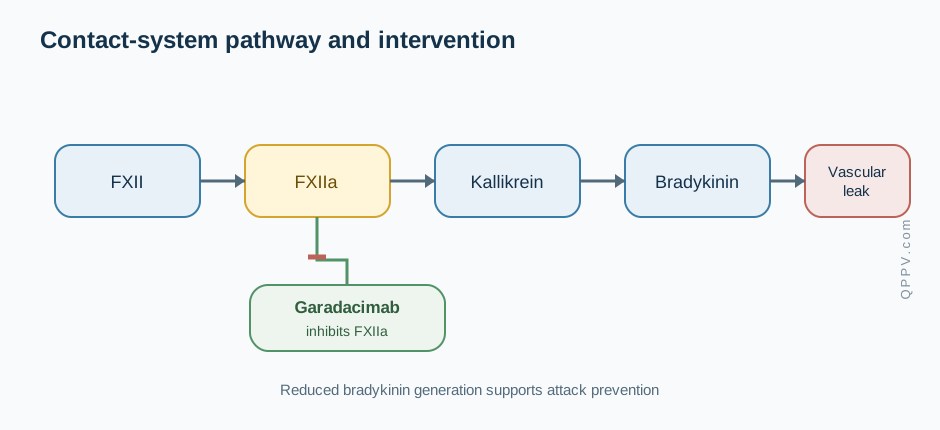
Figure 1. Garadacimab inhibits FXIIa upstream of kallikrein and bradykinin generation. The simplified pathway highlights the intended mechanism and omits other interacting contact, coagulation and inflammatory pathways.
Authorised use and treatment pattern
The EU indication is routine prevention of recurrent HAE attacks in adults and adolescents aged 12 years and older. The current product information specifies a loading sequence followed by monthly subcutaneous administration. The exact dose and injection instructions should be verified from the current SmPC for clinical use.
The indication is preventive, not acute rescue treatment. A breakthrough attack during prophylaxis should be clinically managed according to the patient’s action plan and applicable HAE guidance; the attack should not be assumed to be prevented or safely self-limited because garadacimab is being used. Patients may still require access to effective on-demand treatment.
The EMA notes that patients with HAE and normal C1-INH are a distinct group, with less certain response. For this population the product information provides a clinical review point: if there is no reduction in attacks after three months, discontinuation should be considered. Pharmacovigilance records should preserve HAE subtype, diagnostic basis, baseline attack burden and response history so that apparent lack of effect can be interpreted against the authorised use and evidence base.
Clinical evidence and safety interpretation
The pivotal EU assessment compared garadacimab with placebo over a defined prophylaxis period in patients with HAE associated with low or dysfunctional C1-INH. EMA reports a lower average monthly attack rate in the garadacimab group than in the placebo group. That group-level result supports efficacy in the studied population; it does not guarantee prevention for every patient or establish efficacy to the same degree in all forms of HAE.
Commonly reported adverse reactions in the EU product information include injection-site reactions, headache and abdominal pain. Injection-site symptoms should be described precisely, including onset, duration, severity and whether they recur at subsequent injections. Abdominal pain can also be an HAE attack manifestation, so chronology, associated swelling and attack adjudication are important before classifying it as a treatment reaction.
Because FXII participates in contact-system activation and has connections with coagulation biology, reviewers may be tempted to infer bleeding or thrombotic effects solely from mechanism. Such inferences must remain hypotheses unless supported by clinical and regulatory evidence. Assess reported coagulation events on their merits, with objective diagnoses, other medicines, underlying conditions and current label information; do not state a mechanism-based risk as an established product effect without evidence.
Evaluating attacks during prophylaxis
A breakthrough attack is not automatically evidence of lack of efficacy. Review the event’s location, symptoms, onset and duration; the patient’s established attack phenotype; C1-INH status; dose and injection dates; adherence; injection technique; intercurrent illness; and use of rescue medicine. Distinguish a true bradykinin-mediated attack from allergic swelling, infection, trauma, medication-associated angioedema or other causes when the available evidence allows.
Assess preventive effectiveness longitudinally. A single event can occur despite a beneficial reduction in attack frequency. Conversely, repeated or severe attacks despite adequate exposure may indicate inadequate response, diagnostic uncertainty, treatment interruption, or a clinically meaningful product-performance issue. Record baseline attack frequency and severity so that post-treatment rates have a usable comparator.
The treatment’s monthly administration also makes exposure dating important. Case reports should capture the actual injection date rather than only the scheduled due date. If an attack occurs near the end of an interval, the date may inform a hypothesis about waning effect, but one temporally clustered report does not prove a pharmacokinetic failure.
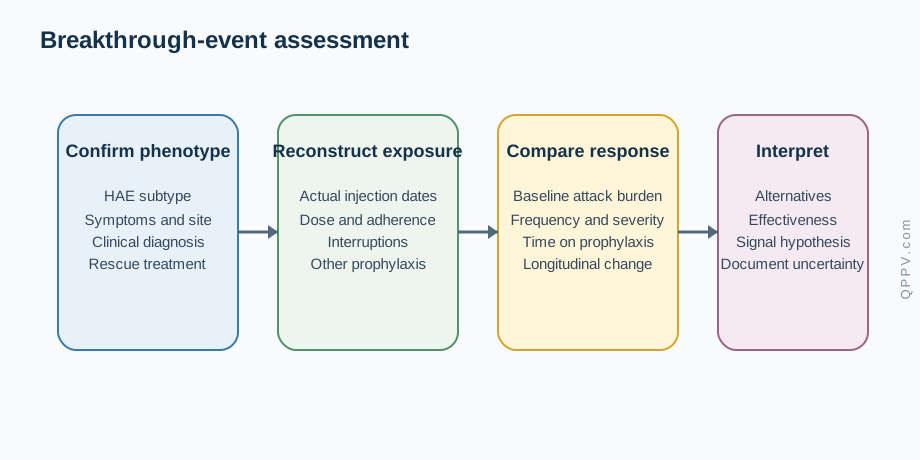
Figure 2. A structured review distinguishes the clinical event from the question of preventive effectiveness. Baseline burden and exposure timing are needed before a breakthrough event is interpreted as treatment failure.
Operational pharmacovigilance
Case-processing procedures should capture:
- HAE subtype and diagnostic evidence, including C1-INH level and function where available;
- baseline attack frequency, sites and severity;
- garadacimab dose, route, injection date and adherence;
- attack chronology, phenotype, treatment and outcome;
- rescue medicines and other preventive HAE therapies;
- treatment interruption, restart and response after re-exposure.
For periodic and signal evaluation, stratify by HAE subtype, age group, baseline burden, duration of prophylaxis and relevant prior preventive therapy where data permit. A rise in reported attacks may reflect increased exposure, improved reporting or a change in patient mix as well as altered effectiveness. Spontaneous-report counts cannot be used to calculate attack rates or comparative effectiveness without appropriate exposure and clinical denominator data.
A likely data-quality failure is coding an attack as “abdominal pain” without recording whether it represented HAE. Another is treating scheduled administration as confirmed administration. Targeted follow-up should seek information that changes medical interpretation, treatment assessment or product traceability, rather than asking for every possible datum indiscriminately.
Governance and inspection perspective
An effective process should show how the organisation distinguishes prophylaxis from acute management, identifies the HAE phenotype and reconstructs actual exposure. Reviewers may examine case narratives, follow-up forms, coding guidance, product-performance evaluations and the rationale for escalation. An illustrative inspection question would be whether a series of reported breakthrough events was assessed against baseline attack burden and adherence, rather than counted without clinical context.
If an apparent loss of effect emerges, the assessment should distinguish the signal hypothesis from established causality and define what evidence would confirm or weaken it. Decisions about label changes or risk-management action belong to the applicable regulatory process; internal operational controls should not be presented as legal requirements unless the relevant source establishes them.
Key takeaways
- Garadacimab blocks FXIIa upstream of kallikrein and bradykinin generation.
- It is indicated for routine prevention; it does not replace on-demand treatment for acute attacks.
- HAE subtype, baseline attack burden and actual injection dates are essential to assess breakthrough events.
- Mechanistic plausibility alone does not establish bleeding, thrombosis or treatment failure.
- Evaluate response longitudinally and distinguish confirmed events from diagnostic alternatives.
References
- European Medicines Agency. Andembry: European Public Assessment Report.
- European Medicines Agency. Andembry: current EU product information.
- European Medicines Agency. Good pharmacovigilance practices.
- European Medicines Agency. Andembry initial assessment and post-authorisation documents, available through the EPAR assessment history.
Regulatory Note
This article reflects the EU authorisation and product information reviewed on 24 September 2026. The current SmPC and applicable HAE management guidance govern clinical use. The suggested case fields and review approaches are operational recommendations, not additional legal requirements.