Garetosmab: Classification, Mechanism, Evidence and Pharmacovigilance
Garetosmab is a monoclonal antibody against activin A. The U.S. Food and Drug Administration approved garetosmab-grts on 19 August 2026 to reduce formation of new heterotopic ossification (HO) lesions and clinician-assessed flare-ups in adults with fibrodysplasia ossificans progressiva (FOP). FOP is an ultra-rare genetic disorder in which dysregulated activin A signalling through mutant activin A receptor type 1 (ACVR1) contributes to inappropriate bone formation in soft tissues. [1,2]
- Garetosmab: Classification, Mechanism, Evidence and Pharmacovigilance
Disease biology and mechanism
Most people with classic FOP have an activating ACVR1 variant that changes how the receptor responds to ligands. Activin A, which does not normally drive osteogenic signalling through wild-type ACVR1 in the same way, can activate mutant ACVR1 and promote signalling that contributes to heterotopic ossification. Neutralising activin A is therefore an upstream strategy intended to reduce a disease-driving signal rather than to remove bone that has already formed. [1,3]
Garetosmab binds activin A and reduces activation of the abnormal ACVR1 pathway. This mechanism explains why the clinical programme focuses on new HO lesions and disease flare-ups. It also sets a boundary on interpretation: treatment can reduce new disease activity without reversing established ankylosis or pre-existing heterotopic bone.
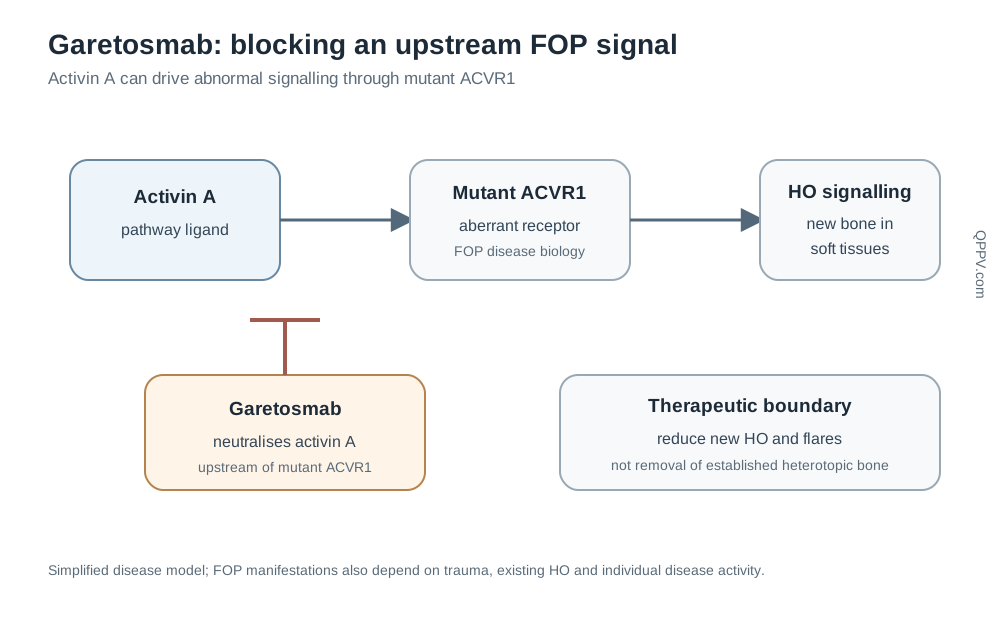
Figure 1. Simplified FOP pathway. Garetosmab neutralises activin A upstream of mutant ACVR1; the figure does not imply removal of pre-existing heterotopic bone.
Current U.S. indication and dose context
The current U.S. indication is restricted to adults with FOP. FDA describes a recommended starting dose of 10 mg/kg by intravenous infusion every four weeks, with reduction to 3 mg/kg every four weeks when the 10 mg/kg dose is not tolerated. [1] The lower dose is therefore part of dose-management guidance, not evidence that the two doses are clinically interchangeable in every circumstance.
Because trauma can itself provoke FOP flare activity, treatment administration, procedures and safety investigations require disease-specific judgement. A pharmacovigilance system should preserve whether an event followed routine disease activity, an injection or procedure, accidental trauma, surgery, infection, or study treatment. The same coded term can have very different causal implications depending on that chronology.
Evidence supporting the 2026 authorisation
FDA’s approval summary describes a randomised, double-blind, placebo-controlled study in 63 adults with FOP. Participants received garetosmab 10 mg/kg, 3 mg/kg or placebo every four weeks for 56 weeks. The primary efficacy endpoint was the number of new HO lesions detected by full-body low-dose CT; clinician-assessed flare-ups were also evaluated. [1]
By week 56, FDA reported 2 new HO lesions among 23 patients receiving 10 mg/kg, 1 among 19 patients receiving 3 mg/kg, and 19 among 21 patients receiving placebo. Clinician-assessed flare-ups numbered 9, 53 and 66 respectively. These counts show treatment effects in the studied population, but they should not be converted into individual predictions of disease course. The small population and rarity of FOP also make complete case documentation especially valuable after authorisation. [1]
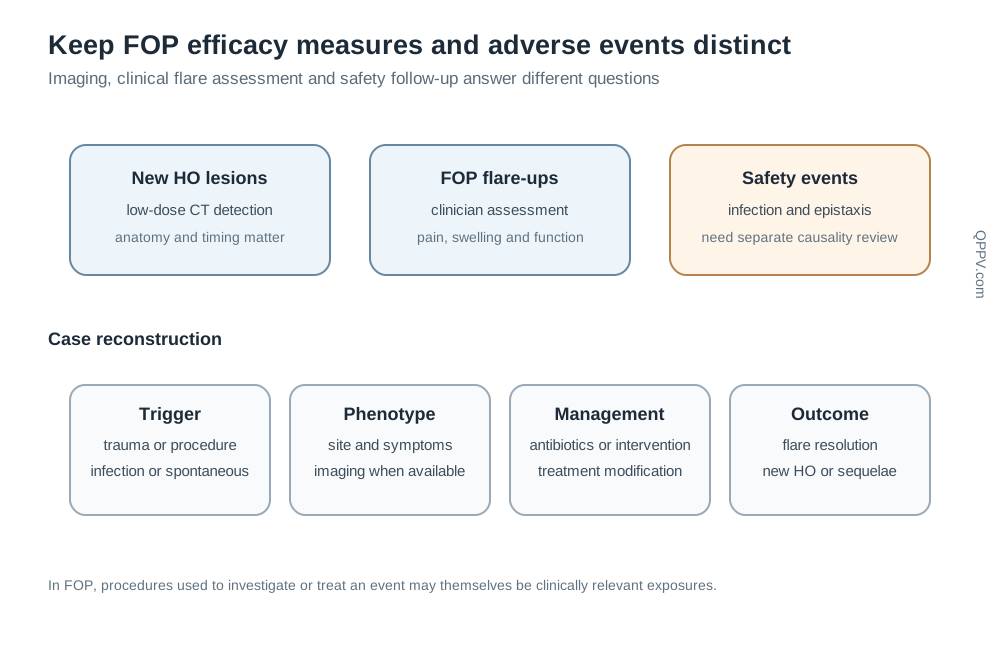
Figure 2. The approval evidence used complementary disease-activity measures. Pharmacovigilance must separately reconstruct new HO, clinical flares and adverse events.
Earlier LUMINA-1 evidence and why chronology matters
The earlier phase 2 LUMINA-1 study randomised 44 adults to garetosmab 10 mg/kg or placebo for 28 weeks before an open-label period. Its period-1 primary efficacy endpoint—total lesion activity by PET-CT—was not met statistically. However, fewer new HO lesions were observed during garetosmab exposure, which supported further study of the pathway. [3]
Five deaths occurred during the open-label period. Investigators considered them unlikely to be treatment related, but the publication states that causality could not be ruled out. This historical observation should neither be erased by later approval nor presented as proof of a treatment-caused mortality signal. It illustrates why the full development chronology and the regulator’s later assessment should be kept distinct. [3]
Safety profile
FDA warns about skin and soft-tissue infections that may require treatment or hospitalisation, epistaxis requiring medical intervention, and fetal harm. The most common adverse reactions reported in the approval summary include epistaxis, increased hair growth, abscess and acne. [1]
These events require phenotype-specific follow-up. For infection, capture site, microbiology, abscess formation, drainage or surgery, antimicrobial treatment, systemic involvement and outcome. Procedures can themselves be clinically consequential in FOP, so the management of an infection is part of the safety narrative rather than a separate administrative detail.
For epistaxis, record duration, recurrence, haemodynamic effect, laboratory results, local intervention, transfusion if any, concomitant anticoagulant or antiplatelet therapy, nasal trauma and other bleeding sites. For increased hair growth or acne, document onset and severity but avoid treating cosmetic impact as equivalent to medically significant infection or bleeding.
Distinguishing a flare from another event
FOP flare-ups may involve pain, swelling, stiffness and reduced movement. Similar symptoms can accompany infection, injury or evolving HO. A high-quality report should specify the anatomical site, trigger, timing, imaging if performed, clinician assessment and whether the event was judged to be a disease flare, a new HO lesion, an adverse reaction or more than one of these.
Pharmacovigilance implementation
Garetosmab is used in a disease where both spontaneous activity and medical intervention can change the course of an event. Case collection should therefore avoid forcing all observations into a single causal category. A soft-tissue infection may trigger local inflammation; a procedure used to manage it may create additional tissue trauma; and subsequent HO may occur in the same region. Each component needs its own chronology.
For new HO, record imaging modality, anatomical location, previous local disease, preceding flare or trauma and the interval from treatment. For flare reports, retain the assessment method and whether the flare was clinician-assessed or patient-reported. These distinctions are important because trial endpoints used defined methods that cannot be recreated retrospectively from a vague spontaneous report.
Aggregate review and governance
Aggregate safety review should examine serious infections by site and intervention, clinically significant epistaxis, pregnancy exposure, and any unexpected pattern of severe morbidity or mortality. Historical LUMINA-1 deaths should remain visible as part of the evidence base, while signal conclusions should be based on the totality of current data rather than on an isolated historical count. [3]
Effectiveness reports also need careful interpretation. Development of an HO lesion during treatment is not by itself evidence of product failure: the approved indication is to reduce new lesion formation and flare-ups, not to guarantee their elimination. Conversely, repeated reports of unexpected disease activity may become relevant when exposure, imaging and disease context are sufficiently documented.
Practical checklist
- Confirm an adult FOP diagnosis and the treatment dose used.
- Record infusion dates, any dose reduction and the reason for dose modification.
- For infection, document site, microbiology, treatment, invasive procedures and outcome.
- For epistaxis, capture severity, intervention, concomitant medicines and other bleeding.
- Separate clinician-assessed flare-ups from imaging-confirmed new HO lesions.
- Record preceding trauma, injections, surgery or procedures.
- Use current U.S. prescribing information for pregnancy precautions and treatment decisions.
Key takeaways
- Garetosmab neutralises activin A, reducing aberrant signalling through mutant ACVR1 in FOP.
- The U.S. indication is for adults and focuses on reducing new HO lesions and clinician-assessed flare-ups.
- The 2026 approval evidence should be distinguished from the earlier LUMINA-1 phase 2 study and its different endpoints.
- Skin and soft-tissue infection and clinically significant epistaxis are central product-specific safety domains.
- FOP itself makes chronology of trauma, procedures, flares and new HO essential to causality assessment.
References
- U.S. Food and Drug Administration. FDA Approves Second Treatment for Fibrodysplasia Ossificans Progressiva. 19 August 2026. https://www.fda.gov/drugs/news-events-human-drugs/fda-approves-second-treatment-fibrodysplasia-ossificans-progressiva
- U.S. Food and Drug Administration. BLA 761508 approval letter: garetosmab-grts. 19 August 2026. https://www.accessdata.fda.gov/drugsatfda_docs/appletter/2026/761508Orig1s000ltr.pdf
- Di Rocco M, et al. Garetosmab in fibrodysplasia ossificans progressiva: a randomized, double-blind, placebo-controlled phase 2 trial. Nat Med. 2023. PMID: 37770652. https://pubmed.ncbi.nlm.nih.gov/37770652/
- Wang Y, et al. Garetosmab in Fibrodysplasia Ossificans Progressiva: Clinical Pharmacology Results from the Phase 2 LUMINA-1 Trial. J Clin Pharmacol. 2024;64:264-274. PMID: 37694449. https://pubmed.ncbi.nlm.nih.gov/37694449/
Regulatory Note
Regulatory status was checked on 1 October 2026. This article describes the current U.S. authorisation and the published development evidence. Indications, dosing and safety information may differ in other jurisdictions or change after regulatory variation. This article is educational and does not replace current prescribing information.