GVP Module III: Pharmacovigilance Inspections
- GVP Module III: Pharmacovigilance Inspections
- Introduction
- 1. Why Pharmacovigilance Inspections Exist
- 2. Inspection Is About the System, Not Just Documents
- 3. Who Can Inspect a Pharmacovigilance System?
- 4. Routine and Triggered Inspections
- 5. Announced and Unannounced Inspections
- 6. What Inspectors Are Trying to Establish
- 7. The Role of the QPPV During Inspection
- 8. The PSMF During Inspection
- 9. Inspection Readiness Is a Permanent Capability
- 10. Evidence Should Be Retrievable
- 11. The Difference Between Evidence and Explanation
- 12. Sampling Is a Powerful Inspection Technique
- 13. Inspection Traces Can Cross the System
- 14. Inspection Readiness and Data Integrity
- 15. Inspection Preparation Should Start With Risk
- 16. Planning an Inspection
- 17. Document and Data Requests
- 18. Conduct of the Inspection
- 19. Interviews and System Demonstrations
- 20. Sampling and Inspection Traces
- 21. Daily Management During an Inspection
- 22. Inspection Findings and Their Classification
- 23. Response to the Inspection Report
- 24. Root-Cause Analysis and CAPA
- 25. Follow-up and Reinspection
- 26. QPPV and Management Responsibilities After Inspection
- 27. Interfaces With Other GVP Modules
- 28. Common Failure Patterns
- 29. Illustrative Inspection Trace
- 30. Inspection-Readiness Checklist
- 31. Key Takeaways
- References
- Regulatory Note
Introduction
Pharmacovigilance inspections are one of the principal mechanisms through which EU regulatory authorities assess whether a pharmacovigilance system is operating in accordance with applicable requirements.
An inspection is not simply a review of whether the marketing authorisation holder (MAH) has the correct procedures. It is an examination of whether the pharmacovigilance system works in practice, whether important risks are controlled and whether the organisation can demonstrate that required activities have been performed effectively.
GVP Module III provides the EU good-pharmacovigilance-practice framework for pharmacovigilance inspections.
The most useful way to understand the module is therefore not as an inspection checklist, but as a description of the regulatory mechanism through which authorities test the pharmacovigilance system.
The relationship is cyclical: authorities plan and conduct inspections against the operating pharmacovigilance system; findings lead to corrective action and effectiveness verification; and the resulting learning must improve routine system control.
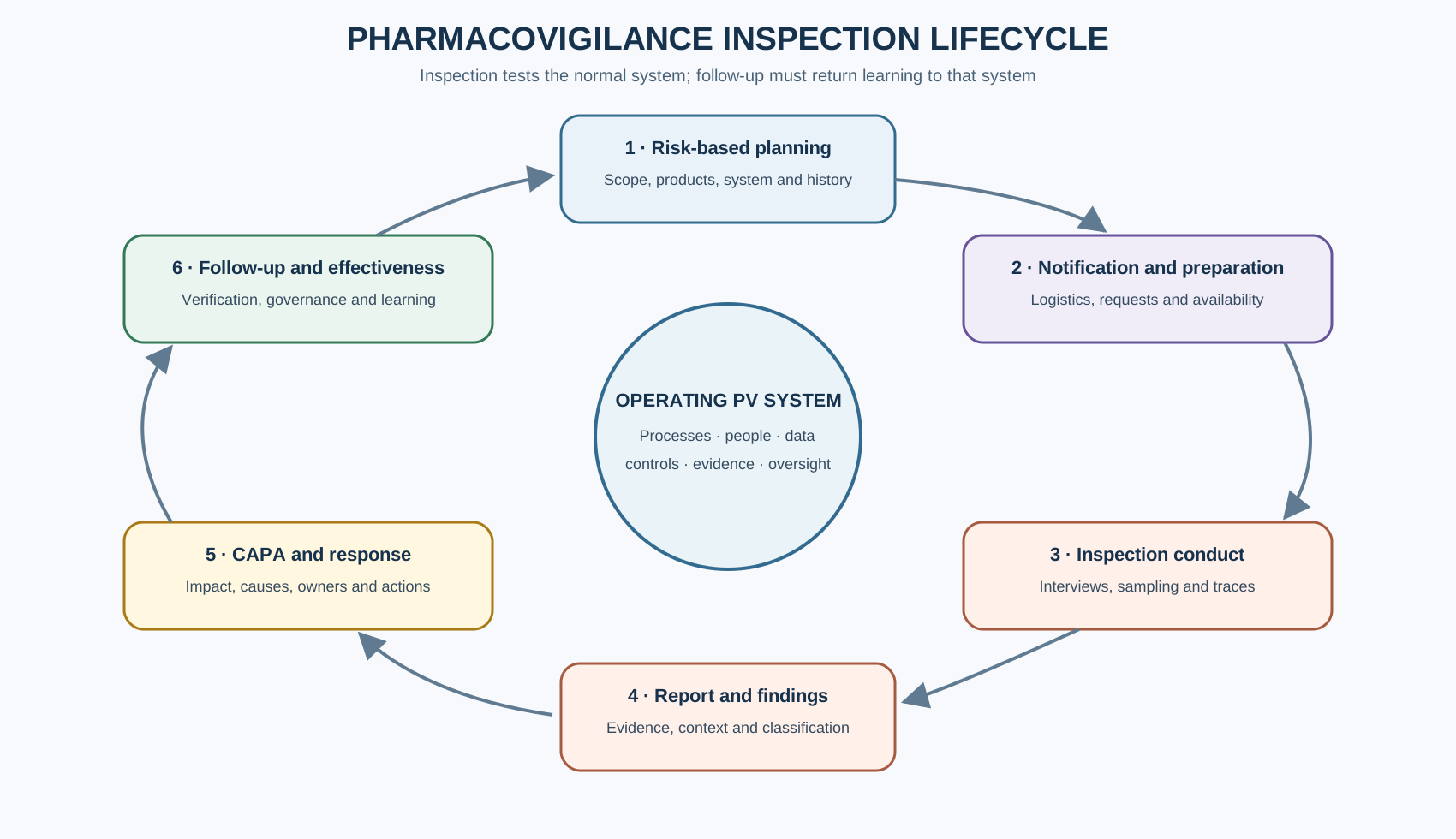
Figure 1. The pharmacovigilance inspection lifecycle. Risk-based planning and inspection test the normal operating system. Reporting, CAPA and follow-up complete the cycle only when improvement is implemented and shown to be effective.
1. Why Pharmacovigilance Inspections Exist
The purpose of pharmacovigilance inspection is ultimately to protect public health by providing regulatory oversight of the systems used to monitor the safety of medicinal products.
A pharmacovigilance system can appear compliant on paper while failing operationally.
For example, an MAH may have:
- an approved SOP for individual case processing;
- a documented signal-management procedure;
- a vendor contract;
- a QPPV;
- a training programme;
- and a quality-management system;
but still have unacceptable performance because cases are delayed, signals are not evaluated appropriately, vendor problems are not escalated or the QPPV does not receive sufficient information to exercise effective oversight.
Inspection provides an independent regulatory test of those controls.
2. Inspection Is About the System, Not Just Documents
Documents are important evidence, but they are only one part of the inspection.
An inspector may compare:
What the procedure says
          ↓
What employees say they do
          ↓
What the systems show actually happened
          ↓
What quality records show about performance
If these four layers do not agree, the discrepancy can become important.
For example, an SOP may require reconciliation every month, while interviews reveal that reconciliation is actually performed quarterly and system records confirm the practice.
The inspection issue is then not merely a documentation problem. It may indicate a control failure and potentially a broader governance weakness.
3. Who Can Inspect a Pharmacovigilance System?
Pharmacovigilance inspections can involve competent authorities of EU Member States and, for centrally authorised products and relevant Union-level activities, the European Medicines Agency and associated regulatory structures.
The precise authority and inspection arrangements depend on the legal framework, product, procedure and circumstances.
An MAH should therefore understand that inspection responsibility is part of the wider EU regulatory network rather than being limited to one central inspection body.
4. Routine and Triggered Inspections
Inspections can arise for different reasons.
A regulatory authority may conduct routine inspection as part of its oversight programme.
An inspection may also be triggered by a specific concern, such as:
- a serious or repeated compliance problem;
- significant safety information;
- suspected failure to comply with reporting requirements;
- concerns identified during another regulatory procedure;
- information received from another authority;
- a major organisational or system change;
- or other circumstances indicating that inspection is warranted.
The distinction matters because a triggered inspection may have a narrower initial focus but can expand if inspectors identify additional systemic concerns.
5. Announced and Unannounced Inspections
Inspection arrangements can differ according to the circumstances.
An announced inspection gives the organisation time to prepare logistics, identify subject-matter experts and assemble requested evidence.
An unannounced inspection reduces the ability to prepare specifically for the inspection and therefore tests the normal state of the system more directly.
A mature pharmacovigilance system should not depend on extensive last-minute preparation to become inspectable.
6. What Inspectors Are Trying to Establish
At a high level, inspectors are interested in whether the pharmacovigilance system is capable of meeting applicable requirements consistently.
Questions can therefore extend beyond individual activities.
An inspector may seek to understand:
- who has responsibility;
- how the system is organised;
- how the QPPV exercises oversight;
- how safety information enters the system;
- how important activities are controlled;
- how compliance is monitored;
- how failures are detected;
- how problems are escalated;
- and how corrective action is verified.
This is why inspection readiness should be designed as a system capability rather than an event-management exercise.
7. The Role of the QPPV During Inspection
The QPPV has a particularly important role because inspection may test whether the QPPV has sufficient oversight of the pharmacovigilance system.
The QPPV should not necessarily answer every operational question personally.
However, the QPPV should be able to explain the overall system and demonstrate awareness of significant compliance risks, safety issues and quality weaknesses.
The QPPV should also have access to appropriate evidence showing how important activities are controlled.
A useful distinction is:
Operational ownership: the function performs the activity.
System oversight: the QPPV and governance framework ensure that the pharmacovigilance system remains appropriately controlled.
8. The PSMF During Inspection
The PSMF is a major inspection resource because it provides a structured description of the pharmacovigilance system.
An inspector may use it to understand:
- organisational structure;
- responsibilities;
- locations;
- vendors;
- systems;
- quality arrangements;
- audits;
- training;
- performance monitoring;
- and other important components of the system.
The PSMF should therefore be consistent with the system inspectors encounter during interviews and evidence review.
A mismatch between the PSMF and actual practice can undermine confidence in the reliability of the system description.
9. Inspection Readiness Is a Permanent Capability
Inspection readiness is often described as preparation for an upcoming inspection.
That is too narrow.
A better definition is:
Inspection readiness is the continuing ability to demonstrate that the pharmacovigilance system operates effectively and that reliable evidence can be produced when required.
This requires routine controls such as:
- document management;
- record retention;
- quality monitoring;
- training;
- issue management;
- vendor oversight;
- audit;
- CAPA;
- and governance.
The inspection should reveal the normal controlled system rather than a temporary inspection version of it.
10. Evidence Should Be Retrievable
A pharmacovigilance system can have excellent records but still be difficult to inspect if evidence cannot be retrieved efficiently.
The organisation should know where important evidence resides and who can provide it.
Typical evidence categories include:
| Area | Examples of evidence |
|---|---|
| System | PSMF, organisation and governance records |
| Cases | Case records, workflow history, QC |
| Signals | Signal logs and assessments |
| Risk management | RMPs and safety assessments |
| Aggregate reporting | PSUR/PBRER records and submissions |
| Quality | Deviations, CAPA, quality indicators |
| Vendors | Oversight, KPIs, audits, issues |
| Training | Training and competency records |
| Regulatory | Submissions, decisions, correspondence |
| Governance | Minutes, escalation and oversight records |
The exact evidence depends on the inspection scope.
11. The Difference Between Evidence and Explanation
An interview answer is not always sufficient evidence.
For example, saying that a vendor is monitored is an explanation.
Showing documented vendor-performance reviews, quality indicators, issue escalation and governance records provides evidence.
The strongest inspection response usually combines:
Clear explanation
      +
Relevant controlled evidence
      +
Consistent system records
This principle should guide inspection preparation.
12. Sampling Is a Powerful Inspection Technique
Inspectors may sample records rather than reviewing every transaction.
A sample can be selected to test whether a process works across different situations.
For example, an inspector may select cases involving different seriousness, sources, products, reporting routes or dates.
The organisation should therefore not assume that a few excellent examples demonstrate system-wide performance.
A robust process should perform consistently across the population.
13. Inspection Traces Can Cross the System
An inspector may begin with one record and follow its consequences through multiple processes.
For example:
Individual case
      ↓
Safety assessment
      ↓
Signal
      ↓
Aggregate report
      ↓
Risk-management decision
      ↓
Regulatory action
This means that a weakness in one process can expose weaknesses elsewhere.
The pharmacovigilance system should therefore be designed with traceability between interconnected activities.
14. Inspection Readiness and Data Integrity
Data used to demonstrate pharmacovigilance compliance should be reliable, complete and traceable.
Inspectors may examine whether system records can establish:
- what happened;
- when it happened;
- who performed the activity;
- what information was available at the time;
- whether changes were made;
- and whether the final record accurately represents the underlying activity.
Computerised-system controls and audit trails can therefore become important inspection evidence.
15. Inspection Preparation Should Start With Risk
When an inspection is announced, organisations often attempt to collect everything.
A better approach is to begin with the likely scope and highest-risk processes.
For each important area, ask:
What requirement applies?
      ↓
What process implements it?
      ↓
What could go wrong?
      ↓
What controls detect the failure?
      ↓
What evidence proves control effectiveness?
This produces a more useful preparation plan than simply assembling large document folders.
The next chunk will examine inspection planning, interviews, evidence management, findings, grading and response, CAPA, follow-up inspections and common inspection failure patterns.
16. Planning an Inspection
Inspection planning translates the regulatory objective into a defined scope. The inspecting authority considers factors such as the type and range of products, the complexity of the pharmacovigilance system, previous inspection history, changes to the system, compliance information, safety concerns and information from other authorities. GVP Module III describes risk-based inspection planning; it does not imply that every inspection must examine every pharmacovigilance activity.
For the MAH, the first operational task after notification is to establish governance without creating a parallel temporary system. A named coordinator can manage requests, logistics and communications, while process owners remain responsible for explaining their activities and producing evidence. Escalation routes should include the QPPV, quality management, legal or data-protection expertise where needed, and senior management for matters that may affect patient safety or regulatory compliance.
The inspection scope should be mapped to the actual pharmacovigilance system. Relevant products, legal entities, affiliates, partners, service providers, databases, locations and time periods should be identified. If the initial request contains ambiguity, clarification should be sought through the designated regulatory channel rather than resolved through assumption.
Readiness review versus retrospective repair
A readiness review can confirm that documents are current, evidence is retrievable, personnel are available and known issues are accurately represented. It should not be used to backdate records, conceal deviations or create evidence for activities that did not occur. If a gap is found shortly before inspection, the defensible response is to document the facts, assess the impact, take proportionate containment or corrective action, and preserve the chronology.
The distinction is fundamental. Remediation may improve the system, but it does not change what happened during the period under inspection.
17. Document and Data Requests
Authorities may request information before and during an inspection. The response process should control four things: interpretation of the request, selection of responsive records, quality review, and traceable delivery. A request log should show what was requested, when it was received, the responsible owner, clarifications, the material supplied and the time of transmission.
Quality review should confirm that the response is complete, readable and responsive. It should not remove unfavourable evidence or alter source records. Where a document requires explanation—for example, because a later CAPA changed the process—the explanation should distinguish the contemporaneous record from subsequent action.
Data extracts deserve particular control. The organisation should be able to explain the population, fields, filters, date logic, time zones, exclusions and transformations. A polished spreadsheet with an uncertain derivation is weaker evidence than a reproducible extract with documented limitations.
18. Conduct of the Inspection
An opening meeting normally establishes the scope, agenda, communication arrangements and practical conduct of the inspection. The inspection then proceeds through interviews, demonstrations, document review and sampling. The sequence may change as evidence emerges. A question about one delayed case can lead to reconciliation, vendor oversight, deviation management, aggregate reporting and QPPV governance.
Inspection conduct should therefore be managed as an evidence process rather than a presentation exercise. Subject-matter experts should answer the question asked, distinguish knowledge from assumption and identify the record that supports the answer. If information is not known, it is preferable to confirm it through the controlled response process than to speculate.
Remote and hybrid methods change logistics but not the underlying standard. Screen sharing, secure document transfer, access to electronic systems, time-zone coordination and remote interviews should be tested in advance. The MAH remains responsible for making relevant evidence available even when a system or record is maintained by a service provider.
19. Interviews and System Demonstrations
Interviews allow inspectors to compare written arrangements with operational understanding. They may test whether personnel know their responsibilities, recognise deviations, escalate safety information and understand how their work connects to other processes. Consistency does not require rehearsed identical wording; it requires a shared process that is reflected in records.
System demonstrations can reveal workflow status, audit trails, permissions, configuration, queues, reconciliations and reporting logic. Demonstrators should use controlled environments and real evidence as agreed with inspectors. Screenshots prepared in advance may help navigation but should not substitute for the underlying system where direct review is requested.
The QPPV should be able to explain the pharmacovigilance system at an appropriate level and demonstrate awareness of significant safety and compliance matters. Operational specialists should remain available for detailed process questions. Effective oversight is demonstrated by connected governance and evidence, not by requiring the QPPV to perform every task personally.
20. Sampling and Inspection Traces
Sampling tests whether controls operate across a population. Inspectors may select records by product, seriousness, source, timeliness, outcome, geography, vendor, reporting period or another risk characteristic. They may also follow a vertical trace from source information through case processing, signal evaluation, aggregate reporting, risk management and regulatory action.
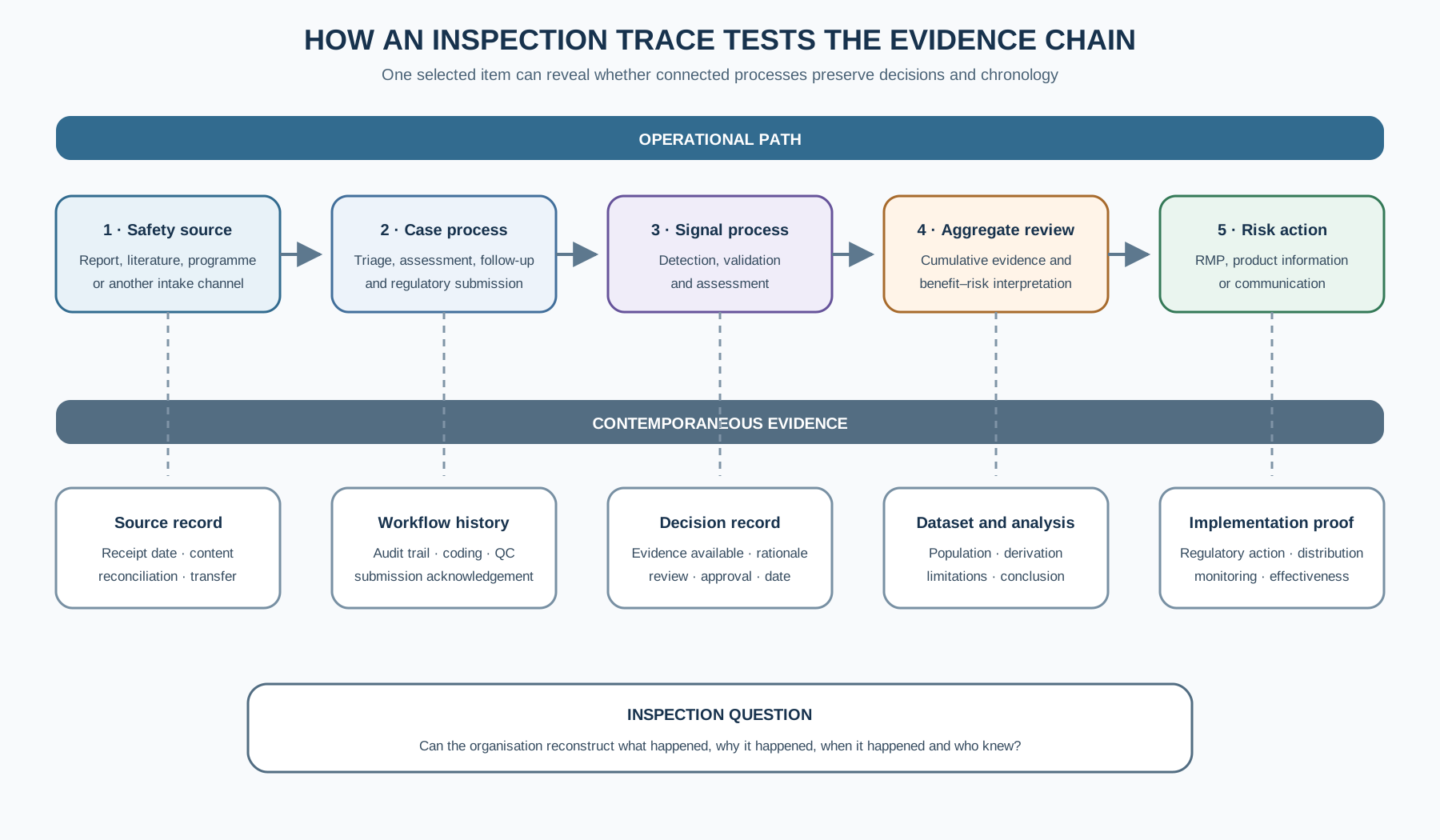
Figure 2. An inspection trace follows one safety item across connected processes and compares each transition with contemporaneous records. The lower evidence layer is not a separate workflow; it shows the records that support the corresponding operational step.
The MAH should be able to reproduce the history of the sampled item: what information existed at each decision point, who acted, which rule applied, whether the action was timely, and how any exception was managed. Retrospective explanation cannot replace missing contemporaneous evidence, although it may help the inspector understand the context and impact.
21. Daily Management During an Inspection
An internal daily review can reconcile open requests, confirm deadlines, identify emerging cross-functional themes and ensure that significant matters reach the QPPV and management. Notes should be factual and access-controlled. The purpose is coordination and accuracy, not directing witnesses or manufacturing uniform answers.
Potential immediate patient-safety issues should not wait for the final report. They should be assessed and escalated through the established safety and quality systems. The inspection process does not suspend the MAH's continuing pharmacovigilance obligations.
22. Inspection Findings and Their Classification
At the end of evidence collection, inspectors evaluate observed non-compliance against applicable requirements. Findings should be based on evidence and placed in the context of their actual or potential effect on the pharmacovigilance system and public health. The terminology and classification used in the inspection report follow the applicable Union or national procedure.
GVP Module III distinguishes critical, major and minor findings. Classification is not simply a count of errors. It considers the nature of the requirement, the extent and persistence of the failure, its effect or potential effect on patient safety and the reliability of the pharmacovigilance system, and whether several weaknesses together indicate systemic failure. Organisations should use the classification assigned by the inspecting authority rather than recategorising a finding to make it appear less serious.
An exit or closing meeting may communicate preliminary observations. These are important for immediate understanding, but the formal report and applicable procedure govern the documented outcome. If the organisation identifies a factual misunderstanding, it should explain it with precise evidence rather than argue from preference.
23. Response to the Inspection Report
A response should address each finding directly. It normally needs to show that the organisation understands the observation, has assessed its scope and impact, has contained any immediate risk, has investigated causes, and has defined corrective and preventive action with owners and target dates.
A persuasive response is not necessarily a long response. It links evidence to the finding and distinguishes:
- correction—repair of the specific detected instance;
- containment—immediate control of continuing risk;
- corrective action—removal or reduction of the cause of the detected non-compliance;
- preventive or systemic action—control of comparable risk elsewhere where justified; and
- effectiveness verification—evidence that the intended improvement operates and persists.
Disagreement with a finding does not remove the need to assess patient-safety and system implications. Any challenge should identify the disputed fact or interpretation, the applicable requirement and the supporting evidence.
24. Root-Cause Analysis and CAPA
Weak CAPA plans restate the observation as its cause: “the report was late because the process was not followed.” A useful root-cause analysis asks why the control failed and why existing detection did not prevent or identify the failure. Contributing factors may include unclear ownership, unsuitable system design, workload, training, vendor interfaces, fragmented data, incentives, change control or governance.
The depth of analysis should be proportionate to the finding. A single isolated administrative error does not automatically require an enterprise-wide programme, while repeated failures across products or regions should not be closed through retraining alone without examining the system.
CAPA evidence should include approved actions, ownership, due dates, implementation records, change control where applicable and a defined method for effectiveness evaluation. Closure of an action is not the same as demonstration of effectiveness. A revised SOP can be implemented on its effective date; whether it produces timely, complete and consistent performance requires subsequent evidence.
25. Follow-up and Reinspection
The Union follow-up procedure provides a framework for requesting, reviewing and monitoring CAPA plans and for sharing relevant information among authorities. Follow-up may involve written evidence, progress reports, meetings, targeted verification or reinspection. The approach depends on the findings, the adequacy of proposed actions, patient-safety implications and the need to verify sustained compliance.
The organisation should retain a traceable link from each finding to impact assessment, action, implementation evidence, effectiveness result and governance closure. If an action is delayed or proves ineffective, the risk should be reassessed and escalated. Administrative closure should not be used to conceal unresolved risk.
26. QPPV and Management Responsibilities After Inspection
The QPPV should have sufficient visibility of findings that affect the pharmacovigilance system, safety profile or fulfilment of pharmacovigilance obligations. Oversight includes understanding the significance of the finding, ensuring that relevant safety consequences are assessed, and confirming that corrective action is integrated into the system rather than treated as an inspection project detached from routine governance.
Senior management is responsible for ensuring that the pharmacovigilance quality system has appropriate resources and that significant deficiencies are addressed. Process owners and quality functions implement and verify actions within their respective responsibilities. Clear allocation avoids both extremes: assigning every CAPA to the QPPV or excluding the QPPV from systemic matters.
27. Interfaces With Other GVP Modules
Module III supplies the inspection framework, but the standards being inspected are found throughout legislation, GVP and product-specific obligations.
| Interface | What the inspection may test |
|---|---|
| Module I—quality systems | Governance, procedures, training, resources, performance monitoring, deviations and CAPA |
| Module II—PSMF | Accuracy of the system description, annex maintenance, accessibility and consistency with practice |
| Module IV—audits | Risk-based audit planning, independence, reporting, CAPA and use of audit results |
| Modules V and XVI—risk management | Maintenance of the RMP, implementation and effectiveness of risk-minimisation measures |
| Module VI—ICSRs | Collection, validation, processing, submission, follow-up, reconciliation and data quality |
| Module VII—PSURs | Data completeness, analytical quality, submission and consistency with other safety processes |
| Module VIII—PASS | Study governance, reporting, safety information and regulatory commitments |
| Module IX—signals | Detection, validation, prioritisation, assessment, timelines, decisions and records |
| Module XV—communication | Governance, regulatory coordination, distribution and effectiveness where applicable |
This cross-module character explains why findings often reveal relationships rather than isolated errors. A case-processing delay can affect expedited reporting, signal detection, a PSUR dataset, the PSMF description and QPPV oversight.
28. Common Failure Patterns
The following are illustrative failure patterns, not claimed findings from a particular authority or inspection:
- procedures describe a control that records show was not operating;
- the PSMF omits or misstates vendors, locations, systems or delegated activities;
- reconciliation detects discrepancies but there is no timely escalation or resolution;
- metrics report averages that conceal overdue high-risk items;
- vendor governance reviews performance without examining source evidence;
- deviations are repeatedly closed through retraining without addressing system causes;
- signal decisions cannot be reconstructed from contemporaneous records;
- data extracts used for regulatory reporting cannot be reproduced;
- the QPPV receives summary dashboards but not information needed to understand significant exceptions; or
- CAPA is marked complete when documents are issued, without verifying changed performance.
The practical response is not to create a checklist matching these examples. It is to ensure that each critical process has a clear requirement, accountable ownership, effective controls, reliable evidence and governance capable of detecting deterioration.
29. Illustrative Inspection Trace
Consider a hypothetical inspection sample involving a serious case received through a patient-support programme. The case was transferred to the safety database after the contractual handoff period, and the regulatory report was consequently late.
An inspection confined to the case might identify a missed timeline. A system trace would ask additional questions: Was programme reconciliation complete? Did the service provider recognise the report? Was the agreement clear? Were late transfers visible in metrics? Had similar deviations occurred? Did vendor governance escalate them? Did the QPPV know of the trend? Were affected aggregate analyses assessed for completeness?
The correct response depends on the evidence. If the issue resulted from one documented technical interruption that was promptly contained, the systemic implications may be limited. If repeated late transfers were hidden by an average performance metric, the same case can reveal weaknesses in data collection, vendor oversight, compliance monitoring and governance.
This example illustrates why inspection findings are evidence-based and context-dependent. It does not predict how an authority would classify a real finding.
30. Inspection-Readiness Checklist
An MAH should be able to demonstrate that:
- the PSMF accurately describes the current pharmacovigilance system;
- the QPPV has the access, authority and information needed for oversight;
- critical processes have current controlled procedures and accountable owners;
- safety information is reconciled across relevant sources and interfaces;
- vendors and partners are governed on the basis of performance and evidence;
- compliance and quality metrics reveal important exceptions rather than only averages;
- deviations are assessed for impact and recurrence;
- CAPA addresses causes and includes effectiveness verification;
- regulatory submissions and decisions are traceable to source data and approvals;
- electronic-system records, audit trails and data extracts can be explained and reproduced;
- inspection evidence can be retrieved promptly without altering source records;
- personnel can explain both their task and its interfaces;
- significant deficiencies are escalated through governance; and
- inspection follow-up remains controlled until effectiveness is demonstrated.
This checklist supports preparation but does not define the legal scope of an inspection. The applicable legislation, GVP, Union procedures, national procedures and the authority's specific requests remain controlling.
31. Key Takeaways
- Pharmacovigilance inspections are conducted by competent authorities to verify compliance with pharmacovigilance requirements and the system described in the PSMF.
- GVP Module III explains risk-based planning, inspection types, conduct, reporting and follow-up; it should be read with applicable legislation and Union procedures.
- Inspection readiness is a continuing property of the pharmacovigilance system, not a short pre-inspection exercise.
- Inspectors compare procedures, interviews, system behaviour and contemporaneous records.
- Sampling and cross-process traces test whether controls operate consistently and whether safety decisions can be reconstructed.
- Findings require impact assessment, causal analysis, proportionate CAPA and evidence of effectiveness.
- QPPV oversight concerns the functioning and safety implications of the system; it does not replace operational ownership.
- A complete evidence chain—requirement, action, record, review and governance—is more persuasive than explanation alone.
References
- European Parliament and Council. Directive 2001/83/EC on the Community code relating to medicinal products for human use, particularly Articles 104 and 111 and Title IX. Consolidated text. https://eur-lex.europa.eu/legal-content/EN/TXT/?uri=CELEX:02001L0083-20220101
- European Parliament and Council. Regulation (EC) No 726/2004, particularly provisions on pharmacovigilance supervision and inspections. Consolidated text. https://eur-lex.europa.eu/legal-content/EN/TXT/?uri=CELEX:02004R0726-20220128
- European Commission. Commission Implementing Regulation (EU) No 520/2012 on the performance of pharmacovigilance activities. Consolidated text. https://eur-lex.europa.eu/legal-content/EN/TXT/?uri=CELEX:02012R0520-20250812
- European Medicines Agency and Heads of Medicines Agencies. Guideline on good pharmacovigilance practices (GVP): Module III—Pharmacovigilance inspections (Rev. 1). EMA/119871/2012 Rev. 1. Legal effective date 16 September 2014. https://www.ema.europa.eu/en/documents/scientific-guideline/guideline-good-pharmacovigilance-practices-module-iii-pharmacovigilance-inspections_en.pdf
- European Medicines Agency. Pharmacovigilance inspection procedures: human. https://www.ema.europa.eu/en/human-regulatory-overview/marketing-authorisation/compliance-marketing-authorisation/pharmacovigilance-inspections-veterinary-medicines/pharmacovigilance-inspection-procedures-human
- European Medicines Agency. Union procedure on the preparation, conduct and reporting of EU pharmacovigilance inspections. EMA/INS/PhV/192230/2014. https://www.ema.europa.eu/en/human-regulatory-overview/marketing-authorisation/compliance-marketing-authorisation/pharmacovigilance-inspections-veterinary-medicines/pharmacovigilance-inspection-procedures-human
- European Medicines Agency. Union procedure on the follow-up of pharmacovigilance inspections. EMA/INS/PhV/327777/2018. Legal effective date 1 May 2020. https://www.ema.europa.eu/en/documents/regulatory-procedural-guideline/union-procedure-follow-pharmacovigilance-inspections_en.pdf
- European Medicines Agency. Union procedure on the coordination of EU pharmacovigilance inspections. EMA/INS/PhV/192234/2014. https://www.ema.europa.eu/en/human-regulatory-overview/marketing-authorisation/compliance-marketing-authorisation/pharmacovigilance-inspections-veterinary-medicines/pharmacovigilance-inspection-procedures-human
- European Medicines Agency. Union procedure on sharing of pharmacovigilance inspection information. EMA/INS/PhV/192233/2014. https://www.ema.europa.eu/en/human-regulatory-overview/marketing-authorisation/compliance-marketing-authorisation/pharmacovigilance-inspections-veterinary-medicines/pharmacovigilance-inspection-procedures-human
- European Medicines Agency. Coordination of pharmacovigilance inspections. https://www.ema.europa.eu/en/coordination-pharmacovigilance-inspections-0
Regulatory Note
This article is an educational reference and does not replace applicable EU or national legislation, the current GVP modules, Union inspection procedures, national inspectorate procedures, an inspection notification or authority instructions. GVP Module III Rev. 1 remained the current EMA version when checked on 3 September 2026. The scope, conduct, classification of findings, response expectations and follow-up of a specific inspection are determined by the competent authority and applicable procedure.