Ibuprofen: Discovery, Development, Safety and Pharmacovigilance
Ibuprofen is a widely used propionic-acid nonsteroidal anti-inflammatory drug (NSAID) with analgesic, antipyretic and anti-inflammatory effects. Its accessibility creates a pharmacovigilance paradox: an established medicine may be taken briefly without a prescription, but the same active substance is also prescribed at much higher doses for chronic inflammatory disease. Serious gastrointestinal bleeding, acute kidney injury, cardiovascular thrombotic events and fetal renal effects can occur in clinically vulnerable circumstances, even when the product is familiar. A useful benefit–risk assessment must reconstruct which formulation, dose, duration, indication, co-medications and patient vulnerabilities were present, rather than classifying all ibuprofen exposure as equivalent. [3,4]
This article follows the international nonproprietary name (INN) ibuprofen across its lifecycle. The principal product-specific listedness comparison is between US Preferred Pharmaceuticals/Westminster ibuprofen prescription tablets, 400/600/800 mg, with prescribing text revised January 2026, and UK Viatris Brufen 400 mg tablets, SmPC text revised March 2026 and posted on emc 17 April 2026. The UK SmPC is a UK national product document, not an EU-wide centralised authorisation. The two labels differ in manufacturer, authorised indication scope, maximum prescribed daily dose and adverse-reaction terminology. Over-the-counter (OTC), paediatric suspension, intravenous, topical and combination products must be assessed against their own instructions and are not silently treated as interchangeable. [3,4]
- Ibuprofen: Discovery, Development, Safety and Pharmacovigilance
- Discovery: the Boots research programme
- Pharmacological mechanism and exposure
- The unifying safety principle
- Clinical evidence: efficacy and safety must be interpreted together
- Gastrointestinal and haemorrhagic safety
- Kidney injury: dependence on prostaglandin-mediated perfusion
- Pregnancy, reproduction and paediatric exposure
- Hypersensitivity, severe skin reactions and infection
- Product-specific listedness: US prescription tablets versus UK Brufen
- Practical pharmacovigilance: reconstruct exposure before attributing harm
- From individual cases to signal evaluation
- Common analytical failures and a concise review checklist
- Key Takeaways
- References
- Regulatory Note
Discovery: the Boots research programme
From aspirin alternatives to propionic-acid chemistry
Ibuprofen arose from a sustained effort at the Boots Pure Drug Company in Nottingham to identify anti-rheumatic medicines with a more acceptable balance of efficacy and tolerability than older agents. Pharmacologist Stewart Adams led the programme, with medicinal chemist John Nicholson and other colleagues contributing to the screening and chemical work. The search was not a straight line from a single successful molecule: many candidate compounds were abandoned because of inadequate activity or adverse effects. The team's return to arylpropionic acids produced the compound later named ibuprofen. Historical accounts place identification in 1961, with subsequent preclinical and clinical development. [1,2]
The company history describes a small double-blind clinical comparison against aspirin in 1965 before the larger development programme. Boots launched the prescription anti-rheumatic product Brufen in the UK on 3 February 1969. This chronology matters because the first clinical proposition was chronic inflammatory disease, not the much later public perception of ibuprofen as a universal household pain reliever. The 1969 launch preceded the modern appreciation of cyclooxygenase isoenzymes, platelet interactions and dose-related cardiovascular risk. Scientific understanding and regulatory risk minimisation continued to develop after commercial introduction. [1,2]
From prescription anti-rheumatic to mass-market analgesic
Clinical use broadened from rheumatoid and other inflammatory arthropathies to short-term pain, primary dysmenorrhoea and fever relief. Boots' historical account dates the UK switch to nonprescription Nurofen to 8 August 1983. That switch changed the exposure environment: people could use ibuprofen without a clinician systematically reviewing ulcer history, kidney function, antihypertensives or pregnancy status. The commercial significance lies less in a brand's sales volume than in the distribution of safety responsibility across prescribers, pharmacists, manufacturers and consumers. [1]
Ibuprofen is now marketed by many manufacturers as prescription tablets, OTC tablets/capsules, liquid formulations and combination products. The current UK Brufen 400 mg SmPC identifies Viatris Products Limited as the marketing authorisation holder, while the chosen US DailyMed label is a Preferred Pharmaceuticals repackaged prescription product. These are contemporary regulatory facts, not evidence that either company invented ibuprofen. Nor can turnover from an ibuprofen-containing combination be attributed wholly to the ibuprofen ingredient. [3,4]
Milestones and evidence interpretation
| Period | Development or safety milestone | Why it matters |
|---|---|---|
| 1950s–1960s | Boots anti-rheumatic research; arylpropionic-acid candidate selection | Establishes the discovery lineage rather than a retrospective brand story [1,2] |
| 1965–1969 | Early clinical testing; UK Brufen prescription launch | Initially a chronic anti-inflammatory medicine [1] |
| 1983 | UK nonprescription Nurofen launch | Exposure expands beyond routine prescription review [1] |
| 2015 | EMA/CMDh high-dose cardiovascular safety advice | Dose and baseline cardiovascular risk become explicit risk-minimisation variables [5] |
| 2020 | FDA fetal renal/oligohydramnios warning from around 20 weeks | Pregnancy risk window extends earlier than the familiar late-gestation ductus concern [6] |
| 2026 | Current US and UK tablet labelling reviewed here | Enables product-specific, dated listedness rather than generic class assumptions [3,4] |
The dates above are historical and regulatory landmarks, not a claim that all safety signals were first observed in those years. A signal may precede its formal label update by years; the record of when a company or regulator became aware of evidence is distinct from the date a document was revised.
Pharmacological mechanism and exposure
Cyclooxygenase inhibition explains both therapeutic action and harm
Ibuprofen inhibits cyclooxygenase-mediated prostanoid synthesis. Inhibition of inflammatory prostaglandin production helps relieve pain, fever and inflammatory symptoms. Yet prostanoids also maintain gastric mucosal defence, renal perfusion under haemodynamic stress and several cardiovascular and reproductive physiological processes. Suppressing the same pathway can therefore yield desirable symptom relief and undesirable organ effects. The drug's inhibition of platelet cyclooxygenase is reversible, unlike aspirin's irreversible platelet effect; it does not confer aspirin's established antithrombotic prevention benefit. [3,4]
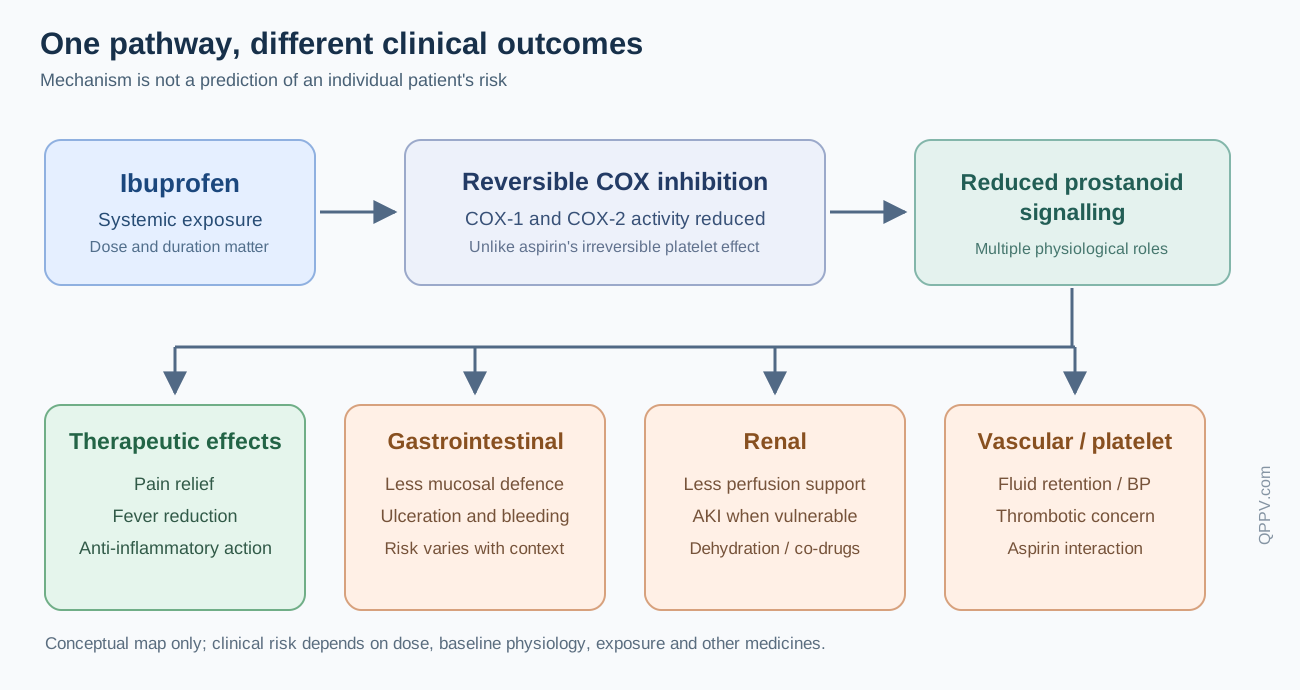
Figure 1. Qualitative mechanism map: reversible cyclooxygenase inhibition reduces prostanoid signalling, producing therapeutic effects while altering gastrointestinal, renal and vascular physiology. The diagram is not a quantitative prediction of an individual's risk and does not imply that every pathway is equally affected at every dose.
The central mechanistic distinction is between a physiological pathway and a clinical endpoint. Inhibition of prostaglandin synthesis is established; a particular myocardial infarction or renal injury still requires a case-specific causal assessment. Mechanistic plausibility cannot replace clinical evidence or establish incidence.
Racemate, pharmacokinetics and why dosing context matters
Ibuprofen is marketed as a racemate, with the S-enantiomer responsible for much of the cyclooxygenase-inhibitory activity; stereochemical conversion of some R-ibuprofen to S-ibuprofen contributes to exposure. Oral ibuprofen is absorbed relatively rapidly. The reviewed labels report peak concentrations at approximately one to two hours and an elimination half-life around two hours. The drug undergoes hepatic metabolism and urinary elimination of metabolites. Food can slow the rate of absorption without substantially reducing its extent. [3,4]
A short plasma half-life does not mean that adverse-event risk ends two hours after the last dose. Gastrointestinal lesions, haemodynamic renal injury, drug interactions and hypersensitivity may evolve on different time scales. Likewise, a single normal creatinine result cannot exclude later renal impairment in a patient who becomes dehydrated or continues exposure.
Formulations, indications and dose ceilings are not universal
The chosen US prescription label indicates rheumatoid arthritis, osteoarthritis, mild-to-moderate pain and primary dysmenorrhoea. It describes a maximum of 3,200 mg/day for its prescription tablet product and notes that controlled analgesic trials found no added mean analgesic benefit above 400 mg per dose. The UK Brufen 400 mg SmPC has a broader stated musculoskeletal and pain indication scope and specifies 2,400 mg/day as its maximum adult daily dose. These are product- and jurisdiction-specific labelled instructions, not an invitation to escalate to either ceiling. [3,4]
OTC directions commonly set lower limits and shorter intended courses. In a pharmacovigilance case, a patient's statement that they took “two ibuprofen tablets” is insufficient: the strength could differ markedly. Verify the exact package, active ingredients, route, daily total, frequency, start and stop dates, and whether a cold/flu combination supplied additional ibuprofen.
The unifying safety principle
The smallest effective exposure for the shortest necessary duration is the consistent principle in both assessed prescription labels. It is not a guarantee of safety: some serious reactions occur early, and a susceptible patient may have substantial baseline risk. The rest of this article evaluates clinical evidence, product-specific listedness and the operational consequences for individual-case and aggregate pharmacovigilance. [3,4]
Clinical evidence: efficacy and safety must be interpreted together
Historical arthritis and analgesia studies
The US prescription label describes controlled comparisons in rheumatoid arthritis and osteoarthritis in which ibuprofen relieved pain and inflammation comparably to aspirin, with fewer milder gastrointestinal complaints in the populations studied. It also describes controlled studies in dental, post-procedural and menstrual pain. Those results established symptomatic efficacy, not freedom from ulceration, bleeding or cardiovascular events. A reduction in dyspepsia relative to aspirin does not demonstrate that an ibuprofen-treated patient cannot develop a bleeding ulcer. [3]
For acute mild-to-moderate pain, the reviewed US label reports that doses above 400 mg did not provide greater average analgesic efficacy in its controlled analgesic studies. This illustrates why an apparently stronger tablet is not automatically a more effective pain intervention, while increasing total exposure can increase toxicity. Chronic inflammatory disease requires a different evaluation of dose, duration and benefit. A trial of short-term dental pain should not be used to justify a high daily dose for months in an older patient with renal disease. [3]
The 1960s and 1970s studies were conducted before contemporary trial reporting standards, cardiovascular adjudication, routine gastroprotection and modern background treatment. Their historical importance is real, but event counts and comparator designs do not directly estimate current population risks. Subsequent randomised evidence and pharmacoepidemiology have refined the safety picture.
PRECISION: a cardiovascular comparison, not an all-dose safety guarantee
PRECISION randomised 24,081 patients with osteoarthritis or rheumatoid arthritis and established or increased cardiovascular risk to celecoxib, naproxen or ibuprofen. The mean ibuprofen dose was approximately 2,045 mg/day, and the mean treatment duration was about 20 months. In the intention-to-treat analysis, the primary composite of cardiovascular death, nonfatal myocardial infarction or nonfatal stroke occurred in 2.3% assigned celecoxib, 2.5% naproxen and 2.7% ibuprofen. Celecoxib met the trial's prespecified noninferiority criterion against the comparators; the study was not a placebo-controlled demonstration that any of the three drugs lacked cardiovascular risk. [7]
PRECISION also reported fewer adjudicated gastrointestinal events with celecoxib than with ibuprofen or naproxen and fewer renal events with celecoxib than with ibuprofen. Interpretation requires the protocol's doses and the high rates of discontinuation: 68.8% stopped their assigned study medicine and 27.4% discontinued follow-up. The result should not be transported without qualification to a healthy person taking one OTC dose, or to patients with different baseline risk and co-medications. [7]
PRECISION-ABPM: blood pressure is a safety endpoint
A prespecified four-month ambulatory blood-pressure substudy randomised 444 patients. Mean 24-hour systolic pressure changed by −0.3 mmHg with celecoxib, +3.7 mmHg with ibuprofen and +1.6 mmHg with naproxen. The between-group difference for celecoxib versus ibuprofen was statistically significant. New-onset hypertension among participants with normal baseline pressure was reported in 23.2% of the ibuprofen group compared with 10.3% of the celecoxib group. [8]
These data show why an NSAID safety assessment should consider a patient's blood-pressure trajectory, oedema, heart failure and the apparent loss of response to antihypertensive therapy. The substudy is not an individual-level prediction: changes in renal function, volume status and other treatments can produce similar clinical findings.
Randomised-trial meta-analysis: dose and event type matter
The Coxib and traditional NSAID Trialists' Collaboration pooled individual participant data from randomised trials. In the high-dose ibuprofen comparisons, major coronary events were increased relative to placebo (rate ratio 2.22, 95% CI 1.10–4.48), whereas the estimate for the broader major vascular events endpoint (rate ratio 1.44, 95% CI 0.89–2.33) was not statistically significant. Upper gastrointestinal complications were increased (rate ratio 3.97, 95% CI 2.22–7.10). [9]
Those are relative rates in the analysed trial settings, not the probability that a particular person will have a myocardial infarction or gastrointestinal bleed. The confidence intervals, definitions, duration, dose and baseline event rates must be retained. Nor should a statistically nonsignificant result be rewritten as proof of no risk. In 2015, EMA's PRAC/CMDh review concluded that ibuprofen at or above 2,400 mg/day carries a small increased cardiovascular risk and advised avoiding high doses in patients with serious cardiovascular disease. The review did not identify an increased cardiovascular risk at doses up to 1,200 mg/day in the assessed evidence; that finding is not a declaration that all low-dose use is risk-free. [5]
Gastrointestinal and haemorrhagic safety
Dyspepsia is not a reliable sentinel for major bleeding
Nausea, epigastric discomfort, heartburn and dyspepsia are common reasons for stopping ibuprofen. Serious gastric or duodenal ulceration, bleeding and perforation can occur without preceding symptoms. The US label carries a boxed gastrointestinal warning, and the UK SmPC describes potentially fatal bleeding or perforation, particularly in older people. A safety intake that codes only “abdominal pain” when the source also describes melaena and transfusion misses the clinically decisive event. [3,4]
Risk is modified by prior ulcer or bleeding, increasing dose and duration, older age, poor health, and concomitant corticosteroids, anticoagulants, antiplatelets or selective serotonin reuptake inhibitors. In a suspected bleed, establish the source of haemorrhage, haemoglobin trend, endoscopic findings, transfusions, and whether ibuprofen was the only NSAID exposure. A proton-pump inhibitor may reduce some upper-GI risk but does not make concurrent NSAID exposure universally safe, nor prevent every lower-GI complication.
Platelet function and aspirin interaction
Ibuprofen reversibly occupies platelet cyclooxygenase and can interfere with low-dose aspirin's access to the enzyme when taken at certain intervals. The US label documents pharmacodynamic interaction studies with immediate-release and enteric-coated aspirin; it explicitly warns that timing findings for once-daily ibuprofen and immediate-release aspirin cannot simply be extended to enteric-coated aspirin. The UK SmPC likewise notes uncertainty about the clinical implications of repeated dosing. [3,4]
A reported myocardial infarction in a patient using aspirin and ibuprofen therefore requires more than a yes/no co-medication field. Document the aspirin indication, formulation, adherence, ibuprofen dose and timing, cardiovascular history, competing causes and whether the event occurred during ongoing exposure. Laboratory thromboxane inhibition is a mechanistic surrogate, not proof that a particular clinical event was caused by a dosing interaction. Conversely, prescribing aspirin does not neutralise the intrinsic gastrointestinal risk of adding ibuprofen.
Kidney injury: dependence on prostaglandin-mediated perfusion
A functional vulnerability, not just an accumulation problem
Renal prostaglandins help preserve renal blood flow when perfusion is threatened. Inhibition by ibuprofen can precipitate a haemodynamic fall in glomerular filtration, particularly during dehydration, heart failure, cirrhosis, pre-existing renal impairment or concurrent use of medicines that alter renal haemodynamics. The short plasma half-life of ibuprofen does not negate this physiological risk. Long-term NSAID exposure has also been associated with other renal pathology, including papillary injury. [3,4]
A population-based nested case-control study by Lapi and colleagues found that concurrent diuretic + ACE inhibitor or angiotensin-receptor blocker + NSAID exposure was associated with acute kidney injury (adjusted rate ratio 1.31, 95% CI 1.12–1.53), with a stronger association during the first 30 days (rate ratio 1.82, 95% CI 1.35–2.46). This “triple whammy” result applies to NSAIDs as a group in an observational design; it is not an ibuprofen-specific randomised effect estimate. [10]
The operational lesson is to capture baseline and serial creatinine, urine output, fluid intake, vomiting or diarrhoea, sepsis, diuretic changes and dates of all three medicines. An apparent dechallenge improvement after withholding ibuprofen supports but does not prove causality, especially if hydration and several other drugs were changed simultaneously.
Chronic and unusual renal phenotypes
The UK Brufen SmPC describes renal tubular acidosis and hypokalaemia associated with prolonged high-dose use, including doses exceeding recommended limits. A patient with unexplained weakness, metabolic acidosis and low potassium should prompt a detailed review of duration and cumulative ibuprofen exposure, particularly when OTC use was not recorded in the prescribed medication list. [4]
These phenotypes should be coded separately from generic “renal failure” when the clinical evidence supports them. A case may involve more than one process: chronic high-dose exposure, an acute dehydrating illness and interacting antihypertensives can coexist. Signal evaluation should stratify by duration, dose, renal baseline and co-medication rather than pooling all renal preferred terms without review.
Pregnancy, reproduction and paediatric exposure
The gestational risk window changed with postmarketing evidence
The familiar late-pregnancy NSAID concern is premature constriction or closure of the fetal ductus arteriosus. The FDA's October 2020 safety communication also emphasised an earlier risk: from approximately 20 weeks' gestation, maternal NSAID use can cause fetal renal dysfunction and oligohydramnios, sometimes with neonatal renal impairment. Reports included onset as soon as 48 hours, and some cases improved after stopping exposure. FDA advises avoiding NSAIDs at 20 weeks or later unless specifically recommended by a healthcare professional, limiting any necessary treatment between 20 and 30 weeks, and considering amniotic-fluid monitoring if treatment exceeds 48 hours. At about 30 weeks and later, the additional ductal risk supports avoidance. [6]
The UK Brufen 400 mg SmPC is more categorical for its own product: third-trimester use is contraindicated under section 4.3; section 4.6 addresses risks from the 20th week and monitoring after several days of exposure. These are not contradictory descriptions of a single gestational threshold. They are different regulatory formulations of several related risks, with a UK product-specific contraindication and US risk-minimisation instructions. [3,4]
A pregnancy-exposure report should record estimated gestational age at each dose, actual dose and duration, indication, fetal ultrasound findings, amniotic-fluid measurements, ductal assessment, neonatal renal outcomes and alternative explanations. Maternal and fetal outcomes should not be collapsed into one undifferentiated event. An ultrasound finding that resolved after cessation is relevant dechallenge evidence, but spontaneous case counts cannot yield a population incidence estimate.
Fertility, lactation and children
Prostaglandin inhibition can affect ovulation, and the UK SmPC warns that ibuprofen may impair female fertility, with withdrawal considered in women being investigated for infertility. The assessed US prescription-tablet label states that controlled trials establishing paediatric safety and efficacy for that prescription product have not been conducted; this must not be paraphrased as meaning that no ibuprofen formulation is authorised or used in children. Different oral suspensions and OTC products have their own age, weight and dosing instructions. [3,4]
Dehydration is particularly important in children with fever, vomiting or diarrhoea. A suspected paediatric renal event requires actual administered mg/kg, formulation concentration, measuring device, fluid losses, concomitant medicines and timing. The UK SmPC cautions about renal impairment in dehydrated children and adolescents. [4]
Hypersensitivity, severe skin reactions and infection
NSAID-exacerbated respiratory disease and anaphylaxis
Cross-reactive bronchospasm in patients with aspirin-sensitive asthma, rhinitis or nasal polyps is a predictable class concern, but an individual reaction may also reflect selective hypersensitivity. Both assessed labels contraindicate use after certain aspirin/NSAID hypersensitivity reactions. The US label describes serious anaphylactoid reactions, and the UK section 4.8 lists anaphylactic reaction and bronchospasm. A report should capture latency after ingestion, objective respiratory signs, mucosal swelling, urticaria, epinephrine treatment, prior tolerance and reactions to other NSAIDs. [3,4]
A patient with a rash and dyspnoea during a viral illness may have competing explanations; however, immediate clinical management should not await causality adjudication. The pharmacovigilance record must preserve what was observed, what was inferred and which criteria were used to assess seriousness.
SCARs, aseptic meningitis and less familiar phenotypes
The US label warns about DRESS, Stevens–Johnson syndrome (SJS), toxic epidermal necrolysis (TEN) and exfoliative dermatitis. In its adverse-reaction table, SJS is placed in a “probable causal relationship” category, while TEN is included in a “causal relationship unknown” category. These table categories must not be conflated with the separate serious-skin warning. [3]
The UK Brufen SmPC section 4.8 lists SJS/TEN and exfoliative dermatitis under very-rare severe cutaneous reactions; DRESS, acute generalised exanthematous pustulosis (AGEP) and fixed drug eruption appear with frequency “not known.” It also lists Kounis syndrome, renal tubular acidosis and hypokalaemia with frequency “not known.” These are specific public-label differences in the documents reviewed, not evidence that a reaction is impossible in the United States. [4]
Aseptic meningitis is described in both labels, especially in people with systemic lupus erythematosus or related connective-tissue disorders, though it can occur without those conditions. Diagnostic review requires cerebrospinal-fluid findings, infectious work-up, neurological course, immune background and exposure timing. Rechallenge is generally inappropriate for a potentially serious hypersensitivity phenotype merely to prove causation.
Fever suppression can delay recognition of infection
Antipyresis is useful symptom relief, but suppressing fever and pain can also obscure progression of an underlying infection. The UK SmPC specifically warns that masking of infection may delay appropriate treatment, citing observations in community-acquired bacterial pneumonia and bacterial complications of varicella. It advises monitoring and review if symptoms persist or worsen. This is a warning about clinical recognition and timing, not proof that ibuprofen directly causes every severe infection reported during its use. [4]
In signal review, distinguish infection already present at ibuprofen initiation from a new infection; record symptom onset, antibiotic timing, microbiology, imaging, disease severity and whether the analgesic may have delayed escalation.
Product-specific listedness: US prescription tablets versus UK Brufen
Documents, scope and interpretation
This comparison was performed against the following publicly accessible documents on 2 November 2026:
- United States: Preferred Pharmaceuticals Inc. repackaged ibuprofen tablets USP, 400/600/800 mg, DailyMed set ID
b84ea215-e61d-4c00-8a34-d47c4080779b, revised January 2026 (effective 19 January 2026). Principal evidence: boxed warning, Contraindications, Warnings, Precautions, Adverse Reactions and Pregnancy. The packager is identified as Preferred; the document also identifies Westminster Pharmaceuticals as manufacturer-for/distributor in the underlying packaging chain. [3] - United Kingdom: Viatris Products Limited Brufen 400 mg tablets, SmPC text revised March 2026, emc page updated 17 April 2026. Principal evidence: sections 4.1–4.8, 5.1 and 5.2. This is a UK SmPC and should not be called an EMA centrally authorised SmPC. [4]
The US label's adverse-reaction table combines clinical-trial and marketing observations using categories of probable causal relationship and causal relationship unknown. The UK section 4.8 uses MedDRA system organ classes and frequency categories, including “not known.” Neither system supports direct numerical comparison of postmarketing rates between jurisdictions.
What is listed, warned about or contraindicated?
| Safety question | US prescription label, January 2026 | UK Brufen SmPC, March 2026 |
|---|---|---|
| Serious GI bleeding, ulceration, perforation | Boxed warning; ulcer/haemorrhage in Adverse Reactions | Sections 4.4 and 4.8; prior NSAID-related bleeding and recurrent ulceration in 4.3 contraindications |
| Myocardial infarction, stroke | Boxed warning for cardiovascular thrombotic events; CABG setting contraindicated | High-dose arterial-event risk in 4.4 and 4.8; severe NYHA IV heart failure contraindicated |
| Kidney injury | Renal warnings; acute renal failure and related events in Adverse Reactions | Renal injury in 4.8; severe renal failure contraindicated; tubular acidosis and hypokalaemia “not known” in 4.8 |
| Severe skin reactions | DRESS/SJS/TEN in Warnings; SJS and TEN appear in different causality columns of adverse-reaction table | SJS/TEN very rare; DRESS, AGEP and fixed drug eruption “not known” in 4.8 |
| Aseptic meningitis | Warnings and adverse-reaction table | Section 4.8, rare; connective-tissue disease risk in 4.4 |
| Kounis syndrome | Not identified in the assessed US adverse-reaction table or warnings | Explicitly listed in 4.8, frequency “not known” |
| Pregnancy | Fetal renal effects from about 20 weeks; avoid at about 30 weeks and later | From week 20, oligohydramnios/ductal monitoring advice; third trimester contraindicated |
| Dose and indication | Maximum 3,200 mg/day for the assessed prescription product; RA/OA, pain and dysmenorrhoea | Maximum 2,400 mg/day for the assessed 400 mg tablets; broader musculoskeletal indications |
The table distinguishes not identified in the assessed public document from known not to occur. In particular, Kounis syndrome, tubular acidosis and hypokalaemia should not be declared universally “unlisted in the US” without checking the precise product's reference safety information and any later revisions. Equally, DRESS appears as a US warning even though it is not in the old adverse-reaction table: an assessment limited to section headings or one table would miss it. [3,4]
Public-label listedness is not case expectedness
“Listed” here means identified in the named, dated public document and the specified section. Case-specific expectedness may require a company core safety document, local label, investigator brochure or other applicable reference safety information (RSI), depending on the regulatory context. An adverse reaction being in a warning rather than a frequency table may matter to a local workflow, but a medical writer cannot infer the organisation's reporting determination from this comparison alone. Seriousness, causality, expectedness and reportability are distinct assessments. See Listedness, Expectedness and Reference Safety Information for the underlying framework.
A label comparison also cannot establish that a regional difference was caused by a new signal, a higher event rate or regulatory disagreement. Differences may reflect revision timing, evidence, historical format or product scope; the actual cause requires regulatory-history evidence. The comparison is therefore a dated snapshot, not a permanent cross-market rule.
Practical pharmacovigilance: reconstruct exposure before attributing harm
Intake and case validity
Ibuprofen reports arise from spontaneous consumer contacts, pharmacies, clinicians, poison centres, literature, digital channels and organised programmes. The first task is to preserve the reporter's account and establish the locally applicable minimum criteria for a valid individual case safety report (ICSR), followed by appropriate medical follow-up. The ICH E2D(R1) guideline provides harmonised definitions and management principles; EU GVP Module VI Rev. 2 addresses collection, management, follow-up and reporting in the EU. Neither source makes every case medically caused by the suspected medicine, and implementation dates must be checked in the relevant region. [11,12]
The intake process should separate an adverse event (what happened) from the reporter's suspected drug relationship and the medical assessor's evaluation. A case involving a nonprescription medicine is not intrinsically less important than a prescription case. In fact, the absence of a prescribing record may increase the need to reconstruct the product, concentration and actual administration.
A practical exposure and evidence matrix
| Information to obtain | Why it changes assessment |
|---|---|
| Brand, INN, formulation, strength, route, batch when relevant | Distinguishes 200 mg OTC tablets, higher-strength prescription tablets, suspensions and combinations; identifies possible medication error |
| Start/stop dates, every dose, daily total, missed doses and repeated courses | Tests chronology, cumulative exposure and high-dose risk |
| Indication and pre-treatment symptoms | Separates underlying infection, arthritis, pain or disease progression from suspected adverse reaction |
| Age, pregnancy timing, hydration, kidney and cardiovascular history, prior ulcer | Identifies important baseline vulnerability and absolute-risk modifiers |
| Aspirin formulation and timing; anticoagulants, diuretics, ACE inhibitors/ARBs, SSRIs, steroids, other NSAIDs | Evaluates pharmacodynamic and haemodynamic interactions |
| Objective results: haemoglobin, creatinine, potassium, bicarbonate, ECG, endoscopy, imaging, ultrasound | Establishes clinical phenotype, severity and alternative causes |
| Dechallenge, treatment, recovery, follow-up and other medicine changes | Supports chronology without falsely assigning all improvement to ibuprofen withdrawal |
| Reporter source, receipt date, identifiers and possible duplicate reports | Enables traceability, validity review and correct regional processing |
If the report concerns a child or a pregnant patient, weight-based dose calculations or gestational timing may be essential; do not substitute adult label assumptions. In a suspected medication error, record the actual pack or photograph when available and whether a combination product supplied the same ingredient twice.
Four illustrative cases
Case A — gastrointestinal bleed. An older patient receiving an anticoagulant buys OTC ibuprofen for back pain and is hospitalised with melaena. The investigation should identify the exact product and duration, endoscopy, haemoglobin, transfusion, anticoagulant regimen, prior ulcer history and other NSAIDs. The bleed may be serious even if the source reports no preceding dyspepsia. It is inappropriate to assign a numerical probability of ibuprofen causality merely because the event is labelled. [3,4]
Case B — acute kidney injury after a febrile illness. A patient receiving a diuretic and an angiotensin-receptor blocker takes ibuprofen during several days of vomiting. Creatinine rises. The case may fit the renal haemodynamic mechanism and the observational “triple whammy” pattern, but sepsis, volume depletion and co-medications are competing or interacting contributors. Record all exposure dates and recovery after fluid correction and medication changes. [10]
Case C — fetal renal effect. A pregnant patient reports ibuprofen use around week 23 and an ultrasound shows oligohydramnios. The relevant facts include exact gestational dating, duration, amniotic-fluid measurements, alternative causes, maternal conditions and neonatal follow-up. The FDA communication and both assessed labels provide a recognised risk context; they do not turn a spontaneous temporal association into a definitive individual causal finding. [3,4,6]
Case D — severe rash with systemic findings. A patient develops fever, widespread eruption, lymphadenopathy and liver-test abnormalities after several weeks of ibuprofen. DRESS is a relevant differential, but infection, other new medicines and the diagnostic criteria must be assessed. Preserve clinical photographs and laboratory chronology when appropriately available; serious suspected SCAR warrants urgent clinical action, while PV causality is assessed separately. [3,4]
These cases are hypothetical teaching examples, not real inspection findings or individual case reports.
From individual cases to signal evaluation
Stratification avoids misleading pooled counts
Ibuprofen's broad exposure base creates substantial confounding. A disproportionality signal for “renal injury” may mix dehydration-related acute kidney injury, interstitial nephritis, chronic papillary injury and tubular acidosis. A cardiovascular dataset may mix arterial thrombosis, oedema, heart failure and blood-pressure elevation. Each phenotype has different clinical criteria and plausible risk windows. Case-level review should precede causal interpretation of aggregate counts.
Useful stratification includes daily dose band (OTC-range versus prescription high-dose), duration, age, sex and pregnancy status, baseline kidney and cardiovascular disease, ulcer history, co-medication, route/formulation and region. It is especially important to identify duplicate reports across consumers, healthcare professionals, literature and regulatory databases. A rising count may reflect awareness, media coverage, stimulated reporting or greater exposure rather than a rising incidence.
Triangulate different evidence streams
Spontaneous reports can identify unusual patterns, but they generally lack a reliable exposed denominator and are affected by under-reporting and reporting bias. Randomised trials contribute comparative evidence but may exclude frail, pregnant or multimorbid populations. Observational studies improve real-world coverage but require careful control of confounding by indication, illness severity and time-varying exposure. Biological mechanism helps test plausibility; product labelling and regulatory decisions document established risk communication, not the incidence in a particular practice. [5,7,9,10]
A mature signal assessment might ask whether prolonged high-dose use is increasing among people with cardiovascular disease, whether preventable AKI clusters involve triple therapy and dehydration, or whether reports of tubular acidosis are being coded consistently. A signal should not be declared confirmed solely from a disproportionality statistic, and lack of a disproportionality signal does not rule out a known serious reaction.
Risk minimisation and governance
Practical controls include medication-list reconciliation that captures OTC products, pack-strength verification, patient-facing pregnancy warnings, pharmacist review of duplicate NSAIDs and interactions, appropriate renal and blood-pressure monitoring for prolonged therapy, and escalation pathways for suspected bleeding or SCAR. These are operational recommendations informed by labels and evidence; their precise legal status depends on the market and authorisation conditions. [3,4,6]
An MAH's quality system should preserve versioned reference labels, evidence supporting signal decisions, rationale for any product-information updates, implementation records, training and effectiveness measures where required. A useful effectiveness measure tests behaviour—such as whether users recognise duplicate ibuprofen exposure—rather than merely counting distributed leaflets. Reconciliation between medical information, product complaints and safety databases is especially relevant when brand names obscure the shared INN.
Common analytical failures and a concise review checklist
A frequent error is to report “ibuprofen 400 mg” without frequency and then compare the case with evidence from 2,400 mg/day trials. Another is to equate a drug being widely sold without prescription with a low probability of serious harm in every patient. A third is to treat a UK SmPC frequency category as directly comparable to the US adverse-reaction table's causal categories. Finally, a serious event must not be described as a proven drug reaction simply because it is labelled.
Before closing a medically important case, confirm: the actual product and exposure; patient vulnerabilities; competing diagnoses and co-drugs; objective phenotype and seriousness; pregnancy or paediatric specifics when applicable; follow-up and outcome; applicable dated reference safety information; duplicate search; and documented causality/expectedness/reporting decisions. The list is a quality-control aid, not a replacement for jurisdiction-specific procedures.
Key Takeaways
Ibuprofen's history spans prescription anti-rheumatic development, expansion to OTC use and decades of accumulating safety evidence. Reversible cyclooxygenase inhibition explains both benefit and organ-system vulnerabilities. High-dose cardiovascular risk, gastrointestinal bleeding, renal injury, fetal renal effects and serious hypersensitivity require different exposure windows and assessment methods. The US and UK prescription labels agree on major risks but differ in maximum daily dose, contraindication wording and adverse-reaction presentation. Sound pharmacovigilance therefore starts with precise exposure reconstruction and separates clinical observation, public-label listedness, causal inference and regulatory reporting. [3–6]
References
- Boots UK. Boots Hidden Heroes – Honouring Dr Stewart Adams. 1 February 2019. Company historical account.
- Rainsford KD. History and Development of Ibuprofen. In: Ibuprofen. 2015. DOI: 10.1002/9781118743614.ch1.
- Preferred Pharmaceuticals Inc. Ibuprofen Tablets USP 400, 600 and 800 mg, US DailyMed prescription information; revised January 2026, effective 19 January 2026. Current document assessed 2 November 2026.
- Viatris Products Limited. Brufen 400 mg Tablets, UK Summary of Product Characteristics; text revised March 2026, emc updated 17 April 2026. SmPC assessed 2 November 2026.
- European Medicines Agency. PRAC recommends updating advice on use of high-dose ibuprofen. 13 April 2015; EMA/217862/2015. Regulatory review.
- US Food and Drug Administration. FDA recommends avoiding use of NSAIDs in pregnancy at 20 weeks or later because they can result in low amniotic fluid. Drug Safety Communication, 15 October 2020. FDA communication.
- Nissen SE, et al. Cardiovascular Safety of Celecoxib, Naproxen, or Ibuprofen for Arthritis. N Engl J Med. 2016;375:2519–2529. DOI: 10.1056/NEJMoa1611593.
- Ruschitzka F, et al. Differential blood pressure effects of ibuprofen, naproxen, and celecoxib: PRECISION-ABPM. Eur Heart J. 2017;38:3282–3292. DOI: 10.1093/eurheartj/ehx508.
- Coxib and traditional NSAID Trialists' Collaboration. Vascular and upper gastrointestinal effects of non-steroidal anti-inflammatory drugs. Lancet. 2013;382:769–779. DOI: 10.1016/S0140-6736(13)60900-9.
- Lapi F, et al. Concurrent use of diuretics, ACE inhibitors/ARBs and NSAIDs and risk of acute kidney injury. BMJ. 2013;346:e8525. DOI: 10.1136/bmj.e8525.
- International Council for Harmonisation. ICH E2D(R1): Post-Approval Safety Data, Definitions and Standards for Management and Reporting of ICSRs. Step 4, adopted 15 September 2025. Final guideline.
- European Medicines Agency/Heads of Medicines Agencies. GVP Module VI, Revision 2: Collection, management and submission of reports of suspected adverse reactions. Effective 22 November 2017. Guideline.
Regulatory Note
This is an educational scientific and pharmacovigilance review, not a prescribing recommendation or an MAH's approved reference safety information. Regulatory statements are attributed to the specific, dated US prescription label and UK SmPC reviewed on 2 November 2026; neither represents all ibuprofen formulations or markets. The 2015 EMA safety review and 2020 FDA communication are historical regulatory evidence, while ICH E2D(R1) is a harmonised guideline whose local implementation must be checked. Clinical-study estimates apply to their study populations and regimens. Individual-case seriousness, causality, expectedness and reporting obligations require independent, current, jurisdiction-appropriate assessment.