Lisinopril: Discovery, Development, Safety and Pharmacovigilance
Lisinopril is an orally administered angiotensin-converting enzyme (ACE) inhibitor used in hypertension and selected cardiovascular and renal conditions. Its clinical importance extends beyond lowering blood pressure: by reducing angiotensin II production and aldosterone signalling it alters intraglomerular haemodynamics, potassium handling and compensatory responses to impaired circulation. Those mechanisms explain both therapeutic benefit and several clinically important adverse reactions. The same pharmacology that benefits a patient with proteinuric kidney disease can produce acute deterioration in renal function when renal perfusion depends on angiotensin II.
This reference follows lisinopril as an individual active substance rather than a particular brand. Indications, contraindications, monitoring instructions and formulation details must always be checked against the applicable country's currently authorised product information. The discussion of clinical trials does not imply authorisation for every studied population or endpoint.
- Lisinopril: Discovery, Development, Safety and Pharmacovigilance
- Origin and pharmaceutical development
- Pharmacology and pharmacokinetics
- Regulatory scope and indications
- Clinical development and cardiovascular outcome evidence
- The contemporary therapeutic setting
- Safety profile and biological interpretation
- Important interactions and clinical modifiers
- Pharmacovigilance case evaluation
- Signal detection, evaluation and regulatory action
- QPPV and inspection considerations
- Practical review checklist
- Key Takeaways
- References
- Regulatory Note
Origin and pharmaceutical development
The development of lisinopril followed the establishment of ACE as a therapeutic target within the renin–angiotensin system. Captopril had shown that an orally active ACE inhibitor could treat hypertension, but medicinal chemistry programmes sought compounds with different chemical, pharmacokinetic and administration properties. Merck's enalapril programme included the active diacid enalaprilat (MK-422), generated after enzymatic conversion of the prodrug enalapril (MK-421). Lisinopril, the lysine analogue of MK-422, was investigated as MK-521. Unlike enalapril, MK-521 was already active without requiring metabolic activation.
A 1982 human pharmacokinetic comparison by Ulm and colleagues showed that MK-521 was absorbed more slowly than enalapril and was recovered largely unchanged. A companion investigation by Biollaz and colleagues linked circulating drug concentrations to ACE inhibition and suppression of angiotensin II formation. Hodsman and colleagues subsequently examined sustained biochemical and haemodynamic effects during once-daily administration. These early studies [1–3] did not establish long-term cardiovascular outcome benefit; they established the mechanistic and pharmacokinetic basis for testing the drug clinically.
The distinction between a directly active compound and a prodrug remains relevant to pharmacovigilance. Lisinopril is not dependent on hepatic bioactivation for its principal effect; its elimination depends substantially on renal excretion. Consequently, deterioration in renal function can increase exposure, while renal haemodynamics can themselves change with ACE inhibition. This reciprocal relationship makes the clinical context of a creatinine rise more important than any isolated laboratory value.
Pharmacology and pharmacokinetics
Renin release produces angiotensin I, which ACE converts to angiotensin II. Angiotensin II promotes vasoconstriction, aldosterone release and preferential efferent arteriolar constriction within the kidney. Inhibiting ACE therefore tends to reduce systemic vascular resistance, suppress aldosterone and decrease glomerular capillary pressure. ACE also participates in bradykinin degradation. Reduced bradykinin breakdown helps explain both the characteristic persistent dry cough and the potentially life-threatening bradykinin-mediated angioedema associated with this class.
Lisinopril is hydrophilic, is not substantially metabolised and is eliminated predominantly in urine. These properties help explain why dose adjustment may be required in renal impairment; they do not mean it is free from clinically important interactions. The most consequential interactions often arise from combined effects on renal perfusion, potassium balance or the renin–angiotensin system rather than hepatic enzyme inhibition.
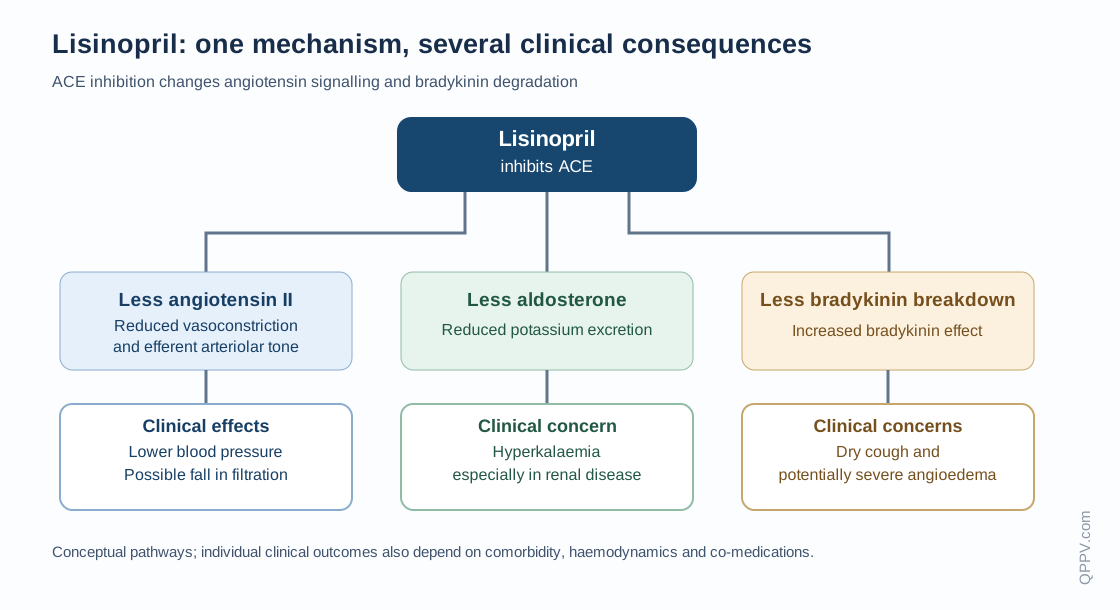
Figure 1. Conceptual pathways linking ACE inhibition to blood-pressure reduction, altered renal haemodynamics, potassium retention, cough and angioedema. These are mechanistic relationships, not patient-level predictions.
The antihypertensive response depends on sodium status, circulating volume, renal perfusion, concomitant therapy and the physiology driving hypertension. A pronounced first-dose blood-pressure fall is especially relevant in volume depletion, intensive diuretic treatment or decompensated heart failure. Response should therefore be assessed in the clinical context rather than treated as uniform across patients.
Regulatory scope and indications
The UK lisinopril SmPC revised in September 2026 [4] lists hypertension, symptomatic heart failure, short-term treatment in haemodynamically stable patients following acute myocardial infarction and renal disease in hypertensive patients with type 2 diabetes and incipient nephropathy. These are product-information statements for that licensed presentation and jurisdiction; readers must not apply them automatically to products authorised elsewhere. Dose selection depends on indication, renal function, blood pressure and background treatment.
In the European Union, marketing-authorisation holders operate pharmacovigilance systems under the applicable EU legislation and Good Pharmacovigilance Practices. For lisinopril, relevant activities include individual case safety reporting, aggregate safety evaluation, signal management, product-information maintenance and risk minimisation. GVP explains how these processes should function; it is not evidence that every recommended clinical monitoring step is an independent legal obligation imposed on the prescriber.
The mature generic market presents a distinctive challenge. Safety evidence is generated across many manufacturers and settings, while the pharmacological risks are largely shared. Companies must nevertheless maintain product-specific documentation, track relevant literature and regulatory actions, and assess any formulation or quality signal without assuming that all reports have an identical origin.
Clinical development and cardiovascular outcome evidence
Early clinical evaluation
The MK-521 clinical programme moved from volunteer studies of pharmacokinetics and ACE inhibition to investigations in hypertension and heart failure. Small physiological studies demonstrated changes in haemodynamics and renin–angiotensin biomarkers. Such mechanistic findings supported later studies but could not substitute for clinical outcome trials. The drug eventually entered routine clinical practice in multiple markets; a global first-approval chronology should not be inferred from a single country's brand history.
Acute myocardial infarction: GISSI-3
The GISSI-3 trial assessed early lisinopril and transdermal nitrate treatment after acute myocardial infarction using a factorial design. It randomised 19,394 patients and examined six-week mortality and left ventricular outcomes. Six-week mortality was lower in the lisinopril-assigned group than in those not assigned lisinopril (6.3% versus 7.1%); the factorial trial did not establish a comparable mortality benefit from the nitrate intervention. [6] The trial is important because it connects ACE inhibition to remodelling and early post-infarction physiology, while also illustrating that initiation shortly after infarction requires haemodynamic stability. Hypotension and renal vulnerability are particularly relevant in acute coronary care, where an apparently routine antihypertensive effect may carry different clinical consequences.
Clinical-trial outcomes from this setting should not be generalised indiscriminately to late presentation, shock or unstable patients. Product-specific SmPC language limits early lisinopril treatment after infarction to haemodynamically stable patients and specifies its short-term use.
Hypertension: the ALLHAT comparison
ALLHAT provides unusually informative comparative evidence. In its three major treatment arms, 33,357 older high-risk hypertensive participants were assigned chlorthalidone, amlodipine or lisinopril. [5] The primary outcome of fatal coronary heart disease or nonfatal myocardial infarction did not significantly differ between lisinopril and chlorthalidone. However, lisinopril had higher rates of several secondary outcomes, including stroke, heart failure and combined cardiovascular disease. This is a comparison of initial treatment strategies and their achieved blood-pressure control, not evidence that lisinopril is intrinsically cardiotoxic.
The trial also documented angioedema more often with lisinopril than with chlorthalidone. Unlike modest changes in blood pressure or creatinine, angioedema can abruptly threaten the airway. A pharmacovigilance account of ALLHAT therefore needs both the comparative efficacy context and the observed safety signal. Analyses by subgroup require care: population-level differences in response cannot justify unexamined assumptions about an individual patient's treatment or causality.
Heart failure and dose-intensity evidence
Heart-failure use draws on the broader ACE-inhibitor evidence base and lisinopril-specific trials. The ATLAS trial randomised 3,164 patients with symptomatic heart failure and reduced ejection fraction to low-dose (2.5–5 mg daily) or high-dose (32.5–35 mg daily) lisinopril. High-dose treatment did not demonstrate a statistically significant reduction in all-cause mortality alone, but reduced the combined outcome of death or any hospital admission and reduced heart-failure hospitalisations. Dizziness and renal insufficiency were more common with high-dose treatment. These differences inform the balance between clinical benefit and treatment-limiting hypotension, renal effects and hyperkalaemia. The inference for care is not simply to maximise dose but to titrate according to indication, blood pressure, renal function, potassium and symptoms. [9]
Diabetes-related renal disease
ACE inhibition can reduce intraglomerular pressure and albuminuria, creating a rationale for treatment in selected patients with diabetic kidney disease. This benefit must be distinguished from treatment-induced reductions in filtration pressure. A modest early creatinine increase may accompany the intended haemodynamic action; a progressive or pronounced deterioration requires assessment for volume depletion, renal artery disease, concurrent nephrotoxins and other causes. Neither an isolated laboratory abnormality nor the generic phrase 'renal protection' is sufficient for assessing an individual suspected adverse reaction.
The contemporary therapeutic setting
Lisinopril is widely available as a generic medicine and may be used alone or with other antihypertensives. The relevant safety exposure is therefore not limited to one manufacturer or brand. Fixed-dose combinations may modify tolerability and risk: a diuretic may intensify hypotension or alter potassium, while other renin–angiotensin agents may increase the risk of renal impairment and hyperkalaemia. One should not assign all events seen with a combination product to lisinopril without considering the other constituents and underlying illness.
Its longstanding availability also changes how safety information evolves. Established reactions such as cough, angioedema, hyperkalaemia and renal dysfunction remain central, but individual reports still matter when they reveal unusual presentation, interaction, preventable medication error or a new pattern associated with a particular population, formulation or treatment pathway.
Safety profile and biological interpretation
Angioedema
Angioedema involving the tongue, lips, face, pharynx or larynx is a major ACE-inhibitor risk. Unlike histamine-driven urticaria, ACE-inhibitor angioedema is commonly associated with altered bradykinin metabolism and may occur without a rash. Onset is not restricted to treatment initiation; cases can occur after long exposure. Airway assessment and emergency management take precedence over proving causality. Previous ACE-inhibitor-associated angioedema is a contraindication in the relevant SmPC. Rechallenge after convincing ACE-inhibitor angioedema is not a routine confirmation strategy and may be dangerous.
Clinical case evaluation should document anatomical sites, airway compromise, timing, concomitant medicines, prior swelling episodes, history of hereditary or idiopathic angioedema, treatment and outcome. The record should distinguish any suspected mechanism from demonstrated laboratory evidence, and assess potential contributors such as medicines that affect bradykinin handling.
Hyperkalaemia and renal dysfunction
Reduced aldosterone activity limits renal potassium excretion. Risk rises with chronic kidney disease, diabetes, acute illness, potassium supplements, potassium-sparing diuretics and other drugs that affect renal potassium handling. Acute kidney injury may arise when glomerular filtration depends on angiotensin-II-mediated efferent arteriolar tone, particularly during volume depletion, bilateral renal artery stenosis or concurrent exposure to medicines reducing renal perfusion.
For an individual case, the absolute creatinine or potassium result is less informative without baseline values, timing, eGFR, urine output, haemodynamic status, intercurrent illness and co-medications. Hyperkalaemia can be clinically serious even if asymptomatic. Severe or rapidly changing values require immediate clinical management according to local protocols, not retrospective pharmacovigilance adjudication first.
A rise in creatinine following initiation is not automatically an adverse drug reaction requiring permanent withdrawal, nor is it automatically harmless. Attribution requires the magnitude, trajectory and alternative explanations to be weighed against the expected haemodynamic effect and the product's monitoring instructions.
Hypotension and syncope
ACE inhibition can produce symptomatic hypotension, particularly with reduced effective circulating volume, concurrent diuretics, cardiac failure or early post-infarction instability. Syncope may lead to falls, injury or reduced renal perfusion. In serious cases, establish whether the event reflects an excessive dose, interaction, dosing change, fluid loss, underlying arrhythmia or another competing clinical explanation.
Cough
Persistent dry cough is a recognised ACE-inhibitor adverse effect and an important source of treatment discontinuation. It can be delayed and may resolve after withdrawal, though the course varies. The differential diagnosis includes respiratory infection, asthma, reflux, heart failure and other drugs. A clinical response to discontinuation supports—but does not by itself prove—drug causality.
Pregnancy and reproductive exposure
Medicines acting on the renin–angiotensin system can harm the developing fetus, particularly with exposure later in pregnancy. Current product information should guide contraindications, discontinuation and assessment. For pharmacovigilance, document gestational timing, exposure dates, dose, maternal condition, imaging and neonatal findings rather than assigning every adverse pregnancy outcome to the medicine. The urgency of clinical review and substitution of suitable treatment is separate from the evidence threshold for causal attribution.
Other clinically relevant reactions
Product information also describes reactions involving hypersensitivity, hepatic injury, blood counts and skin manifestations, with varying frequency and certainty. An uncommon serious reaction should not be dismissed solely because it is not among the most frequent effects in trials. Conversely, spontaneous reporting does not support a reliable incidence estimate. Signal evaluation requires case-level assessment and consideration of background risk, alternative causes and reporting trends.
Important interactions and clinical modifiers
| Exposure or setting | Potential consequence | Assessment emphasis |
|---|---|---|
| Potassium supplements or potassium-sparing medicines | Hyperkalaemia | Baseline kidney function, potassium trend, necessity of combination |
| Non-steroidal anti-inflammatory drugs, especially with diuretics | Reduced renal perfusion and acute kidney injury | Dehydration, dose, timing and other causes |
| Additional renin–angiotensin blockade | Renal dysfunction, hypotension, hyperkalaemia | Specific combination contraindications and warnings |
| Volume depletion or intensive diuresis | First-dose or dose-escalation hypotension | Orthostasis, fluid status, blood pressure, kidney function |
| Pregnancy | Fetal toxicity | Gestational age, exposure chronology, maternal therapy alternatives |
| Prior angioedema | Potentially severe recurrence | Previous episode's phenotype and suspect-drug history |
This table groups clinical mechanisms, not a single uniform legal list of contraindications. Refer to the exact authorised label for prohibited combinations and prescribing decisions; operational monitoring should be tailored to patient risk.
Drug-interaction terminology
An interaction report should capture whether the combination was actually co-administered, whether either drug was started or escalated recently and whether a relevant laboratory or physiological change preceded symptoms. The fact that two medicines interact mechanistically does not establish that the interaction caused the observed event. For example, hyperkalaemia during acute sepsis and kidney injury requires assessment of the illness as well as the ACE inhibitor.
Pharmacovigilance case evaluation
Lisinopril case processing should follow the applicable reporting rules rather than a product-specific shortcut. Initial validation establishes an identifiable patient, identifiable reporter, suspect medicinal product and suspected adverse reaction. Clinical evaluation then places the report in context: indication, treatment duration, formulation and manufacturer where available, daily dose, titration, organ function, co-medication, seriousness, clinical management and outcome.
For potential angioedema, the highest-value follow-up questions concern airway involvement, emergency intervention, previous episodes and medicines affecting bradykinin pathways. For renal injury and hyperkalaemia, a chronological series of blood pressure, creatinine, eGFR and potassium values is more useful than a single value. Pregnancy exposure reports require gestational dating and follow-up appropriate to the exposure window. Cough reports require consideration of competing respiratory diagnoses and what happened after withdrawal.
Illustrative case: hyperkalaemia after intercurrent illness
A patient stable on lisinopril develops vomiting and poor intake, starts an anti-inflammatory medicine and is found to have acute kidney injury with elevated potassium. This is a hypothetical learning scenario, not a documented inspection finding. A defensible assessment explores volume loss, illness severity, anti-inflammatory exposure and the timing of drug interruption and recovery. The outcome cannot reasonably be attributed to lisinopril alone merely because it was listed as a suspect product, but neither should its contributory role be dismissed.
Follow-up and causality
Follow-up should be proportionate to the seriousness and uncertainty of the case. Chronology, plausibility, improvement after withdrawal, alternative causes and relevant objective tests are central. Unintentional re-exposure, when it occurs, may be informative, but deliberate rechallenge of a severe reaction such as angioedema is inappropriate. Medical assessment and reporting obligations are related but separate: an uncertain causal link does not automatically remove a valid suspected adverse reaction report from regulatory reporting pathways.
Signal detection, evaluation and regulatory action
For an established active substance, signal management is not limited to looking for entirely new reaction terms. Questions may concern increased severity, susceptible populations, a changed interaction pattern, medication errors, an unexpected quality defect or emerging evidence that existing instructions are ineffective. Signals from spontaneous reports should be integrated with clinical trials, epidemiology, literature, regulatory information and the known biological mechanism.
A reported-event count cannot directly measure incidence because exposure denominators, duplicate reports, stimulated reporting and underreporting are uncertain. Disproportionality can aid screening but cannot by itself establish causation. Robust evaluation distinguishes a new pharmacological risk from a previously documented effect newly reported under different circumstances.
The quality system should ensure that product information, safety databases, signal documentation and safety communications remain coherent. Where a change in product information is warranted, the marketing-authorisation holder should follow the applicable regulatory procedure and document decisions, implementation and relevant effectiveness assessment.
QPPV and inspection considerations
The EU QPPV requires a functioning oversight framework, not personal medical review of every report. For lisinopril and other mature generics, a risk-based oversight approach should allow the QPPV to understand the current safety profile, significant unresolved signals, reporting and vendor interfaces, changes to regulatory information and the effectiveness of corrective actions.
An inspector examining a serious renal-injury signal might trace selected reports from intake and source documentation to coding, seriousness classification, follow-up, case assessment, aggregate review and governance minutes. This is an illustrative inspection question. It would be inappropriate to describe it as an actual agency finding without a cited inspection record.
Relevant evidence includes version-controlled procedures, reconciliations, case narratives, literature search records, signal decisions, changes to the reference safety information and training where required. The control objective is not to demonstrate that every serious event was preventable; it is to show that relevant information was collected, assessed, reported, escalated and acted on consistently.
Practical review checklist
Before closing a medically significant lisinopril safety assessment, confirm the correct product and strength, actual exposure chronology, relevant renal and electrolyte baseline, blood-pressure context, possible pregnancy, interaction exposures, seriousness and outcome. For angioedema, verify airway involvement and previous similar episodes. For apparent renal dysfunction, distinguish expected haemodynamic change from evolving kidney injury using serial data. Record what is known, what is missing and why follow-up is or is not feasible.
Key Takeaways
Lisinopril's effectiveness and major safety risks arise from the same renin–angiotensin and bradykinin pathways. Its long clinical history supplies strong comparative evidence, particularly from ALLHAT and post-infarction studies, while continuing use across generic products makes exposure context and manufacturer identification important. For pharmacovigilance, the principal challenge is rarely recognising that cough, angioedema or hyperkalaemia can occur; it is determining the clinical circumstances, competing explanations, severity and implications for risk management.
References
- Ulm EH, et al. Enalapril maleate and a lysine analogue (MK-521): disposition in man. Br J Clin Pharmacol. 1982;14:357–362. https://pubmed.ncbi.nlm.nih.gov/6289858/
- Biollaz J, et al. Enalapril maleate and a lysine analogue (MK-521) in normal volunteers: relationship between plasma drug levels and the renin angiotensin system. Br J Clin Pharmacol. 1982;14:363–368. https://pubmed.ncbi.nlm.nih.gov/6289859/
- Hodsman GP, et al. Enalapril (MK421) and its lysine analogue (MK521): comparison of acute and chronic effects. Br J Clin Pharmacol. 1984;17:233–241. https://pubmed.ncbi.nlm.nih.gov/6324833/
- UK electronic Medicines Compendium. Lisinopril 5 mg tablets, SmPC, last updated 24 September 2026. https://www.medicines.org.uk/emc/product/10113/smpc
- ALLHAT Officers and Coordinators. Major outcomes in high-risk hypertensive patients randomized to ACE inhibitor or calcium channel blocker vs diuretic. JAMA. 2002;288:2981–2997. https://jamanetwork.com/journals/jama/fullarticle/195626
- Gruppo Italiano per lo Studio della Sopravvivenza nell'Infarto Miocardico. GISSI-3: effects of lisinopril and transdermal glyceryl trinitrate singly and together on 6-week mortality and ventricular function after acute myocardial infarction. Lancet. 1994;343:1115–1122. https://pubmed.ncbi.nlm.nih.gov/7910229/
- ALLHAT Collaborative Research Group. Outcomes in hypertensive Black and non-Black patients treated with chlorthalidone, amlodipine, and lisinopril. JAMA. https://jamanetwork.com/journals/jama/fullarticle/200638
- NHS/eMC. Lisinopril 10 mg tablets, SmPC, updated 9 January 2026. https://www.medicines.org.uk/emc/product/15574/smpc
- Packer M, et al. Comparative effects of low and high doses of lisinopril on morbidity and mortality in chronic heart failure: ATLAS. Circulation. 1999;100:2312–2318. https://pubmed.ncbi.nlm.nih.gov/10587334/
Regulatory Note
This article distinguishes historical studies, current product-information statements and operational recommendations. Product information varies by jurisdiction and marketing authorisation; the identified UK SmPC versions do not replace the currently approved local prescribing documents. This reference is not prescribing advice. Pharmacovigilance activities should follow applicable EU legislation, current EMA GVP guidance and the marketing-authorisation holder's authorised procedures. Clinical decisions require consideration of the individual patient's circumstances.