Meningococcal Groups A, B, C, W and Y Vaccine: Combined Antigen Design and Pharmacovigilance
Invasive meningococcal disease is caused by Neisseria meningitidis, an encapsulated bacterium capable of causing meningitis and rapidly progressive bloodstream infection. Vaccination is complicated by the fact that clinically important meningococci are divided into antigenically different groups and that group B cannot be approached in exactly the same way as A, C, W and Y.
The pentavalent vaccine solves this by combining two distinct immunological strategies in one injection programme. Groups A, C, W and Y are represented by capsular polysaccharides conjugated to a protein carrier. Group B is represented by recombinant factor-H-binding protein (fHbp) antigens from two subfamilies.
- Meningococcal Groups A, B, C, W and Y Vaccine: Combined Antigen Design and Pharmacovigilance
- Classification and Antigen Architecture
- Regulatory Context
- Immunological Endpoint
- Safety and Reactogenicity
- Schedule and Administration Errors
- Breakthrough Invasive Meningococcal Disease
- Pregnancy and Other Special Situations
- Product Quality and Traceability
- Practical PV Data Set
- Illustrative Failure Modes
- Inspection and Governance Considerations
- Key Takeaways
- References
- Regulatory Note
Classification and Antigen Architecture
The product is a multicomponent bacterial vaccine. Its A/C/W/Y components are polysaccharide–protein conjugates, while its group-B components are recombinant proteins adsorbed with an aluminium-containing adjuvant.
Why conjugation is used for A, C, W and Y
Isolated bacterial polysaccharides can stimulate B cells but generate relatively limited T-cell-dependent immune memory, especially in younger immune systems. Covalently linking each polysaccharide to a carrier protein allows polysaccharide-specific B cells to internalise the conjugate and present carrier-derived peptides to helper T cells. The response can therefore gain class switching, affinity maturation and immune memory.
Why group B uses protein antigens
The group-B capsule is unsuitable as the sole basis of a conventional capsular-polysaccharide vaccine. Instead, the vaccine uses two lipidated recombinant fHbp variants representing subfamilies A and B. Antibodies directed against fHbp can support complement-mediated killing of susceptible meningococci.
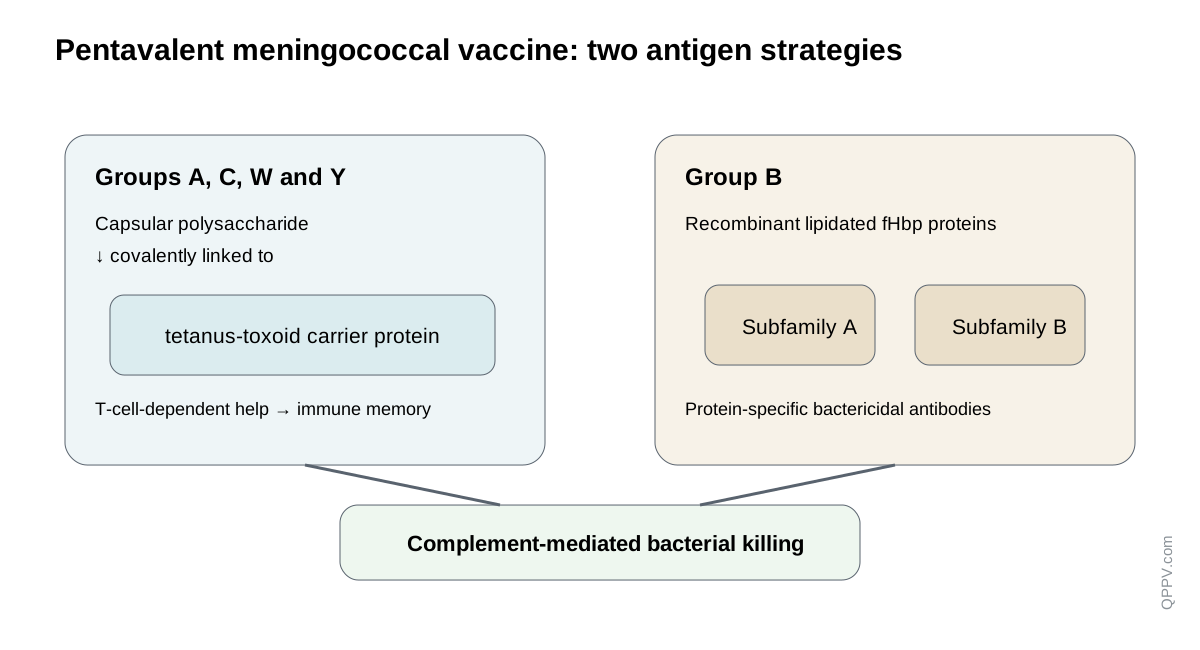
Figure 1. The pentavalent meningococcal vaccine combines A/C/W/Y polysaccharide–carrier conjugates with two recombinant group-B fHbp antigens, converging on bactericidal antibody protection.
Regulatory Context
Regulatory status must be described by jurisdiction. In the United States, the vaccine is licensed for active immunisation against invasive disease caused by groups A, B, C, W and Y in individuals 10 through 25 years of age.
The European Union granted a marketing authorisation in November 2024 for individuals 10 years and older, but that authorisation was withdrawn on 20 January 2025 at the marketing-authorisation holder's request for commercial reasons. EMA explicitly states that the withdrawal was commercial. It should therefore not be misrepresented as a safety-driven regulatory action.
This is a useful PV lesson: authorisation status and benefit-risk conclusions are related but not interchangeable concepts.
Immunological Endpoint
Protection is mediated primarily through functional bactericidal antibodies capable of killing meningococci in the presence of complement. Antibody quantity alone is therefore an incomplete description of immune function. The breadth of group-B protection also depends on whether circulating strains express fHbp variants that are recognised sufficiently by vaccine-induced antibodies.
Safety and Reactogenicity
Local pain, swelling and redness and systemic symptoms such as fatigue, headache and muscle pain are expected vaccine reactogenicity patterns. Their interpretation depends on timing, severity and duration. A short-lived injection-site reaction is not equivalent to bacterial cellulitis, and transient post-vaccination fever is not equivalent to invasive meningococcal disease.
Immediate allergic reactions require the same clinical precision used for other vaccines: onset, skin or mucosal involvement, respiratory compromise, hypotension, treatment and outcome. Syncope around adolescent vaccination should also be distinguished from anaphylaxis or neurological disease.
Schedule and Administration Errors
Combination vaccines reduce the number of injections needed to cover multiple antigens, but they create a different error problem: the vaccinator must know whether a prior dose contained MenACWY components, MenB components, or both. A history recorded only as "meningococcal vaccine" can be insufficient for reconstructing the intended series.
PV follow-up should therefore capture the exact previous vaccine product or antigen coverage, dates, current dose, age and reason for vaccination. Wrong interval, duplicate vaccination, missed component coverage and administration outside the locally authorised age range should be differentiated.
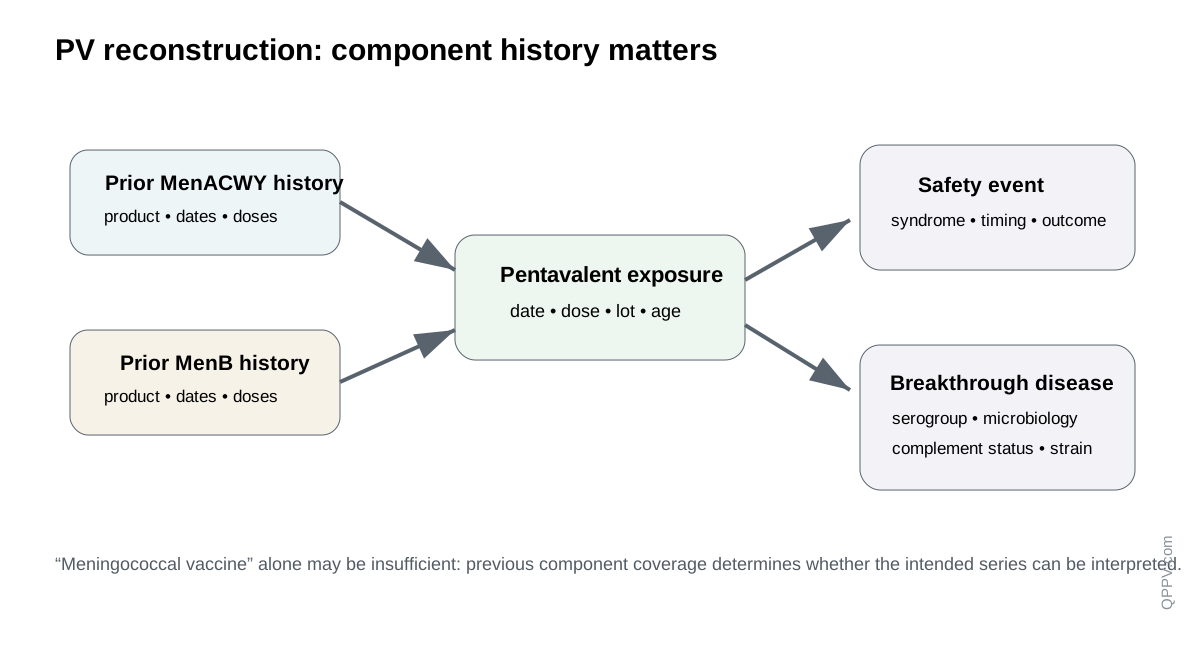
Figure 2. Pharmacovigilance should preserve prior MenACWY and MenB vaccination history separately, because the combined product contains both antigen systems and schedule errors may affect only one component of intended protection.
Breakthrough Invasive Meningococcal Disease
Invasive meningococcal disease after vaccination is medically important but does not automatically demonstrate product failure. Case evaluation should identify serogroup, clinical syndrome, culture or molecular confirmation, vaccination dates, completion of the recommended series, immune status and complement-modifying treatment.
For group B, additional strain information can be particularly informative because protection is based on protein-antigen recognition rather than capsule group alone. Where fHbp expression or variant information is unavailable, the report should say so rather than infer antigen mismatch.
Complement deficiency and complement inhibition
The complement system is essential for killing meningococci. People with terminal complement deficiency or those receiving terminal-complement inhibitors remain at increased meningococcal risk even when vaccinated. A post-vaccination case in such a patient therefore requires host-risk context and should not be interpreted as equivalent to disease in an immunocompetent vaccinee.
Pregnancy and Other Special Situations
Pregnancy exposure, immune suppression and co-administration with other vaccines require product-information-based assessment. Routine surveillance should separate maternal adverse events from pregnancy outcomes and neonatal outcomes. Evidence gaps should be described as such rather than converted into presumptive risk.
Product Quality and Traceability
As with other vaccines, lot and storage information become important when cases cluster by time or site or when reduced effectiveness is suspected. Cold-chain excursion, incorrect reconstitution or administration technique, where applicable to the presentation, should be evaluated as potential product-use or quality issues rather than automatically coded as adverse reactions.
Practical PV Data Set
A serious adverse-event report should preserve vaccine identity, date, dose in series, previous MenACWY and MenB vaccination, age, concomitant vaccines, relevant allergy history, lot and clinical course. A suspected lack-of-effect report additionally needs microbiological confirmation and host susceptibility factors.
Signal and effectiveness surveillance
Safety surveillance and effectiveness surveillance answer different questions. The former asks whether vaccination is associated with harmful outcomes; the latter asks whether vaccinated populations are protected against circulating disease. They can interact—for example, a cluster of invasive disease may prompt examination of storage, administration and antigenic match—but they should not be merged analytically.
Illustrative Failure Modes
These are hypothetical process examples, not reported inspection findings.
| Failure mode | Consequence | Control |
|---|---|---|
| Prior dose recorded only as "meningitis vaccine" | Series cannot be reconstructed | Record antigen/product history |
| Breakthrough disease lacks serogroup | Coverage cannot be interpreted | Seek microbiology result |
| EU withdrawal described as safety withdrawal | False regulatory conclusion | Record documented commercial reason |
| Complement inhibitor omitted from breakthrough case | Major host risk is hidden | Capture complement-modifying therapy |
| All post-vaccination fainting coded as anaphylaxis | Distorts safety profile | Reconstruct clinical syndrome and timing |
Inspection and Governance Considerations
A mature system should demonstrate that vaccine dictionaries distinguish multicomponent products from their component vaccines, that follow-up forms collect prior vaccination history, and that serious invasive-disease cases are routed for microbiological and effectiveness review where appropriate.
Regulatory intelligence should also prevent jurisdictional drift. A product can be actively licensed in one territory while no longer authorised in another. Global aggregate reports should state this accurately without implying that withdrawal in one region changes the scientific identity of exposure elsewhere.
Key Takeaways
The pentavalent vaccine is not simply "five serogroups in one vial." It combines conjugate-vaccine biology for A/C/W/Y with recombinant-protein vaccine biology for B. That structure explains both its immunology and its pharmacovigilance data needs.
High-quality PV preserves previous component vaccination, exact schedule, lot, host complement status and microbiological characterisation of breakthrough disease. Current U.S. use and historical EU authorisation must be distinguished explicitly.
References
- U.S. Food and Drug Administration. Meningococcal Groups A, B, C, W, and Y Vaccine: licensed product information and approval history.
- European Medicines Agency. Penbraya EPAR. Marketing authorisation issued 14 November 2024 and withdrawn 20 January 2025 for commercial reasons.
- European Medicines Agency. Public assessment report for meningococcal groups A, C, W, Y conjugate and group B vaccine (recombinant, adsorbed). EMA/464092/2024.
- European Medicines Agency. Summary of the risk management plan for the pentavalent meningococcal vaccine.
- U.S. Centers for Disease Control and Prevention. Meningococcal vaccination and meningococcal disease guidance, current version as applicable.
Regulatory Note
Marketing status, age indication, schedule and public-health recommendations are jurisdiction-specific and may change. The EU marketing authorisation discussed here is no longer valid; current U.S. prescribing information and applicable immunisation recommendations should be checked before use. A commercial withdrawal should not be described as evidence of a safety-related regulatory action.