Metformin: Discovery, Development, Safety and Pharmacovigilance
Metformin is an oral biguanide used principally to improve glycaemic control in type 2 diabetes. It reduces glucose without directly stimulating insulin secretion, so hypoglycaemia is uncommon with metformin alone. Its familiar place in prescribing can obscure a distinctive safety problem: exposure may become hazardous when renal function, tissue oxygenation or acute illness changes, even after years of otherwise uneventful treatment. Conversely, vitamin B12 deficiency can develop gradually and resemble diabetic neuropathy. [7–9,11]
The pharmacovigilance subject is the international nonproprietary name metformin, rather than one brand or fixed-dose combination. Product-specific regulatory requirements are identified by jurisdiction. The article follows the medicine from scientific discovery to clinical development, current safety controls and the evidence needed to assess individual cases.
- Metformin: Discovery, Development, Safety and Pharmacovigilance
- From guanidine chemistry to a diabetes medicine
- Development and commercial history
- Pharmacology: how therapeutic action relates to risk
- Pivotal evidence: from glucose lowering to clinical outcomes
- Regulatory framework and product-specific interpretation
- Renal function and changing benefit-risk
- Metformin-associated lactic acidosis
- Gastrointestinal tolerability, hypoglycaemia and drug interactions
- Vitamin B12 deficiency: a delayed and potentially overlooked effect
- Pregnancy, breastfeeding and other special populations
- Product quality, nitrosamine recalls and traceability
- Translating the safety profile into pharmacovigilance practice
- Key takeaways
- References
- Regulatory Note
From guanidine chemistry to a diabetes medicine
Metformin was not isolated directly from a herbal remedy. Its scientific lineage includes Galega officinalis (goat's rue), whose guanidine-related compounds helped stimulate research into glucose-lowering chemistry. Guanidine itself was too toxic for routine treatment. Dimethylbiguanide, subsequently named metformin, is a defined synthetic derivative belonging to the biguanide family. The botanical history explains a research direction, not the manufacturing origin of the marketed active substance. [1,2]
Guanidine derivatives and biguanides were investigated during the early twentieth century. The discovery of insulin and toxicity of some early compounds limited their development. Interest in metformin resurfaced through work on antimalarial and anti-influenza compounds in the 1940s. These observations provided a starting point for clinical investigation but were not a modern controlled diabetes programme. [1,2]
The French physician Jean Sterne investigated dimethylbiguanide with collaborators in the clinical and pharmaceutical setting associated with Aron Laboratories. He reported its use in diabetes in 1957 and proposed the name Glucophage. The early findings suggested glucose lowering without the same propensity for hypoglycaemia as insulin secretagogues. They did not establish the later cardiovascular evidence, modern renal-use thresholds or the safety of every subsequently studied population. [1,2]
Phenformin and buformin entered use during the same broad period, but lactic-acidosis concerns led to withdrawal or severe restriction of these related biguanides in many markets. Metformin's different pharmacokinetic and clinical profile helped it persist in Europe. The class experience nevertheless shaped continuing attention to renal elimination, hypoxic illness and lactate metabolism. [1]
Development and commercial history
Metformin's history spans different sponsors, territories and formulations. Early European development and marketing involved Aron and the pharmaceutical lineage later associated with Lipha. Its US introduction occurred much later: current US metformin labelling identifies 1995 as the year of initial US approval, with Glucophage marketed in that market by Bristol-Myers Squibb. That date is neither the molecule's invention nor its first worldwide clinical use. [1,8]
Generic immediate-release and modified-release formulations subsequently broadened access. Fixed-dose combinations introduced additional active substances, creating a new attribution problem: an adverse reaction may arise from metformin, its partner drug, a combination effect or a particular finished product. A manufacturing defect may affect one formulation or lot without implicating all metformin products. For case processing, the active substance, formulation, manufacturer, lot and country are therefore distinct pieces of evidence.
Pharmacology: how therapeutic action relates to risk
Metformin reduces hepatic glucose production and changes glucose handling in the intestine and other tissues. Its molecular action is not adequately described by a single mitochondrial-complex-I or AMP-activated protein kinase (AMPK) pathway. Experimental work implicates changes in cellular energy and redox signalling, AMPK-dependent and independent mechanisms, intestinal glucose handling, incretin responses and the microbiome. Their relative contributions at usual human exposures remain incompletely resolved. Proposed molecular effects should not be treated as established explanations for every clinical outcome. [7]
The drug is absorbed incompletely and is excreted largely unchanged through the kidneys, using both glomerular filtration and active tubular secretion. Reduced kidney function or interference with relevant transporters can increase exposure. This creates a direct pharmacokinetic link to metformin-associated lactic acidosis, particularly when acute illness simultaneously increases lactate production or impairs clearance. The mere presence of metformin in a patient with acidosis, however, does not prove that it caused the event. [8,9,16]
Gastrointestinal intolerance generally appears during initiation or dose escalation, whereas vitamin B12 deficiency may arise after prolonged exposure. These contrasting time courses explain why a metformin safety assessment needs more than an adverse-event term: dose changes, formulation, renal trajectory, co-medications, acute illness and duration of therapy can be decisive.
Pivotal evidence: from glucose lowering to clinical outcomes
UKPDS 34 and the meaning of long-term benefit
The United Kingdom Prospective Diabetes Study (UKPDS) helped establish metformin as more than a short-term glucose-lowering treatment. In UKPDS 34, 753 overweight participants with newly diagnosed type 2 diabetes were included in a randomised comparison of conventional management, primarily dietary treatment, against an intensive metformin policy. Median follow-up was 10.7 years. Compared with conventional management, metformin allocation was associated with relative reductions of 32% in any diabetes-related endpoint, 42% in diabetes-related death and 36% in all-cause mortality. These are results for the trial's selected population and treatment policies, not general effect estimates for all people taking metformin today. [3]
The trial also contained a more difficult finding. In a supplementary randomised comparison, adding metformin to maximal sulfonylurea treatment was associated with increased diabetes-related mortality compared with continuing sulfonylurea alone. Wider analyses in the same report did not establish a corresponding overall increase with combination treatment. A responsible lifecycle account must retain both findings and avoid converting an isolated comparison into a universal contraindication. [3]
Ten-year post-trial follow-up found that benefits associated with the original metformin assignment persisted, including reductions in myocardial infarction and all-cause mortality, despite early convergence of glycated haemoglobin between groups. This follow-up strengthened the historical case for early glycaemic treatment but was not a new randomised comparison of present-day multidrug regimens. The current US generic label separately states that conclusive macrovascular risk reduction has not been established for the labelled product. That labelling statement and the UKPDS findings address different evidentiary scopes and should not be silently conflated. [4,8]
Diabetes prevention: DPP and regulatory scope
The US Diabetes Prevention Program (DPP) randomised 3,234 high-risk adults without diabetes to placebo, metformin or intensive lifestyle intervention. Over an average 2.8 years, diabetes incidence was reduced by 31% with metformin and 58% with lifestyle intervention, each compared with placebo. These results support prevention or delay in a selected population; they do not establish that all people with mildly raised glucose should receive the drug. [5]
The American Diabetes Association's 2026 standards recommend considering metformin for prevention in selected high-risk adults, especially groups resembling DPP participants. This is a professional clinical recommendation, not itself a new US marketing authorisation for prevention. Where a product is used outside its approved indication, the indication, rationale and jurisdiction should be recorded rather than inferred from the molecule's widespread use. [17]
ADOPT and the limits of monotherapy
The ADOPT trial compared metformin, rosiglitazone and glyburide in recently diagnosed type 2 diabetes. Estimated five-year monotherapy failure was 21% with metformin, 15% with rosiglitazone and 34% with glyburide. These data show that glycaemic durability differs between treatments and that progressive disease often requires escalation. They do not make glycaemic durability interchangeable with cardiovascular outcomes, safety or present-day treatment preference. [6]
Metformin's long clinical evidence base therefore requires attention to trial design and context. A historical result in newly diagnosed, overweight patients is not a substitute for product-specific evidence in advanced chronic kidney disease, pregnancy or a new combination regimen. Similarly, a favourable glucose trajectory does not exclude a slowly developing nutritional adverse effect.
Regulatory framework and product-specific interpretation
Metformin is an established active substance authorised through multiple national and other regulatory routes. It is not governed by a single worldwide label. The UK Glucophage summary of product characteristics (SmPC) and a representative US metformin immediate-release label agree on core principles, including type 2 diabetes use and avoidance in severe renal impairment, but differ in some initiation, dose and pregnancy statements. A marketing authorisation holder must follow its applicable authorised product information, not a generic international summary. [8,9]
The US label describes metformin tablets as an adjunct to diet and exercise for adults and children aged ten years and older with type 2 diabetes. The UK Glucophage SmPC also describes use in children from age ten, with formulation-specific dose schedules. Both describe combination treatment, but the risk profile of the additional drug must be assessed separately. Neither the US indication statement nor a guideline recommendation should be stretched into an authorisation for cancer prevention, longevity or every form of diabetes prevention. [8,9,17]
Clinical recommendations, legally approved indications, pharmacovigilance obligations and local prescribing practices occupy different levels of authority. The article therefore uses labelled directions when describing product-specific contraindications and dosing, and explicitly labels broader monitoring proposals as recommended operational controls.
Renal function and changing benefit-risk
Metformin's renal restrictions illustrate how post-marketing evidence can reshape the use of an established medicine. In 2016, EMA concluded that selected patients with moderately reduced kidney function could receive metformin with adjusted doses and monitoring, while severe impairment remained a contraindication. The review called for continued analysis of lactic-acidosis cases in periodic safety reviews. [10]
The current UK Glucophage SmPC and representative US tablet label agree on the need to assess renal function, but differ in detailed initiation and dose recommendations. US labelling distinguishes starting therapy from reassessing patients already receiving it; the UK SmPC includes a renal-function-based maximum-dose table. Neither is a universal worldwide instruction. [8,9]
A pharmacovigilance review should preserve serial renal results, treatment duration, dose changes, acute illness and concomitant medicines. A stable chronic impairment and a rapidly evolving acute kidney injury are not equivalent exposure circumstances.
Interpreting renal thresholds across jurisdictions
A contraindication is different from a recommendation against initiating treatment or a requirement to reassess treatment already underway. The representative US immediate-release label advises against initiating metformin when eGFR is 30–45 mL/min/1.73 m², calls for reassessment if eGFR later falls below 45, and contraindicates treatment below 30. The UK Glucophage SmPC permits use at GFR 30–44 with a maximum daily dose of 1,000 mg, provided its risk-factor and initiation instructions are observed; below 30 it is contraindicated. [8,9]
Both labels require renal surveillance, but their dose schedules and precautions are product-specific. The US label specifies assessment before initiation and at least annually thereafter, with more frequent checks in patients at greater risk of deterioration. A measured eGFR cannot be interpreted safely without the treatment phase, formulation, jurisdiction and trajectory. [8,9]
Acute illness, surgery and contrast procedures
Stable chronic kidney disease and an acute fall in renal function are different safety situations. Dehydration, severe infection, shock, hypoxia and restricted food or fluid intake can alter metformin exposure and lactate handling rapidly. The UK SmPC advises temporary interruption during dehydration or acute illness that may impair renal function. The US label includes precautions for hypoxic states and periods of restricted food and fluids during procedures. These are authorised product-information precautions; they do not imply that every minor illness requires discontinuation. [8,9]
The cited US label specifies interruption at or before certain iodinated-contrast procedures, including selected patients with eGFR 30–60, a history of liver disease, alcoholism or heart failure, and those receiving intra-arterial contrast. It specifies renal reassessment after 48 hours before restarting if function is stable. Local imaging protocols may differ, so the actual product information and clinical circumstances must be checked. [8]
From a pharmacovigilance perspective, failure to apply a relevant precaution and acute kidney injury despite appropriate management are separate questions. The case record should establish what happened, what instructions applied and whether the sequence suggests a medication-use problem, a change in underlying illness or both.
Metformin-associated lactic acidosis
Metformin-associated lactic acidosis (MALA) is uncommon but potentially fatal. The US label carries a boxed warning describing potentially subtle symptoms, including malaise, muscle pain, breathing difficulty, somnolence and abdominal discomfort. A suspected event requires urgent clinical assessment; an adverse-event narrative should not equate any raised lactate concentration with metformin causation. [8]
Metformin is cleared through the kidneys, so impaired clearance may increase exposure. Sepsis, shock, hypoxia and hepatic dysfunction can independently cause lactic acidosis and may coexist with metformin accumulation. Observational evidence found an association with acidosis principally in severe renal impairment; such data do not override product contraindications or exclude confounding. [16]
Useful case evidence includes the treatment and dose timeline, serial kidney function, lactate and acid-base results, acute illness, interacting drugs, dechallenge, treatment and outcome. The question is whether metformin materially contributed to the syndrome, not whether it was the only possible cause.
Mechanistic interpretation and differential diagnosis
The term metformin-associated is intentionally broader than metformin-induced. In one pathway, declining filtration and tubular secretion permit drug accumulation; in another, severe infection, circulatory failure or impaired oxygen delivery increases lactate production or reduces its clearance. These pathways can coexist. A high lactate result alone is insufficient: clinicians evaluate the acid-base disturbance, renal and haemodynamic trajectory, other causes of high-anion-gap acidosis and the clinical setting. Where measured, a metformin concentration may support exposure assessment, but it is not a standalone proof of causation. [8,9,16]
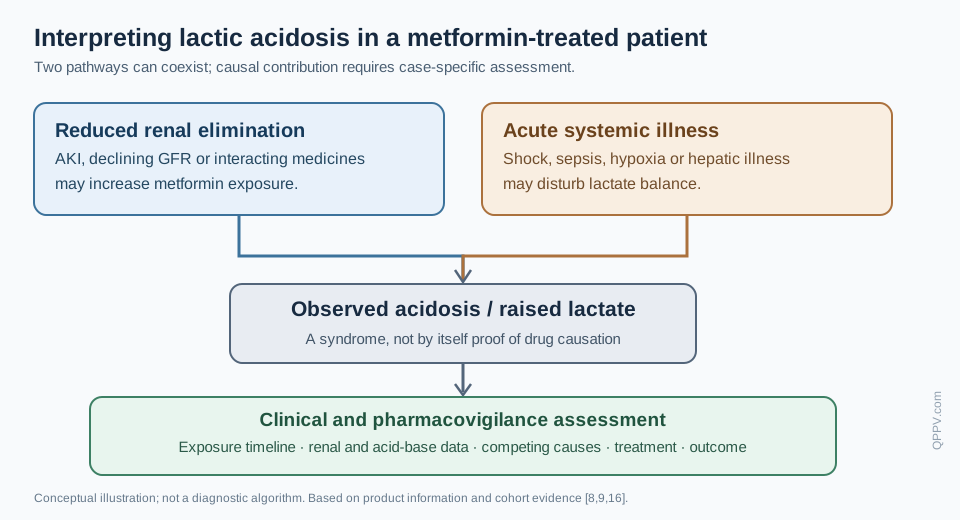
Figure 1. Reduced metformin elimination and acute systemic illness can converge in an acidotic presentation. The pathways may coexist, but a temporal and differential-diagnostic assessment is needed before attributing causation. This is a conceptual illustration, not a diagnostic algorithm. [8,9,16]
In a community-based cohort analysis by Lazarus and colleagues, metformin exposure was associated with hospitalisation for acidosis at eGFR below 30 mL/min/1.73 m² (adjusted hazard ratio 2.07; 95% confidence interval 1.33–3.22), but not clearly at eGFR 30–44 or 45–59. The outcome was hospitalisation with acidosis, not a laboratory-confirmed metformin-specific causal syndrome in every patient. Residual confounding and selection effects remain possible. This evidence helps explain regulatory reassessment; it does not license use below the contraindicated threshold. [16]
The US label describes urgent supportive treatment in hospital and recommends prompt haemodialysis for diagnosed or strongly suspected metformin-associated lactic acidosis. These are clinical-management directions from the cited product information; pharmacovigilance personnel should record the intervention and outcome, not attempt to adjudicate emergency treatment from a case form. [8]
Evidence needed for a defensible case assessment
A clinically meaningful case chronology starts before the admission: baseline kidney function, metformin dose and formulation, relevant co-medications, intercurrent illness and the date of the last administered dose. It then reconstructs the acute event using serial creatinine/eGFR, blood gas or bicarbonate, lactate, haemodynamic observations, infectious or ischaemic diagnoses, drug interruption and renal-replacement therapy where applicable. A recorded “renal failure” term without timing may conceal the key distinction between chronic disease, an acute precipitating factor and a consequence of shock.
The investigator should separate three judgements: whether the patient had lactic acidosis; whether metformin exposure could have contributed; and whether a preventable medication-use or monitoring failure occurred. These questions are related but not interchangeable. Seriousness and reportability are assessed under the applicable regional ICSR framework, while the medical evaluation records competing explanations and uncertainty. [8,15]
Gastrointestinal tolerability, hypoglycaemia and drug interactions
The commonest adverse effects of metformin are gastrointestinal: diarrhoea, nausea, abdominal discomfort, flatulence and reduced appetite. They often occur when treatment begins or the dose increases, and may lessen with slower titration or a formulation change. The frequency estimates in a particular US clinical trial should not be applied to every generic, dose or combination. A patient who stops treatment because of persistent diarrhoea has a different benefit-risk problem from a patient with mild, transient symptoms who remains adherent. [8,9]
For pharmacovigilance, the timeline should capture formulation (immediate- or modified-release), dose, meals, concomitant gastrointestinal medicines and competing causes such as infection. A change to an extended-release formulation can improve tolerability for some patients, but it does not abolish the need to review the relevant label, renal function or product identity. Modified-release tablets should be used according to their own administration instructions, rather than assumed interchangeable in tablet handling or dose. [8,9]
Metformin does not ordinarily cause clinically important hypoglycaemia when used alone because it does not directly stimulate insulin secretion. Hypoglycaemia becomes more plausible when insulin or a sulfonylurea is also prescribed, during inadequate nutritional intake or when another illness changes glucose requirements. The attribution should identify all active substances and the timing of each dose rather than coding the event automatically as a metformin monotherapy reaction. [8,9]
Drug interactions can change the risk without producing an immediate, recognisable symptom. The US label identifies drugs that reduce metformin clearance, including cimetidine and certain other transporter-interacting medicines, and carbonic anhydrase inhibitors that may increase acidosis risk. Excessive alcohol intake can affect lactate metabolism. These are risk factors to investigate, not proof that every exposed patient will experience lactic acidosis. For a fixed-dose combination, each constituent has its own interaction and contraindication profile. [8]
Vitamin B12 deficiency: a delayed and potentially overlooked effect
Vitamin B12 deficiency illustrates a different temporal pattern from gastrointestinal intolerance. The adverse effect may emerge after prolonged treatment and can present with anaemia, neuropathy or non-specific fatigue. These findings overlap with complications of diabetes and with other nutritional or haematological disorders. If the case is labelled simply as “diabetic neuropathy,” a potentially treatable drug-associated contributor may be missed. [11,14]
A placebo-controlled trial by de Jager and colleagues studied 390 insulin-treated adults with type 2 diabetes over approximately 4.3 years. Adding metformin was associated with a greater decline in vitamin B12 concentration and an approximately seven-percentage-point higher absolute risk of biochemical deficiency than placebo. The study supports a causal effect on B12 status in that population; it does not imply that every patient with neuropathy taking metformin has B12 deficiency. [14]
In June 2022, the UK MHRA strengthened advice on this recognised adverse reaction, describing reduced vitamin B12 levels or deficiency as a common adverse effect and identifying higher dose, longer duration and pre-existing risk factors as relevant. It advises testing when deficiency is suspected, including in new-onset neuropathy or megaloblastic anaemia, and considering periodic monitoring in patients with risk factors. Relevant risk factors include malabsorption, restricted dietary B12 intake and some concomitant medicines. [11]
The cited US tablet label describes annual haematological measurements and vitamin B12 testing at two- to three-year intervals, with management of abnormalities. The 2026 ADA Standards separately recommend considering periodic B12 assessment, especially in long-term users with anaemia or peripheral neuropathy. These are distinct sources of authority and should not be merged into a supposed single international testing rule. [8,17]
When deficiency is detected, management follows the patient's clinical condition and local recommendations. MHRA advises correcting B12 deficiency while continuing metformin if tolerated and not contraindicated. The safety case should capture diagnostic findings, alternative causes, supplementation, neurological outcome and any treatment change. Absence of improvement after a short interval does not necessarily exclude a contribution from a longstanding nutritional deficit. [11]
Clinical interpretation in longitudinal surveillance
The contrast between early gastrointestinal intolerance and delayed B12 deficiency has a governance consequence. A safety database concentrating on acute serious events may overlook cumulative tolerability problems, treatment discontinuation and nutritional complications. Conversely, periodic monitoring programmes should not turn every abnormal laboratory value into a drug reaction without considering clinical context and competing explanations.
An experienced reviewer asks whether the safety profile remains reflected in current product information, whether patients and clinicians can recognise symptoms, and whether new case patterns indicate a change in frequency, severity, risk factors or preventability. Those are signal-evaluation questions; a single case does not establish a population-level risk change. [11,15]
Pregnancy, breastfeeding and other special populations
Metformin's reproductive safety illustrates why an older drug may undergo important label evolution long after initial authorisation. Untreated hyperglycaemia around conception and during pregnancy itself carries substantial maternal and fetal risks. Assessing metformin exposure therefore requires an appropriate comparison group and attention to the indication, disease severity, concomitant treatment and glycaemic control; an adverse pregnancy outcome cannot be attributed to metformin merely because the drug was taken. [12]
Following review of register-based pregnancy evidence, MHRA announced in March 2022 that UK metformin product information would reflect the possibility of use during pregnancy and the periconceptional period, as an addition or alternative to insulin when clinically needed. The current UK Glucophage SmPC states that available human data have not identified an increased risk of congenital abnormalities or feto-neonatal toxicity and that metformin may be considered when clinically needed. It also acknowledges uncertainty concerning longer-term offspring outcomes. This is a product-specific UK position, not a blanket endorsement of every metformin-containing combination or a claim of proven long-term developmental neutrality. [9,12]
The representative US immediate-release label addresses pregnancy through a risk-summary framework and recognises the risks of poorly controlled diabetes. Its wording should be consulted directly for US prescribing and safety communication; UK authorisation language must not be copied into a US safety document as if it were the FDA's own conclusion. [8]
A pregnancy safety report should capture timing relative to conception, trimester, indication (pre-existing diabetes, gestational diabetes or another condition), dose, glycaemic measures where available, maternal comorbidities, other antidiabetic agents, fetal assessments, delivery and neonatal outcomes. Follow-up may be needed to understand the event, but the limits of ascertainment and potential confounding should be recorded. These are recommended case-quality practices, not a new metformin-specific legal reporting deadline.
Metformin enters breast milk. The cited UK SmPC does not recommend breastfeeding during treatment because available infant data are limited, despite no observed adverse effects in the reported breastfed newborns or infants. A different product's lactation wording may not be identical. Decisions require the applicable label and clinical context rather than an inference from pregnancy findings. [9]
In children aged ten years and older, the cited immediate-release US label and UK Glucophage SmPC contain type 2 diabetes indications with paediatric dosing instructions. Older patients may have changing renal function and comorbidity, requiring closer surveillance. For any age group, an event associated with insulin or a sulfonylurea combination must be evaluated across all relevant drugs. [8,9]
Product quality, nitrosamine recalls and traceability
A separate strand of metformin's post-marketing history concerns the quality of the finished product rather than the intrinsic pharmacology of the active substance. In 2020 and early 2021, the US FDA announced multiple voluntary recalls of certain extended-release metformin products after detection of N-nitrosodimethylamine (NDMA) above acceptable intake limits. The actions concerned specified manufacturers and lots. FDA reported that its testing had not shown the same NDMA findings in immediate-release metformin products at the time. This is a historical statement about the agency's testing, not a permanent assurance about every future lot. [13]
NDMA is a probable human carcinogen based on laboratory evidence; the impurity issue is therefore a potential risk from long-term exposure, not evidence that a particular patient's cancer was caused by metformin. Nor does a recall establish a new intrinsic adverse reaction to metformin. FDA advised patients not to discontinue diabetes treatment without arranging replacement or clinical advice, recognising the immediate harm that uncontrolled hyperglycaemia could cause. [13]
Quality and pharmacovigilance systems intersect when a suspected adverse reaction may be associated with a defective product. Case intake should preserve brand, strength, release formulation, manufacturer, lot, expiry, country and dispensing details when available, and communicate a suspected defect to the appropriate quality function. The investigation must distinguish the product-quality signal from any adverse reaction and follow the applicable regulatory notification pathways for each. GVP Module VI addresses suspected adverse reactions associated with quality defects; it does not make a quality complaint without a suspected reaction automatically a valid ICSR. [15]
The broader commercial history reinforces this distinction. Metformin is marketed by many manufacturers and as a component of numerous combinations. A safety action against one formulation, manufacturing site or lot must not be represented as a global withdrawal of the active substance. Conversely, a substance-level signal may require evaluation across products even when one marketing authorisation holder first identifies it.
Translating the safety profile into pharmacovigilance practice
The product's long history does not reduce the need for systematic safety surveillance. Rather, it makes the principal risks easier to misclassify: lactic acidosis can arise during acute multisystem illness; vitamin B12 deficiency may be attributed to diabetes; pregnancy outcomes require a comparator-aware interpretation; and nitrosamine recalls concern specified products and lots. A pharmacovigilance system should preserve the distinctions between the clinical syndrome, suspected causal contribution, product identity and regulatory action. [8–16]
Case intake, clinical evaluation and follow-up
For a suspected lactic-acidosis case, medical review reconstructs renal and haemodynamic status before and during the event, relevant metformin exposure, competing causes, treatment and outcome. For neuropathy or anaemia, it establishes B12 results and alternative explanations. For pregnancy exposure, it records timing and outcomes without assuming causation. For a quality-related report, it identifies the exact formulation and lot and routes quality evidence to the appropriate function. These examples describe information needed for robust evaluation, not additional validity criteria beyond those applicable to an ICSR. [15]
In the EU, the relevant binding reporting obligations arise from pharmacovigilance legislation; GVP Module VI provides operational guidance on collecting, validating, following up and submitting suspected adverse-reaction reports. GVP Modules I, VII and IX address system quality, periodic evaluation and signal management. The applicable reporting rules depend on the event, source, region and product; an illustrative metformin scenario does not create its own submission timeline. [15]
Aggregate evaluation and governance
At aggregate level, reviewers should look for changes in clinical severity, preventability, exposure circumstances and affected populations. For example, a cluster of acidosis reports following acute dehydration might prompt review of patient information and interruption advice; an increase in B12-deficiency reports might reflect improved testing rather than a true change in incidence. Spontaneous-report counts cannot establish rates without an appropriate exposure denominator and assessment of reporting bias.
The marketing authorisation holder should be able to show how it keeps product information current, detects and evaluates safety information, reconciles relevant medical and quality data, documents decisions, and follows through on any agreed regulatory or risk-minimisation action. The QPPV's oversight concerns the functioning and adequacy of that system; it does not imply personal medical adjudication of every case. These are system-level governance considerations derived from the EU framework, not a claim that a specific metformin-only process is legally mandated. [15]
Illustrative inspection questions
An inspector could select a reported acidosis case and trace the first receipt, seriousness assessment, medical follow-up, source laboratory evidence, product identification and final submission record. A second trace might follow a suspected B12-deficiency signal from case coding through periodic evaluation and any product-information decision. A quality-linked case could be checked for communication between pharmacovigilance and quality assurance, including whether the affected lot was identified.
These are hypothetical inspection questions, not documented inspection findings. The evidence of effectiveness is a reconstructable chain from information received to assessment, decision, action and verification—not the existence of a procedure alone.
For the general handling of coded suspected reactions, see MedDRA coding in pharmacovigilance. For the interface between safety, quality and other information sources, see pharmacovigilance reconciliation. These are process references, not metformin-specific regulatory requirements.
Key takeaways
Metformin's benefit-risk profile cannot be understood from its age or widespread use alone. Historical outcome trials, later renal reassessment, the recognition of B12 deficiency, evolving pregnancy information and product-specific nitrosamine recalls answer different questions. Current use must be judged against the authorised product information for the relevant jurisdiction and formulation. In pharmacovigilance, the essential discipline is to reconstruct exposure and clinical context, preserve uncertainty and keep substance-level safety evaluation distinct from formulation- or lot-specific quality action.
References
- Bailey CJ. Metformin: historical overview. Diabetologia. 2017;60:1566–1576. DOI: 10.1007/s00125-017-4318-z.
- Bailey CJ, Day C. Metformin: its botanical background. Practical Diabetes International. 2004;21:115–117. DOI: 10.1002/pdi.606.
- UK Prospective Diabetes Study (UKPDS) Group. Effect of intensive blood-glucose control with metformin on complications in overweight patients with type 2 diabetes (UKPDS 34). Lancet. 1998;352:854–865. DOI: 10.1016/S0140-6736(98)07037-8.
- Holman RR, Paul SK, Bethel MA, Matthews DR, Neil HAW. 10-year follow-up of intensive glucose control in type 2 diabetes. N Engl J Med. 2008;359:1577–1589. DOI: 10.1056/NEJMoa0806470.
- Diabetes Prevention Program Research Group. Reduction in the incidence of type 2 diabetes with lifestyle intervention or metformin. N Engl J Med. 2002;346:393–403. DOI: 10.1056/NEJMoa012512.
- Kahn SE et al. Glycemic durability of rosiglitazone, metformin, or glyburide monotherapy. N Engl J Med. 2006;355:2427–2443. DOI: 10.1056/NEJMoa066224.
- Rena G, Hardie DG, Pearson ER. The mechanisms of action of metformin. Diabetologia. 2017;60:1577–1585. DOI: 10.1007/s00125-017-4342-z.
- DailyMed/National Library of Medicine. Metformin hydrochloride immediate-release tablets, representative US prescribing information, set ID f39ee08d-73db-71b9-e053-2995a90a877c. Current label. Accessed 20 October 2026; verify the specific marketed product's latest version before application.
- Merck Serono Ltd. Glucophage 500 mg film-coated tablets: UK Summary of Product Characteristics. emc product 987. Accessed 20 October 2026.
- European Medicines Agency. Use of metformin to treat diabetes now expanded to patients with moderately reduced kidney function. 14 October 2016. EMA review.
- Medicines and Healthcare products Regulatory Agency. Metformin and reduced vitamin B12 levels: new advice for monitoring patients at risk. Drug Safety Update, 20 June 2022. MHRA notice.
- Medicines and Healthcare products Regulatory Agency. Metformin in pregnancy: study shows no safety concerns. Drug Safety Update, 15 March 2022. MHRA notice.
- US Food and Drug Administration. FDA updates and press announcements on NDMA in metformin. 2020–2021 recall communications. FDA archive.
- de Jager J et al. Long term treatment with metformin in patients with type 2 diabetes and risk of vitamin B-12 deficiency: randomised placebo controlled trial. BMJ. 2010;340:c2181. DOI: 10.1136/bmj.c2181.
- European Medicines Agency. Good pharmacovigilance practices (GVP), particularly Modules I, VI, VII and IX; consult current adopted revisions and relevant EU legislation. EMA GVP collection.
- Lazarus B et al. Association of metformin use with risk of lactic acidosis across the range of kidney function: a community-based cohort study. JAMA Intern Med. 2018;178:903–910. DOI: 10.1001/jamainternmed.2018.0292.
- American Diabetes Association Professional Practice Committee. 3. Prevention or Delay of Diabetes and Associated Comorbidities: Standards of Care in Diabetes—2026. Diabetes Care. 2026. DOI: 10.2337/dc26-s003.
Regulatory Note
This article distinguishes scientific and historical evidence, current product-specific authorised information, regulator safety communications, GVP guidance and recommended pharmacovigilance practice. It is not a substitute for the current SmPC or prescribing information of a specific product or for clinical judgement. US and UK directions may differ; verify the applicable local authorisation, formulation, date and clinical circumstances before relying on a numerical threshold or monitoring recommendation. Information reviewed through 20 October 2026.