MHRA Beyond ADMET: AI for Medicines Safety and the Regulatory Sandbox
In June 2026, the UK Medicines and Healthcare products Regulatory Agency (MHRA) announced a regulatory sandbox intended to explore how artificial intelligence could improve the prediction and assessment of medicines safety. By September, the programme had acquired a more specific name and scope: Beyond ADMET: AI for Medicines Safety. The MHRA's call for evidence describes an initiative concerned with AI-based approaches to absorption, distribution, metabolism, excretion and toxicity (ADMET), but deliberately extends the concept beyond conventional preclinical prediction by considering integration of preclinical, clinical and real-world data. [1,2]
For pharmacovigilance professionals, the significance is not that the MHRA has approved AI as a new safety-assessment method. It has not. The significance is that a regulator is creating a structured environment in which developers, researchers and regulators can examine what evidence would be needed before AI-derived predictions could become credible inputs to medicines-development or regulatory decisions. The programme therefore sits upstream of many conventional post-authorisation pharmacovigilance activities, while potentially affecting the evidence base that later informs safety specifications, risk-management plans, labelling, post-authorisation studies and benefit-risk assessment.
The distinction between exploring regulatory acceptability and establishing regulatory acceptance is central to understanding the programme. The September 2026 MHRA material explicitly describes AI-based ADMET tools as being at an early stage of regulatory readiness and identifies unresolved questions around model performance, evidential requirements, data quality, access, sharing and validation. [2,3]
- MHRA Beyond ADMET: AI for Medicines Safety and the Regulatory Sandbox
- Purpose and Scope
- Why Move Beyond Conventional ADMET?
- Regulatory Status: Sandbox, Not New Rule
- How the Sandbox Is Expected to Work
- The Evidence Chain for an AI Safety Model
- 1. What decision is the model intended to support?
- 2. Are the data fit for that purpose?
- 3. Was model development separated from model evaluation?
- 4. Does the validation measure the clinically relevant failure modes?
- 5. Can the output be interpreted in the evidentiary context?
- 6. What happens when the model or its environment changes?
- Real-World Data: Opportunity and Constraint
- Underrepresented Populations and Fairness
- Relationship to Pharmacovigilance
- Relationship to AI Used Inside PV Operations
- Practical Governance for Organisations Exploring Similar Methods
- Potential Failure Modes
- Inspection and Audit Considerations
- What the Sandbox Could Change
- Key Takeaways
- References
- Regulatory Note
Purpose and Scope
A regulatory sandbox is a supervised environment in which a regulator and innovators can examine a new technology or method before the rules, evidence expectations or regulatory pathways are fully settled. The MHRA described the medicines-safety sandbox in June 2026 as a regulator-monitored environment for generating robust evidence. Its initial announcement envisaged testing up to five AI-driven approaches and working with industry and academic partners to shape the programme. [1]
The September call for evidence provides a clearer scientific frame. The programme is concerned with AI methods that may improve safety evaluation by combining traditional preclinical evidence with clinical and real-world data. The intended opportunity is broader than predicting a conventional ADMET endpoint from chemical structure. AI could potentially model interactions among biological characteristics, disease states, clinical conditions and heterogeneous patient populations that are difficult to represent in conventional experimental systems. [2,3]
This creates several possible uses across the development lifecycle. An AI method might help prioritise compounds before first-in-human exposure, predict pharmacokinetic behaviour, identify a toxicity hypothesis, model variation in susceptibility between populations, integrate multiple evidence streams, or help investigate an adverse effect that emerges later. These are possible applications, not currently established MHRA-endorsed uses.
The programme should also be distinguished from AI used to operate a pharmacovigilance system. A model that predicts hepatotoxicity from integrated development data poses a different regulatory-science question from a language model that extracts adverse events from incoming case reports. The former concerns whether an AI-derived scientific result is sufficiently reliable and relevant to become regulatory evidence; the latter concerns whether an AI-supported operational process can perform an existing PV obligation under appropriate quality controls.
That distinction makes Beyond ADMET complementary to, rather than a replacement for, broader AI-governance frameworks such as the CIOMS Working Group XIV principles for artificial intelligence in pharmacovigilance.
Why Move Beyond Conventional ADMET?
ADMET is a useful organising concept because many medicines fail or acquire restrictions when their disposition or toxic effects differ from what earlier models predicted. Traditional safety evaluation combines laboratory assays, animal and non-animal models, pharmacology, toxicology, pharmacokinetics, clinical trials and, after authorisation, evidence from routine use. Each source has strengths and limitations.
The challenge is not simply lack of data. Safety evidence is distributed across different scales and contexts. Molecular and cellular findings may not translate directly to clinical outcomes. Clinical trials are designed to answer specific questions in selected populations and may be too small or too short to characterise uncommon, delayed or population-specific harms. Post-authorisation data provide broader exposure but introduce confounding, missingness, selection effects and variable data quality.
AI is attractive because computational methods can, in principle, learn relationships across large and heterogeneous datasets. The MHRA specifically highlights the potential to combine preclinical, clinical and real-world data and to improve understanding across populations, disease states and clinical conditions. Its June announcement also emphasised groups often underrepresented in studies, including children, older people and people from diverse backgrounds. [1–3]
The scientific opportunity, however, does not remove the evidentiary problem. A model can generate a precise numerical prediction without generating trustworthy evidence. Its usefulness depends on the fitness of the input data, the definition of the outcome, the intended context of use, the validation population, the possibility of data leakage, the stability of performance and the clinical consequences of error.
For regulators, therefore, the central question is not whether an AI model is technically sophisticated. It is whether the model can produce evidence of sufficient validity, relevance and reliability for a defined regulatory purpose.
Regulatory Status: Sandbox, Not New Rule
The June 2026 announcement and September call for evidence are regulatory-science initiatives. They do not themselves amend UK medicines legislation, create a new pharmacovigilance reporting obligation or establish that an AI output may replace an existing evidence requirement.
This distinction should remain visible in organisational governance. Participation in a sandbox, use of a similar AI method, or publication of promising model performance does not confer regulatory qualification. Likewise, a regulator's willingness to explore a method should not be represented internally as acceptance of that method for a marketing-authorisation application, safety variation or post-authorisation regulatory decision.
As of October 2026, the programme is still being shaped. The MHRA is collecting information from organisations involved in toxicology, preclinical and clinical research, life sciences, biotechnology and AI. The call for evidence remains open until 22 December 2026 and is intended to inform the sandbox's development, future workshops and regulatory work. [2]
A useful way to interpret the current position is:
| Question | Current position |
|---|---|
| Has MHRA announced a medicines-safety AI sandbox? | Yes. It was announced on 9 June 2026. [1] |
| Does it now have a defined programme identity? | Yes: Beyond ADMET: AI for Medicines Safety. [2,3] |
| Is MHRA exploring integration of preclinical, clinical and real-world data? | Yes. [2,3] |
| Are AI-based ADMET methods already generally accepted regulatory evidence? | No such general acceptance is established by the sandbox announcements. |
| Has the sandbox created new statutory PV obligations? | No new PV obligation is created by the announcement or call for evidence. |
| Is the evidence framework final? | No. The programme is explicitly intended to identify evidence gaps and regulatory needs. [2,3] |
This status is important because it determines how pharmacovigilance and regulatory teams should describe the programme: as prospective regulatory science, not as a completed regulatory standard.
How the Sandbox Is Expected to Work
The September 2026 programme description indicates that Beyond ADMET will use iterative workshops as a structured regulatory environment in which developers can test, demonstrate and refine AI-based predictive tools intended for drug development and regulatory submissions. The purpose is to build foundational knowledge, identify evidence gaps and regulatory needs, and establish principles for judging regulatory acceptability. [3]
That model is different from a conventional clinical trial or a formal qualification procedure. The sandbox can expose assumptions that would otherwise remain hidden until a late regulatory interaction. For example, a developer may describe a model as predicting “drug-induced liver injury,” while a regulator may need to know whether the model predicts biochemical liver-test abnormalities, Hy's law cases, clinically adjudicated DILI, a mechanistic precursor, or a composite endpoint. Clarifying the context of use changes what constitutes appropriate training and validation evidence.
The same reasoning applies to population claims. A model cannot be assumed to perform well in children, older adults or people with comorbidities simply because those groups are represented somewhere in a large training dataset. The relevant questions include how many informative examples are present, whether outcome ascertainment differs, whether missing data are systematic, whether treatment patterns differ, and whether performance has been evaluated separately in the population in which the claim is made.
A productive sandbox therefore tests more than model accuracy. It tests the evidence argument connecting the model, data and intended regulatory use.
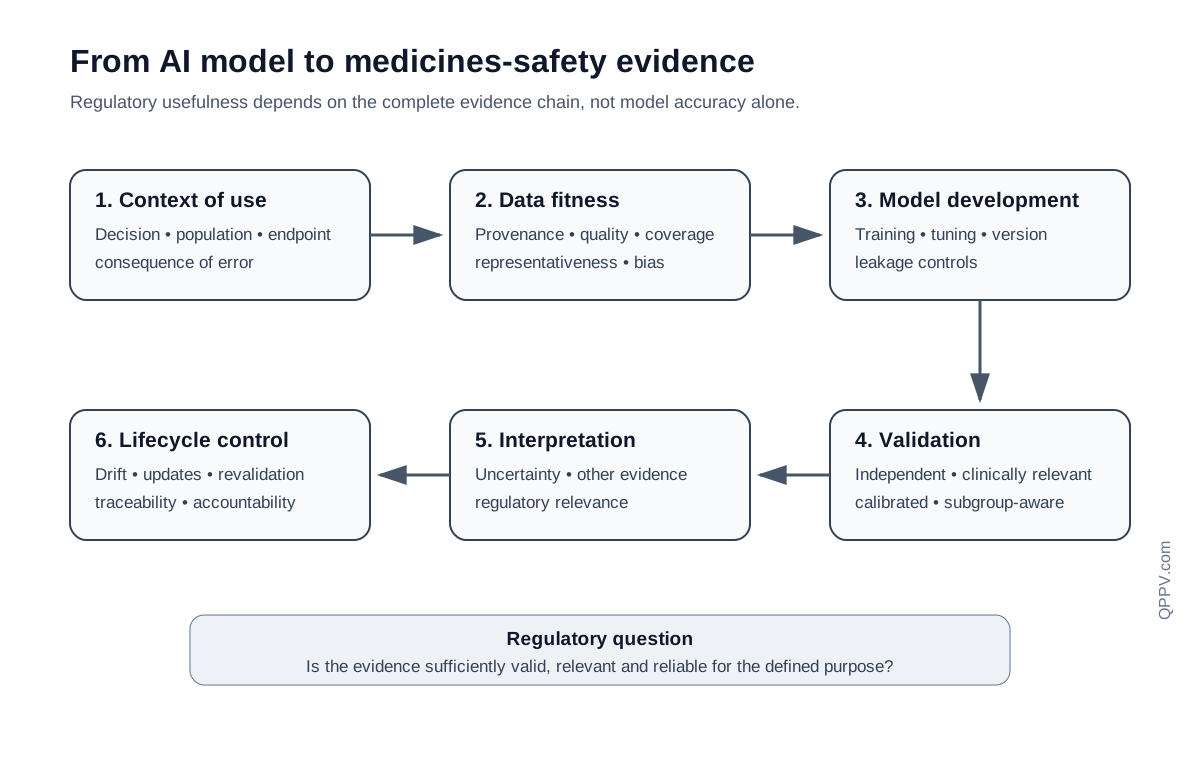
Figure 1. Beyond ADMET should be understood as an evidence-development pathway. A technically functioning model is only one component; regulatory usefulness depends on a defined context of use, fit-for-purpose data, appropriate validation, interpretable limitations and controls for change over time.
The Evidence Chain for an AI Safety Model
A pharmacovigilance professional evaluating AI-derived safety evidence can usefully separate the evidence chain into six linked questions.
1. What decision is the model intended to support?
The intended use should specify the stage of development, target population, endpoint and consequence of the output. “Predict toxicity” is not sufficiently specific. A model used to prioritise compounds for additional laboratory testing has a different consequence of error from one proposed to support omission of an established study or to influence a regulatory safety conclusion.
The acceptable balance between sensitivity and specificity may also differ. Missing a rare severe toxicity may be more consequential than generating additional false-positive hypotheses in an early screening context. Performance should therefore be judged against the intended decision rather than a generic benchmark.
2. Are the data fit for that purpose?
Data quantity alone is insufficient. Provenance, completeness, measurement quality, representativeness and linkage accuracy matter. Preclinical datasets may encode assay-specific effects. Clinical-trial data may reflect eligibility restrictions and protocol-driven ascertainment. Real-world datasets may contain coding variation, incomplete adherence information, missing laboratory values and confounding by indication.
The MHRA's September call explicitly identifies data quality, accessibility and cross-sector data sharing as unresolved issues. [2,3] For PV professionals, this connects directly with familiar principles from pharmacoepidemiology: a larger dataset does not automatically eliminate bias.
3. Was model development separated from model evaluation?
A model can appear highly accurate when evaluated on data that are not genuinely independent from its training process. Leakage can occur through duplicated patients, temporally overlapping records, derived variables, repeated measurements or model selection performed against the eventual test set.
External validation is particularly important when the intended use extends across institutions, healthcare systems or populations. Temporal validation may be necessary where treatment practices and coding systems change. Subgroup performance matters when the claimed benefit includes populations underrepresented in conventional development.
4. Does the validation measure the clinically relevant failure modes?
A single global performance metric can conceal clinically important weaknesses. Sensitivity, specificity, calibration, positive and negative predictive values, error distributions and subgroup performance may each be relevant depending on the task.
Calibration is especially important when a model's probability is used as evidence of risk. A model that ranks patients correctly but systematically overestimates absolute risk may still mislead a regulatory or clinical decision.
The validation dataset must also contain enough informative examples of the relevant safety outcome. Apparent performance for a rare event can be unstable when only a small number of true cases are available.
5. Can the output be interpreted in the evidentiary context?
Explainability is not a single technical property. A regulator may need to understand data provenance, model inputs, transformations, version, intended use, known limitations and the basis for a particular output. A mechanistic explanation may be useful but is not always necessary; conversely, a visually appealing explanation does not prove that the model is valid.
For pharmacovigilance, interpretability also means that AI-derived findings can be related to other evidence. A predicted association should be examined alongside clinical chronology, biological plausibility, trial data, spontaneous reports, epidemiology and alternative explanations rather than being treated as a self-validating signal.
6. What happens when the model or its environment changes?
AI performance can change without an obvious software failure. Source data can drift, clinical practice can change, new medicines can enter use, coding systems can be updated, or a model can itself be retrained.
A regulatory evidence framework therefore needs version control and lifecycle monitoring. If the evidence supporting version 1 is used to justify version 3 after substantial retraining, the organisation needs a defensible argument that the validation remains applicable or must generate new evidence.
These six questions form a continuous chain. Weakness in one link can invalidate confidence generated elsewhere. Excellent discrimination cannot rescue an inappropriate endpoint; representative data cannot rescue a poorly specified intended use; and strong initial validation cannot guarantee continued performance after material change.
Real-World Data: Opportunity and Constraint
The inclusion of real-world data is one of the most consequential features of the Beyond ADMET concept. It potentially allows predictive models to learn from the heterogeneity that is deliberately reduced in many pre-authorisation trials. The MHRA specifically identifies variability across populations, disease states and clinical conditions as an area in which integrated data may improve safety understanding. [2,3]
For pharmacovigilance, this creates a bridge between development safety and post-authorisation evidence. A model could potentially be updated or tested against routine clinical experience, helping investigators examine whether an early mechanistic or preclinical concern manifests in practice or whether susceptibility differs between groups.
But real-world data are observations, not automatically ground truth. Diagnosis codes can be proxies. Laboratory monitoring can be influenced by clinical suspicion. Patients receiving a medicine may differ systematically from those receiving alternatives. Exposure may be incompletely captured. Healthcare utilisation affects whether outcomes are recorded.
The appropriate response is not to reject RWD, but to make its limitations part of the model's evidence package. Dataset fitness should be assessed for the specific question. Outcome definitions should be validated where necessary. Confounding and selection processes should be considered. Missingness should be characterised rather than silently imputed without justification.
Where AI combines multiple data types, provenance becomes more—not less—important. A model that integrates chemistry, omics, trial data and healthcare records may discover useful patterns, but investigators need to know which sources drive performance and whether the same information will exist in the intended deployment setting.
Underrepresented Populations and Fairness
The June announcement explicitly links the programme to better understanding of medicines across groups often underrepresented in studies, including children, older people and people from diverse backgrounds. [1] This is scientifically important because safety risk is not uniform across populations.
An AI model can potentially improve representation by using data that extend beyond conventional trial populations. It can also reproduce or amplify existing data inequalities. A group may be numerically present but poorly measured. Historical differences in access to care, diagnostic practice or laboratory monitoring can become encoded as predictive features. A model may perform well overall while performing poorly in a smaller subgroup.
Accordingly, claims about broader representation require empirical evaluation. Relevant questions include whether subgroup labels are reliable, whether sample size supports meaningful performance estimates, whether calibration differs, whether the endpoint is measured consistently, and whether errors have different clinical consequences between groups.
This is where regulatory science and pharmacovigilance converge. Both disciplines are concerned not only with average performance but with identifying who may be harmed when an assumption fails.
Relationship to Pharmacovigilance
Beyond ADMET is primarily a medicines-development and regulatory-science programme, not a new post-marketing reporting system. Nevertheless, its outputs could affect pharmacovigilance at several points.
First, AI-derived evidence generated during development could contribute to hypotheses about important identified or potential risks. Those hypotheses may influence what is monitored in trials, what is described in regulatory submissions and what receives particular attention after authorisation.
Second, post-authorisation data may become part of model development or validation. This creates interfaces with spontaneous reports, observational databases, registries, electronic health records and other real-world sources. Each source was created for a particular purpose and has limitations that must be preserved when data are transformed into model inputs.
Third, AI predictions could eventually contribute to safety evaluation. If that occurs, they should be integrated into established evidence-assessment processes rather than creating an untraceable parallel channel. The model version, input data, output, interpretation, reviewer and downstream decision should be reconstructable when the output materially contributes to a regulatory safety conclusion.
Fourth, model-generated hypotheses can themselves create workload. A highly sensitive system may identify many plausible associations. Pharmacovigilance teams will need methods to distinguish useful prioritisation from indiscriminate alert generation. The relevant performance question is therefore not merely whether a model detects known safety issues, but whether it improves decision-making at an acceptable false-positive and false-negative burden.
Relationship to AI Used Inside PV Operations
The distinction between AI as safety evidence and AI as a PV operational tool prevents governance confusion.
| Dimension | AI for medicines-safety evidence | AI in PV operations |
|---|---|---|
| Example | Model predicts a toxicity or susceptible population | Model extracts ICSR fields or prioritises literature |
| Primary question | Is the scientific output valid for its intended regulatory use? | Can the regulated PV process meet its obligations reliably? |
| Core evidence | Context of use, dataset fitness, validation, calibration, generalisability | Process validation, task performance, human oversight, auditability, quality controls |
| Typical consequence | Influences scientific or regulatory interpretation | Influences execution of an existing PV activity |
| Relevant governance | Regulatory science, clinical/nonclinical safety, statistics/data science, PV | PV quality system, system owner, validation/IT, data protection, vendor governance |
| Current Beyond ADMET scope | Directly relevant | Not the programme's primary purpose |
The two domains can overlap. A model used for signal detection, for example, is both an operational tool and a generator of evidence. In such cases both sets of questions apply.
This is also why the MHRA medicines-safety sandbox should not be conflated with AI Airlock. AI Airlock is the MHRA regulatory sandbox for AI-enabled medical devices. Its published reports concern challenges such as post-market surveillance, explainability and lifecycle oversight of AI medical devices. Beyond ADMET concerns AI approaches used in medicines-safety evaluation. [4,5]
Practical Governance for Organisations Exploring Similar Methods
Until more specific regulatory expectations emerge, organisations can prepare by building an evidence dossier around each intended use rather than treating AI as a single platform qualification.
A practical dossier would normally describe the scientific question; intended context of use; model and version; training, tuning and validation datasets; data provenance; endpoint definitions; inclusion and exclusion rules; preprocessing; missing-data handling; performance measures; subgroup analyses; external or temporal validation; uncertainty; known limitations; change controls; and the human interpretation process.
This is recommended operational practice, not a new MHRA statutory checklist. Its purpose is to make the evidence argument inspectable and to prevent important assumptions from being distributed across data-science notebooks, vendor documents and regulatory narratives.
Cross-functional ownership is particularly important. Data scientists can explain architecture and performance but may not recognise that an endpoint is clinically heterogeneous. Clinicians and toxicologists can assess biological and clinical meaning but may not identify leakage or calibration problems. Pharmacovigilance can connect predictions to emerging post-authorisation evidence. Regulatory colleagues can define the decision context and engagement strategy. Quality and data-governance functions can ensure that provenance, versions and changes remain controlled.
Questions for a Regulatory or Scientific Review
When an AI-derived safety result is proposed for use, reviewers can ask:
- What exact decision could change because of this output?
- What evidence shows that the model is valid in that context?
- Were the training and evaluation data genuinely independent?
- Does the dataset represent the population and clinical setting of the claim?
- How was the safety endpoint defined and verified?
- Which errors matter most clinically, and how often did they occur?
- Is probability output calibrated, or merely a ranking score?
- How does performance vary across relevant subgroups?
- Can the model, data and output version be reconstructed?
- What other evidence supports or contradicts the result?
- What change would trigger revalidation?
- Who is accountable for accepting, rejecting or escalating the model's conclusion?
These questions are useful whether or not an organisation participates in the MHRA sandbox because they focus on the scientific credibility of the evidence rather than the novelty of the algorithm.
Potential Failure Modes
The most important failure modes are often conceptual rather than computational.
Undefined context of use. A model validated for compound screening is later treated as evidence for a clinical risk conclusion. The technical model has not changed, but the claim has.
Data leakage. Information from the evaluation population enters training or model selection, creating inflated performance.
Unrepresentative validation. Overall performance is strong because the validation set resembles the development data, while the intended population differs in age, disease severity, comorbidity or treatment setting.
Proxy endpoints. The model predicts a convenient code or laboratory abnormality that is only imperfectly related to the clinically important adverse outcome.
Hidden changes. A vendor updates a model, preprocessing pipeline or source dataset without a corresponding assessment of whether existing validation remains applicable.
Automation of interpretation. A model-generated hypothesis is treated as a causal conclusion without integration with the wider safety evidence.
False reassurance from negative prediction. Absence of a predicted risk is interpreted as evidence that a risk is absent, despite limited sensitivity or lack of validation for rare outcomes.
Alert inflation. A model generates large numbers of weak hypotheses, consuming expert review capacity without improving safety decisions.
These are illustrative failure modes, not published MHRA inspection findings. Their value is in showing why regulatory evaluation must encompass the complete evidence system.
Inspection and Audit Considerations
If AI-derived evidence becomes material to a regulated pharmacovigilance process, an inspector or auditor is likely to be interested in traceability and effectiveness rather than the sophistication of the model alone.
The organisation should be able to reconstruct what model version was used, what data were supplied, what output was produced, how the output was interpreted and what decision followed. Where a model is supplied by a third party, vendor arrangements should not make essential evidence inaccessible.
An inspector could also examine whether stated human oversight is effective. If reviewers routinely accept model output without meaningful challenge, the formal presence of a human step may provide little control. Conversely, systematic documentation of overrides, disagreements and model errors can become valuable performance-monitoring evidence.
Where AI contributes to signal management or another formal PV process, existing requirements for the process remain applicable. The presence of AI does not create a lower evidentiary standard or transfer responsibility to the algorithm.
What the Sandbox Could Change
The most useful long-term output of Beyond ADMET may be greater clarity about what good evidence looks like for AI-based predictive safety methods. That could include expectations for contexts of use, validation design, representative data, uncertainty, model change, transparency and the circumstances in which AI-derived evidence can complement established methods.
The sandbox could also help identify where current regulatory frameworks are already sufficient. Not every problem requires a new AI-specific rule. Established principles of scientific validity, data integrity, benefit-risk assessment and lifecycle oversight may remain applicable even when the analytical method changes.
Equally, sandbox work may identify gaps that require new guidance or qualification pathways. The September call for evidence expressly seeks information on regulatory considerations and barriers, indicating that these questions remain open. [2]
Pharmacovigilance organisations should therefore watch the programme for emerging methodological expectations, but should not pre-empt them by converting exploratory statements into internal “regulatory requirements.”
Key Takeaways
- The MHRA announced a medicines-safety AI regulatory sandbox on 9 June 2026; by September it was being developed as Beyond ADMET: AI for Medicines Safety. [1,2]
- The programme explores AI methods that may integrate preclinical, clinical and real-world data to improve safety prediction and assessment. [2,3]
- The MHRA describes AI-based ADMET approaches as being at an early stage of regulatory readiness; validation, evidence requirements, data quality, access and sharing remain active questions. [2,3]
- A sandbox is an evidence-generating regulatory environment. Its existence does not mean that AI predictions are already generally accepted regulatory evidence or that existing safety requirements have been replaced.
- The core regulatory-science problem is the evidence chain: intended use → data fitness → independent validation → clinically relevant performance → interpretation → lifecycle control.
- Real-world data may broaden the populations and conditions represented in safety models, but they also introduce confounding, missingness, measurement and selection problems.
- Beyond ADMET should not be confused with MHRA AI Airlock, which concerns AI-enabled medical devices. [4,5]
- For PV teams, the practical issue is how AI-derived predictions are integrated with established safety evidence, traceability, signal evaluation, benefit-risk assessment and quality governance.
References
- Medicines and Healthcare products Regulatory Agency. MHRA launches AI sandbox to accelerate medicines development and improve safety. 9 June 2026. https://www.gov.uk/government/news/mhra-launches-ai-sandbox-to-accelerate-medicines-development-and-improve-safety
- Medicines and Healthcare products Regulatory Agency. Beyond ADMET: AI for medicines safety — survey. 22 September 2026. https://www.gov.uk/government/calls-for-evidence/beyond-admet-ai-for-medicines-safety-survey
- Medicines and Healthcare products Regulatory Agency. Beyond ADMET: AI for Medicines Safety. MHRA survey programme description, accessed October 2026. https://www.surveys.mhra.gov.uk/6a96d31d5f8f3771f000f83a
- Medicines and Healthcare products Regulatory Agency. AI Airlock: a regulatory sandbox for AI enabled Medical Devices. Updated 6 October 2026. https://www.gov.uk/government/collections/ai-airlock-a-regulatory-sandbox-for-ai-enabled-medical-devices
- Medicines and Healthcare products Regulatory Agency. AI Airlock Sandbox Phase 2 Programme Report. Published 9 June 2026; updated 27 July 2026. https://www.gov.uk/government/publications/ai-airlock-sandbox-phase-2-programme-report
- Medicines and Healthcare products Regulatory Agency. MHRA Safety Roundup: June 2026. 30 June 2026. https://www.gov.uk/drug-device-alerts/mhra-safety-roundup-june-2026
Regulatory Note
This article describes the MHRA's Beyond ADMET regulatory-science initiative as publicly documented through 7 October 2026. The sandbox announcement, call for evidence and associated programme descriptions are not themselves new pharmacovigilance legislation and should not be interpreted as general regulatory qualification of AI-based safety methods. Requirements applicable to a particular medicinal product, study, marketing authorisation holder, pharmacovigilance activity or regulatory submission must be determined from the applicable legislation, regulatory guidance and product-specific obligations. Because the programme is actively developing, later MHRA publications may materially change its scope or evidentiary expectations.