Moroctocog Alfa: Classification, Mechanism, Safety and Pharmacovigilance
Moroctocog alfa is a recombinant factor VIII replacement therapy used for treatment and prophylaxis of bleeding in haemophilia A. It is a B-domain-deleted recombinant molecule: the large B domain of native factor VIII is not required for the cofactor function that supports factor X activation. This structural engineering distinguishes the product from full-length recombinant factor VIII while preserving the physiological role needed for haemostasis.
- Moroctocog Alfa: Classification, Mechanism, Safety and Pharmacovigilance
- Classification and haemophilia A context
- Mechanism of action
- Development and regulatory history
- Major safety and effectiveness domains
- Home treatment, reconstitution and device use
- Pharmacovigilance implementation
- Illustrative failure modes
- Inspection and governance considerations
- Practical checklist
- Key Takeaways
- References
- Regulatory Note
Classification and haemophilia A context
Haemophilia A results from deficiency or dysfunction of factor VIII. Activated factor VIII (FVIIIa) acts as a cofactor for activated factor IX on phospholipid surfaces. Together they form the intrinsic tenase complex that markedly accelerates conversion of factor X to Xa, supporting thrombin generation and fibrin formation.
Moroctocog alfa is a standard-half-life, B-domain-deleted recombinant factor VIII. It does not contain von Willebrand factor and is therefore not a treatment for von Willebrand disease. This is both a classification distinction and a practical safeguard against assuming that all factor VIII-containing products have the same composition or indications.
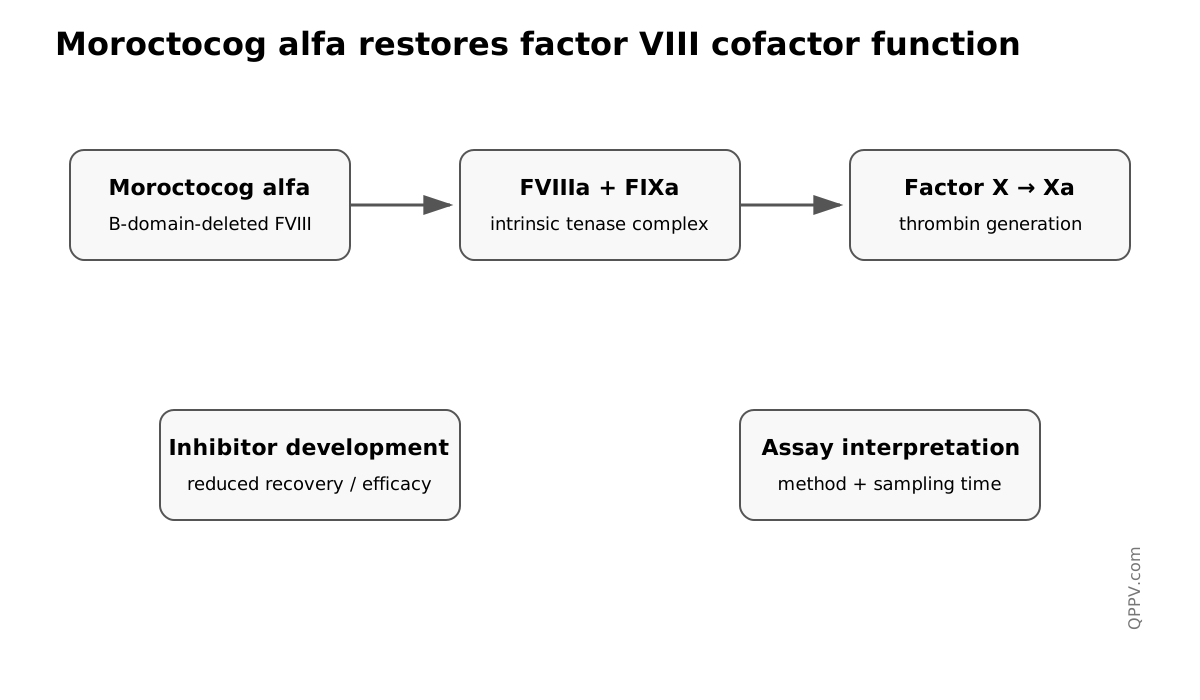
Figure 1. Moroctocog alfa replaces factor VIII function, allowing FVIIIa to support FIXa-mediated activation of factor X.
Mechanism of action
After intravenous administration, moroctocog alfa replaces deficient factor VIII. When activated to FVIIIa, it acts as a cofactor within the intrinsic tenase complex. The therapeutic effect is therefore temporary restoration of haemostatic capacity rather than permanent correction of the underlying genetic defect.
The B-domain deletion reduces molecular size but does not remove the domains required for factor VIII cofactor activity. For a non-specialist reader, the B domain can be thought of as a large segment that is not necessary for the key catalytic-support function of activated factor VIII; deleting it changes product architecture without changing the fundamental therapeutic task.
Development and regulatory history
Moroctocog alfa has a long regulatory history in Europe and is authorised for adults and children of all ages, including newborns. Over that history, manufacturing, potency assignment, analytical methods and presentation have been subjects of regulatory oversight. This makes it a useful example of why long-established biological products still require precise product identification and assay-aware pharmacovigilance.
Major safety and effectiveness domains
Factor VIII inhibitor development
Neutralising antibodies to factor VIII are among the most important complications of replacement therapy. They may present as unexpected bleeding, reduced recovery or loss of previously adequate haemostatic response. Pharmacovigilance follow-up should capture exposure history, previous treatment days where available, inhibitor assay results, timing of testing, measured factor VIII activity and the clinical response to replacement.
The risk is not interpreted from a single laboratory value. Inhibitor assessment depends on assay method, timing relative to infusion and the clinical pattern. A report of “low factor VIII” without these details is incomplete.
Hypersensitivity
Hypersensitivity reactions can occur with recombinant factor VIII products. Useful case information includes timing during or after infusion, cutaneous, respiratory and cardiovascular features, previous exposure, treatment given, recurrence and inhibitor status where clinically relevant.
Thrombosis
Factor VIII replacement is designed to correct a bleeding tendency, but thrombotic events may occur in susceptible contexts. Assessment should include dose, factor VIII activity where available, surgery, vascular access devices, malignancy, immobility, cardiovascular risk and concomitant procoagulant treatment.
Lack of efficacy and recovery
Apparent treatment failure may reflect inhibitor development, underdosing, delayed administration, reconstitution error, infusion-device problems, incorrect body weight, assay timing or the severity/location of bleeding. The PV system should therefore reconstruct the whole exposure event rather than code “drug ineffective” as a self-explanatory diagnosis.
Laboratory assay interpretation
Factor VIII activity measurement is not merely background monitoring; it is part of causality assessment. Product-specific assay characteristics and local laboratory methods can influence apparent recovery. When a safety report hinges on an unexpectedly low level, the assay method, sampling time and laboratory context should be captured.
Home treatment, reconstitution and device use
Patients and carers may administer treatment outside the clinic. Medication errors can arise from reconstitution, dose calculation, incomplete transfer, syringe/device handling, missed prophylaxis or incorrect storage. These events may produce either no clinical consequence or breakthrough bleeding and therefore need reconciliation across medication-error, product-quality and adverse-event workflows.
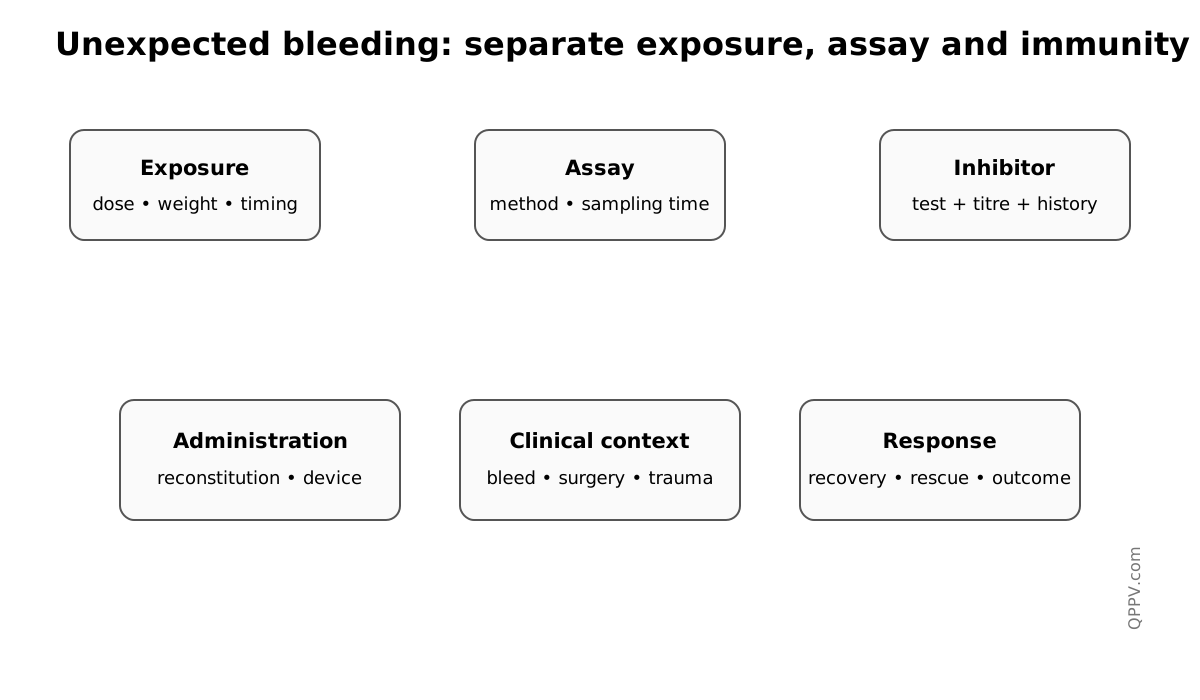
Figure 2. Unexpected bleeding should trigger a structured review of inhibitor status, factor VIII recovery, assay timing, dose and administration rather than immediate attribution to product failure.
Pharmacovigilance implementation
The central product-level PV question is whether an unexpected clinical outcome represents inhibitor development, insufficient exposure, administration error, laboratory interpretation or another clinical cause. For bleeding or lack-of-efficacy reports, capture prophylaxis versus on-demand use, dose, body weight, timing, factor VIII activity, assay timing and method, inhibitor status, bleeding site, response to additional treatment and relevant surgery or trauma.
Aggregate review should distinguish inhibitor reports from non-immune lack of efficacy and should avoid comparing crude event counts across periods without accounting for exposure, age distribution, switching and changes in laboratory practice.
Illustrative failure modes
An illustrative failure mode is a breakthrough bleed recorded without the last prophylactic dose or factor VIII level. Another is an unexpectedly low activity result interpreted as product failure without documenting sampling time or assay method. A third is an apparent administration failure that is never reconciled with a device or product-quality complaint.
These are hypothetical examples of weak evidence capture, not actual inspection findings.
Inspection and governance considerations
An inspector could examine whether inhibitor follow-up is triggered by unexpected lack of efficacy, whether assay-dependent information is captured, whether home-administration errors are reconciled with product complaints, and whether biological product and batch traceability is maintained. Product-specific safety review should also remain linked to the broader recombinant factor VIII class knowledge base without duplicating it.
Practical checklist
- Record the exact treatment purpose: prophylaxis, bleed treatment or surgery.
- Capture dose, body weight, timing and batch where available.
- Investigate unexpected bleeding for inhibitor development.
- Record factor VIII level, sampling time and assay method.
- Distinguish true product failure from underdosing or administration error.
- Capture hypersensitivity phenotype and treatment.
- Reconcile reconstitution/device errors with clinical consequences and quality complaints.
Key Takeaways
Moroctocog alfa is a B-domain-deleted recombinant factor VIII whose pharmacovigilance is inseparable from haemostatic effectiveness. Inhibitor development, recovery and laboratory interpretation dominate product-specific assessment, while home administration and long-term biological traceability remain important operational controls.
References
- European Medicines Agency. ReFacto AF (moroctocog alfa): EPAR and product information. Current EU regulatory information, accessed September 2026.
- European Medicines Agency. ReFacto AF: risk-management-plan summary and post-authorisation assessment history.
- European Medicines Agency. Public statement on changes to ReFacto potency assignment/specification. Historical regulatory context.
- World Federation of Hemophilia. Guidelines for the Management of Hemophilia. 3rd edition.
Regulatory Note
Dosing, factor-level monitoring, inhibitor testing and perioperative management must follow the current locally applicable product information and specialist haemophilia guidance. Assay interpretation should use product-appropriate validated laboratory methods.