Narsoplimab: Classification, Mechanism and Pharmacovigilance
Narsoplimab targets a defined complement-pathway enzyme. Its evidence and regulatory status need to be read in the context of a severe post-transplant syndrome and a small, non-comparative evidence base.
1. Product identity and clinical context
Narsoplimab is the active substance in Yartemlea in the United States. The U.S. indication is treatment of adults and children aged 2 years and older with haematopoietic stem-cell transplant-associated thrombotic microangiopathy (TA-TMA). A stem-cell transplant replaces diseased or damaged marrow; TA-TMA is a serious complication involving injury to small blood vessels, red-cell damage, platelet consumption and possible organ dysfunction.
TA-TMA does not have a single universally applied diagnostic rule in every clinical setting. A patient may have thrombocytopenia, evidence of microangiopathic haemolysis, elevated lactate dehydrogenase, renal or other organ injury, and overlapping complications such as graft-versus-host disease or infection. The clinical team’s diagnostic basis and timeline therefore matter when assessing an outcome after treatment.
The FDA approved Yartemlea in December 2025. The EMA issued a negative opinion on the EU marketing-authorisation application on 25 June 2026; the applicant requested re-examination, and the EMA page updated 15 July 2026 said that a final recommendation would follow that review. These are different jurisdictional decisions, and the EU process was not complete at the date of that update.[1–3]
2. Classification and therapeutic rationale
Narsoplimab is a human IgG4 monoclonal antibody that binds mannan-binding lectin-associated serine protease 2 (MASP-2). MASP-2 is an effector enzyme in the lectin pathway, one of the routes that activates the complement system. This places narsoplimab within complement-modifying antibodies, but at a different point in the pathway from antibodies that bind complement component C5.
The treatment rationale is to inhibit lectin-pathway activation that may contribute to endothelial injury after transplantation. The biological rationale does not, by itself, establish how much of a patient’s TA-TMA is driven by that pathway or predict an individual response. Transplant conditioning, infection, graft-versus-host disease, medicines, underlying disease and other complement pathways can contribute to the same clinical picture.
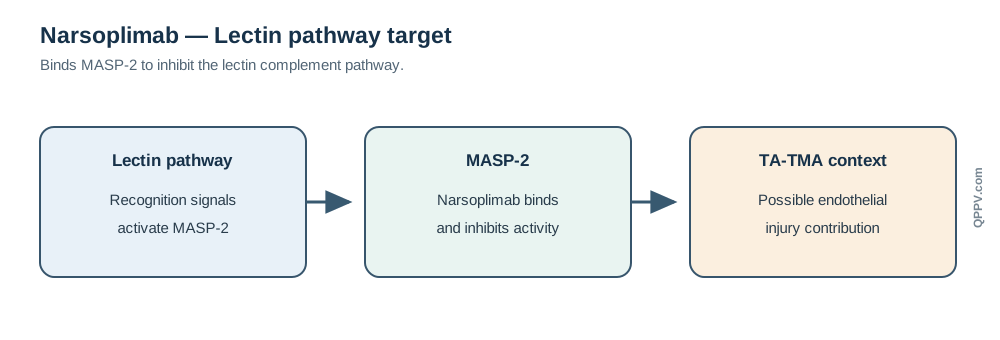
Figure 1. Narsoplimab binds MASP-2 in the lectin pathway. The diagram shows the proposed intervention point; it does not imply that all TA-TMA has one cause or that other complement pathways are blocked.
3. From target engagement to clinical use
By binding MASP-2, narsoplimab inhibits its enzymatic activity in the lectin pathway. This is a pathway-level intervention, not direct anticoagulation and not a general replacement for transplant supportive care. The U.S. prescribing information gives intravenous dosing once weekly, with frequency adjustment described for inadequate improvement; the exact weight-based dose and administration instructions must be taken from the current U.S. label.[1]
The pivotal TA-TMA study was open-label and single-arm. It enrolled 28 adults after transplant; the U.S. label also describes patient-level response data from 19 adults and children in an expanded-access programme. The study had no concurrent placebo or active comparator. This design can describe outcomes in treated patients but cannot separate treatment effect from disease course, co-interventions, patient selection or changes in supportive care.
The EMA’s June 2026 assessment highlighted uncertainty around the non-comparative design, concomitant treatments, study conduct, efficacy measurement and dose selection. It also concluded that the evidence did not support the proposed paediatric dose and effectiveness. The FDA’s approval and the EMA’s negative opinion therefore represent different evaluations of the submitted evidence; neither should be substituted for the other.[2,3]
4. Safety profile and interpretation
The U.S. label warns about serious infections. Serious infections were reported in 10 of 28 patients (36%) in the clinical study, independent of causality. In a post-transplant population with frequent immunosuppression, infection risk is clinically important, but the observed proportion is not an estimate of the drug-attributable risk: baseline illness, transplant complications and concurrent immunosuppressive treatment are major competing explanations.[1]
The label also lists common adverse reactions observed in the study, including viral infections, sepsis, haemorrhage, gastrointestinal symptoms, neutropenia, fever, fatigue and hypokalaemia. These are observations from a small, seriously ill population, not a list of events that should automatically be attributed to narsoplimab.
For an individual report, preserve the transplant date and type, TA-TMA diagnostic criteria, disease severity, baseline organ function, infection status, graft-versus-host disease, concomitant immunosuppressants, dose dates, laboratory trajectories and clinical response. Record whether an event began before or after treatment and whether narsoplimab was held, stopped or restarted.
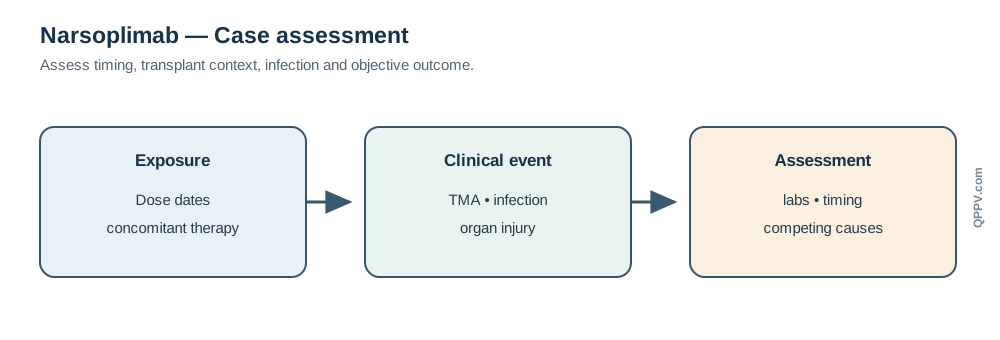
Figure 2. A TA-TMA safety case needs exposure timing, transplant and disease context, infection evaluation and objective outcome data before causality is interpreted.
5. Pharmacovigilance case assessment
A useful case chronology separates three questions: Was TA-TMA present before the first dose? Did a new event arise after exposure? Did the event change after dose interruption or other treatment? Kidney injury, bleeding, thrombocytopenia, haemolysis, infection and death may be outcomes of TA-TMA or transplant care as well as potential adverse events. A report should retain the reporter’s suspected relationship while documenting these competing explanations.
For a suspected infection, capture organism and site, cultures or other diagnostic evidence, immune status, prophylaxis, antimicrobial treatment and outcome. For a suspected lack of effect, preserve diagnostic criteria, dose and duration, platelet and lactate-dehydrogenase trends, organ function, transfusion needs and concomitant treatment. Distinguish a clinically meaningful response definition from a change in one laboratory marker.
The FDA label reports treatment-emergent anti-drug antibodies in 3 of 28 patients in the study, including one neutralising-antibody result; the label reported no apparent correlation with pharmacokinetic or pharmacodynamic response in this small dataset.[1] Do not treat that observation as proof that immunogenicity is irrelevant in broader use.
6. Regulatory status and practical safeguards
As of the EMA update dated 15 July 2026, Yartemlea had a negative CHMP opinion and a requested re-examination; no EU marketing authorisation had been granted. The EMA cited unresolved benefit–risk uncertainty, not a confirmed product-safety withdrawal. In the United States, the FDA label and its indication apply. Reports from other jurisdictions should be assessed against the product information and reporting rules applicable there.[1–3]
Narsoplimab is most informative for pharmacovigilance when case review links molecular target, transplant setting, disease criteria, concurrent immunosuppression and measurable outcome. Avoid interpreting every post-transplant complication as drug-caused, and avoid using the U.S. approval to imply EU authorisation.
Key takeaways
- Narsoplimab inhibits MASP-2 in the lectin complement pathway.
- The U.S. indication is TA-TMA after haematopoietic stem-cell transplant in patients aged 2 years and older.
- Serious infection is a labelled risk; post-transplant context complicates attribution.
- The FDA and EMA outcomes differ; the EMA re-examination was pending in its 15 July 2026 update.
References
- U.S. Food and Drug Administration. Yartemlea prescribing information. Revised December 2025.
- U.S. Food and Drug Administration. FDA approves first drug to treat serious complication of stem-cell transplant. 5 January 2026.
- European Medicines Agency. Yartemlea: European public assessment report and current application status. Includes the 25 June 2026 negative opinion and 15 July 2026 re-examination update.
- Khaled SK, et al. Narsoplimab for adult haematopoietic stem-cell transplantation-associated thrombotic microangiopathy. Journal of Clinical Oncology. 2022.
- European Medicines Agency. Good Pharmacovigilance Practices, including current reporting and signal-management guidance.
Regulatory Note
This article describes the U.S. FDA indication and the EMA application status available on the date stated. It is an educational reference, not a treatment recommendation or a substitute for the current jurisdiction-specific product information, applicable law or clinical judgement.