Nimotuzumab: Classification, Mechanism and Pharmacovigilance
Nimotuzumab has been studied and used in several national settings, but its regulatory history is not a single global authorisation. The EU application history and the local product information must be kept distinct.
1. Product identity and regulatory history
Nimotuzumab is a humanised IgG1 monoclonal antibody directed against epidermal growth factor receptor (EGFR). It has been developed for cancer treatment in multiple countries. Brand names and indications differ by jurisdiction, and a local approval or study in one country does not establish a harmonised EU indication.
An EU centralised marketing application for Theraloc was submitted in 2007 and withdrawn in 2008 while under review. The applicant stated that it could not address the CHMP’s concerns about quality and efficacy within the required timeframe. This was a withdrawal of an application, not an EU marketing authorisation later withdrawn for safety reasons. EMA orphan designations for nimotuzumab were also not marketing authorisations.[1,2]
A CDSCO public list of rDNA-based products records nimotuzumab as a bulk new drug substance in 2013. That entry is evidence about the listed bulk substance; it should not be expanded into a finished-product indication or treated as a current national label. For treatment and case review, use the approved local product information and relevant national regulatory record.[3]
2. Classification and mechanism
Nimotuzumab binds the extracellular domain of EGFR, a receptor that can activate intracellular growth and survival signalling when engaged by its ligands. Blocking receptor activation can reduce downstream signalling in susceptible tumour contexts. EGFR is also expressed in normal tissues, so target biology alone does not imply tumour-only binding or absence of normal-tissue effects.
Nimotuzumab is an antibody, not a small-molecule kinase inhibitor. It acts at the cell surface and may affect receptor signalling and immune-effector mechanisms. The amount of receptor on a cell, tumour heterogeneity, ligand activity and concurrent radiotherapy or chemotherapy can influence the observed effect. These are reasons to preserve tumour type, treatment combination and jurisdiction-specific indication when interpreting an outcome.[4]
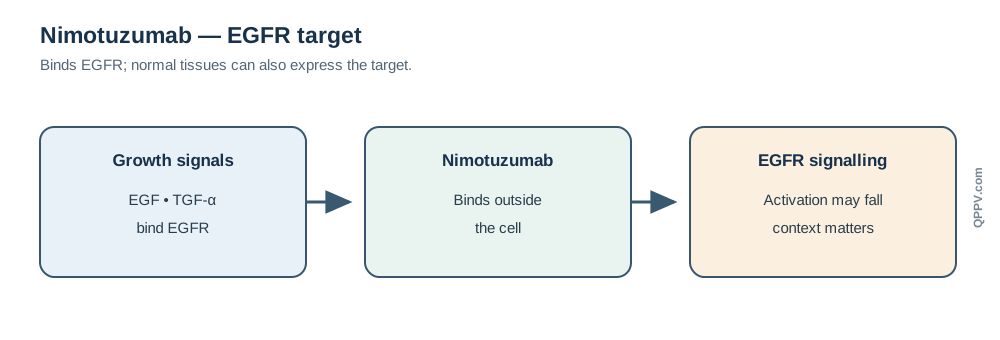
Figure 1. Nimotuzumab binds extracellular EGFR and may reduce ligand-driven signalling; the simplified pathway does not imply selective binding only to malignant cells.
3. Clinical evidence and treatment context
Nimotuzumab has been studied in different tumour types and treatment combinations, including head-and-neck cancer with chemoradiotherapy. Evidence from one tumour, regimen or country should not be generalized to every indication in another jurisdiction. For example, a trial evaluating nimotuzumab with cisplatin and radiotherapy answers a different question from a study of monotherapy or a different tumour type.[5]
Radiotherapy and chemotherapy can independently cause mucositis, skin reactions, swallowing problems, cytopenias, infection and other complications. A safety report should name each product and include radiation field, dose and schedule where relevant. Without these details, an event attributed to the antibody may be impossible to distinguish from the expected effects of the regimen or disease.
4. Safety assessment and pharmacovigilance
Published trials describe their own event patterns and patient populations; they are not substitutes for a current local label. Avoid transferring the safety profile of another EGFR antibody to nimotuzumab as if the molecules, affinity, formulation, dose and evidence were interchangeable. A class comparison can inform a hypothesis, but it is not proof of a nimotuzumab-specific risk.
For a suspected skin or mucosal event, capture onset, anatomical site, severity, tumour type, radiation exposure, chemotherapy, supportive care and outcome. For an infusion reaction, record infusion chronology, symptoms, vital signs, rate changes and any subsequent exposure. For lack of effect, preserve the tumour assessment method, baseline disease, EGFR testing where performed, treatment duration, dose intensity and co-treatment.
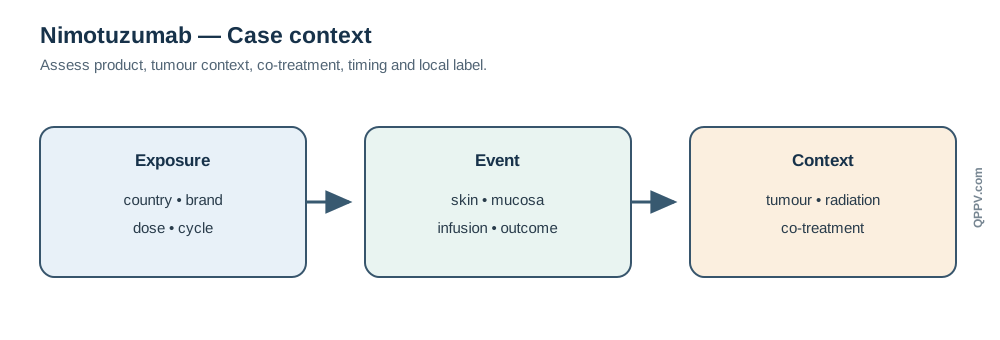
Figure 2. Nimotuzumab safety interpretation depends on exposure and local label alongside tumour, radiotherapy, chemotherapy and objective event evidence.
5. Case review and evidence discipline
Start each report with the exact product identity, country, brand, formulation and local label version. Confirm whether the exposure occurred within a locally authorised indication, a clinical trial, named-patient access or another pathway. Regulatory pathway changes what records exist and which reporting obligations apply.
For suspected toxicity, establish chronology and alternative causes. For a patient receiving radiotherapy, obtain treatment dates, field and dose; for concomitant chemotherapy, record each agent, cycle and dose modification. For suspected lack of effect, distinguish progression from inadequate exposure, interruption, tumour heterogeneity or measurement differences. A spontaneous report can raise a signal but cannot alone determine comparative benefit or risk.
6. Current regulatory interpretation
The EMA record confirms that the Theraloc EU application was withdrawn during assessment after unresolved quality and efficacy concerns; it does not establish a safety-based withdrawal of an EU-authorised medicine. The 2013 CDSCO record cited below is limited to a bulk new drug substance entry. Neither record supplies a universal current product label. Article users should consult the competent authority and current product information for the country and product involved.[1–3]
Key takeaways
- Nimotuzumab is a humanised IgG1 anti-EGFR antibody.
- The EU Theraloc application was withdrawn during review in 2008; it was not an EU-authorised product later withdrawn for safety.
- National authorisations and product information vary; a bulk-substance record is not a finished-product indication.
- Radiotherapy, chemotherapy, tumour biology and dose chronology are essential case context.
References
- European Medicines Agency. Oncoscience AG withdraws its application for Theraloc (nimotuzumab). 4 December 2008.
- European Medicines Agency. Withdrawal assessment report for Theraloc (nimotuzumab).
- Central Drugs Standard Control Organisation, India. Final list of rDNA-based drugs approved in India. The cited record lists nimotuzumab as bulk new drug substance.
- Ramakrishnan MS, et al. Nimotuzumab, a promising therapeutic monoclonal antibody for tumours of epithelial origin. mAbs. 2009.
- Patil VM, et al. Randomised phase 3 trial of nimotuzumab with cisplatin chemoradiotherapy in locally advanced head-and-neck cancer. 2019.
- European Medicines Agency. Good Pharmacovigilance Practices.
Regulatory Note
This article is educational and describes the cited EU application history and a limited Indian bulk-substance record. It does not assert a universal current indication or replace current national product information, applicable law or clinical judgement.