Nintedanib: Discovery, Development, Safety and Pharmacovigilance
Nintedanib is an oral small-molecule tyrosine kinase inhibitor developed by Boehringer Ingelheim. Its history is unusual: a compound investigated in oncology became an important antifibrotic medicine for progressive interstitial lung diseases (ILDs). That transition is clinically meaningful because the same inhibition of growth-factor signalling that may restrain pathological fibroblast activity can also affect gastrointestinal tolerance, liver function, vascular biology and reproductive development. Pharmacovigilance must evaluate these effects in patients whose underlying lung disease itself produces serious morbidity and mortality.
- Nintedanib: Discovery, Development, Safety and Pharmacovigilance
- Discovery and translational rationale
- Two development branches: cancer and pulmonary fibrosis
- Mechanism and pharmacology
- Clinical development in idiopathic pulmonary fibrosis
- Regulatory entry and expansion
- Evidence beyond idiopathic pulmonary fibrosis
- Safety profile
- Comparing trial populations without false precision
- Diarrhoea, dehydration and treatment persistence
- Liver enzyme elevations and drug-induced liver injury
- Bleeding, arterial events and gastrointestinal perforation
- Proteinuria and renal context
- Embryo-fetal and paediatric developmental risks
- Less frequent postmarketing safety reports
- Drug interactions and administration errors
- Benefit–risk across the lifecycle
- Pharmacovigilance case and signal workflows
- Practical checklist
- Key takeaways
- References
- Regulatory Note
Discovery and translational rationale
Nintedanib, initially known as BIBF 1120, was designed as an inhibitor of several receptor tyrosine kinases, notably those involved in vascular endothelial growth factor (VEGF), fibroblast growth factor (FGF) and platelet-derived growth factor (PDGF) signalling. Its original development included cancer research, reflecting the importance of these pathways in tumour angiogenesis and growth. Hilberg and colleagues described the indolinone derivative BIBF 1120 in 2008 as a triple angiokinase inhibitor and demonstrated inhibition of VEGFR, FGFR and PDGFR signalling in preclinical systems [9]. These experiments established a pharmacological rationale, not a proven clinical effect. Subsequent antifibrotic work explored whether overlapping pathways involved in tissue repair and fibroblast activation might be therapeutically modified in pulmonary fibrosis [1–3].
The molecule originated in Boehringer Ingelheim's research programme, and its early history should not be confused with a later independent discovery by a pulmonary-fibrosis team. The first clinical programmes were oncology-oriented. In a phase I dose-escalation study involving 61 patients with advanced solid tumours, gastrointestinal reactions and reversible liver enzyme elevations were already conspicuous; the study informed exposure, dosing and tolerability before the pulmonary trials [10]. The recurring hepatic and gastrointestinal findings across development programmes are important historical evidence, although frequencies cannot be compared directly across cancer and ILD populations.
This repurposing was not simply a change of marketing language. Idiopathic pulmonary fibrosis (IPF) is a progressive fibrotic disease in which injury responses and tissue remodelling impair lung mechanics. The development hypothesis was that a multi-target kinase inhibitor could slow deterioration in lung function. The intended effect was slowing decline, not reversing established scarring or curing the disease.
Two development branches: cancer and pulmonary fibrosis
Nintedanib did not abandon oncology when antifibrotic development succeeded. In the European Union, Vargatef received marketing authorisation on 21 November 2014 for use with docetaxel in a defined adult population with previously treated non-small-cell lung cancer (NSCLC) of adenocarcinoma histology [13]. The pivotal LUME-Lung 1 trial found a progression-free survival benefit in the overall population, while the overall-survival advantage was demonstrated in the adenocarcinoma subgroup rather than in the entire randomised population [11]. This is an important limit on the inference that the molecule benefits all NSCLC histologies.
Other oncology investigations produced mixed or negative evidence. LUME-Lung 2, evaluating addition to pemetrexed in pretreated non-squamous NSCLC, stopped recruitment after a prespecified interim futility assessment. Subsequent centrally reviewed progression-free survival analysis favoured nintedanib, but overall survival was not improved; both the early stopping decision and later endpoint result need to be reported rather than reducing the study to a simple positive or negative label [12]. The phase III LUME-Meso study in unresectable pleural mesothelioma did not meet its progression-free survival primary endpoint [16]. None of these oncology regimens establishes efficacy for a different tumour or justifies using the antifibrotic dosing instructions for combination chemotherapy.
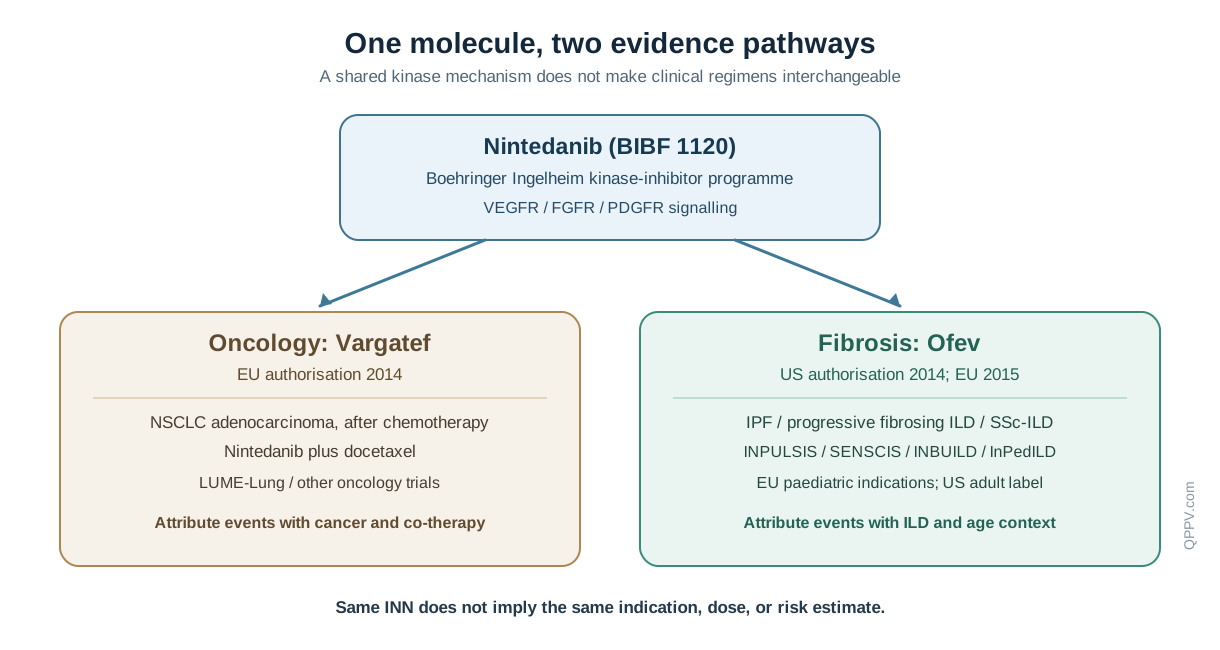
Figure 1. The same INN developed along distinct oncology and antifibrotic evidence pathways. Vargatef and Ofev are different EU products with different indications, regimens and co-treatment contexts. The branches are not interchangeable, and the schematic does not compare clinical efficacy across diseases.
Mechanism and pharmacology
Nintedanib competitively inhibits ATP-binding sites of selected tyrosine kinases, including VEGFR 1–3, FGFR 1–3 and PDGFR alpha and beta. These receptors participate in cellular signalling relevant to fibroblast migration, proliferation and differentiation. The product also has activity against certain non-receptor kinases; clinical efficacy cannot be assigned to any one receptor in isolation [1,2].
At a cellular level, PDGF and FGF pathways are involved in fibroblast recruitment and growth, while VEGF signalling also contributes to vascular responses. The clinical effects are therefore plausibly connected to a network of signalling rather than a single 'fibrosis receptor'. Conversely, inhibition of these pathways does not prove that every adverse event is an on-target effect. Diarrhoea, hepatic injury and bleeding require their own clinical and epidemiological evidence. Mechanistic plausibility strengthens a hypothesis; it does not substitute for exposure-adjusted comparisons or case assessment.
Nintedanib is administered orally, generally with food. The adult US labelled starting dose is 150 mg twice daily, with dose adjustment or interruption for tolerability and particular patient characteristics. The US label recommends 100 mg twice daily for mild hepatic impairment and does not recommend use in moderate or severe hepatic impairment [1]. Product-specific recommendations must not be transposed automatically to children, where EU dosing is weight-based. The US label, updated on 20 November 2025, also notes that nintedanib is predominantly cleared through ester cleavage followed by glucuronidation, while CYP3A4 is a minor metabolic route [1]. This helps explain why P-gp transport interactions deserve attention even though the medicine is not primarily cleared by CYP3A4. Capsule strengths and product formulations must be verified for the actual market: the EU Ofev SmPC lists 25-mg, 100-mg and 150-mg capsules, including 25-mg capsules used for weight-based paediatric dosing, while the cited US adult Ofev label lists 100-mg and 150-mg capsules [7]. The antifibrotic Ofev and oncology Vargatef regimens are not substitutes.
Clinical development in idiopathic pulmonary fibrosis
TOMORROW: dose-finding and proof of concept
The phase II TOMORROW trial explored nintedanib in IPF. It provided a signal that higher-dose treatment might reduce the decline in forced vital capacity (FVC), while identifying gastrointestinal and liver-related adverse events requiring attention. The study was not a definitive mortality trial, and exploratory findings should be interpreted in light of multiplicity and sample size [3].
INPULSIS-1 and INPULSIS-2
The phase III INPULSIS trials randomised patients with IPF to nintedanib or placebo. Annual rates of FVC decline were lower with nintedanib in both studies: approximately −114.7 versus −239.9 mL/year in INPULSIS-1 and −113.6 versus −207.3 mL/year in INPULSIS-2 [4]. FVC is a physiologic surrogate reflecting lung-function progression. A reduction in its rate of decline does not establish that the drug reverses fibrosis or guarantees survival benefit for an individual patient.
Diarrhoea was a prominent adverse event and contributed to dose reductions or interruptions. The clinical value of a treatment that slows progression depends partly on managing tolerability well enough for sustained use.
Regulatory entry and expansion
The US FDA initially approved Ofev for IPF in 2014, followed by European authorisation on 14 January 2015. Additional evidence led to indications in systemic sclerosis-associated ILD and other chronic fibrosing ILDs with a progressive phenotype. The US 2025 prescribing information describes three adult indications: IPF, progressive chronic fibrosing ILDs and slowing decline in lung function in systemic sclerosis-associated ILD [1]. The EU product information now includes specified paediatric indications from age six, subject to separate conditions and monitoring [2].
The product's European and US indications therefore cannot be presented as identical. A global pharmacovigilance document should record the exact product-information revision and jurisdiction for each statement about authorised population, contraindications and dosing. As of October 2026, the EMA lists the Ofev EU product information updated on 6 January 2026, whereas the US DailyMed Ofev label is dated 20 November 2025 [1,2]. The EMA also authorised the generic product Nintedanib Viatris in August 2025, with bioequivalence assessed against Ofev [15]. A generic authorisation does not create a second INN lifecycle, but it does introduce manufacturer- and product-level traceability needs for individual safety reports.
Evidence beyond idiopathic pulmonary fibrosis
SENSCIS: systemic sclerosis-associated ILD
The SENSCIS study enrolled patients with systemic sclerosis-associated ILD and assessed the annual rate of FVC decline. Nintedanib reduced the rate of decline compared with placebo; the trial was not designed to demonstrate reversal of systemic sclerosis or a definitive survival advantage. The population differed from classic IPF, including the presence of systemic autoimmune disease and background immunomodulatory treatment [5].
INBUILD: progressive fibrosing ILD
INBUILD studied fibrosing ILDs other than IPF that showed progression despite management considered appropriate in clinical practice. It found a smaller annual FVC decline with nintedanib than placebo. The trial's progression criteria and inclusion rules matter: its findings do not mean every stable or non-progressive ILD warrants antifibrotic treatment [6]. Subgroup analyses are useful but should not be misrepresented as separately powered trials for every diagnosis.
Paediatric development and remaining uncertainty
The EU authorisation includes children aged six to seventeen with clinically significant progressive fibrosing ILD, and children above six with systemic sclerosis-associated ILD, as specified in current EMA materials [2]. The paediatric evidence base relies in part on pharmacokinetic exposure matching and extrapolation from adult efficacy, rather than an independently powered demonstration of clinical outcome benefit in every paediatric subtype. InPedILD randomised 39 children aged 6–17 years with clinically significant fibrosing ILD (26 nintedanib, 13 placebo) during a 24-week double-blind period, followed by open-label treatment. The co-primary endpoints were pharmacokinetic exposure and treatment-emergent adverse events, not a confirmatory FVC efficacy endpoint [14]. Similar proportions of children in the two groups experienced adverse events during the blinded period (84.6% each), but the sample was too small to exclude uncommon or late developmental harm. EMA explicitly identifies uncertainty around long-term effects on growth and tooth development. Monitoring of dental development and growth is therefore a central paediatric safety question, not an incidental precaution. The EMA overview specifies dental examination at least every six months until teeth are fully developed; the current EU SmPC recommends annual bone imaging for patients with open epiphyses, alongside regular growth monitoring [2,7]. Doses are adjusted by body-weight band, and the SmPC does not recommend use below 13.5 kg [7]. These are product-specific monitoring instructions, not a claim that the trial proved dental damage. Case collection should distinguish delayed development due to underlying chronic disease, steroid exposure or nutrition from a suspected treatment effect.
Safety profile
Comparing trial populations without false precision
The adult programmes used similar FVC-based primary outcomes but recruited different diseases. In SENSCIS, the between-group difference in the annual rate of FVC decline was about 41 mL/year; in INBUILD it was about 107 mL/year, while the replicate IPF trials showed differences of 125.3 and 93.7 mL/year [4–6]. These are trial-specific estimates, not a head-to-head ranking of responsiveness. Baseline FVC, expected natural-history decline, imaging phenotype, concomitant treatment and inclusion criteria differ. The trials were not designed to establish equivalent mortality effects, and individual clinical decisions cannot be made by comparing these four numbers alone.
Diarrhoea, dehydration and treatment persistence
Diarrhoea is among the most frequent adverse reactions. It may begin early and lead to dehydration, electrolyte imbalance, weight loss, dose interruption or discontinuation. The US label advises prompt hydration and antidiarrhoeal treatment, with dose adjustment or discontinuation when severe symptoms persist [1]. A report should document onset, stool frequency, clinical dehydration, electrolytes, renal function, other gastrointestinal disease, dose history and response to intervention. Calling every case a minor expected adverse reaction risks overlooking hospitalisation or clinically significant volume depletion.
Liver enzyme elevations and drug-induced liver injury
Nintedanib is associated with increased ALT, AST and bilirubin, and postmarketing reports include serious drug-induced liver injury with fatal outcomes. The US label advises liver tests before treatment, regularly during the first three months and periodically thereafter [1]. It identifies a potentially higher risk of enzyme elevations in patients with lower body weight, Asian patients, female patients and older patients; these are labelled risk observations, not deterministic predictors of an individual's outcome. US dosing guidance includes interruption or reduction for specified laboratory abnormalities and discontinuation for more severe elevations or clinical signs of liver injury [1]. A pharmacovigilance article should not replace the label's numerical dose-modification rules with a vague instruction to 'monitor'. Early-onset events are common, but later events remain possible. Suspected DILI requires a chronology of laboratory values, bilirubin, alkaline phosphatase, symptoms, competing causes, other hepatotoxic drugs and dechallenge. LiverTox documents clinically apparent injury and emphasises that a postmarketing causal assessment may remain only possible or probable despite plausible chronology [8]. An isolated transaminase elevation is not synonymous with severe DILI. For biochemical pattern classification, alternative-cause assessment and the distinction between Hy's law and a suspected liver injury case, see the QPPV references on drug-induced liver injury and Hy's law.
Liver impairment changes nintedanib exposure. Adult patients with mild impairment have a lower recommended starting dose in US labelling; moderate or severe impairment is a reason not to use the product under that label [1]. A pharmacovigilance reviewer must distinguish pre-existing hepatic disease from treatment-emergent injury.
Bleeding, arterial events and gastrointestinal perforation
Nintedanib's VEGF-pathway activity is relevant to warnings concerning bleeding and arterial thromboembolic events. Bleeding cases should record anticoagulant or antiplatelet use, site, severity, underlying disease and procedural context. Myocardial infarction or other arterial events require careful assessment of baseline cardiovascular risk and competing causes. The US label also warns about gastrointestinal perforation, especially in patients with recent abdominal surgery, diverticular disease or relevant co-medications such as corticosteroids or NSAIDs [1]. These are distinct outcomes with different clinical and evidentiary requirements.
Proteinuria and renal context
Nephrotic-range proteinuria has been reported postmarketing. A suspected case should include quantitative urine protein, renal function, blood pressure, oedema, urinalysis and other potential renal causes. Labelling advises considering interruption for new or worsening proteinuria [1]. It would be inaccurate to treat every renal-function change during diarrhoeal illness as a direct nephrotoxic effect of nintedanib.
Embryo-fetal and paediatric developmental risks
Nintedanib can cause fetal harm, and pregnancy precautions differ by jurisdiction. The EU SmPC lists pregnancy as a contraindication [2]; the US label has no listed contraindications in section 4 but addresses embryo-fetal toxicity through warnings, pregnancy testing and contraception advice [1]. The EU contraindications also include hypersensitivity to nintedanib, peanut, soya or listed excipients [7]. The distinction is a regulatory classification difference, not evidence that fetal exposure is safer in one jurisdiction. The US label recommends highly effective contraception during treatment and for at least three months after the last dose, and warns that vomiting or diarrhoea may compromise absorption of oral hormonal contraceptives [1]. Paediatric tooth and growth monitoring is a distinct issue requiring longitudinal follow-up and cannot be inferred from adult trial safety alone.
Less frequent postmarketing safety reports
The US label lists postmarketing reports of thrombocytopenia, pancreatitis and posterior reversible encephalopathy syndrome (PRES), among other events [1]. Their presence in postmarketing information does not provide a reliable incidence estimate or prove causality in a specific patient. PRES follow-up, for example, should document neurological symptoms, blood pressure, brain imaging, alternative causes and concurrent medicines; an isolated headache cannot be classified as PRES without supporting evidence.
Drug interactions and administration errors
Nintedanib is a substrate of P-glycoprotein (P-gp) and, to a lesser extent, CYP3A4. Strong inhibitors or inducers can change exposure. Smoking may decrease nintedanib exposure; counselling and case assessment should record changes in smoking status. Anticoagulants can complicate bleeding risk, but a co-medication list alone cannot establish a drug–drug interaction [1].
Administration errors include missed doses, taking an extra dose to compensate, confusion between 100-mg and 150-mg strengths, and inadvertent continuation despite severe gastrointestinal or hepatic adverse events. The EU label states that a missed dose should be skipped rather than doubled [2]. Case follow-up should verify what was actually swallowed, not only what was prescribed.
Benefit–risk across the lifecycle
Nintedanib's value lies in slowing pulmonary function decline in populations with progressive fibrosis. The benefit–risk calculation varies by diagnosis, rate of progression, age, comorbidity and tolerance. For a patient with severe diarrhoea, reduced exposure from repeated interruptions may erode practical effectiveness. For a child, uncertainty about tooth and skeletal development may require years of surveillance beyond the duration of pre-authorisation studies.
A further interpretive challenge arises from dual use in oncology and fibrosis. A serious adverse event observed in a patient receiving nintedanib with docetaxel may involve the cytotoxic co-treatment, malignancy, infection or the kinase inhibitor. The correct comparison is not with a patient taking Ofev alone for IPF. Case coding should preserve the administered brand, regimen and disease setting so that aggregate safety analyses do not accidentally pool clinically incompatible exposures.
The clinical development programme also illustrates why regulatory indication expansions should be tied to the evidence actually reviewed. IPF, systemic sclerosis-associated ILD, other progressive fibrosing ILDs and paediatric disease have different populations, background treatments and endpoints. Cross-trial numerical comparisons should not be treated as head-to-head efficacy evidence.
Pharmacovigilance case and signal workflows
Suspected serious liver injury
Illustrative case, not a reported regulatory finding. A patient starts nintedanib and develops jaundice with increased ALT and bilirubin six weeks later. Follow-up seeks pre-treatment tests, dated serial results, concomitant medicines, alcohol use, viral or biliary investigations, imaging where relevant, treatment interruption and recovery. The medical reviewer evaluates a plausible temporal association alongside competing causes. The reporting narrative should not declare Hy's law solely because ALT and bilirubin are both high; the specific laboratory thresholds and alternative-cause assessment matter.
Persistent diarrhoea and dehydration
Illustrative case. A patient with fibrosing ILD reports worsening diarrhoea after dose escalation and is hospitalised with acute kidney dysfunction. Important questions include actual dose, onset, fluid intake, other diarrhoea-causing medicines, blood pressure, electrolyte results, renal trajectory and management. Separate the primary gastrointestinal reaction, its complications and underlying renal risk.
Paediatric growth and dental surveillance
Illustrative follow-up. A child receives treatment over several years. The record should link weight-based dose changes, growth velocity, bone-imaging assessments, dental examinations, developmental stage, concomitant medicines and clinical disease course. Isolated reports may generate hypotheses; evaluating developmental safety requires longitudinal data and suitable comparison groups.
Product traceability and medication errors
An INN-based reference article is useful for teaching, but case processing needs a more granular identity. Confirm whether the product was Ofev, Vargatef or a generic; record the manufacturer, country, strength, batch when available, indication and co-treatment. For oncology cases, the docetaxel cycle and nintedanib dosing days are material. For ILD cases, distinguish 100-mg and 150-mg capsules, dose interruption and re-escalation, and whether the patient took capsules with food. Do not classify a case as a quality defect merely because a known adverse effect occurred.
Aggregate assessment and governance
A mature programme combines individual case reports, clinical trials, registries, literature and regulatory assessments. DILI review should stratify by baseline hepatic impairment and early treatment period. Bleeding review should account for anticoagulant exposure. Paediatric surveillance needs longitudinal denominators and a method to capture growth and dental findings that may arise well after treatment begins. Signal detection does not itself establish causality or incidence.
EU pharmacovigilance obligations and GVP govern applicable signal and case-processing activities. Suggested internal practices—such as a standardised diarrhoea follow-up form or paediatric dental-surveillance dataset—are quality-management recommendations unless specifically required by the applicable authorisation or risk-management plan. Inspection-ready documentation should trace the evidence, assessment, decision, implementation and effectiveness of any safety action.
Practical checklist
- Confirm the exact INN, brand, strength, jurisdiction, indication and current label revision.
- Record baseline lung disease, progression criteria, background treatment and FVC history.
- For diarrhoea, capture severity, hydration, electrolytes, renal function and dose changes.
- For suspected DILI, obtain baseline and serial ALT, AST, bilirubin and alkaline phosphatase, symptoms and competing causes.
- For bleeding or arterial events, capture cardiovascular risk, anticoagulants, procedures and objective diagnostic evidence.
- For proteinuria, seek quantitative urine measurements and renal assessment.
- In paediatric cases, document growth, dental examinations, imaging, dose changes and duration of exposure.
- Distinguish observed events, clinical causality, regulatory label requirements and recommended operational practices.
Key takeaways
Nintedanib moved from kinase-inhibitor research into antifibrotic treatment through a sequence of trials that established slower FVC decline in defined ILD populations. The principal safety challenges are gastrointestinal toxicity, liver injury, bleeding and vascular events, perforation, proteinuria and embryo-fetal risk. The oncology branch and EU generic authorisations add product identity and co-treatment attribution challenges. EU paediatric indications add developmental monitoring obligations and long-term uncertainty. A sound pharmacovigilance assessment links the right product and jurisdiction to the right population, exposure, laboratory evidence and clinical outcome.
References
- US National Library of Medicine. DailyMed: Ofev (nintedanib) capsules, US prescribing information updated 20 November 2025. https://dailymed.nlm.nih.gov/dailymed/fda/fdaDrugXsl.cfm?setid=da1c9f37-779e-4682-816f-93d0faa4cfc9
- European Medicines Agency. Ofev: EPAR overview and product information, EU authorisation and paediatric indications. https://www.ema.europa.eu/en/medicines/human/EPAR/ofev
- Richeldi L et al. Efficacy of a tyrosine kinase inhibitor in idiopathic pulmonary fibrosis. N Engl J Med. 2011;365:1079–1087. https://pubmed.ncbi.nlm.nih.gov/21992121/
- Richeldi L et al. Efficacy and safety of nintedanib in idiopathic pulmonary fibrosis. N Engl J Med. 2014;370:2071–2082. https://doi.org/10.1056/NEJMoa1402584
- Distler O et al. Nintedanib for systemic sclerosis-associated interstitial lung disease. N Engl J Med. 2019;380:2518–2528. https://doi.org/10.1056/NEJMoa1903076
- Flaherty KR et al. Nintedanib in progressive fibrosing interstitial lung diseases. N Engl J Med. 2019;381:1718–1727. https://doi.org/10.1056/NEJMoa1908681
- European Medicines Agency. Ofev: EU product information. https://www.ema.europa.eu/en/documents/product-information/ofev-epar-product-information_en.pdf
- National Institutes of Health. LiverTox: Nintedanib. https://www.ncbi.nlm.nih.gov/books/NBK548135/
- Hilberg F et al. BIBF 1120: triple angiokinase inhibitor with sustained receptor blockade and good antitumor efficacy. Cancer Res. 2008;68:4774–4782. https://pubmed.ncbi.nlm.nih.gov/18559524/
- Mross K et al. Phase I study of the angiogenesis inhibitor BIBF 1120 in patients with advanced solid tumors. Clin Cancer Res. 2010. https://pubmed.ncbi.nlm.nih.gov/20028771/
- Reck M et al. Docetaxel plus nintedanib versus docetaxel plus placebo in previously treated non-small-cell lung cancer (LUME-Lung 1). Lancet Oncol. 2014. https://pubmed.ncbi.nlm.nih.gov/24411639/
- Hanna NH et al. Nintedanib plus pemetrexed versus placebo plus pemetrexed (LUME-Lung 2). Lung Cancer. 2016;102:65–73. https://pubmed.ncbi.nlm.nih.gov/27987591/
- European Medicines Agency. Vargatef: European public assessment report, initial EU authorisation 21 November 2014. https://www.ema.europa.eu/en/medicines/human/EPAR/vargatef
- Deterding R et al. Nintedanib in children and adolescents with fibrosing interstitial lung diseases (InPedILD). Eur Respir J. 2023;61:2201512. https://pubmed.ncbi.nlm.nih.gov/36041751/
- European Medicines Agency. Nintedanib Viatris: European public assessment report, EU authorisation 22 August 2025. https://www.ema.europa.eu/en/medicines/human/EPAR/nintedanib-viatris
- Scagliotti GV et al. Nintedanib plus pemetrexed and cisplatin in malignant pleural mesothelioma (LUME-Meso). Lancet Respir Med. 2019;7:569–580. https://pubmed.ncbi.nlm.nih.gov/31103412/
Regulatory Note
This article is an educational scientific and pharmacovigilance reference, not an individual prescribing recommendation. The US and EU product information differ in indication, age coverage, contraindications and monitoring details; consult the current locally authorised documents. Clinical-trial evidence, regulatory requirements, product warnings, interpretation and recommended operational practices are distinct and should be documented as such.