Olaparib: Discovery, Development, Safety and Pharmacovigilance
Olaparib illustrates how understanding a tumour's defective DNA-repair machinery can guide treatment, but also why a compelling mechanism does not make every homologous-recombination-repair alteration equally predictive of benefit. The medicine inhibits poly(ADP-ribose) polymerase (PARP), particularly PARP1 and PARP2, and has become a treatment component across several biomarker-defined malignancies. Its clinical use demands interpretation of tumour lineage, germline versus somatic alterations, prior platinum exposure, combination partners and the precise authorised indication. The same DNA-repair mechanism that contributes to anticancer activity makes haematological toxicity and rare therapy-related myeloid malignancy particularly important to assess.
This reference follows the molecule from the scientific rationale for synthetic lethality through clinical development and post-authorisation safety. It distinguishes evidence obtained in a specific trial population from a general claim about all BRCA-mutated or homologous-recombination-deficient cancers. Product-specific US and EU safety statements must be interpreted against the applicable formulation and dated label, not inferred from a drug-class summary.
- Olaparib: Discovery, Development, Safety and Pharmacovigilance
- The scientific foundation: synthetic lethality
- From discovery biology to an oncology medicine
- How to read the efficacy evidence
- Evidence in ovarian cancer: maintenance is not salvage therapy
- Evidence beyond ovarian cancer
- Interpretation of negative, exploratory and evolving evidence
- Safety pharmacology and the pattern of adverse effects
- Listedness against the assessed US and EU product information
- Dose, formulation and interaction safety
- From individual cases to an actionable safety signal
- Development, ownership and access: why the history matters
- Practical checklist for prescribing and PV review
- Key takeaways
- References
- Regulatory Note
The scientific foundation: synthetic lethality
Cells encounter single-strand and double-strand DNA lesions during ordinary replication and after exposure to chemotherapy or environmental insults. PARP enzymes participate in detecting DNA damage and coordinating repair responses. Inhibiting PARP catalytic activity and trapping PARP–DNA complexes can interfere with replication, generate lesions that require effective homologous recombination and eventually cause cell death. The relative contribution of catalytic inhibition and trapping differs across inhibitors and experimental systems; a simplified description of olaparib as merely blocking single-strand-break repair misses this important biology.
BRCA1 and BRCA2 proteins help maintain accurate homologous-recombination repair of double-strand DNA breaks. A tumour with deficient BRCA-dependent repair may therefore be particularly vulnerable when PARP-mediated responses are also impaired. This relationship is called synthetic lethality: simultaneous impairment of two compensating functions is harmful even when impairment of either function alone can be tolerated. The complementary experimental studies by Farmer and Bryant and colleagues in 2005 established this rationale in BRCA-deficient systems. [12,14] 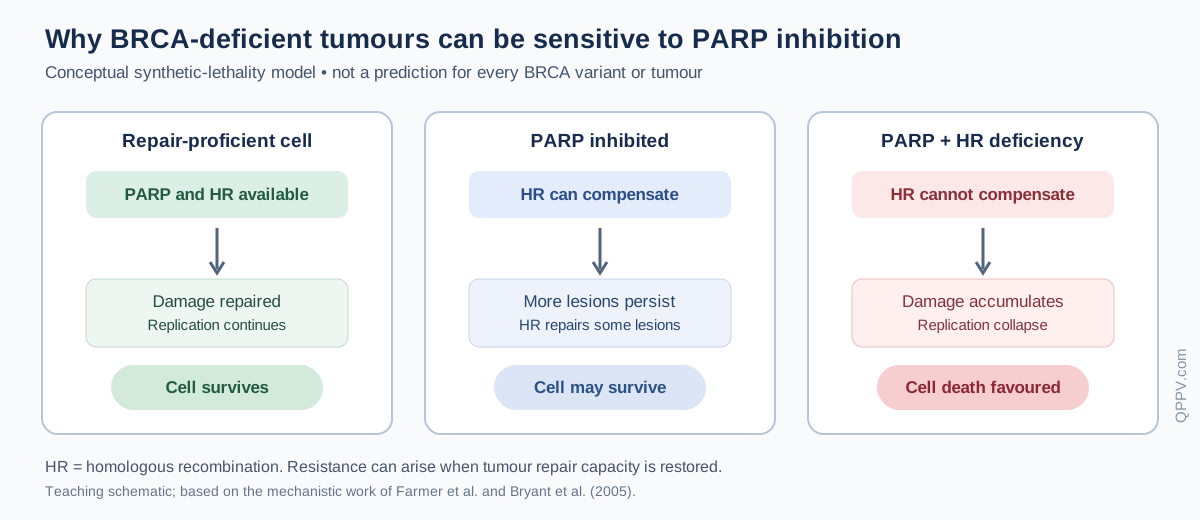
Figure 1. PARP inhibition can be compensated by functional homologous recombination; combining PARP inhibition with homologous-recombination deficiency favours accumulation of replication-associated DNA damage. This conceptual model is not a patient-level response prediction. [12,14]
The concept predicts a therapeutic window, not absolute selectivity. Normal proliferating tissues can still be injured, and cancers may acquire resistance through restoration of homologous recombination, changes in drug transport, or other mechanisms.
The biomarker question is consequently more subtle than whether a tumour contains any variant in a DNA-repair gene. Pathogenicity, zygosity, loss of the remaining functional allele, genomic context, functional repair capacity and previous treatment all influence interpretation. Germline BRCA variants also raise hereditary-cancer and family-counselling considerations, which must not be confused with somatic tumour-test results. The product label specifies which biomarkers and companion diagnostic pathways are relevant for each authorised use.
From discovery biology to an oncology medicine
Research on DNA-damage responses and inherited BRCA-associated cancer predisposition converged with the experimental demonstration that BRCA-deficient cells could be selectively sensitive to PARP inhibition. Olaparib, also known during development as AZD2281 and KU-0059436, emerged from this medicinal-chemistry programme and was subsequently developed clinically by AstraZeneca. The discovery narrative should distinguish the origin of the compound and the institutions conducting early research from the later marketing-authorisation holder; company ownership and licensing relationships are not interchangeable with inventorship.
Early clinical studies established oral dosing feasibility, pharmacodynamic activity and preliminary signals in BRCA-associated cancers. The pivotal development challenge was to show that a molecularly plausible effect translated into clinically meaningful benefit in well-defined populations. The first European and US approvals occurred in 2014, initially focused on ovarian cancer with BRCA-associated disease and substantial differences in eligibility and treatment setting. [1,2,7] The original European product included 50-mg capsules; subsequent tablet development changed administration and expanded treatment programmes. Capsule and tablet doses must never be assumed interchangeable milligram for milligram.
Later evidence expanded the clinical programme into first-line ovarian maintenance, selected breast cancer settings, platinum-sensitive pancreatic cancer maintenance and biomarker-defined prostate cancer. These advances involved distinct trial populations, endpoints, combinations and regulatory decisions. A trial showing longer progression-free survival in one population cannot automatically establish overall-survival benefit or justify prescribing in another.
How to read the efficacy evidence
The first question in evaluating any olaparib trial is the clinical setting: maintenance after a response to platinum treatment is different from active treatment of progressing disease. The next is the biomarker definition: BRCA1/2 pathogenic alteration, a broader homologous-recombination-deficiency assay and an individual homologous-recombination-repair gene alteration are not equivalent categories. The third is the comparison: placebo, active therapy, or the same backbone treatment with olaparib added. Finally, one must separate investigator-assessed progression-free survival, blinded central assessment, patient-reported outcomes, overall survival and exploratory subgroup findings.
For ovarian cancer, SOLO-1 investigated maintenance after first-line platinum response in newly diagnosed advanced BRCA-mutated disease, whereas PAOLA-1 assessed olaparib added to bevacizumab maintenance in a broader advanced-disease setting with particular importance of homologous-recombination-deficiency status. SOLO-2 and Study 19 addressed recurrent platinum-sensitive disease and helped define earlier maintenance practice. For breast cancer, OlympiAD addressed metastatic HER2-negative germline BRCA-mutated disease, whereas OlympiA tested adjuvant therapy in selected high-risk early breast cancer. POLO examined maintenance in germline BRCA-mutated metastatic pancreatic cancer without progression after first-line platinum therapy. PROfound and PROpel informed prostate-cancer treatment, but their biomarker populations and combination designs differ materially.
These trial names provide an evidence map rather than a claim that all studies were uniformly positive across all outcomes. The following sections examine the trial outcomes, negative or inconclusive findings, evolving regulatory restrictions and safety profile that determine how this mechanism can be applied in practice. [1–11]
Evidence in ovarian cancer: maintenance is not salvage therapy
SOLO-1 and long-term follow-up
SOLO-1 randomised 391 patients with newly diagnosed advanced BRCA1/2-mutated ovarian, fallopian-tube or primary-peritoneal cancer who had responded to first-line platinum chemotherapy. Olaparib 300 mg twice daily was compared with placebo as maintenance, generally for up to two years in patients without evidence of disease. At the primary analysis, the hazard ratio for progression or death was approximately 0.30. This was a large effect on progression-free survival in a deliberately selected, platinum-responsive, BRCA-mutated population—not evidence that every ovarian cancer is similarly sensitive. The trial did not test olaparib as a substitute for surgery or initial platinum treatment. [3,4]
At seven years, the estimated overall-survival proportions were 67.0% with olaparib and 46.5% with placebo; the reported overall-survival hazard ratio was 0.55. Importantly, the prespecified threshold for declaring statistical significance was P < 0.0001, whereas the reported P was 0.0004. The appropriate conclusion is a clinically encouraging long-term survival difference that did not meet the trial's prespecified statistical-significance boundary, rather than a formally proven survival advantage under that analysis plan. Subsequent therapies, follow-up and the nonproportional hazards possible with durable maintenance effects complicate interpretation of a single hazard ratio. [4]
PAOLA-1 and the role of HRD
PAOLA-1 tested the addition of olaparib to bevacizumab maintenance after first-line platinum chemotherapy plus bevacizumab in advanced high-grade ovarian cancer. The comparator was placebo plus bevacizumab, not placebo alone. The most clinically informative treatment-selection signal came from tumours classified as homologous-recombination deficient (HRD-positive), including those with a BRCA alteration or qualifying genomic instability. The EMA's public summary reports median progression-free survival of 37.2 versus 17.7 months in its HRD-positive population. The biomarker definition and the prior bevacizumab-containing regimen are indispensable to applying this finding. [2,5]
HRD-positive does not mean that every gene listed on a broad sequencing panel is interchangeable with BRCA loss. Conversely, a negative or uninformative result may reflect assay limitations, specimen quality, tumour heterogeneity or a different biological mechanism. Before prescribing or assessing an apparent lack of effect, establish which validated assay was used, what tissue was sampled and whether the result satisfies the specific local authorisation. The final PAOLA-1 survival analyses should be read separately from its primary progression-free-survival result, particularly because biomarker-defined subgroups and multiplicity constrain inferential certainty. [5,6]
Recurrent disease and a consequential negative safety–efficacy history
Study 19 and SOLO-2 helped establish maintenance treatment after response to platinum in recurrent ovarian cancer. That evidence is distinct from olaparib monotherapy for actively progressing, heavily pretreated disease. In the later-line SOLO-3 programme, overall-survival findings raised concern about possible harm relative to chemotherapy, particularly after several previous lines. The US approval of the capsule application for the former late-line ovarian-treatment indication was withdrawn following FDA discussions; the withdrawal became effective in 2024. This was not a wholesale withdrawal of olaparib tablets or all ovarian maintenance indications. It is a useful example of why accelerated or earlier treatment approvals must be reassessed when mature survival data become available. [1,7]
Evidence beyond ovarian cancer
Breast cancer: metastatic and curative-intent settings
OlympiAD compared olaparib with physician's-choice chemotherapy in HER2-negative metastatic breast cancer with germline BRCA1/2 mutations and prior therapy. The EMA summary describes median progression-free survival of 7.0 versus 4.2 months. The benefit belongs to this biomarker- and treatment-defined metastatic population, not to all HER2-negative disease. [2]
OlympiA addressed a different question: whether one year of adjuvant olaparib after standard local and systemic therapy reduces recurrence in high-risk, HER2-negative early breast cancer with a germline pathogenic BRCA variant. At six years, updated trial results reported invasive disease-free survival of 79.6% versus 70.3% and overall survival of 87.5% versus 83.2% with olaparib versus placebo. The overall-survival hazard ratio was 0.72 (95% CI 0.56–0.93). This is evidence of benefit in an appropriately selected curative-intent population, not a reason to extrapolate to lower-risk patients or nonpathogenic BRCA variants. Treatment integration with newer adjuvant strategies may require additional evidence because the trial was designed before some became routine. [8]
Pancreatic cancer: POLO and the missing overall-survival difference
POLO enrolled patients with metastatic pancreatic adenocarcinoma carrying germline BRCA1/2 mutations whose disease had not progressed after at least 16 weeks of first-line platinum chemotherapy. Maintenance olaparib improved median progression-free survival (7.4 versus 3.8 months). Final overall-survival analysis did not show a statistically significant benefit: reported median survival was 19.0 versus 19.2 months. It would be misleading to convert a progression-free-survival result into a proven survival gain. The clinical choice also depends on tolerance, the alternatives to ongoing cytotoxic chemotherapy and the patient's goals. [2,9]
Prostate cancer: PROfound and combination therapy
PROfound evaluated olaparib after progression on an androgen-receptor pathway inhibitor in metastatic castration-resistant prostate cancer (mCRPC) with prespecified homologous-recombination-repair alterations. The largest and most consistent signal was in BRCA-altered disease; results for individual non-BRCA genes were more heterogeneous. The US July 2025 tablet label includes a broader HRR-mutated monotherapy indication, whereas the EU public overview frames the corresponding monotherapy population more narrowly around BRCA1/2. Those are jurisdiction-specific authorisation differences, not a disagreement about the molecule's identity. [1,2,10]
PROpel evaluated olaparib added to abiraterone plus prednisone or prednisolone in mCRPC. The US indication in the assessed label is specifically BRCA-mutated disease. A trial of combination therapy must be interpreted as a comparison of regimens: adverse events may arise from the PARP inhibitor, androgen-synthesis inhibition, corticosteroid or underlying disease. Neither an HRR-positive test nor an apparent response in an exploratory subgroup automatically satisfies a particular national label. [1,2]
Endometrial cancer: the EU-specific DUO-E pathway
DUO-E randomised 718 patients with advanced or recurrent endometrial cancer to chemotherapy-based treatment with or without durvalumab, followed by maintenance regimens with or without olaparib. The EU authorisation includes olaparib with durvalumab maintenance in the mismatch-repair-proficient (pMMR) setting after initial chemotherapy plus durvalumab. The EMA overview reports median progression-free survival of 15.1 months for durvalumab–olaparib maintenance versus 10.2 months for durvalumab maintenance without olaparib in the relevant study comparison; the exact randomisation and analysis populations should be consulted before treating that descriptive comparison as a direct, independently powered treatment effect. The EMA also notes uncertainty about long-term benefit and ongoing follow-up. [2,11]
The July 2025 US Lynparza label reviewed for this article does not list endometrial cancer among its authorised indications. This is an important cross-jurisdiction distinction: an EU indication cannot be silently imported into US prescribing guidance, and the presence of a clinical trial does not itself create a marketing authorisation. [1,2]
Interpretation of negative, exploratory and evolving evidence
PARP inhibition is a particularly clear case where molecular plausibility, biomarker subgroup signals and regulatory scope must be separated. A positive primary progression-free-survival endpoint may coexist with an inconclusive overall-survival analysis. A statistically significant overall-trial result may not establish a reliable effect in each gene-defined subgroup. A later mature survival result may alter the benefit–risk balance of a previously accepted treatment line. These are not contradictions to be smoothed away: they are essential elements of the evidence history.
When documenting a clinical benefit–risk decision, record the tumour type, stage, line and purpose of therapy; pathogenic variant and test method; prior treatment and response; comparator evidence; treatment duration; and the precise jurisdiction and label revision. The record should make clear whether a statement is a regulatory indication, trial finding, exploratory analysis or clinical interpretation. [1,2,7,10]
Safety pharmacology and the pattern of adverse effects
The dominant day-to-day toxicity is often haematological or gastrointestinal rather than a rare, dramatic signal. Olaparib can cause anaemia, neutropenia, thrombocytopenia, nausea, vomiting, diarrhoea, fatigue and reduced appetite. These reactions may require dose interruption or reduction and can be confused with effects of prior chemotherapy, the underlying cancer, bleeding, infection or concurrent treatment. The clinical question is not simply whether an adverse event occurred during therapy, but whether its timing, severity, alternative causes, laboratory evolution and response to interruption are compatible with a drug contribution. [1,2]
Cytopenias, MDS and AML
Anaemia is common enough to justify a planned complete-blood-count (CBC) surveillance pathway. The US July 2025 tablet label directs a CBC at baseline and monthly during treatment. Patients should recover from previous chemotherapy-related haematological toxicity before starting therapy. For prolonged cytopenia, the label instructs interruption and weekly blood-count monitoring; if counts do not recover to grade 1 or lower within four weeks, haematology evaluation including marrow and cytogenetic investigations is indicated. Confirmed myelodysplastic syndrome (MDS) or acute myeloid leukaemia (AML) requires discontinuation. [1]
The same US label reports MDS/AML in approximately 1.2% of exposed patients across its pooled clinical-study population, with most events having a fatal outcome. In SOLO-2, the reported incidence was 8% (15/195) with olaparib and 4% (4/99) with placebo. These numbers are not interchangeable estimates of a universal patient risk: study population, previous platinum exposure, treatment duration, follow-up, underlying susceptibility and ascertainment differ. A case of persistent pancytopenia months after chemotherapy requires assessment of all these factors rather than automatic attribution to olaparib. [1]
Pneumonitis and competing pulmonary diagnoses
The US label reports pneumonitis, including fatal cases, in 1.0% (29/2,851) of patients receiving olaparib as monotherapy or in combinations across the analysed clinical studies. New cough, dyspnoea, fever or radiological changes warrant interruption and prompt assessment; confirmed pneumonitis requires discontinuation under the assessed US label. The differential includes infection, pulmonary embolism, progression, radiation injury and toxicity from other anticancer agents. A temporal association alone does not establish causality, but delay while searching for certainty can be harmful. [1]
Thromboembolism and liver injury
Venous thromboembolism (VTE), including pulmonary embolism, is especially important in prostate-cancer regimens. In the combined PROfound and PROpel populations reported in the US label, VTE occurred in 8% of olaparib-treated patients versus 2.5% in control arms; pulmonary embolism was reported in 6% versus 1.5%. These are context-specific trial comparisons and should not be generalised to every olaparib indication. Evaluate new chest pain, breathlessness, unilateral leg swelling or hypoxaemia urgently, considering malignancy-associated thrombosis and treatment-related contributions. [1]
Drug-induced liver injury (DILI) is identified in US postmarketing experience and the July 2025 label includes hepatotoxicity among warnings. The label calls for bilirubin and transaminase assessment at baseline and throughout treatment, with more frequent monitoring when abnormalities occur. Suspected DILI warrants withholding olaparib; confirmed DILI warrants discontinuation. The fact that a reaction is listed in postmarketing section 6.2 does not supply a reliable frequency estimate or prove causality in an individual case. [1]
Pregnancy, lactation and fertility
PARP inhibition can injure developing tissues; the US label warns of embryo-fetal toxicity based on mechanism and animal findings. Pregnancy assessment, counselling about effective contraception and the specified post-treatment contraceptive periods are product-label matters, not optional assumptions. The assessed US label advises against breastfeeding during treatment and for a period afterward. The EU public overview likewise states that breastfeeding is prohibited during treatment and for one month after discontinuation. Reproductive counselling should be documented before therapy, particularly when olaparib is used in a curative-intent breast-cancer setting. [1,2]
Listedness against the assessed US and EU product information
Scope and source control. The US comparison is the FDA Lynparza 100-mg and 150-mg oral tablets, prescribing information revised July 2025, sections 5, 6, 7 and 8; accessed 31 October 2026. The EU comparison is Lynparza, EMA product-information record last updated 19 February 2026 and its publicly accessible EMA medicine overview; accessed 31 October 2026. The EU downloadable SmPC PDF returned HTTP 429 during this review. Consequently, the EU public overview supports positive identification of common reactions and high-level restrictions, but does not permit a complete section-4.8 listedness or frequency comparison. No EU reaction is classified as unlisted solely because it is absent from the overview. [1,2]
| Safety concept | US July 2025 tablet USPI | EU February 2026 EMA public overview | Interpretation |
|---|---|---|---|
| Nausea, fatigue, anaemia, vomiting, diarrhoea | Listed as common adverse reactions in section 6.1 | Named among most common side effects | Positively identified in both assessed public sources |
| Neutropenia, leukopenia, thrombocytopenia | Reported in section 6.1, with regimen-specific frequencies | Identified among common or severe effects | Frequencies cannot be compared without EU SmPC table |
| MDS/AML | Explicit warning in section 5.1 | Not detailed in the short EMA overview | EU listedness not independently adjudicated |
| Pneumonitis | Explicit warning in section 5.2; adverse-event tables vary by regimen | Not detailed in the short EMA overview | EU listedness not independently adjudicated |
| VTE/pulmonary embolism | Explicit warning in section 5.3; important mCRPC data | Not detailed in the short EMA overview | EU listedness not independently adjudicated |
| DILI | Warning in section 5.4 and postmarketing reaction in 6.2 | Not detailed in the short EMA overview | EU listedness not independently adjudicated |
| Embryo-fetal toxicity / breastfeeding | Warning and reproductive-population guidance in sections 5 and 8 | Breastfeeding restriction described | Warnings and restrictions are not automatically section-4.8 adverse-reaction entries |
| Endometrial maintenance with durvalumab | Not an indication in the assessed USPI | Described as an EU use in pMMR disease | Material indication difference, not an adverse-reaction listedness difference |
A reaction's appearance in a warning, a clinical-study laboratory table or a postmarketing narrative is not synonymous with inclusion as a named adverse reaction in the relevant reference safety information. Public USPI/SmPC listedness is also distinct from the marketing-authorisation holder's company core safety information, a case-specific expectedness decision under applicable reporting rules, and a causality assessment. For a real case, document the exact product and source version used and seek the complete applicable EU SmPC before declaring EU listedness. [1,2]
Dose, formulation and interaction safety
The US July 2025 tablet label gives a usual dose of 300 mg orally twice daily, with indication-specific duration and modification rules. The 100-mg and 150-mg tablet strengths support dose adjustment. Earlier 50-mg capsules are a different presentation and are not interchangeable with the tablet formulation on a milligram-for-milligram basis. Historical capsule approvals and current tablet prescribing must not be merged into one undifferentiated dose history. [1,7]
Olaparib is principally metabolised through CYP3A pathways. Strong or moderate CYP3A inhibitors can increase exposure and require avoidance or dose modification according to the label; strong or moderate inducers can lower exposure and should generally be avoided. Reconciliation must include prescribed antibiotics, antifungals, anticonvulsants, herbal preparations and oncology supportive medicines. Moderate renal impairment (creatinine clearance 31–50 mL/min) requires a US-label reduction to 200 mg twice daily. A dose entered without a contemporaneous renal-function assessment can therefore represent a preventable exposure error. [1]
Combination regimens change the causal landscape. Bevacizumab contributes vascular and hypertensive risks; abiraterone and corticosteroids have distinct metabolic, fluid, hepatic and endocrine effects; durvalumab introduces immune-mediated toxicity. Do not assign a combined-regimen event to olaparib merely because it appears in a trial's olaparib arm. Record all agents, start/stop dates, dose modifications, pre-existing conditions and concurrent supportive therapy. [1,2,11]
From individual cases to an actionable safety signal
An olaparib safety case should begin with a precise exposure record. Record the active substance and marketed presentation, dose and schedule, batch where relevant, start and stop dates, indication, treatment line, combination partners and prior platinum or radiation exposure. Capture the tumour's BRCA/HRD test result with method and specimen, not merely the shorthand “BRCA-positive”. Where possible, establish baseline blood counts, liver tests, renal function, concomitant CYP3A-modifying medicines and previous episodes of cytopenia. This is recommended operational practice to improve interpretation, not a claim that every element is a universal statutory minimum for an individual case safety report. [1,13]
For a suspected MDS/AML case, the narrative should reconstruct earlier myelosuppressive therapy, latency, marrow findings, cytogenetics, transfusion requirements and alternative haematological explanations. For suspected pneumonitis, it should distinguish infection and pulmonary embolism from inflammatory lung injury and document imaging, microbiology, oxygen requirement and response to withdrawal. For a liver injury report, record ALT, AST, alkaline phosphatase and bilirubin trends, viral or obstructive causes, immune-oncology co-exposures and any rechallenge information. A case can be serious and reportable without proving olaparib causation; conversely, a reaction that is already labelled can still merit investigation if severity, outcome or a specific exposure pattern changes. [1,13]
An illustrative assessment pathway
Consider a patient receiving olaparib maintenance after platinum therapy who develops persistent anaemia and neutropenia. The clinical team checks bleeding, haemolysis, nutritional deficiency, infection, marrow infiltration and recent chemotherapy exposure while following the product's interruption and monitoring instructions. If counts fail to recover within the US-label interval, haematology evaluation is escalated. The PV team documents exposure chronology, competing causes and the result of investigations; it does not classify the case as MDS simply because the label contains an MDS warning. If a marrow diagnosis later confirms MDS, the case is updated, seriousness and expectedness are reassessed against the appropriate reference safety information, and the finding is considered in aggregate surveillance. This is an illustrative scenario, not a reported inspection finding or a patient case. [1,13]
Signal evaluation should ask whether there is a plausible new pattern by indication, previous chemotherapy, treatment duration, biomarker group, combination partner or dose-modifying interaction. Numerators without denominators can be misleading, especially when spontaneous reports rise after a new indication or publicity. Trial incidence, exposure-adjusted observational rates, pharmacovigilance reports, literature and mechanistic evidence answer different questions and should be triangulated rather than pooled indiscriminately. The EMA's pharmacovigilance framework describes the collection and management of suspected adverse-reaction reports; an MAH's actual signal and reporting obligations depend on the applicable jurisdiction and guidance. [13]
Development, ownership and access: why the history matters
The PARP synthetic-lethality rationale arose from independent academic work in DNA repair, notably the complementary 2005 studies by Farmer and colleagues and Bryant and colleagues. These papers demonstrated heightened sensitivity of BRCA-deficient experimental systems to PARP inhibition; they were not themselves pivotal clinical efficacy trials for olaparib. The compound's medicinal-chemistry and clinical-development history subsequently involved the KuDOS programme and AstraZeneca, with later oncology collaboration involving Merck/MSD. This is a development and commercialisation history, not a basis for attributing all underlying DNA-repair discoveries to a single company. [12,14]
Regulatory evolution altered both the clinical and business context. Initial capsule-era authorisation in 2014, later tablet formulation and biomarker-selected expansion into several tumour types were followed by a meaningful reversal in the former heavily pretreated ovarian-treatment setting. In 2024 the US capsule application was formally withdrawn after survival concerns from SOLO-3; other tablet indications remained. Such events affect patient access, label scope, safety communication and the interpretation of historical commercial reports. Revenue for combination regimens or co-marketed products cannot be assigned wholesale to olaparib without primary financial reconciliation. [1,2,7]
Practical checklist for prescribing and PV review
| Decision point | Evidence to retain | Principal failure to prevent |
|---|---|---|
| Eligibility | Tumour type, stage, treatment line, response, validated biomarker and local label | Applying one indication's evidence to another |
| Formulation and dose | Tablet strength, prescribed schedule, renal function, interaction review | Capsule–tablet substitution or excess exposure |
| Baseline safety | CBC, hepatic tests, prior cytotoxic exposure and relevant symptoms | Misattributing pre-existing abnormalities |
| Monitoring | Scheduled CBC, symptom assessment and hepatic follow-up | Delayed recognition of cytopenia or DILI |
| Acute escalation | Dyspnoea, fever, thrombosis symptoms, persistent cytopenia | Delayed investigation of pneumonitis, PE or MDS |
| Case processing | Exact chronology, co-medication, alternative causes, reference label version | Unsupported causality or listedness conclusions |
| Aggregate review | Indication-specific exposure and stratified safety trends | Mistaking reporting volume for incidence |
Key takeaways
Olaparib translated synthetic-lethality biology into several clinically important but distinct oncology indications. Its strongest evidence is not a single universal “BRCA benefit”; the relevant biomarker, line of therapy, comparator and outcome must be specified. SOLO-1 shows a major first-line ovarian maintenance effect with a nuanced long-term survival analysis; POLO improved progression-free survival without demonstrating a significant overall-survival advantage; and the former late-line ovarian capsule indication was withdrawn after concerning mature evidence. [3,4,7,9]
For practical pharmacovigilance, baseline and ongoing blood-count monitoring, timely investigation of persistent cytopenia, respiratory symptoms, thrombosis and liver injury, and careful review of CYP3A interactions are central. US and EU authorisations differ in important respects, including the EU endometrial combination indication. The available EMA public overview is not a substitute for the full EU SmPC when determining case-specific listedness. [1,2,13]
References
- US Food and Drug Administration. Lynparza (olaparib) tablets: Full Prescribing Information. Revised July 2025; NDA 208558, supplement 031. Sections 1, 2, 5, 6, 7, 8 and 14. Accessed 31 October 2026. https://www.accessdata.fda.gov/drugsatfda_docs/label/2025/208558s031lbl.pdf
- European Medicines Agency. Lynparza: EPAR, product-information record and medicine overview. EU authorisation 16 December 2014; product information updated 19 February 2026. Full SmPC PDF was rate-limited during this review. Accessed 31 October 2026. https://www.ema.europa.eu/en/medicines/human/EPAR/lynparza
- Moore K, et al. Maintenance olaparib in patients with newly diagnosed advanced ovarian cancer (SOLO-1). N Engl J Med. 2018;379:2495–2505. doi:10.1056/NEJMoa1810858. https://pubmed.ncbi.nlm.nih.gov/30345884/
- DiSilvestro P, et al. Overall survival with maintenance olaparib at a 7-year follow-up in newly diagnosed BRCA-mutated advanced ovarian cancer. J Clin Oncol. 2023;41:609–617. doi:10.1200/JCO.22.01549. https://pubmed.ncbi.nlm.nih.gov/36082969/
- Ray-Coquard I, et al. Olaparib plus bevacizumab as first-line maintenance in ovarian cancer (PAOLA-1). N Engl J Med. 2019;381:2416–2428. doi:10.1056/NEJMoa1911361. https://pubmed.ncbi.nlm.nih.gov/31851799/
- Ray-Coquard I, et al. PAOLA-1 final overall-survival results. Ann Oncol. 2023;34:681–692. doi:10.1016/j.annonc.2023.05.005. https://pubmed.ncbi.nlm.nih.gov/37211045/
- US Food and Drug Administration. Withdrawal of approval of NDA for Lynparza (olaparib) capsules. Federal Register. 26 March 2024; notice 2024-06298. https://regulations.justia.com/regulations/fedreg/2024/03/26/2024-06298.html
- Garber JE, Cameron D, Campbell C, et al. Sustained benefit of adjuvant olaparib in germline BRCA-associated high-risk HER2-negative early breast cancer: updated OlympiA results. Ann Oncol. Published online 24 August 2026. doi:10.1016/j.annonc.2026.08.002. https://doi.org/10.1016/j.annonc.2026.08.002
- Kindler HL, et al. Overall survival results from the POLO trial. J Clin Oncol. 2022. doi:10.1200/JCO.21.01604. https://pubmed.ncbi.nlm.nih.gov/35834777/
- de Bono J, et al. Olaparib for metastatic castration-resistant prostate cancer (PROfound). N Engl J Med. 2020;382:2091–2102. doi:10.1056/NEJMoa1911440. https://pubmed.ncbi.nlm.nih.gov/32343890/
- Westin SN, et al. Durvalumab plus carboplatin/paclitaxel followed by maintenance durvalumab with or without olaparib (DUO-E). J Clin Oncol. 2024;42:283–299. doi:10.1200/JCO.23.02132. https://pubmed.ncbi.nlm.nih.gov/37864337/
- Farmer H, et al. Targeting the DNA repair defect in BRCA mutant cells as a therapeutic strategy. Nature. 2005;434:917–921. doi:10.1038/nature03445. https://pubmed.ncbi.nlm.nih.gov/15829967/
- European Medicines Agency. Good pharmacovigilance practices, Module VI: Collection, management and submission of reports of suspected adverse reactions, Rev. 2. Effective 22 November 2017. https://www.ema.europa.eu/en/human-regulatory-overview/post-authorisation/pharmacovigilance-post-authorisation/good-pharmacovigilance-practices-gvp
- Bryant HE, et al. Specific killing of BRCA2-deficient tumours with PARP inhibitors. Nature. 2005;434:913–917. doi:10.1038/nature03443. https://pubmed.ncbi.nlm.nih.gov/15829966/
Regulatory Note
This educational article describes evidence and publicly accessible product information assessed on 31 October 2026. It does not replace the current locally authorised prescribing information, the full EU SmPC, specialist clinical judgement or a marketing-authorisation holder's reference safety information. Indications, dose modifications, contraindications and risk-minimisation requirements must be checked against the applicable current label before clinical or regulatory decisions. The EMA SmPC PDF could not be independently retrieved during this review; therefore no comprehensive EU section-4.8 listedness determination is made.