Osimertinib: Discovery, Development, Safety and Pharmacovigilance
Osimertinib is an oral, irreversible, third-generation epidermal growth factor receptor (EGFR) tyrosine kinase inhibitor developed by AstraZeneca as AZD9291. Its development illustrates a change in oncology drug development: a medicine initially designed to overcome a specific resistance mutation became a treatment in several earlier stages of EGFR-mutated non-small-cell lung cancer (NSCLC). This expansion changed the pharmacovigilance problem. Patients may now receive prolonged adjuvant treatment or treatment following thoracic chemoradiotherapy, where the interpretation of new pulmonary symptoms differs from that in advanced disease [1–4].
The canonical article subject is the INN osimertinib. Tagrisso is the originator brand and contains osimertinib mesilate. Trial outcomes, authorised indications and safety estimates must be tied to the correct disease setting, genotype, comparator and treatment combination.
- Osimertinib: Discovery, Development, Safety and Pharmacovigilance
- 1. EGFR biology and the molecular treatment question
- 2. Discovery and development of AZD9291
- 3. Mechanism, resistance and what a biomarker can establish
- 4. AURA3: the original post-EGFR-inhibitor setting
- 5. FLAURA: moving into first-line advanced disease
- 6. ADAURA: adjuvant therapy after complete resection
- 7. FLAURA2: combination with platinum–pemetrexed
- 8. LAURA: treatment after chemoradiotherapy
- 9. Safety interpretation must follow the treatment setting
- 10. Interactions and administration: product-specific questions
- 11. Safety of a combination is not the sum of two isolated labels
- 12. The boundary between treatment efficacy and medicine safety
- 13. Pharmacovigilance: reconstruct the clinical context first
- 14. Case processing and medical review
- 15. Regulatory governance and risk minimisation
- 16. Reading evidence across indications
- 17. Practical quality checks and open questions
- Key Takeaways
- References
- Regulatory Note
1. EGFR biology and the molecular treatment question
EGFR is a transmembrane receptor tyrosine kinase. Ligand binding normally promotes receptor dimerisation, phosphorylation and signalling through networks including RAS–RAF–MEK–ERK and PI3K–AKT. Certain activating EGFR mutations sustain oncogenic signalling in NSCLC. Common sensitising variants include exon 19 deletions (Ex19del) and the exon 21 L858R substitution. The tumour mutation is a predictive biomarker for selected therapies, not a diagnosis of lung cancer by itself [1,2,5].
First-generation EGFR inhibitors such as gefitinib and erlotinib improved treatment of susceptible tumours but frequently encountered acquired resistance. The T790M substitution in the kinase domain can interfere with binding of earlier inhibitors. T790M often becomes relevant after progression on an earlier EGFR inhibitor, whereas Ex19del or L858R may define initial treatment eligibility. Plasma testing may miss a mutation when circulating tumour DNA is insufficient; interpretation requires the clinical setting and validated assay [3,5,6].
2. Discovery and development of AZD9291
AstraZeneca's medicinal-chemistry programme sought activity against both sensitising EGFR mutations and the T790M resistance variant, while sparing wild-type EGFR to a greater extent than earlier approaches. Finlay and colleagues described discovery and optimisation of AZD9291 in Journal of Medicinal Chemistry in 2014. Preclinical work by Cross and colleagues established mutant-EGFR signalling inhibition and activity in experimental tumour models. These publications establish the discovery rationale; neither is a randomised clinical survival trial [3,4].
Osimertinib forms a covalent interaction with EGFR C797 in the kinase domain, inhibiting susceptible mutant receptors. Its selectivity is relative, not absolute: normal tissues and other systems may be affected. CNS activity was a development objective and became part of the clinical evidence. It does not imply universal response in patients with brain metastases [2,3,5].
The AURA programme advanced from early activity in previously treated patients to randomised confirmatory evidence. Early responses in T790M-positive disease supported US accelerated approval in November 2015. In the EU, Tagrisso received conditional authorisation on 2 February 2016, converted to full authorisation on 24 April 2017. US regular approval followed in March 2017 after AURA3 [1,6,7]. These are different regional regulatory decisions, not interchangeable dates.
3. Mechanism, resistance and what a biomarker can establish
Ex19del/L858R are common sensitising EGFR alterations; T790M may explain resistance to earlier inhibitors. A subsequent C797S alteration can impair covalent binding by osimertinib. Other progression mechanisms include MET amplification, other bypass signalling and histological transformation. These routes can coexist, and some progressive tumours have no identified mechanism despite testing [3,13].
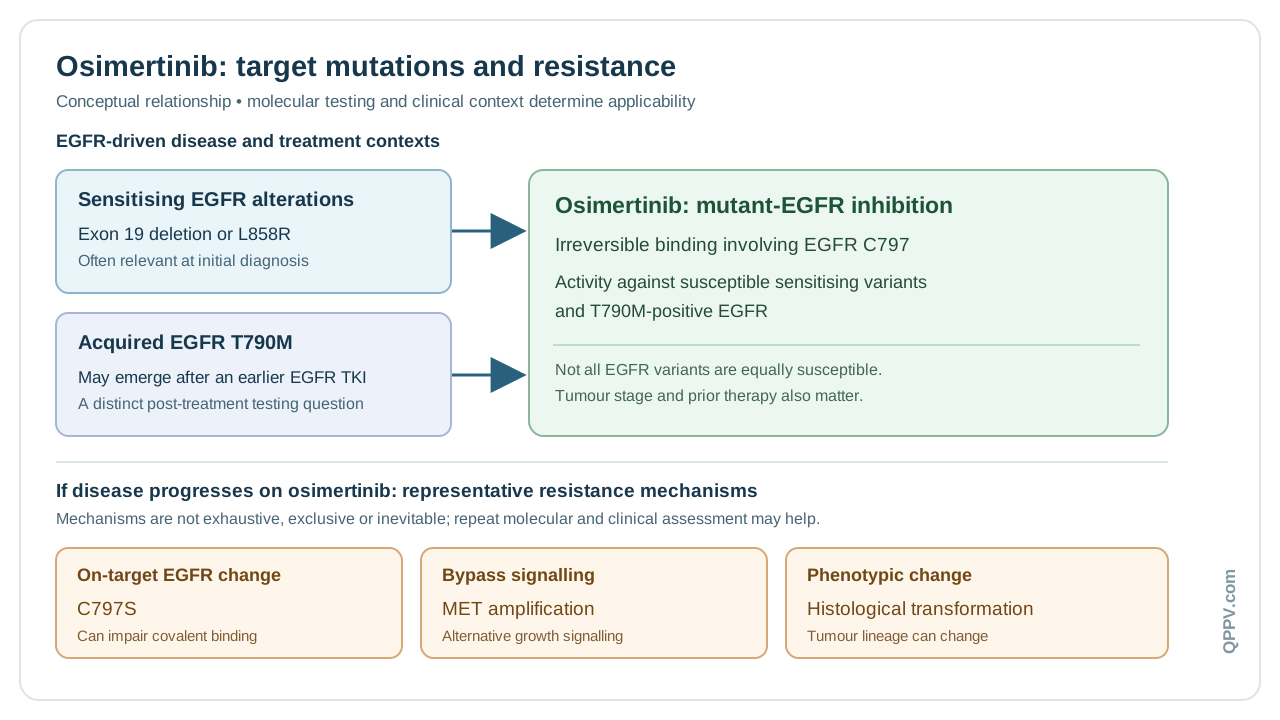
Figure 1. Ex19del/L858R and T790M define different treatment questions. Osimertinib inhibits susceptible mutant EGFR, but acquired progression can arise through on-target change, bypass signalling or lineage transformation. Branches illustrate examples, not a mandatory sequence, complete taxonomy or treatment algorithm.
A report of 'osimertinib resistance' must distinguish tumour progression or lack of efficacy from an adverse drug reaction. Molecular progression is important for benefit–risk evaluation but does not automatically constitute an ICSR. Treatment changes can generate separate safety questions about drug interactions or combination toxicity.
4. AURA3: the original post-EGFR-inhibitor setting
The randomised AURA3 trial studied 419 patients with T790M-positive advanced NSCLC after progression on first-line EGFR inhibitor therapy. Median progression-free survival (PFS) was 10.1 months with osimertinib versus 4.4 months with platinum–pemetrexed chemotherapy (hazard ratio [HR] 0.30, 95% CI 0.23–0.41). The trial demonstrated a clinically important improvement in the time to progression or death; it should not be paraphrased as proving a 70% improvement in overall survival. The later US label reports an overall-survival HR of 0.87 (95% CI 0.67–1.12) for this comparison [2,6].
AURA3 addressed a particular sequence: a prior EGFR inhibitor, documented progression and a T790M-positive tumour. It did not establish that every EGFR-mutated tumour after every previous therapy benefits equally. The initial regulatory story is therefore about biomarker-specific acquired resistance, not a blanket 'third-line lung cancer' indication.
5. FLAURA: moving into first-line advanced disease
The FLAURA phase III trial randomised 556 previously untreated patients with Ex19del/L858R-positive advanced NSCLC to osimertinib or an earlier-generation EGFR inhibitor (gefitinib or erlotinib). Median PFS was 18.9 versus 10.2 months. With longer follow-up, median overall survival was 38.6 versus 31.8 months. The latter is a distinct outcome from PFS, and its survival comparison must not be substituted into AURA3 or the post-chemoradiation LAURA setting [5,8].
This first-line indication changed the population exposed to osimertinib: patients no longer needed to develop T790M on another inhibitor first. Its CNS activity is relevant to the clinical choice, but CNS endpoints and patient selection require separate interpretation. Regional product information can differ in wording; for example, the EU first-line monotherapy indication refers to activating EGFR mutations in locally advanced or metastatic NSCLC, while the US label specifically identifies Ex19del/L858R in metastatic disease [1,2].
6. ADAURA: adjuvant therapy after complete resection
In ADAURA, patients with completely resected stage IB–IIIA NSCLC and Ex19del/L858R were randomised to adjuvant osimertinib or placebo, with or without prior adjuvant chemotherapy. The planned overall-survival analysis published in 2023 reported five-year survival of 88% versus 78% in the overall stage IB–IIIA population (HR 0.49, 95.03% CI 0.34–0.70) [9]. The clinical aim here is reducing recurrence and improving survival after curative-intent surgery, not treating radiographically measurable metastatic disease.
A September 2026 exploratory eight-year update, reported by the International Association for the Study of Lung Cancer and the sponsor, estimated 79% versus 64% overall survival in the stage IB–IIIA population (HR 0.52, 95% CI 0.39–0.71). The update is informative but must be labelled exploratory: not every surviving participant had new follow-up information, and some survival observations remained censored from the prior planned analysis [10]. These figures are not interchangeable with the five-year prespecified analysis.
The US adjuvant label allows treatment for up to three years, unless recurrence or unacceptable toxicity occurs [2]. Longer exposure among patients who may be disease-free makes treatment burden, persistent adverse reactions, fertility concerns and follow-up particularly important to benefit–risk discussions.
7. FLAURA2: combination with platinum–pemetrexed
FLAURA2 compared first-line osimertinib plus platinum–pemetrexed with osimertinib alone in 557 patients with Ex19del/L858R-positive advanced NSCLC. The initial PFS analysis reported 25.5 versus 16.7 months (HR 0.62, 95% CI 0.49–0.79). A subsequently published final overall-survival analysis found median survival of 47.5 versus 37.6 months (HR 0.77, 95% CI 0.61–0.96) [11,12].
The improved survival came with greater toxicity burden: grade 3 or higher adverse events of any cause occurred in 70% versus 34%, and adverse events leading to osimertinib discontinuation in 12% versus 7% in the final analysis [12]. Those are trial-arm results for combination versus monotherapy, not intrinsic osimertinib-only toxicity rates. Myelosuppression and renal laboratory changes may arise from the chemotherapy component, the cancer, supportive care or their interactions. Attribution should preserve the full regimen.
8. LAURA: treatment after chemoradiotherapy
The LAURA phase III trial randomised 216 patients with unresectable stage III Ex19del/L858R-positive NSCLC without progression after definitive platinum-based chemoradiotherapy. Median PFS was 39.1 months with osimertinib versus 5.6 months with placebo (HR 0.16, 95% CI 0.10–0.24). Overall-survival data were immature at the reported interim analysis; this PFS result must not be converted into a proven overall-survival gain [14,15].
The US FDA approved this setting on 25 September 2024 [15]. The 2026 EMA EPAR likewise lists post-chemoradiation monotherapy in the appropriate molecularly selected population [1]. Importantly, prior thoracic irradiation complicates assessment of interstitial lung disease (ILD) and pneumonitis; the US label contains different interruption/discontinuation instructions for recent definitive chemoradiotherapy than for patients without that exposure [2]. The treatment setting is therefore a safety determinant, not just an efficacy label.
9. Safety interpretation must follow the treatment setting
The US DailyMed label updated 14 September 2026 and the EMA product information last updated 18 August 2026 provide current regulatory anchors [1,2]. Common reactions during osimertinib monotherapy include diarrhoea, rash, nail changes, dry skin, stomatitis and fatigue. A reported adverse-event percentage has a denominator and clinical setting. Rates from adjuvant monotherapy, advanced disease, chemotherapy combinations and post-chemoradiation treatment must not be combined into one undifferentiated 'osimertinib risk' [2].
9.1 ILD and pneumonitis: drug, radiation and infection
Interstitial lung disease (ILD)/pneumonitis is a potentially severe and fatal risk. The September 2026 US label reports ILD/pneumonitis in 4% of 1,813 monotherapy recipients without recent definitive chemoradiotherapy; the label reports a 0.4% fatal-event proportion. In FLAURA2 combination recipients, the label reports 3.3% of 276 patients, with a 0.4% fatal-event proportion [2].
In LAURA, the label groups ILD/pneumonitis including radiation pneumonitis: 56% of 143 osimertinib recipients versus 38% of 73 placebo recipients following chemoradiotherapy. These figures cannot be compared directly with the 4% non-chemoradiation result as if the endpoint definition and baseline lung injury were identical [2,14].
US label instructions differ by setting. Outside recent definitive chemoradiotherapy, diagnosed ILD/pneumonitis leads to permanent discontinuation. Following recent definitive platinum-based chemoradiotherapy, grade 1 cases may be managed differently, whereas diagnosed grade 2 or higher ILD/pneumonitis requires permanent discontinuation [2]. These are US product-label provisions, not a universal clinical algorithm. The relevant local SmPC and specialist assessment remain essential.
Case assessment should reconstruct symptom onset, oxygen requirement, imaging, radiation fields and dates, infectious investigations, other pneumotoxic medicines, tumour progression and treatment interruption. Imaging alone may not distinguish drug-induced ILD, radiation pneumonitis and infection.
9.2 QTc prolongation and cardiomyopathy
The US label warns of QTc interval prolongation and advises ECG and electrolyte monitoring for patients with risk factors or QT-prolonging medicines [2]. Follow-up should record the correction formula, baseline and event ECGs, potassium, magnesium, cardiac symptoms and co-medication chronology. An asymptomatic QTc increase and a confirmed ventricular arrhythmia are different safety endpoints.
Cardiomyopathy is a separate labelled risk; the US label reports it in 3.8% of the described population and recommends left ventricular ejection fraction (LVEF) assessment for patients with cardiac risk factors [2]. A report needs baseline and follow-up LVEF, heart-failure symptoms, cardiac imaging, coronary history and prior cardiotoxic treatment. Alternative causes should be assessed before concluding that every decline in LVEF represents direct medicine toxicity.
9.3 Skin, ocular and haematological safety
Common EGFR-inhibitor skin and nail toxicity must be distinguished from erythema multiforme major, Stevens–Johnson syndrome and toxic epidermal necrolysis, all addressed in US labelling, as is cutaneous vasculitis [2]. Reports should include diagnostic findings, mucosal involvement, photographs where available, biopsy and relevant co-medications. A mild acneiform eruption is not a diagnosis of SJS.
Keratitis requires ophthalmological assessment when symptoms suggest corneal injury. Aplastic anaemia warrants careful evaluation because cytopenias can also arise from chemotherapy, marrow disease or infection. The US label recommends complete blood count with differential before treatment and periodically thereafter; confirmed aplastic anaemia requires permanent discontinuation under that label [2].
9.4 September 2026 update: myalgia or myositis with CPK elevation
The September 2026 US label revision added an explicit warning on myalgia or myositis with creatine phosphokinase (CPK) elevation. In a pooled monotherapy safety population of 1,813 patients, the label reports myalgia in 4.8%, grade 3 myalgia in 0.1%, myalgia with concurrent CPK elevation in 0.1%, and grade 1 myositis in 0.2%. Rhabdomyolysis has been reported postmarketing; its frequency cannot reliably be calculated from voluntary reports [2].
The updated US instructions advise patients to report unexplained muscle pain or tenderness and call for CPK monitoring periodically and when clinically indicated. Follow-up should capture weakness, CPK time course, renal function, recent exertion, relevant medicines and competing diagnoses. Myalgia, myositis, CPK elevation and rhabdomyolysis are not interchangeable diagnoses. This recent change also illustrates why a 2024 label cannot substitute for current 2026 safety information.
9.5 Reproductive and special-population considerations
Animal findings and mechanism support a warning of embryo-fetal harm. The US label includes contraception and lactation counselling [2]. A report involving pregnancy needs gestational timing, actual exposure, maternal cancer history, other anticancer medicines, pregnancy outcome and neonatal follow-up where available. An exposed pregnancy without a reported adverse outcome should not be recast as a congenital-anomaly case.
Age, renal and hepatic function, prior anticancer therapy and performance status affect interpretation of safety. Consult the current regional label before inferring dose recommendations for special populations.
10. Interactions and administration: product-specific questions
The US label identifies strong CYP3A inducers as a clinically important cause of reduced osimertinib exposure; it recommends avoiding coadministration and provides a specific contingency in circumstances where coadministration cannot be avoided [2]. This is a label-specific recommendation, not permission to improvise treatment changes. Drug reconciliation should include anticonvulsants, antimicrobials and herbal preparations.
Osimertinib may increase exposure to certain BCRP and P-glycoprotein substrates. The label also addresses concurrent medicines with known QT-prolonging potential [2]. In a case report, distinguish an interaction causing toxicity from reduced drug exposure and apparent treatment failure. The exact concomitant medicine, start and stop dates, indication, relevant laboratory values and pharmacological plausibility are necessary.
The current US product is available as 40 mg and 80 mg tablets. The usual labelled osimertinib regimen for the principal adult settings is once daily; duration and modifications depend on the setting. The US adjuvant regimen is limited to up to three years, while advanced-disease and post-chemoradiation regimens have different stopping conditions [2]. Do not transfer one setting's treatment duration to another.
11. Safety of a combination is not the sum of two isolated labels
When osimertinib is combined with pemetrexed and platinum chemotherapy, the safety profile includes overlapping adverse effects and distinct chemotherapy toxicities. Neutropenia, thrombocytopenia, anaemia, renal laboratory abnormalities and infection may have several contributors. The fact that a regimen is authorised does not establish that every event in its trial arm is caused by osimertinib [2,11,12].
For aggregate assessment, preserve a separate denominator for monotherapy, combination therapy and post-chemoradiation use. Where a regulator updates a monotherapy warning, determine whether it applies across settings and how the local product information expresses it. Differences in ascertainment, treatment duration, patient selection and adverse-event definitions can create apparent differences that are not causal comparisons.
12. The boundary between treatment efficacy and medicine safety
Progressive cancer, drug resistance and absence of expected response can be clinically serious without being adverse drug reactions. They can nevertheless require investigation under applicable reporting and quality systems. A suspected lack-of-efficacy case should document baseline tumour genotype, treatment history, adherence, drug interactions, imaging, the definition of progression and any repeat molecular findings. The goal is to prevent a vague report of 'ineffective osimertinib' from obscuring a genuine safety or quality issue.
Conversely, a confirmed serious adverse reaction can occur during a period of excellent tumour response. Safety decisions cannot be made by substituting radiographic efficacy for tolerability.
13. Pharmacovigilance: reconstruct the clinical context first
For osimertinib, the same symptom can have a different meaning in a patient after thoracic radiotherapy, a patient receiving combination chemotherapy or a patient taking prolonged adjuvant monotherapy. Case intake should therefore capture treatment setting, tumour genotype, prior treatments, formulation, start date, interruptions, combination medicines and current disease status before detailed causality discussion.
| Suspected event | Minimum useful clinical detail | Distinguishing considerations |
|---|---|---|
| Dyspnoea, cough, pneumonitis | Oxygenation, chest imaging, onset, CT pattern, radiotherapy dates and fields | Infection, radiation injury, tumour progression, pulmonary embolism |
| QTc prolongation or arrhythmia | Serial ECGs, correction method, electrolytes, co-medications | Pre-existing cardiac disease, electrolyte loss, QT-prolonging supportive care |
| Heart failure or LVEF decline | Baseline and follow-up LVEF, symptoms, cardiac evaluation | Previous cardiotoxic treatment, ischaemia, other causes |
| Cytopenia or suspected aplastic anaemia | CBC trend, differential, marrow evaluation where performed, combination therapy | Chemotherapy, marrow infiltration, infection, nutritional deficits |
| Severe skin reaction | Morphology, mucosal involvement, biopsy/photographs, medication timeline | Infection, other culprit medicines, ordinary EGFR rash |
| Muscle pain or suspected myositis | CPK and renal function trend, weakness, other medicines, exertion | Musculoskeletal disease, exercise injury, other treatment |
| Suspected interaction or lack of efficacy | Full medication timeline, adherence, genotype, imaging, dispensing record | Enzyme induction, disease biology, nonadherence, supply issues |
| Pregnancy exposure | Gestational timing, other anticancer medicines, maternal and infant outcomes | Underlying malignancy, obstetric factors, incomplete follow-up |
These are recommended follow-up fields for clinically useful reports. They do not replace the jurisdiction's minimum criteria for a valid individual case safety report (ICSR) or create additional statutory deadlines.
Illustrative case: pulmonary symptoms after chemoradiotherapy
A patient with unresectable EGFR-mutated stage III NSCLC develops cough and new ground-glass changes after chemoradiotherapy and during osimertinib treatment. A report stating only 'pneumonitis after osimertinib' would omit the most important competing exposure. Follow-up should establish radiation completion, field distribution, clinical grade, infection work-up, oxygen need, radiological progression and treatment action. The LAURA safety population and US label's specific post-chemoradiation provisions are relevant, but they do not replace individual clinical judgement [2,14]. This is a hypothetical teaching case, not a real safety report.
Illustrative case: delayed muscle symptoms
A patient taking long-term osimertinib reports muscle pain and weakness with a raised CPK measurement. A useful narrative records the onset relative to treatment, actual CPK values and trend, renal findings, other medicines, exercise history, clinical diagnosis and response to treatment interruption if it occurred. The September 2026 label warning provides a basis for focused follow-up, but raised CPK does not alone prove inflammatory myositis [2]. This is also a hypothetical example.
14. Case processing and medical review
An oncology ICSR may originate from a clinician, patient, literature report, organised programme or regulatory exchange. Medical review should preserve the reporter's words while assigning the most specific supported clinical terms. When seriousness is established, assess the relevant jurisdictional expedited-reporting rules and applicable data-exchange processes. Do not infer a deadline from the seriousness of a hypothetical event alone.
Follow-up prioritisation should be clinically proportionate. New respiratory deterioration, suspected severe skin reactions, arrhythmia, aplastic anaemia or clinically significant muscle injury may require prompt medical attention independent of the administrative reporting workflow. Pharmacovigilance personnel document the information and escalation; they do not substitute for the treating oncologist.
Where there are multiple suspected medicines, preserve each exposure and clinical chronology. Duplicate checking should consider different reporter channels, oncology registries and follow-up submissions without suppressing medically important new information.
15. Regulatory governance and risk minimisation
The EU pharmacovigilance system applies the relevant legal framework and current GVP guidance for case management, signal detection, periodic benefit–risk evaluation and risk management. These obligations should be interpreted through the applicable marketing authorisation and product-specific documentation, not through assumptions about the sponsor's internal standard operating procedures.
Practical governance connects the case narrative to medical coding, signal review, aggregate exposure, literature monitoring, quality complaints, labelling changes and risk-minimisation effectiveness. A QPPV should be able to trace what evidence triggered escalation, how uncertainty was handled and why the resulting action was proportionate. Product-specific safety changes such as the 2026 US CPK warning should prompt assessment of local regulatory applicability, case follow-up forms, medical information and relevant training rather than automatic copying of US text into EU documents.
An important limitation is that spontaneous reports cannot establish incidence. Changes in treatment indications, publicity around a new warning, combination prescribing and longer survival can all change reporting volume. Disproportionality may identify an issue for investigation, not prove a causal effect.
16. Reading evidence across indications
AURA3 established progression-free survival benefit after earlier EGFR-inhibitor treatment in patients with T790M-positive disease. FLAURA studied first-line treatment of advanced Ex19del/L858R-positive disease. ADAURA evaluated adjuvant treatment after complete resection. FLAURA2 compared an osimertinib–chemotherapy combination with osimertinib alone, and LAURA studied treatment after chemoradiotherapy for unresectable stage III disease [5,6,9,11,12,14].
These studies cannot be ranked using an isolated hazard ratio. They have different comparators, patient populations, treatment objectives, follow-up durations and endpoints. The adjuvant trial's overall survival estimate is not an efficacy estimate for patients with metastatic cancer. Likewise, the LAURA trial's post-chemoradiotherapy pulmonary safety results should not be substituted for the monotherapy population without prior thoracic irradiation.
17. Practical quality checks and open questions
A useful medical-review checklist asks whether the exact EGFR alteration was confirmed; whether treatment was adjuvant, advanced, combined with chemotherapy or given after chemoradiotherapy; whether relevant co-medications and prior radiotherapy were recorded; whether the event has a supported diagnosis; and whether the current local label was checked.
Acquired resistance is heterogeneous, and a single liquid-biopsy result may not capture the full tumour biology. Long-term adjuvant exposure changes the population living with treatment-related symptoms. The 2026 exploratory ADAURA update adds information but has limitations from incomplete extended follow-up [10]. The newer US muscular warning requires continued assessment of clinical presentation and risk minimisation [2].
Key Takeaways
Osimertinib began as a targeted answer to EGFR T790M resistance, then acquired distinct evidence and authorisations in first-line advanced disease, adjuvant treatment after resection, combination chemotherapy and the post-chemoradiation setting. Its benefits must be attributed to the correct trial and endpoint. Major safety considerations include ILD/pneumonitis, QTc changes, cardiomyopathy, serious skin reactions, keratitis, aplastic anaemia and the September 2026 US warning for myalgia/myositis with CPK elevation. Effective pharmacovigilance begins with the patient's treatment setting and full exposure history.
References
- European Medicines Agency. Tagrisso (osimertinib): EPAR and product information. Product information updated 18 August 2026. https://www.ema.europa.eu/en/medicines/human/EPAR/tagrisso
- US National Library of Medicine DailyMed. Tagrisso (osimertinib) tablets: US prescribing information. Updated 14 September 2026. https://www.dailymed.nlm.nih.gov/dailymed/drugInfo.cfm?setid=5e81b4a7-b971-45e1-9c31-29cea8c87ce7
- Finlay MRV, et al. Discovery of a potent and selective EGFR inhibitor (AZD9291) of both sensitizing and T790M resistance mutations that spares the wild type form of the receptor. J Med Chem. 2014;57:8249–8267. https://doi.org/10.1021/jm500973a
- Cross DAE, et al. AZD9291, an irreversible EGFR TKI, overcomes T790M-mediated resistance to EGFR inhibitors in lung cancer. Cancer Discovery. 2014;4:1046–1061. https://doi.org/10.1158/2159-8290.CD-14-0337
- Soria J-C, et al. Osimertinib in untreated EGFR-mutated advanced non-small-cell lung cancer. N Engl J Med. 2018;378:113–125. https://doi.org/10.1056/NEJMoa1713137
- Mok TS, et al. Osimertinib or platinum–pemetrexed in EGFR T790M-positive lung cancer. N Engl J Med. 2017;376:629–640. https://doi.org/10.1056/NEJMoa1612674
- FDA benefit-risk assessment of osimertinib for metastatic NSCLC harbouring EGFR T790M mutation. The Oncologist. 2018. https://pmc.ncbi.nlm.nih.gov/articles/PMC5905690/
- US National Cancer Institute. Osimertinib improves survival in advanced lung cancer with EGFR mutations. 12 December 2019. https://www.cancer.gov/news-events/cancer-currents-blog/2019/osimertinib-lung-cancer-improves-survival-flaura
- Tsuboi M, et al. Overall survival with osimertinib in resected EGFR-mutated NSCLC. N Engl J Med. 2023;389:137–147. https://doi.org/10.1056/NEJMoa2304594
- International Association for the Study of Lung Cancer. Eight-year ADAURA update: sustained overall survival benefit with adjuvant osimertinib. 14 September 2026; exploratory landmark analysis. https://www.iaslc.org/iaslc-news/press-release/eight-year-adaura-update-shows-sustained-overall-survival-benefit-adjuvant
- US FDA. FDA approves osimertinib with chemotherapy for EGFR-mutated non-small-cell lung cancer. 16 February 2024. https://www.fda.gov/drugs/resources-information-approved-drugs/fda-approves-osimertinib-chemotherapy-egfr-mutated-non-small-cell-lung-cancer
- Planchard D, et al. Survival with osimertinib plus chemotherapy in EGFR-mutated advanced NSCLC. N Engl J Med. 2025. https://doi.org/10.1056/NEJMoa2510308
- Zeng Y, et al. Resistance mechanisms to osimertinib and emerging therapeutic strategies in nonsmall cell lung cancer. Curr Opin Oncol. 2022;34:54–65. https://doi.org/10.1097/CCO.0000000000000805
- Lu S, et al. Osimertinib after chemoradiotherapy in stage III EGFR-mutated NSCLC. N Engl J Med. 2024. https://doi.org/10.1056/NEJMoa2402614
- US FDA. FDA approves osimertinib for locally advanced, unresectable stage III NSCLC following chemoradiation. 25 September 2024. https://www.fda.gov/drugs/resources-information-approved-drugs/fda-approves-osimertinib-locally-advanced-unresectable-stage-iii-non-small-cell-lung-cancer
Regulatory Note
Educational review prepared 22 October 2026. The US label updated 14 September 2026 and EMA product information updated 18 August 2026 were consulted. US and EU indications, warnings and regulatory dates are distinguished; one region's wording must not be applied automatically to another. Trial efficacy, product warnings, scientific hypotheses, recommended case follow-up and binding pharmacovigilance obligations are different evidence categories. Illustrative cases are hypothetical and this article is not individual treatment advice.