Palbociclib: Discovery, Development, Safety and Pharmacovigilance
Palbociclib is an oral, selective inhibitor of cyclin-dependent kinases 4 and 6 (CDK4/6), developed as PD-0332991 and commercialised by Pfizer as Ibrance. Its arrival changed the treatment of hormone-receptor-positive (HR-positive), HER2-negative advanced breast cancer: inhibiting a cell-cycle checkpoint alongside endocrine treatment delayed progression more effectively than endocrine treatment alone. The subsequent history is less linear. The pivotal advanced-disease trials improved progression-free survival (PFS), but their final overall-survival analyses did not establish a statistically significant survival advantage; two major adjuvant trials were negative. Later, combinations with a PI3K inhibitor and with HER2-directed maintenance treatment opened distinct US indications. These are different clinical questions, not interchangeable demonstrations of benefit [1–13].
Palbociclib is also an instructive pharmacovigilance product. Myelosuppression is common and requires a cycle-aware complete-blood-count (CBC) schedule; serious infection and interstitial lung disease (ILD) demand prompt assessment; drug interactions can alter exposure; and combination regimens create attribution problems. This article uses the US Ibrance tablet prescribing information effective 6 July 2026 and the EU Ibrance product information last updated 7 March 2025, accessed 26 October 2026, as explicit regional reference points [1,2]. Their differences matter, particularly after the 2024 and 2026 US indication changes.
- Palbociclib: Discovery, Development, Safety and Pharmacovigilance
- Discovery: a selective cell-cycle inhibitor
- Mechanism: the importance of RB and endocrine context
- Pharmacokinetics, formulations and exposure
- PALOMA: efficacy established in advanced HR-positive, HER2-negative disease
- The 2024–26 expansion into biomarker and HER2-defined combinations
- Regulatory and commercial lifecycle in context
- Safety profile: marrow suppression and the cycle clock
- Listedness against current public US and EU product information
- Drug interactions and special populations
- Case assessment: the clinical timeline is the evidence
- Signal detection, benefit–risk and EU governance
- Common interpretation errors
- Pharmacovigilance checklist
- Key takeaways
- References
- Regulatory Note
Discovery: a selective cell-cycle inhibitor
The scientific rationale predates the drug. D-type cyclins activate CDK4 and CDK6, which phosphorylate the retinoblastoma protein (RB), permitting E2F-dependent transcription and progression through the G1-to-S cell-cycle checkpoint. The hypothesis was that a tumour retaining a functional RB checkpoint might be arrested by selective inhibition of these kinases. Earlier broad-spectrum CDK inhibitors made selectivity a central medicinal-chemistry problem: inhibiting unrelated CDKs could add toxicity without providing the desired therapeutic window [3,4].
Palbociclib emerged from a Parke-Davis medicinal-chemistry programme later developed within Pfizer after its acquisition of Warner-Lambert. Toogood and colleagues reported optimisation of a pyrido[2,3-d]pyrimidin-7-one scaffold; a 2-aminopyridine substitution improved selectivity, and compound 43, PD-0332991, became the clinical candidate. Fry and colleagues reported inhibition of CDK4 and CDK6 at approximately 11 and 16 nmol/L in biochemical assays, respectively, with G1 arrest in RB-positive experimental systems. These are preclinical assay values, not concentrations needed in patients or proof of activity in every tumour [3,4].
The molecule's development was not a licensing story involving a later acquired independent originator: the Parke-Davis/Warner-Lambert origin and subsequent Pfizer programme explain its corporate lineage. Public histories describe an extended interval between early discovery and focused breast-cancer development. The robust documentary milestones are the 2004–05 preclinical publications, PALOMA-1, and the 2015 US accelerated approval. Claims about exact internal development decisions or financial value should not be inferred from the interval [3–5].
Mechanism: the importance of RB and endocrine context
Palbociclib competitively inhibits the ATP-binding activity of CDK4/6, reducing RB phosphorylation and downstream E2F-dependent cell-cycle entry. Endocrine therapy decreases oestrogen-driven proliferative signalling; palbociclib acts at a downstream checkpoint. This mechanistic complementarity explains why it was developed with letrozole, other aromatase inhibitors or fulvestrant rather than simply replacing endocrine treatment. Functional RB is relevant to preclinical sensitivity, but routine clinical decisions should follow validated biomarkers and the authorised indication, not an improvised RB assay threshold [1,3,4].
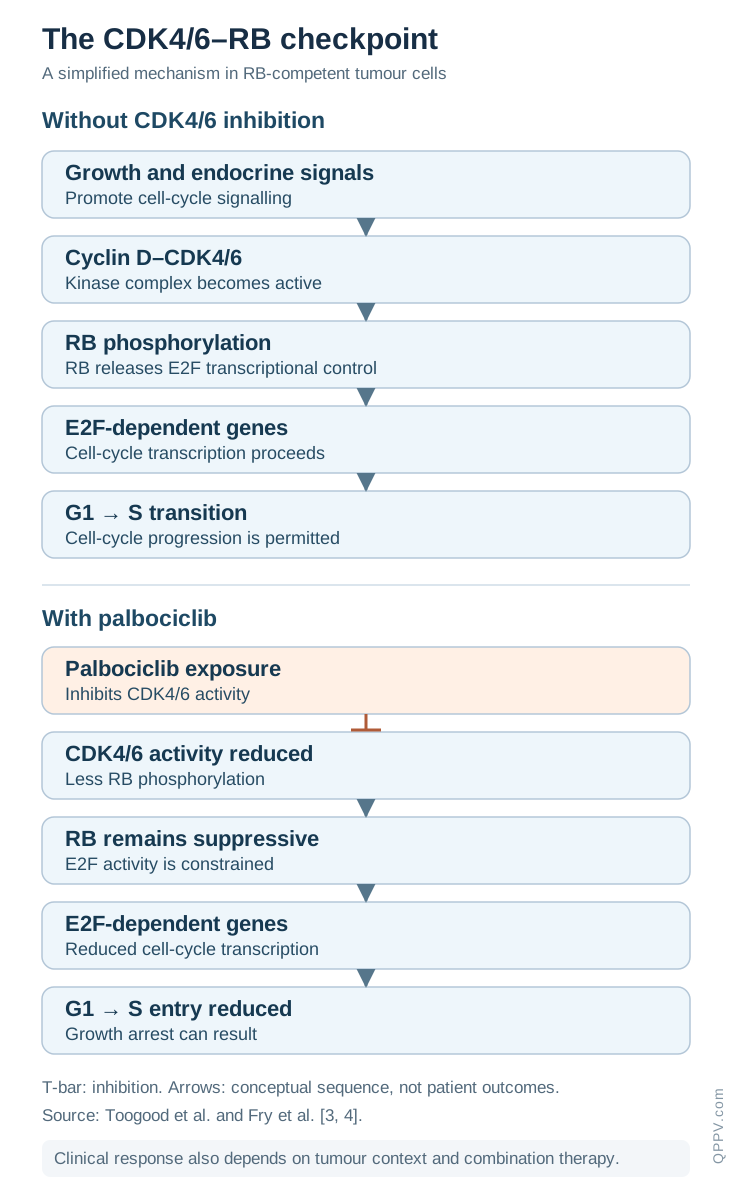
Figure 1. Simplified RB-dependent cell-cycle pathway. Endocrine signalling can promote cyclin D–CDK4/6 activity; palbociclib inhibits CDK4/6-mediated RB phosphorylation and reduces E2F-driven G1-to-S progression. The diagram illustrates a mechanism, not a clinical response prediction or an assertion that all breast tumours retain functional RB.
A consequence of this mechanism is predictable suppression of dividing marrow precursors. Neutropenia is often reversible during treatment interruption, but the degree of neutrophil reduction is not a surrogate for antitumour response. A patient can have profound laboratory neutropenia without fever, or a clinically important infection with less marked cytopenia. The distinction determines monitoring, case coding and management [1,2].
Pharmacokinetics, formulations and exposure
Palbociclib is given orally on a 21-days-on, seven-days-off schedule within a 28-day cycle. The usual starting dose is 125 mg daily, with dose reductions to 100 mg and then 75 mg for toxicity under the relevant product label. It is metabolised mainly by CYP3A and SULT2A1 and is a time-dependent weak inhibitor of CYP3A. Strong CYP3A inhibitors can raise palbociclib exposure; strong inducers can reduce it. A case reviewer should obtain a dated medication reconciliation, including antifungals, macrolides, antiepileptics, herbal products and changes in prescriptions during the event window [1,2].
Formulation is a safety variable. US Ibrance tablets can be taken with or without food, whereas the capsules should be taken with food. Both must be swallowed intact. Acid-suppression effects are particularly important when evaluating capsule exposure: fasting plus a proton-pump inhibitor can reduce absorption; the tablet and capsule should not be treated as identical in a drug-interaction narrative. The EU SmPC includes both capsule and tablet presentations, with formulation-specific instructions. Product identification, formulation, strength, meal timing and concurrent acid suppressants therefore belong in the exposure history [1,2,14].
The half-life is approximately 29 hours, but this does not justify calculating an unsupervised catch-up regimen. If a dose is missed or vomiting follows administration, the labels instruct against taking an additional dose that day; the next dose is taken at the scheduled time. For a medication-error case, record what was actually swallowed rather than assuming adherence from dispensing records [1,2].
PALOMA: efficacy established in advanced HR-positive, HER2-negative disease
PALOMA-1 and the first regulatory decision
PALOMA-1/TRIO-18 was a randomised, open-label phase II study in 165 postmenopausal women with ER-positive, HER2-negative advanced breast cancer. Palbociclib plus letrozole produced a median PFS of 20.2 months, versus 10.2 months with letrozole alone (hazard ratio 0.488; 95% CI 0.319–0.748). The small study supported FDA accelerated approval on 3 February 2015. The original decision depended on the expectation that a larger confirmatory trial would characterise benefit more robustly; accelerated approval was not equivalent to evidence of an overall-survival benefit [5,6].
The PALOMA-1 final survival analysis did not demonstrate a statistically significant overall-survival improvement. This is an important example of why the first positive efficacy endpoint and later mature survival findings must both appear in a lifecycle account, with their designs and uncertainty preserved [6].
PALOMA-2: confirmatory PFS, but no proven OS gain
PALOMA-2 randomised 666 postmenopausal women to palbociclib plus letrozole or placebo plus letrozole as initial treatment for advanced ER-positive, HER2-negative disease. At the primary analysis, median investigator-assessed PFS was 24.8 versus 14.5 months (hazard ratio 0.58; 95% CI 0.46–0.72). This trial confirmed a clinically important delay in progression and supported regular US approval in 2017 [7].
The 2024 final OS report did not show a statistically significant improvement: median OS was 53.9 versus 51.2 months (HR 0.96; 95% CI 0.78–1.18). Interpretation was limited by unequal proportions with unknown survival status. An analysis using recovered survival data also remained non-significant. It would be incorrect either to advertise a demonstrated survival advantage from PALOMA-2 or to conclude that the trial proved there is no survival benefit of any size [8].
PALOMA-3: disease control after endocrine progression
PALOMA-3 enrolled 521 patients with HR-positive, HER2-negative advanced breast cancer after prior endocrine therapy. Palbociclib plus fulvestrant improved PFS compared with placebo plus fulvestrant. In the updated trial analysis reflected in current US product information, median PFS was 9.5 versus 4.6 months, with a hazard ratio of approximately 0.46. Earlier publications used different data cutoffs and reported different medians; these should not be blended as if they were one analysis [1,9].
The prespecified OS analysis reported 34.9 versus 28.0 months (HR 0.81; 95% CI 0.64–1.03), a numerical difference that did not meet conventional statistical significance in the overall intention-to-treat population. Later exploratory analyses and endocrine-sensitive subgroups are scientifically interesting but cannot retroactively turn the prespecified overall-population result into a definitive positive trial [10].
The negative adjuvant programme: PALLAS and PENELOPE-B
Advanced-disease PFS success did not translate into a universal early-breast-cancer indication. In PALLAS, adding two years of palbociclib to adjuvant endocrine therapy did not improve invasive disease-free survival (four-year iDFS 84.2% versus 84.5%; HR 0.96; 95% CI 0.81–1.14). PENELOPE-B, studying one year of palbociclib after neoadjuvant chemotherapy in high-risk residual HR-positive, HER2-negative disease, also failed its primary iDFS endpoint (HR 0.93; 95% CI 0.74–1.17) [11,12].
These negative results constrain indication claims and benefit–risk arguments. High discontinuation and treatment exposure were debated, but a post hoc explanation cannot replace the prespecified trial results. Other CDK4/6 inhibitors have different adjuvant evidence; a class mechanism does not authorise palbociclib in early breast cancer. For pharmacovigilance, off-label adjuvant exposure must be captured as a distinct treatment setting rather than merged into the approved advanced-disease denominator.
The 2024–26 expansion into biomarker and HER2-defined combinations
INAVO120: a PI3K inhibitor added to palbociclib–fulvestrant
On 10 October 2024, FDA approved inavolisib with palbociclib and fulvestrant for a narrowly defined population: adults with endocrine-resistant, PIK3CA-mutated HR-positive, HER2-negative locally advanced or metastatic breast cancer following recurrence on or after adjuvant endocrine therapy. INAVO120 compared the addition of inavolisib with placebo, both on a palbociclib–fulvestrant backbone. Median PFS was 15.0 versus 7.3 months (HR 0.43; 95% CI 0.32–0.59). The 2025 final OS analysis showed 34.0 versus 27.0 months (HR 0.67; 95% CI 0.48–0.94), meeting the trial's specified statistical boundary [13,15].
That OS benefit estimates the incremental effect of adding inavolisib to the common backbone in the trial population. It is not evidence that palbociclib alone improved OS by seven months. The regimen also introduces clinically important inavolisib-associated hyperglycaemia, stomatitis and gastrointestinal toxicity. A triplet-regimen safety report should document each agent, the molecular test and any interruption separately [1,13,15].
PATINA: maintenance treatment after induction in HR-positive, HER2-positive disease
PATINA asked a different question. Adults with HR-positive, HER2-positive advanced breast cancer without progression after induction taxane and HER2-directed therapy were randomised to maintenance trastuzumab, with or without pertuzumab, plus endocrine therapy with or without palbociclib. The phase III study randomised 518 patients. Investigator-assessed PFS favoured palbociclib (HR 0.76; 95% CI 0.59–0.97); OS data were immature at the regulatory analysis. Median PFS was not reliably estimable in the FDA review because of censoring. Patients progressing during induction were not represented in the randomised comparison [16,17].
On 24 June 2026, FDA approved palbociclib for this specific maintenance combination after induction. The June 2026 US label incorporates PATINA safety findings; the EU March 2025 product information does not contain this indication. The result does not authorise palbociclib monotherapy, all HER2-positive metastatic presentations or adjuvant HER2-positive disease [1,2,16,17].
Regulatory and commercial lifecycle in context
Pfizer's US accelerated authorisation in February 2015, EU authorisation on 9 November 2016, and subsequent US extensions show how indication scope can change while the same INN remains in use [1,2,5,18]. Palbociclib was initially supplied as capsules and subsequently as tablets, adding an important product-identification and food-effect distinction. Its commercial relevance lies in establishing CDK4/6 inhibition as a major therapeutic approach; no revenue figure or unverified global INN sales ranking is needed to explain the safety lifecycle.
| Clinical setting | Main supporting evidence | Interpretive limit |
|---|---|---|
| HR-positive, HER2-negative advanced disease, initial endocrine therapy | PALOMA-1 and PALOMA-2 PFS | PALOMA-2 final OS not statistically significant |
| HR-positive, HER2-negative progression after endocrine therapy | PALOMA-3 PFS | Overall-population OS did not meet prespecified significance |
| Early HR-positive, HER2-negative adjuvant disease | PALLAS and PENELOPE-B | Both failed primary iDFS endpoints; no extrapolated palbociclib adjuvant indication |
| PIK3CA-mutated endocrine-resistant advanced disease | INAVO120 | Benefit tests inavolisib added to palbociclib–fulvestrant; US-specific regimen |
| HR-positive, HER2-positive advanced disease after induction | PATINA | Maintenance-selected population; US 2026 approval, OS immature |
Safety profile: marrow suppression and the cycle clock
Neutropenia, febrile neutropenia and infection
Neutropenia is the defining common toxicity. In the EU SmPC's pooled PALOMA dataset of 872 palbociclib-exposed patients, neutropenia occurred in 82.1%, including Grade 3 in 57.3% and Grade 4 in 11.1%; median time to first neutropenia was 15 days, and median duration of Grade 3 or higher neutropenia was seven days. These figures are tied to a defined pooled clinical-trial population and must not be presented as population-wide postmarketing incidence or applied without adjustment to the newer PATINA and INAVO120 regimens [2].
Both regional labels call for CBC before starting treatment, at the start of each cycle, on Day 15 of cycles 1 and 2, and as clinically indicated; monitoring may be less frequent later in selected patients meeting label criteria. The US label reports febrile neutropenia in 1.8% across PALOMA-2/3 and 0.8% in PATINA, and one neutropenic-sepsis death in PALOMA-3. These are different denominators and clinical contexts [1].
For a safety case, establish the day within the 28-day cycle, actual ANC and trend, body temperature, infection workup, recent antimicrobials, concurrent marrow-suppressive drugs, G-CSF exposure, dose interruptions and recovery. A laboratory count alone does not establish febrile neutropenia. Conversely, an infection in a patient with apparently recovered ANC can remain serious. Follow the relevant label's grading and interruption algorithm rather than applying a generic class rule to every patient.
ILD and pneumonitis: a potentially fatal event
In September 2019, FDA announced a class-wide warning for rare but severe lung inflammation with CDK4/6 inhibitors [19]. Current US Ibrance labelling warns that severe or fatal ILD/pneumonitis can occur and calls for immediate interruption and evaluation of suspected cases, with permanent discontinuation for severe disease. The US label reports approximately 1% any-grade ILD/pneumonitis across PALOMA-1/2/3 and 1% in PATINA, while postmarketing fatalities have occurred. The EU SmPC uses a different pooled estimate (1.4% across PALOMA studies); this is a source/dataset difference, not evidence that EU patients intrinsically have greater risk [1,2].
Cancer-related lung disease, infection, pulmonary embolism, radiotherapy and other medicines may mimic drug-related pneumonitis. Obtain chest imaging and its pattern, oxygen requirement, microbiology, recent radiation, tumour status, timing of each systemic agent, steroid treatment and dechallenge. Where appropriate, distinguish pneumonitis from neutropenic pneumonia rather than coding every infiltrate as a single unspecified respiratory event.
Gastrointestinal, mucosal, skin and constitutional reactions
Fatigue, nausea, diarrhoea, stomatitis, alopecia, rash and appetite changes contribute to tolerability, dose reductions and adherence. In combination regimens, inavolisib adds a different pattern, particularly hyperglycaemia and stomatitis; HER2-directed antibodies and endocrine agents can contribute additional effects. An observed event during a triplet regimen is not automatically attributable to palbociclib. Record which drug was interrupted, whether others continued and the temporal response [1,2,13,15].
The EU SmPC lists palmar-plantar erythrodysaesthesia, cutaneous lupus erythematosus and erythema multiforme within its adverse-reaction table at different frequency categories. The US tablet label includes palmar-plantar erythrodysesthesia syndrome in section 6.2 postmarketing experience, where a reliable frequency cannot be estimated. These terms require careful case morphology and alternative-cause review; a coding term alone does not establish a characteristic drug eruption [1,2].
Venous thromboembolism, hepatic effects and laboratory findings
The EU SmPC's adverse-reaction table includes venous thromboembolism, and its warnings advise vigilance for deep-vein thrombosis and pulmonary embolism. Advanced malignancy itself, immobility and systemic therapy are important competing risks. US label tables contain laboratory abnormalities including aminotransferase increases and blood-creatinine increases, but a laboratory result is not synonymous with clinically diagnosed liver failure or kidney injury. Obtain actual values, timing, baseline disease and concomitant treatment before assigning a diagnosis [1,2].
An important EU interaction warning concerns rhabdomyolysis with simvastatin or atorvastatin, including reported fatal cases, in the setting of CYP3A4/BCRP substrate exposure. This appears in the EU SmPC interaction section 4.5, not as an automatically frequency-estimable adverse reaction in section 4.8. In a suspected case, request the precise statin, CK trajectory, kidney function, muscle symptoms, CYP3A co-medications and dose changes [2].
Listedness against current public US and EU product information
Sources assessed (26 October 2026): US Ibrance film-coated tablets prescribing information, revised July 2026, DailyMed set ID 89a142d5-7e61-48bf-9e77-e2cd124c4792, effective 6 July 2026, sections 1, 5, 6.1, 6.2, 7 and 8 [1]; EU Ibrance capsules and tablets, EMA Annex I SmPC published 7 March 2025, sections 4.1–4.8 and 5.2 [2]. The 2026 US capsule label is a separate presentation; the food requirement is checked against that label as well [14]. These are public-label comparisons, not the sponsor's company-core safety information or case-specific reference safety information.
| Topic | US tablet USPI (July 2026) | EU Ibrance SmPC (March 2025) | PV interpretation |
|---|---|---|---|
| Neutropenia and infections | Section 5.1 warning; clinical-study adverse-reaction and laboratory tables in 6.1 | Section 4.4 warning; neutropenia, febrile neutropenia and infections tabulated in 4.8 | Listed in both, with different presentation and study denominators |
| ILD/pneumonitis | Section 5.2 warning; ILD/noninfectious pneumonitis in 6.2 postmarketing | Section 4.4 warning; ILD/pneumonitis in 4.8 | Listed in both; postmarketing frequencies cannot be inferred from US 6.2 |
| Stomatitis, nausea, diarrhoea, fatigue, alopecia | Trial adverse reactions in 6.1, regimen-specific tables | Tabulated in 4.8 | Listed in both; frequency comparisons require matching populations |
| Palmar-plantar erythrodysaesthesia | PPES in 6.2 postmarketing | PPES in 4.8, common | Listed in both but evidence/frequency format differs |
| Cutaneous lupus erythematosus and erythema multiforme | Not identified as named reactions in assessed US 6.1/6.2 | Uncommon in section 4.8 | Named in EU 4.8; not identified by those terms in the assessed US sections; do not infer absolute absence from US clinical experience |
| Venous thromboembolism | Not identified as a named reaction in assessed US 6.1/6.2 | Common in 4.8 and discussed in 4.4 | Listed in EU 4.8; not identified by that term in assessed US adverse-reaction sections |
| Statin-associated rhabdomyolysis | No corresponding named adverse reaction identified in assessed US 6.1/6.2 | Reported including fatal cases in interaction section 4.5 | Mentioned in EU interaction text, not classified here as a 4.8 listed adverse reaction |
| Authorised regimens | Includes PIK3CA-mutated inavolisib triplet and post-induction HER2-positive maintenance regimen | Assessed 4.1 restricted to HR-positive, HER2-negative locally advanced/metastatic disease with endocrine partners | Material indication divergence; do not transfer US combination safety denominators to EU label |
The phrase “not identified in the assessed US sections” is intentionally narrower than a global claim that a reaction is unlisted. The USPI and EU SmPC have different structures, study populations, terminology and revision dates. A listedness assessment for a specific ICSR must name the exact applicable reference document, its version and scope. Public-label presence does not decide expectedness under a company's reference safety information, does not prove causality, and does not determine a report's regulatory submission category. For the conceptual distinction, see Listedness, Expectedness and Reference Safety Information.
Drug interactions and special populations
Palbociclib exposure rises with strong CYP3A inhibitors such as certain azole antifungals and falls with strong inducers such as rifampicin. The US/EU labels advise avoiding these combinations where possible and contain specific dose-adjustment guidance if a strong inhibitor cannot be avoided. St John's wort is an explicit EU contraindication; the US tablet label's section 4 states no contraindications, while section 7 advises avoiding strong CYP3A inducers. This is a regulatory-language difference, not evidence of divergent underlying pharmacology [1,2].
Severe hepatic impairment calls for a reduced dose under both labels. Pregnancy is a concern because of embryo-fetal toxicity observed in animals and the mechanism of action; human pregnancy data are limited. The US label specifies effective contraception for females during therapy and at least three weeks after the last dose, and for males with female partners of reproductive potential for at least three months after the last dose. The EU SmPC specifies three weeks for females and 14 weeks for males after treatment. These differences must not be silently normalised. Breastfeeding is not recommended during treatment, with jurisdiction-specific timing for resumption [1,2].
For pre- or perimenopausal women, ovarian suppression accompanies relevant endocrine regimens. In men, US treatment is within the authorised adult population, but the supporting evidence and endocrine-partner considerations differ from the pivotal trials of postmenopausal women. Record sex, menopausal status, ovarian suppression, fertility counselling, pregnancy timing, organ impairment and exact concomitant medicines rather than treating every exposed person as an interchangeable PALOMA participant [1,2].
Case assessment: the clinical timeline is the evidence
The key operational distinction is between a known labelled risk, a suspected adverse reaction in one patient, and a new aggregate signal. A labelled event still needs clinical assessment and may have a competing cause. Conversely, an unusual event deserves investigation even when not named in a public label. A case's reportability is governed by the applicable regional rules and the report's circumstances; it is not determined solely by whether a term appears in an adverse-reaction table.
Illustrative case A: fever on Day 16
A patient receiving palbociclib plus letrozole reports fever on Day 16 of the first cycle. The ANC is markedly reduced and the patient is admitted. The case reviewer obtains baseline and Day 15 CBCs, temperature, cultures, antibiotics, comorbidities, timing of the last palbociclib dose and the clinical diagnosis. Neutropenia, febrile neutropenia, infection and sepsis should not be collapsed into one event unless the medical record supports the diagnosis. Hospitalisation and life-threatening complications are assessed under the applicable seriousness criteria; causality and expectedness are separate questions.
The clinical team follows the label's hold/restart algorithm and local febrile-neutropenia care. Pharmacovigilance captures dose reduction, treatment interruption and outcome, then asks whether this is an isolated anticipated toxicity, a medication error, or a cluster requiring further evaluation. A second report after a different cycle day may have a different exposure explanation.
Illustrative case B: dyspnoea during HER2-positive maintenance
A patient receives palbociclib, trastuzumab, pertuzumab and endocrine therapy after induction treatment and develops progressive dyspnoea. The clinical differential includes ILD, infection, pulmonary embolism, tumour progression and cardiac dysfunction associated with the overall treatment context. Review imaging, oxygenation, cardiac assessment, cultures, ANC, prior taxane exposure and all therapy dates. PATINA's population and combination should be recorded, rather than coding the case as an ordinary PALOMA endocrine doublet.
Immediate clinical management follows the relevant label and medical judgement. The safety narrative should identify which agents were interrupted and why; dechallenge of four simultaneous agents is not specific proof of palbociclib causality. Severe pneumonitis has a clear palbociclib discontinuation recommendation in US/EU labelling [1,2].
Illustrative case C: statin interaction and muscle injury
A patient taking atorvastatin begins palbociclib and develops myalgia, markedly increased CK and acute kidney injury. The EU SmPC explicitly describes reported rhabdomyolysis, including fatal cases, with atorvastatin or simvastatin [2]. The assessment requires statin dose and duration, recent CYP3A inhibitors, renal and thyroid history, CK and creatinine series, urine findings, other muscle injury causes and recovery. Document the interaction warning accurately as a section 4.5 statement; do not claim that every statin combination causes rhabdomyolysis or that the event has an established frequency.
Illustrative case D: a mistaken off-week
A patient takes palbociclib continuously for 28 days instead of observing the seven-day interruption and presents with severe neutropenia. Record the dispensed calendar pack, label instructions, caregiver involvement, actual doses, whether the patient confused tablet and capsule instructions, and any advice given after missed doses. The medication error, resulting exposure and clinical harm are distinct report elements. A correct prescription alone does not establish that administration was correct.
Signal detection, benefit–risk and EU governance
Routine safety monitoring should use several evidence streams rather than interpreting spontaneous-report counts as incidence. Clinical-trial and postauthorisation data differ in eligibility, follow-up, concomitant medicines and denominator quality. For palbociclib, useful case-series strata include formulation, cycle and dose, endocrine versus PI3K versus HER2 combination, disease stage, renal/hepatic impairment, CYP3A exposure and regional label version. These strata prevent a new-regimen event cluster from being concealed inside an older pooled PALOMA estimate.
A signal assessment should define the medical question and case definition before counting reports. For neutropenia, record grade, infection, intervention and recovery; for ILD, apply a consistent adjudication framework; for rhabdomyolysis, obtain CK, statin and interaction chronology; for severe stomatitis or hyperglycaemia, establish whether inavolisib was part of the regimen. Disproportionality may justify investigation but cannot establish causal incidence. Where possible, evaluate background oncology risk, concomitant agents, treatment duration and missing follow-up.
EU GVP provides the framework for signal management and periodic benefit–risk evaluation; company procedures implement these obligations with traceable roles, timelines and decisions. An internal recommendation to use a regimen-specific follow-up form is good operational practice, not an invented EU legal mandate. An inspection-ready record would show the initial concern, validated case definitions, reviewed sources, medical and statistical assessment, decision, regulatory communication if applicable, effectiveness follow-up and QPPV oversight. The latest US PATINA approval should trigger a documented review of the company's local surveillance stratification, not an assumption that EU authorisation has automatically changed.
Common interpretation errors
| Error | Why it matters | Better practice |
|---|---|---|
| Equating PFS improvement with proven OS improvement | PALOMA-2 and PALOMA-3 final OS findings have different limits | State endpoint, analysis cutoff, population and uncertainty |
| Describing INAVO120's OS effect as palbociclib monotherapy benefit | Palbociclib–fulvestrant was present in both randomised arms | Attribute the contrast to added inavolisib |
| Calling PATINA a first-line treatment trial for all HER2-positive disease | Randomisation followed non-progressive induction | Preserve the maintenance-selected population |
| Importing US 2026 indications into the EU 2025 SmPC | Authorisations and revision dates differ | Name product, jurisdiction and version |
| Treating capsule and tablet food instructions as identical | Exposure can change with formulation and meals | Capture presentation, food, acid suppressants |
| Treating spontaneous reports as incidence or proof | Reporting lacks a reliable exposed denominator | Use signal language and seek stronger evidence |
| Confusing an interaction warning with a tabulated adverse reaction | Label sections carry different meanings | Record exact sections 4.5 versus 4.8 or US 6.1/6.2 |
Pharmacovigilance checklist
- Verify the INN, Ibrance formulation, strength, batch when available, indication, country and applicable label version.
- Record tumour HR/HER2 status, PIK3CA testing where relevant, treatment line and the exact combination regimen.
- Reconstruct cycle day, actual dosing, missed doses, off-week, reductions, interruptions and adherence.
- Obtain CBC/ANC baseline and trajectory, fever, cultures, antimicrobial exposure and seriousness criteria for marrow/infection cases.
- For pulmonary cases, obtain imaging, oxygenation, infection and embolism workup, prior radiotherapy and other pneumotoxic exposures.
- Review CYP3A inhibitors/inducers, statins, grapefruit/St John's wort, acid suppressants and capsule food timing.
- Separate palbociclib from partner-drug toxicities, especially inavolisib-related metabolic events and HER2-directed regimens.
- Assess pregnancy, lactation, organ impairment and endocrine-partner suppression against the correct regional label.
- Document dechallenge/rechallenge only as actually observed; do not equate temporal association with proof.
- Keep individual-case assessment, public-label listedness, reference-safety-information expectedness and aggregate signal decisions distinct.
Key takeaways
Palbociclib demonstrates the strengths and limits of mechanism-guided oncology development. Selective CDK4/6 inhibition improved PFS in advanced HR-positive, HER2-negative breast cancer, but neither the negative adjuvant studies nor the mature PALOMA survival analyses can be omitted. INAVO120 and PATINA subsequently established specific combination and maintenance questions that changed the US indication landscape by June 2026; the EU SmPC assessed here retains a narrower scope. For drug safety, the recurring operational problems are cycle-aware neutropenia assessment, ILD differential diagnosis, formulation/interaction errors, and disentangling events in multidrug regimens. Good surveillance depends on the exact product, regimen, label and evidence type, not a generic CDK4/6 class narrative.
References
- US National Library of Medicine, DailyMed. IBRANCE (palbociclib) film-coated tablets: US Prescribing Information. Revised July 2026; effective 6 July 2026; sections 1, 2, 5–8, 12 and 14. Accessed 26 October 2026. https://dailymed.nlm.nih.gov/dailymed/fda/fdaDrugXsl.cfm?setid=89a142d5-7e61-48bf-9e77-e2cd124c4792
- European Medicines Agency. Ibrance: EU Summary of Product Characteristics, Annex I (capsules and tablets), published 7 March 2025; sections 4.1–4.8 and 5.2. Accessed 26 October 2026. https://www.ema.europa.eu/en/documents/product-information/ibrance-epar-product-information_en.pdf
- Toogood PL, et al. Discovery of a potent and selective inhibitor of cyclin-dependent kinase 4/6. J Med Chem. 2005;48:2388–2406. https://doi.org/10.1021/jm049354h
- Fry DW, et al. Specific inhibition of cyclin-dependent kinase 4/6 by PD 0332991 and associated antitumor activity in human tumor xenografts. Mol Cancer Ther. 2004;3:1427–1438. https://pubmed.ncbi.nlm.nih.gov/15542782/
- US FDA scientific review. FDA approval: palbociclib for postmenopausal ER-positive, HER2-negative metastatic breast cancer. Clin Cancer Res. 2015;21:4760–4766. https://doi.org/10.1158/1078-0432.CCR-15-1185
- Finn RS, et al. PALOMA-1/TRIO-18 randomised phase II study. Lancet Oncol. 2015;16:25–35. https://doi.org/10.1016/S1470-2045(14)71159-3
- Finn RS, et al. Palbociclib and letrozole in advanced breast cancer (PALOMA-2). N Engl J Med. 2016;375:1925–1936. https://doi.org/10.1056/NEJMoa1607303
- Slamon DJ, et al. Overall survival with palbociclib plus letrozole in advanced breast cancer. J Clin Oncol. 2024;42:994–1000. https://doi.org/10.1200/JCO.23.00137
- Turner NC, et al. Palbociclib in hormone-receptor-positive advanced breast cancer (PALOMA-3). N Engl J Med. 2015;373:209–219. https://doi.org/10.1056/NEJMoa1505270
- Turner NC, et al. Overall survival with palbociclib and fulvestrant in advanced breast cancer. N Engl J Med. 2018;379:1926–1936. https://doi.org/10.1056/NEJMoa1810527
- Gnant M, et al. Adjuvant palbociclib for early breast cancer: PALLAS trial. J Clin Oncol. 2022;40:282–293. https://doi.org/10.1200/JCO.21.02554
- Loibl S, et al. Palbociclib for residual high-risk invasive HR-positive, HER2-negative early breast cancer: PENELOPE-B. J Clin Oncol. 2021;39:1518–1530. https://doi.org/10.1200/JCO.20.03639
- US Food and Drug Administration. FDA approves inavolisib with palbociclib and fulvestrant, 10 October 2024. https://www.fda.gov/drugs/resources-information-approved-drugs/fda-approves-inavolisib-palbociclib-and-fulvestrant-endocrine-resistant-pik3ca-mutated-hr-positive
- US National Library of Medicine, DailyMed. IBRANCE (palbociclib) capsules: US Prescribing Information, revised June 2026; label updated 2 July 2026. Accessed 26 October 2026. https://dailymed.nlm.nih.gov/dailymed/drugInfo.cfm?setid=e0e6412f-50b4-4fd4-9364-62818d121a07
- Jhaveri KL, et al. Overall survival with inavolisib in PIK3CA-mutated advanced breast cancer (INAVO120). N Engl J Med. 2025;393:151–161. https://doi.org/10.1056/NEJMoa2501796
- Metzger O, et al. Palbociclib for hormone-receptor-positive, HER2-positive advanced breast cancer (PATINA). N Engl J Med. 2026;394:451–462. https://doi.org/10.1056/NEJMoa2511218
- US Food and Drug Administration. FDA approves palbociclib with trastuzumab, with or without pertuzumab, and endocrine therapy for maintenance treatment, 24 June 2026. https://www.fda.gov/drugs/resources-information-approved-drugs/fda-approves-palbociclib-trastuzumab-or-without-pertuzumab-and-endocrine-therapy-maintenance
- European Medicines Agency. Ibrance: European public assessment report and authorisation history, first authorised 9 November 2016. https://www.ema.europa.eu/en/medicines/human/EPAR/ibrance
- US Food and Drug Administration. Drug Safety Communication: CDK4/6 inhibitors and severe lung inflammation, 13 September 2019. https://www.fda.gov/safety/medical-product-safety-information/ibrance-palbociclib-kisqali-ribociclib-and-verzenio-abemaciclib-drug-safety-communication-due-rare
Regulatory Note
This is an educational, source-dated account and not individual treatment advice or a substitute for current local product information. US and EU authorisations, presentation-specific administration instructions, contraindications and adverse-reaction classifications can differ. Trial estimates are tied to the stated populations and cutoffs; observational findings, spontaneous reports, clinical-trial endpoints, legal duties, GVP recommendations and suggested operational practices are different evidence categories. Public-label listedness does not itself establish case-specific expectedness, causality or reporting obligations.