Pantoprazole: Discovery, Development, Safety and Pharmacovigilance
Pantoprazole is a substituted benzimidazole proton-pump inhibitor (PPI) that suppresses gastric acid secretion by inhibiting the gastric parietal-cell H+/K+-ATPase. Its widespread use creates a distinctive pharmacovigilance challenge: common, usually mild symptoms coexist with uncommon but potentially serious reactions, while numerous observational associations with long-term PPI exposure require careful causal interpretation. The relevant safety question is not whether all patients should stop acid suppression, but whether each patient has an appropriate indication, formulation, dose, duration and response to emerging risks.
- Pantoprazole: Discovery, Development, Safety and Pharmacovigilance
- From acid physiology to proton-pump inhibition
- Clinical use and regulatory scope
- Reading the evidence responsibly
- Discovery and development: a second-generation design problem
- Regulatory and commercial lifecycle
- What later trials changed about long-term safety inference
- The established safety profile: different types of evidence
- A practical evidence classification
- Pharmacokinetics, interactions and medication-error risks
- Special populations and individualised prescribing
- Operational pharmacovigilance: from individual cases to signals
- Inspection and quality-system perspective
- Practical review checklist
- Key Takeaways
- References
- Regulatory Note
From acid physiology to proton-pump inhibition
The biological target
Histamine, acetylcholine and gastrin activate different upstream signalling pathways in the parietal cell, but converge on the apical H+/K+-ATPase that exchanges intracellular hydrogen ions for luminal potassium. Inhibiting this terminal secretory step produces substantial acid suppression regardless of the upstream stimulus. PPIs therefore differ mechanistically from histamine H2-receptor antagonists, which block only one stimulatory pathway.
Pantoprazole is acid-labile and is formulated to protect it from degradation before intestinal absorption. Following systemic distribution, the weakly basic prodrug accumulates in the acidic secretory canaliculi of active parietal cells, where protonation and chemical activation yield reactive species that inhibit the proton pump. Acid suppression persists beyond the plasma elimination phase because restoration of acid secretion requires recovery of functional pump activity. These mechanistic principles help explain why plasma half-life alone does not predict clinical duration of action.
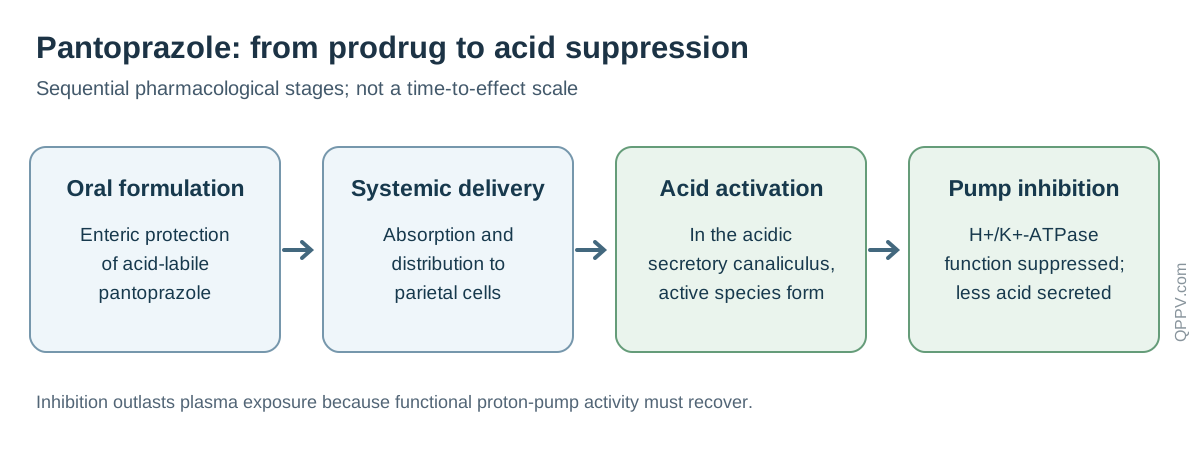
Figure 1. Enteric protection enables delivery of pantoprazole to parietal cells; acidic canalicular activation precedes inhibition of H+/K+-ATPase. This is a conceptual sequence, not a dosing or time-to-effect diagram [1,3].
What distinguishes pantoprazole from a class description
A product-specific account must distinguish pantoprazole's authorised formulations, labelled populations, interactions and evidence base from claims about PPIs as a group. The presence of a class warning does not establish equal absolute risk across all PPIs, nor does an observational association prove that pantoprazole caused an outcome in an individual patient. Conversely, a rare serious reaction may warrant action even when its incidence cannot be reliably estimated.
Clinical use and regulatory scope
The US Protonix delayed-release tablet and oral-suspension prescribing information, in the DailyMed record updated 18 May 2026, identifies three principal uses: short-term healing and symptomatic relief of erosive oesophagitis associated with gastro-oesophageal reflux disease (GERD), maintenance of healed erosive oesophagitis in adults, and pathological hypersecretory conditions including Zollinger–Ellison syndrome. For erosive oesophagitis, the labelled population includes adults and children aged five years and older, with weight-based paediatric dosing. Adult maintenance trials described in the label did not extend beyond twelve months; this is an evidence-duration qualification, not a universal twelve-month prohibition.
Pantoprazole is also used in clinical practice in settings such as Helicobacter pylori eradication regimens and ulcer prevention, but the regulatory status of each use depends on jurisdiction and product. Such practice must not be described as an FDA-approved indication for the referenced US oral Protonix label without separate confirmation. Intravenous presentations have distinct labels and age ranges; their indications and administration rules cannot simply be transferred to oral formulations.
Exposure and formulation matter to case assessment
A suspected reaction report should identify the exact presentation, dose, route, treatment dates, indication and concomitant medicines. Delayed-release tablets should not be crushed or chewed under the referenced US instructions. The oral suspension has specific administration requirements, and intravenous treatment involves a separate administration pathway. Confusion between presentations can introduce medication errors and distort assessment of exposure, treatment failure or unexpected toxicity.
Reading the evidence responsibly
The US prescribing information describes common adverse reactions in nine comparative adult GERD trials, including headache, diarrhoea, nausea, abdominal pain, vomiting, flatulence, dizziness and arthralgia. Those percentages are trial observations in selected populations and cannot be treated as post-marketing incidence estimates or directly compared with rates from unrelated trials. Spontaneously reported post-marketing events have an uncertain denominator and may be affected by confounding, stimulated reporting and incomplete follow-up.
A complete lifecycle analysis must therefore use different standards of inference for randomised efficacy trials, controlled safety comparisons, spontaneous reports, observational epidemiology and mechanistic hypotheses. The next sections examine those evidence types separately and translate labelled risks into practical safety surveillance.
Discovery and development: a second-generation design problem
Pantoprazole emerged from medicinal-chemistry work at Byk Gulden in Germany, later associated with Altana, in an era when omeprazole had established the therapeutic potential of targeting the gastric proton pump. The design challenge was not merely to produce another inhibitor of the same enzyme. An orally useful compound needed adequate stability outside the strongly acidic canaliculus, reliable absorption, selective acid-triggered conversion to an active inhibitor and a clinically acceptable interaction profile. Senn-Bilfinger and Sturm's account of the programme places pantoprazole within this deliberate analogue-development strategy [3].
The selected sodium sesquihydrate salt offered pharmaceutical advantages for development of stable formulations. Its development is best understood as a progression from a chemical lead to a deliverable medicine: compound selection, acid-protective formulation, pharmacodynamic testing, controlled trials and post-authorisation formulation diversification. Neither the originating research programme nor the eventual product can be reduced to a single inventor's discovery.
Early clinical proof of concept
The first pivotal clinical question was whether the pharmacological effect translated into endoscopic healing and symptom relief, rather than merely a change in gastric pH. A 1995 German multicentre double-blind trial randomised 249 patients with grade II–III reflux oesophagitis to pantoprazole 40 mg once daily or ranitidine 150 mg twice daily. In the protocol-correct population, complete healing at eight weeks was 82% with pantoprazole and 67% with ranitidine (p < 0.01); the four-week difference, 69% versus 57%, did not reach conventional statistical significance (p = 0.054). The authors reported a low frequency of adverse events without a difference between treatment groups [4]. This distinction between an eight-week positive result and a borderline four-week result should not be erased in a retrospective lifecycle account.
A smaller mechanistic clinical study later connected acid suppression with oesophageal exposure. Among 24 patients randomised to pantoprazole or ranitidine, pantoprazole reduced the fraction of time with oesophageal pH below 4 from 21% to 3%; healing counts were 6/11 versus 3/13 and were not statistically different in this small study [5]. It provides physiological corroboration, not a substitute for the larger healing trials.
Healing, maintenance and treatment duration
The current US oral label summarises a multicentre placebo-controlled study enrolling 603 patients with endoscopically confirmed erosive oesophagitis. In the per-protocol population, eight-week healing rates were 92.6% for pantoprazole 40 mg daily and 39.7% for placebo; the labelled analysis also shows a dose response [1]. Because this is a selected per-protocol analysis, the result should not be presented as an unqualified population-level effectiveness estimate.
Maintenance treatment addressed a different problem: relapse after successful healing. In a randomised study of 349 patients with previously healed erosive oesophagitis, the proportions remaining healed after twelve months were 78% with pantoprazole 40 mg, 55% with 20 mg, 46% with 10 mg and 21% with ranitidine 150 mg twice daily [6]. The trial establishes a maintenance benefit in its enrolled population; it does not determine how long every future patient should receive a PPI. The decision to continue requires the underlying diagnosis, relapse history, bleeding risk and competing clinical priorities.
| Development question | Evidence source | Supported conclusion | Important limit |
|---|---|---|---|
| Does acid suppression improve oesophagitis healing? | Koop et al., 1995 [4] | Better eight-week healing than ranitidine | Protocol-correct analysis; not every time point significant |
| Does pantoprazole reduce oesophageal acid exposure? | Armbrecht et al., 1997 [5] | Marked reduction in measured acid exposure | Small physiological study; healing comparison underpowered |
| Is there an effective daily dose for erosive disease? | US label, trial summary [1] | Clear dose-related endoscopic healing | Labelled population and trial-specific analysis |
| Can treatment prevent relapse after healing? | Richter et al., 2004 [6] | Superior twelve-month maintenance versus ranitidine | Not evidence for indefinite therapy in all patients |
Regulatory and commercial lifecycle
Pantoprazole-containing medicines have been available in Europe since 1994, according to the European Medicines Agency. The US label identifies initial US approval in 2000 [1,7]. Different territories subsequently authorised different strengths, indications and presentations, and a product's regulatory status should never be inferred solely from the active ingredient.
The European Commission granted an EU-wide marketing authorisation for the 20 mg non-prescription product Pantozol Control on 12 June 2009 for short-term treatment of reflux symptoms in adults [7]. Its self-care instructions include seeking medical advice when symptoms fail to improve after two weeks and not continuing beyond four weeks without medical consultation. This OTC context creates surveillance challenges absent from prescription-only studies: patients may take repeated courses, combine brands or omit OTC exposure when reporting a suspected reaction.
The UK 40 mg gastro-resistant tablet SmPC updated in February 2026 includes reflux oesophagitis in adults and adolescents aged twelve years or older, and adult indications covering gastric and duodenal ulcer, H. pylori eradication with appropriate antibiotics and hypersecretory conditions [2]. The corresponding US oral label instead lists erosive oesophagitis, its maintenance and pathological hypersecretion [1]. These are product- and jurisdiction-specific statements, not a contradiction about pharmacology.
In the US, Wyeth marketed the originator product Protonix; Pfizer completed its acquisition of Wyeth in October 2009 [8]. That ownership transition is relevant to historical safety databases, brand attribution and identification of the responsible company at a particular point in time. Generic availability and subsequent formulation diversity further increase the importance of recording the actual product, manufacturer and country of supply. They do not imply that adverse-event frequencies can be compared reliably across brands using spontaneous-report counts.
What later trials changed about long-term safety inference
For years, observational studies associated PPI use with outcomes including chronic kidney disease, fractures, pneumonia, dementia and cardiovascular events. Such studies can generate important hypotheses, but patients receiving long-term acid suppression often differ substantially from non-users in age, comorbidity, healthcare contact, medication exposure and indication. Confounding by indication and residual confounding may persist after statistical adjustment.
The COMPASS pantoprazole substudy provided unusually informative randomised evidence. In a double-blind factorial design, 17,598 patients with stable cardiovascular or peripheral arterial disease were assigned pantoprazole 40 mg daily (8,791) or placebo (8,807) alongside trial antithrombotic strategies. Median follow-up was 3.01 years. Enteric infections were reported in 1.4% versus 1.0%, respectively (odds ratio 1.33; 95% CI 1.01–1.75). The prespecified other safety outcomes did not show statistically significant differences; C. difficile infections were few and the apparent difference was not statistically significant [9].
This trial supports a more restrained interpretation of many observational associations, but does not prove the absence of every rare or delayed risk. It enrolled a selected cardiovascular population, had finite follow-up and limited power for infrequent events. Recognised idiosyncratic events such as acute tubulointerstitial nephritis may remain important even when a large trial does not detect an excess. The American College of Gastroenterology guideline similarly distinguishes association from established causality when discussing long-term PPI safety [10].
The established safety profile: different types of evidence
The May 2026 US label describes common adverse reactions in controlled studies and a separate set of serious warnings, some informed by post-marketing reports [1]. These categories should not be collapsed into a single frequency ranking. For example, a headache in a clinical trial is not evidentially equivalent to biopsy-supported drug-associated nephritis after marketing. A professional safety narrative must preserve the nature of the evidence, its denominator, the seriousness of the outcome and the degree of diagnostic certainty.
Acute tubulointerstitial nephritis and kidney injury
Acute tubulointerstitial nephritis (ATIN) is an important labelled risk of pantoprazole and other PPIs. It may arise at any point during treatment and need not present with the classic combination of fever, rash and eosinophilia. Clinical manifestations can be nonspecific, including malaise, nausea, reduced urine output or an otherwise unexplained creatinine increase. The US label advises discontinuing pantoprazole and evaluating patients when ATIN is suspected [1].
The central pharmacovigilance task is to distinguish a suspected immune-mediated renal reaction from competing causes of acute kidney injury. Review dehydration, sepsis, obstruction, haemodynamic change, contrast exposure and nephrotoxic co-medication. Capture serial creatinine and urinalysis, renal specialist assessment, biopsy results if available, treatment changes and the time course after withdrawal. Absence of biopsy does not invalidate a report, but should temper diagnostic certainty. Rechallenge solely to establish causality would generally be inappropriate for a potentially serious renal reaction.
Chronic kidney disease associations from epidemiology should not be described as proof that pantoprazole causes progressive renal failure in every long-term user. The acute immune-mediated syndrome and a population-level association with chronic disease are different safety questions.
Infections, diarrhoea and the microbiome
Acid suppression changes a physiological barrier to ingested organisms. The US label warns of possible increased risk of Clostridioides difficile-associated diarrhoea, particularly when diarrhoea does not improve [1]. The COMPASS randomised study found a modest excess of enteric infections overall, providing stronger evidence than a purely observational association for this particular outcome [9]. It did not establish that every diarrhoeal episode during pantoprazole therapy is infectious or drug-related.
A useful case follow-up obtains stool testing and clinical diagnosis, antibiotic exposure, hospital or long-term-care contact, immunosuppression, onset relative to PPI initiation and severity markers such as dehydration, colitis or hospitalisation. In patients receiving H. pylori eradication treatment, the antibiotics themselves are major alternative explanations for diarrhoea. Reporting and signal analyses should distinguish an infectious diagnosis from nonspecific gastrointestinal symptoms.
Severe hypersensitivity and autoimmune reactions
Severe cutaneous adverse reactions, including Stevens–Johnson syndrome, toxic epidermal necrolysis, drug reaction with eosinophilia and systemic symptoms, and acute generalised exanthematous pustulosis, are included in the US warning framework. The label directs discontinuation at the first signs or symptoms of a severe cutaneous reaction and appropriate evaluation [1]. For a suspected case, document morphology, mucosal involvement, body-surface area, fever, laboratory findings, skin biopsy if obtained, other recent medicines and exact exposure dates. Do not use a generic term such as 'rash' when the available evidence supports a more specific medically reviewed diagnosis.
Subacute cutaneous lupus erythematosus (SCLE) and systemic lupus erythematosus have also been reported with PPIs, with cutaneous presentations more common. New disease and exacerbation of existing autoimmune illness require different baseline assessments. A history of a similar reaction to another PPI is relevant, but cross-reactivity should not be presumed or dismissed without product-specific clinical evaluation. The label recommends stopping the suspected PPI and specialist assessment when compatible signs arise [1].
Hypomagnesaemia, mineral disturbances and nutrition
Rare hypomagnesaemia has been reported after at least three months of PPI treatment, most often after a year. Severe cases may include tetany, arrhythmia or seizures, and can coexist with hypocalcaemia or hypokalaemia. In some patients magnesium replacement alone does not fully resolve the problem while the PPI continues. The US label advises considering baseline and periodic magnesium monitoring for patients expected to receive prolonged therapy or concomitant medicines such as digoxin or diuretics, and gives additional considerations for those at risk of hypocalcaemia [1]. This is a risk-based consideration, not a universal legal requirement to test every PPI user at a fixed interval.
A case assessment should record the total treatment duration, electrolyte measurements before and after the event, renal function, gastrointestinal losses, alcohol exposure, diuretics, supplements and dechallenge. Long-term reduction in gastric acidity may also affect vitamin B12 absorption; evaluate compatible haematological or neurological symptoms and alternative nutritional or malabsorptive causes. The label discusses this concern particularly with prolonged daily acid suppression, rather than as an inevitable consequence of treatment [1].
Fractures, polyps and neoplastic concerns
US labelling warns that long-term and multiple-daily-dose PPI therapy may be associated with osteoporosis-related fractures. This language reflects a risk concern, not proof that pantoprazole causes fractures independently of all other determinants. Age, falls, steroid use, prior fractures, frailty and baseline bone disease matter when interpreting an individual event. Routine bone-health assessment should follow clinical risk and local standards rather than an invented pantoprazole-specific schedule [1,10].
Fundic gland polyps are associated with longer PPI exposure and are often found incidentally on endoscopy. Rodent carcinogenicity findings involving enterochromaffin-like cells are described in nonclinical labelling, with uncertain relevance to human tumour development. Neither a benign polyp nor an animal finding should be equated with a confirmed human gastric cancer signal [1].
Diagnostic delay and uncommon post-marketing events
A symptomatic response to pantoprazole does not exclude an underlying gastric malignancy. The US label advises additional follow-up and diagnostic testing in adults when clinically appropriate, especially if symptoms recur or warning features persist [1]. This is a diagnostic-safety concern rather than evidence that pantoprazole causes the malignancy. Post-marketing reports also include serious hepatocellular injury and blood dyscrasias; when these phenotypes are suspected, evaluate the diagnosis, timing, co-medication and alternative causes without assigning a reliable frequency from voluntary reports [1].
A practical evidence classification
| Safety question | Evidence to prioritise | What cannot be inferred |
|---|---|---|
| ATIN after pantoprazole | Clinical chronology, renal evaluation, biopsy where available, dechallenge | That every creatinine rise is immunologically mediated |
| Serious skin reaction | Specific diagnosis, onset, concurrent drugs, mucosal/systemic findings | That a nonspecific rash establishes SJS/TEN |
| C. difficile-associated disease | Microbiology, antibiotics, healthcare exposure, clinical severity | That PPI exposure alone proves infection causation |
| Hypomagnesaemia | Serial Mg/Ca/K, exposure duration, co-medication, response to withdrawal | That all long-term users develop deficiency |
| Fracture or dementia in an observational dataset | Controlled design, confounding assessment, comparator, exposure duration | A patient-level causal attribution from association alone |
| Long-term tolerability | COMPASS randomised evidence and its limitations | Absence of rare events or risks after much longer exposure |
The important clinical distinction is not between 'safe' and 'unsafe' drugs, but between evidence-supported treatment and avoidable exposure, alongside early recognition of a small number of consequential phenotypes.
Pharmacokinetics, interactions and medication-error risks
Pantoprazole is metabolised mainly through CYP2C19, with contributions from other hepatic pathways including CYP3A4. Genetic variation in CYP2C19 changes exposure, but the US label does not recommend routine adult dose adjustment solely because a patient is a poor metaboliser. For known paediatric poor metabolisers, it advises considering dose reduction [1]. A pharmacokinetic difference is therefore not automatically a clinically demonstrated toxicity difference.
A second and often more consequential interaction mechanism is gastric pH change. Pantoprazole can reduce the absorption of drugs that depend on an acidic gastric environment. This effect may occur without meaningful CYP inhibition and may not be prevented simply by separating doses by a few hours, because acid suppression persists beyond pantoprazole's plasma presence.
Interactions with different clinical consequences
| Co-medication or test | Mechanism and clinical concern | US-label direction or practical interpretation |
|---|---|---|
| Rilpivirine-containing antiretrovirals | Reduced exposure from elevated gastric pH; risk of virological failure/resistance | Contraindicated with oral Protonix [1] |
| Atazanavir, nelfinavir and selected other antiretrovirals | Reduced or otherwise altered exposure | Follow the specific antiretroviral label; nelfinavir co-use is to be avoided in the US Protonix label [1] |
| High-dose methotrexate | Possible delayed elimination and toxicity | Temporary PPI withdrawal may be considered in selected patients; do not assert a universal prohibition [1] |
| Warfarin | Reports of increased INR/prothrombin time and bleeding | Monitor anticoagulation as directed by product information [1] |
| Mycophenolate mofetil | Reduced exposure to mycophenolic acid observed in pharmacokinetic studies | Use caution in transplant recipients; clinical effect on rejection remains uncertain [1] |
| Selected azoles and oral anticancer agents | Absorption may depend on gastric acidity | Verify the affected drug's own interaction instructions [1,2] |
| Clopidogrel | CYP2C19-mediated activation is a theoretical concern | US pantoprazole label states no clopidogrel dose adjustment is necessary with approved pantoprazole doses; avoid transferring omeprazole warnings wholesale [1] |
| Chromogranin A assay | PPI-induced hypergastrinaemia can raise CgA and mislead neuroendocrine-tumour evaluation | US label specifies withholding pantoprazole at least 14 days before CgA assessment [1] |
The difference between contraindication, avoidance, monitoring, caution and possible temporary interruption is operationally important. A safety database should preserve the exact co-prescribed agent and intervention rather than assign every combination the same generic 'interaction' status. UK and EU SmPCs may phrase particular combinations differently; the local product information governs the clinical decision.
Laboratory interference and misleading diagnoses
Elevated chromogranin A can produce false-positive investigations for neuroendocrine tumours. The May 2026 US label advises stopping Protonix at least fourteen days before CgA assessment and repeating testing when initially elevated; some UK SmPCs specify a shorter initial withholding interval, with repeat testing if values remain raised [1,2]. This difference must be preserved by jurisdiction, not silently harmonised.
The US label also reports possible false-positive urine immunoassay screening for tetrahydrocannabinol in patients receiving PPIs [1]. A screening result should be confirmed with a more specific analytical method when clinically consequential. An analytical false positive is not the same as a pharmacological adverse reaction, yet it may lead to significant downstream clinical or social harm if not recognised.
Special populations and individualised prescribing
Paediatric patients
The US oral product's erosive-oesophagitis indication starts at age five years, whereas the cited UK 40 mg gastro-resistant tablet SmPC describes use from twelve years for reflux oesophagitis [1,2]. These are presentation-specific authorisations, not evidence that pantoprazole is uniformly approved from one age worldwide. Weight thresholds and administration requirements are critical in younger children. The 40 mg oral-suspension packet must not be divided to create an unapproved 20 mg dose under the US instructions [1].
A paediatric report should record age, weight, formulation, route, caregiver preparation, indication and duration. If exposure followed an off-label prescription, record that fact without automatically treating the use itself as an adverse reaction.
Pregnancy and breastfeeding
The US label notes potential fetal harm based on animal data, while the evidence in human pregnancy is limited and must be interpreted in context. The decision to treat reflux during pregnancy balances maternal disease, alternatives, timing of exposure and the applicable label [1]. For a pregnancy-exposure report, document trimester, dose, indication, relevant co-medications and the outcome when known; an exposure without an adverse outcome is not equivalent to a suspected adverse reaction.
Pantoprazole may be present in human milk; available clinical information is limited. For lactation cases, record maternal dose, infant age, feeding pattern and any suspected infant event. Do not infer infant toxicity solely from the possibility of exposure [1].
Hepatic and renal impairment
Hepatic dysfunction may increase pantoprazole exposure. The cited UK 40 mg SmPC limits severe hepatic impairment to a maximum of 20 mg daily and advises liver-enzyme monitoring in that setting [2]. The US oral label reports altered pharmacokinetics in hepatic impairment but does not impose an identical general dose rule [1]. This is another reason to cite a specific label rather than invent a global dosing instruction.
Renal impairment does not ordinarily require a pharmacokinetic dose adjustment under the US oral label, but this does not remove the need to investigate suspected ATIN or other renal deterioration. Baseline renal disease may complicate attribution and increase the consequences of an acute insult.
Long-term therapy, self-medication and discontinuation
A reasonable ongoing indication is the organising principle for treatment duration. The American Gastroenterological Association advises regular documentation of the indication and consideration of deprescribing when chronic treatment is not clearly needed. It also cautions against discontinuing therapy solely because of anxiety about observationally associated harms when a strong indication remains [11].
Stopping long-term PPI therapy can produce transient rebound acid symptoms. Such symptoms should be distinguished from recurrence of the original disease and from a newly emerging safety event. Patients with severe erosive disease, strictures, high gastrointestinal bleeding risk or certain other conditions may need continued acid suppression. This is a clinical benefit-risk decision, not a one-size-fits-all 'PPI holiday'.
Operational pharmacovigilance: from individual cases to signals
A high-volume, multisource product such as pantoprazole demands disciplined case interpretation. Prescription and non-prescription exposure may be intermittent; a patient may alternate originator and generic presentations; and the adverse event may occur long after initiation. A medically useful case should establish the chronology before deciding how much weight to assign a suspected causal relationship.
The European pharmacovigilance framework distinguishes case collection, validation, medical assessment, follow-up, reporting and aggregate signal evaluation. The applicable EU rules and current ICH E2D(R1) implementation material should be checked alongside GVP guidance rather than assuming that one unchanged version of Module VI governs every operational detail [12]. The examples below are recommended review practices, not a claim that a regulator requires every listed field for every report.
Intake and medically targeted follow-up
For a suspected pantoprazole reaction, seek the product name, strength, route, manufacturer when available, country, indication, start and stop dates, actual pattern of use, prior courses and any re-exposure. Ask specifically about self-purchased 20 mg products and use during combination H. pylori treatment. Then establish the diagnosis, onset, seriousness, outcome, relevant tests and concomitant conditions and medicines.
| Suspected event | Highest-value follow-up | Major competing explanations |
|---|---|---|
| Acute tubulointerstitial nephritis | Creatinine trajectory, urinalysis, nephrology opinion, biopsy if performed, dechallenge | Infection, volume depletion, NSAIDs, antibiotics, obstruction |
| Hypomagnesaemia with arrhythmia | Serial Mg/K/Ca, ECG, treatment duration, supplementation, diuretic exposure | Diuretics, diarrhoea, malabsorption, renal losses |
| C. difficile-associated diarrhoea | Stool test, clinical severity, antibiotics, hospital exposure | Antibiotics, other infection, inflammatory disease |
| SCLE or severe cutaneous reaction | Morphology, photos where appropriately consented, mucosa, biopsy, systemic findings, medication timeline | Other recent drugs, infection, autoimmune disease |
| Interaction-associated treatment failure | Exact co-medication, start/stop chronology, drug levels or disease markers when available | Nonadherence, resistance, underlying disease progression |
| Suspected product-quality problem | Batch, expiry, appearance, storage, manufacturer, defect description and AE chronology | Incorrect preparation, packaging confusion, unrelated event |
Do not classify a report as medically invalid simply because a laboratory test or biopsy is missing. Conversely, do not upgrade a tentative diagnosis to a confirmed reaction when the available records do not support it. Maintain traceability between the reporter's words, coded terms, clinical assessment and any later follow-up.
Two illustrative cases
Case A — suspected ATIN (hypothetical). A patient taking pantoprazole for several months presents with fatigue and a rising serum creatinine. A course of antibiotics and intermittent ibuprofen began shortly before the deterioration. The initial report is clinically important, but its chronology permits several competing causes. Follow-up should clarify renal baseline, urinalysis, imaging or biopsy if undertaken, exact exposure dates and outcome after treatment changes. The final medical assessment may remain uncertain despite a valid and serious case.
Case B — possible interaction with rilpivirine (hypothetical). A patient with previously controlled HIV infection begins pantoprazole and later has an increased viral load. The US Protonix label contraindicates coadministration with rilpivirine-containing products because of reduced exposure [1]. The case assessment should establish the antiretroviral regimen, adherence, virological chronology, pharmacy dispensing, resistance testing if performed and alternative causes of treatment failure. A known mechanistic interaction increases plausibility but does not replace investigation.
Aggregate signal detection and benefit-risk governance
Individual cases may reveal a recognisable pattern, but spontaneous-report counts cannot establish incidence without reliable exposure denominators. A defensible signal evaluation may stratify by duration, route, indication, age, co-medication, country and formulation; evaluate duplicates; compare case narratives; and assess whether an observed change reflects reporting behaviour or a genuine change in clinical phenotype.
Important questions include whether a newly reported renal event represents the known ATIN phenotype or a different mechanism; whether an apparent infection signal persists after accounting for antibiotics and hospital exposure; and whether a suspected interaction has a plausible mechanism supported by clinical data. Regulatory labelling, randomised evidence, pharmacoepidemiology and case-series evidence should be integrated rather than ranked by raw volume.
A QPPV or other responsible safety leader should be able to trace the path from an incoming report through medical review, signal decisions, benefit-risk evaluation, reference safety information and any required regulatory action. Where a risk is already labelled, surveillance should still consider changes in severity, preventability, susceptible populations and effectiveness of existing advice. Appropriate risk minimisation may involve clearer patient instructions, interaction alerts, clinical communication or revised product information, but each action must be justified by evidence and the applicable regulatory process.
Inspection and quality-system perspective
A useful inspection trail connects the reported event to its source document, receipt date, product identity, coding, seriousness assessment, follow-up attempts, duplicate checks and the rationale for the final decision. For a long-marketed product, inspection risk may arise from fragmented historical data or unclear responsibilities between originator, generic, distributor, medical-information and OTC channels. A strong process documents these interfaces and tests whether cases are actually transferred and reconciled.
Illustrative failure pattern: A patient reports hypomagnesaemia to a medical-information team, but the safety database receives only a generic 'weakness' term without the laboratory result or two-year treatment history. The case may be technically entered yet medically degraded. Corrective work should address the intake question set, source-document retention, medical coding review and effectiveness of follow-up rather than simply retraining one individual.
Practical review checklist
Before finalising a pantoprazole case or signal assessment, verify the precise product and local label; document indication, dose, formulation and actual duration; identify OTC exposure and co-prescribed medicines; obtain clinically decisive tests when feasible; preserve alternative explanations; separate clinical trial findings from spontaneous reports and observational associations; record the reasoning behind causality and expectedness decisions; and apply the relevant jurisdiction's reporting and governance procedures.
Key Takeaways
Pantoprazole's lifecycle illustrates the strengths and limitations of modern drug-safety evidence. Rational analogue design produced an effective acid-suppressing medicine; controlled trials established healing and maintenance benefits; broad use and multiple formulations expanded exposure; and post-marketing surveillance identified serious but uncommon clinical phenotypes. The randomised COMPASS safety substudy is reassuring about many proposed long-term harms over approximately three years, while supporting a modest excess of enteric infections. It cannot exclude all rare or very delayed reactions.
For pharmacovigilance, the priorities are accurate exposure reconstruction, recognition of ATIN, serious skin reactions, infection, electrolyte disturbances and clinically important interactions, and disciplined separation of causation from association. Long-term use should be justified by the patient's indication, not governed by a universal stop date.
References
- US National Library of Medicine, DailyMed. PROTONIX delayed-release tablets and oral suspension (pantoprazole sodium): US prescribing information. Updated 18 May 2026. https://dailymed.nlm.nih.gov/dailymed/drugInfo.cfm?setid=08098cb2-c048-4640-f387-6beec4a38936
- Amarox Limited. Pantoprazole 40 mg gastro-resistant tablets: UK Summary of Product Characteristics. Electronic Medicines Compendium; updated 26 February 2026. https://www.medicines.org.uk/emc/product/14644/smpc
- Senn-Bilfinger J, Sturm E. The Development of a New Proton-Pump Inhibitor: The Case History of Pantoprazole. In: Analogue-based Drug Discovery. 2006. https://doi.org/10.1002/3527608001.ch6
- Koop H, Schepp W, Dammann HG, et al. Comparative trial of pantoprazole and ranitidine in the treatment of reflux esophagitis. J Clin Gastroenterol. 1995;20:192–195. https://pubmed.ncbi.nlm.nih.gov/7797824/
- Armbrecht U, Abucar A, Hameeteman W, et al. Treatment of reflux oesophagitis of moderate and severe grade with ranitidine or pantoprazole: comparison of 24-hour intragastric and oesophageal pH. Aliment Pharmacol Ther. 1997;11:959–965. https://pubmed.ncbi.nlm.nih.gov/9354207/
- Richter JE, Fraga P, Mack M, et al. Prevention of erosive oesophagitis relapse with pantoprazole. Aliment Pharmacol Ther. 2004;20:567–575. https://pubmed.ncbi.nlm.nih.gov/15339328/
- European Medicines Agency. Pantozol Control: European Public Assessment Report. EU-wide authorisation 12 June 2009. https://www.ema.europa.eu/en/medicines/human/EPAR/pantozol-control
- Pfizer. Pfizer Completes Acquisition of Wyeth. Company announcement, 14 October 2009. https://www.pfizer.com/news/press-release/press-release-detail/pfizer_completes_acquisition_of_wyeth
- Moayyedi P, Eikelboom JW, Bosch J, et al. Safety of Proton Pump Inhibitors Based on a Large, Multi-Year, Randomized Trial of Patients Receiving Rivaroxaban or Aspirin. Gastroenterology. 2019;157:682–691.e2. https://doi.org/10.1053/j.gastro.2019.05.056
- Katz PO, Dunbar KB, Schnoll-Sussman F, et al. ACG Clinical Guideline for the Diagnosis and Management of Gastroesophageal Reflux Disease. Am J Gastroenterol. 2022;117:27–56. https://doi.org/10.14309/AJG.0000000000001538
- Targownik LE, Fisher DA, Saini SD. AGA Clinical Practice Update on De-Prescribing of Proton Pump Inhibitors: Expert Review. Gastroenterology. 2022. https://pubmed.ncbi.nlm.nih.gov/35183361/
- European Medicines Agency. Good pharmacovigilance practices (GVP): current modules and implementation notices. Accessed October 2026. https://www.ema.europa.eu/en/human-regulatory-overview/post-authorisation/pharmacovigilance-post-authorisation/good-pharmacovigilance-practices-gvp
Regulatory Note
This educational review was prepared 24 October 2026 from the specifically dated US oral Protonix label, a February 2026 UK 40 mg tablet SmPC, EMA public information and published clinical evidence. Indications, doses, age limits, contraindications, interaction wording and laboratory-test precautions may differ by country, marketing authorisation and formulation. Check the current local product information before clinical or regulatory decisions. Scientific trial results, post-marketing reports, epidemiological associations, label warnings, professional guidance and proposed operational controls are distinct evidence categories. Illustrative cases are fictional teaching scenarios, not reported patient cases.