Paracetamol: Discovery, Development, Safety and Pharmacovigilance
Paracetamol—called acetaminophen in the United States—is among the most familiar medicines for pain and fever. Its familiarity conceals an unusual safety profile: a drug tolerated by many patients at correctly selected doses can cause severe, sometimes fatal liver injury when exposure is excessive, repeated across overlapping products, or complicated by particular clinical circumstances. Its role in medicines regulation is equally distinctive. The same active substance appears in non-prescription tablets, paediatric liquids, intravenous infusions and prescription combinations; each presentation has its own instructions and risk controls. [1–4]
This is a lifecycle reference for the single international nonproprietary name paracetamol. The B033 queue entry arose from the hydrocodone/paracetamol combination in a US outpatient prescribing dataset; the combination's prescription count is not an independent count for paracetamol. The article therefore separates evidence about paracetamol alone from evidence about opioids, caffeine, cold remedies and other co-ingredients. A report of injury after a combination product cannot be attributed to every constituent without assessing the clinical mechanism and actual exposure. [2–4]
The central distinction is between therapeutic use, medication error and poisoning. Hepatotoxicity after an overdose is well established; it should not be treated as if its frequency were an ordinary adverse-reaction rate at a correctly administered dose. Conversely, the absence of overdose does not eliminate the possibility of rare hypersensitivity, a clinically important interaction, or high-anion-gap metabolic acidosis in a susceptible patient. The exact label and clinical history determine what is known, what is suspected and what remains uncertain. [2–5]
- Paracetamol: Discovery, Development, Safety and Pharmacovigilance
- Discovery: an old molecule becomes a modern medicine
- Pharmacology: analgesia, antipyresis and exposure
- Clinical evidence: familiar indications, uneven benefit
- Hepatotoxicity: a mechanistic and clinical sequence
- Product-specific listedness: United States and European Union
- Pregnancy and neurodevelopment: a contested evidence question
- Pharmacovigilance: from product exposure to a defensible case
- Key Takeaways
- References
- Regulatory Note
Discovery: an old molecule becomes a modern medicine
Chemistry before clinical adoption
Paracetamol belongs to the para-aminophenol family. Nineteenth-century chemists investigated related aromatic compounds at a time when fever reduction and pain relief relied heavily on salicylates and substances derived from coal-tar chemistry. Historical accounts place synthesis of the molecule in the late 1870s, but synthesis, clinical evaluation and routine medicinal use are different milestones. Early attention instead centred on acetanilide and phenacetin, agents whose toxicity and metabolic fate helped scientists recognise the importance of paracetamol. The FDA's historical account dates its discovery to 1878 and identifies its therapeutic emergence in the early 1950s. [1]
The decisive scientific advance was not a novel receptor discovery but an understanding of metabolism. Work associated with Bernard Brodie and Julius Axelrod in the 1940s helped explain that paracetamol was an active metabolite of older analgesics and could provide antipyretic and analgesic effects without some of their characteristic methemoglobinaemia problems. That comparative advantage did not establish complete safety. Subsequent clinical use exposed a different, dose-dependent liver hazard, showing why medicinal chemistry and early tolerability are only the beginning of benefit–risk evaluation. [1,4]
The 1955 commercial launch and its consequences
In 1955 the US FDA approved McNeil Laboratories' Tylenol Elixir for Children. McNeil's liquid formulation made the compound accessible in paediatric care, while subsequent adult formulations widened its market. Johnson & Johnson acquired McNeil in 1959; the FDA's historical exhibit also documents the company's 1975 emphasis on a 500-mg extra-strength presentation. These events matter to pharmacovigilance because changing product strengths, package design and consumer expectations can change exposure patterns even when the active ingredient is unchanged. [1]
The business story did not stop with the original sponsor. Paracetamol became widely available through multiple generic suppliers, national brands and fixed combinations. Current US Tylenol Extra Strength labelling identifies Kenvue Brands LLC as labeler, whereas the French Doliprane tablet authorisation identifies Opella Healthcare France SAS. Historical corporate ownership must not be substituted for the actual manufacturer, authorisation holder or batch information in a contemporary case. Nor should sales for a multicomponent brand family be assigned to paracetamol alone. [2,3]
From retail analgesic to formulation-safety problem
The product's expansion generated several distinct risk environments. In self-care, patients may buy several remedies without recognising that each contains the same active ingredient. In hospitals, an intravenous concentration stated in mg/mL creates a risk of confusing dose and volume, especially in smaller patients. In opioid combinations, the analgesic's presence can be overlooked while attention focuses on the controlled ingredient. In paediatric care, adult tablet strengths, multiple liquid concentrations and weight-based calculations demand separate controls. These are medication-system hazards, not proof that a correctly administered molecule has changed its intrinsic pharmacology. [2–4,11,13]
Regulatory responses have therefore targeted both intrinsic harms and preventable errors. US prescription combination products were limited to 325 mg of acetaminophen per dosage unit, while OTC single-ingredient products continue to exist at higher unit strengths with their own Drug Facts directions. The restriction on one category must not be misrepresented as a universal ban on 500-mg paracetamol tablets. [2,13]
Pharmacology: analgesia, antipyresis and exposure
What paracetamol does—and what remains uncertain
Paracetamol reduces fever and can relieve some forms of mild to moderate pain. Central modulation of prostaglandin signalling is important, but the full analgesic mechanism remains incompletely resolved; it should not be described as a proven selective peripheral COX-2 inhibitor or as equivalent to a conventional anti-inflammatory NSAID. Its weak peripheral anti-inflammatory effect helps explain why a medicine useful for fever or certain pain syndromes may offer little clinically important benefit in established inflammatory or mechanical conditions. [3,6,7]
After oral administration, paracetamol is generally absorbed rapidly. Its principal clearance pathways are hepatic glucuronidation and sulfation, producing metabolites eliminated in urine. A smaller fraction undergoes oxidative metabolism, including via CYP2E1, to the reactive intermediate N-acetyl-p-benzoquinone imine (NAPQI). At usual exposure, glutathione conjugation helps detoxify NAPQI. In overdose, increased reactive-metabolite burden and depletion of protective glutathione can lead to hepatocellular injury. The proportion entering each pathway varies with age, dose and physiology; a simple fixed percentage should not be projected across all patients. [3,4]
Why timing and formulation matter
The plasma concentration after an acute ingestion is only meaningful alongside a credible time of ingestion and formulation history. A level drawn too early cannot be plotted reliably on the standard acute-ingestion treatment nomogram. Modified-release products and co-ingestion with opioids or anticholinergic drugs may delay absorption and require repeat measurements. Repeated supratherapeutic use is a different exposure pattern altogether and cannot be assessed by plotting one concentration against a single time point. [4]
A product's stated daily maximum is also product- and jurisdiction-specific. For example, the June 2026 US Tylenol Extra Strength 500-mg caplet label directs adults and children aged at least 12 years to take two caplets every six hours as needed, but no more than six caplets in 24 hours unless directed by a doctor. Its liver warning separately mentions more than 4,000 mg of acetaminophen from all sources. The 3,000-mg product direction and 4,000-mg warning threshold are not interchangeable instructions. [2]
The French Doliprane 500-mg tablet SmPC specifies a usual 3,000-mg daily maximum for adults and children weighing at least 50 kg, with lower limits and different instructions for certain clinical situations and children. These are instructions for that French product, not a universal international dose rule. A clinician or pharmacist should use the actual product's authorised information, patient weight and clinical condition rather than an internet-wide default. [3]
Clinical evidence: familiar indications, uneven benefit
Pain and fever are not one endpoint
The existence of a broad analgesic indication does not establish equal effectiveness for every painful condition. Fever reduction, headache relief, postoperative pain, osteoarthritis and acute nonspecific low-back pain have different mechanisms, comparators and patient-important outcomes. A pharmacovigilance reference must consider benefit evidence alongside harm: a small benefit may justify less exposure than a clear short-term effect in a patient with a specific indication. The 500-mg US Tylenol and French Doliprane labels cover symptomatic pain and fever, but neither proves that paracetamol is an optimal choice for every cause of pain. [2,3]
The PACE trial, published in 2014, randomly assigned people with acute low-back pain to regular paracetamol, as-needed paracetamol or placebo, with advice and reassurance in each group. Median recovery was approximately 17, 17 and 16 days, respectively; neither active regimen significantly accelerated recovery. This is an important negative study because it tested a widely used intervention against an appropriate placebo comparator in a common condition. It does not prove that paracetamol lacks antipyretic activity or cannot help any other pain state. The relevant conclusion is narrower: routine paracetamol did not improve recovery from acute nonspecific low-back pain under those trial conditions. [6]
A 2019 Cochrane review of 10 randomised trials involving 3,541 participants found that paracetamol provided only a small, probably clinically unimportant improvement in pain and function for hip or knee osteoarthritis. The average pain advantage was approximately 3.2 points on a 0–100 scale, below the review's prespecified threshold for clinical importance. Overall adverse-event rates were similar, but abnormal liver tests were more frequent in paracetamol groups and the clinical meaning of those changes was uncertain. Most trials were relatively short, so the findings should not be converted into precise estimates of rare long-term injury. [7]
These studies changed the clinical interpretation of an old drug without changing its chemical identity. They also demonstrate why adverse-event denominators from one disease population should not be carried into another. A trial of short-term musculoskeletal pain cannot quantify risks in a malnourished patient taking multiple cold remedies for several weeks; nor does an observational poison-centre series establish a rate among people following labelled directions. [4,6,7]
Evidence from combination and intravenous treatment
Paracetamol can be one component of multimodal analgesia. An opioid/paracetamol trial measures a combination regimen, not the isolated contribution of either ingredient unless its design specifically permits that attribution. Opioid-associated respiratory depression and paracetamol-associated liver injury require separate clinical assessment, although a single medication error may expose the patient to both. Cross-linking to the hydrocodone lifecycle article is useful for this distinction. [4,13]
Intravenous paracetamol offers a route when oral administration is unsuitable, but the route creates a different error mechanism: a 10-mg/mL solution requires correct conversion between milligrams and millilitres, weight-based dosing for smaller patients, and accounting for oral and rectal paracetamol already given. The US injection prescribing information carries a boxed warning concerning medication errors and hepatotoxicity. Its dose limits, preparation instructions and adverse-reaction tables must not be transferred wholesale to an OTC tablet label. [11]
Hepatotoxicity: a mechanistic and clinical sequence
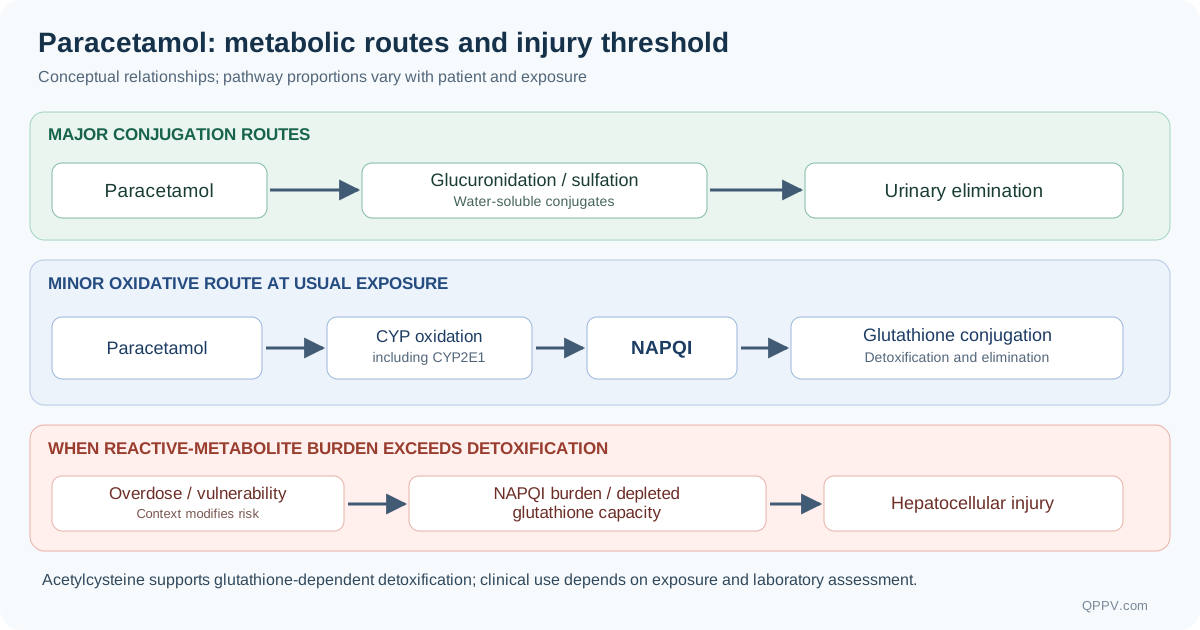
Figure 1. Conceptual hepatic metabolic pathways. The major conjugation routes and the minor oxidative route are shown separately; the lower pathway represents the risk of hepatocellular injury when reactive-metabolite burden exceeds detoxification capacity. No numerical pathway fractions or patient-specific treatment thresholds are implied. Acetylcysteine supports glutathione-dependent detoxification. [4]
Why an apparently well patient can be critically poisoned
In a substantial acute overdose, early symptoms may be absent or nonspecific. Nausea and vomiting do not reliably indicate the extent of subsequent hepatic injury. Biochemical hepatocellular injury and coagulopathy may develop later, after the opportunity for maximally effective early antidotal treatment has narrowed. A reassuring examination immediately after ingestion is therefore not evidence that the patient is safe. The essential first steps are an accurate exposure history, appropriate emergency assessment and prompt poison-centre or clinical-toxicology input. [3,4]
For a single acute oral ingestion with a reliable time, the 2023 US/Canadian consensus statement uses a revised Rumack–Matthew nomogram to guide acetylcysteine treatment from a plasma paracetamol concentration obtained at the appropriate post-ingestion time. Concentrations taken before four hours cannot be used in the standard nomogram decision. The consensus also addresses uncertain timing, delayed absorption, high-risk exposures, repeated supratherapeutic ingestion, pregnancy and IV administration separately. These distinctions matter because using the nomogram outside its validated context can produce false reassurance. [4]
Acetylcysteine and stopping criteria
N-acetylcysteine (NAC) helps restore glutathione-dependent detoxification and can reduce liver injury when given promptly. Treatment decisions depend on the ingestion pattern, elapsed time, concentration, clinical findings and laboratory tests; they are not a fixed antidote schedule triggered solely by a reported number of tablets. The 2023 consensus recommends administering NAC when indicated without waiting for delayed results in specified high-risk presentations, and continuing until clinical and laboratory stopping criteria are met rather than discontinuing automatically when a nominal infusion duration expires. [4]
An early presentation may allow activated charcoal after assessment of airway safety and timing. A late presentation with abnormal aminotransferases or suspected hepatic failure needs urgent specialist evaluation even when the original dose or time is uncertain. The treatment nomogram is not validated for intravenous exposures and should not be used to assess repeated ingestions extending beyond 24 hours. In those situations, clinical-toxicology guidance and serial laboratory results are central. [4]
The consensus is professional guidance for poisoning management in the United States and Canada, not a binding global law. French SmPC overdose instructions are product-specific regulatory text and may differ in operational details. A service should follow its current national poison-centre pathway and applicable clinical protocols, while recording which guideline was used and why. [3,4]
Factors that alter the risk picture
Repeated dosing above the authorised maximum, use of multiple products, poor nutrition, depleted glutathione reserves, underlying liver disease and some drug or alcohol exposures can complicate risk assessment. Chronic alcohol use and enzyme induction require a careful history rather than a simplistic rule that every patient has the same susceptibility. Frailty, low body weight, dehydration and renal dysfunction may change the safe dosing decision or the differential diagnosis. [3,4]
The crucial distinction is between dose-dependent overdose injury and idiosyncratic or other reactions at therapeutic exposure. A patient who develops hepatitis while taking paracetamol may have viral, autoimmune, ischaemic, obstructive or other drug-induced liver disease. Causality assessment should reconstruct all acetaminophen sources, actual timing, biochemical evolution, competing diagnoses and the response to withdrawal and treatment. A paracetamol concentration alone does not settle every case. [3,4]
Product-specific listedness: United States and European Union
Documents, jurisdictions and the limits of comparison
For an authoritative public-label comparison, this article assesses two single-ingredient, immediate-release oral 500-mg products accessed on 30 October 2026:
- United States: Kenvue Brands LLC Tylenol Extra Strength, acetaminophen 500-mg film-coated caplets, DailyMed SPL version 3, effective 3 June 2026, NDC family 50580-108. This is an OTC Drug Facts label, not a prescription USPI with a section 6 adverse-reaction table. [2]
- European Union (France): Opella Healthcare France SAS Doliprane 500 mg, comprimé, a standard oral tablet authorised nationally in France; ANSM SmPC text updated 25 August 2025 and accessed through the French public medicines database on 30 October 2026. The public database page was refreshed in September 2026, which must not be mistaken for a new SmPC text revision. [3]
This is a US-versus-French-EU national product comparison, not an assertion that all EU paracetamol SmPCs are identical. The UK Panadol Original Tablets SmPC, updated on the electronic medicines compendium in June 2025, provides a useful additional reference but is not substituted for an EU SmPC after the UK's departure from the EU. Different dosage forms, brands, paediatric products and IV preparations require their own label checks. [2,3,12]
The adverse-reaction and warning comparison
| Safety concept | US Tylenol Extra Strength Drug Facts, June 2026 | French Doliprane 500-mg tablet SmPC, August 2025 |
|---|---|---|
| Liver injury | Prominent liver warning for excess total acetaminophen, co-use of other products and heavy daily alcohol consumption; emergency overdose warning | Sections 4.4 and 4.9 describe overdose, underlying vulnerabilities and potentially fatal hepatic failure; increased hepatic enzymes appear in section 4.8 with frequency unknown |
| Severe skin reaction | Allergy alert says severe skin reactions may occur, with redness, blisters or rash; stop and seek medical help | Section 4.8 lists serious cutaneous reactions as very rare; erythema, urticaria and rash as rare; fixed drug eruption with frequency unknown |
| Hypersensitivity | Allergy alert and instruction not to use if allergic to ingredients; no graded adverse-reaction frequency table | Section 4.8 includes rare hypersensitivity and frequency-unknown anaphylaxis, anaphylactic shock and angioedema |
| Blood and respiratory events | Not individually enumerated in the assessed Drug Facts warnings | Section 4.8 lists very-rare thrombocytopenia, leukopenia and neutropenia; bronchospasm with frequency unknown |
| High-anion-gap metabolic acidosis (HAGMA) | Not specifically named in the assessed Drug Facts label | Sections 4.4, 4.5 and 4.8 discuss pyroglutamic acidosis, risk contexts and flucloxacillin; section 4.8 frequency unknown |
| Drug interactions | Advises consultation before use with warfarin | Section 4.5 describes vitamin-K-antagonist effects with repeated high-dose use and the flucloxacillin/HAGMA concern |
| Contraindication / do-not-use | Drug Facts says do not use with other acetaminophen products or with allergy to active/inactive ingredients | SmPC section 4.3 contains product-specific contraindications; sections 4.2/4.4 contain further dosing and caution rules |
| Dosing and population | Two 500-mg caplets per dose for age at least 12; no more than six caplets per 24 hours unless directed by a doctor | Weight- and age-specific instructions beginning at 27 kg, usual maximum 3 g/day for patients at least 50 kg; further restrictions in risk groups |
The difference in document architecture is material. An event may be explicitly listed in French section 4.8 while the US OTC Drug Facts label contains only a broader warning or no individually named reaction. That does not establish a difference in biological susceptibility between populations. Equally, an event described in French section 4.9 as a consequence of overdose is not thereby an ordinary therapeutic-dose adverse-reaction frequency. The table compares public product labels, not underlying company safety databases. [2,3]
For example, pyroglutamic high-anion-gap metabolic acidosis is listed in the assessed French Doliprane SmPC section 4.8 (frequency unknown), whereas it is not specifically named in the assessed June 2026 US Tylenol Extra Strength Drug Facts label. This is a defensible, narrowly defined public-listedness observation. It does not imply that the event cannot occur in US patients, that every case is causally related, or that it is necessarily unexpected under the reference safety information used for a particular study or safety report. [2,3]
Similarly, the US Drug Facts severe-skin-reaction allergy alert should not be described as a formal frequency-ranked adverse-reaction listing. France explicitly includes very-rare serious cutaneous reactions in section 4.8. FDA has separately identified Stevens–Johnson syndrome, toxic epidermal necrolysis and acute generalised exanthematous pustulosis as rare serious reactions associated with acetaminophen. That FDA communication adds class-level safety context; it does not turn those named diagnoses into entries in the particular US Drug Facts label assessed here. [2,3,5]
Dosing boundaries are safety information, not global thresholds
The US product's instruction not to exceed six 500-mg caplets in 24 hours unless a doctor directs otherwise differs from the broader 4,000-mg liver-warning threshold on the same label. France's Doliprane 500-mg tablet SmPC normally limits adults of at least 50 kg to 3 g/day and provides separate weight bands for children. These figures are not competing estimates of a universal toxic dose. They are product-specific directions intended to reduce avoidable harm. Actual overdose risk is influenced by exposure pattern and patient context, and any suspected overdose warrants urgent assessment rather than home calculation from a single threshold. [2–4]
The French SmPC also describes increased bleeding risk with prolonged high-dose paracetamol alongside vitamin K antagonists, and a risk of pyroglutamic acidosis in certain patients receiving flucloxacillin. The US OTC label's instruction to consult a clinician when taking warfarin is narrower in detail. For a suspected interaction, record the dose, duration, INR trend, concomitant illness and competing medicines, rather than treating the presence of both drug names as proof of causality. [2,3]
Public listedness is not ICSR expectedness
A public-label comparison is an educational starting point. Formal expectedness depends on the applicable reference safety information (RSI), product, jurisdiction, reporting context and the event's specificity and severity. A reaction mentioned in warnings but absent from an adverse-reaction table may require different interpretation under a study protocol or local reporting rules. Listedness is not causality: a reaction can be listed but unrelated in an individual case, or unlisted in a chosen label yet medically plausible. Likewise, seriousness, severity and reportability are distinct assessments. A well-governed case record preserves the exact source document, version, event term and medical reasoning. [2–5]
Pregnancy and neurodevelopment: a contested evidence question
Paracetamol's long use in pregnancy has generated a large observational literature. In September 2025, the US FDA announced initiation of a label-change process concerning a possible association between prenatal acetaminophen exposure and neurodevelopmental conditions. The agency explicitly acknowledged that causation had not been established and that contrary studies existed. An announcement of a proposed or initiated change is not proof that the specific June 2026 OTC Drug Facts label contains a new warning; the actual label must be read separately. [2,9]
A Swedish nationwide study published in 2024 analysed approximately 2.48 million children. Small associations in conventional population analyses were not present in sibling-controlled analyses: adjusted sibling comparisons yielded hazard ratios around 0.98 for autism, 0.98 for ADHD and 1.01 for intellectual disability. Such designs reduce some familial confounding but cannot eliminate every measurement or selection problem. A Danish nationwide study published in April 2026 also reported no association between prenatal acetaminophen exposure and autism in its assessed cohort. These findings challenge simple causal interpretations of earlier correlations, but they do not establish that all possible long-term outcomes have been definitively excluded. [8,10]
The French Doliprane SmPC describes neurodevelopmental epidemiology as inconclusive and advises use in pregnancy when clinically necessary at the lowest effective dose for the shortest duration and frequency. This is compatible with recognising that untreated maternal fever and pain may themselves have consequences. For PV, collect indication, infection or fever severity, gestational timing, dose, duration, co-medication and outcome ascertainment. Avoid turning an ecological trend, media headline or single unadjusted association into a product-specific causal safety finding. [3,8–10]
Pharmacovigilance: from product exposure to a defensible case
Reconstruct the exposure before judging the reaction
The most important first question in a suspected paracetamol safety case is often not “What was the dose?” but “Which products, routes and doses were actually used over time?” A reporter may remember the brand of a prescribed opioid but not the acetaminophen in it, or may describe “one dose” without distinguishing a 500-mg tablet from a 10-mg/mL infusion. Collect the exact product name, active ingredients, formulation, strength, route, prescribed and administered amounts, body weight when relevant, timing, package and batch information if available, and all non-prescription co-exposures. Preserve the original reporter's terms and distinguish verified records from estimates. [2–4,11,13]
Minimum valid ICSR elements and jurisdiction-specific submission rules remain separate from the additional clinical information needed to assess the case well. Seriousness depends on applicable regulatory criteria, not on whether the reporter used the adjective “severe.” An intentional self-harm exposure, accidental double dose, prescribing error, dispensing error, infusion-pump programming error and ordinary therapeutic use may have overlapping laboratory outcomes but different safety-prevention implications. The event narrative should retain that distinction rather than collapse everything into a generic “overdose” code. [4,11]
For suspected liver injury, seek serial ALT/AST, bilirubin, INR, creatinine, lactate, glucose and relevant imaging or virology as clinically appropriate; record the exposure pattern and acetylcysteine treatment. If a case concerns an acute ingestion, document whether the time is reliable and whether the sample was obtained in a valid nomogram window. For repeated exposure, obtain a day-by-day reconstruction and clinical-toxicology assessment. A normal early transaminase does not rule out subsequent injury. [4]
Four illustrative cases
Case 1: overlapping self-care products. A patient takes a branded 500-mg analgesic for headache and a night-time cold remedy for fever. Both contain paracetamol, but the patient considers them different medicines. The pharmacist's reconciliation discovers a cumulative exposure above the directions on one or both packs. The key safety issue is duplicate active-substance exposure; the follow-up must capture exact ingredients, actual amounts, timing, symptoms and liver tests. The preventive action is clear ingredient visibility and counselling, not simply a warning against one brand. [2,3,13]
Case 2: infusion dose/volume confusion. A small child receives an IV order written in milligrams, but preparation or pump programming is performed in millilitres without a verified conversion. A tenfold error is suspected. Immediate clinical assessment and poison-centre advice take precedence. The PV and medication-safety investigation should preserve the original order, concentration, preparation record, pump log, administered volume, independent checks and outcome. The injection's boxed warning specifically addresses this error pathway; it must not be described as a tablet adverse-reaction frequency. [4,11]
Case 3: therapeutic-dose acidosis in a vulnerable patient. A patient with severe infection, poor nutrition and renal impairment receives repeated paracetamol and flucloxacillin, then develops high-anion-gap metabolic acidosis. The French SmPC explicitly recognises pyroglutamic acidosis in such contexts, but causality still requires acid–base assessment, medication chronology and exclusion of lactate, ketoacidosis, renal and toxicological causes. Urinary 5-oxoproline, when available and clinically indicated, may help. A case can be both listed in the assessed French SmPC and medically complex. [3,12]
Case 4: a suspected pregnancy outcome. A reporter associates a child's neurodevelopmental diagnosis with maternal paracetamol use years earlier. Obtain contemporaneous medication and pregnancy records where possible, including indication, fever/infection, dose, trimester, other medicines, family history and diagnostic ascertainment. A temporal sequence alone cannot establish causality; the 2024 sibling analysis and 2026 Danish study are important context. The 2025 FDA announcement should be represented accurately as an evidence review and proposed label process, not as proof of a demonstrated causal effect. [8–10]
Signal assessment and risk-minimisation effectiveness
Spontaneous case reports can reveal unusual patterns, including unexpected formulation errors, rare hypersensitivity or combinations of clinical risk factors. They do not by themselves supply incidence denominators. A rise in reports after a public warning may reflect increased recognition or stimulated reporting. Conversely, low reporting in OTC use can reflect incomplete patient and product identification. Signal work should therefore combine de-duplicated case series with dispensing, poison-centre, hospital, exposure and other data where valid, while recording the limitations of each source.
A practical analysis stratifies by single ingredient versus combination, oral versus IV, product strength, prescribed versus actual exposure, age and weight, repeated versus acute ingestion, and relevant comorbidity. Outcomes should distinguish laboratory abnormalities, acute liver failure, transplantation, death, severe skin reactions, metabolic acidosis and medication error without harm. A safety signal about a 500-mg OTC tablet should not be generalised to all paediatric solutions or to a specific IV manufacturer without evidence. [2–5,11]
Risk minimisation should be measurable. For example, an institution may implement electronic total-daily-acetaminophen checks across oral, rectal and IV orders; use standard weight-based paediatric concentrations; separate mg and mL fields; and train staff to reconcile home cold remedies. Evaluation should examine intercepted duplicate orders, confirmed dose errors, clinically significant liver injuries, and whether patients can identify paracetamol on combination labels. Simply distributing educational material or observing fewer reports is not proof that preventable harm declined. [4,11,13]
Governance and inspection readiness
An inspection-ready case or signal decision should connect the source report to product verification, medical review, the exact applicable label, seriousness and expectedness assessments, follow-up attempts, duplicate checks, quality complaints, signal discussion, regulatory submission decisions and corrective-action effectiveness. A batch concern should be investigated with quality colleagues without assuming that all clinical reactions are manufacturing defects. Where a signal crosses products or companies, the rationale for pooled analysis and the limits of attribution should be explicit.
In a hypothetical audit, a team may have correctly coded an “acetaminophen overdose” yet failed to capture that a second medicine contained the same substance. The coding alone would not explain the root cause or support a targeted preventive action. A stronger record includes the complete medication history, dose reconstruction, treatment timeline and the decision whether the error requires a product-information, packaging, training or system change. This is a recommended quality approach, not an invented regulatory finding.
Key Takeaways
Paracetamol's history illustrates how a chemically old, widely available medicine can remain a major pharmacovigilance priority. The clinical benefit is indication-specific: the negative PACE low-back-pain trial and modest osteoarthritis effects should inform exposure decisions, while fever and other pain indications have their own evidence. Hepatotoxicity is strongly related to exposure and context; acetylcysteine decisions depend on ingestion pattern, timing and clinical assessment. The assessed June 2026 US Tylenol OTC Drug Facts and August 2025 French Doliprane SmPC differ in format and in explicitly named reactions, particularly pyroglutamic acidosis. Pregnancy observational findings remain subject to confounding and should not be reduced to a causal headline. Effective safety work begins with accurate identification of every product containing paracetamol, then distinguishes dose error, toxicity, idiosyncratic reaction, public listedness, RSI expectedness and regulatory reportability.
References
- US Food and Drug Administration. Drug Therapeutics & Regulation in the U.S., historical exhibit, Tylenol (acetaminophen): discovery, 1955 McNeil approval, 1959 acquisition and 1975 extra-strength commercial history. Accessed 30 October 2026. https://www.fda.gov/about-fda/fda-history-exhibits/drug-therapeutics-regulation-us
- DailyMed, US National Library of Medicine. Tylenol Extra Strength, acetaminophen 500-mg film-coated tablet, Kenvue Brands LLC; SPL version 3, effective 3 June 2026; Drug Facts and product data, NDC 50580-108. Accessed 30 October 2026. https://dailymed.nlm.nih.gov/dailymed/drugInfo.cfm?setid=3f653262-b931-7d42-e063-6394a90adddd
- ANSM, Base de Données Publique des Médicaments (France). Doliprane 500 mg, comprimé, Opella Healthcare France SAS; French SmPC text updated 25 August 2025, particularly sections 4.2–4.9. Accessed 30 October 2026. https://base-donnees-publique.medicaments.gouv.fr/medicament/63368332/extrait
- Dart RC, Mullins ME, Matoushek T, et al. Management of Acetaminophen Poisoning in the US and Canada: A Consensus Statement. JAMA Network Open. 2023;6(8):e2327739. https://doi.org/10.1001/jamanetworkopen.2023.27739
- US Food and Drug Administration. Questions and Answers: FDA warns of rare but serious skin reactions with acetaminophen, including SJS, TEN and AGEP. Accessed 30 October 2026. https://www.fda.gov/drugs/drug-safety-and-availability/questions-and-answers-fda-warns-rare-serious-skin-reactions-pain-relieverfever-reducer-acetaminophen
- Williams CM, Maher CG, Latimer J, et al. Efficacy of paracetamol for acute low-back pain: a double-blind, randomised controlled trial. Lancet. 2014;384:1586–1596. https://doi.org/10.1016/S0140-6736(14)60805-9
- Leopoldino AO, Machado GC, Ferreira PH, et al. Paracetamol versus placebo for knee and hip osteoarthritis. Cochrane Database of Systematic Reviews. 2019;CD013273. https://doi.org/10.1002/14651858.CD013273
- Ahlqvist VH, Sjöqvist H, Dalman C, et al. Acetaminophen Use During Pregnancy and Children's Risk of Autism, ADHD, and Intellectual Disability. JAMA. 2024;331:1205–1214. https://doi.org/10.1001/jama.2024.3172
- US Food and Drug Administration. FDA Responds to Evidence of Possible Association Between Autism and Acetaminophen Use During Pregnancy, news release, 22 September 2025. https://www.fda.gov/news-events/press-announcements/fda-responds-evidence-possible-association-between-autism-and-acetaminophen-use-during-pregnancy
- Prahm KP, Chen P, Rode L, et al. Acetaminophen Exposure During Pregnancy and the Risk of Autism in Offspring. JAMA Pediatrics. 2026;180:687–690. https://doi.org/10.1001/jamapediatrics.2026.0646
- DailyMed, US National Library of Medicine. Acetaminophen injection, solution, 10 mg/mL, US prescription label, revised March 2026; boxed warning, sections 2, 3, 5 and 10. This is a separate IV formulation, not the oral comparator in the listedness table. Accessed 30 October 2026. https://dailymed.nlm.nih.gov/dailymed/drugInfo.cfm?setid=1d456d07-fca2-4d43-92c0-f3b3c8b54420
- Haleon UK Trading Limited. Panadol Original Tablets 500 mg, UK SmPC, last updated on emc 24 June 2025; sections 4.4–4.9. UK context only, not an EU comparator. Accessed 30 October 2026. https://www.medicines.org.uk/emc/product/6474/smpc
- US Food and Drug Administration. Withdrawal of Approval of Abbreviated New Drug Applications for Prescription Pain Medications Containing More Than 325 Milligrams of Acetaminophen. Federal Register. 2014;79:17163–17168, effective 27 March 2014. https://www.govinfo.gov/content/pkg/FR-2014-03-27/html/2014-06801.htm
Regulatory Note
This article is a scientific and pharmacovigilance reference, not individual medical advice or a substitute for the current local product information and poison-centre guidance. Public product-label listedness, case-specific causality, seriousness, expectedness under applicable RSI, and reporting obligations are separate determinations. US OTC Drug Facts, US prescription labelling and nationally authorised EU SmPCs have different structures and may be updated independently. Clinical-toxicology consensus recommendations are professional guidance; national emergency and regulatory requirements must be checked in their own jurisdiction. The comparison and evidence review were assessed on 30 October 2026.