Pertuzumab–Trastuzumab–Hyaluronidase Fixed-Dose Subcutaneous Combination: Safety and Pharmacovigilance
- Pertuzumab–Trastuzumab–Hyaluronidase Fixed-Dose Subcutaneous Combination: Safety and Pharmacovigilance
- Product architecture
- Why hyaluronidase changes delivery but not the therapeutic target
- Fixed dosing and loading versus maintenance
- Clinical use
- Safety profile: what is inherited and what is formulation-specific
- Medication-error architecture
- Switching between intravenous and subcutaneous treatment
- Pharmacokinetic interpretation
- Pharmacovigilance case assessment
- Signal detection and aggregate review
- Risk management and operational controls
- Illustrative failure modes
- Inspection and governance perspective
- Key Takeaways
- References
- Regulatory Note
A fixed-dose subcutaneous combination of pertuzumab and trastuzumab changes the delivery architecture of dual HER2 blockade. The two monoclonal antibodies retain their established HER2 targets and complementary epitopes, while recombinant human hyaluronidase facilitates dispersion and absorption of the injected volume through the subcutaneous extracellular matrix.
The product should therefore be understood at two levels. At the pharmacodynamic level, it is dual HER2 blockade and shares the major class risks of pertuzumab and trastuzumab. At the product-use level, it is a distinct fixed-dose subcutaneous medicinal product with different preparation, administration, injection-site reactions, loading/maintenance presentations and medication-error possibilities.
Product architecture
| Component | Function | PV significance |
|---|---|---|
| Pertuzumab | Binds HER2 subdomain II and inhibits ligand-dependent dimerisation | Contributes HER2-pathway efficacy and safety |
| Trastuzumab | Binds HER2 subdomain IV | Contributes HER2-pathway efficacy, immune effector activity and cardiac/reproductive risk |
| Recombinant human hyaluronidase | Temporarily modifies subcutaneous extracellular-matrix permeability | Enables administration of a large fixed-volume combination injection |
| Fixed-dose presentation | Delivers both antibodies together | Eliminates independent antibody dose selection but creates product/presentation-specific error modes |
| Subcutaneous route | Administration into thigh rather than intravenous infusion | Adds injection-site and route-specific safety questions |
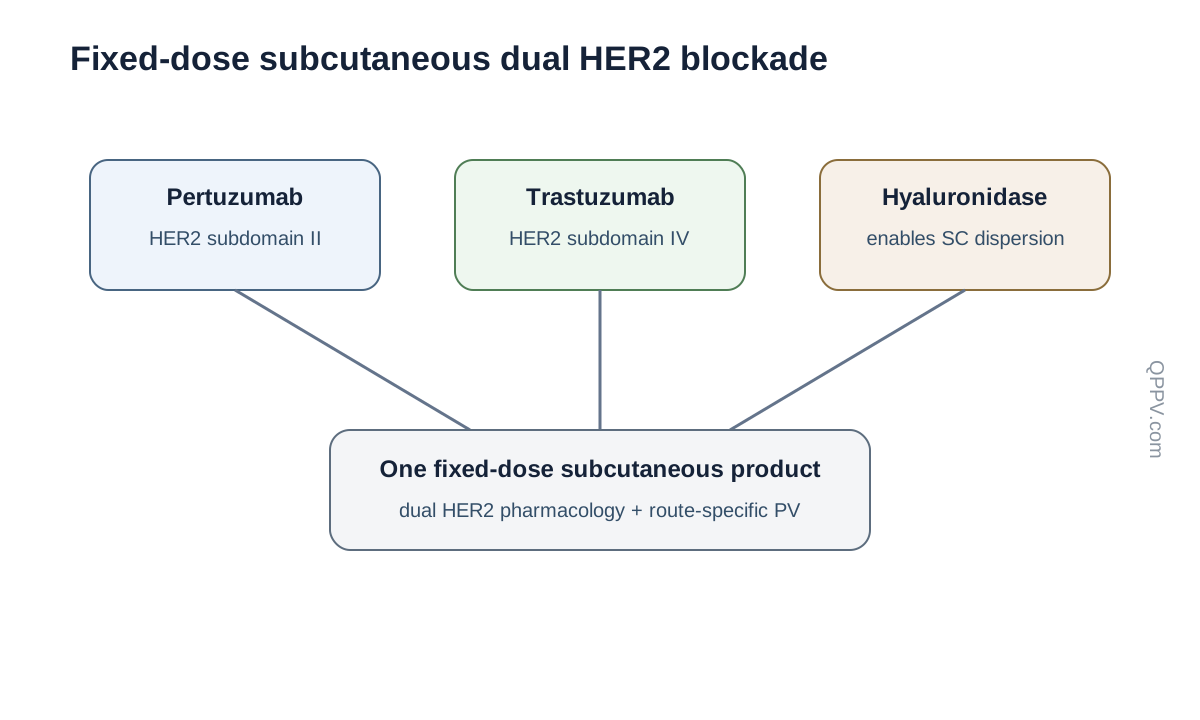
Figure 1. The product combines two HER2-directed antibodies with hyaluronidase-enabled subcutaneous delivery. Antibody pharmacology and formulation/administration pharmacology should be assessed separately.
Why hyaluronidase changes delivery but not the therapeutic target
Hyaluronan is an extracellular-matrix polysaccharide that contributes to the physical resistance of subcutaneous tissue to bulk fluid dispersion. Recombinant human hyaluronidase transiently depolymerises hyaluronan locally, increasing tissue permeability and permitting a larger injected volume to disperse.
This does not create a third antitumour mechanism. Hyaluronidase enables delivery; pertuzumab and trastuzumab provide the anticancer pharmacology. That distinction is useful when assessing adverse reactions. A local swelling or pain event may be route/formulation related, whereas left-ventricular dysfunction is better understood through HER2-pathway biology.
Fixed dosing and loading versus maintenance
The EU product uses a higher pertuzumab-containing loading presentation followed by a lower pertuzumab maintenance presentation, while the trastuzumab amount remains fixed. This differs from separately prepared intravenous regimens and means that product selection—not body-weight calculation—becomes the key dosing control.
Medication-error prevention therefore depends on recognising the correct presentation, treatment phase and route. The existence of two fixed-dose strengths makes “one vial” an unsafe shorthand unless the loading/maintenance status is known.
Clinical use
The combination is authorised in HER2-positive breast cancer settings corresponding to established dual HER2 blockade, including defined neoadjuvant, adjuvant and metastatic use with appropriate chemotherapy partners. Treatment intent and chemotherapy context remain essential to safety interpretation.
Safety profile: what is inherited and what is formulation-specific
Cardiac dysfunction
The fixed-dose product does not remove the cardiac risk associated with dual HER2 blockade. Left-ventricular ejection fraction decline and symptomatic heart failure remain central safety questions. Assessment should preserve baseline and serial cardiac measurements, prior anthracycline exposure, previous HER2-directed therapy, cardiovascular comorbidity and recovery after treatment modification.
Embryo-fetal toxicity
HER2-directed treatment can cause fetal harm. Pregnancy cases require exact timing of the fixed-dose combination, gestational age, chemotherapy co-exposures, fetal monitoring and outcome. Because both antibodies are delivered together, product-level exposure should be preserved rather than split artificially into two independent administrations unless the clinical record truly supports separate exposure.
Injection-site and administration-related reactions
Subcutaneous delivery introduces local pain, erythema, swelling and other injection-site events that are not equivalent to intravenous infusion reactions. Systemic administration-related reactions and hypersensitivity can still occur, however, so timing and phenotype remain important.
The reviewer should establish whether symptoms were confined to the injection site, whether systemic signs such as hypotension or bronchospasm occurred, and whether the event followed the loading or maintenance presentation.
Diarrhoea, neutropenia and regimen effects
Diarrhoea and febrile neutropenia remain important clinical events in pertuzumab-containing treatment, but chemotherapy contributes strongly to their frequency and severity. A subcutaneous formulation does not simplify causality. The complete regimen, treatment cycle, neutrophil nadir, infection evidence and supportive treatment remain necessary.
Medication-error architecture
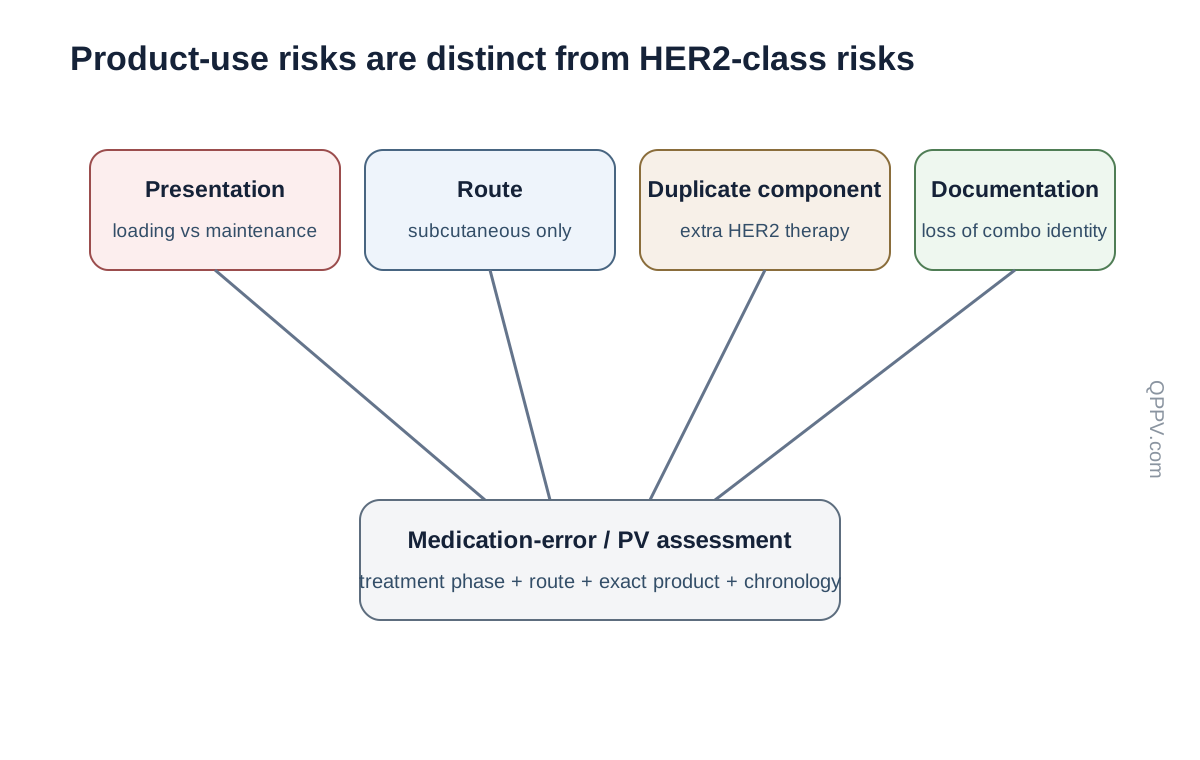
Figure 2. Product-use risks arise from presentation selection, route, treatment phase and combination identity. They are distinct from the biological risks of HER2 blockade.
Potential error modes include:
- selection of the maintenance presentation when a loading dose is required or vice versa;
- confusion between the fixed-dose combination and single-agent trastuzumab or pertuzumab products;
- incorrect route assumptions based on familiarity with intravenous HER2 therapy;
- duplicate administration if the fixed-dose combination is given and one component is then inadvertently administered separately;
- incomplete documentation of the combined product, causing one antibody exposure to disappear from the safety record.
These are not merely pharmacy problems. Medication errors can distort pharmacovigilance data if the product dictionary stores only one active substance or if the case narrative loses the fact that both antibodies were delivered simultaneously.
Switching between intravenous and subcutaneous treatment
Switching route may be clinically appropriate under current product information, but it creates an attribution boundary. A reaction after a switch could reflect accumulated HER2 exposure, a new subcutaneous local effect, formulation-specific excipients, or coincidence. Safety assessment should therefore capture the date of the last intravenous doses and the first fixed-dose subcutaneous administration.
Pharmacokinetic interpretation
The fixed-dose subcutaneous formulation was developed to achieve clinically comparable exposure to separately administered intravenous antibodies within the authorised regimen. Comparable exposure does not mean identical concentration-time curves at every moment. Absorption from subcutaneous tissue adds a depot phase and changes the route by which systemic exposure is achieved.
For routine PV, exact pharmacokinetic modelling is rarely needed. What matters is recognising that route changes can alter timing of administration reactions and that fixed dosing shifts the main error-control problem from calculation to product selection and treatment-phase recognition.
Pharmacovigilance case assessment
Product-level follow-up should capture both biological and administration variables.
| Question | Why it matters |
|---|---|
| Exact fixed-dose presentation | Distinguishes loading from maintenance and supports medication-error assessment |
| Route and injection site | Separates subcutaneous events from intravenous-treatment history |
| Prior HER2 treatment | Helps interpret cardiac and hypersensitivity events |
| Complete chemotherapy regimen | Essential for diarrhoea, cytopenia, infection and attribution |
| Cardiac baseline and serial LVEF | Supports assessment of HER2-associated cardiac dysfunction |
| Pregnancy timing | Necessary for embryo-fetal risk assessment |
| Injection-reaction phenotype | Distinguishes local site reaction from systemic hypersensitivity |
| Product/batch details | Supports biological traceability and quality investigation |
Signal detection and aggregate review
Aggregate review should distinguish formulation-specific from class-wide safety questions. A rise in local injection reactions after uptake of the subcutaneous product should not be interpreted as a new HER2-class toxicity. Conversely, cardiac or pregnancy signals should be evaluated across the broader HER2-directed exposure context while preserving the specific formulation.
Medication-error reports deserve separate trending by wrong presentation, wrong route, duplicate component administration and documentation/product-selection error. A formulation can therefore generate a meaningful safety signal even when the underlying antibody toxicities are unchanged.
Risk management and operational controls
Current regional product information governs administration, observation, treatment modification and patient selection. Recommended operational controls include distinct product-dictionary entries for the fixed-dose combination, explicit loading-versus-maintenance fields, structured route capture, and targeted follow-up for serious administration reactions and cardiac events.
Illustrative failure modes
The following are hypothetical operational examples, not published inspection findings:
- A maintenance presentation is administered as the first dose because the treatment phase is not checked.
- A case records only “trastuzumab” even though the patient received the fixed pertuzumab–trastuzumab combination.
- An injection-site reaction is pooled with intravenous infusion reactions, obscuring route-specific safety.
- A cardiac case omits prior anthracycline and intravenous HER2 exposure after the patient switched formulation.
- The combined product is entered as two independent products with different administration times, creating an artificial chronology.
Inspection and governance perspective
An inspector could test whether product dictionaries, case-processing conventions and medication-error workflows preserve the combination identity and distinguish loading from maintenance. Evidence should show that route-specific events can be analysed separately and that serious class risks remain linked to the complete HER2 exposure history.
Key Takeaways
The fixed-dose subcutaneous pertuzumab–trastuzumab–hyaluronidase product is not merely a convenience version of two intravenous antibodies. It preserves dual HER2 pharmacology while introducing a distinct delivery system, fixed-dose presentations, subcutaneous reactions and medication-error pathways.
Good PV therefore separates what comes from HER2 blockade from what comes from the formulation and administration system. Product identity, treatment phase, route, regimen and prior HER2 exposure are the core variables.
References
- European Medicines Agency. Pertuzumab/trastuzumab fixed-dose subcutaneous combination: EPAR and current product information. Product information updated 28 October 2025. https://www.ema.europa.eu/en/medicines/human/EPAR/phesgo
- Tan AR, Im SA, Mattar A, et al. Fixed-dose combination of pertuzumab and trastuzumab for subcutaneous injection plus chemotherapy in HER2-positive early breast cancer (FeDeriCa). Lancet Oncol. 2021;22:85-97.
- European Medicines Agency. Pertuzumab: EPAR and product information. Current information.
- European Medicines Agency. Trastuzumab: EPAR and product information. Current information.
Regulatory Note
Authorised indications, loading and maintenance presentations, administration conditions and observation requirements vary by jurisdiction and may change. Regulatory statements were checked against current EMA information available in September 2026. Operational recommendations are pharmacovigilance practice unless explicitly identified as regulatory requirements.