Pivekimab Sunirine: Classification, Mechanism, Evidence and Pharmacovigilance
Pivekimab sunirine is a CD123-directed antibody-drug conjugate (ADC). The U.S. Food and Drug Administration approved pivekimab sunirine-pvzy on 27 May 2026 for adults with blastic plasmacytoid dendritic cell neoplasm (BPDCN). FDA describes the medicine as a CD123-directed antibody and alkylating-agent conjugate. Its safety profile therefore has to be understood as the result of a targeted biological delivery system carrying a potent cytotoxic component, not as the safety profile of an unconjugated monoclonal antibody. [1,2]
BPDCN and the CD123 target
BPDCN is a rare haematological malignancy derived from plasmacytoid dendritic-cell precursors and commonly expresses high levels of CD123, the alpha chain of the interleukin-3 receptor. CD123 provides a surface target that can be used to concentrate a cytotoxic payload in malignant cells.
The antibody portion of pivekimab sunirine binds CD123. After target binding and cellular uptake, the conjugate delivers its cytotoxic component, which can damage DNA and kill the target cell. This architecture creates at least three pharmacovigilance layers: events related to the antibody or infusion, events related to delivery of the cytotoxic payload, and complications of BPDCN or its intensive treatment pathway. [1,3]
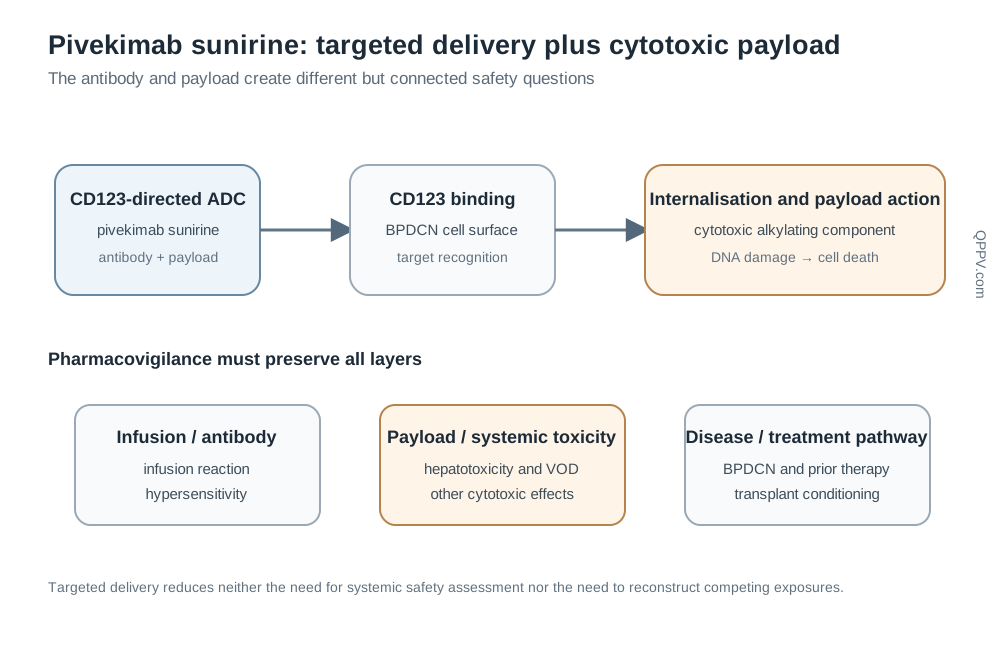
Figure 1. Simplified ADC mechanism. CD123 targeting supports delivery of a cytotoxic alkylating component to CD123-expressing cells; it does not make exposure biologically confined to malignant cells.
Current U.S. regulatory scope
The FDA indication covers adult patients with BPDCN and is not restricted in the approval wording to a single prior-treatment category. The recommended dose in the FDA approval summary is 0.045 mg/kg intravenously over approximately 15 to 30 minutes every three weeks until disease progression or unacceptable toxicity. [1]
For pharmacovigilance, line of therapy remains important even when it is not part of the broad indication. A treatment-naïve patient, a patient with relapsed disease after prior therapy and a patient proceeding to haematopoietic stem-cell transplantation have different competing risks for cytopenias, infection, hepatic injury and mortality. The case record should therefore preserve treatment history rather than relying only on the labelled indication.
CADENZA evidence
FDA evaluated efficacy in CADENZA, a multicentre, open-label, single-arm study. The regulatory efficacy population included 33 adults with treatment-naïve BPDCN and 51 with relapsed or refractory BPDCN, without active central nervous system disease. The principal response measure was complete remission or clinical complete remission (CR/CRc). [1]
Among treatment-naïve patients, 23 of 33 achieved CR/CRc, a rate of 69.7% (95% CI 51.3–84.4), with a median response duration of 9.7 months. Among relapsed or refractory patients, 8 of 51 achieved CR/CRc, a rate of 15.7% (95% CI 7.0–28.6), with a median response duration of 9.2 months. These cohorts should remain separate when describing benefit: the markedly different response proportions reflect different clinical populations and cannot be averaged into a single treatment effect. [1]
Published CADENZA analyses provide additional clinical context, but publication analysis sets and regulatory analysis sets are not always identical. When describing the authorised medicine, the current FDA assessment and prescribing information should control regulatory claims. [1,3]
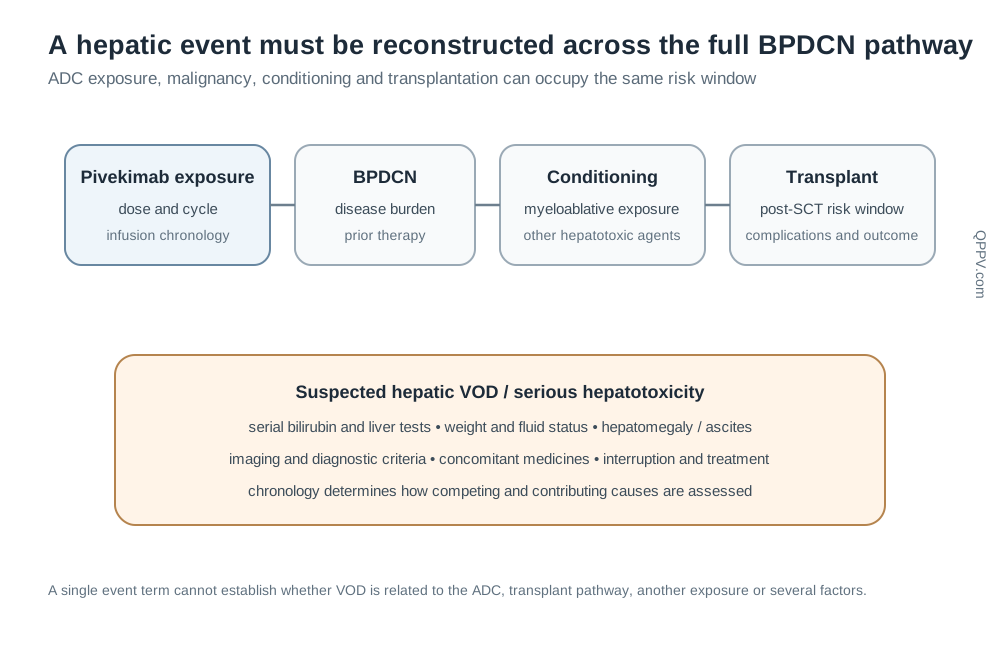
Figure 2. A suspected event should be assessed against three overlapping sources: the ADC, the underlying malignancy and the wider treatment pathway, including transplantation.
Hepatotoxicity and hepatic veno-occlusive disease
The U.S. prescribing information carries a Boxed Warning for hepatotoxicity, including hepatic veno-occlusive disease (VOD). FDA also identifies warnings for infusion-related reactions, oedema, sulfite allergic reactions and embryo-fetal toxicity. [1,2]
VOD is a clinically important syndrome involving hepatic sinusoidal injury and impaired venous outflow. A suspected case requires rapid and detailed follow-up. Capture bilirubin and liver-enzyme trends, weight change, fluid retention, hepatomegaly, ascites, imaging and other diagnostic findings, as well as the exact timing of pivekimab sunirine and all other hepatotoxic or myeloablative exposures.
Transplantation as a critical confounder and modifier
Some patients with BPDCN may proceed to stem-cell transplantation after achieving response. Conditioning regimens and transplantation themselves can be associated with hepatic sinusoidal injury and VOD. A post-treatment VOD report therefore cannot be interpreted from the pivekimab sunirine exposure date alone. The narrative should show the sequence of ADC treatment, response, conditioning, transplantation, onset of liver abnormalities, diagnostic work-up and outcome.
This does not mean transplant-associated VOD should be dismissed as unrelated to the ADC. It means causality assessment must preserve all biologically relevant exposures and the timing between them.
Other safety domains
For infusion-related reactions, record the infusion number, onset relative to administration, symptoms, vital signs, treatment, interruption and outcome. For oedema, document anatomical distribution, weight trajectory, cardiac, renal and hepatic evaluation, concomitant fluids and whether the finding occurred with hypoalbuminaemia or disease progression.
Sulfite-related reactions require a clear allergy history and clinical phenotype. Reports of cytopenia, infection or bleeding should be assessed against marrow involvement by BPDCN, previous cytotoxic therapy and subsequent transplantation rather than attributed solely from temporal proximity.
Pharmacovigilance implementation
Pivekimab sunirine illustrates why ADC pharmacovigilance should not be organised as if the medicine were only an antibody. The safety database needs enough treatment context to distinguish target-related biology, payload-related toxicity, infusion phenomena and complications of a haematological malignancy.
For hepatic cases, serial laboratory values are more informative than a single “liver function abnormal” term. Record baseline bilirubin, alanine and aspartate aminotransferases, alkaline phosphatase, weight and fluid status where available, then preserve the trajectory through interruption, supportive treatment, transplant conditioning and recovery or progression. When VOD is suspected, diagnostic criteria and specialist assessment should be captured rather than inferred from oedema or hyperbilirubinaemia alone.
Aggregate review and governance
Aggregate review should separately track VOD, other serious hepatotoxicity, infusion-related reactions, clinically significant oedema, serious allergic reactions, severe cytopenic complications and fatal cases. VOD cases warrant individual medical review because the same syndrome can arise after more than one exposure in the BPDCN treatment pathway.
Response and safety also intersect. A patient who achieves remission and proceeds to transplantation may have a different subsequent risk window from a patient with refractory disease and continuing treatment. Exposure denominators and time-at-risk therefore need interpretation; simple case counts can mislead when treatment pathways differ substantially.
Practical checklist
- Confirm BPDCN status and whether treatment was frontline or relapsed/refractory.
- Record dose, infusion dates, prior cytotoxic therapy and subsequent transplantation.
- For hepatic events, obtain serial bilirubin and liver tests, fluid/weight changes and diagnostic findings.
- For suspected VOD, reconstruct conditioning, transplant and ADC exposure chronologically.
- For infusion reactions, document onset during or after infusion and management.
- For oedema, assess hepatic, renal, cardiac and disease-related alternatives.
- Use current U.S. prescribing information for monitoring, interruption and reproductive precautions.
Key takeaways
- Pivekimab sunirine is a CD123-directed antibody-drug conjugate, not an unconjugated antibody.
- The 2026 U.S. indication covers adults with BPDCN.
- CADENZA showed different response proportions in treatment-naïve and relapsed/refractory cohorts; those populations should not be collapsed in benefit interpretation.
- Hepatotoxicity including hepatic VOD is the defining serious labelled safety concern.
- Transplant conditioning, prior therapy and BPDCN itself are essential competing or modifying factors in case assessment.
References
- U.S. Food and Drug Administration. FDA approves pivekimab sunirine-pvzy for blastic plasmacytoid dendritic cell neoplasm, an ultra-rare hematologic malignancy. 27 May 2026. https://www.fda.gov/drugs/resources-information-approved-drugs/fda-approves-pivekimab-sunirine-pvzy-blastic-plasmacytoid-dendritic-cell-neoplasm-ultra-rare
- U.S. Food and Drug Administration. Multidiscipline Review: BLA 761460, pivekimab sunirine. 2026. https://www.accessdata.fda.gov/drugsatfda_docs/nda/2026/761460Orig1s000MultidisciplineR.pdf
- Pemmaraju N, Marconi G, Montesinos P, et al. Pivekimab Sunirine in Blastic Plasmacytoid Dendritic Cell Neoplasm. J Clin Oncol. 2026;44:861-873. PMID: 41671533. https://pubmed.ncbi.nlm.nih.gov/41671533/
- U.S. Food and Drug Administration. Orphan Drug Designations and Approvals: pivekimab sunirine-pvzy. https://www.accessdata.fda.gov/scripts/opdlisting/oopd/detailedIndex.cfm?cfgridkey=781620
Regulatory Note
Regulatory status was checked on 1 October 2026. This article describes the current U.S. authorisation and supporting evidence. Product information, indications and risk-minimisation requirements may differ in other jurisdictions or change over time. The article is educational and does not replace current prescribing information.