Respiratory Syncytial Virus Vaccine (Bivalent, Recombinant): Biology, Maternal Immunisation and Pharmacovigilance
The bivalent recombinant respiratory syncytial virus (RSV) vaccine is a protein-subunit vaccine built around the viral fusion protein in its prefusion conformation. It contains stabilised prefusion F antigens representing RSV subgroups A and B. The prefusion structure matters because it displays neutralising epitopes that are altered when the fusion protein rearranges into its postfusion form.
Its pharmacovigilance is unusually instructive because vaccination can protect two different recipients through two different biological routes: direct active immunisation of an adult, or vaccination during pregnancy followed by transplacental transfer of maternal antibody that passively protects the infant after birth.
- Respiratory Syncytial Virus Vaccine (Bivalent, Recombinant): Biology, Maternal Immunisation and Pharmacovigilance
- Classification and Antigen Design
- Two Protection Pathways
- Current Regulatory Context
- Safety and Pharmacovigilance Across the Two Protection Pathways
- Vaccine-Use and Product-Identification Errors
- Product-Specific Case Assessment
- Aggregate Surveillance and Benefit–Risk Interpretation
- Illustrative Failure Modes
- Inspection and Governance Considerations
- Practical Checklist
- Key Takeaways
- References
- Regulatory Note
Classification and Antigen Design
This is a bivalent recombinant protein vaccine. It is not a live RSV vaccine and does not contain replicating RSV. “Bivalent” refers to the inclusion of prefusion F antigens from RSV A and RSV B; it does not mean that the vaccine generates only two antibody clones.
Why prefusion F is the key antigen
RSV uses the F protein to fuse viral and host-cell membranes. Before fusion, F adopts a metastable prefusion conformation containing highly neutralisation-sensitive antigenic sites. Stabilising that state allows vaccination to present immune cells with the configuration most useful for generating neutralising antibody.
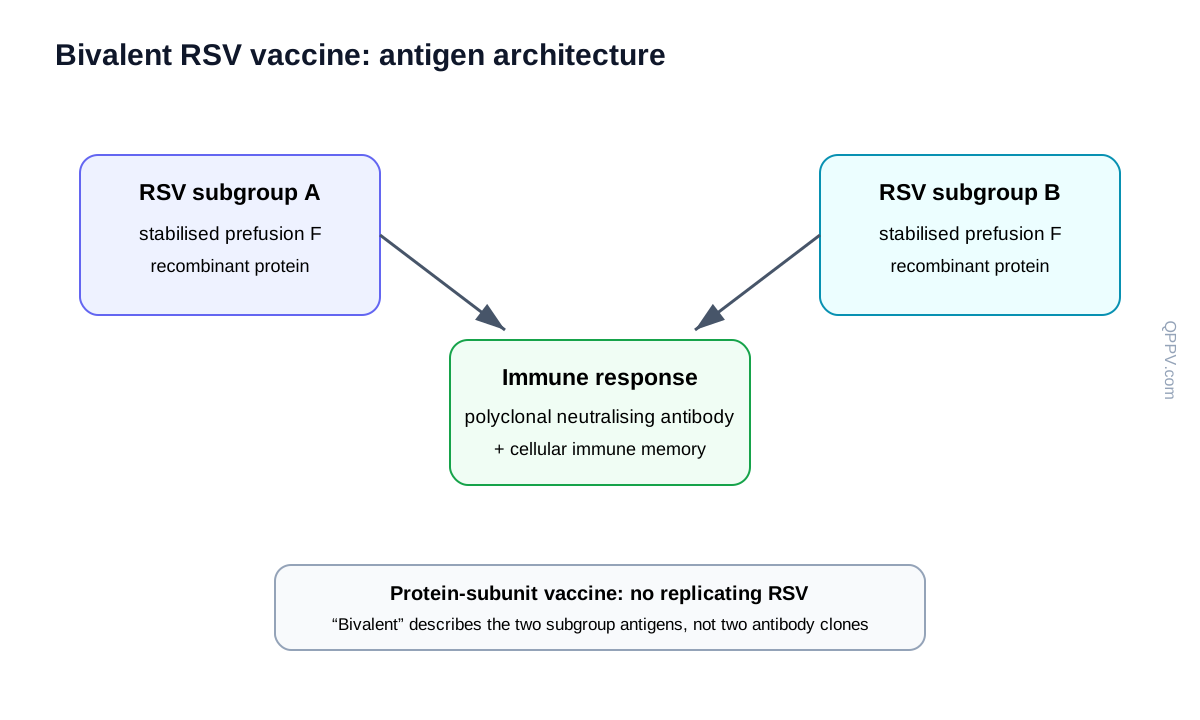
Figure 1. The vaccine combines recombinant prefusion F antigens from RSV A and B to induce polyclonal neutralising immunity without using replicating virus.
Two Protection Pathways
Active adult immunisation
After intramuscular vaccination, antigen-presenting cells and lymphocytes generate humoral and cellular immune responses. Protection depends on the vaccinated person developing immunity before subsequent RSV exposure.
Maternal immunisation and passive infant protection
During pregnancy, vaccination induces maternal antibodies that can cross the placenta through Fc-receptor-mediated transport. The infant therefore receives ready-made antibody rather than being directly vaccinated. Antibody concentrations then decline after birth, which explains why maternal vaccination is designed to protect a defined early-infancy period rather than establish permanent infant immunity.
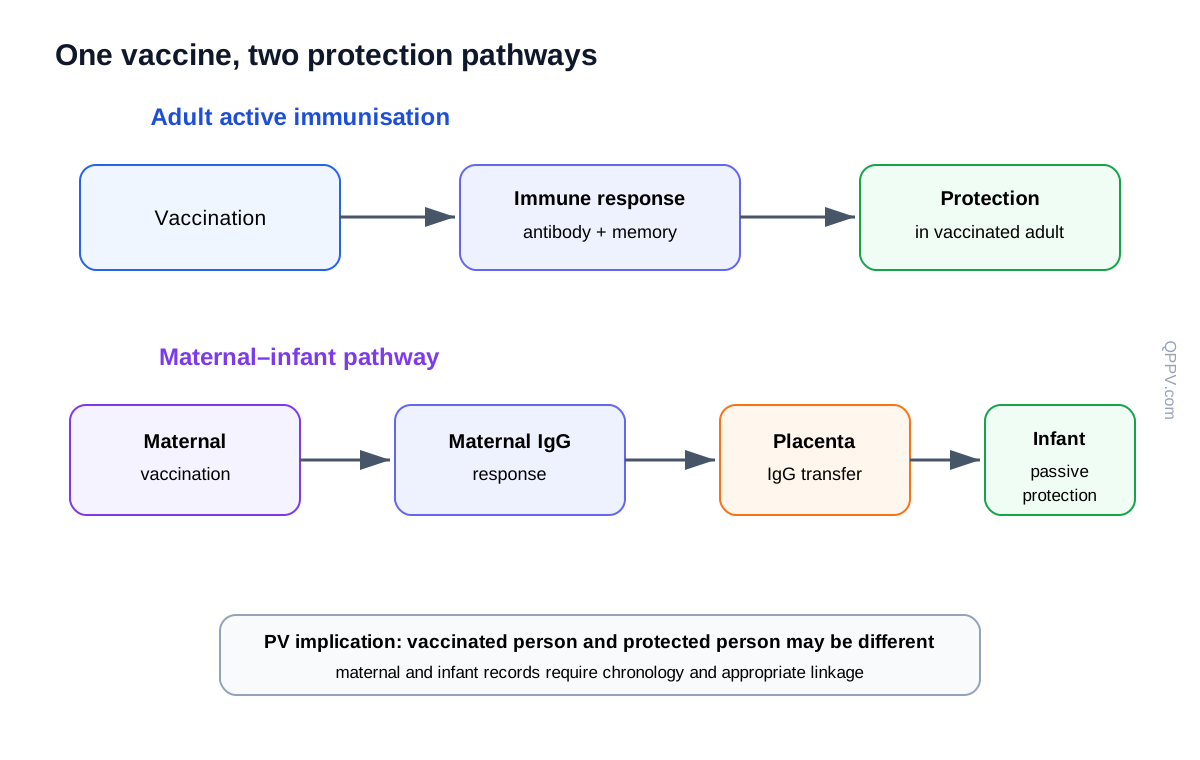
Figure 2. Adult vaccination produces active immunity in the vaccine recipient; maternal vaccination adds a second step—placental IgG transfer—creating passive protection in the infant.
Current Regulatory Context
In the European Union, the vaccine is authorised for passive protection against RSV lower respiratory tract disease in infants from birth through 6 months following maternal immunisation, and for active immunisation of individuals 18 years and older. Current EU product information was updated on 6 August 2026 and the product remains under additional monitoring.
The EU overview specifies administration during weeks 24–36 of pregnancy. In the United States, the authorised maternal window is narrower, 32–36 weeks of gestation. This jurisdictional difference is important: a PV assessment must use the product information applicable where vaccination occurred rather than treating one gestational window as globally universal.
Safety and Pharmacovigilance Across the Two Protection Pathways
Expected reactogenicity and hypersensitivity
Local injection-site pain and systemic symptoms such as fatigue, headache and myalgia are expected vaccine reactions. Their interpretation remains clinically straightforward when onset, duration and severity are documented. Serious hypersensitivity requires a different level of follow-up: timing after vaccination, objective features of anaphylaxis, treatment, previous allergy history, co-administered vaccines and outcome should be captured.
Guillain–Barré syndrome surveillance
Neurological surveillance requires particular precision. In January 2025, the U.S. regulator required Guillain–Barré syndrome (GBS) warnings for RSV vaccines after postmarketing observational analyses suggested an increased risk during the 42 days after vaccination in older adults. This is a regulatory safety signal and warning, not proof that every temporally associated GBS case is caused by vaccination.
A useful report should capture exact vaccination date, neurological symptom onset, weakness pattern, reflex findings, cerebrospinal-fluid and electrophysiological data where available, Brighton or other diagnostic classification if used, antecedent respiratory or gastrointestinal infection, other recent vaccines, hospitalisation, treatment and outcome. Aggregate analyses should preserve the risk window rather than grouping all lifetime GBS reports together.
Pregnancy and preterm-birth surveillance
Maternal immunisation creates a second safety unit: the pregnancy. In the pre-authorisation programme, a numerical imbalance in preterm births was observed in the vaccine and placebo groups. U.S. regulatory review stated that available data were insufficient to establish or exclude a causal relationship. The appropriate PV response is therefore structured surveillance, not causal shorthand.
Pregnancy reports should record gestational age at vaccination, estimated due date, maternal risk factors for preterm birth, hypertensive disorders, infections, multiple pregnancy, obstetric history, onset and reason for labour or delivery, gestational age at birth, birth weight, neonatal complications and outcome. The authorised gestational window is jurisdiction-specific and should be assessed against the local label.
Linking mother and infant
For maternal vaccination, the mother and infant are biologically linked but remain distinct safety subjects. Maternal adverse events belong to the maternal record; congenital, neonatal and infant outcomes belong to the infant record with an appropriate linkage that preserves privacy and traceability.
An infant RSV infection after maternal vaccination is not automatically an adverse reaction. It may represent breakthrough disease or lack of expected protection and should be assessed using virological confirmation, age at onset, severity, maternal vaccination date and gestational timing.
Vaccine-Use and Product-Identification Errors
RSV vaccines are not interchangeable descriptions. A report that says only “RSV vaccine” may lose information about antigen platform, adjuvant status, authorised age or pregnancy use and reconstitution requirements.
Important error modes include use outside the locally authorised pregnancy window, administration to the wrong age/risk population, incorrect reconstitution, wrong diluent, incomplete dose, wrong route, cold-chain excursion and confusion between different RSV vaccines. Co-administration with other vaccines should also be captured when evaluating acute systemic or neurological events.
Product-Specific Case Assessment
| Scenario | High-value follow-up |
|---|---|
| GBS or acute neuropathy | Vaccine date, onset interval, neurological examination, CSF/electrophysiology, antecedent infection, co-vaccines |
| Preterm birth | Gestational week at vaccination and delivery, maternal risk factors, reason for delivery, neonatal outcome |
| Infant RSV disease | Maternal dose date, gestational week, infant age, laboratory confirmation, severity and outcome |
| Anaphylaxis | Onset, objective criteria, treatment, previous allergy, co-administered vaccines |
| Administration error | Exact vaccine, lot, intended population, gestational/chronological age, preparation, route, dose, consequence |
The unifying principle is that vaccine exposure must be reconstructed around the biological recipient of protection. Adult active immunisation and maternal–infant passive protection should not be collapsed into one undifferentiated dataset.
Aggregate Surveillance and Benefit–Risk Interpretation
Aggregate analysis should separate the major exposure contexts: non-pregnant adults, pregnant vaccine recipients and linked infants. Within adult analyses, age and baseline risk of severe RSV disease matter. Within pregnancy analyses, gestational week at vaccination and delivery is essential. Infant effectiveness or breakthrough-disease analyses should preserve the maternal vaccination date and infant age.
Neurological surveillance should retain diagnostic certainty and onset interval. Pregnancy surveillance should compare observed outcomes with appropriate background data rather than interpreting raw counts without denominators. Lot, co-administration and jurisdiction should be retained where they could explain clustering or differences in use.
Illustrative Failure Modes
These are hypothetical operational scenarios, not reported inspection findings.
- A GBS report is closed without symptom-onset date or objective neurological findings.
- A preterm-birth report records only “vaccinated during pregnancy” without gestational week at vaccination or delivery.
- Maternal and infant records are not linked, preventing reconstruction of passive-protection exposure.
- An infant RSV hospitalisation is coded as vaccine failure without laboratory confirmation or infant age.
- A medication-error report records only “RSV vaccine,” preventing identification of the actual product and platform.
- EU and U.S. pregnancy windows are treated as though they were identical.
Inspection and Governance Considerations
An inspector could reasonably examine whether pregnancy and infant outcomes are linked appropriately, whether the system actively follows serious neurological reports, and whether vaccine identity and lot are preserved. Evidence may include pregnancy follow-up processes, mother–infant linkage conventions, signal-review methods, lot-trending outputs and procedures for reconciling product-quality or administration-error reports.
For maternal immunisation, governance should ensure that one clinical episode is not fragmented across unconnected maternal, obstetric and infant records. Recommended structured follow-up is an operational quality measure, not an additional legal reporting criterion.
Practical Checklist
- Identify the exact RSV vaccine and lot.
- Record route, dose, administration date and co-administered vaccines.
- For adults, capture age and baseline RSV-risk context.
- For maternal vaccination, record gestational week precisely.
- Link maternal and infant outcomes appropriately.
- For preterm birth, document risk factors, reason for delivery and neonatal outcome.
- For GBS, reconstruct the onset interval and diagnostic evidence.
- For breakthrough RSV disease, seek laboratory confirmation and severity.
- Assess administration errors against the locally applicable authorised use.
- Preserve jurisdiction because authorised pregnancy windows differ.
Key Takeaways
The bivalent recombinant RSV vaccine uses stabilised prefusion F antigens from RSV A and B to generate neutralising immunity. In adults this is direct active immunisation. During pregnancy, the same maternal immune response supports a second biological pathway: transplacental antibody transfer and temporary passive protection of the infant.
That dual pathway means high-quality PV must preserve who was vaccinated, who experienced the outcome, gestational timing where relevant, exact vaccine identity, lot and chronology. GBS and pregnancy outcomes require structured surveillance without converting regulatory signals or numerical imbalances into unsupported causal conclusions.
References
- European Medicines Agency. Abrysvo: EPAR and product information. Product information updated 6 August 2026. https://www.ema.europa.eu/en/medicines/human/EPAR/abrysvo
- U.S. Food and Drug Administration. ABRYSVO — Respiratory Syncytial Virus Vaccine. Current product information and regulatory history. https://www.fda.gov/vaccines-blood-biologics/abrysvo
- U.S. Food and Drug Administration. FDA requires Guillain–Barré syndrome warning in prescribing information for RSV vaccines Abrysvo and Arexvy. 7 January 2025. https://www.fda.gov/safety/medical-product-safety-information/fda-requires-guillain-barre-syndrome-gbs-warning-prescribing-information-rsv-vaccines-abrysvo-and
- U.S. Food and Drug Administration. FDA approves first vaccine for use in pregnant individuals to prevent RSV in infants. 21 August 2023. https://www.fda.gov/news-events/press-announcements/fda-approves-first-vaccine-pregnant-individuals-prevent-rsv-infants
Regulatory Note
Authorised age groups, pregnancy windows and recommendations differ by jurisdiction and can change through lifecycle variation. This article uses the current EU and U.S. regulatory context to explain pharmacovigilance principles; local product information and immunisation recommendations remain controlling. Numerical imbalances and postmarketing safety signals are described according to regulatory interpretation and are not presented as proof of causality.