Ribociclib: Discovery, Development, Safety and Pharmacovigilance
Ribociclib is an oral cyclin-dependent kinase 4 and 6 (CDK4/6) inhibitor used with endocrine treatment in hormone receptor (HR)-positive, human epidermal growth factor receptor 2 (HER2)-negative breast cancer. Its history illustrates how a molecularly targeted drug can progress from metastatic disease to prolonged adjuvant therapy while retaining important, sometimes treatment-limiting toxicities. In particular, ribociclib requires clinicians and pharmacovigilance teams to understand the relationship between exposure, corrected QT interval, hepatic injury, blood counts, concomitant medicines and changing benefit–risk context.
- Ribociclib: Discovery, Development, Safety and Pharmacovigilance
- Biological rationale: interrupting cell-cycle progression
- Discovery and development programme
- Regulatory evolution and clinical settings
- Clinical evidence: endpoints are not interchangeable
- The MONALEESA evidence programme
- NATALEE and expansion into early breast cancer
- Pharmacokinetics and interactions
- Safety profile and surveillance priorities
- Drug interactions as preventable safety contributors
- Pharmacovigilance in routine practice
- Practical review checklist
- Key takeaways
- References
- Regulatory Note
Biological rationale: interrupting cell-cycle progression
The cyclin D–CDK4/6 complex phosphorylates the retinoblastoma (RB) protein and promotes passage through the G1 restriction point. In RB-competent tumours, inhibiting CDK4/6 can maintain RB-mediated suppression of E2F-dependent transcription and slow progression into DNA synthesis. HR-positive breast cancer frequently depends on oestrogen-receptor signalling, which also promotes cyclin D activity. Combining endocrine therapy with CDK4/6 inhibition therefore targets two connected drivers of proliferation rather than two interchangeable pathways.
Ribociclib does not directly antagonise the oestrogen receptor and is not a cytotoxic chemotherapy agent. Its activity depends partly on tumour biology; resistance can arise through changes affecting RB, cyclin E–CDK2 signalling, endocrine pathways and other mechanisms. Such mechanisms are biologically plausible explanations for treatment failure, not sufficient evidence to assign a specific patient's progression to a molecular pathway without appropriate testing.
Discovery and development programme
Ribociclib, initially known as LEE011, emerged from a research collaboration between the Novartis Institutes for BioMedical Research and Astex Therapeutics, announced in December 2005. Astex's own development history attributes the discovery programme to that collaboration; Novartis subsequently led clinical development and commercialised ribociclib as Kisqali. This distinction matters: a company credited with the discovery collaboration is not necessarily the later marketing-authorisation holder. [12]
The early programme sought selective oral inhibition of CDK4/6 with sufficient exposure to arrest tumour-cell cycling while allowing recovery from reversible marrow suppression. A 21-days-on, seven-days-off schedule became the pivotal metastatic regimen, initially at 600 mg daily. The 400-mg adjuvant regimen was studied later and should not be described as the dose used in the original metastatic registration programme. Dose finding and subsequent dose modification reflect a therapeutic-window problem: pharmacodynamic inhibition is useful only if prolonged exposure remains clinically tolerable.
The initial trial strategy combined ribociclib with endocrine therapy because oestrogen-receptor signalling and cyclin D–CDK4/6 activation are linked. The strategy did not establish that ribociclib monotherapy would have the same clinical benefit, nor does it imply that every HR-positive tumour retains an intact RB pathway. This mechanistic rationale preceded the definitive randomised evidence.
This discovery history should not be conflated with that of palbociclib or abemaciclib: all inhibit CDK4/6, but their development programmes, doses, adverse-reaction profiles and authorised combinations differ. The class mechanism provides context; the ribociclib label governs ribociclib-specific precautions.
Regulatory evolution and clinical settings
The FDA first approved ribociclib on 13 March 2017, with an aromatase inhibitor as initial endocrine-based treatment for postmenopausal women with HR-positive/HER2-negative advanced or metastatic breast cancer. MONALEESA-2 supplied the principal registration evidence. Subsequent US expansion broadened the populations and endocrine partners, including fulvestrant; the current label defines the permitted combinations. The EU marketing authorisation was issued on 22 August 2017, with Novartis Europharm Limited as the current EU marketing-authorisation holder. [2,3]
On 17 September 2024, the FDA approved ribociclib with an aromatase inhibitor for adjuvant treatment of adults with stage II or III HR-positive/HER2-negative early breast cancer at high risk of recurrence, based on NATALEE. The same action covered a ribociclib–letrozole co-pack. The FDA's reviewed population and trial selection criteria are not interchangeable with every national reimbursement policy. [4]
The EMA's current EPAR also includes adjuvant treatment of high-risk HR-positive/HER2-negative early breast cancer and advanced/metastatic indications. EU wording refers to patients with high-risk early disease and selection criteria in the SmPC, whereas the US label explicitly specifies stages II–III. In the EU, the advanced/metastatic indication describes women; the current US label describes adults. In pre/perimenopausal women and in men receiving an aromatase inhibitor, the EU EPAR specifies concomitant luteinising hormone-releasing hormone suppression. Such jurisdictional differences are substantive, not stylistic. [1,2]
The July 2026 US Kisqali label distinguishes two starting regimens: 400 mg daily for 21 days followed by seven days off in early breast cancer, and 600 mg on the same 21/7 schedule in advanced or metastatic disease. These are labelled starting regimens, not interchangeable doses. Interruption, reduction or permanent discontinuation depends on toxicity and the applicable product instructions. The adjuvant regimen was studied for three years, whereas the metastatic setting generally involves treatment until progression or unacceptable toxicity.
Jurisdiction matters beyond the indication. The US July 2026 structured product label and the EU product information updated August 2026 are separate source versions. Product traceability should include the dispensed presentation, manufacturer/marketing-authorisation holder where relevant, batch if available, region and the label version used for medical assessment. The same INN can be sold in different packs or combinations; a co-pack does not create a new active-substance lifecycle. [1,2]
Dose and treatment duration
For US-labelled adjuvant treatment, ribociclib begins at 400 mg once daily for 21 consecutive days, then seven days off, repeated for up to three years or until recurrence or unacceptable toxicity. In advanced/metastatic disease, the US starting dose is 600 mg on the same 21/7 cycle, continued while clinically appropriate. These doses must not be swapped merely because both use 200-mg tablets. The endocrine partner continues according to its own schedule. Tablets are swallowed whole; the US label instructs that a missed or vomited dose is not replaced with an extra dose that day. [1]
Clinical care also needs to distinguish dose interruption from permanent discontinuation. A temporary hold for a reversible laboratory abnormality may preserve treatment, while certain severe or recurrent toxicities require stopping ribociclib. The current label's event-specific modification tables—not a generic CDK4/6 algorithm—govern these decisions.
Clinical evidence: endpoints are not interchangeable
Ribociclib's efficacy story spans progression-free survival (PFS), overall survival (OS) and invasive disease-free survival (iDFS). These measure different clinical questions. PFS in metastatic disease is not equivalent to cure; iDFS in the adjuvant setting captures recurrence-related events and cannot by itself establish an OS advantage. The next section considers the trials by disease state before turning to safety and practical surveillance.
The MONALEESA evidence programme
MONALEESA-2: first-line metastatic treatment
MONALEESA-2 randomised 668 postmenopausal women with previously untreated HR-positive/HER2-negative advanced disease to ribociclib plus letrozole or placebo plus letrozole. The FDA's original approval review reported an investigator-assessed PFS hazard ratio of 0.556 (95% CI 0.429–0.720). In the later prespecified final OS analysis, median survival was 63.9 versus 51.4 months, respectively (HR for death 0.76, 95% CI 0.63–0.93). These are trial-level comparisons, not a prediction of an individual's survival. [3,5,6]
The survival finding strengthened the case for early use of the combination in the trial-defined population. It does not establish the same magnitude of benefit in every line of treatment, in patients with major organ dysfunction excluded from trials, or after a different sequence of targeted therapies. Subsequent treatment and follow-up also influence OS, so the mature result should be distinguished from the initial PFS-based registration decision.
MONALEESA-7: premenopausal and perimenopausal disease
MONALEESA-7 addressed a previous evidence gap by enrolling 672 premenopausal or perimenopausal women receiving goserelin with endocrine therapy. Its prespecified OS analysis reported a hazard ratio for death of 0.71 (95% CI 0.54–0.95) for ribociclib versus placebo, with estimated survival at 42 months of 70.2% versus 46.0%. The study included both aromatase-inhibitor and tamoxifen endocrine backbones, but this historical trial design must not be mistaken for current prescribing approval. [7]
QTc prolongation was a concern with concomitant tamoxifen. The July 2026 US label explicitly states that ribociclib is not indicated for concomitant use with tamoxifen. In pharmacovigilance review, identify the exact endocrine partner rather than recording the nonspecific term “hormonal therapy.”
MONALEESA-3: fulvestrant combinations
MONALEESA-3 studied 726 postmenopausal women receiving fulvestrant, randomised 2:1 to ribociclib or placebo. The protocol-specified OS analysis reported an HR for death of 0.72 (95% CI 0.57–0.92), with estimated survival at 42 months of 57.8% versus 45.9%. The trial included first-line and second-line settings, and a descriptive analysis found first-line median PFS of 33.6 versus 19.2 months. [8]
This evidence supports ribociclib with a different endocrine backbone. It does not show that all CDK4/6 inhibitors, all fulvestrant combinations or all endocrine-resistant tumours behave identically. Different trial eligibility, prior exposure, subsequent therapy and follow-up preclude simple cross-trial rankings.
| Programme | Population and endocrine backbone | Main clinical question | Interpretive caution |
|---|---|---|---|
| MONALEESA-2 | Postmenopausal advanced disease; letrozole | PFS and later OS | Metastatic evidence is not adjuvant evidence |
| MONALEESA-7 | Premenopausal/perimenopausal advanced disease; ovarian suppression and endocrine therapy | Benefit in younger endocrine-responsive populations | Tamoxifen combination raises a distinct QT concern |
| MONALEESA-3 | Advanced disease; fulvestrant | Benefit with a different endocrine partner and treatment history | Treatment-line differences matter |
| NATALEE | Stage II–III high-risk early disease; nonsteroidal aromatase inhibitor | Prevent invasive recurrence; later OS follow-up | iDFS established at approval; 2026 OS readout is later conference-reported evidence, not a 2024 approval result |
NATALEE and expansion into early breast cancer
NATALEE randomised 5,101 adults, including men, with eligible stage II or III HR-positive/HER2-negative early breast cancer to ribociclib plus a nonsteroidal aromatase inhibitor or endocrine therapy alone. Ribociclib was given at a 400-mg starting dose for three years, with endocrine treatment continuing separately. Trial eligibility incorporated tumour stage, nodal status, grade and additional high-risk features; the results cannot be automatically generalised to all node-negative stage I disease. [4,9,13]
At the FDA's final iDFS analysis, estimated 36-month iDFS was 90.7% with ribociclib versus 87.6% with endocrine therapy alone (HR 0.749, 95% CI 0.628–0.892). The absolute difference was approximately 3.1 percentage points at that time point. The endpoint combined invasive recurrence and specified other events; it was not an overall-survival endpoint. OS was immature at the September 2024 approval assessment. [4]
This shift from advanced to adjuvant disease changes benefit–risk assessment. A patient without evident metastatic disease may receive prolonged treatment to reduce future recurrence risk. Toxicity, treatment burden, reproductive counselling and adherence therefore matter alongside recurrence endpoints. An adverse reaction that is manageable in metastatic disease may have a different impact on the acceptability of years of adjuvant therapy.
Longer follow-up: 2025 peer-reviewed data and October 2026 conference results
The five-year NATALEE follow-up published in ESMO Open showed a persistent iDFS benefit after the planned three years of ribociclib had ended. The 2025 analysis reported five-year iDFS of 85.5% versus 81.0% (HR approximately 0.72); the overall-survival estimate remained favourable but its confidence interval included no effect. This distinction matters: continued reduction in recurrence events did not, at that time, establish a definitive OS difference. [10]
New evidence reported on 23 October 2026: Novartis announced a prespecified six-year NATALEE analysis presented at ESMO Congress 2026, with OS HR 0.809 (95% CI 0.661–0.989) and six-year OS approximately 91.9% versus 89.7%. The sponsor reported a nominal one-sided P value of 0.019. Six-year iDFS was approximately 83.2% versus 77.9% (HR 0.741). These are conference-reported, sponsor-disclosed findings available at this article's 24 October 2026 cutoff, not yet a peer-reviewed full publication or a new regulatory-label efficacy determination. The nominal P value should not be described without its testing context; the final protocol and statistical analysis must be examined when the full report is published. [11]
This temporal separation is essential: 2024 regulatory decision → 2025 longer-follow-up peer-reviewed evidence → 2026 conference OS report. A statement that NATALEE has never shown an OS signal is now outdated; a statement that the 2024 approval was based on proven OS would also be incorrect. Future evidence should clarify durability, subsequent therapies, subgroup estimates and long-term safety.
The FDA's approval assessment called for continued evaluation of survival and representation. A regulatory postmarketing commitment is not evidence that a particular adverse outcome occurred; it specifies information to be collected. The EMA's product assessment and risk-management plan likewise need to be interpreted as their own jurisdictional documents. [2,4]
Pharmacokinetics and interactions
Ribociclib exposure is influenced by CYP3A-mediated metabolism. Strong CYP3A inhibitors can increase ribociclib exposure, potentially worsening concentration-related toxicity, while strong inducers can reduce exposure and jeopardise effectiveness. Ribociclib can also affect exposure to susceptible CYP3A substrates. Medication review must therefore include prescription drugs, over-the-counter products, supplements and temporary antimicrobials or antiarrhythmics.
The 2026 US label advises avoiding strong CYP3A inhibitors where possible and specifies dose modification if an inhibitor cannot be avoided. It advises avoiding strong CYP3A inducers and drugs known to prolong QT. These instructions should be applied from the current local product information rather than reproduced as an oversimplified universal interaction rule.
A useful medication-reconciliation question is not merely whether an interacting drug appears on a list, but when it was started relative to ribociclib, whether the ribociclib dose was adjusted, whether QTc or laboratory abnormalities followed, and whether the combination was subsequently changed. Temporal detail is essential for causality and preventability assessments.
Safety profile and surveillance priorities
The July 2026 US prescribing information identifies QT prolongation, hepatotoxicity, neutropenia, interstitial lung disease or pneumonitis, severe cutaneous adverse reactions, and embryo-fetal toxicity as major safety concerns. Each requires its own clinical assessment and reporting context. A spontaneous report cannot establish incidence, while clinical-trial proportions depend on trial eligibility, monitoring and exposure duration. [1]
The safety profile is not simply the sum of these warnings. In the adjuvant NATALEE safety population, the US label reports 20% permanent discontinuation due to an adverse reaction, 73% interruption of ribociclib plus endocrine treatment and 23% ribociclib dose reduction. These are different management outcomes and should not be added together as though mutually exclusive. Their clinical meaning is particularly important when treatment is intended to continue for three years. [1]
Monitoring as a longitudinal process
The first two cycles have a denser scheduled laboratory programme, followed by planned reassessment through cycle six and symptom-driven evaluation thereafter. The figure shows the US-labelled cadence; it is not a substitute for the dose-modification tables or a universal schedule for all jurisdictions.
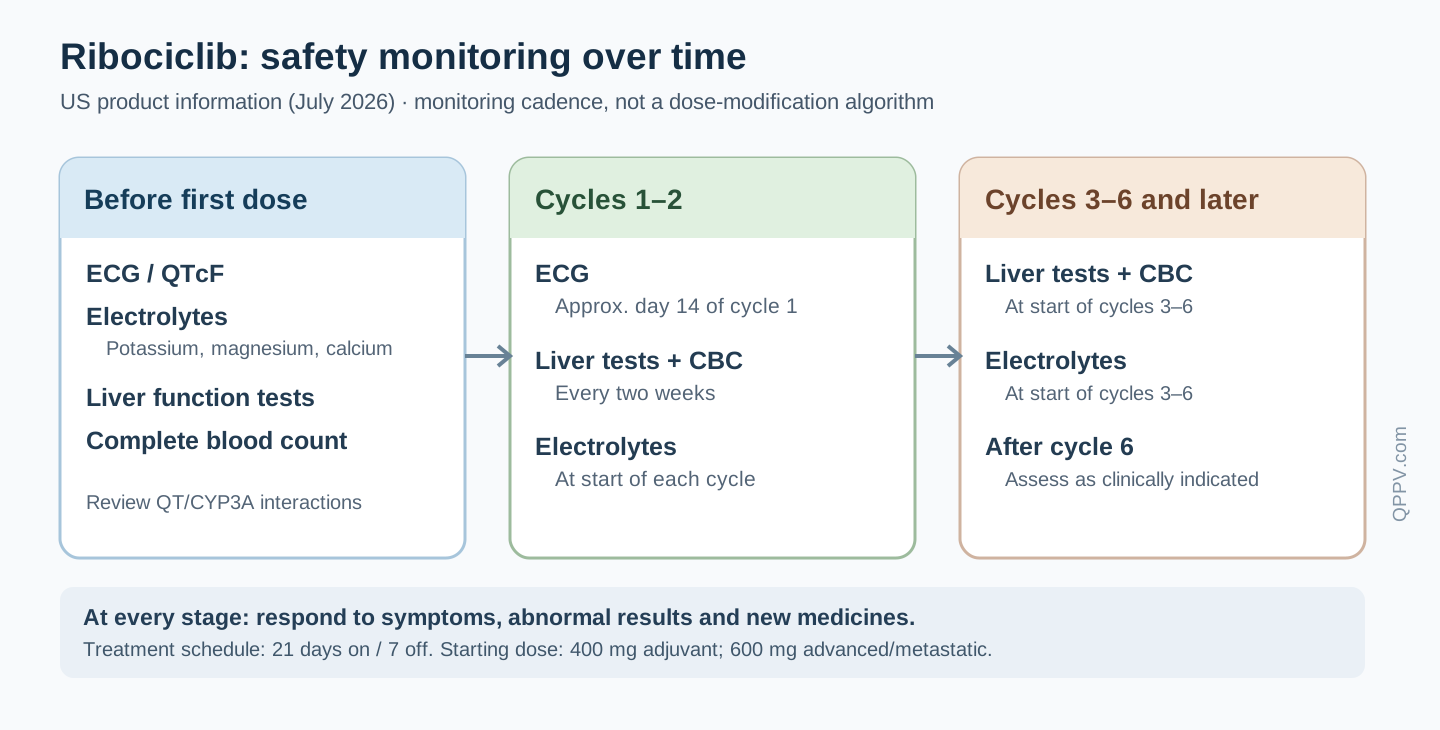
Figure 1. US-label monitoring sequence for ECG, electrolytes, liver tests and complete blood counts. Clinical findings, abnormal results and concomitant medicines can require additional assessments at any time; confirm the current local label before use.
QT prolongation
Ribociclib prolongs QT in a concentration-dependent manner. The US label directs ECG assessment before treatment, around day 14 of the first cycle, and subsequently as indicated. Electrolyte assessment is also specified. In the NATALEE ECG-assessable population, post-baseline QTcF above 500 ms occurred in 8 of 2,494 recipients (0.3%), and a rise exceeding 60 ms occurred in 50 of 2,494 (2%). These are monitored trial observations rather than general-population incidence. The label also identifies patients at substantial risk of torsades de pointes, including those with relevant cardiac disease, electrolyte abnormalities or interacting medicines, as requiring avoidance of ribociclib. [1]
A case assessment should capture ECG dates, actual QT and QTc values, correction method, baseline rhythm, electrolytes, co-medications, symptoms, cardiac history, exposure and outcome. Syncope may be a more informative clinical event than an isolated tracing, but both should be assessed. Where an ECG value crosses a label threshold, medical review and the specific interruption/reduction algorithm are required; this article deliberately does not improvise a dosing decision.
Hepatotoxicity
Ribociclib may cause liver-enzyme abnormalities and drug-induced liver injury. The US label calls for liver-function testing before treatment, every two weeks during the first two cycles, at the beginning of the next four cycles, and as clinically indicated. NATALEE identified nine drug-induced liver injury cases (0.4%), including five grade 3 or higher events. The US label separately describes eight clinically confirmed Hy's Law cases (0.3%), four overlapping with those nine DILI cases. These groups must not be added as 17 distinct patients. Hy's Law evaluation requires a particular biochemical and exclusionary assessment; a laboratory threshold alone is not a final causality verdict. [1]
Safety follow-up should distinguish isolated laboratory changes from clinically significant hepatic dysfunction and record baseline and sequential ALT, AST, bilirubin, alkaline phosphatase, reference ranges, symptoms, imaging, hepatic disease, infection and other medicines. Assess the pattern of liver injury, time to onset, resolution after interruption and alternative causes. A positive dechallenge is informative but does not remove competing explanations.
Neutropenia and infection
The US label reports laboratory decreases in neutrophil counts in 94% of ribociclib-treated NATALEE patients, including grade 3–4 decreases in 45%; febrile neutropenia occurred in 0.3%. Laboratory changes, coded adverse reactions and febrile neutropenia are distinct endpoints. CBC monitoring is specified before treatment, every two weeks in the first two cycles, at the beginning of the next four cycles, and subsequently when indicated. For a suspected event, obtain blood-count trajectories, infection findings, fever, hospitalisation and treatment history. An absolute neutrophil count nadir without symptoms can prompt treatment modification; febrile neutropenia requires a separate urgency assessment.
The distinction between on-target, often reversible cell-cycle suppression and severe infection is useful clinically, but the mechanistic explanation does not negate the seriousness of an infected or hospitalised patient. In signal review, laboratory event terms, febrile neutropenia and serious infection should be analysed with consistent case definitions and appropriate deduplication.
Pulmonary and cutaneous events
Severe or fatal ILD/pneumonitis is a labelled risk. Assessment of new respiratory symptoms should consider imaging, infection, cancer progression, radiotherapy and other medicines. Serious cutaneous reactions, including Stevens–Johnson syndrome, toxic epidermal necrolysis and DRESS, also appear in the US warnings. Case documentation should capture timing, distribution, mucosal or systemic involvement, specialist findings and competing exposures. The label contains specific interruption and discontinuation instructions; these must be checked against the actual clinical presentation.
Reproductive risk and treatment burden
The US label warns of embryo-fetal toxicity and provides pregnancy, contraception and lactation advice. Follow-up of pregnancy exposure should document gestational timing, treatment dates and outcome without making unsupported conclusions from isolated cases. More common symptoms and laboratory abnormalities—including fatigue, nausea, diarrhoea, infections and blood-count changes—also influence treatment persistence. In adjuvant care, cumulative tolerability can matter even without a serious adverse event. Patient-reported interruptions, missed cycles and the effect of endocrine co-treatment should be recorded without automatically attributing all symptoms to ribociclib.
Interpreting laboratory changes without double counting
NATALEE's 94% neutrophil-count decrease is a laboratory finding, whereas febrile neutropenia was reported in 0.3%. Likewise, increased transaminases, investigator-reported DILI and Hy's Law cases are overlapping but distinct clinical constructs. A safety database can contain several MedDRA terms for the same episode; aggregate analyses should group related records by patient and event chronology before calculating case counts. The goal is to preserve medically important detail without inflating the number of affected people.
Drug interactions as preventable safety contributors
Strong CYP3A inhibitors may increase ribociclib exposure, while strong inducers may reduce it. Ribociclib can affect exposure to CYP3A substrates. QT-prolonging co-medications are a separate concern. A medication-reconciliation record should include recent prescriptions, temporary antibiotics, antifungals, antiarrhythmics, supplements and changes around the event. The US label does not indicate ribociclib for concomitant use with tamoxifen. These distinctions should be preserved when evaluating medication errors and suspected interaction cases.
Pharmacovigilance in routine practice
A structured case assessment
Ribociclib cases benefit from a chronological, product-specific dataset: indication and stage of breast cancer; endocrine partner; ribociclib starting dose and schedule; actual dosing, interruptions and reductions; date of symptom or laboratory onset; baseline values; concomitant medicines; treatment and outcomes. For a serious case, source documents and follow-up should support the medical narrative without replacing the reporter's account with assumptions.
The critical analytical distinction is between what happened, whether the event is plausibly related to treatment, and what the available evidence establishes. A temporal relationship and improvement after interruption can strengthen a suspected association but may be confounded by concurrent treatments. A serious event reported after a new drug interaction should prompt review of exposure and preventability without presuming causality.
Aggregate surveillance and benefit–risk
Periodic review should consider labelled risks, new case patterns, emerging literature, trial updates and regional regulatory actions. Relevant questions include whether cases cluster after a particular concomitant medication, whether monitoring gaps contribute to preventable severe outcomes, and whether adverse reactions affect long-term adjuvant adherence. Exposure-adjusted trial estimates, spontaneous-report disproportionality and observational data answer different questions; none should be represented as interchangeable proof of causality.
A risk-management system should trace the signal or safety concern to its evidence, any product-information action, communication, local implementation, and subsequent effectiveness assessment. Where a jurisdiction imposes a specific reporting or risk-minimisation obligation, that legal basis should be recorded explicitly rather than inferred from a general professional recommendation. EU GVP Module VI provides the framework for collection, management and submission of suspected adverse-reaction reports; it does not replace the applicable legal provisions or country-specific operational instructions. [14]
For aggregate review, maintain a clear evidence hierarchy. A signal is a hypothesis requiring validation and evaluation, not an automatically confirmed adverse reaction. The EMA EPAR and risk-management plan document the EU regulatory context; the US label documents a different jurisdiction's approved risk language. An organisation should not label every difference between these documents a safety signal: some differences arise from assessment dates, indications, presentation or regulatory wording. [1,2]
Practical evidence trail and inspection perspective
A defensible audit trail connects the original report, source records, follow-up requests, medical review, coding, seriousness and expectedness decisions, regulatory submissions where required, reconciliation, signal review and any resulting label or communication action. These are process evidence categories, not a claim that a specific ribociclib inspection finding has occurred.
A useful periodic case-series review asks whether the same risk is repeatedly recognised late, whether ECG or laboratory values are missing despite reported severe outcomes, whether CYP3A interactions are systematically overlooked, and whether discontinuation events are captured consistently across clinical and postmarketing datasets. A trend can reflect reporting behaviour or exposure mix rather than a new biological hazard; interpretation should consider denominator quality, temporal changes and comparator information.
Illustrative case: QT change after a new prescription
Hypothetical learning example. A patient receiving ribociclib develops an elevated corrected QT interval after starting another medicine. The safety reviewer should reconstruct the medication timeline, ECG correction method, electrolytes, ribociclib dose, symptoms, other cardiac risks, treatment changes and subsequent ECG results. The purpose is not to assign causality from one tracing but to establish a medically interpretable record and identify a potentially preventable interaction.
Illustrative case: hepatic abnormalities in adjuvant treatment
Hypothetical learning example. An asymptomatic patient develops raised transaminases during the first cycles of adjuvant treatment. The reviewer obtains baseline and sequential liver tests, bilirubin, symptoms, imaging and alternative causes, documents any interruption and follow-up, and distinguishes a laboratory finding from an adjudicated drug-induced liver injury diagnosis. An individual event may be clinically important without establishing a new population-level signal.
Practical review checklist
- Verify the exact ribociclib formulation, jurisdictional label, indication, endocrine partner and dose.
- Reconstruct treatment and event chronology, including interrupted cycles and adherence.
- Review ECG, electrolytes, liver tests and blood counts where relevant to the event.
- Check CYP3A and QT-related interactions and newly introduced medicines.
- Document competing diagnoses, seriousness, outcome and medically appropriate follow-up.
- Separate observed facts, reporter opinion, medical assessment and regulatory conclusions.
- Reconcile safety information across medical information, clinical teams, vendors and literature channels.
- Track aggregate trends and evaluate whether risk communications or operational controls are effective.
Key takeaways
Ribociclib's clinical value rests on distinct trials in advanced and early HR-positive/HER2-negative breast cancer. MONALEESA established progression and overall-survival benefits in studied metastatic populations. NATALEE established an adjuvant invasive disease-free survival benefit; the October 2026 six-year analysis newly reports an overall-survival advantage, but at this article's cutoff the evidence is a sponsor-disclosed conference result, distinct from the 2024 approval basis and pending full publication. [4,6–11]
The July 2026 US label differentiates 400-mg adjuvant and 600-mg metastatic starting doses. QT prolongation, hepatic injury, neutropenia, pulmonary and cutaneous toxicity, interactions and reproductive risks make high-quality case chronology and monitoring central to pharmacovigilance. A laboratory abnormality, an adverse reaction, a serious outcome and a safety signal are related but different concepts. [1]
References
- National Library of Medicine. DailyMed: Kisqali (ribociclib) tablets, structured US product label, updated 1 July 2026. https://dailymed.nlm.nih.gov/dailymed/drugInfo.cfm?setid=aaeaef94-f3f5-4367-8ea2-b181d7be2da8
- European Medicines Agency. Kisqali: European public assessment report, product information and risk-management plan, product information updated 19 August 2026. https://www.ema.europa.eu/en/medicines/human/EPAR/kisqali
- US Food and Drug Administration. Ribociclib (Kisqali): initial approval, 13 March 2017. https://www.fda.gov/drugs/resources-information-approved-drugs/ribociclib-kisqali
- US Food and Drug Administration. FDA approves ribociclib with an aromatase inhibitor for high-risk early breast cancer, 17 September 2024. https://www.fda.gov/drugs/resources-information-approved-drugs/fda-approves-ribociclib-aromatase-inhibitor-and-ribociclib-and-letrozole-co-pack-early-high-risk-0
- Hortobagyi GN et al. Ribociclib as first-line therapy for HR-positive advanced breast cancer. N Engl J Med. 2016. https://doi.org/10.1056/NEJMoa1609709
- Hortobagyi GN et al. Overall survival with ribociclib plus letrozole in advanced breast cancer. N Engl J Med. 2022. https://doi.org/10.1056/NEJMoa2114663
- Im SA et al. Overall survival with ribociclib plus endocrine therapy in breast cancer. N Engl J Med. 2019. https://doi.org/10.1056/NEJMoa1903765
- Slamon DJ et al. Overall survival with ribociclib plus fulvestrant in advanced breast cancer. N Engl J Med. 2020. https://doi.org/10.1056/NEJMoa1911149
- Slamon DJ et al. Ribociclib plus endocrine therapy in early breast cancer. N Engl J Med. 2024. https://doi.org/10.1056/NEJMoa2305488
- Crown JP et al. Adjuvant ribociclib plus nonsteroidal aromatase inhibitor therapy in HR-positive/HER2-negative early breast cancer: five-year follow-up of NATALEE efficacy outcomes and updated overall survival. ESMO Open. 2025. https://doi.org/10.1016/j.esmoop.2025.105858
- Novartis. Six-year NATALEE overall-survival analysis: ESMO Congress 2026 sponsor disclosure, 23 October 2026. Conference-level evidence; full peer-reviewed publication pending. https://www.novartis.com/news/media-releases/kisqali-shows-clinically-meaningful-overall-survival-broadest-hrher2-early-breast-cancer-population-high-risk-recurrence
- Astex Therapeutics. Kisqali (ribociclib) development history, Novartis–Astex research collaboration. https://astx.com/research-development/clinical-pipeline/kisqali-ribociclib-cdk46-inhibitor-oncology/
- ClinicalTrials.gov. NATALEE (NCT03701334), registry and protocol record. https://clinicaltrials.gov/study/NCT03701334
- European Medicines Agency. Good pharmacovigilance practices (GVP), Module VI, Revision 2, and related guidance. https://www.ema.europa.eu/en/human-regulatory-overview/post-authorisation/pharmacovigilance-post-authorisation/good-pharmacovigilance-practices-gvp
Regulatory Note
This article is an educational review, not a prescribing instruction or a substitute for current local product information. Approval scope, dosing, monitoring and risk-management requirements vary by jurisdiction and may change. The US DailyMed label cited here was updated 1 July 2026, and the EMA EPAR product information 19 August 2026. The 23 October 2026 NATALEE six-year OS finding is a conference/sponsor report, not an FDA or EMA label update or a full peer-reviewed publication as of this article's editorial cutoff. Clinical-trial results, regulatory label statements, medical interpretation and suggested pharmacovigilance practice are deliberately distinguished. Verify the latest authorised product information and applicable pharmacovigilance obligations before clinical or regulatory action.