Risankizumab: Classification, History, Mechanism of Action, Safety and Pharmacovigilance
- Risankizumab: Classification, History, Mechanism of Action, Safety and Pharmacovigilance
- Multidimensional classification
- From classification to a safety hypothesis
- Development and regulatory context
- Development History and Regulatory Evolution
- Clinical Safety Architecture
- Indication-Specific Safety Interpretation
- Practical Exposure Reconstruction
- Follow-up That Changes the Medical Assessment
- Immunogenicity and Loss of Response
- Vaccination, Infection and Tuberculosis
- Liver Findings in Inflammatory Bowel Disease
- Administration and Medication-Use Errors
- Signal Detection and Aggregate Safety Review
- Benefit-Risk Interpretation
- Risk Management and Pharmacovigilance Controls
- Common Failure Modes
- Inspection and Governance Perspective
- Practical Case-Assessment Framework
- Current Regulatory Status and Ongoing Surveillance
- Key Takeaways
- References
- Regulatory Note
Risankizumab is a humanised IgG1 monoclonal antibody directed against the p19 subunit of interleukin-23. Its active pharmacology is neutralises IL-23 p19 and reduces maintenance of pathogenic Th17-type inflammatory responses. That places the substance within the selective IL-23 cytokine inhibitor class and makes pharmacovigilance dependent on both the intended pathway effect and the patient’s treatment context.
The pharmacovigilance question is broader than whether an event appears in a label. A useful assessment asks what biological function changed, when exposure occurred, what other therapies were present, which disease processes could produce the same finding and whether the event persisted after treatment was held.
Multidimensional classification
| Axis | Risankizumab | PV significance |
|---|---|---|
| Molecular class | humanised IgG1 monoclonal antibody directed against the p19 subunit of interleukin-23 | A biological medicinal product with substance- and product-specific quality attributes |
| Target | IL-23 p19 | Identifies the pathway whose modulation anchors plausible benefit and harm |
| Functional class | selective IL-23 cytokine inhibitor | Helps define event phenotypes and differential diagnoses |
| Route | subcutaneous injection; intravenous induction may apply in selected inflammatory bowel disease regimens | Shapes administration chronology, local or systemic reactions and traceability |
| Clinical context | plaque psoriasis, psoriatic arthritis, Crohn’s disease and ulcerative colitis in selected patients; indication, induction and maintenance schedules vary by jurisdiction | Indication, disease severity and co-therapy alter background risk and benefit |
| Product category | Biological medicinal product | Presentation, batch, storage and preparation may matter in investigation |
From classification to a safety hypothesis
The target identifies the pathway being modified. The antibody format identifies a biological product with critical quality attributes that can influence product behaviour and immunogenicity. The route creates a defined exposure chronology with opportunities for administration reactions, handling errors and incomplete traceability.
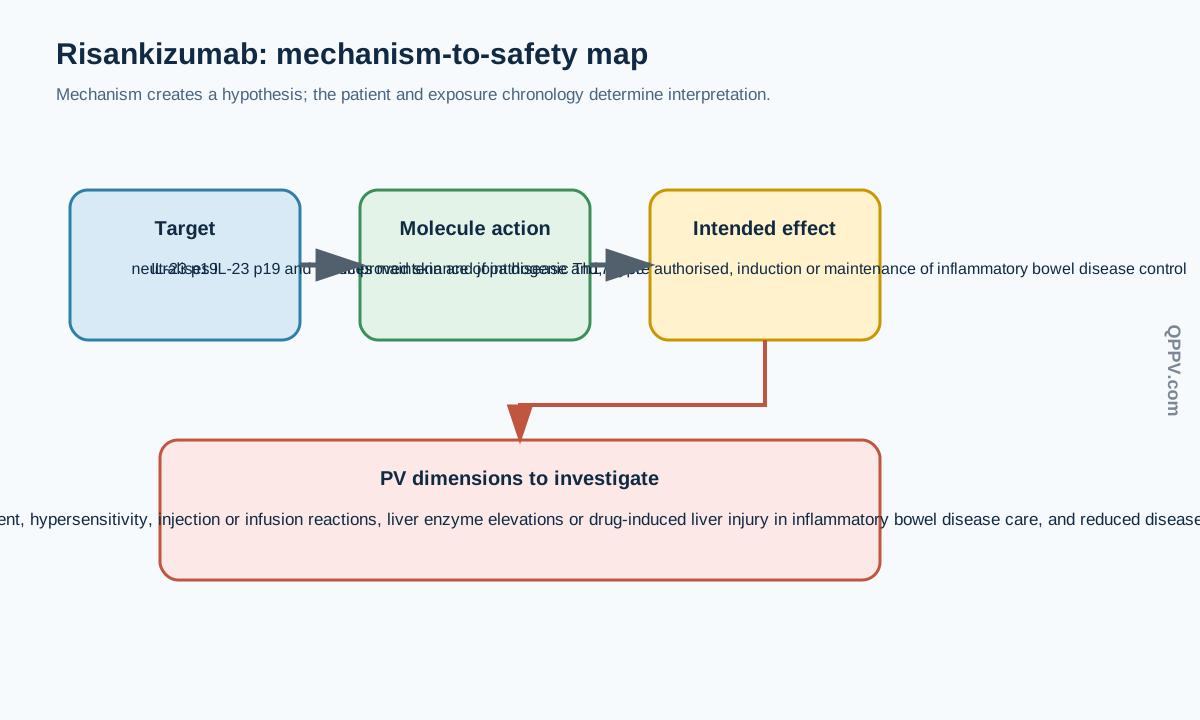
For Risankizumab, the principal mechanism-led safety hypothesis is that neutralises IL-23 p19 and reduces maintenance of pathogenic Th17-type inflammatory responses. The likely clinical benefit is improved skin and joint disease and, where authorised, induction or maintenance of inflammatory bowel disease control. The relevant PV concern is not simply “immune effect”; it is the combination of target biology, tissue expression, host susceptibility, concurrent treatment and persistence of pharmacodynamic activity.
The mechanism therefore directs attention to infections including tuberculosis risk assessment, hypersensitivity, injection or infusion reactions, liver enzyme elevations or drug-induced liver injury in inflammatory bowel disease care, and reduced disease control after interruption. It does not establish causality. A reported event must still be assessed against timing, objective findings, dechallenge, rechallenge when it occurs in routine care, alternative explanations and outcome.
Development and regulatory context
The clinical role of Risankizumab has been shaped by the disease population studied, the measurable endpoint used and the risk controls needed for the route and mechanism. Authorised indications, age groups, dosing schedules and monitoring requirements can differ across jurisdictions. The case record should preserve the local indication, treatment intent, dose, formulation, route and, where available, batch.
The history of a biological medicine is also a history of changing use. New indications, new age groups, new devices, switching patterns, combination regimens and longer exposure create new denominators and new opportunities for signal detection. A periodic review should therefore distinguish evidence generated in the original development programme from evidence arising after broader clinical use.
A case that records only the substance name may be insufficient for investigation. Conversely, the presence of a plausible pathway does not mean that every infection, laboratory abnormality, neurological symptom or disease flare is drug-related. The useful question is whether the phenotype, timing, objective evidence and alternatives fit the proposed mechanism better than competing explanations do.
Development History and Regulatory Evolution
Risankizumab was developed initially as BI 655066 by Boehringer Ingelheim. In 2016, AbbVie acquired worldwide rights to the programme while it was already in phase 3 development for psoriasis. The transaction also contemplated development in Crohn's disease, psoriatic arthritis and other inflammatory indications. This transfer is relevant to the product's history because the clinical programme subsequently expanded across disease areas with materially different baseline risks and treatment goals. citeturn2search0turn2search2
The pivotal psoriasis programme established the clinical value of selective IL-23 p19 blockade. In the phase 3 UltIMMa-1 and UltIMMa-2 trials, risankizumab 150 mg produced substantially higher PASI 90 and clear/almost-clear skin responses at week 16 than placebo and ustekinumab. The trials did not identify unexpected safety findings over their primary periods, although controlled trials necessarily provide only a limited view of rare and long-latency events. citeturn1search0
The EU marketing authorisation was issued on 26 April 2019. Subsequent variations expanded the product's use, and the EMA record now includes psoriasis, psoriatic arthritis, Crohn's disease and ulcerative colitis. The current EPAR product information was updated in September 2026, with additional post-authorisation procedures and a 2026 extension recorded by EMA. citeturn0search0turn0search5
The inflammatory-bowel-disease programme also changed the exposure model. Crohn's disease induction uses intravenous risankizumab before subcutaneous maintenance in the authorised regimen. In ADVANCE and MOTIVATE, phase 3 induction studies in moderately to severely active Crohn's disease, both coprimary clinical and endoscopic outcomes at week 12 were met with risankizumab. The safety experience therefore needs to be interpreted separately from the earlier psoriasis programme, particularly when assessing route, disease severity and concomitant treatment. citeturn0search1
For ulcerative colitis, the INSPIRE induction and COMMAND maintenance programme subsequently demonstrated efficacy for induction and maintenance of remission. The trials broadened the evidence base but did not remove the need for post-authorisation surveillance, because trial populations, follow-up duration and treatment selection differ from routine use. citeturn1search3
The development history therefore has direct pharmacovigilance consequences. A product initially characterised largely through dermatology populations became a treatment used in chronic inflammatory bowel disease, with intravenous induction, different background therapies and different competing causes for serious events. Aggregate analyses that pool these populations without preserving indication and treatment phase can lose clinically meaningful information.
Clinical Safety Architecture
The current EU product information identifies upper respiratory tract infection as the most common adverse reaction and emphasises infection precautions. Treatment should not be initiated in patients with a clinically important active infection, and patients should be evaluated for tuberculosis before treatment. Patients with chronic or recurrent infection require particular clinical consideration. citeturn0search0turn0search48
The US prescribing information similarly warns about serious infections and requires assessment for infections and tuberculosis before initiation. It also contains a warning concerning serious hypersensitivity reactions. These are regulatory risk controls, not evidence that every infection or allergic symptom in an exposed patient is caused by risankizumab. citeturn0search49
A pharmacovigilance case should therefore preserve the exposure context and the competing-risk context. Important variables include the indication, disease severity, prior biological therapy, corticosteroids or other immunomodulators, baseline infection status, vaccination history, recent procedures, comorbidities and the precise treatment chronology.
Indication-Specific Safety Interpretation
Plaque psoriasis
In psoriasis, the principal competing explanations for many reported events include the inflammatory disease itself, background cardiovascular and metabolic risk, infections unrelated to treatment and concomitant systemic therapies. Long-term clinical-trial analyses provide substantial exposure, but the open-label nature of extension studies and differences between trial populations and routine care remain limitations.
The final LIMMitless analysis followed almost 900 patients for up to six years of continuous treatment. It reported a favourable long-term safety profile, but this type of extension evidence remains complementary to spontaneous reports, registries and routine-care data rather than replacing them. citeturn1search6
Psoriatic arthritis
Psoriatic arthritis adds musculoskeletal disease activity, pain, functional limitation and frequent concomitant treatment to the causality assessment. KEEPsAKE-1 and KEEPsAKE-2 provided controlled phase 3 evidence for efficacy in patients with inadequate response or intolerance to conventional or biological therapies. The prior-treatment burden is relevant when interpreting infections, laboratory findings and symptoms that may have preceded risankizumab exposure. citeturn0search6
Long-term integrated clinical-trial analyses have evaluated thousands of patients with psoriatic disease. They provide useful exposure-adjusted context, but their findings should not be treated as incidence estimates for every population receiving the product after broader authorisation. citeturn1search2
Crohn's disease
Crohn's disease requires a different safety framework because patients may have active intestinal inflammation, nutritional compromise, anaemia, prior surgery, corticosteroid exposure, multiple prior biologics and infection risk. The induction regimen also includes intravenous administration.
In ADVANCE and MOTIVATE, the phase 3 programme enrolled patients with moderately to severely active disease, including populations with prior treatment failure. This makes those studies particularly useful for understanding the product in a high-risk clinical context, but also means that background disease and concomitant treatment must be considered when interpreting serious events. citeturn0search1
Ulcerative colitis
Ulcerative colitis similarly creates background risks that can mimic or confound adverse reactions: infection, anaemia, gastrointestinal symptoms, thrombo-inflammatory complications and treatment-related effects from concomitant immunosuppression. INSPIRE and COMMAND provide the controlled evidence base for induction and maintenance, while post-authorisation surveillance must capture the broader population and longer exposure. citeturn1search3
Practical Exposure Reconstruction
For a risankizumab case, the exposure history should be sufficiently precise to distinguish induction from maintenance and intravenous from subcutaneous administration where relevant. The record should capture:
| Element | Why it matters |
|---|---|
| Indication | Determines background disease and authorised treatment context |
| Treatment phase | Induction and maintenance can involve different routes and schedules |
| Dose and dates | Establishes chronology and cumulative exposure |
| Route and presentation | Important for administration-related events and medication-error review |
| Concomitant treatment | Helps identify alternative causes and interacting risk factors |
| Prior biological therapy | Changes baseline immune and disease-treatment history |
| Baseline disease activity | Prevents disease flare from being misclassified as loss of efficacy or toxicity |
| Infection/TB history | Important for interpreting infectious events |
| Product and batch | Supports traceability and quality investigation where relevant |
| Outcome and follow-up | Determines seriousness, reversibility and strength of causal assessment |
A high-quality narrative should connect these elements rather than place them in disconnected fields. The purpose is to allow another reviewer to reconstruct what happened without relying on assumptions.
Follow-up That Changes the Medical Assessment
Follow-up should be driven by the event and by the uncertainty that needs to be resolved. For a serious infection, useful information includes the anatomical site, organism, microbiology, imaging, treatment, hospitalisation, outcome and relevant immune or concomitant-treatment factors. For suspected hypersensitivity, the exact administration chronology, clinical phenotype, treatment and repeat exposure are more informative than a generic statement that an allergy occurred.
For a suspected hepatic event, baseline and serial liver tests, competing causes, concomitant medicines and the clinical course are essential. For apparent loss of efficacy, the reviewer should establish adherence, dosing interval, objective disease activity, treatment interruption, prior response and whether the observed findings could represent natural disease progression.
The aim is not to maximise the number of follow-up questions. It is to obtain information capable of changing seriousness, causality, expectedness, signal interpretation or product traceability.
Immunogenicity and Loss of Response
Risankizumab is a therapeutic protein and immunogenicity is therefore part of the clinical-development and post-authorisation evidence framework. Detection of anti-drug antibodies does not by itself establish that an adverse event or loss of efficacy was caused by immunogenicity. Assay characteristics, antibody titre and persistence, exposure, clinical phenotype and pharmacokinetic or pharmacodynamic evidence all affect interpretation.
When loss of response is reported, the first step is to establish that there is genuine objective loss of response. In inflammatory bowel disease, this may require clinical, biochemical or endoscopic evidence rather than symptoms alone. In psoriasis and psoriatic arthritis, disease activity should similarly be assessed against the expected treatment schedule and the patient's baseline response.
Vaccination, Infection and Tuberculosis
The infection risk-management framework is clinically important because IL-23 blockade changes immune signalling without producing the same broad immunosuppressive profile as every other immunomodulator. The appropriate interpretation is therefore neither that infection risk is absent nor that every infection is pharmacologically caused.
Current EU and US information requires attention to active infection and tuberculosis. A case of tuberculosis should preserve pre-treatment screening, previous latent-TB treatment where known, geographic and epidemiological context, timing, microbiological evidence and management. The absence of a positive screening result does not by itself establish or exclude causality. citeturn0search48turn0search49
Vaccination status may also be relevant to clinical management, but vaccination history should not be converted into an unsupported causal explanation for an adverse event. The case assessment should remain anchored to the phenotype and evidence.
Liver Findings in Inflammatory Bowel Disease
Liver-test abnormalities require particular care in patients with Crohn's disease or ulcerative colitis because the differential diagnosis is broad. Causes can include inflammatory bowel disease-associated hepatobiliary disease, concomitant medicines, infection, metabolic liver disease and unrelated acute illness.
A signal assessment should therefore avoid treating an isolated enzyme elevation as synonymous with drug-induced liver injury. Serial testing, bilirubin, alkaline phosphatase, clinical symptoms, competing causes and the complete medication history are necessary before a stronger conclusion is reached.
This distinction is especially important when a product is used in a population with substantially different baseline risks from the population in which it was first characterised.
Administration and Medication-Use Errors
Risankizumab's route differs by indication and treatment phase. A medication-error case should therefore establish the intended route and schedule, what was actually administered, the presentation used, the dose, the setting and the clinical consequences.
An administration error without clinical harm is still useful pharmacovigilance information when it reveals a recurrent vulnerability in the product-use system. Conversely, an adverse event after correct administration should not be classified as a medication error merely because the event followed an injection or infusion.
The same distinction applies to device or preparation complaints. Where a product-quality issue is suspected, product identity, batch, storage, preparation and other affected units should be preserved for investigation.
Signal Detection and Aggregate Safety Review
A risankizumab safety signal should be evaluated as a structured hypothesis rather than as a count of preferred terms. The first question is whether the cases describe a coherent clinical phenotype. The next is whether the pattern is compatible with exposure, whether alternative explanations are plausible, and whether the observed reporting is disproportionate to an appropriate background or comparator.
Indication should be a primary stratification variable. Plaque psoriasis, psoriatic arthritis, Crohn's disease and ulcerative colitis differ in age distribution, comorbidity, baseline inflammation, prior treatment and concomitant immunomodulation. Treatment phase and route should also be retained, particularly because inflammatory bowel disease induction can involve intravenous administration.
Useful strata can include:
- indication and treatment phase;
- age and relevant baseline disease severity;
- prior biological exposure;
- concomitant corticosteroids or immunomodulators;
- duration of treatment;
- serious versus non-serious outcomes;
- event phenotype rather than only preferred term;
- route and presentation;
- geographic or healthcare-setting differences where relevant;
- and product or batch when a quality hypothesis exists.
A numerical imbalance does not establish causality. Conversely, a small number of well-characterised cases can be more informative than a large collection of poorly characterised reports. Medical review should therefore preserve case-level reasoning alongside quantitative signal-detection methods.
Benefit-Risk Interpretation
Benefit-risk assessment should follow the changing clinical role of the product. In psoriasis and psoriatic arthritis, sustained control of chronic inflammatory disease is weighed against infectious and other safety risks in populations that may otherwise require long-term systemic therapy. In Crohn's disease and ulcerative colitis, the benefit assessment additionally considers control of intestinal inflammation, endoscopic outcomes, steroid-sparing potential and avoidance of disease complications.
The controlled development programme provides the most interpretable comparative evidence for common outcomes, while long-term extensions provide additional exposure and durability information. Post-authorisation sources add populations and circumstances that may be underrepresented in trials, including rare events, medication errors, comorbid patients, pregnancy exposures and unusual clinical contexts.
No single evidence stream should therefore be treated as sufficient. The strength of the overall conclusion depends on how well the streams fit together and how uncertainty is handled.
Risk Management and Pharmacovigilance Controls
The operational control system should make the information needed for medical assessment retrievable. At minimum, important records should preserve the indication, treatment phase, dose, route, dates, concomitant treatment, relevant baseline findings, event phenotype, investigations, outcome and product identity.
For serious infection and tuberculosis, the system should support retrieval of relevant infection history and clinical management. For suspected hypersensitivity, administration chronology and clinical phenotype are essential. For hepatic events, baseline and serial laboratory results should be accessible. For suspected product-quality problems, batch and presentation information become critical.
The quality of these controls can be assessed by traceability. A reviewer should be able to move from the original source through the case record, medical assessment, follow-up, aggregate review and regulatory decision without losing the reasoning chain.
Common Failure Modes
Several recurring analytical errors can weaken risankizumab pharmacovigilance.
Pooling distinct indications. A common adverse-event term may have a different background rate or clinical meaning in psoriasis than in inflammatory bowel disease.
Treating mechanism as proof of causality. IL-23 biology can support a hypothesis but cannot replace case-level assessment.
Using symptoms as a surrogate for disease activity. Fatigue, pain, abdominal symptoms and skin findings can represent treatment failure, disease activity or unrelated illness.
Ignoring treatment phase. Intravenous induction and subcutaneous maintenance should not be treated as interchangeable exposure contexts.
Calling an enzyme elevation DILI without a differential diagnosis. Baseline abnormalities, concomitant medicines and inflammatory bowel disease-associated hepatobiliary disease can provide competing explanations.
Treating anti-drug antibodies as causal by themselves. Immunogenicity results require clinical and assay context.
Using a single global safety denominator. Changing indications and exposure patterns can make an aggregate rate difficult to interpret.
Failing to preserve product identity. When a quality or medication-use hypothesis emerges, lack of presentation or batch information can prevent meaningful investigation.
These are analytical failure modes rather than claims that each has been identified as a regulatory finding for risankizumab.
Inspection and Governance Perspective
An inspection-oriented review should ask whether the organisation can demonstrate that the safety system adapts as the product's clinical use expands. A procedure written for a dermatology indication may not, by itself, demonstrate effective control after expansion into inflammatory bowel disease with a different induction route and patient population.
Useful inspection questions include:
- How does the organisation distinguish the safety experience of each major indication?
- Can a serious infection case be reconstructed from source through medical review and follow-up?
- How are tuberculosis-related cases identified and medically assessed?
- How does the system distinguish disease activity from adverse drug reactions?
- How are intravenous induction and subcutaneous maintenance represented in safety data?
- How are product-quality complaints and batch information connected to safety cases?
- How are signals stratified when the exposed population changes?
- How are important conclusions incorporated into aggregate reports and risk-management activities?
- Can the QPPV demonstrate visibility of material changes in the safety profile?
- Can the organisation explain the uncertainty that remains after assessment?
These are illustrative inspection questions, not an official regulator checklist.
Practical Case-Assessment Framework
A useful case review can be organised as:
| Step | Question |
|---|---|
| Product | What exact risankizumab product, presentation and route was used? |
| Context | Why was treatment given and what was the disease state? |
| Exposure | What were the dates, doses, induction/maintenance phase and concomitant therapies? |
| Phenotype | What objectively happened, when, and how severe was it? |
| Alternatives | What competing diagnoses or medicines could explain the event? |
| Follow-up | What missing information could change the conclusion? |
| Outcome | Did the event resolve, persist, recur or result in death? |
| Causality | What evidence supports, weakens or leaves uncertain the relationship? |
| Signal relevance | Does the case add information to an existing safety issue or suggest a new pattern? |
| Traceability | Can the conclusion be reconstructed from source information? |
This framework is deliberately broader than a coding checklist. Its purpose is to preserve the reasoning that connects an individual case to the pharmacovigilance system.
Current Regulatory Status and Ongoing Surveillance
As of 4 October 2026, Skyrizi has an EU marketing authorisation held by AbbVie Deutschland GmbH & Co. KG, with the EMA EPAR showing a marketing-authorisation date of 26 April 2019 and a product-information revision updated in September 2026. The current EPAR records post-authorisation procedures, including a 2026 extension and paediatric-investigation-plan completion documentation. citeturn0search0
The EMA explicitly states that safety data continue to be monitored and that product information contains the current precautions and conditions of use. This is important for QPPV practice because a stable product label does not mean that the pharmacovigilance process has become static. New populations, longer exposure and new formulations can change the evidence base without necessarily producing an immediate change to the authorised safety wording. citeturn0search0
Key Takeaways
Risankizumab is a selective IL-23 p19 monoclonal antibody whose clinical and pharmacovigilance history has expanded substantially beyond its original psoriasis development programme. The product's development by Boehringer Ingelheim, subsequent transfer of rights to AbbVie, EU authorisation in 2019 and later expansion into psoriatic arthritis and inflammatory bowel disease created a progressively broader safety evidence base. citeturn2search0turn0search0
The central pharmacovigilance principle is to preserve clinical context. Indication, treatment phase, route, prior therapy, concomitant immunomodulation, baseline disease and objective event findings can materially change the interpretation of the same reported term.
Mechanism-led assessment is useful because IL-23 p19 blockade provides a coherent biological framework. It is not sufficient for causality. High-quality pharmacovigilance combines mechanism, chronology, clinical phenotype, competing explanations, follow-up, aggregate stratification and traceability.
References
- European Medicines Agency. Skyrizi (risankizumab): EPAR and current product information. Updated August/September 2026. urlEMA Skyrizi EPARhttps://www.ema.europa.eu/en/medicines/human/EPAR/skyrizi
- European Medicines Agency. Skyrizi: current product information. Updated 11 September 2026. urlEMA Skyrizi product informationhttps://www.ema.europa.eu/en/documents/product-information/skyrizi-epar-product-information_en.pdf
- U.S. Food and Drug Administration. Skyrizi (risankizumab-rzaa) prescribing information. urlFDA Skyrizi labelhttps://www.accessdata.fda.gov/drugsatfda_docs/label/2025/761105s039%2C761262s011lbl.pdf
- Gordon KB, Strober B, Lebwohl M, et al. Efficacy and safety of risankizumab in moderate-to-severe plaque psoriasis (UltIMMa-1 and UltIMMa-2). Lancet. 2018;392:650-661. doi:10.1016/S0140-6736(18)31713-6. urlPubMed — UltIMMa-1 and UltIMMa-2https://pubmed.ncbi.nlm.nih.gov/30097359/
- D'Haens G, Panaccione R, Baert F, et al. Risankizumab as induction therapy for Crohn's disease: results from the phase 3 ADVANCE and MOTIVATE induction trials. Lancet. 2022;399:2015-2030. doi:10.1016/S0140-6736(22)00467-6. urlPubMed — ADVANCE and MOTIVATEhttps://pubmed.ncbi.nlm.nih.gov/35644154/
- Louis E, Schreiber S, Panaccione R, et al. Risankizumab for ulcerative colitis: two randomized clinical trials. JAMA. 2024;332:881-897. doi:10.1001/jama.2024.12414. urlPubMed — INSPIRE and COMMANDhttps://pubmed.ncbi.nlm.nih.gov/39037800/
- Papp KA, Blauvelt A, Puig L, et al. Long-term safety and efficacy of risankizumab for moderate-to-severe plaque psoriasis: interim analysis of LIMMitless up to 5 years. J Am Acad Dermatol. 2023;89:1149-1158. doi:10.1016/j.jaad.2023.07.1024. urlPubMed — LIMMitless interim analysishttps://pubmed.ncbi.nlm.nih.gov/37553030/
- Papp KA, et al. Long-term safety and efficacy of risankizumab to treat moderate-to-severe plaque psoriasis: final LIMMitless phase 3 open-label extension results. Am J Clin Dermatol. 2025;26:829-841. doi:10.1007/s40257-025-00964-6. urlPubMed — final LIMMitless resultshttps://pubmed.ncbi.nlm.nih.gov/40728772/
- Gordon KB, et al. Long-term safety of risankizumab in patients with psoriatic disease: comprehensive analysis from clinical trials. Dermatol Ther (Heidelb). 2024;14:2523-2538. doi:10.1007/s13555-024-01238-5. urlPubMed — long-term psoriatic-disease safetyhttps://pubmed.ncbi.nlm.nih.gov/39153059/
- AbbVie. AbbVie and Boehringer Ingelheim announce global collaboration on immunology compounds, 7 March 2016. urlAbbVie — 2016 collaboration announcementhttps://investors.abbvie.com/node/7596
- AbbVie. Acquisition of BI 655066 and BI 655064 from Boehringer Ingelheim, SEC-filed report. urlSEC filing — BI 655066 acquisitionhttps://www.sec.gov/Archives/edgar/data/1551152/000110465916137453/a16-11616_110q.htm
- European Medicines Agency. Good pharmacovigilance practices (GVP), current modules and guidance. urlEMA GVP overviewhttps://www.ema.europa.eu/en/human-regulatory-overview/post-authorisation/pharmacovigilance-post-authorisation/good-pharmacovigilance-practices-gvp
Regulatory Note
This article is an educational product-pharmacovigilance reference. It distinguishes regulatory requirements and authorised product information from scientific interpretation, clinical evidence and recommended operational practice. Current EU and US product information should be checked for jurisdiction-specific indications, dosing, contraindications, warnings, monitoring and risk-minimisation measures before operational use. Illustrative inspection questions and failure modes are not published regulatory findings.