Ruxolitinib: Discovery, Development, Safety and Pharmacovigilance
Ruxolitinib illustrates the difference between inhibiting a disease-associated signalling pathway and treating a single mutation. This orally administered Janus kinase (JAK)1/JAK2 inhibitor was first developed for myeloproliferative neoplasms, in which abnormal cytokine signalling contributes to splenic enlargement and systemic symptoms. Its later use in graft-versus-host disease (GvHD) rests on the same pathway's role in inflammatory immune-cell activation. These settings have different baseline hazards, comparators, treatment goals and safety profiles. A laboratory abnormality in a patient with myelofibrosis cannot be interpreted identically to one after allogeneic transplantation.
The drug's lifecycle also exposes important pharmacovigilance traps. Ruxolitinib can cause dose-dependent cytopenias and increase susceptibility to infection; discontinuation can produce rapid return of disease symptoms and, in some reports, severe clinical deterioration. In 2026 the US product family includes immediate-release Jakafi and extended-release Jakafi XR, whereas the EU Jakavi authorisation includes tablets and an oral solution with younger paediatric GvHD populations. The active substance is shared, but administration schedules, labelled populations and formulations are not interchangeable by assumption. [1,2]
- Ruxolitinib: Discovery, Development, Safety and Pharmacovigilance
- Scientific origins: the JAK–STAT pathway
- Discovery and early development
- Why indications must be separated
- Randomised evidence in myelofibrosis
- Polycythaemia vera after hydroxyurea failure
- Graft-versus-host disease: a different therapeutic rationale
- The principal safety problems
- Product-specific listedness: United States versus European Union
- Pharmacovigilance: from an event report to an actionable assessment
- Aggregate safety, risk minimisation and governance
- Key takeaways
- References
- Regulatory Note
Scientific origins: the JAK–STAT pathway
Cytokine receptors commonly lack their own intrinsic tyrosine kinase activity. Binding of cytokines or growth factors promotes activation of receptor-associated JAK proteins, phosphorylation of signal transducer and activator of transcription (STAT) proteins, STAT dimerisation and altered gene transcription. This is an important pathway for haematopoiesis and immune responses. JAK2 transmits signals from erythropoietin and thrombopoietin receptors; JAK1 participates in signalling by several inflammatory cytokines. Inhibition can therefore reduce disease-associated proliferation and inflammation while also impairing normal blood-cell production and immune defence.
The 2005 identification of the acquired JAK2 V617F mutation in many patients with polycythaemia vera, essential thrombocythaemia and myelofibrosis accelerated interest in JAK inhibition. However, not all affected patients harbour that mutation, and ruxolitinib is not a mutation-specific inhibitor. JAK–STAT activation can arise through other driver mutations and cytokine-mediated processes. Clinical responses in myelofibrosis were observed regardless of JAK2 V617F status. The biological rationale is pathway dependence, not a requirement for a positive mutation test. [3,4]
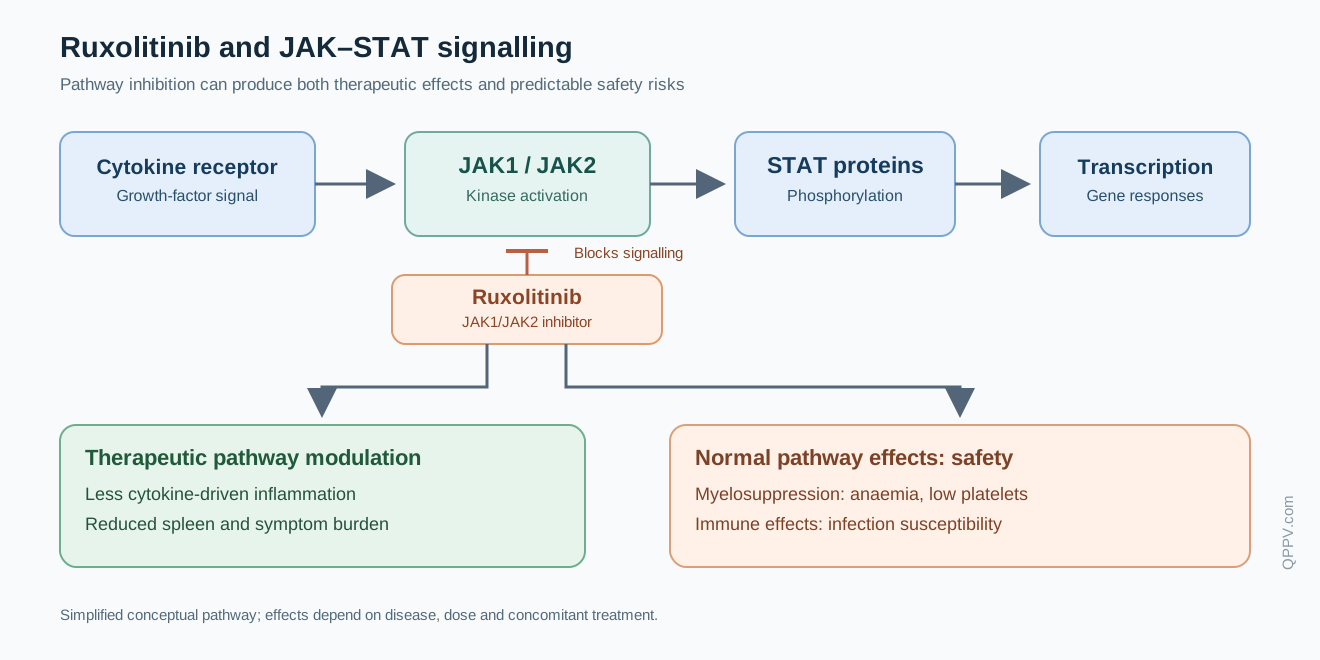
Figure 1. Conceptual mechanism: ruxolitinib inhibits JAK1/JAK2-mediated signalling, affecting pathological cytokine responses and normal haematopoietic or immune functions. This is a simplified pathway map, not a claim of selective inhibition in malignant cells.
Discovery and early development
Incyte developed the small molecule initially designated INCB018424 (also known as INCB18424). Preclinical research characterised inhibition of JAK1/JAK2, effects on cytokine signalling and activity in experimental myeloproliferative disease models. The compound's clinical development was driven by the unmet need for treatments capable of reducing spleen burden and constitutional symptoms in myelofibrosis, where conventional therapies had limited durable benefit. The original medicinal-chemistry and pharmacology papers should be credited for scientific work rather than inferring individual inventorship from subsequent brand ownership. [3,4]
The early phase I/II programme identified thrombocytopenia as an exposure-limiting toxicity and explored schedules intended to balance symptom relief with blood-count tolerability. The 2010 clinical report described reductions in splenomegaly and improvements in symptoms, providing a rationale for randomised studies. That study was not a substitute for controlled evidence of survival or for evaluation of longer-term rare harms. The early development sequence also established why platelet counts and haemoglobin must be considered before dosing, not merely monitored after a patient becomes symptomatic. [4]
Incyte, Novartis and geographic rights
A November 2009 collaboration granted Novartis exclusive rights outside the United States to develop and commercialise ruxolitinib for specified haematology and oncology indications, while Incyte retained US commercial responsibility. This explains the names Jakafi in the US and Jakavi in the EU and why public product information is maintained by different marketing-authorisation holders. The agreement's business terms are historical evidence of development and licensing, not a basis for attributing global product revenue to a single partner. [5]
The FDA first approved Jakafi for intermediate- or high-risk myelofibrosis in November 2011. The European Commission granted Jakavi authorisation in August 2012. Subsequent authorisations added polycythaemia vera after hydroxyurea failure or intolerance, and acute and chronic GvHD in defined treatment-resistant populations. The authorisations developed differently across regions and age groups. In the US, the July 2026 prescribing information encompasses Jakafi immediate-release tablets and Jakafi XR extended-release tablets; in the EU, the November 2025 Jakavi product information includes younger paediatric GvHD patients and an oral solution. [1,2,5]
Why indications must be separated
Myelofibrosis is a clonal marrow disorder characterised by abnormal haematopoiesis, splenomegaly, symptoms and risks of transformation and death. A clinically meaningful spleen response or symptom improvement is valuable but is not automatically equivalent to disease eradication. Polycythaemia vera instead requires durable haematocrit control, management of thrombotic risk and symptom relief. Acute and chronic GvHD are inflammatory complications of allogeneic transplantation, with infection, cytopenia, organ injury and competing causes of death already common before ruxolitinib is given.
For pharmacovigilance, the indication is therefore a core variable. It determines expected background events, typical co-medications, the appropriate label population and whether a new laboratory abnormality is likely to be related to the underlying disease, transplant complications or treatment. A report stating only "ruxolitinib 10 mg" lacks information needed for safe interpretation: one must also establish formulation, frequency, indication, age, treatment line and the dates of interruptions or dose changes.
Randomised evidence in myelofibrosis
COMFORT-I: spleen volume and symptom burden
COMFORT-I was a double-blind, placebo-controlled trial in patients with intermediate-2 or high-risk myelofibrosis. It enrolled 309 patients, randomising 155 to ruxolitinib and 154 to placebo. The primary endpoint was at least a 35% reduction in spleen volume at week 24, measured by imaging. This threshold was achieved in 41.9% versus 0.7%, respectively (P<0.001). At least a 50% reduction in total symptom score occurred in 45.9% versus 5.3%. These outcomes show effects on splenic disease burden and patient experience, but the endpoints were not designed as direct measures of cure or freedom from leukaemic transformation. [6]
The initial analysis reported 13 deaths with ruxolitinib and 24 with placebo (hazard ratio 0.50; 95% CI 0.25–0.98). Interpretation requires care because the number of deaths was small, crossover occurred, and subsequent follow-up was influenced by changes in assigned treatment. The observed survival signal must be discussed separately from the primary spleen endpoint, rather than claiming that spleen shrinkage itself proves a survival advantage. Anaemia and thrombocytopenia were more common with ruxolitinib early in treatment. These are predictable pharmacological effects with consequences for dose selection, transfusion and monitoring. [6]
COMFORT-II: an active-treatment comparison
COMFORT-II compared ruxolitinib with investigator-selected best available therapy in 219 patients with intermediate-2 or high-risk myelofibrosis. At week 48, the primary endpoint of at least 35% spleen-volume reduction occurred in 28% of patients receiving ruxolitinib versus none receiving best available therapy. Best available therapy was heterogeneous and included different approaches to symptom and disease management; it was not a single fixed active comparator. [7]
Longer follow-up showed durable spleen responses and a survival signal, but crossover and subsequent treatment complicate interpretation of overall survival. The comparison established clinical benefit against treatment options available at the time. It did not show that all patients should receive the same starting dose or that ruxolitinib reverses the molecular driver of myelofibrosis. Patients with low platelet counts require a distinct dosing strategy, and those with advanced marrow failure may be less able to tolerate treatment. [7,8]
What the two trials collectively establish
Together the trials support meaningful reduction of splenic enlargement and symptom burden in appropriately selected myelofibrosis patients. Their primary endpoints are consistent but not identical in timing or comparator. The studies do not establish efficacy in every myeloproliferative neoplasm or in every risk category. Subsequent care has also changed, including other JAK inhibitors and transplant strategies. In an individual case, assessment of treatment failure should distinguish insufficient spleen or symptom response, intolerance, interruption and progression to a different disease state.
Polycythaemia vera after hydroxyurea failure
RESPONSE: a composite endpoint
The phase III RESPONSE trial studied patients with polycythaemia vera who had an inadequate response to, or unacceptable adverse effects from, hydroxyurea and who had splenomegaly. The composite primary endpoint required both haematocrit control without phlebotomy eligibility and at least 35% spleen-volume reduction at week 32. It was met in 20.9% with ruxolitinib versus 0.9% with standard therapy (P<0.001). Haematocrit control alone occurred in 60.0% versus 19.6%, and spleen response alone in 38.2% versus 0.9%. [9]
The composite was stringent, and reporting only its percentage can conceal substantial differences in individual components. Equally, success on a haematocrit/spleen endpoint is not proof that long-term thrombosis, transformation or survival outcomes are improved to the same degree. The trial's selected hydroxyurea-resistant/intolerant population should not be generalised to every newly diagnosed patient with polycythaemia vera. Herpes zoster and non-melanoma skin cancer were safety concerns requiring follow-up, while the underlying neoplasm itself contributes to vascular and malignant risks. [9]
RESPONSE-2 and the importance of baseline spleen status
RESPONSE-2 addressed a complementary population without palpable splenomegaly. It supported the clinical relevance of haematocrit control in patients who could not satisfy a spleen-based composite endpoint. The distinction illustrates why eligibility and endpoint construction are essential when comparing studies. A drug may have useful activity even when a composite endpoint built for another phenotype is not applicable. For pharmacovigilance, the underlying PV phenotype and prior cytoreductive treatment should be recorded before interpreting efficacy or adverse-event patterns. [13]
Graft-versus-host disease: a different therapeutic rationale
REACH2: acute steroid-refractory GvHD
REACH2 was a randomised, open-label phase III trial comparing ruxolitinib with investigator-selected best available therapy for glucocorticoid-refractory acute GvHD after allogeneic haematopoietic transplantation. The study enrolled patients aged at least 12 years and evaluated overall response at day 28. Response was 62% with ruxolitinib versus 39% with control, and durable response at day 56 was also higher. This demonstrated clinically important activity after inadequate steroid response, while the open-label design and heterogeneous comparator require careful assessment of subjective outcomes and later therapy changes. [10]
Patients with acute GvHD are exposed to corticosteroids, calcineurin inhibitors, prophylactic antimicrobials and other immunosuppressive therapies. Infections, cytopenias, organ dysfunction and death can occur from transplant complications independently of ruxolitinib. A higher response rate cannot be interpreted without the serious infection and haematological adverse-event context. Final follow-up analyses help characterise durability and failure-free survival but do not remove competing-risk and crossover limitations. [10,11]
REACH3: chronic GvHD
REACH3 randomised patients with glucocorticoid-refractory or -dependent chronic GvHD. Overall response at week 24 was 49.7% versus 25.6% for ruxolitinib and control, respectively (odds ratio 2.99; P<0.001). Failure-free survival and symptom response also favoured ruxolitinib. Grade 3 or higher thrombocytopenia and anaemia were more frequent with ruxolitinib in the comparative period. [12]
Chronic GvHD differs from acute disease in organ involvement, long-term immunosuppression and the definition of clinically meaningful response. The response endpoint does not mean that every affected organ improved; lung and liver responses remained difficult in both groups. Treatment decisions therefore require organ-specific assessment, infection surveillance and a plan for cautious tapering where appropriate.
Paediatric evidence and extrapolation
The EU Jakavi authorisation now includes acute GvHD from 28 days of age and chronic GvHD from six months, with paediatric oral solution dosing based on age and body surface area. The US July 2026 Jakafi/Jakafi XR label specifies patients aged 12 years and older for both acute and chronic GvHD. These differences matter for expectedness, medication-error assessment and the legality of local use. Younger-child evidence includes pharmacokinetic and clinical data and regulatory extrapolation from older patients; it should not be portrayed as if the original REACH2/REACH3 trials directly randomised neonates. [1,2]
The historical progression from a myelofibrosis agent to GvHD treatment is a demonstration of mechanism-based development, but every indication expansion brings a new safety denominator and additional confounding. Trial adverse-event frequencies should be presented by indication, not pooled into a universal "ruxolitinib incidence."
The principal safety problems
Cytopenias and marrow reserve
Anaemia, thrombocytopenia and neutropenia are central to ruxolitinib's benefit–risk profile. JAK2 signalling supports normal erythropoiesis and thrombopoiesis, so inhibition can worsen cytopenias even while it reduces abnormal cytokine-driven symptoms. Myelofibrosis itself frequently causes anaemia and abnormal platelet counts, making pretreatment values, dose changes and serial measurements indispensable to causality assessment. A low haemoglobin value without a chronology cannot distinguish baseline marrow failure, bleeding, haemolysis, treatment effect or progression. [1,2]
The US and EU labels require a complete blood count before treatment and continued monitoring. The US July 2026 label specifies CBC monitoring every two to four weeks until doses stabilise, then as clinically indicated. EU Jakavi has a corresponding schedule. Starting doses for myelofibrosis are platelet-count dependent, and dose interruption or reduction may be necessary for severe cytopenias. GvHD requires separate dose-modification rules, because transplant recipients may have cytopenias from conditioning, infection, other drugs or active GvHD. No single threshold table should be copied across indications without checking the applicable label. [1,2]
In a suspected case, document absolute haemoglobin, neutrophil and platelet trajectories, marrow findings if available, bleeding, transfusion support, infections, other myelosuppressants and any dechallenge response. Dose reduction is a risk-minimisation tool, not proof that an event was caused by the medicine. Similarly, recovery after interruption may reflect supportive treatment or resolution of the underlying illness.
Infections, viral reactivation and opportunistic disease
JAK1/JAK2 inhibition affects cytokine-dependent immune function. The labels describe serious infections, including bacterial, mycobacterial, fungal and viral infections, and warn about herpes zoster, tuberculosis and hepatitis B reactivation. The US July 2026 label additionally identifies postmarketing herpes simplex virus reactivation or dissemination in section 6.2. The EU SmPC warns about progressive multifocal leukoencephalopathy (PML) and recommends suspending treatment if PML is suspected until excluded. [1,2]
The assessment of an infection case requires its anatomical site, microbiological evidence, severity, immune status, neutrophil count, transplantation history, corticosteroid exposure, antimicrobial prophylaxis, vaccination history when relevant and the timing of ruxolitinib initiation or interruption. A patient receiving several immunosuppressants after transplantation has a very different background risk from a patient with polycythaemia vera. Viral reactivation may be clinically silent before a laboratory finding becomes symptomatic. Monitor and manage infections according to local clinical guidance and the product label rather than assuming that one fixed screening panel is universally mandated.
Discontinuation and symptom rebound
Stopping ruxolitinib may lead to rapid recurrence of myelofibrosis symptoms and splenomegaly. Severe deterioration resembling systemic inflammatory relapse has also been reported after discontinuation. The US label includes a dedicated warning about symptom exacerbation after interruption or discontinuation; the EU SmPC likewise discusses withdrawal effects and tapering. Abrupt cessation can be unavoidable during severe toxicity, but an interruption should not be considered a clinically neutral event. [1,2]
For a suspected withdrawal syndrome, capture the final dose, taper schedule, time from last administration, fever, hypotension, respiratory status, inflammatory markers, infection investigations, changes in steroids and supportive treatment. It is essential to rule out sepsis, progression and other causes before attributing a clinical collapse to withdrawal. Rechallenge must never be undertaken solely to prove causality.
Vascular, dermatological and malignant outcomes
The July 2026 US label contains warnings on major adverse cardiovascular events (MACE), thrombosis and secondary malignancies, as well as non-melanoma skin cancer. The EU SmPC discusses MACE and thrombosis in the context of a large trial with another JAK inhibitor, tofacitinib, and reports events observed with Jakavi. The cross-drug evidence should not be presented as if it were a head-to-head ruxolitinib trial demonstrating the same risk magnitude. Patients with myeloproliferative neoplasms already have disease-related thrombotic and malignant risks. [1,2]
When investigating thrombosis or cancer, record smoking, cardiovascular risk, disease duration and activity, previous cytoreductive therapy, transplant status, prior malignancy, concurrent therapies and observation time. For non-melanoma skin cancer, relevant prior skin lesions, ultraviolet exposure and earlier immunosuppression should be captured. Clinical recognition and risk management do not depend on proving that a particular event was caused by ruxolitinib.
Metabolic changes and pharmacokinetic interactions
Lipid elevations are recognised, and the US label recommends assessment 8–12 weeks after treatment begins. Fluconazole, a dual CYP2C9/CYP3A4 inhibitor, can increase exposure; the US label advises avoiding doses above 200 mg/day and modifying ruxolitinib dosing at lower fluconazole doses. Strong CYP3A4 inhibitors also increase exposure, with an important US GvHD-specific exception to the usual dose-modification recommendation. Renal or hepatic impairment may require distinct starting doses or avoidance according to indication. [1,2]
The combination of azole antifungals, immunosuppression and organ dysfunction in GvHD makes medication reconciliation especially important. An apparently unexplained rise in ruxolitinib exposure may follow a newly prescribed antifungal rather than a change in the ruxolitinib dose itself. The case chronology should include both drugs' actual use and any interruptions.
Product-specific listedness: United States versus European Union
The following comparison is limited to the public regulatory documents inspected on 2 November 2026. It is not a substitute for the company core safety information, the applicable reference safety information (RSI), or an individual-case expectedness or reportability decision.
- United States: Incyte Jakafi immediate-release tablets and Jakafi XR extended-release tablets, DailyMed SPL updated 20 July 2026, full prescribing information revised July 2026. Relevant sections: 1–8 and 14. [1]
- European Union: Novartis Europharm Jakavi tablets and oral solution, EMA Annex I SmPC, product information updated 10 November 2025. Relevant sections: 4.1–4.8 and 5.1. [2]
| Assessment dimension | US Jakafi / Jakafi XR, July 2026 | EU Jakavi, November 2025 |
|---|---|---|
| Authorised GvHD ages | Acute and chronic GvHD from 12 years, with different line-of-therapy wording | Acute from 28 days; chronic from 6 months, after inadequate response to corticosteroids or other systemic therapies |
| Formulation scope | Immediate-release tablets and once-daily extended-release tablets; strength and conversion differ | Twice-daily tablets and oral solution; age/size-dependent paediatric dosing |
| Haematological reactions | Anaemia, thrombocytopenia and neutropenia in sections 5.1 and 6.1 | Anaemia, thrombocytopenia and neutropenia in sections 4.4 and 4.8 |
| Infection safety | Serious infections and viral reactivation warnings; herpes simplex reactivation/dissemination explicitly in 6.2 | Serious infections, HBV reactivation and herpes zoster warnings; PML specifically discussed in 4.4 |
| MACE, thrombosis, malignancy | Explicit warnings in sections 5.6–5.8; NMSC in 5.4 | Discussed in section 4.4 with distinction between Jakavi reports and evidence from another JAK inhibitor |
| Pregnancy and lactation | Section 8 risk information and lactation advice; section 4 lists no contraindications | Pregnancy and lactation explicitly contraindicated in section 4.3 |
| Adverse-reaction presentation | Indication-specific clinical-trial tables and a short postmarketing section 6.2 | Indication-specific section 4.8 frequency tables, laboratory abnormalities and narrative descriptions |
The table does not mean that an event omitted from the US postmarketing subsection is absent from all US labelling, nor that a risk discussed in an EU warning is necessarily an adverse reaction listed in section 4.8. For example, PML is explicitly a serious EU warning; this is not evidence of a quantified incidence. The US label's absence of section-4 contraindications does not make use during pregnancy safe. Differences may reflect data, presentation, product scope and regulatory decisions, but their causes cannot be inferred from the labels alone. [1,2]
Listedness conclusion: Anaemia, thrombocytopenia and neutropenia are represented as recognised adverse reactions in the assessed US and EU product information. Herpes simplex reactivation/dissemination is explicitly included in the assessed US postmarketing section; EU warnings explicitly discuss PML. A precise decision on any individual MedDRA preferred term must inspect the relevant section and product version, not assume that broad concepts or class warnings establish identical listedness across jurisdictions.
Pharmacovigilance: from an event report to an actionable assessment
Establish the exposure precisely
A useful ruxolitinib safety report begins with the medicinal product actually administered: INN, brand, manufacturer if known, formulation, strength, route, prescribed and taken dose, dosing frequency, lot where available and treatment dates. Record indication, age, relevant disease stage, transplant date if applicable, previous therapies, platelet count at initiation, renal and hepatic function and interacting medicines. In 2026, mistaking once-daily Jakafi XR for twice-daily immediate-release Jakafi, or treating an EU paediatric oral solution regimen as an adult tablet regimen, could obscure a medication error. [1,2]
A robust timeline should distinguish exposure initiation, dose escalation, interruption, re-initiation and discontinuation. Capture laboratory trends with dates and units, not just the lowest value. Separate observed findings from reporter interpretations. A case may be medically serious even if causality remains uncertain, and a known labelled adverse reaction may still warrant reporting under applicable rules.
Illustrative case: febrile neutropenia after an azole is added
Consider a patient receiving ruxolitinib for chronic GvHD who develops fever and neutropenia after fluconazole is prescribed. The assessment should identify baseline counts, the fluconazole dose and start date, other immunosuppressants, cultures, antimicrobial prophylaxis, liver and kidney function, and whether ruxolitinib dosing was reviewed. The suspected interaction has a plausible exposure mechanism, but transplant-related marrow suppression and infection remain competing explanations. Do not assume that an interaction automatically establishes drug causation or that the same dose adjustment applies across GvHD and myelofibrosis. [1,2]
The immediate priority is clinical assessment and treatment of possible infection. The PV record should separately describe the clinical event, potential interacting exposure, seriousness, outcome and any relevant medication-use error. An investigation of the dispensing or prescribing process may be appropriate if the label's formulation-specific instructions were overlooked.
Illustrative case: respiratory deterioration after treatment stops
A patient with myelofibrosis has ruxolitinib stopped during hospitalisation and develops fever, hypoxaemia and hypotension several days later. A meaningful case narrative includes the indication, reason for interruption, prior dose, symptom history, imaging, microbiology, inflammatory markers, concurrent corticosteroid changes, transfusions and supportive treatment. Disease rebound is plausible, but infection, cardiac disease and progression must be actively evaluated. The event's temporal proximity to discontinuation is informative but insufficient to assign causality. [1,2]
Where interruption is unavoidable, clinical management takes precedence over causal experimentation. A case processor should never recommend an unmonitored rechallenge merely to strengthen a report. The risk-management question may instead concern whether the clinical team had a safe interruption plan and whether patient counselling reflected the product label.
Illustrative case: suspected skin cancer during long-term treatment
A person with polycythaemia vera develops a squamous-cell carcinoma after years of ruxolitinib and previous hydroxyurea treatment. Record the pathology, date of diagnosis, past skin cancers, ultraviolet exposure, smoking history, duration of both medicines, immunosuppression and any relevant dermatological surveillance. The presence of a skin-cancer warning does not identify the individual cause. Aggregate evaluation should compare similarly affected patients and account for prior treatment, age and duration of follow-up rather than divide spontaneous reports by prescriptions to calculate an incidence rate. [1,2]
Aggregate safety, risk minimisation and governance
Signal evaluation in distinct clinical populations
For a suspected new signal, define the event phenotype, identify duplicates, assess temporality and dose-response, review the applicable label version and consider confounding by disease. Compare cases separately for myelofibrosis, polycythaemia vera, acute GvHD and chronic GvHD before considering pooled patterns. Transplant recipients have distinctive infection and organ-injury risks; myeloproliferative disease patients have baseline thrombosis and malignant transformation risks. A disproportionate reporting signal is a hypothesis generator, not a direct estimate of relative risk or causality.
Use trial and extension-study denominators where valid, supplemented by registries, observational studies and postmarketing case series. For infection and malignancy, long follow-up and treatment-history adjustment are especially important. For abrupt-interruption events, focus on the interval since last dose, clinical severity and the presence of alternative causes. A regulator may request additional evidence or update product information, but no specific regulatory action should be assumed without a documented decision.
Risk minimisation and its effectiveness
The most actionable routine controls include indication-appropriate baseline CBC and repeated monitoring, documented dose adjustment, infection assessment, medication reconciliation, lipid review, skin surveillance where applicable and counselling about interruption. A safety programme should ask whether these controls reach the patients and prescribers who need them. An audit of blood-count monitoring frequency alone is less informative than evidence that clinically significant results led to timely review and appropriate action.
In a multicentre or outsourced PV system, trace how a suspected case travels from a treating service or partner to the safety database, medical review, duplicate search, aggregate analysis and risk-management decision. Reconciliation should cover literature, patient support programmes, medical information, clinical trials and commercial partners where relevant. The QPPV or responsible safety governance should be able to explain the evidence behind a signal decision and any change in risk minimisation; a template that merely states "no new signals" is not an adequate analysis.
What would constitute a new signal?
A cluster of serious infections in a previously under-studied paediatric age band, a recurring pattern of clinically severe withdrawal deterioration, or a formulation-switch error leading to unexpected exposure could warrant evaluation. Such scenarios are illustrative, not claims of actual new signals. Assessment would require verified cases, background rates, exposure and comparator information, and an explicit distinction between pharmacological plausibility and observed excess risk.
Key takeaways
Ruxolitinib is a pathway-directed JAK1/JAK2 inhibitor, not a JAK2 V617F-specific drug. The myelofibrosis trials established spleen and symptom benefit; RESPONSE demonstrated haematocrit/spleen control in selected polycythaemia vera; REACH2 and REACH3 supported treatment-resistant GvHD. Each evidence set has different endpoints and background hazards. Cytopenias, infections, interruption-related deterioration and long-term vascular or malignant outcomes require longitudinal assessment. As of November 2026, US Jakafi/Jakafi XR and EU Jakavi have important formulation, age-range and safety-presentation differences. Public-label listedness must not be conflated with company-core expectedness or individual causality.
References
-
Incyte Corporation. Jakafi (ruxolitinib) tablets and Jakafi XR extended-release tablets: US prescribing information. DailyMed; revised July 2026, updated 20 July 2026. Sections 1–8, 14. https://dailymed.nlm.nih.gov/dailymed/drugInfo.cfm?setid=f1c82580-87ae-11e0-bc84-0002a5d5c51b
-
European Medicines Agency. Jakavi (ruxolitinib): EU product information, Annex I Summary of Product Characteristics. Novartis Europharm Limited; product-information update 10 November 2025. Sections 4.1–4.8, 5.1. https://www.ema.europa.eu/en/documents/product-information/jakavi-epar-product-information_en.pdf
-
Quintás-Cardama A, Vaddi K, Liu P, et al. Preclinical characterization of the selective JAK1/2 inhibitor INCB018424: therapeutic implications for the treatment of myeloproliferative neoplasms. Blood. 2010;115:3109–3117. https://doi.org/10.1182/blood-2009-04-214957
-
Verstovsek S, Kantarjian H, Mesa RA, et al. Safety and efficacy of INCB018424, a JAK1 and JAK2 inhibitor, in myelofibrosis. N Engl J Med. 2010;363:1117–1127. https://doi.org/10.1056/NEJMoa1002028
-
Incyte Corporation. Form 10-K: 2015 annual report, Novartis collaboration and ruxolitinib development history. US Securities and Exchange Commission. https://www.sec.gov/Archives/edgar/data/879169/000155837016003196/incy-20151231x10k.htm
-
Verstovsek S, Mesa RA, Gotlib J, et al. A double-blind, placebo-controlled trial of ruxolitinib for myelofibrosis (COMFORT-I). N Engl J Med. 2012;366:799–807. https://doi.org/10.1056/NEJMoa1110557
-
Harrison C, Kiladjian JJ, Al-Ali HK, et al. JAK inhibition with ruxolitinib versus best available therapy for myelofibrosis (COMFORT-II). N Engl J Med. 2012;366:787–798. https://doi.org/10.1056/NEJMoa1110556
-
Cervantes F, Vannucchi AM, Kiladjian JJ, et al. Three-year efficacy, safety, and survival findings from COMFORT-II. Blood. 2013;122:4047–4053. https://doi.org/10.1182/blood-2013-02-485888
-
Vannucchi AM, Kiladjian JJ, Griesshammer M, et al. Ruxolitinib versus standard therapy for the treatment of polycythemia vera (RESPONSE). N Engl J Med. 2015;372:426–435. https://doi.org/10.1056/NEJMoa1409002
-
Zeiser R, von Bubnoff N, Butler J, et al. Ruxolitinib for glucocorticoid-refractory acute graft-versus-host disease (REACH2). N Engl J Med. 2020;382:1800–1810. https://doi.org/10.1056/NEJMoa1917635
-
Zeiser R, et al. Ruxolitinib versus best available therapy in steroid-refractory acute GvHD: final REACH2 analysis. J Clin Oncol. 2025. https://doi.org/10.1200/JCO-25-00809
-
Zeiser R, Polverelli N, Ram R, et al. Ruxolitinib for glucocorticoid-refractory chronic graft-versus-host disease (REACH3). N Engl J Med. 2021;385:228–238. https://doi.org/10.1056/NEJMoa2033122
-
Passamonti F, Griesshammer M, Palandri F, et al. Ruxolitinib for inadequately controlled polycythaemia vera without splenomegaly (RESPONSE-2): a randomised phase 3b study. Lancet Oncol. 2017;18:88–99. https://doi.org/10.1016/S1470-2045(16)30558-7
Regulatory Note
This article describes publicly available evidence and selected product information accessed on 2 November 2026. The US and EU documents differ in formulation, indication and age scope. Regulatory wording may change after publication. The text is an educational reference, not prescribing advice or a substitute for the current local authorised product information, individual clinical judgement, the marketing-authorisation holder's reference safety information, or applicable pharmacovigilance reporting rules.