Siltartoxatug: Classification, Mechanism, Evidence and Pharmacovigilance
Siltartoxatug is a recombinant monoclonal antibody directed against tetanus toxin. China’s National Medical Products Administration (NMPA) authorised it in 2025 for emergency tetanus prophylaxis in adults. Its role is passive immunisation: it supplies antibody that can bind accessible toxin. It does not replace tetanus vaccination or establish that active immunisation is unnecessary. [1]
Classification and biological context
The NMPA describes siltartoxatug as a recombinant anti-tetanus toxin monoclonal antibody that binds primarily to the toxin’s AB fragment. Unlike polyclonal tetanus immunoglobulin, a monoclonal antibody is a defined immunoglobulin with selected target specificity. [1]
Tetanus toxin is produced by Clostridium tetani. Once toxin enters peripheral neurons, it disrupts inhibitory neurotransmission and can cause rigidity and spasms. Antibody can act on toxin that remains accessible outside cells; it should not be assumed to reverse toxin already internalised at nerve endings. This distinction underlies the time-sensitive purpose of prophylaxis.
Passive antibody is not vaccination
Passive antibody provides immediate but temporary activity. Tetanus-toxoid vaccination prompts the recipient to develop an active immune response and memory. The two approaches have different biological roles. Wound management and vaccination decisions remain governed by applicable clinical guidance and the current local product information.
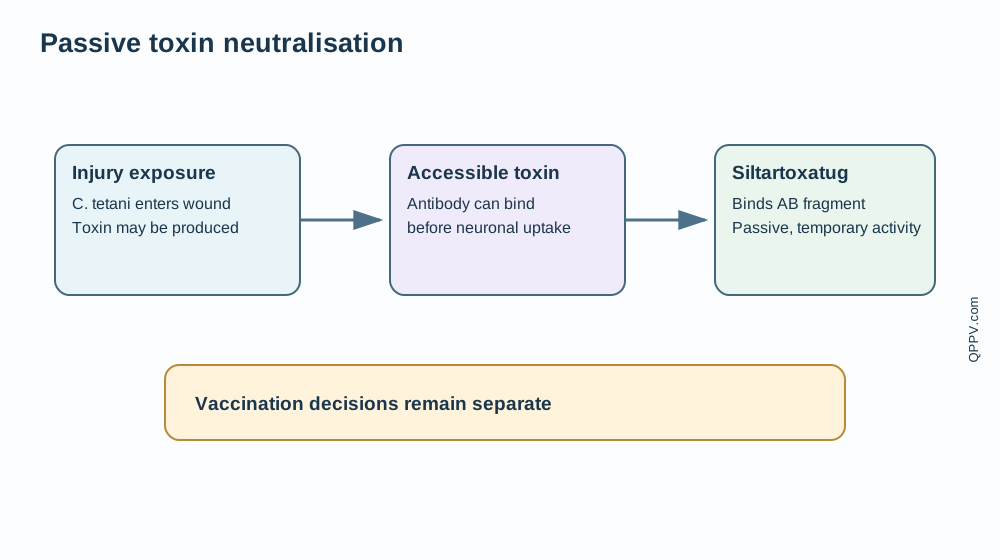
Figure 1. Simplified passive toxin-binding model. It does not imply reversal of established neurological disease.
Regulatory status
The 11 June 2025 NMPA notice records approval for adult emergency tetanus prophylaxis and identifies the product as a recombinant anti-toxin antibody. This is a China-specific authorisation statement and does not establish approval in other jurisdictions. [1]
The pivotal phase 3 study compared siltartoxatug with plasma-derived human tetanus immunoglobulin. Its primary endpoint was an early neutralising-antibody titre response, not clinical tetanus incidence. The endpoint boundary is central to interpreting the evidence. [2]
Mechanism and clinical evidence
Siltartoxatug binds the tetanus toxin AB fragment, with the intended effect of neutralising accessible toxin before it enters neural tissue. The target description is product-specific; claims about protection in every wound setting should not be inferred beyond the regulator’s label and trial evidence. [1]
In a randomised, double-blind phase 3 study, 675 participants received one intramuscular dose of siltartoxatug 10 mg or human tetanus immunoglobulin 250 IU in a 2:1 allocation. The primary outcome was an increase in neutralising titre of at least 0.01 IU/mL at 12 hours. The response occurred in 95.4% versus 53.2%; the difference was 42.3 percentage points (95% CI 35.5–49.1). Adverse events were reported in 38.2% and 33.9%, respectively. [2]
This supports a greater frequency of the specified early serological response under study conditions. It does not estimate how much the antibody reduces clinical tetanus, establish efficacy in every exposure scenario, or show that post-exposure vaccination is unnecessary. The disease is uncommon in many study settings, and a titre endpoint is a surrogate for a clinical outcome.
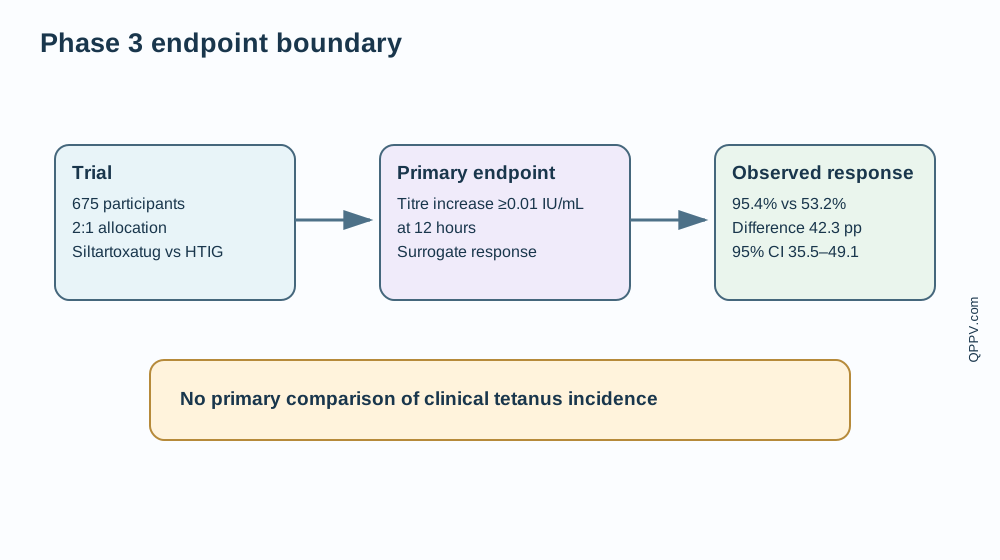
Figure 2. The trial compared an early antibody-titre response and collected safety data; it did not use tetanus incidence as its primary endpoint.
Safety and case context
Trial-level overall adverse-event rates were similar, but finite sample size and follow-up cannot exclude rare or delayed events. Use current local product information for the complete safety profile, precautions and administration instructions. [2,3]
For a report, distinguish injection reactions or hypersensitivity from manifestations related to the wound, infection, vaccination or other prophylaxis. Record product, dose, route, lot where available, administration time, injury and wound details, tetanus-immunisation history, concomitant interventions, onset, treatment and outcome. For suspected tetanus, capture the diagnostic basis and clinical course.
Pharmacovigilance priorities
A suspected lack-of-effect report merits careful review because the pivotal endpoint was serological. Capture the exposure-to-dose interval, wound characteristics, active immunisation, other prophylaxis and the clinical evidence for tetanus. Do not treat a titre result as equivalent to clinical protection.
Aggregate review can stratify events by dose, route, latency, seriousness and concomitant vaccination or immunoglobulin. Preserve uncertainty where injury-related and product-related causes overlap. A comparative trial with similar overall event proportions should not be paraphrased as proof that one product is safer.
Governance and practical review
Use a consistent case-review checklist:
- Verify product, dose, route, batch, indication and administration time.
- Record injury details, wound management, vaccination history and other prophylaxis.
- Describe event chronology, objective findings, treatment, outcome and alternative causes.
- For suspected lack of effect, distinguish antibody-titre response from clinical disease.
- Preserve the reporter’s diagnosis while documenting the medical assessment.
The marketing-authorisation holder should maintain traceability from the original report through coding, seriousness and expectedness assessments, follow-up and aggregate review under applicable local rules. The record should explain why causality was considered related, unrelated or indeterminate.
Inspection perspective
The safety system should recognise the prophylaxis context. Review whether intake forms capture injury and vaccination history, whether suspected tetanus is escalated for medical follow-up, and whether local reports reconcile with the central safety database. The audit trail should show how competing explanations were considered.
Key takeaways
- Siltartoxatug is a recombinant monoclonal antitoxin authorised in China for adult emergency tetanus prophylaxis.
- Passive toxin binding and active vaccination serve different roles.
- Phase 3 superiority was shown for an early titre endpoint, not clinical tetanus incidence.
- Safety reports need the injury, immunisation and intervention timeline.
- Use current local product information and jurisdiction-specific reporting rules.
References
- China National Medical Products Administration. Siltartoxatug Injection Approved for Marketing by China NMPA. 11 June 2025. https://english.nmpa.gov.cn/2025-06/11/c_1102164.htm
- Liang Z, et al. Recombinant monoclonal antibody siltartoxatug versus plasma-derived human tetanus immunoglobulin for tetanus: a randomised, double-blind, active-controlled, phase 3 trial. Nat Med. 2025. PMID: 40628965. https://pubmed.ncbi.nlm.nih.gov/40628965/
- ClinicalTrials.gov. Siltartoxatug versus human tetanus immunoglobulin, NCT05664750. https://clinicaltrials.gov/study/NCT05664750
Regulatory Note
Regulatory status and source details were checked on 25 September 2026. The described authorisation is the China NMPA status in the cited notice. Local product information, clinical guidance and reporting duties may differ. This article is educational and does not replace clinical assessment.