Somatropin: Classification, Growth Hormone Biology, Safety and Pharmacovigilance
Somatropin is recombinant human growth hormone. Unlike long-acting fusion proteins, it reproduces the amino-acid sequence and receptor pharmacology of endogenous growth hormone without a deliberate half-life-extending carrier. The important pharmacovigilance consequence is that safety cannot be separated from the physiology being replaced: treatment affects linear growth, insulin-like growth factor 1 (IGF-1), carbohydrate and lipid metabolism, fluid balance, thyroid and adrenal physiology, and the biomechanics of a growing skeleton.
- Somatropin: Classification, Growth Hormone Biology, Safety and Pharmacovigilance
- Classification and Molecular Context
- Growth Hormone–IGF-1 Biology
- Clinical-Use Context
- Safety Profile Through the Biology of Growth Hormone
- Administration, Adherence and Device Pharmacovigilance
- Product-Specific Case Assessment
- Aggregate Surveillance and Benefit–Risk Interpretation
- Illustrative Failure Modes
- Inspection and Governance Considerations
- Practical Checklist
- Key Takeaways
- References
- Regulatory Note
Classification and Molecular Context
Somatropin is a recombinant protein therapeutic and growth-hormone receptor agonist. It is not a monoclonal antibody, vaccine or plasma-derived product. The medicine belongs to the broader class of recombinant replacement or substitution biologics, although the clinical objective is not simply to replace a measured serum concentration; dose and response are interpreted through growth velocity, IGF-1 and the underlying diagnosis.
Relationship to endogenous growth hormone
Endogenous growth hormone is secreted in pulses from the anterior pituitary. Somatropin provides exogenous receptor stimulation through subcutaneous administration, creating a pharmacokinetic pattern that differs from normal pulsatile secretion even though the receptor ligand is functionally equivalent.
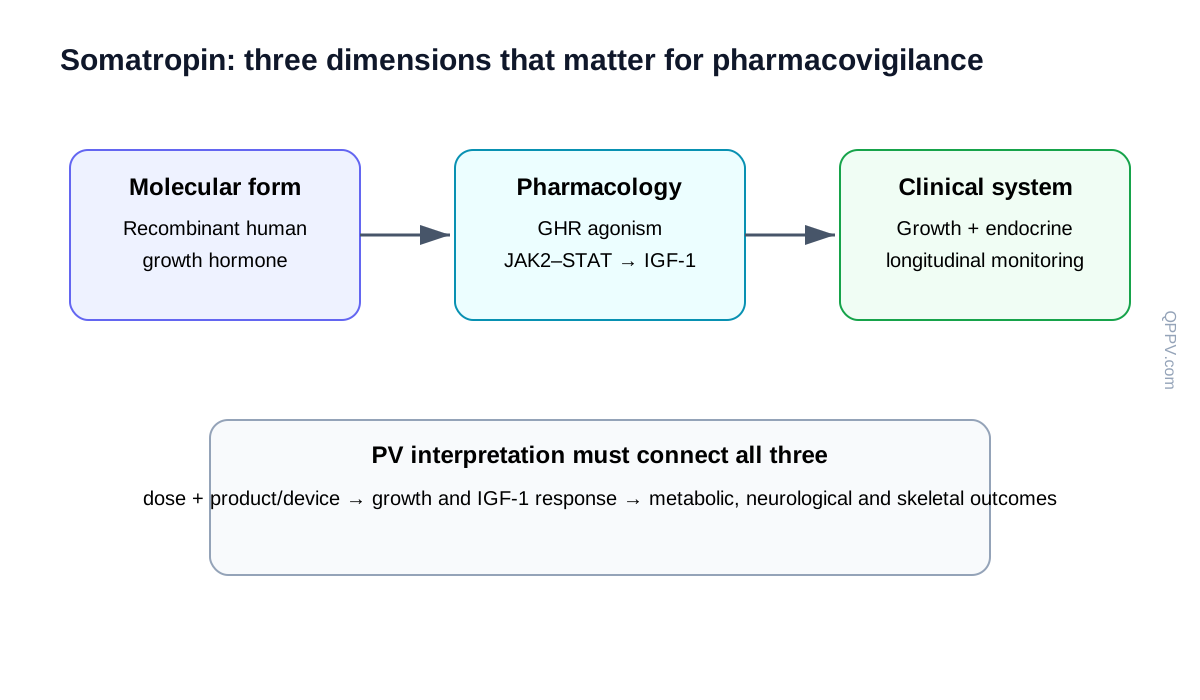
Figure 1. Somatropin is best understood across three linked dimensions: recombinant-protein structure, growth-hormone receptor pharmacology and longitudinal endocrine use.
Growth Hormone–IGF-1 Biology
Growth hormone binds preformed growth-hormone receptor complexes and changes receptor geometry, activating associated JAK2 and downstream STAT proteins. This signalling increases hepatic and local IGF-1 production and also produces direct metabolic effects. IGF-1 contributes substantially to longitudinal bone growth and tissue anabolism, while growth hormone itself promotes lipolysis and can reduce insulin sensitivity.
The pathway therefore behaves more like a regulated growth programme than an acute pharmacological switch. A single laboratory value rarely captures the whole treatment effect; interpretation depends on age, pubertal stage, diagnosis, adherence, dose, growth trajectory and timing.
Clinical-Use Context
Authorised indications and age ranges differ between products and jurisdictions. Depending on the applicable label, somatropin may be used for paediatric growth hormone deficiency and selected other growth disorders, and in adults with confirmed growth hormone deficiency. Product-specific contraindications and warnings must therefore be checked rather than inferred from the active substance alone.
The distinction from somatrogon is operationally important. Somatropin is typically administered daily, whereas long-acting growth-hormone products use different exposure profiles. A medication history should identify the exact active substance, product, device and schedule rather than recording only “growth hormone”.
Safety Profile Through the Biology of Growth Hormone
The most useful way to organise somatropin safety is to ask what can happen when growth-hormone signalling is excessive for the individual patient, when treatment unmasks another endocrine disorder, or when rapid growth changes tissue mechanics.
Glucose metabolism and fluid effects
Growth hormone can reduce insulin sensitivity. New hyperglycaemia or worsening diabetes therefore requires baseline metabolic status, dose history, concomitant medicines, intercurrent illness and temporal relation to treatment. Oedema, arthralgia and paraesthesia are more prominent in some adult treatment settings and may reflect dose-related fluid retention.
Intracranial hypertension
Headache, visual symptoms, nausea or papilloedema require prompt clinical evaluation. For PV, a useful case should establish onset after initiation or dose change, ophthalmological findings, imaging or lumbar-puncture data where performed, dose interruption and outcome. “Headache on growth hormone” is not sufficient evidence to characterise intracranial hypertension.
Skeletal effects during growth
Slipped capital femoral epiphysis is a clinically important differential when a growing child develops hip or knee pain or a limp. Progression of scoliosis may become more apparent during rapid growth; growth hormone is not simply interpreted as a direct cause of every scoliosis event. Case assessment must capture growth velocity, pubertal stage, baseline orthopaedic disease and imaging.
Thyroid and adrenal physiology
Growth-hormone treatment can alter thyroid-hormone metabolism and may expose previously unrecognised central hypothyroidism. In patients with pituitary disease, glucocorticoid sufficiency is also relevant because changing growth-hormone status can alter cortisol metabolism. These are endocrine-system interactions rather than isolated laboratory adverse events.
Neoplasia and underlying disease
Active malignancy is a contraindication in relevant product information. In cancer survivors or patients with predisposing conditions, a new or recurrent neoplasm requires careful separation of background risk, prior radiotherapy or chemotherapy, genetic predisposition and growth-hormone exposure. Spontaneous reports should not be used to infer causality without that context.
Administration, Adherence and Device Pharmacovigilance
Somatropin is commonly delivered with reusable or disposable injection devices. Treatment reliability therefore depends on more than the active substance.
Important error modes include incorrect cartridge or pen strength, wrong dose-setting units, failure to reconstitute a presentation correctly, inadequate needle technique, repeated use of the same injection site, missed daily doses, storage excursions and confusion when switching products or devices.
Lipoatrophy or local reactions should prompt review of injection-site rotation and technique. Reports of apparent lack of effect should include adherence, device function, storage history, prescribed and administered dose, growth measurements and IGF-1 rather than being coded as drug ineffectiveness alone.
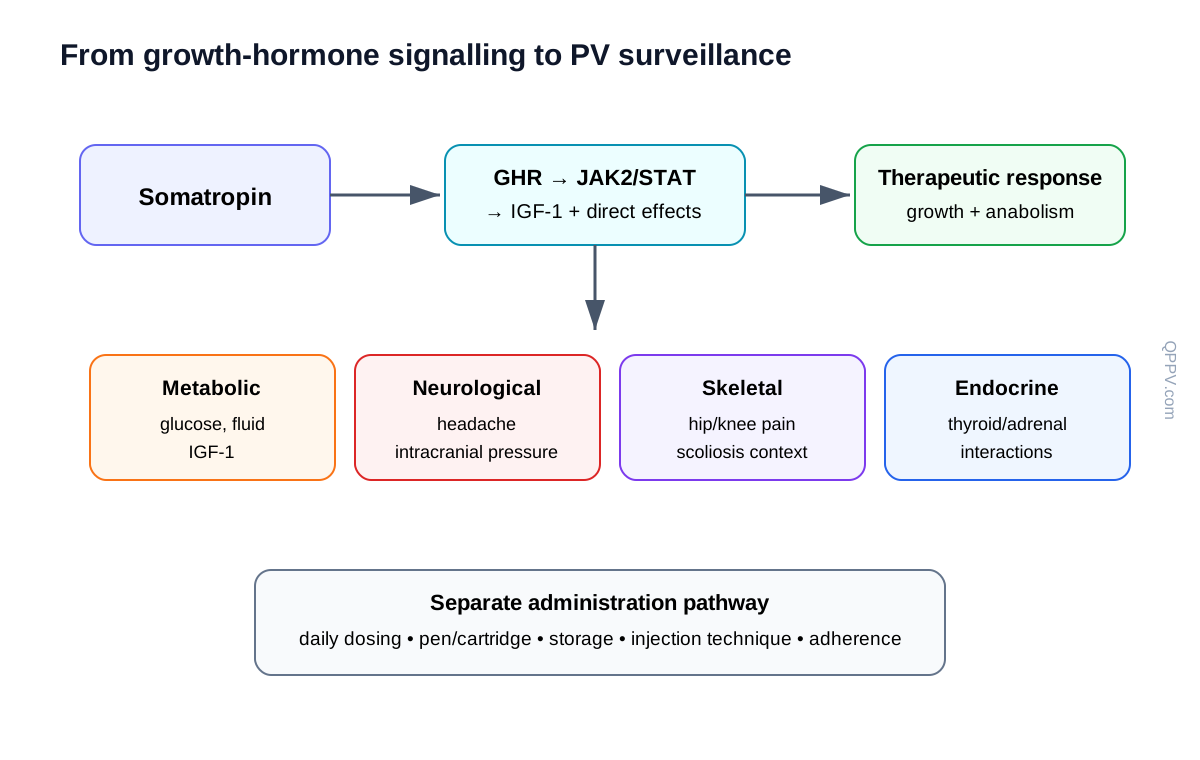
Figure 2. Growth-hormone receptor activation links therapeutic growth effects to metabolic, endocrine, neurological and skeletal surveillance, while the injection device creates a separate administration-risk pathway.
Product-Specific Case Assessment
| Reported issue | High-value follow-up |
|---|---|
| Poor growth response | Diagnosis, dose, adherence, device technique, growth velocity, IGF-1, thyroid status |
| Hyperglycaemia | Baseline glucose/diabetes, dose, weight, steroids, intercurrent illness |
| Headache/visual symptoms | Papilloedema, ophthalmology findings, imaging/LP if performed, dechallenge |
| Hip or knee pain/limp | Age, growth velocity, puberty, imaging, orthopaedic diagnosis |
| Suspected neoplasm | Original disease, prior cancer therapy, latency, pathology, treatment duration |
| Medication error | Exact product, device, strength, intended dose, delivered dose and clinical consequence |
The central principle is longitudinal reconstruction. Somatropin adverse-event interpretation is strongest when exposure is connected to the patient’s changing growth and endocrine state over time.
Aggregate Surveillance and Benefit–Risk Interpretation
Somatropin is a mature biological with long clinical experience, so aggregate review should not become a simple count of familiar adverse reactions. The useful question is whether the pattern has changed by age, indication, product/device, dose, formulation, switching history or patient subgroup.
Growth-related outcomes need denominators and follow-up duration. Metabolic events require background obesity and diabetes risk. Neoplasia analyses require underlying disease and prior oncological treatment. Medication-error review should be stratified by device and presentation because errors can cluster around a specific delivery system without representing a change in the molecule’s pharmacology.
Illustrative Failure Modes
These are hypothetical operational scenarios, not reported inspection findings.
- A lack-of-efficacy case is closed without asking whether the child actually received the prescribed daily dose or whether the pen was used correctly.
- Recurrent headache reports are grouped without identifying papilloedema or ophthalmological assessment.
- A new malignancy is counted as a drug-related event without documenting the original cancer, radiotherapy exposure or genetic predisposition.
- Product switching is captured only as “somatropin”, preventing traceability to the actual presentation and device.
- An apparent increase in injection-site reactions is reviewed at active-substance level even though all cases originate from one device or technique pattern.
Inspection and Governance Considerations
An inspector evaluating somatropin pharmacovigilance could reasonably examine whether the system preserves product and device identity, obtains meaningful longitudinal growth and endocrine data, and distinguishes predictable physiological effects from clinically important syndromes. Evidence may include follow-up questionnaires, signal-review outputs, product-quality interfaces, device complaint reconciliation and documentation of how medication errors are trended.
Recommended operational practice is to maintain structured follow-up fields for growth velocity, IGF-1, glucose status, thyroid/adrenal context, neurological symptoms, orthopaedic findings, adherence and device use. This is not a separate legal reporting standard; it is a way to obtain the clinical information needed for valid scientific assessment.
Practical Checklist
- Identify exact somatropin product, strength and device.
- Record indication, age, pubertal stage and relevant pituitary diagnosis.
- Reconstruct dose history and adherence.
- Obtain growth velocity and IGF-1 where relevant.
- Capture glucose, thyroid and adrenal context for endocrine/metabolic events.
- Investigate headache with clinically appropriate neurological/ophthalmological detail.
- For limb pain or limp, seek the final orthopaedic diagnosis.
- For malignancy, document background risk and prior cancer treatment.
- Reconcile device complaints and product-quality issues with PV cases.
Key Takeaways
Somatropin is recombinant human growth hormone whose therapeutic and safety effects arise from the same GHR–JAK2–STAT–IGF-1 biological system. Effective PV is therefore longitudinal and physiology-aware. The strongest case records connect exposure to growth response, metabolic and endocrine state, neurological and skeletal symptoms, adherence and device performance.
The molecule should not be conflated with long-acting growth-hormone products. Shared receptor biology does not remove important differences in dosing interval, device use and exposure reconstruction.
References
- U.S. Food and Drug Administration. FDALabel entry for somatropin products, including current GENOTROPIN labelling; most recent SPL listed 30 April 2026. https://nctr-crs.fda.gov/fdalabel/ui/spl-summaries/criteria/385650
- European Medicines Agency. Ngenla (somatrogon): EPAR and product information. Used for comparison of long-acting versus conventional growth-hormone biology. https://www.ema.europa.eu/en/medicines/human/EPAR/ngenla
- Growth Hormone Research Society and international endocrine literature on diagnosis and monitoring of growth-hormone deficiency. Product-specific prescribing decisions should follow the applicable local label and clinical guidance.
Regulatory Note
Somatropin products are not governed by one globally identical indication, age range, dose, contraindication set or device. This article explains active-substance pharmacology and pharmacovigilance principles; the current local product information remains controlling for authorised use, dosing, contraindications and risk-management instructions. Operational recommendations in this article are not presented as additional legal requirements.